
Jeremiah 20:11

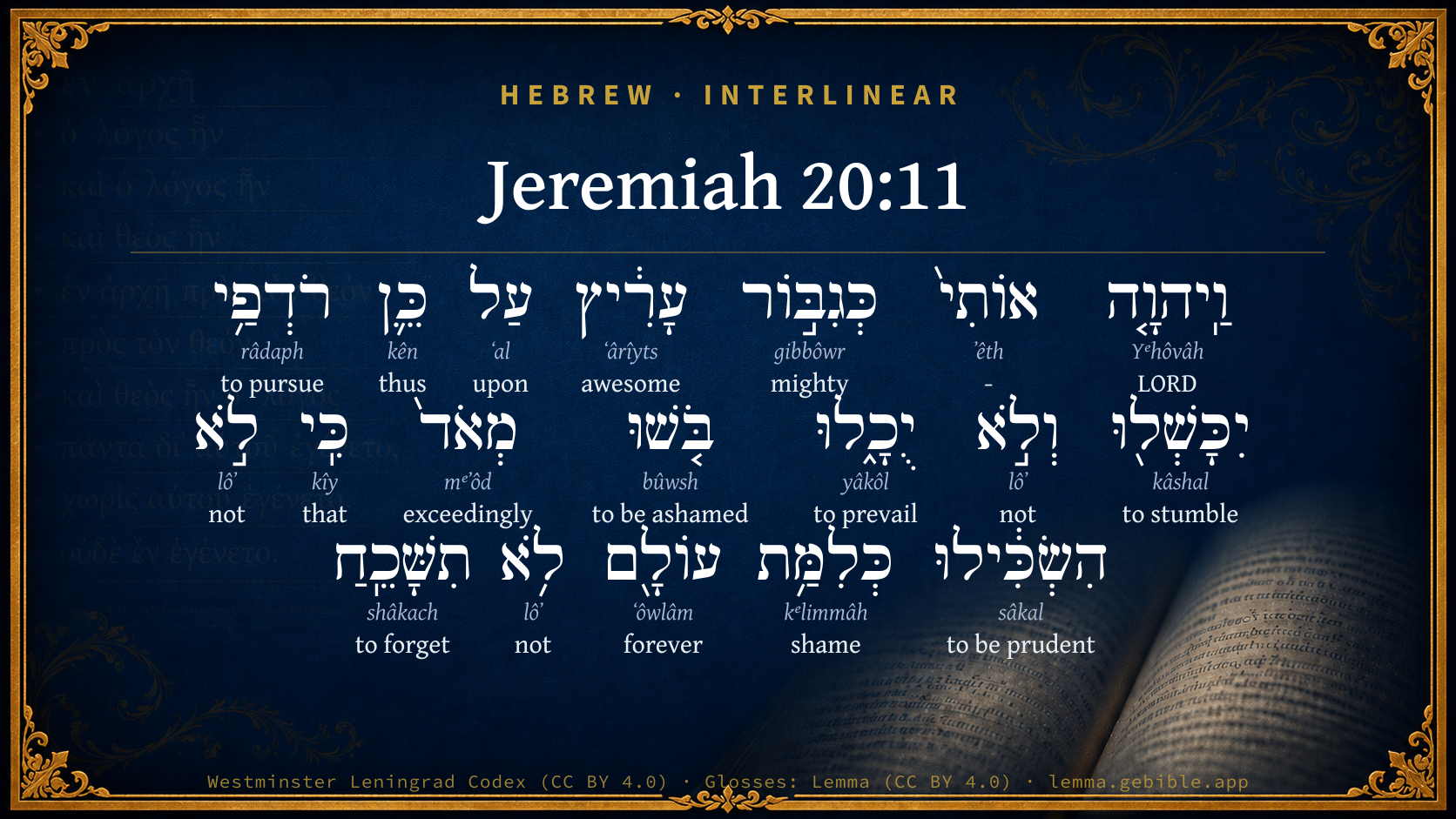
Hebrew (Westminster Leningrad Codex) Jeremiah 20:11 appears in the Hebrew Old Testament. The text above is from the Westminster Leningrad Codex. Each word links to its Strong’s number, a concise gloss, and parsing drawn from the Open Scriptures Hebrew Bible morphology. Click any word for its full Brown-Driver-Briggs (BDB) entry.
Download image
Cite this verse

Jeremiah 20:11 (World English Bible). Public Domain. Lemma interlinear Bible study tool, https://lemma.gebible.app/v/jeremiah/20/11.

Show BibTeX & RIS
BibTeX
RIS
English Translation
But Yahweh is with me as an awesome mighty one: therefore my persecutors shall stumble, and they shall not prevail; they shall be utterly disappointed, because they have not dealt wisely, even with an everlasting dishonor which shall never be forgotten.
World English Bible · Public Domain
Download a study sheet

One document with this verse’s original text, its word-by-word gloss line, the meaning frame, cross-references with their text, attributed commentary, and full source and license credits — printable, and it pastes into notes with its structure intact.

This verse Autodidact and up

Study sheet (.html) Plain text (.txt)

A passage Seminary Student

Up to 50 verses in one chapter. A passage sheet keeps up to 6 commentary sources and 12 cross-references per verse, in the order this page ranks them, and says so on the sheet whenever that leaves anything out. Ask for a single verse and you get the Autodidact verse sheet above.

Everything on this page stays free to read, with no account — the sheet is a download of what is already on screen, not access to it.

Want to remove ads? Support Godless Engineer
Compare translations 3

The same verse in 3 English versions, stacked beneath the original-language interlinear above. Click any original word for its lexicon entry.

Each is an independent rendering of the whole verse — the interlinear is not word-aligned to these translations.

Highlighted words mark where these versions differ — a whole-verse word diff, not a word-by-word alignment.

  • World English Bible Public Domain
    But Yahweh is with me as an awesome mighty one: therefore my persecutors shall stumble, and they shall not prevail; they shall be utterly disappointed, because they have not dealt wisely, even with an everlasting dishonor which shall never be forgotten.
  • King James Version Public Domain
    But the LORD is with me as a mighty terrible one: therefore my persecutors shall stumble, and they shall not prevail: they shall be greatly ashamed; for they shall not prosper: their everlasting confusion shall never be forgotten.
  • unfoldingWord Literal Text CC BY-SA 4.0
    But Yahweh with me like a ruthless mighty warrior; therefore my pursuers will stumble and will not prevail. They will be greatly ashamed, for they have not succeeded; everlasting humiliation will not be forgotten.

unfoldingWord Literal Text — © unfoldingWord, licensed CC BY-SA 4.0. Word-aligned USFM3 via Door43 (git.door43.org/unfoldingWord/en_ult).

Versions to compare (up to 4)

3 of 4 selected

Show all 18 translations

Every available English version of this verse, each an independent rendering of the whole verse.

  • World English Bible Public Domain
    But Yahweh is with me as an awesome mighty one: therefore my persecutors shall stumble, and they shall not prevail; they shall be utterly disappointed, because they have not dealt wisely, even with an everlasting dishonor which shall never be forgotten.
  • Berean Standard Bible Public Domain
    But the LORD is with me like a fearsome warrior. Therefore, my persecutors will stumble and will not prevail. Since they have not succeeded, they will be utterly put to shame, with an everlasting disgrace that will never be forgotten.
  • Majority Standard Bible Public Domain
    But the LORD is with me like a fearsome warrior. Therefore, my persecutors will stumble and will not prevail. Since they have not succeeded, they will be utterly put to shame, with an everlasting disgrace that will never be forgotten.
  • King James Version Public Domain
    But the LORD is with me as a mighty terrible one: therefore my persecutors shall stumble, and they shall not prevail: they shall be greatly ashamed; for they shall not prosper: their everlasting confusion shall never be forgotten.
  • American Standard Version (1901) Public Domain
    But Jehovah is with me as a mighty one `and' a terrible: therefore my persecutors shall stumble, and they shall not prevail; they shall be utterly put to shame, because they have not dealt wisely, even with an everlasting dishonor which shall never be forgotten.
  • Revised Version (1885) Public Domain
    But the LORD is with me as a mighty one and a terrible: therefore my persecutors shall stumble, and they shall not prevail: they shall be greatly ashamed, because they have not dealt wisely, even with an everlasting dishonour which shall never be forgotten.
  • Geneva Bible (1599) Public Domain
    But the Lord is with me like a mightie gyant: therefore my persecuters shall be ouerthrowen, and shall not preuaile, and shalbe greatly confounded: for they haue done vnwisely, and their euerlasting shame shall neuer be forgotten.
  • Douay-Rheims (1899) Public Domain
    But the Lord is with me as a strong warrior: therefore they that persecute me shall fall, and shall be weak: they shall be greatly confounded, because they have not understood the everlasting reproach, which never shall be effaced.
  • Young's Literal Translation Public Domain
    And Jehovah `is' with me, as a terrible mighty one, Therefore my persecutors stumble and prevail not, They have been exceedingly ashamed, For they have not acted wisely, Confusion age-during is not forgotten.
  • Literal Standard Version CC BY-SA 4.0
    And YHWH [is] with me, as a mighty, awesome One, || Therefore my persecutors stumble and do not prevail, || They have been exceedingly ashamed, || For they have not acted wisely, || Continuous confusion is not forgotten.
  • Unlocked Literal Bible CC BY-SA 4.0
    But Yahweh is with me like a powerful warrior, so the ones pursuing me will stagger. They will not defeat me. They will be greatly ashamed, because they will not succeed. They will have unending shame, it will never be forgotten.
  • unfoldingWord Literal Text CC BY-SA 4.0
    But Yahweh with me like a ruthless mighty warrior; therefore my pursuers will stumble and will not prevail. They will be greatly ashamed, for they have not succeeded; everlasting humiliation will not be forgotten.
  • Darby Bible Public Domain
    But Jehovah is with me as a mighty terrible one; therefore my persecutors shall stumble and shall not prevail; they shall be greatly ashamed, for they have not prospered: it shall be an everlasting confusion that shall not be forgotten.
  • World Messianic Bible Public Domain
    But the LORD is with me as an awesome mighty one. Therefore my persecutors will stumble, and they won’t prevail. They will be utterly disappointed because they have not dealt wisely, even with an everlasting dishonor which will never be forgotten.
  • Webster's Bible Public Domain
    But the LORD is with me as a mighty terrible one: therefore my persecutors shall stumble, and they shall not prevail: they shall be greatly ashamed; for they shall not prosper: their everlasting confusion shall never be forgotten.
  • Free Bible Version CC BY-SA 4.0
    But the Lord stands beside me like a powerful warrior. So those who are attacking me will fall. They won't win! Because they're not successful they will be totally disgraced. Their shame won't ever be forgotten.
  • Bible in Basic English Public Domain
    But the Lord is with me as a great one, greatly to be feared: so my attackers will have a fall, and they will not overcome me: they will be greatly shamed, because they have not done wisely, even with an unending shame, kept in memory for ever.
  • JPS Tanakh (1917) Public Domain
    But the LORD is with me as a mighty warrior; therefore my persecutors shall stumble, and they shall not prevail; they shall be greatly ashamed, because they have not prospered, even with an everlasting confusion which shall never be forgotten.

Literal Standard Version (2020), Covenant Press — licensed CC BY-SA 4.0. Text via the HelloAO Bible API (eBible.org). Unlocked Literal Bible (unfoldingWord) — licensed CC BY-SA 4.0. Text via the HelloAO Bible API (eBible.org). unfoldingWord Literal Text — © unfoldingWord, licensed CC BY-SA 4.0. Word-aligned USFM3 via Door43 (git.door43.org/unfoldingWord/en_ult). Free Bible Version, Dr. Jonathan Gallagher — licensed CC BY-SA 4.0. Text via the HelloAO Bible API (eBible.org).

Word by word

More ways to search: Search by grammar → Find every occurrence → Compare this word →

Practice this passage: Drill this verse → Learn its vocabulary →

עָרִ֔יץ
ʻârîyts
H6184
“awesome”
Adjective, Adjective, Masculine, Singular, Absolute
Part of Speech
Adjective
Type
Adjective
Gender
Masculine
Number
Singular
State
Absolute
Full BDB Definition

Origin: from H6206

TWOT: 1702b

awe-inspiring, terror-striking, awesome, terrifying, ruthless, mighty
  1. וַֽיהוָ֤ה Yᵉhôvâh H3068 “and · LORD” Conjunction + Noun, Proper
  2. אוֹתִי֙ ʼêth H853 “- · me” Particle, Direct Object + Suffix, Personal, 1st Person, Common, Singular
  3. כְּגִבּ֣וֹר gibbôwr H1368 “like/as · mighty” Preposition + Adjective, Adjective, Masculine, Singular, Absolute
  4. עַל ʻal H5921 “upon” Preposition
  5. כֵּ֛ן kên H3651 “thus” Particle, Demonstrative
  6. רֹדְפַ֥י râdaph H7291 “pursuing · me” Verb, Qal, Participle Active, Masculine, Plural, Construct + Suffix, Personal, 1st Person, Common, Singular
  7. יִכָּשְׁל֖וּ kâshal H3782 “to stumble” Verb, Niphal, Imperfect, 3rd Person, Masculine, Plural
  8. וְלֹ֣א lôʼ H3808 “and · not” Conjunction + Particle, Negative
  9. יֻכָ֑לוּ yâkôl H3201 “to prevail” Verb, Qal, Imperfect, 3rd Person, Masculine, Plural
  10. בֹּ֤שׁוּ bûwsh H954 “to be ashamed” Verb, Qal, Perfect, 3rd Person, Common, Plural
  11. מְאֹד֙ mᵉʼôd H3966 “exceedingly” Adverb
  12. כִּֽי kîy H3588 “that” Conjunction
  13. לֹ֣א lôʼ H3808 “not” Particle, Negative
  14. הִשְׂכִּ֔ילוּ sâkal H7919 “to be prudent” Verb, Hiphil, Perfect, 3rd Person, Common, Plural
  15. כְּלִמַּ֥ת kᵉlimmâh H3639 “shame of” Noun, Common, Feminine, Singular, Construct
  16. עוֹלָ֖ם ʻôwlâm H5769 “forever” Noun, Common, Masculine, Singular, Absolute
  17. לֹ֥א lôʼ H3808 “not” Particle, Negative
  18. תִשָּׁכֵֽחַ shâkach H7911 “to forget” Verb, Niphal, Imperfect, 3rd Person, Feminine, Singular

About this verse

These counts appear in no published source. They are computed here, from the morphology-tagged text and Lemma’s own curated glosses. What Lemma adds →

19
words
17
distinct lemmas
Prophets
section

Notable vocabulary

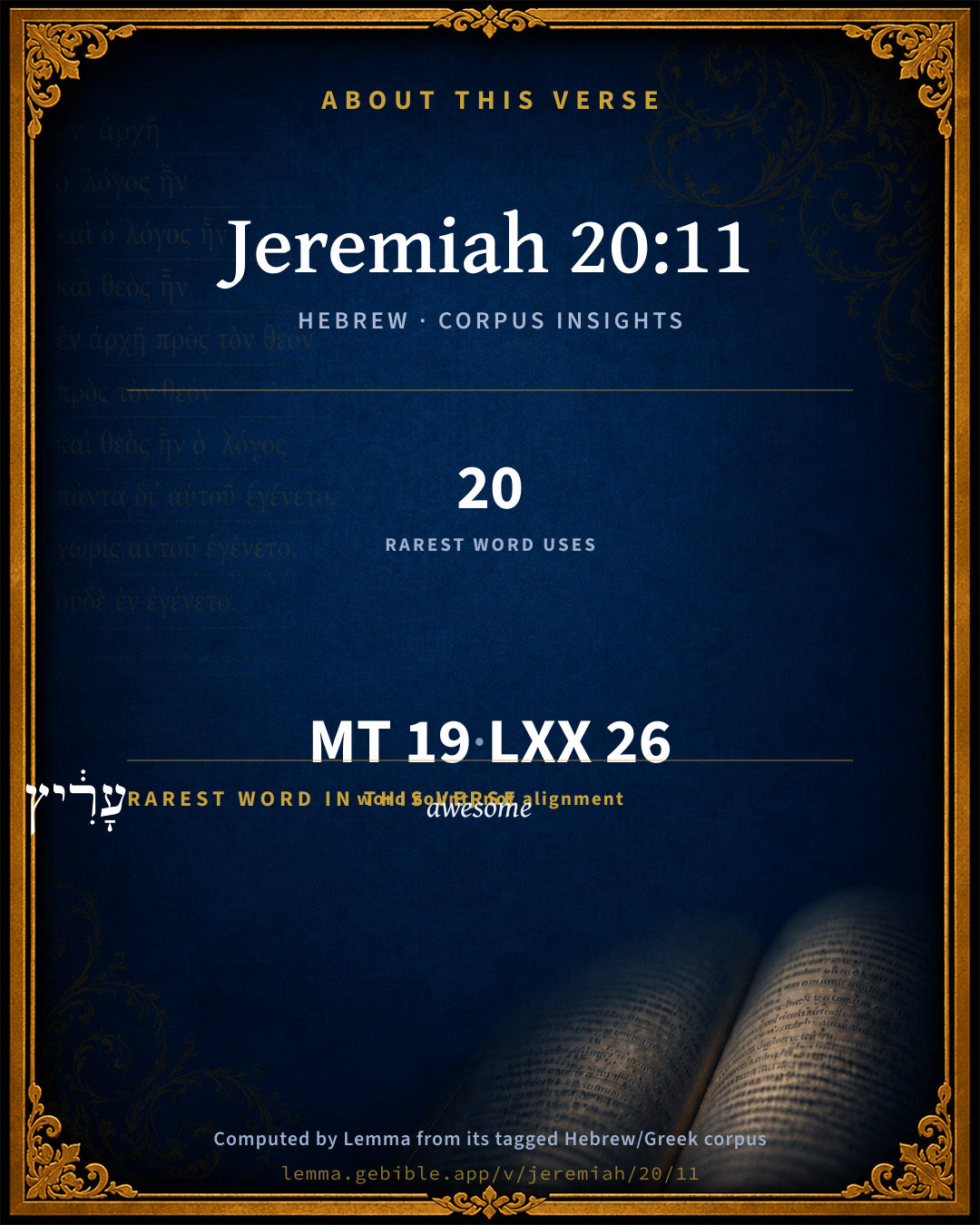
The rarest word here is עָרִ֔יץ awesome H6184 — appearing just 20 times in the whole Hebrew Bible.

Shared distinctive vocabulary

עָרִ֔יץ awesome H6184 occurs in 20 verses of the Hebrew Bible. Also found in:

Grammatical profile

  • 6 verbs
  • 3 nouns
  • 2 adjectives
  • 1 preposition
  • 1 conjunction
  • 1 adverb
  • 5 particles

Verb forms

  • רֹדְפַ֥י Qal · Participle Active
  • יִכָּשְׁל֖וּ Niphal · Imperfect
  • יֻכָ֑לוּ Qal · Imperfect
  • בֹּ֤שׁוּ Qal · Perfect
  • הִשְׂכִּ֔ילוּ Hiphil · Perfect
  • תִשָּׁכֵֽחַ Niphal · Imperfect

Repetition

A word recurs within this verse — often emphatic in Hebrew:

  • וְלֹ֣א not H3808 ×3

Hebrew & Septuagint length

In the original languages it is 19 Hebrew tokens and 26 Greek tokens — but the two are counted differently (Hebrew bundles its prefixes and suffixes into one token; the Greek is in lemma form), so that isn’t a like-for-like length.

Cross-references

20

Topical passages linked to Jeremiah 20:11 in the Treasury of Scripture Knowledge — connected by theme and wording, ordered by reader-vote popularity; previews shown in the World English Bible.

  • Jeremiah 1:19 They shall fight against you; but they shall not prevail against you: for I am with you, says Yahweh, to deliver you.
  • Jeremiah 1:8 Don't be afraid because of them; for I am with you to deliver you, says Yahweh.
  • Jeremiah 15:20 I will make you to this people a fortified brazen wall; and they shall fight against you, but they shall not prevail against you; for I am with you to save you and to deliver you, says Yahweh.
  • Isaiah 41:10 Don't you be afraid, for I am with you; don't be dismayed, for I am your God; I will strengthen you; yes, I will help you; yes, I will uphold you with the right hand of my righteousness.
  • Jeremiah 17:18 Let them be disappointed who persecute me, but let not me be disappointed; let them be dismayed, but don't let me be dismayed; bring on them the day of evil, and destroy them with double destruction.
  • Psalms 40:14 Let them be disappointed and confounded together who seek after my soul to destroy it. Let them be turned backward and brought to dishonor who delight in my hurt.
  • Psalms 6:10 May all my enemies be ashamed and dismayed. They shall turn back, they shall be disgraced suddenly.
  • Psalms 35:26 Let them be disappointed and confounded together who rejoice at my calamity. Let them be clothed with shame and dishonor who magnify themselves against me.
  • Jeremiah 23:40 and I will bring an everlasting reproach on you, and a perpetual shame, which shall not be forgotten.
  • Romans 8:31 What then shall we say about these things? If God is for us, who can be against us?
  • Psalms 66:5 Come, and see God's deeds-- Awesome work on behalf of the children of men.
  • Isaiah 45:16 They shall be disappointed, yes, confounded, all of them; they shall go into confusion together who are makers of idols.
  • 2 Timothy 4:17 But the Lord stood by me, and strengthened me, that through me the message might be fully proclaimed, and that all the Gentiles might hear; and I was delivered out of the mouth of the lion.
  • Deuteronomy 32:35–36 Vengeance is mine, and recompense, At the time when their foot shall slide: For the day of their calamity is at hand, The things that are to come on them shall make haste.
  • Psalms 27:1–2 Yahweh is my light and my salvation. Whom shall I fear? Yahweh is the strength of my life. Of whom shall I be afraid?
  • Psalms 47:2 For Yahweh Most High is awesome. He is a great King over all the earth.
  • Psalms 65:5 By awesome deeds of righteousness, you answer us, God of our salvation. You who are the hope of all the ends of the earth, Of those who are far away on the sea;
  • Daniel 12:2 Many of those who sleep in the dust of the earth shall awake, some to everlasting life, and some to shame and everlasting contempt.
  • Isaiah 41:14 Don't be afraid, you worm Jacob, and you men of Israel; I will help you, says Yahweh, and your Redeemer is the Holy One of Israel.
  • John 18:4–6 Jesus therefore, knowing all the things that were happening to him, went forth, and said to them, "Who are you looking for?"

Cross-references courtesy of OpenBible.info (CC BY 4.0).

Hebrew and Greek witnesses Masoretic Hebrew ↔ Greek Septuagint

The same verse in the two great witnesses to the Old Testament, shown verse-for-verse.

These are two independent witnesses, not word-aligned to each other, and the Septuagint is shown in lemma (dictionary) form.

Hebrew Jeremiah 20:11 Masoretic · Westminster Leningrad Codex

וַֽיהוָ֤ה אוֹתִי֙ כְּגִבּ֣וֹר עָרִ֔יץ עַל כֵּ֛ן רֹדְפַ֥י יִכָּשְׁל֖וּ וְלֹ֣א יֻכָ֑לוּ בֹּ֤שׁוּ מְאֹד֙ כִּֽי לֹ֣א הִשְׂכִּ֔ילוּ כְּלִמַּ֥ת עוֹלָ֖ם לֹ֥א תִשָּׁכֵֽחַ

But Yahweh is with me as an awesome mighty one: therefore my persecutors shall stumble, and they shall not prevail; they shall be utterly disappointed, because they have not dealt wisely, even with an everlasting dishonor which shall never be forgotten.

World English Bible · Public Domain

Greek LXX Structure differs

In the Septuagint, Jeremiah is about an eighth shorter than the Hebrew and arranges its material differently — the Oracles Against the Nations (Hebrew chapters 46–51) appear in the middle of the Greek book, after 25:13. Because the chapter and verse boundaries do not line up, a verse-for-verse comparison with the Hebrew is not shown.

A verse-for-verse comparison isn’t shown here because the chapters and verses don’t line up. Switch to the LXX edition with the MT / LXX toggle above to read the Greek directly.

Hebrew: Westminster Leningrad Codex (CC BY 4.0). Greek: Septuagint (public domain); English from a public-domain English Septuagint. How the Septuagint differs from the Hebrew →

Targum (Aramaic paraphrase)

1

The Targum is the ancient Jewish Aramaic paraphrase of the Hebrew Scriptures — an interpretive translation, not the Hebrew text itself. Onkelos (literal) and Pseudo-Jonathan (expansive) render the Torah, and Jonathan the Prophets. Coverage is partial: where no permissively-licensed English translation exists for a verse, only the Aramaic is shown. This is verse-level text, not a word-by-word alignment to the Hebrew.

  1. Targum Jonathan Prophets (Joshua–Malachi)
    וַיָי מֵימְרֵיהּ בְּסַעְדִי כְּגִבַּר תַּקִיף עַל כָּל רָדְפַי יִתְקְלוּן וְלָא יֵכְלוּן לְמֵיקַם יִבְהֲתוּן לַחֲדָא אֲרֵי לָא יִצְלְחוּן וְתַחְפִינוּן אִתְכְּנָעוּת עֲלָם דְלָא תִפְסוֹק:

    (no public-domain English translation for this verse)

    Targum Jonathan — Aramaic: “Mikraot Gedolot” (public domain). English: “Sefaria Community Translation” (CC0 1.0 (public-domain dedication)); “London "Chaldee Paraphrase," 1871” (public domain). Text via Sefaria.

Commentary

Notes on Jeremiah 20:11 from classic Christian and Jewish commentators (each source and its license shown beneath its notes). The classic Christian expositions comment on the surrounding passage and are grouped to its opening verse, so a note may address several verses; the Jewish commentaries on the Tanakh (Rashi and others) are per-verse, so they appear only where the commentator wrote on this verse.

Lemma curates 59 commentaries, every one of them public domain or Creative Commons licensed, each selected and text-cleaned for this edition rather than reprinted as found. About our sources →

Trapp's Complete Commentary

John Trapp

Jer 20:11 But the LORD [is] with me as a mighty terrible one: therefore my persecutors shall stumble, and they shall not prevail: they shall be greatly ashamed; for they shall not prosper: [their] everlasting confusion shall never be forgotten.

Ver. 11. But the Lord is with me as a mighty terrible one.] Instar gigantis robusti, {a} as a strong giant, and mine only champion on whom I lean. Here the Spirit begins to get the better of the flesh, could Jeremiah but hold his own. But as the ferryman plies the oar, and eyes the shore homeward where he would be, yet there comes a gust of wind that carrieth him back again; so it fared with our prophet. See Jer 20:14-15, &c.

{a} Ut formidabilis heros. - Pisc.

John Trapp, A Commentary or Exposition upon All the Books of the Old and New Testament (1647–1656) — public domain. Text from a community e-Sword module.

Tyndale Open Study Notes

Tyndale Open Resources

20:11 Jeremiah realized that God was like a great warrior standing at his side. Jeremiah’s persecutors were at a real disadvantage and would completely fail.

Tyndale Open Study Notes — © Tyndale Open Resources, licensed CC BY-SA 4.0. Text via the HelloAO Bible API.

Geneva Bible (1599)

Geneva Bible translators

Here he showeth how his faith did strive against tentation, and sought to the Lord for strength.

Geneva Bible (1599) marginal notes — public domain. Text via Bolls.life.

Jamieson, Fausset & Brown

Robert Jamieson, A. R. Fausset & David Brown

not prevail--as they hoped to do (Jer 20:10; Jer 15:20).

prosper--in their plot.

Jamieson, Fausset & Brown — Commentary Critical and Explanatory on the Whole Bible (1871) — public domain (CC PDM 1.0). Text via the HelloAO Bible API.

Adam Clarke's Commentary

Verse 11. But the Lord is with me as a mighty terrible one] Thus was he, by his strong confidence in the strong God, delivered from all his fears, and enabled to go on comfortably with his work.

Adam Clarke's Commentary on the Bible (1810–1826) — public domain. Text from a community e-Sword/MySword module.

John Calvin's Commentaries

Here the Prophet sets up God’s aid against all the plottings formed against him. However, then, might perfidious friends on one hand try privately to entrap him, and open enemies might on the other hand publicly oppose him, he yet doubted not but that God would be a sufficient protection to him. And we ought to act exactly in the same manner, whenever Satan rouses the wicked against us to oppose us either by secret artifices or by open cruelty; God alone must be, as they say, our brazen wall. But we must first know that he stands on our side; for the power of God can avail nothing to animate us, except we be firmly persuaded of this truth, that he is on our side. And how this confidence can be obtained, we shall presently see.

He says, that his persecutors would fall, so that they would not prevail, but be ashamed We see how many persecuted the holy man, and also with what arms they were furnished; for they possessed great power, and were also endued with guiles and intrigues. But the Prophet was satisfied with the help of God alone, and boldly concluded, that they would fall; for it could not be but that God would prove victorious. Whenever, then, we fight with the world and the devil and his slaves, this ought in the first place to come to our minds, that God stands on our side to defend our cause and to protect our safety. This being settled, we may then boldly defy both the artifices and the violence of all enemies; for it cannot be but that God will scatter, lay prostrate, overwhelm, and reduce to nothing all those who fight against him.

He further says that their reproach would be perpetual, and would never come to oblivion We have seen already that the Prophet was loaded with many reproaches; but whenever God suffers his servants to be exposed to the curses of the wicked, he in due time aids them; and therefore we ought fully to expect that he will shortly dissipate, as mists, such calumnies. As then God, according to what is said in Psalm 37:6, brings forth the innocency of the godly like the dawn, which in a moment appears while the earth seems buried in darkness, so the Prophet now says that on the other hand the reproach with which God will cover all the wicked will be perpetual. It now follows, —

John Calvin's Commentaries (1540-1563) — public domain. Text from the Calvin Translation Society English edition (1840s-50s) via the Christian Classics Ethereal Library (ccel.org). Calvin's coverage is partial (roughly two-thirds of the Bible); uncommented books and verses are honest gaps, never fabricated. The 19th-century editor's footnotes and remarks are omitted so the notes are faithfully Calvin's own voice.

Ellicott's Commentary for English Readers

(11) But the Lord is with me.—As in Psalms 22 and other like utterances, the prophet, though perplexed. is yet not in despair (2Co_4:8). He passes through the deep waters, but struggles out of them to the rock of refuge. The word “terrible” was used with a special significance. Jehovah had promised to deliver the prophet from the “terrible” ones (Jer_15:21). He, the mighty God (Isa_9:6) would now show that He was more terrible than the prophet’s foes, that it was better to come under their wrath than His (Isa_8:12-13).

For they shall not prosper.—Better, because they have not dealt wisely. The word is the same as in Jer_10:21, where see Note.

Their everlasting confusion.—Better, as carrying on the structure of the previous clause, with an everlasting confusion that shall never be forgotten.

A Bible Commentary for English Readers, edited by Charles John Ellicott (1878–1897) — public domain. Text from a community e-Sword module.

The Cambridge Bible for Schools and Colleges

gen. ed. J. J. S. Perowne

11. dealt wisely] mg. prospered. The Hebrew word includes the notion of success as the result of wise action.

11–13. See summary at commencement of section. The prophet’s courage is renewed.

The Cambridge Bible for Schools and Colleges (gen. ed. J. J. S. Perowne; Cambridge University Press, 1878–1918) — public domain. Text from a community e-Sword module.

John Gill's Exposition

But the Lord is with me as a mighty terrible one,.... The Targum is,

"the Word of the Lord is for my help.''

"Mighty" to support, uphold, defend, and deliver him; and "terrible" to his enemies. The prophet looks back to the promise the Lord had made him, of his gracious and powerful presence, Jer 1:18; which he now takes comfort from; and it would have been well if he had kept this always in view, and had continued in the same actings of faith and temper of mind: but this lasted not long, as some following verses show;

therefore my persecutors shall stumble, and shall not prevail; though they should very hotly and furiously pursue him, yet they should stumble and fall by the way, and not be able to overtake him, and execute their designs upon him; the Lord, who was with him, and on his side, would throw some things in their way, at which they should stumble, and which should hinder them from proceeding;

they shall be greatly ashamed, for they shall not prosper; when they see their schemes are disappointed, and they do not succeed, they shall be filled with shame and confusion: or, "because they do not deal prudently" (g), as the word is rendered, Isa 52:13; they do not act a wise, but a foolish part, and therefore shame will be the consequence of it;

their everlasting confusion shall never be forgotten; neither by themselves nor others; the memory of it will always continue, to their everlasting grief and reproach. A very learned man connects these words with the former, thus, "they shall be greatly ashamed, for they shall not prosper, with an everlasting shame never to be forgotten" (h), very rightly; so another learned interpreter (i).

(g) "quia non prudenter egerunt", Montanus, Piscator; "prudenter agunt", Calvin. (h) "Erubescent valde, quia non prosperabuntur, ignominia aeterna non obliviscenda", De Dieu. (i) "Pudefient, quod non profecerint, ignominia perpetuitatis (quae) non tradetur oblivioni", Schmidt.

John Gill's Exposition of the Whole Bible (1746–1763) — public domain (CC PDM 1.0). Text via the HelloAO Bible API.

Matthew Poole's English Annotations

The prophet recovering himself out of his fit of passion, encourageth himself in his God, whom he calls the

mighty and

terrible one, so declaring his faith in the power of God, as one able to save him, and in the promise and good-will of God toward him; therefore he saith,

The Lord is with me; such was the promise of God to this prophet, when he first undertook the prophetical office, Jer 1:8, Be not afraid of their faces; for I am with thee to deliver thee, saith the Lord. From hence he concludeth, that though he had many that pursued after his life, yet they should stumble in their ways of violence, and should not prevail; that they should either be ashamed of what they had done, or be brought to shame for what they had done; for

prosper they should not; or, they acted like fools, and did not deal prudently for themselves (so this word is translated, Isa 52:13).

Their everlasting confusion shall never be forgotten; they should come to a reproach and ignominy, and their reproach should not be like his, for a time, but it should be a lasting, perpetual reproach that should not be forgotten. This was not only written for that generation, but for all generations that are yet to come, and hath been made good in the experience of all ages past. The persecutors of God’s ministers have found that God hath been with his ministers according to his promise, Mat 28:20, and that they have stumbled in their way, and not at last prevailed; that they have not acted prudently for their own good, and the good of their families; that a perpetual ignominy clave to the memory of those who have been employed in this work. There stands to this day a blot upon the memory of them who persecuted Isaiah, Jeremiah, &c., the apostles, and such faithful ministers as have been since their time.

Matthew Poole's English Annotations on the Holy Bible (1683–1685) — public domain. Text from a community e-Sword/MySword module.

Whedon's Commentary on the Bible

Daniel D. Whedon

11-13. The Lord is with me — Very strikingly does the lament rise into a clear and strong expression of faith in God. Deeper than his despondency, and stronger than the terrors about him, is his trust in God’s unfailing strength. And at last, in Jer_20:13, this faith rises into triumph, and he speaks of his deliverance as already accomplished.

Daniel D. Whedon (gen. ed.), Commentary on the Old and New Testaments (1874–1909) — public domain. Text from a community e-Sword module.

The Pulpit Commentary

As a mighty terrible one; rather, as a formidable warrior. They shall not prevail. This was in fact, the Divine promise to Jeremiah at the outset of his ministry. (Jer_1:19) For they shall not prosper; rather, because they have not pros-pored.

The Pulpit Commentary (1880–1919), ed. H.D.M. Spence-Jones & Joseph S. Exell — public domain. Text from a community e-Sword module.

John Wesley's Explanatory Notes

But - The prophet recovering himself out of his fit of passion, encourageth himself in his God, whom he calls the mighty and terrible one, so declaring his faith in the power of God, as one able to save him, and in the promise and good will of God toward him; therefore he saith, The Lord is with me; such was the promise of God to this prophet, when he first undertook the prophetical office, chap. i, 8. Be not afraid of their faces, for I am with thee to deliver thee saith the Lord: from hence be concludes, that though he had many that pursued after his life, yet they should stumble in their ways of violence, and should not prevail. Ashamed - That they should be ashamed of what they had done, or be brought to shame for what they had done; for prosper they should not: or they acted like fools, and did not deal prudently for themselves (so this word is translated, Isaiah lii, 13,) yea, they should become a reproach, and their reproach should be a lasting perpetual reproach that should not be forgotten.

John Wesley, Explanatory Notes Upon the Whole Bible (1754–1765) — public domain. Text via the GEBible commentary corpus.

Rashi

Rabbi Shlomo Yitzchaki (Rashi)

for they did not succeed They did not succeed with their plan.

Rashi on the Tanakh — English translations: “The Judaica Press complete Tanach with Rashi, translated by A. J. Rosenberg” (CC BY 4.0); “Pentateuch with Rashi's commentary by M. Rosenbaum and A.M. Silbermann, 1929-1934” (public domain); “The Metsudah Tanach series, Lakewood, N.J” (CC BY 4.0); and “The Book of Joshua, Metsudah Publications, 1997” (CC BY 4.0). Text via Sefaria.

Lesson kit

Teaching starters — assembled from the data on this page, not authored interpretation. Every prompt links to the verse data it draws on. Edit before teaching.

Jeremiah, in the Prophets, opens this verse with 19 words (17 distinct Hebrew lemmas). Its most distinctive word is ʻârîyts (“awesome”). A historical commentator’s framing appears above. Read the whole chapter for the surrounding context.

Discussion questions

  1. What does “awesome” (ʻârîyts) contribute to the verse as a whole?
  2. How does Job 6:23, which shares the word «awesome», read alongside this verse?
  3. What does the repetition of “not” (3× in this one verse) do in this verse?
  4. The translations on this page render this verse differently — a whole-verse word diff, not a word-by-word alignment. What might account for the different wordings?
  5. «רֹדְפַ֥י» is a Qal Participle Active verb. How does that grammatical form shape the action described?
  6. Compare how Trapp's Complete Commentary and Tyndale Open Study Notes read this verse. Where do they agree or differ?

Things to notice

Reading settings

Reading text

Shown beneath each verse's original-language words.

Old Testament
Old Testament edition

Read the OT as the Masoretic Hebrew (MT) or the Greek Septuagint (LXX).

English shown for the Greek Septuagint (in the Hebrew ↔ Greek comparison).

Comparing translations? Open the Compare panel on any verse page to stack up to four side by side.