
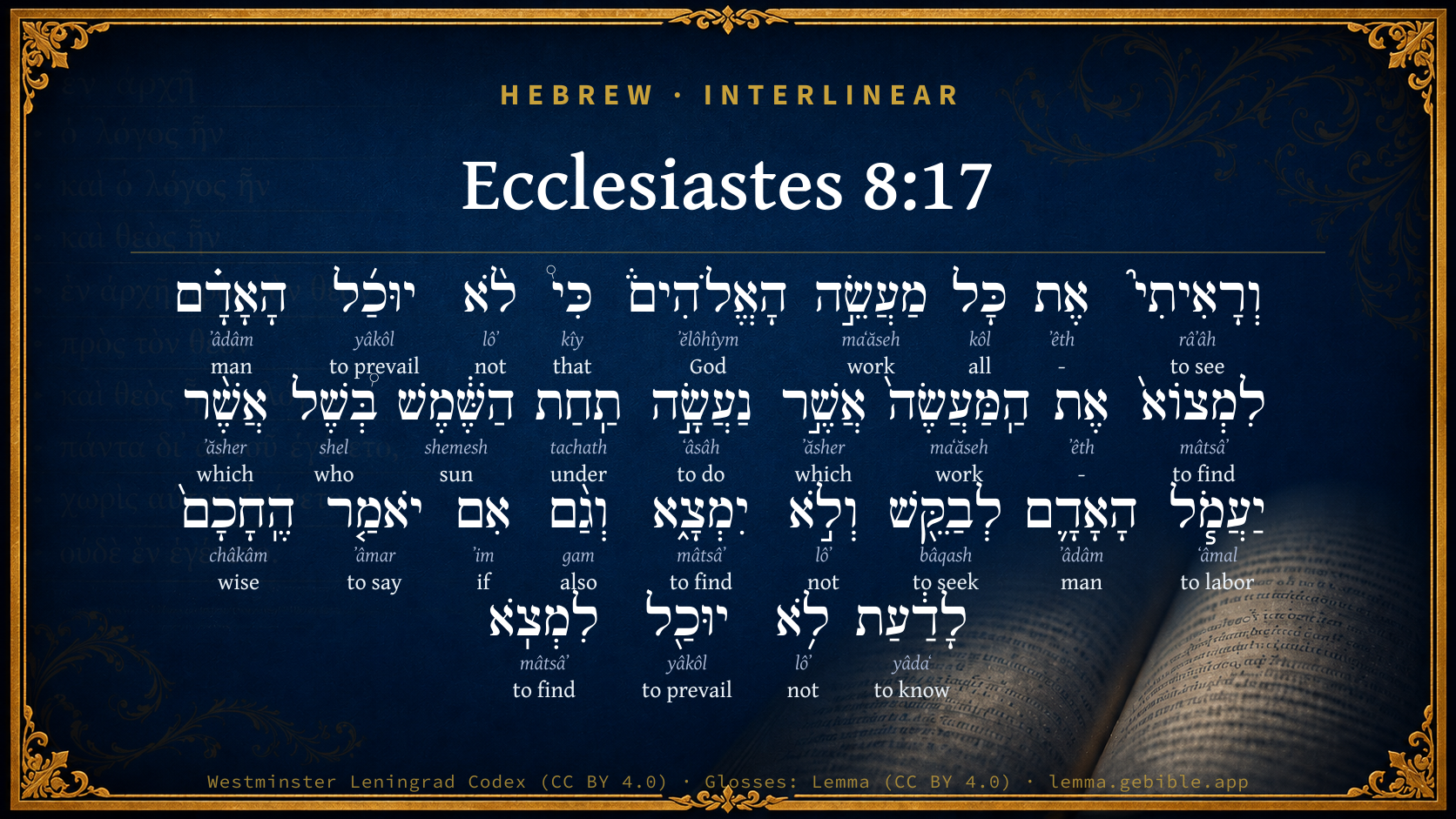
Ecclesiastes 8:17

Hebrew (Westminster Leningrad Codex) Ecclesiastes 8:17 appears in the Hebrew Old Testament. The text above is from the Westminster Leningrad Codex. Each word links to its Strong’s number, a concise gloss, and parsing drawn from the Open Scriptures Hebrew Bible morphology. Click any word for its full Brown-Driver-Briggs (BDB) entry.
Download image
Cite this verse

Ecclesiastes 8:17 (World English Bible). Public Domain. Lemma interlinear Bible study tool, https://lemma.gebible.app/v/ecclesiastes/8/17.

Show BibTeX & RIS
BibTeX
RIS
English Translation
then I saw all the work of God, that man can't find out the work that is done under the sun, because however much a man labors to seek it out, yet he won't find it. Yes even though a wise man thinks he can comprehend it, he won't be able to find it.
World English Bible · Public Domain
Download a study sheet

One document with this verse’s original text, its word-by-word gloss line, the meaning frame, cross-references with their text, attributed commentary, and full source and license credits — printable, and it pastes into notes with its structure intact.

This verse Autodidact and up

Study sheet (.html) Plain text (.txt)

A passage Seminary Student

Up to 50 verses in one chapter. A passage sheet keeps up to 6 commentary sources and 12 cross-references per verse, in the order this page ranks them, and says so on the sheet whenever that leaves anything out. Ask for a single verse and you get the Autodidact verse sheet above.

Everything on this page stays free to read, with no account — the sheet is a download of what is already on screen, not access to it.

Want to remove ads? Support Godless Engineer
Compare translations 3

The same verse in 3 English versions, stacked beneath the original-language interlinear above. Click any original word for its lexicon entry.

Each is an independent rendering of the whole verse — the interlinear is not word-aligned to these translations.

Highlighted words mark where these versions differ — a whole-verse word diff, not a word-by-word alignment.

  • World English Bible Public Domain
    then I saw all the work of God, that man can't find out the work that is done under the sun, because however much a man labors to seek it out, yet he won't find it. Yes even though a wise man thinks he can comprehend it, he won't be able to find it.
  • King James Version Public Domain
    Then I beheld all the work of God, that a man cannot find out the work that is done under the sun: because though a man labour to seek it out, yet he shall not find it; yea farther; though a wise man think to know it, yet shall he not be able to find it.
  • unfoldingWord Literal Text CC BY-SA 4.0
    then I saw every deed of the God: that humanity is not able to find the deed that is done under the sun, on account of which humanity toils to seek, yet he will not find, and even if the wise says to know, he is not able to find.

unfoldingWord Literal Text — © unfoldingWord, licensed CC BY-SA 4.0. Word-aligned USFM3 via Door43 (git.door43.org/unfoldingWord/en_ult).

Versions to compare (up to 4)

3 of 4 selected

Show all 18 translations

Every available English version of this verse, each an independent rendering of the whole verse.

  • World English Bible Public Domain
    then I saw all the work of God, that man can't find out the work that is done under the sun, because however much a man labors to seek it out, yet he won't find it. Yes even though a wise man thinks he can comprehend it, he won't be able to find it.
  • Berean Standard Bible Public Domain
    I saw every work of God, and that a man is unable to comprehend the work that is done under the sun. Despite his efforts to search it out, he cannot find its meaning; even if the wise man claims to know, he is unable to comprehend.
  • Majority Standard Bible Public Domain
    I saw every work of God, and that a man is unable to comprehend the work that is done under the sun. Despite his efforts to search it out, he cannot find its meaning; even if the wise man claims to know, he is unable to comprehend.
  • King James Version Public Domain
    Then I beheld all the work of God, that a man cannot find out the work that is done under the sun: because though a man labour to seek it out, yet he shall not find it; yea farther; though a wise man think to know it, yet shall he not be able to find it.
  • American Standard Version (1901) Public Domain
    then I beheld all the work of God, that man cannot find out the work that is done under the sun: because however much a man labor to seek it out, yet he shall not find it; yea moreover, though a wise man think to know it, yet shall he not be able to find it.
  • Revised Version (1885) Public Domain
    then I beheld all the work of God, that man cannot find out the work that is done under the sun: because however much a man labour to seek it out, yet he shall not find it; yea moreover, though a wise man think to know it, yet shall he not be able to find it.
  • Geneva Bible (1599) Public Domain
    Then I behelde the whole worke of God, that man cannot finde out ye worke that is wrought vnder the sunne: for the which man laboureth to seeke it, and cannot finde it: yea, and though the wise man thinke to knowe it, he cannot finde it.
  • Douay-Rheims (1899) Public Domain
    And I understood that man can find no reason of all those works of God that are done under the sun: and the more he shall labour to seek, so much the less shall he find: yea, though the wise man shall say, that he knoweth it, he shall not be able to find it.
  • Young's Literal Translation Public Domain
    then I considered all the work of God, that man is not able to find out the work that hath been done under the sun, because though man labour to seek, yet he doth not find; and even though the wise man speak of knowing he is not able to find.
  • Literal Standard Version CC BY-SA 4.0
    then I considered all the work of God, that man is not able to find out the work that has been done under the sun, because though man labor to seek, yet he does not find; and even though the wise man speak of knowing he is not able to find.
  • Unlocked Literal Bible CC BY-SA 4.0
    then I considered all of God's deeds, and that man cannot understand the work that is done under the sun. No matter how much a man labors to find the answers, he will not find them. Even though a wise man might believe he knows, he really does not.
  • unfoldingWord Literal Text CC BY-SA 4.0
    then I saw every deed of the God: that humanity is not able to find the deed that is done under the sun, on account of which humanity toils to seek, yet he will not find, and even if the wise says to know, he is not able to find.
  • Darby Bible Public Domain
    then I saw that all [is] the work of God, [and] that man cannot find out the work that is done under the sun: because however man may labour to seek [it] out, yet doth he not find [it]; and even, if a wise [man] think to know [it], he shall not be able to find [it] out.
  • World Messianic Bible Public Domain
    then I saw all the work of God, that man can’t find out the work that is done under the sun, because however much a man labors to seek it out, yet he won’t find it. Yes even though a wise man thinks he can comprehend it, he won’t be able to find it.
  • Webster's Bible Public Domain
    Then I beheld all the work of God, that a man cannot find out the work that is done under the sun: because though a man may labor to seek it out, yet he shall not find it; yes further; though a wise man thinketh to know it, yet shall he not be able to find it.
  • Free Bible Version CC BY-SA 4.0
    Then I studied everything God does, and I realized that no one can fully understand what happens here. However hard they try, however wise they claim to be, they can't really comprehend it.
  • Bible in Basic English Public Domain
    Then I saw all the work of God, and that man may not get knowledge of the work which is done under the sun; because, if a man gives hard work to the search he will not get knowledge, and even if the wise man seems to be coming to the end of his search, still he will be without knowledge.
  • JPS Tanakh (1917) Public Domain
    then I beheld all the work of God, that man cannot find out the work that is done under the sun; because though a man labour to seek it out, yet he shall not find it; yea further, though a wise man think to know it, yet shall he not be able to find it.

Literal Standard Version (2020), Covenant Press — licensed CC BY-SA 4.0. Text via the HelloAO Bible API (eBible.org). Unlocked Literal Bible (unfoldingWord) — licensed CC BY-SA 4.0. Text via the HelloAO Bible API (eBible.org). unfoldingWord Literal Text — © unfoldingWord, licensed CC BY-SA 4.0. Word-aligned USFM3 via Door43 (git.door43.org/unfoldingWord/en_ult). Free Bible Version, Dr. Jonathan Gallagher — licensed CC BY-SA 4.0. Text via the HelloAO Bible API (eBible.org).

Word by word

More ways to search: Search by grammar → Find every occurrence → Compare this word →

Practice this passage: Drill this verse → Learn its vocabulary →

בְּ֠שֶׁל
shel
H7945
“in/at · who/which · who”
Preposition + Particle, Relative + Preposition
Part of Speech
Preposition + Particle + Preposition
Full BDB Definition

Origin: for the rel H834

TWOT: 184

who, which
  1. וְרָאִיתִי֮ râʼâh H7200 “and · to see” Conjunction + Verb, Qal, Sequential Perfect, 1st Person, Common, Singular
  2. אֶת ʼêth H853 “-” Particle, Direct Object
  3. כָּל kôl H3605 “all of” Noun, Common, Masculine, Singular, Construct
  4. מַעֲשֵׂ֣ה maʻăseh H4639 “work of” Noun, Common, Masculine, Singular, Construct
  5. הָאֱלֹהִים֒ ʼĕlôhîym H430 “the · God(s)” Particle, Definite Article + Noun, Common, Masculine, Plural, Absolute
  6. כִּי֩ kîy H3588 “that” Conjunction
  7. לֹ֨א lôʼ H3808 “not” Particle, Negative
  8. יוּכַ֜ל yâkôl H3201 “to prevail” Verb, Qal, Imperfect, 3rd Person, Masculine, Singular
  9. הָאָדָ֗ם ʼâdâm H120 “the · man” Particle, Definite Article + Noun, Common, Masculine, Singular, Absolute
  10. לִמְצוֹא֙ mâtsâʼ H4672 “to find” Preposition + Verb, Qal, Infinitive Construct
  11. אֶת ʼêth H853 “-” Particle, Direct Object
  12. הַֽמַּעֲשֶׂה֙ maʻăseh H4639 “the · work” Particle, Definite Article + Noun, Common, Masculine, Singular, Absolute
  13. אֲשֶׁ֣ר ʼăsher H834 “which” Particle, Relative
  14. נַעֲשָׂ֣ה ʻâsâh H6213 “to do” Verb, Niphal, Perfect, 3rd Person, Masculine, Singular
  15. תַֽחַת tachath H8478 “under” Preposition
  16. הַשֶּׁ֔מֶשׁ shemesh H8121 “the · sun” Particle, Definite Article + Noun, Common, Both, Singular, Absolute
  17. אֲשֶׁ֨ר ʼăsher H834 “which” Particle, Relative
  18. יַעֲמֹ֧ל ʻâmal H5998 “to labor” Verb, Qal, Imperfect, 3rd Person, Masculine, Singular
  19. הָאָדָ֛ם ʼâdâm H120 “the · man” Particle, Definite Article + Noun, Common, Masculine, Singular, Absolute
  20. לְבַקֵּ֖שׁ bâqash H1245 “to seek” Preposition + Verb, Piel, Infinitive Construct
  21. וְלֹ֣א lôʼ H3808 “and · not” Conjunction + Particle, Negative
  22. יִמְצָ֑א mâtsâʼ H4672 “to find” Verb, Qal, Imperfect, 3rd Person, Masculine, Singular
  23. וְגַ֨ם gam H1571 “and · also” Conjunction + Particle, Accusative
  24. אִם ʼim H518 “if” Conjunction
  25. יֹאמַ֤ר ʼâmar H559 “to say” Verb, Qal, Imperfect, 3rd Person, Masculine, Singular
  26. הֶֽחָכָם֙ châkâm H2450 “the · wise” Particle, Definite Article + Adjective, Adjective, Masculine, Singular, Absolute
  27. לָדַ֔עַת yâdaʻ H3045 “to know” Preposition + Verb, Qal, Infinitive Construct
  28. לֹ֥א lôʼ H3808 “not” Particle, Negative
  29. יוּכַ֖ל yâkôl H3201 “to prevail” Verb, Qal, Imperfect, 3rd Person, Masculine, Singular
  30. לִמְצֹֽא mâtsâʼ H4672 “to find” Preposition + Verb, Qal, Infinitive Construct

About this verse

These counts appear in no published source. They are computed here, from the morphology-tagged text and Lemma’s own curated glosses. What Lemma adds →

31
words
22
distinct lemmas
Wisdom
section

Notable vocabulary

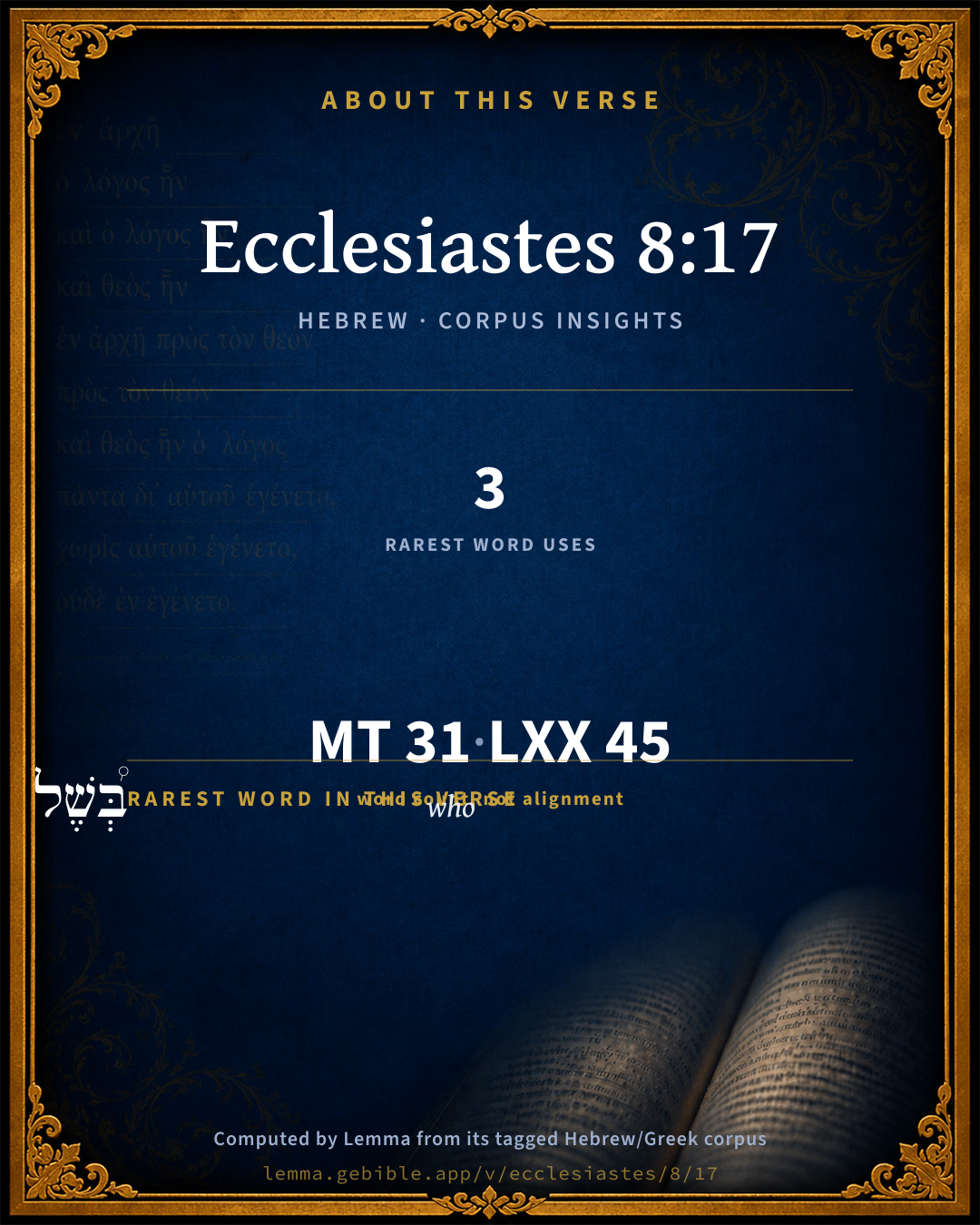
The rarest word here is בְּ֠שֶׁל who H7945 — appearing just 3 times in the whole Hebrew Bible.

Shared distinctive vocabulary

בְּ֠שֶׁל who H7945 occurs in 3 verses of the Hebrew Bible. Also found in:

Grammatical profile

  • 11 verbs
  • 7 nouns
  • 1 adjective
  • 2 prepositions
  • 2 conjunctions
  • 8 particles

Verb forms

  • וְרָאִיתִי֮ Qal · Sequential Perfect
  • יוּכַ֜ל Qal · Imperfect
  • לִמְצוֹא֙ Qal · Infinitive Construct
  • נַעֲשָׂ֣ה Niphal · Perfect
  • יַעֲמֹ֧ל Qal · Imperfect
  • לְבַקֵּ֖שׁ Piel · Infinitive Construct
  • יִמְצָ֑א Qal · Imperfect
  • יֹאמַ֤ר Qal · Imperfect
  • לָדַ֔עַת Qal · Infinitive Construct
  • יוּכַ֖ל Qal · Imperfect
  • לִמְצֹֽא Qal · Infinitive Construct

Repetition

Words recur within this verse — often emphatic in Hebrew:

  • לִמְצוֹא֙ to find H4672 ×3
  • מַעֲשֵׂ֣ה work H4639 ×2
  • יוּכַ֜ל to prevail H3201 ×2
  • הָאָדָ֗ם man H120 ×2
  • לֹ֨א not H3808 ×3
  • אֲשֶׁ֣ר which H834 ×2

Hebrew & Septuagint length

In English translation the verse runs 54 words from the Hebrew and 82 from the Septuagint (LXX English) — the Septuagint runs noticeably longer here. See the side-by-side →

A rough comparison of the two English renderings, which tokenize alike — not a word-level alignment.

Word counts can differ between the Hebrew and the Greek without any difference in meaning — e.g. the Hebrew direct-object marker אֵת has no separate Greek word, and Greek often adds the article ὁ.

In the original languages it is 31 Hebrew tokens and 45 Greek tokens — but the two are counted differently (Hebrew bundles its prefixes and suffixes into one token; the Greek is in lemma form), so that isn’t a like-for-like length.

Cross-references

11

Topical passages linked to Ecclesiastes 8:17 in the Treasury of Scripture Knowledge — connected by theme and wording, ordered by reader-vote popularity; previews shown in the World English Bible.

  • Ecclesiastes 3:11 He has made everything beautiful in its time. He has also set eternity in their hearts, yet so that man can't find out the work that God has done from the beginning even to the end.
  • Psalms 73:16 When I tried to understand this, It was too painful for me;
  • Romans 11:33 Oh the depth of the riches both of the wisdom and the knowledge of God! How unsearchable are his judgments, and his ways past tracing out!
  • Job 5:9 Who does great things that can't be fathomed, Marvelous things without number;
  • Ecclesiastes 7:23–24 All this have I proved in wisdom. I said, "I will be wise;" but it was far from me.
  • Isaiah 40:28 Have you not known? have you not heard? The everlasting God, Yahweh, the Creator of the ends of the earth, doesn't faint, neither is weary; there is no searching of his understanding.
  • Job 11:7–9 "Can you fathom the mystery of God? Or can you probe the limits of the Almighty?
  • Psalms 40:5 Many, Yahweh, my God, are the wonderful works which you have done, And your thoughts which are toward us. They can't be set in order to you; If I would declare and speak of them, they are more than can be numbered.
  • Proverbs 30:3–4 I have not learned wisdom, Neither do I have the knowledge of the Holy One.
  • Ecclesiastes 11:5 As you don't know what is the way of the wind, Nor how the bones grow in the womb of her who is with child; Even so you don't know the work of God who does all.
  • Psalms 104:24 Yahweh, how many are your works! In wisdom have you made them all. The earth is full of your riches.

Cross-references courtesy of OpenBible.info (CC BY 4.0).

Hebrew and Greek witnesses Masoretic Hebrew ↔ Greek Septuagint

The same verse in the two great witnesses to the Old Testament, shown verse-for-verse.

Here the Septuagint runs noticeably longer than the Hebrew — LXX2012 (modern English Septuagint) 82 words vs World English Bible 54. A rough length comparison of the two English translations, not a word-level alignment — read both below.

These are two independent witnesses, not word-aligned to each other, and the Septuagint is shown in lemma (dictionary) form.

Hebrew Ecclesiastes 8:17 Masoretic · Westminster Leningrad Codex

וְרָאִיתִי֮ אֶת כָּל מַעֲשֵׂ֣ה הָאֱלֹהִים֒ כִּי֩ לֹ֨א יוּכַ֜ל הָאָדָ֗ם לִמְצוֹא֙ אֶת הַֽמַּעֲשֶׂה֙ אֲשֶׁ֣ר נַעֲשָׂ֣ה תַֽחַת הַשֶּׁ֔מֶשׁ בְּ֠שֶׁל אֲשֶׁ֨ר יַעֲמֹ֧ל הָאָדָ֛ם לְבַקֵּ֖שׁ וְלֹ֣א יִמְצָ֑א וְגַ֨ם אִם יֹאמַ֤ר הֶֽחָכָם֙ לָדַ֔עַת לֹ֥א יוּכַ֖ל לִמְצֹֽא

then I saw all the work of God, that man can't find out the work that is done under the sun, because however much a man labors to seek it out, yet he won't find it. Yes even though a wise man thinks he can comprehend it, he won't be able to find it.

World English Bible · Public Domain

Greek LXX Ecclesiastes 8:17 Septuagint · lemma form

καί ὁράω σύν πᾶς ὁ ποίημα ὁ θεός ὅτι οὐ δύναμαι ἄνθρωπος ὁ εὑρίσκω σύν ὁ ποίημα ὁ ποιέω ὑπό ὁ ἥλιος ὅσος ἄν μοχθέω ὁ ἄνθρωπος ὁ ζητέω καί οὐ εὑρίσκω καί γέ ὅσος ἄν εἶπον ὁ σοφός ὁ γιγνώσκω οὐ δύναμαι ὁ εὑρίσκω

And I saw all the works of God, that a man shall not be able to discover the work which is wrought under the sun; whatever things a man shall endeavor to seek, however a man may labor to seek it, yet he shall not find it; yes, how much soever a wise man may speak of knowing it, he shall not be able to find it: for I applied all this to my heart, and my heart has seen all this.

LXX2012 (modern English Septuagint) · Public Domain

On this verse, Haydock's Catholic Bible Commentary discusses the Septuagint’s reading. Read the note in Commentary ↓

Hebrew: Westminster Leningrad Codex (CC BY 4.0). Greek: Septuagint (public domain); English from LXX2012 (modern English Septuagint) (Public Domain). How the Septuagint differs from the Hebrew →

Commentary

Notes on Ecclesiastes 8:17 from classic Christian and Jewish commentators (each source and its license shown beneath its notes). The classic Christian expositions comment on the surrounding passage and are grouped to its opening verse, so a note may address several verses; the Jewish commentaries on the Tanakh (Rashi and others) are per-verse, so they appear only where the commentator wrote on this verse.

Lemma curates 59 commentaries, every one of them public domain or Creative Commons licensed, each selected and text-cleaned for this edition rather than reprinted as found. About our sources →

Trapp's Complete Commentary

John Trapp

Ecc 8:17 Then I beheld all the work of God, that a man cannot find out the work that is done under the sun: because though a man labour to seek [it] out, yet he shall not find [it]; yea further; though a wise [man] think to know [it], yet shall he not be able to find [it].

Ver. 17. That a man cannot find out the work.] No, not the wisest that is; the very best empiric in this kind cannot. Let him labour never so much to find it, he shall but be tossed in a labyrinth, or as a wayfaring man in a desert. If a man cannot define anything because the forms of things are unknown, if he know not the creatures themselves, ab imo ad summum, from the lowest to the highest, neither shall he know the reasons and manner of them. {a} As a man may look on a trade, and never see the mystery of it; he may look on artificial things, pictures, watches, &c., and yet not see the art whereby they are made; as a man may look on the letter, and never understand the sense; so it is here, and we must content ourselves with a learned ignorance. Si nos non intelligimus quid quare fiat, debeamus hoc providentiae quod non fiat sine causa: {b} If we understand not why anything is done, let us owe this duty to Providence, to be assured that it is not done without cause.

{a} Granger.

{b} Aug. in Psalm cxlviii.

John Trapp, A Commentary or Exposition upon All the Books of the Old and New Testament (1647–1656) — public domain. Text from a community e-Sword module.

Joseph Benson's Commentary

Ecc 8:17. Then — Hebrew, and, or, moreover, I beheld all the work of God — I considered the counsels and ways of God, and the various methods of his providence toward good and bad men, and the reasons of them. That a man cannot find out the work, &c. — No man, though ever so wise, is able fully and perfectly to understand these things. And therefore, it is best for man not to perplex himself with endless and fruitless inquiries about those matters, but quietly to submit to God’s will and providence, and to live in the fear of God, and the comfortable enjoyment of his blessings.

Joseph Benson's Commentary on the Old and New Testaments (1811–1818) — public domain. Text from a community e-Sword module.

Adam Clarke's Commentary

Verse 17. Then I beheld all the work of God, that a man cannot find out the work that is done under the sun] I saw it to be of such a nature -

1, That a man cannot find it out.

2. That if he labour to find it out, he shall not succeed.

3. That though he be wise - the most instructed among men, and think to find it out, he shall find he is not able. It is beyond the wisdom and power of man. How vain then are all your cavils about Providence. You do not understand it; you cannot comprehend it. Fear God!

Adam Clarke's Commentary on the Bible (1810–1826) — public domain. Text from a community e-Sword/MySword module.

The Cambridge Bible for Schools and Colleges

gen. ed. J. J. S. Perowne

17. then I beheld all the work of God] The confession is like that which we have had before in chap. Ecc_7:23-24 : perhaps, also, we may add, like that of a very different writer dealing with a very different question, “How unsearchable are His judgments, and His ways past finding out” (Rom_11:33). The English reader may be reminded of Bishop Butler’s Sermon (xv.) on the “Ignorance of Man,” of which these verses supply the text. What is noticeable here is that the ignorance (we may use a modern term and say the Agnosticism) is not atheistic. That which the seeker contemplates he recognises as the work of God. Before that work, the wise man bows in reverence with the confession that it lies beyond him. The Finite cannot grasp the Infinite. We may compare Hooker’s noble words “Dangerous it were for the feeble brain of man to wade far into the doings of the Most High; whom although to know be life, and joy to make mention of His name; yet our soundest knowledge is to know that we know Him not as indeed He is, neither can know Him, and our safest eloquence concerning Him is our silence, when we confess without confession that His glory is inexplicable, His greatness above our capacity and reach. He is above, and we upon earth; therefore it behoveth our words to be wary and few” (Eccl. Pol. i. 2, § 3).

The Cambridge Bible for Schools and Colleges (gen. ed. J. J. S. Perowne; Cambridge University Press, 1878–1918) — public domain. Text from a community e-Sword module.

John Gill's Exposition

Then I beheld all the work of God,.... Not of creation, but of Providence; took notice of it, contemplated on it, considered it, and weighed it well; viewed the various steps and methods of it, to find out, if possible, at least, some general rule by which it proceeded: but all so various and uncertain,

that a man cannot find out the work that is done under the sun: he can find out that it is done, but not the reason why it is done: the ways of God are in the deep, and not to be traced; they are unsearchable and past finding out; there is a a depth of wisdom and knowledge, in them, inscrutable by the wisest of men, Psa 72:19;

because, though a man labour to seek it out, yet he shall not find it; Noldius and others render it "although"; not only a man that, in a slight and negligent manner, seeks after the knowledge of the works of divine Providence, and the reasons of them; but even one that is diligent and laborious at it is not able to find them out; they being purposely concealed by the Lord, to answer some ends of his;

yea, further, though a wise man think to know it, yet shall he not be able to find it; a man of a great natural capacity, such an one as Solomon himself, though he proposes to himself, and determines within himself to find it out, and sets himself to the work, and uses all the means and methods he can devise, and imagines with himself he shall be able to find out the reasons of the divine procedure, in his dispensations towards the righteous and the wicked; and yet, after all, he is not able to do it. The Targum is,

"what shall be done in the end of days;''

wherefore it is best for a man to be easy and quiet, and enjoy what he has in the best manner he can, and submit to the will of God.

Next: Ecclesiastes Chapter 9

John Gill's Exposition of the Whole Bible (1746–1763) — public domain (CC PDM 1.0). Text via the HelloAO Bible API.

Haydock's Catholic Bible Commentary

Reason. We know in general that God does all for his own glory, and for the welfare of his elect. But we cannot account for his treatment of mankind in particular cases, Romans xi. 33. (St. Jerome) (Calmet) --- Say. Septuagint, "speak what thing soever, that he may know he," &c. (Haydock)

George Leo Haydock (1774–1849), Haydock's Catholic Family Bible and Commentary, 1859 edition — public domain. Excludes Psalms (Douay-Rheims chapter numbering differs from Protestant) and Deuterocanonical books (Catholic canon only).

Matthew Poole's English Annotations

Then, Heb. and, or moreover, I beheld all the work of God; I considered the counsels and ways of God, and the various methods of his providence towards good and bad men, and the reasons of them.

A man cannot find out; no man, though never so wise, and inquisitive, and studious, as it follows, is able fully and perfectly to understand these things; and therefore it is best for man not to perplex himself with endless and fruitless inquiries about these matters, but quietly to submit to God’s will and providence, and to live in the fear of God, and the comfortable enjoyment of his blessings.

Matthew Poole's English Annotations on the Holy Bible (1683–1685) — public domain. Text from a community e-Sword/MySword module.

Whedon's Commentary on the Bible

Daniel D. Whedon

17. A man cannot find — The sad, weighty conclusion is, that the way and work of God among men is absolutely beyond comprehension. Every effort to compute it is entirely unavailing. Many, many questions may be asked to which God is pleased not to answer, and which man, at his wisest wisdom, cannot. The problem, ever unsolved, stares at him like the sphinx in the desert, “with calm, eternal eyes.”

Daniel D. Whedon (gen. ed.), Commentary on the Old and New Testaments (1874–1909) — public domain. Text from a community e-Sword module.

The Pulpit Commentary

Then I beheld all the work of God. This is the apodosis to the first clause of ver. 16. "God"s work" is the same as the work that is done under the sun, and means men"s actions and the providential ordering thereof. This a man, with his finite understanding, cannot find out, cannot thoroughly comprehend or explain. (comp. Ecc_3:11 Ecc_7:23, Ecc_7:24) Because though a man labor to seek it out. The Septuagint has, Osa a mocqhsh, "Whatsoever things a man shall labor to seek;" Vulgate, Quanto plus laboraverit ad quaerendum, tanto minus inveniat. The interpreters waver between "how much so ever," and "wherefore a man labors." The latter seems to be best. Though a wise man think to know it, yet shall he not be able to find it. It is the part of wisdom to determine to know all that can be known; but the resolution is baffled here (comp. Ecc_7:23) The two verses, with their repetitions and tautologous expressions, seem to denote perturbation of mind in the author and his sense of the gravity of his assertions. He is overwhelmed with the thought of the inscrutability of God"s judgments, while he is forced to face the facts. An exquisite commentary on this passage is found in Hooker, "Eccl. Pol.," 1:2. quoted by Plumptre; and in Bishop Butler"s sermon "On the Ignorance of Man," where we read, "From it the knowledge of our ignorance we may learn with what temper of mind a man ought to inquire into the subject of religion, namely, with what expectation of finding difficulties, and with a disposition to take up and rest satisfied with any evidence whatever which is real. A man should beforehand expect things mysterious, and such as he will not be able thoroughly to comprehend or go to the bottom of.... Our ignorance is the proper answer to many things which are called objections against religion, particularly to those which arise from the appearance of evil and irregularity in the constitution of nature and the government of the world Since the constitution of nature and the methods and designs of Providence in the government of the world are above our comprehension, we should acquiesce in and rest satisfied with our ignorance, turn our thoughts from that which is above and beyond us, and apply ourselves to that which is level to our capacities, and which is our real business and concern .... Lastly, let us adore that infinite wisdom and power and goodness which is above our comprehension (Ecc_1:6).

The conclusion is that in all lowliness of mind we set lightly by ourselves; that we form our temper to an implicit submission to the Divine Majesty, beget within ourselves an absolute resignation to all the methods of his providence in his dealings with the children of men; that in the deepest humility of our souls we prostrate ourselves before him, and join in that celestial song, "Great and marvelous are thy works, Lord God Almighty; just and true are thy ways, thou King of saints. Who shall not fear thee, O Lord, and glorify thy Name?" (Rev_15:3, 4 comp. Rom_11:33)

The impenetrable, inscrutable mystery.

Plain people often think that a wise man is a man who knows, if not all things, yet all things to which he has directed his attention. It does not enter into their mind that wisdom lies largely in the consciousness of the limitation of the human powers. A great thinker has justly and beautifully said that the larger the circle of knowledge, the larger the external circumference which reveals itself to the apprehension. The writer of Ecclesiastes was a wise man, but he confesses himself to have been baffled in his endeavor to find out and master all the work of man, and much more the work of God. In this confession he was not singular. The man who knows a little may be vain of his knowledge; but the man who knows much knows full well how much there is which to him is unknown, and how much more is by him unknowable.

I THE FACT THAT THE THOUGHTFUL MAN IS BAFFLED IN HIS ENDEAVOR TO COMPREHEND GOD"S WAYS, AND TO COMPREHEND HUMAN LIFE AND DESTINY.

II THIS IS JUST WHAT IS TO BE EXPECTED FROM A CONSIDERATION OF

(1) man"s finite nature, and

(2) God"s infinite wisdom.

III THE PROFITABLENESS OF THIS ARRANGEMENT.

1. It tends to raise our thought of God to a juster elevation.

1. It calls forth

1. humility,

2. submission, and

3. faith.

2. It makes the future infinitely interesting and attractive. What we know not here we shall know hereafter. Sow we know as in a mirror, dimly; then, face to lace.

Here it is given only to survey Dawnings of bliss and glimmerings of day; Heaven"s fuller affluence mocks our dazzled sight Too swift its radiance and too clear its light.

T.

The Pulpit Commentary (1880–1919), ed. H.D.M. Spence-Jones & Joseph S. Exell — public domain. Text from a community e-Sword module.

John Wesley's Explanatory Notes

I beheld - I considered the counsels and ways of God, and the various methods of his providence, and the reasons of them. Find out - No man, though ever so wise, is able fully and perfectly to understand these things. And therefore it is best for man not to perplex himself with endless enquiries, but quietly to submit to God's will and providence, and to live in the fear of God, and the comfortable enjoyment of his blessing.

John Wesley, Explanatory Notes Upon the Whole Bible (1754–1765) — public domain. Text via the GEBible commentary corpus.

Rashi

Rabbi Shlomo Yitzchaki (Rashi)

And I saw all the deed of God that He gave over to mankind.

for a person will not be able to fathom, etc. Mankind cannot fathom the way of the Holy One, blessed be He, what the reward is for all the deed that is done under the sun, for they see wicked men prospering and righteous men declining.

because though a man toils to seek because I saw many people toiling to seek and to fathom this phenomena, but they are unable [to understand it].

and even if the wise man claims that he understands it, he will not be able to, for [even] Moses our teacher could not fathom the matter, when he said, (Exod. 33:13): “please let me know Your ways.”

Rashi on the Tanakh — English translations: “The Judaica Press complete Tanach with Rashi, translated by A. J. Rosenberg” (CC BY 4.0); “Pentateuch with Rashi's commentary by M. Rosenbaum and A.M. Silbermann, 1929-1934” (public domain); “The Metsudah Tanach series, Lakewood, N.J” (CC BY 4.0); and “The Book of Joshua, Metsudah Publications, 1997” (CC BY 4.0). Text via Sefaria.

Lesson kit

Teaching starters — assembled from the data on this page, not authored interpretation. Every prompt links to the verse data it draws on. Edit before teaching.

Ecclesiastes, in the Wisdom, opens this verse with 31 words (22 distinct Hebrew lemmas). Its most distinctive word is shel (“who”). The Greek Septuagint runs longer here. A historical commentator’s framing appears above. Read the whole chapter for the surrounding context.

Discussion questions

  1. What does “who” (shel) contribute to the verse as a whole?
  2. 2 Kings 6:11 shares the word «who» with this verse. How do the two illuminate each other?
  3. “to find” occurs 3× in this one verse. What is the effect of the repetition?
  4. Compared with the Hebrew, the Septuagint runs longer here. What questions does that raise?
  5. These translations render this verse differently. What is at stake in choosing one wording over another?
  6. The verb «וְרָאִיתִי֮» is Qal Sequential Perfect. How does its form color the action?
  7. Reading how Trapp's Complete Commentary and Joseph Benson's Commentary read this verse, where do the two commentators agree and where do they part?

Things to notice

Reading settings

Reading text

Shown beneath each verse's original-language words.

Old Testament
Old Testament edition

Read the OT as the Masoretic Hebrew (MT) or the Greek Septuagint (LXX).

English shown for the Greek Septuagint (in the Hebrew ↔ Greek comparison).

Comparing translations? Open the Compare panel on any verse page to stack up to four side by side.