

Jeremiah 20:10

Hebrew (Westminster Leningrad Codex) Jeremiah 20:10 appears in the Hebrew Old Testament. The text above is from the Westminster Leningrad Codex. Each word links to its Strong’s number, a concise gloss, and parsing drawn from the Open Scriptures Hebrew Bible morphology. Click any word for its full Brown-Driver-Briggs (BDB) entry.
Download image
Cite this verse

Jeremiah 20:10 (World English Bible). Public Domain. Lemma interlinear Bible study tool, https://lemma.gebible.app/v/jeremiah/20/10.

Show BibTeX & RIS
BibTeX
RIS
English Translation
For I have heard the defaming of many, terror on every side. Denounce, and we will denounce him, [say] all my familiar friends, those who watch for my fall; peradventure he will be persuaded, and we shall prevail against him, and we shall take our revenge on him.
World English Bible · Public Domain
Download a study sheet

One document with this verse’s original text, its word-by-word gloss line, the meaning frame, cross-references with their text, attributed commentary, and full source and license credits — printable, and it pastes into notes with its structure intact.

This verse Autodidact and up

Study sheet (.html) Plain text (.txt)

A passage Seminary Student

Up to 50 verses in one chapter. A passage sheet keeps up to 6 commentary sources and 12 cross-references per verse, in the order this page ranks them, and says so on the sheet whenever that leaves anything out. Ask for a single verse and you get the Autodidact verse sheet above.

Everything on this page stays free to read, with no account — the sheet is a download of what is already on screen, not access to it.

Want to remove ads? Support Godless Engineer
Compare translations 3

The same verse in 3 English versions, stacked beneath the original-language interlinear above. Click any original word for its lexicon entry.

Each is an independent rendering of the whole verse — the interlinear is not word-aligned to these translations.

Highlighted words mark where these versions differ — a whole-verse word diff, not a word-by-word alignment.

  • World English Bible Public Domain
    For I have heard the defaming of many, terror on every side. Denounce, and we will denounce him, [say] all my familiar friends, those who watch for my fall; peradventure he will be persuaded, and we shall prevail against him, and we shall take our revenge on him.
  • King James Version Public Domain
    For I heard the defaming of many, fear on every side. Report, say they, and we will report it. All my familiars watched for my halting, saying, Peradventure he will be enticed, and we shall prevail against him, and we shall take our revenge on him.
  • unfoldingWord Literal Text CC BY-SA 4.0
    For I have heard the whispering of many: “Terror on every side! Report! Let us report him!” Every man of my peace, the watchers of my stumbling: “Perhaps he will be deceived, then we will prevail against him and we will take our vengeance on him.”

unfoldingWord Literal Text — © unfoldingWord, licensed CC BY-SA 4.0. Word-aligned USFM3 via Door43 (git.door43.org/unfoldingWord/en_ult).

Versions to compare (up to 4)

3 of 4 selected

Show all 18 translations

Every available English version of this verse, each an independent rendering of the whole verse.

  • World English Bible Public Domain
    For I have heard the defaming of many, terror on every side. Denounce, and we will denounce him, [say] all my familiar friends, those who watch for my fall; peradventure he will be persuaded, and we shall prevail against him, and we shall take our revenge on him.
  • Berean Standard Bible Public Domain
    For I have heard the whispering of many: “Terror is on every side! Report him; let us report him!” All my trusted friends watch for my fall: “Perhaps he will be deceived so that we may prevail against him and take our vengeance upon him.”
  • Majority Standard Bible Public Domain
    For I have heard the whispering of many: “Terror is on every side! Report him; let us report him!” All my trusted friends watch for my fall: “Perhaps he will be deceived so that we may prevail against him and take our vengeance upon him.”
  • King James Version Public Domain
    For I heard the defaming of many, fear on every side. Report, say they, and we will report it. All my familiars watched for my halting, saying, Peradventure he will be enticed, and we shall prevail against him, and we shall take our revenge on him.
  • American Standard Version (1901) Public Domain
    For I have heard the defaming of many, terror on every side. Denounce, and we will denounce him, `say' all my familiar friends, they that watch for my fall; peradventure he will be persuaded, and we shall prevail against him, and we shall take our revenge on him.
  • Revised Version (1885) Public Domain
    For I have heard the defaming of many, terror on every side. Denounce, and we will denounce him, say all my familiar friends, they that watch for my halting; peradventure he will be enticed, and we shall prevail against him, and we shall take our revenge on him.
  • Geneva Bible (1599) Public Domain
    For I had heard the railing of many, and feare on euery side. Declare, said they, and wee wil declare it: all my familiars watched for mine halting, saying, It may be that he is deceiued: so we shall preuaile against him, and we shall execute our vengeance vpon him.
  • Douay-Rheims (1899) Public Domain
    For I heard the reproaches of many, and terror on every side: Persecute him, and let us persecute him: from all the men that were my familiars, and continued at my side: if by any means he may be deceived, and we may prevail against him, and be revenged on him.
  • Young's Literal Translation Public Domain
    For I have heard the evil report of many, Fear `is' round about: `Declare, and we declare it,' All mine allies are watching `for' my halting, `Perhaps he is enticed, and we prevail over him, And we take our vengeance out of him.'
  • Literal Standard Version CC BY-SA 4.0
    For I have heard the evil report of many, “Fear [is] all around!” “Declare, and we declare it!” All my allies are watching [for] my halting, “Perhaps he is enticed, and we prevail over him, || And we take our vengeance on him.”
  • Unlocked Literal Bible CC BY-SA 4.0
    I have heard rumors of terror from many people all around. 'Report! We must report it!' Those who are close to me watch to see if I will fall. 'Perhaps he can be tricked. If so, we can overpower him and take our revenge on him.'
  • unfoldingWord Literal Text CC BY-SA 4.0
    For I have heard the whispering of many: “Terror on every side! Report! Let us report him!” Every man of my peace, the watchers of my stumbling: “Perhaps he will be deceived, then we will prevail against him and we will take our vengeance on him.”
  • Darby Bible Public Domain
    For I have heard the defaming of many, terror on every side: Report, and we will report it. All my familiars are watching for my stumbling: Peradventure he will be enticed, and we shall prevail against him; and we shall take our revenge on him.
  • World Messianic Bible Public Domain
    For I have heard the defaming of many: “Terror on every side! Denounce, and we will denounce him!” say all my familiar friends, those who watch for my fall. “Perhaps he will be persuaded, and we will prevail against him, and we will take our revenge on him.”
  • Webster's Bible Public Domain
    For I heard the defaming of many, fear on every side. Report, say they, and we will report it. All my familiars watched for my halting, saying, Perhaps he will be enticed, and we shall prevail against him, and we shall take our revenge on him.
  • Free Bible Version CC BY-SA 4.0
    I've heard many people gossiping: “He's the one who says, ‘Terror is everywhere!’ He has to be reported! Report what he's doing!” All my good friends are waiting for me to slip up. “Maybe he'll make a mistake so we can defeat him and get our revenge on him,” they say.
  • Bible in Basic English Public Domain
    For numbers of them say evil secretly in my hearing (there is fear on every side): they say, Come, let us give witness against him; all my nearest friends, who are watching for my fall, say, It may be that he will be taken by deceit, and we will get the better of him and give him punishment.
  • JPS Tanakh (1917) Public Domain
    For I have heard the whispering of many, terror on every side: 'Denounce, and we will denounce him'; even of all my familiar friends, them that watch for my halting: 'Peradventure he will be enticed, and we shall prevail against him, and we shall take our revenge on him.'

Literal Standard Version (2020), Covenant Press — licensed CC BY-SA 4.0. Text via the HelloAO Bible API (eBible.org). Unlocked Literal Bible (unfoldingWord) — licensed CC BY-SA 4.0. Text via the HelloAO Bible API (eBible.org). unfoldingWord Literal Text — © unfoldingWord, licensed CC BY-SA 4.0. Word-aligned USFM3 via Door43 (git.door43.org/unfoldingWord/en_ult). Free Bible Version, Dr. Jonathan Gallagher — licensed CC BY-SA 4.0. Text via the HelloAO Bible API (eBible.org).

Word by word

More ways to search: Search by grammar → Find every occurrence → Compare this word →

Practice this passage: Drill this verse → Learn its vocabulary →

צַלְעִ֑י
tselaʻ
H6761
“limping · my”
Noun, Common, Masculine, Singular, Construct + Suffix, Personal, 1st Person, Common, Singular
Part of Speech
Noun
Type
Common
Gender
Masculine
Number
Singular
State
Construct
Full BDB Definition

Origin: from H6760

TWOT: 1925a

limping, stumbling
  1. כִּ֣י kîy H3588 “that” Conjunction
  2. שָׁמַ֜עְתִּי shâmaʻ H8085 “to hear” Verb, Qal, Perfect, 1st Person, Common, Singular
  3. דִּבַּ֣ת dibbâh H1681 “slander of” Noun, Common, Feminine, Singular, Construct
  4. רַבִּים֮ rab H7227 “many” Adjective, Adjective, Masculine, Plural, Absolute
  5. מָג֣וֹר mâgôwr H4032 “fear” Noun, Common, Masculine, Singular, Absolute
  6. מִסָּבִיב֒ çâbîyb H5439 “from · round about” Preposition + Noun, Common, Both, Singular, Absolute
  7. הַגִּ֨ידוּ֙ nâgad H5046 “make known” Verb, Hiphil, Imperative, 2nd Person, Masculine, Plural
  8. וְנַגִּידֶ֔נּוּ nâgad H5046 “and · to make known · him” Conjunction + Verb, Hiphil, Imperfect, 1st Person, Common, Plural + Suffix, Personal, 3rd Person, Masculine, Singular
  9. כֹּ֚ל kôl H3605 “all of” Noun, Common, Masculine, Singular, Construct
  10. אֱנ֣וֹשׁ ʼĕnôwsh H582 “man of” Noun, Common, Masculine, Singular, Construct
  11. שְׁלוֹמִ֔י shâlôwm H7965 “peace · my” Noun, Common, Masculine, Singular, Construct + Suffix, Personal, 1st Person, Common, Singular
  12. שֹׁמְרֵ֖י shâmar H8104 “keeping” Verb, Qal, Participle Active, Masculine, Plural, Construct
  13. אוּלַ֤י ʼûwlay H194 “perhaps” Adverb
  14. יְפֻתֶּה֙ pâthâh H6601 “to deceive” Verb, Pual, Imperfect, 3rd Person, Masculine, Singular
  15. וְנ֣וּכְלָה yâkôl H3201 “and · to prevail” Conjunction + Verb, Qal, Cohortative, 1st Person, Common, Plural
  16. וְנִקְחָ֥ה lâqach H3947 “and · to take” Conjunction + Verb, Qal, Cohortative, 1st Person, Common, Plural
  17. נִקְמָתֵ֖נוּ nᵉqâmâh H5360 “vengeance · our” Noun, Common, Feminine, Singular, Construct + Suffix, Personal, 1st Person, Common, Plural
  18. מִמֶּֽנּוּ min H4480 “from · him” Preposition + Suffix, Personal, 3rd Person, Masculine, Singular

About this verse

These counts appear in no published source. They are computed here, from the morphology-tagged text and Lemma’s own curated glosses. What Lemma adds →

20
words
18
distinct lemmas
Prophets
section

Notable vocabulary

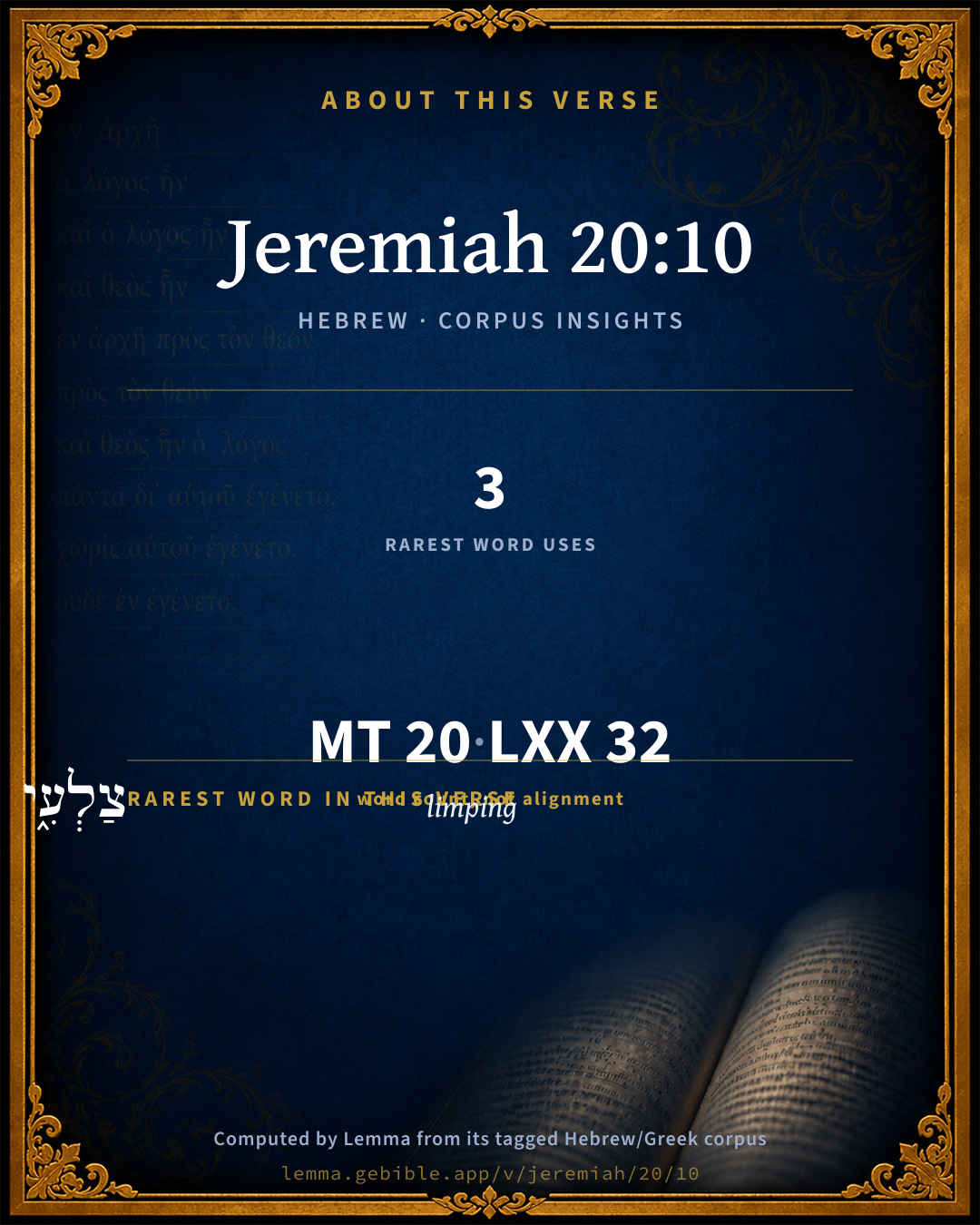
The rarest word here is צַלְעִ֑י limping H6761 — appearing just 3 times in the whole Hebrew Bible.

Shared distinctive vocabulary

צַלְעִ֑י limping H6761 occurs in 3 verses of the Hebrew Bible. Also found in:

Grammatical profile

  • 7 verbs
  • 8 nouns
  • 1 adjective
  • 2 prepositions
  • 1 conjunction
  • 1 adverb

Verb forms

  • שָׁמַ֜עְתִּי Qal · Perfect
  • הַגִּ֨ידוּ֙ Hiphil · Imperative
  • וְנַגִּידֶ֔נּוּ Hiphil · Imperfect
  • שֹׁמְרֵ֖י Qal · Participle Active
  • יְפֻתֶּה֙ Pual · Imperfect
  • וְנ֣וּכְלָה Qal · Cohortative
  • וְנִקְחָ֥ה Qal · Cohortative

Repetition

A word recurs within this verse — often emphatic in Hebrew:

  • הַגִּ֨ידוּ֙ to make known H5046 ×2

Hebrew & Septuagint length

In the original languages it is 20 Hebrew tokens and 32 Greek tokens — but the two are counted differently (Hebrew bundles its prefixes and suffixes into one token; the Greek is in lemma form), so that isn’t a like-for-like length.

Cross-references

27

Topical passages linked to Jeremiah 20:10 in the Treasury of Scripture Knowledge — connected by theme and wording, ordered by reader-vote popularity; previews shown in the World English Bible.

  • Psalms 41:9 Yes, my own familiar friend, in whom I trusted, Who ate bread with me, Has lifted up his heel against me.
  • Psalms 31:13 For I have heard the slander of many, terror on every side, While they conspire together against me, They plot to take away my life.
  • Isaiah 29:21 that make a man an offender in [his] cause, and lay a snare for him who reproves in the gate, and turn aside the just with a thing of nothing.
  • Jeremiah 18:18 Then said they, Come, and let us devise devices against Jeremiah; for the law shall not perish from the priest, nor counsel from the wise, nor the word from the prophet. Come, and let us strike him with the tongue, and let us not give heed to any of his words.
  • Psalms 55:13–14 But it was you, a man like me, My companion, and my familiar friend.
  • Psalms 64:2–4 Hide me from the conspiracy of the wicked, From the noisy crowd of the ones doing evil;
  • Proverbs 10:18 He who hides hatred has lying lips. He who utters a slander is a fool.
  • Jeremiah 6:25 Don't go forth into the field, nor walk by the way; for the sword of the enemy, [and] terror, are on every side.
  • Ezekiel 22:9 Slanderous men have been in you to shed blood; and in you they have eaten on the mountains: in the midst of you they have committed lewdness.
  • Acts 24:13 Nor can they prove to you the things of which they now accuse me.
  • 1 Kings 19:2 Then Jezebel send a messenger to Elijah, saying, So let the gods do to me, and more also, if I don't make your life as the life of one of them by tomorrow about this time.
  • 1 Kings 21:20 Ahab said to Elijah, Have you found me, my enemy? He answered, I have found you, because you have sold yourself to do that which is evil in the sight of Yahweh.
  • Nehemiah 6:6–13 in which was written, It is reported among the nations, and Gashmu says it, that you and the Jews think to rebel; for which cause you are building the wall: and you would be their king, according to these words.
  • Job 19:19 All my familiar friends abhor me. They whom I loved have turned against me.
  • Matthew 26:59–60 Now the chief priests, the elders, and the whole council sought false testimony against Jesus, that they might put him to death;
  • Luke 11:53–54 As he said these things to them, the scribes and the Pharisees began to be terribly angry, and to draw many things out of him;
  • Luke 20:20 They watched him, and sent out spies, who pretended to be righteous, that they might trap him in something he said, so as to deliver him up to the power and authority of the governor.
  • Acts 6:11–15 Then they secretly induced men to say, "We have heard him speak blasphemous words against Moses and God."
  • 1 Kings 22:8 The king of Israel said to Jehoshaphat, there is yet one man by whom we may inquire of Yahweh, Micaiah the son of Imlah: but I hate him; for he does not prophesy good concerning me, but evil. Jehoshaphat said, "Don't let the king say so."
  • 1 Kings 22:27 and say, Thus says the king, Put this fellow in the prison, and feed him with bread of affliction and with water of affliction, until I come in peace.
  • Psalms 57:4 My soul is among lions. I lie among those who are set on fire, Even the sons of men, whose teeth are spears and arrows, And their tongue a sharp sword.
  • Mark 6:19–28 Herodias set herself against him, and desired to kill him, but she couldn't,
  • Luke 12:52–53 For from now on, there will be five in one house divided, three against two, and two against three.
  • Acts 5:33 But they, when they heard this, were cut to the heart, and determined to kill them.
  • Acts 7:54 Now when they heard these things, they were cut to the heart, and they gnashed at him with their teeth.
  • Acts 23:12–15 When it was day, some of the Jews banded together, and bound themselves under a curse, saying that they would neither eat nor drink until they had killed Paul.
  • Acts 24:1–9 After five days, the high priest, Ananias, came down with certain elders and an orator, one Tertullus. They informed the governor against Paul.

Cross-references courtesy of OpenBible.info (CC BY 4.0).

Hebrew and Greek witnesses Masoretic Hebrew ↔ Greek Septuagint

The same verse in the two great witnesses to the Old Testament, shown verse-for-verse.

These are two independent witnesses, not word-aligned to each other, and the Septuagint is shown in lemma (dictionary) form.

Hebrew Jeremiah 20:10 Masoretic · Westminster Leningrad Codex

כִּ֣י שָׁמַ֜עְתִּי דִּבַּ֣ת רַבִּים֮ מָג֣וֹר מִסָּבִיב֒ הַגִּ֨ידוּ֙ וְנַגִּידֶ֔נּוּ כֹּ֚ל אֱנ֣וֹשׁ שְׁלוֹמִ֔י שֹׁמְרֵ֖י צַלְעִ֑י אוּלַ֤י יְפֻתֶּה֙ וְנ֣וּכְלָה ל֔וֹ וְנִקְחָ֥ה נִקְמָתֵ֖נוּ מִמֶּֽנּוּ

For I have heard the defaming of many, terror on every side. Denounce, and we will denounce him, [say] all my familiar friends, those who watch for my fall; peradventure he will be persuaded, and we shall prevail against him, and we shall take our revenge on him.

World English Bible · Public Domain

Greek LXX Structure differs

In the Septuagint, Jeremiah is about an eighth shorter than the Hebrew and arranges its material differently — the Oracles Against the Nations (Hebrew chapters 46–51) appear in the middle of the Greek book, after 25:13. Because the chapter and verse boundaries do not line up, a verse-for-verse comparison with the Hebrew is not shown.

A verse-for-verse comparison isn’t shown here because the chapters and verses don’t line up. Switch to the LXX edition with the MT / LXX toggle above to read the Greek directly.

Hebrew: Westminster Leningrad Codex (CC BY 4.0). Greek: Septuagint (public domain); English from a public-domain English Septuagint. How the Septuagint differs from the Hebrew →

Targum (Aramaic paraphrase)

1

The Targum is the ancient Jewish Aramaic paraphrase of the Hebrew Scriptures — an interpretive translation, not the Hebrew text itself. Onkelos (literal) and Pseudo-Jonathan (expansive) render the Torah, and Jonathan the Prophets. Coverage is partial: where no permissively-licensed English translation exists for a verse, only the Aramaic is shown. This is verse-level text, not a word-by-word alignment to the Hebrew.

  1. Targum Jonathan Prophets (Joshua–Malachi)
    אֲרֵי שְׁמָעֵית מִלֵי סַגִיאַיָא דְמִתְכַּנְשִׁין מִסְחוֹר סְחוֹר הֲווֹ וּנְחַוִינֵיהּ כָּל אֱנַשׁ שְׁלָמִי כָמְנִין לְאַבְאָשָׁא לִי מָאִים יִטְעֵי וְנִכּוֹל לֵיהּ וְנִתְפְּרַע פּוּרְעֲנוּתָנָא מִנֵיהּ:

    (no public-domain English translation for this verse)

    Targum Jonathan — Aramaic: “Mikraot Gedolot” (public domain). English: “Sefaria Community Translation” (CC0 1.0 (public-domain dedication)); “London "Chaldee Paraphrase," 1871” (public domain). Text via Sefaria.

Commentary

Notes on Jeremiah 20:10 from classic Christian and Jewish commentators (each source and its license shown beneath its notes). The classic Christian expositions comment on the surrounding passage and are grouped to its opening verse, so a note may address several verses; the Jewish commentaries on the Tanakh (Rashi and others) are per-verse, so they appear only where the commentator wrote on this verse.

Lemma curates 59 commentaries, every one of them public domain or Creative Commons licensed, each selected and text-cleaned for this edition rather than reprinted as found. About our sources →

Trapp's Complete Commentary

John Trapp

Jer 20:10 For I heard the defaming of many, fear on every side. Report, [say they], and we will report it. All my familiars watched for my halting, [saying], Peradventure he will be enticed, and we shall prevail against him, and we shall take our revenge on him.

Ver. 10. For I heard the defaming of many, fear on every side.] This passage is borrowed from Psa 31:13; {See Trapp on "Psa 31:13"} Some render the text, I heard the defamation of many Magormissabibs, many of his accomplices and Coryphaei, spies set a-work by him to defame and smear me.

Report, say they, and we will report.] Calumniare audacter; broach a slander, and we will blazon it; set it afoot, and we will set it afloat give us but some small hint or inkling of aught spoken by Jeremiah, whereof to accuse him to the king and state, and we desire no more. Athanasius was about thirty times accused, and of no small crimes either, but falsely. The Papists make it their trade to belie the Protestants, their chieftains especially. They reported of Luther that he died despairing; of Calvin, that he was branded on the shoulder for a rogue; of Beza, that he ran away with another man’s wife, &c. And for their authors they allege Baldwin and Bolsecus, a couple of apostates, requested by themselves (and, as some say, hired) to write the lives of these worthies, their professed enemies. But anything of this kind serves their turn, and they cite the writings of these renegades as canonical.

All my familiars.] Heb., Every man of my peace; from such there is the greatest danger. Hence one prayed God to deliver him from his friends, for as for his enemies he could better beware of them. Many friends are like deep ponds, clear at the top, but all muddy at the bottom.

John Trapp, A Commentary or Exposition upon All the Books of the Old and New Testament (1647–1656) — public domain. Text from a community e-Sword module.

The Biblical Illustrator

Joseph S. Exell

Jer_20:10-18

An my familiars watched for my halting.

Pathetic experiences

In these verses we have two distinct aspects of human experience. Within this brief section Jeremiah is on the hill top and in the deepest valley of spiritual dejection. How much depends upon circumstances for mans estimate of life! That estimate varies with climate, with incidents of a very trivial nature, and with much that is only superficial and transitory. Life is one thing to the successful man, and another to the man whose life is one continual series of defeats and disappointments. It is well, therefore, that all men should have a touch of failure, and spend a night or two now and then in deepest darkness that cannot be relieved: such experience teaches sympathy, develops the noblest faculties, brings into beneficent, exercise many generous emotions, and in the morning, after a long nights struggle with doubt, there may be tears in the eyes; but those tears denote the end of weakness and the beginning of strength. The year is not one season, but four, and we must pass through all the four before we can know what the year is. So with life: we must be with Jeremiah on the mountaintop, or with him in the deep valley; we must join his song, and fall into the solemn utterance of his sorrow, before we can know what the whole gamut of life is. How impossible it is to realise all the conflicting experiences at once, and to be wise. There is an abundance of information, there is a plentifulness of criticism that is detestable; but wisdom--large, generous wisdom, that understands every mans case, and has an answer to every mans necessity--oh, whither has that angel-mother fled? We need now and again to come into contact with those who know us altogether, and who can speak the word of cheer when we are cheerless, and the word of chastening when our rapture becomes riotous. Consider the vanity of life, and by its vanity understand its brevity, its uncertainty, its fickleness. We have no gift of time, we have no assurance of continuance; we have a thousand yesterdays, we have not one tomorrow. Then how things disappoint us that were going to make us glad! The flowers have been blighted, or the insects have fallen upon them, or the cold wind has chilled them, and they have never come to full fruition or bloom or beauty; and the child that was going to comfort us in our old age died first, as if frightened by some ghost invisible to us. Then the collisions of life, its continual competitions and rivalries and jealousies; its mutual criticisms, its backbitings and slanderings; its censures, deserved and undeserved: who can stand the rush and tumult of this life? Who has not sometimes longed to lay it down and begin some better, sunnier state of existence? And the sufferings of life, who shall number them?--not the great sufferings that are published, not the great woes that draw the attention even of the whole household to us in tender regard; but sufferings we never mention, spiritual sufferings, yea, even physical sufferings; sufferings that we dare not mention, sufferings that would be laughed at by unsympathetic contempt--but still sufferings. Add all these elements and possibilities together, and then say who has not sometimes been almost anxious to shuffle off this mortal coil, and pass into the liberty of rest. Jesus Christ understands us all. We can all tell Jesus, as the disciples did, what has happened. He can listen to each of us as if His interest were entranced and enthralled. He knows every quiver of the life, every throb of the heart, every palpitation of fear, and every shout of joy. Withhold nothing from Him. You can tell Him all, and when you have ended you will find that you may begin life again. In your hope is His answer. (J. Parker, D. D.)

Evil watchers

All my familiars watched for my halting: the original word does not mean my innermost friends, for true friendship can never be guilty of such treason, but the Hebrew word means, The men of my peace; the men who used to accost me on the highway with, Is it peace?--the men who salaamed me out of civility, but who never really cared for me in their souls: these men, behind their painted masks, watched for my halting; they all watched. Some men take pleasure when other men fall. What is the answer to all this watching of others? It is a clear, plain, simple, useful answer: Watch yourselves; be sober, be vigilant, for your adversary the devil, as a roaring lion, goeth about seeking whom he may devour. It is not enough that others watch you--watch yourselves; be critical about yourselves; be severe with yourselves; penetrate the motive of every action, and say, Is it healthy? Is it honest? Is it such as could bear the criticism of God? Dare we take up this motive and look at it when the sun burns upon it in its revealing glory? If a man so watch himself he need not mind who else watches him. Watch the secret places; watch the out-of-the-way doors, the postern gates, the places that are supposed to be secure against the approach of the burglar; be very careful about all these, and then the result may be left with God. He who does not watch will be worsted in the fray. He who does not watch cannot pray. He who watches others and does not watch himself is a fool. (J. Parker, D. D.)

But the Lord is with me as a mighty terrible one.--

The best Champion

(as a mighty terrible one):--As a strong giant, and mine only Champion on whom I lean. Here the spirit begins to get the better of the flesh, could Jeremiah but hold his own. But as the ferryman plies the oar, and eyes the shore homeward where he would be, yet there comes a gust of wind that carrieth him back again; so it fared with our prophet (verses 14, 15). (John Trapp.)

Cursed be the day wherein I was born.

Existence regretted

Job and Jeremiah were alike in wishing they had never been born. They were both men of sorrow.

I. A preference alike irreligious and irrational.

1. Good men should not for a moment think that non-existence is preferable to life and being. These were both good men, children of God; existence was therefore a blessing to be prized, not an evil to be mourned over. Had they been versed in the design and results of Divine dispensations, as Paul, they would have said, Our light affliction, etc. With such a destiny before them, instead of cursing the day of birth, they would have blessed it as the dawn of an eternal existence, to be hereafter crowned with a glory that fadeth not away.

2. Ungodly men may with some degree of reason prefer non-existence; because in trouble they have no Divine support, in death no good hope, in eternity no expectation but the penalty of sin.

II. Non-existence is preferable to existence unless existence possess more pleasure than pain.

1. If every ungodly man lived out threescore years and ten, and the whole was spent in pleasure, yet, as that period is but momentary as compared with his eternal existence, and as that existence is to be one of pain, he might curse the day of his birth.

2. Existence, eternal existence, is a blessing to all unfallen ones, and also to such fallen ones as are redeemed by the death of Christ.

3. But perpetuity of existence can be no blessing to the angels who kept not their first estate, nor to those of the human race who by impenitence and unbelief reject the great salvation and bring upon themselves the double condemnation of the law and the Gospel.

III. Hell and heaven are two great teachers.

1. Hell teaches--the folly of wickedness, the full enormity of sin in the penalty it has entailed, and leads all its victims amid the consequences of their depravity to curse the day they were born.

2. Heaven teaches--the wisdom of holiness, the full benefits of redemption in the felicity it has secured, and leads all the ransomed to bless the day of their birth as the morn of their noontide of glory.

IV. God is not willing that any should have occasion for preferring non-existence.

1. He has devised and carried out a costly plan by which the existence of fallen ones might be made an eternal blessing.

2. Every man who now wishes for a glorious existence has only to look to Jesus and be saved. (D. Pledge.)

.

The Biblical Illustrator, edited by Joseph S. Exell (c. 1880s–1900s) — public domain. Text from a community e-Sword module.

Joseph Benson's Commentary

Jer 20:10-11. For I heard the defaming of many — The slanderous, injurious reports that were raised concerning me; fear on every side — Hebrew, magor-missabib; as if he had said, The name given to Pashur would have suited me; fear, or cause for fear, was on every side of me. These words are found verbatim in the original, (Psa 31:13,) where the sense of them seems to be exactly the same as here, namely, from the slanderous reports raised upon him, he had reason to apprehend some evil design against his life, as well from treacherous friends as from open enemies. Report, say they, &c. — This seems to be spoken of the enemies of the prophet, exciting one another to accuse him of being in the interest of the Babylonians against his country. Blaney joins this clause with the preceding, thus: Report ye terror all around, and we will report it: all my familiar friends watch for my halting; perhaps, say they, he may be drawn aside, so that we may prevail against him, and we may take our revenge of him. But, &c. — The prophet, having given vent to his painful apprehensions in the preceding gloomy reflections, begins here to rise above his fears, and to encourage himself in his God. The Lord is with me — Is on my side, to take my part against my enemies, and to defend me from their malicious designs upon me; as a mighty and terrible one — Mighty to defend, support, and save me, and terrible to confound and avenge me of them! The Lord had said to him, when he first undertook the prophetic office, (Jer 1:8,) Be not afraid of their faces: for I am with thee to deliver thee. This promise he now recollects, and confiding in the power, love, and faithfulness of God to make it good, he concludes that though he had many enemies who pursued after his life, he should be protected, and they should fail of accomplishing their wicked purpose. Therefore my persecutors shall stumble — In their ways of violence, and not prevail against me. They shall be greatly ashamed — Of what they have done, or shall be brought to shame for it. Their everlasting confusion — That is, their ignominy and disgrace; shall never be forgotten — They shall not forget it themselves, but it shall be to them a constant and lasting vexation whenever they think of it; and others shall not forget it, but it shall leave upon them an indelible reproach.

Joseph Benson's Commentary on the Old and New Testaments (1811–1818) — public domain. Text from a community e-Sword module.

Tyndale Open Study Notes

Tyndale Open Resources

20:10 The people sarcastically threw back on Jeremiah the name that he had given to Pashhur, The Man Who Lives in Terror (20:3). Even Jeremiah’s old friends looked for ways to twist his words and trip him up.

Tyndale Open Study Notes — © Tyndale Open Resources, licensed CC BY-SA 4.0. Text via the HelloAO Bible API.

Geneva Bible (1599)

Geneva Bible translators

Thus the enemies conferred together to know what they had heard him say, that they might accuse him thereof, read Isa. 29:21.

Geneva Bible (1599) marginal notes — public domain. Text via Bolls.life.

Jamieson, Fausset & Brown

Robert Jamieson, A. R. Fausset & David Brown

For--not referring to the words immediately preceding, but to "I will not make mention of Him." The "defaming" or detraction of the enemy on every side (see Psa 31:13) tempted him to think of prophesying no more.

Report . . . we will report--The words of his adversaries one to the other; give any information against him (true or false) which will give color for accusing him; and "we will report it," namely, to the Sanhedrim, in order to crush him.

familiars--literally, "men of my peace"; those who pretended to be on peaceable terms with me (Psa 41:9). Jeremiah is a type of Messiah, referred to in that Psalm. (See Jer 38:22; Job 19:19; Psa 55:13-14; Luk 11:53-54).

watched for my halting-- (Psa 35:15, Margin, "halting"; Psa 38:17; Psa 71:10, Margin). GESENIUS not so well translates, according to Arabic idiom, "those guarding my side" (that is, my most intimate friends always at my side), in apposition to "familiars," and the subject of "say" (instead of "saying). The Hebrew means properly "side," then "halting," as the halt bend on one side.

enticed--to commit some sin.

Jamieson, Fausset & Brown — Commentary Critical and Explanatory on the Whole Bible (1871) — public domain (CC PDM 1.0). Text via the HelloAO Bible API.

Adam Clarke's Commentary

Verse 10. Report - and we will report it.] Let us spread calumnies against him every where; or let us spread reports of dangers coming upon him, that we may intimidate him, and cause him to desist.

Adam Clarke's Commentary on the Bible (1810–1826) — public domain. Text from a community e-Sword/MySword module.

John Calvin's Commentaries

Jeremiah proceeds with the same subject, and before God accuses his enemies, — that they disgracefully contended with him, though he deserved no such treatment, for he had endeavored to secure as far as he could their safety. He then says, that he had heard the slander of many, or as it may be rendered, of the great; but the former rendering is more suitable, for it immediately follows, that there was terror on every side, as though all with one consent assailed him. He then says, that he was surrounded with terror on every side, because he saw that the whole mass was opposed and hostile to him, and that he stood alone. He says, also, that his enemies laid in wait for him, and sought occasions to destroy him.

Report ye, and we will report to him Here he assumes their person and relates what they consulted to do. He, no doubt, introduces here the chief men and the priests as the speakers, who were contriving means to form an accusation against the holy man; for we know what is commonly done in conspiracies of this kind; worthless men run here and there and hunt for every little thing; then they bring their report, and from this the accusation is formed. As, then, it did not comport with the dignity of the chief men and of the priests, to run here and there and to inquire of such as they might meet with what Jeremiah had said, they sat still and sent others, and said, “Go and report to us, and we shall then report to the king.” For the word “king” must be here understood, as the pronoun is put without an antecedent; come then and report, and we will report to him We now perceive what Jeremiah complained of, even that he had not only many enemies who calumniated him, but that he had also those who wished insidiously to entrap him.

And he adds what was still worse, — that he was thus unjustly treated, not only by strangers or those who were openly his enemies, but by his own friends or relations; for the Hebrews called domestics and those connected by relationship, men of peace;

“the man of my peace, in whom I trusted,”

is an expression used in Psalm 41:9; but it is a phrase which often occurs. In short, Jeremiah means, that he was not only in a manner overwhelmed by a vast number of enemies, but that he was also without any friends, for they treacherously betrayed him. He says that they watched his side, or halting. Some render it “breaking;” but halting or debility is the most suitable; and the metaphor is most appropriate; it is taken from the side, and they who halt or through weakness totter, incline now on this side, then on that side. So Jeremiah says, that they watched him; if by chance he go astray, he again speaks in their name, “Let us then watch whether he will halt or go astray from the road; and then we shall prevail against him.”

We may, in short, gather from these words, that this holy servant of God was not only harassed openly by professed enemies, but that he was also insidiously watched, and perfidiously, too, by men who pretended to be his friends, while yet they were his worst enemies. If, then, deceitful men at this time assail us by secret means, and others oppose us openly, let us know that nothing new has happened to us; for in these two ways God tried Jeremiah. We also see that it was a common thing with the ungodly to lay hold on some pretext for calumny; for as soon as the Prophets opened their mouth, they could have said nothing but what was immediately misrepresented; and hence Micah complained that he was assailed by a similar artifice, for when the spoke with severity, they all cried out that he raised a tumult among the people, and sought nothing but new things, so that by disturbing the state of the city and kingdom, he would bring all things to ruin. (Micah 2:6.) If, then, God suffers us to be tried by such intrigues, let us bear such indignity with resigned and calm minds; for no Prophet has been exempt from this kind of trouble and annoyance.

They said further, Let us take our revenge on him, as though, indeed, they had a cause for revenge! for what had Jeremiah done? In what had he offended them? Though, then, they had suffered no wrong, they yet would take revenge! But it is no wonder that the ungodly and the despisers of God spoke thus; for we know that they thought themselves grievously injured whenever their wounds were touched; for they considered reproofs, however just and necessary, to be reproaches. Hence then it was, that their rage kindled in them a desire for revenge, though yet no wrong had been done to them. He afterwards adds, —

John Calvin's Commentaries (1540-1563) — public domain. Text from the Calvin Translation Society English edition (1840s-50s) via the Christian Classics Ethereal Library (ccel.org). Calvin's coverage is partial (roughly two-thirds of the Bible); uncommented books and verses are honest gaps, never fabricated. The 19th-century editor's footnotes and remarks are omitted so the notes are faithfully Calvin's own voice.

Ellicott's Commentary for English Readers

(10) The defaming of many.—Another quotation from the Psalms (Psa_31:13), where the Authorised Version has “the slander of many.”

Fear on every side.—The Magor-missabib still rings in the prophet’s ears, and, for himself as for others, is the burden of his cry. It may be noted that this also comes from the same verse of the psalm just quoted.

Report, say they, and we will report it.—Better, do you report. The words are not spoken as to the prophet, but are those with which his persecutors encouraged each other to inform against him. (Comp. Jer_11:19; Jer_18:18.)

All my familiars.—Literally, every man of my peace, i.e., the men who used to greet him with the wonted “Peace be with thee.” The same phrase is used in the “familiar friends” of Psa_41:9, but it does not in itself describe the intimacy of friendship, but rather the courtesy and good-will of acquaintances who thus salute each other.

Watched for my halting.—Comp. Psa_35:15 (where the same word is rendered “adversity”) and Psa_38:17.

He will be enticed.—The same word as the “deceived” of Jer_20:7. They were on the look-out for some rash and hasty word spoken in prophetic zeal, and the prophet, in the bitterness of his soul, looked on their work and that of Jehovah as tending to the same result. Compare the conduct of the Scribes and Pharisees towards our Lord (Mat_12:10; Mat_22:15; Mar_12:13).

A Bible Commentary for English Readers, edited by Charles John Ellicott (1878–1897) — public domain. Text from a community e-Sword module.

The Cambridge Bible for Schools and Colleges

gen. ed. J. J. S. Perowne

10. defaming] lit. probably, whispering. Cp. Psa_31:13.

watch for my halting] Cp. Psa_35:15; Psa_38:17.

enticed] into some act, which will lay him open to attack.

The Cambridge Bible for Schools and Colleges (gen. ed. J. J. S. Perowne; Cambridge University Press, 1878–1918) — public domain. Text from a community e-Sword module.

John Gill's Exposition

For I heard the defaming of many, fear on every side,.... It was brought to the prophet's ears by some of his friends, how he was defamed by many, and these great and mighty ones, as the word also signifies; how his character was aspersed; his good name taken away; and false and scandalous reports were raised of him from all quarters; which filled him with fear all around, so that he might quickly expect fresh trouble from one side or another; see Psa 31:13; and this was a reason of his entering into the above resolution to leave off prophesying: though some understand it as an additional reason to the former for going on with it; being not only inwardly pressed to it in spirit, but outwardly provoked by the usage of his enemies. Some retain the words "Magormissabib", untranslated, and render the whole thus, "for I heard the defaming of many magormissabibs"; of many such as Pashur, so called, Jer 20:3; but neither the accents nor the syntax will admit of it; since there is an accent on many, which makes a stop, and "magormissabib" is in the singular number: rather it may be rendered, "I have heard the defaming of many; even of magormissabib", that is, of Pashur and his associates;

report, say they, and we will report it; these are the words of the defamers, whether Pashur and his accomplices, or the great ones, the princes and nobles, the priests and false prophets, that more especially bore a grudge to Jeremiah; addressing themselves to the common people, and such who were most acquainted with the prophet, and his manner of life; saying, tell us what you can of him, right or wrong, true or false, that may be any ways improved against him, and we shall tell it to the king, or to the sanhedrim, the court of judicature, and get him punished for it; or we shall take care to have it spread about city and country, and so blast his character and credit with the people, that none will after regard his prophecies;

all my familiars watched for my halting; or, "every man of my peace" (f); who pretended to be at peace, and to be friendly with him, and wished well unto him, spoke fair to his face, as if they were cordial friends, and fond of the most intimate acquaintance with him; perhaps the men of Anathoth, the birth place of Jeremiah, are here meant; whom the priests at Jerusalem, or others, had engaged on their side, narrowly to observe what was said and done by him, of which any handle could be made against him to the government; and accordingly they did; they watched his words, and observed his actions, if they could catch at anything that was imprudently or inadvertently said or done, or what could be misconstrued to his disadvantage;

saying, peradventure he will be enticed; to say or do something that may be laid hold on, and be produced against him, to the ruin of him; he not being on his guard, and knowing of no design against him:

and we shall prevail against him; gain our point, get him accused, condemned, and punished:

and we shall take our revenge on him; for inveighing so severely against their sins, which they could not bear; and for threatening them with punishments that should be inflicted on them, which they liked not to hear.

(f) "omnis homo pacis meae", Montanus, Cocceius, Schmidt; "omnes viri pacis meae", Munster, Vatablus.

John Gill's Exposition of the Whole Bible (1746–1763) — public domain (CC PDM 1.0). Text via the HelloAO Bible API.

Haydock's Catholic Bible Commentary

Side, seeking an opportunity to ruin me, as the Pharisees did our Saviour, Psalm xl. 10. (Calmet) --- Protestants, "familiars watched for my halting, saying, peradventure he," &c. (Haydock)

George Leo Haydock (1774–1849), Haydock's Catholic Family Bible and Commentary, 1859 edition — public domain. Excludes Psalms (Douay-Rheims chapter numbering differs from Protestant) and Deuterocanonical books (Catholic canon only).

Matthew Poole's English Annotations

The prophet here rendereth a reason why he thought of giving over his work as a prophet, his ears were continually filled with the obloquies and reproaches of such as reproached him, and besides he was afraid on all hands, there were so many traps laid for him, so many devices devised against him. They did not only take all advantages against him, but they sought advantages and invited others to raise up false stories of him. They said to men like themselves, Raise but you the report, we will blow it abroad.

All my familiars watched for my halting; not only strangers, but those that I might have expected the greatest kindness from, those that pretended most courteously, watched for opportunities to do me mischief and lay in wait for my halting.

Saying, Peradventure he will be enticed, and we shall prevail against him; desiring nothing more than that I might be enticed to speak or do something which they might make matter of a colourable accusation.

And we shall take our revenge on him; that so they might satisfy their malice upon me. This hath always been the genius of wicked men; Job and David both made complaints much like this, Job 19:19; Psa 31:13; 55:12-14. Thus it fared with Christ himself. The same spirit which yet possesseth wicked men was found in wicked men in all former times. And this ought to be a great relief to the people of God under the like measures, to consider that the servants are not above their Lord, and wicked men thus of old persecuted the prophets.

Matthew Poole's English Annotations on the Holy Bible (1683–1685) — public domain. Text from a community e-Sword/MySword module.

Whedon's Commentary on the Bible

Daniel D. Whedon

10. Defaming — Literally, talking: but the word has in it a sinister and evil animus. It does not necessarily mean slandering, but talking fraught with mischief. Fear, etc. — What follows appear to be fragmentary quotations from his slanderers and opposers.

Familiars — Literally, men of my peace, taken from Psa_41:9. The allusion in the phrase may be to the usual mode of Eastern salutation — Peace be to thee! The “men of my peace,” are those who say when I meet them: Peace be to thee; but who do really watch for my halting.

Daniel D. Whedon (gen. ed.), Commentary on the Old and New Testaments (1874–1909) — public domain. Text from a community e-Sword module.

The Pulpit Commentary

For I heard, etc.; rather, For I have heard the whispering of many; there is terror on every side. Inform (say they), and let us inform against him. This gives us the reason for Ms momentary inclinations to silence. He was surrounded by bitter enemies, who were no longer content with malicious words, but urged each other on to lay an information against him with the authorities as a public criminal. The first clause agrees verbatim with part of Psa_31:13 (this is one of the psalms attributed, by a too bold conjecture, to Jeremiah). "There is terror on every side" (see above, ver. 3, and also note on Jer_6:25) means "everything about me inspires me with terror." All my familiars is, literally, all the men of my peace; i.e. all those with whom I have been on terms of friendship. (same phrase, Jer_38:22) Watched for my halting; i.e. either laid traps for me or waited for me to commit some error for them to take advantage of. The phrase, "my halting," is borrowed(?) from Psa_35:15 Psa_38:18 (Hebrew). He will be enticed; viz. to say something on which a charge of treason can be based.

Vers 10, 11. A prophet persecuted by spies.

I THE PERSECUTION BY SPIES.

1. Consider the persons persecuting.

(1) They were mean and weak. Their names are not given; we know little of their characters and actions; yet the despicable conduct here ascribed to them proclaims them to have been of low and shallow natures. Only such can play the part of a spy. Yet these men could trouble Jeremiah. A spy can persecute a prophet. A gnat can sting a lion. Mean and despicable creatures that can do little good have considerable power of doing harm. This fact is humiliating to our common human nature, and it shows the great need of a Providence to restrain the outrages of wickedness which are so easily executed.

(2) They were numerous. The prophet stood alone beset on every side with malicious spies. How difficult to be faithful in that dreadful solitude of a crowd of unsympathizing persons!

(3) They were Jeremiah"s familiar acquaintances. Religious and political differences separate the best of friends. When a man"s own near acquaintances turn against him the very ground he stands upon seems to be breaking away from beneath his feet. Such men have peculiar power for harm, because

(a) they have been trusted and

(b) they know the weak places in a man"s armor.

2. Consider the character of the persecution. The persecution of spies must have been peculiarly harassing.

(1) It was not open. It is so much easier to meet a frank foe in the field than to cope with the secret devices of spies.

(2) It must have been tainted with untruth. The spy would hear enough to misunderstand, and would unconsciously misrepresent in the effort to make his report consistent and telling. The "whispering" would heighten the color of every tale as it passed from one to another.

(3) It was perpetual. The spies were always on the watch, ready to take advantage of the first unguarded moment.

(4) It was malicious. The spies were eager for Jeremiah"s halting, hoping to entice him to some mistake.

II THE REFUGE FROM THIS PERSECUTION. Jeremiah found his refuge in God.

1. He could do so because he was innocent and because he was suffering in the service of God. How happy to be able thus fearlessly to challenge the arbitration of God between ourselves arid our detractors!

2. The help of God is sought because he knows all. He sees "the reins and the heart." If the spy is watchful, with his prying looks capable of seeing only the surface of things and with only partial views, and listening only to catch up broken fragments of speech to distort and misrepresent, God is righteously watchful of all that his creatures say and do.

3. The help of God is trusted in because he is "a mighty terrible one." "The God is a man of war." The might and majesty of God so terrible to the godless are the refuge of his people. It should be remembered by all of us that God is actively concerned with human affairs, and in his providence, without requiring what we call "miracle," can frustrate the devices of the wise and defeat the efforts of the strong.

Vers. 10-13. The name Magor-Missabib wrongly applied.

I THE HOPES OF JEREMIAH"S ENEMIES. We have seen in the preceding passage (vers. 7-9) how the prophet "was incessantly exposed to exceedingly irritating taunts from his enemies; and how the pain of these taunts in a measure tempted him to try if he could not escape the pain by ceasing to prophesy. Jehovah perfectly preserved him from this danger. The prophetic fire within him, divinely kindled and sustained, was too strong to be thus extinguished. It grew more and more, and the very taunts of the ungodly became as fuel to make it burn more fiercely. But this very faithfulness of the prophet only increased his danger as an object of persecution. His enemies will themselves begin to feel in danger from this continual reference to their evil doings. Mere mockery has itself a tendency to go further. Bengel, referring to the development of the persecuting spirit, as illustrated in the apostolic days, says, "The world begins with ridicule; then afterwards it proceeds to questioning; to threats; to imprisoning; to inflicting stripes; to murder". (see "Gnomon" on Act_2:13) Jeremiah has already been for a night in prison, and he knows not how soon a longer and worse imprisonment may come. He hears threatenings on every hand. The name Magor-Missabib that, by Divine direction, he has applied to Pashur, is retorted on him, as being, in the opinion of his enemies, a name eminently appropriate to his present circumstances. So far as the human elements were concerned, his chances of safety appeared very poor indeed, His enemies are numerous and crafty; and, sharpened by self-interest, they needed no exhortation to be watchful. Those who compare these confessions of the prophet at different times with the experiences of Jesus at the hands of his enemies, will notice a remarkable parallelism. What Jesus said with respect to the scribes and Pharisees is peculiarly forcible when considered in the light of Jeremiah"s trials: "Ye are the children of them which killed the prophets". (Mat_23:31)

II THE SUFFICIENCY OF JEREMIAH"S PROTECTION. Here is the man of strong faith, and of a speech full of confidence and calmness. "He may well be depressed; beset as he is with so much malice, brought into close contact with the worst wickedness of the h-man heart. But, on the other hand, he has this for his comfort, that, the closer wicked men come to him, the closer he finds himself to God. This is the service the wicked render to the witnesses of God, that, the more they persecute them, the more they press them towards the great Helper. The ungodly little dream of the service they render in this respect. So far as abiding results are concerned, the spirit of intolerance has done the direct contrary of what it was intended to do. The purposes of evil -might have been better served if the Church of Christ had had an easier time of it in the beginning. He who is potentially the mighty, terrible One in the midst of his people, needs the opposition of the wicked in order that all his power to defend his people may be known. This, indeed, is one of the lessons taught by the sufferings of Jesus even to death. Darkness was to get its hour and its power, that so the Light of the world might be more fully glorified. Never was it more emphatically true than when Jesus was laid in the grave, that Jehovah was with him as a mighty, terrible One. We look with the natural eye, and we see a cold corpse apparently gone the way of all flesh; we look with the eye of faith, and we discern One Standing by who at the appointed hour will raise that corpse, and make it the channel of manifestations of life such as were not possible before. Y.

The Pulpit Commentary (1880–1919), ed. H.D.M. Spence-Jones & Joseph S. Exell — public domain. Text from a community e-Sword module.

John Wesley's Explanatory Notes

Prevail - Desiring nothing more than that I might be enticed to speak or do something which they might make matter of a colourable accusation.

John Wesley, Explanatory Notes Upon the Whole Bible (1754–1765) — public domain. Text via the GEBible commentary corpus.

unfoldingWord translationNotes

Door43 World Missions Community

Report! We must report it

Jeremiah's enemies say these words.

watch to see if I will fall

Jeremiah speaks of his enemies waiting for him to do something wrong for which they might accuse him as if they were watching for him to fall down. (See: Metaphor)

Perhaps he can be tricked ... take our revenge on him

Jeremiah's enemies say these words.

Perhaps he can be tricked

This can be stated in active form. AT: "Perhaps we can trick him" (See: Active or Passive)

Yahweh is with me like a powerful warrior

Jeremiah compares Yahweh helping him and defending him against his enemies to a powerful warrior. (See: Simile)

so the ones pursuing me will stagger

Jeremiah speaks of his enemies trying to harm him as if they were chasing after him and of their failing to harm him as if they were to stagger. (See: Metaphor)

They will be greatly ashamed

This can be stated in active form. AT: "Yahweh will bring great shame upon them" (See: Active or Passive)

it will never be forgotten

This can be stated in active form. AT: "people will never forget it" (See: Active or Passive)

translationWords

terror

avenge

Yahweh

soldier

shame

unfoldingWord translationNotes — © Distant Shores Media and the Door43 World Missions Community, licensed CC BY-SA 4.0. Source: git.door43.org/Door43/en_tn.

Rashi

Rabbi Shlomo Yitzchaki (Rashi)

For I heard I said that I would not mention Him because I heard the speech of many, those who whisper about me.

a gathering an expression of gathering, and so did Jonathan render it.

tell false testimony against him.

and let us tell about him and let us testify against him. And Menahem (Machbereth p. 53) explained ונגידֶנוּ like (Deut. 14:1) “You shall not cut yourselves (לא תתגודדוּ).” He also joined (Job 17:5) “For the sake of flattering, he destroys (יגיד) his friends.” This is an expression of destruction. Comp. (Dan. 4:11) “Cut down (גֹדוּ) the trees.” But Dunash (Teshuvoth p. 54) interpreted it as an actual expression of telling, and this is its interpretation: “Tell false things about him and we will tell about him to the king.” And we have like נַגִידֶנוּ, we will tell about him, many words in the Scriptures that cannot be interpreted unless they are divided into two words or three. Comp. (Gen. 37: 4) “And they could not speak with him (דַבְּרוֹ) peacefully.” Also (supra 10:20), “My children have left me (יצאני).”

await my destruction Heb. צַלְעֵי

Perhaps he will be enticed. to listen to us and to stray after us. and we will prevail against him to bring him to commit idolatry.

Rashi on the Tanakh — English translations: “The Judaica Press complete Tanach with Rashi, translated by A. J. Rosenberg” (CC BY 4.0); “Pentateuch with Rashi's commentary by M. Rosenbaum and A.M. Silbermann, 1929-1934” (public domain); “The Metsudah Tanach series, Lakewood, N.J” (CC BY 4.0); and “The Book of Joshua, Metsudah Publications, 1997” (CC BY 4.0). Text via Sefaria.

Lesson kit

Teaching starters — assembled from the data on this page, not authored interpretation. Every prompt links to the verse data it draws on. Edit before teaching.

Jeremiah, in the Prophets, opens this verse with 20 words (18 distinct Hebrew lemmas). Its most distinctive word is tselaʻ (“limping”). A historical commentator’s framing appears above. Read the whole chapter for the surrounding context.

Discussion questions

  1. How does “limping” (tselaʻ) shape what this verse is saying?
  2. Psalms 35:15 shares the word «limping» with this verse. How do the two illuminate each other?
  3. “to make known” occurs 2× in this one verse. What is the effect of the repetition?
  4. The translations on this page render this verse differently — a whole-verse word diff, not a word-by-word alignment. What might account for the different wordings?
  5. The verb «שָׁמַ֜עְתִּי» is Qal Perfect. How does its form color the action?
  6. Reading how Trapp's Complete Commentary and The Biblical Illustrator read this verse, where do the two commentators agree and where do they part?

Things to notice

Reading settings

Reading text

Shown beneath each verse's original-language words.

Old Testament
Old Testament edition

Read the OT as the Masoretic Hebrew (MT) or the Greek Septuagint (LXX).

English shown for the Greek Septuagint (in the Hebrew ↔ Greek comparison).

Comparing translations? Open the Compare panel on any verse page to stack up to four side by side.