
Obadiah 1:7

Hebrew (Westminster Leningrad Codex) Obadiah 1:7 appears in the Hebrew Old Testament. The text above is from the Westminster Leningrad Codex. Each word links to its Strong’s number, a concise gloss, and parsing drawn from the Open Scriptures Hebrew Bible morphology. Click any word for its full Brown-Driver-Briggs (BDB) entry.
Download image
Cite this verse

Obadiah 1:7 (World English Bible). Public Domain. Lemma interlinear Bible study tool, https://lemma.gebible.app/v/obadiah/1/7.

Show BibTeX & RIS
BibTeX
RIS
English Translation
All the men of your alliance have brought you on your way, even to the border. The men who were at peace with you have deceived you, and prevailed against you. Friends who eat your bread lay a snare under you. There is no understanding in him.
World English Bible · Public Domain
Highlights Full analysis ↓
Download a study sheet

One document with this verse’s original text, its word-by-word gloss line, the meaning frame, cross-references with their text, attributed commentary, and full source and license credits — printable, and it pastes into notes with its structure intact.

This verse Autodidact and up

Study sheet (.html) Plain text (.txt)

A passage Seminary Student

Up to 50 verses in one chapter. A passage sheet keeps up to 6 commentary sources and 12 cross-references per verse, in the order this page ranks them, and says so on the sheet whenever that leaves anything out. Ask for a single verse and you get the Autodidact verse sheet above.

Everything on this page stays free to read, with no account — the sheet is a download of what is already on screen, not access to it.

Want to remove ads? Support Godless Engineer
Compare translations 3

The same verse in 3 English versions, stacked beneath the original-language interlinear above. Click any original word for its lexicon entry.

Each is an independent rendering of the whole verse — the interlinear is not word-aligned to these translations.

Highlighted words mark where these versions differ — a whole-verse word diff, not a word-by-word alignment.

  • World English Bible Public Domain
    All the men of your alliance have brought you on your way, even to the border. The men who were at peace with you have deceived you, and prevailed against you. Friends who eat your bread lay a snare under you. There is no understanding in him.
  • King James Version Public Domain
    All the men of thy confederacy have brought thee even to the border: the men that were at peace with thee have deceived thee, and prevailed against thee; that they eat thy bread have laid a wound under thee: there is none understanding in him.
  • unfoldingWord Literal Text CC BY-SA 4.0
    All the men of your covenant are sending you away as far as the border. The men of your peace are deceiving you and are prevailing against you. They of your bread will set a trap under you. There is no understanding in him. ts\*

unfoldingWord Literal Text — © unfoldingWord, licensed CC BY-SA 4.0. Word-aligned USFM3 via Door43 (git.door43.org/unfoldingWord/en_ult).

Versions to compare (up to 4)

3 of 4 selected

Show all 18 translations

Every available English version of this verse, each an independent rendering of the whole verse.

  • World English Bible Public Domain
    All the men of your alliance have brought you on your way, even to the border. The men who were at peace with you have deceived you, and prevailed against you. Friends who eat your bread lay a snare under you. There is no understanding in him.
  • Berean Standard Bible Public Domain
    All the men allied with you will drive you to the border; the men at peace with you will deceive and overpower you. Those who eat your bread will set a trap for you without your awareness of it.
  • Majority Standard Bible Public Domain
    All the men allied with you will drive you to the border; the men at peace with you will deceive and overpower you. Those who eat your bread will set a trap for you without your awareness of it.
  • King James Version Public Domain
    All the men of thy confederacy have brought thee even to the border: the men that were at peace with thee have deceived thee, and prevailed against thee; that they eat thy bread have laid a wound under thee: there is none understanding in him.
  • American Standard Version (1901) Public Domain
    All the men of thy confederacy have brought thee on thy way, even to the border: the men that were at peace with thee have deceived thee, and prevailed against thee; `they that eat' thy bread lay a snare under thee: there is no understanding in him.
  • Revised Version (1885) Public Domain
    All the men of thy confederacy have brought thee on thy way, even to the border: the men that were at peace with thee have deceived thee, and prevailed against thee; they that eat thy bread lay a snare under thee: there is none understanding in him.
  • Geneva Bible (1599) Public Domain
    All the men of thy confederacie haue driuen thee to ye borders: the men that were at peace with thee, haue deceiued thee, and preuailed against thee: they that eate thy bread, haue laid a wound vnder thee: there is none vnderstanding in him.
  • Douay-Rheims (1899) Public Domain
    They have sent thee out even to the border: all the men of thy confederacy have deceived thee: the men of thy peace have prevailed against thee: they that eat with thee shall lay snares under thee: there is no wisdom in him.
  • Young's Literal Translation Public Domain
    Unto the border sent thee have all thine allies, Forgotten thee, prevailed over thee, have thy friends, Thy bread they make a snare under thee, There is no understanding in him!
  • Literal Standard Version CC BY-SA 4.0
    All your allies have sent you to the border, || Forgotten you, prevailed over you, have your friends, || They make your bread a snare under you, || There is no understanding in him!
  • Unlocked Literal Bible CC BY-SA 4.0
    All the men of your alliance will send you on your way to the border. The men who were at peace with you have deceived you, and prevailed against you. They who eat your bread have set a trap under you. There is no understanding in him.
  • unfoldingWord Literal Text CC BY-SA 4.0
    All the men of your covenant are sending you away as far as the border. The men of your peace are deceiving you and are prevailing against you. They of your bread will set a trap under you. There is no understanding in him. ts\*
  • Darby Bible Public Domain
    All the men of thy confederacy have pushed thee to the border; the men that were at peace with thee have deceived thee, they have prevailed against thee; [they that eat] thy bread have laid a snare under thee. There is no understanding in him.
  • World Messianic Bible Public Domain
    All the men of your alliance have brought you on your way, even to the border. The men who were at peace with you have deceived you, and prevailed against you. Friends who eat your bread lay a snare under you. There is no understanding in him.”
  • Webster's Bible Public Domain
    All the men of thy confederacy have brought thee even to the border: the men that were at peace with thee have deceived thee, and prevailed against thee; they that eat thy bread have laid a wound under thee: there is no understanding in him.
  • Free Bible Version CC BY-SA 4.0
    All your allies will drive you out, past the borders of your land. Those who were at peace with you will deceive you, and conquer you. Those who ate with you have ambushed you. You don't understand a thing!
  • Bible in Basic English Public Domain
    All the men who were united with you have been false to you, driving you out to the edge of the land: the men who were at peace with you have overcome you; they have taken their heritage in your place.
  • JPS Tanakh (1917) Public Domain
    All the men of thy confederacy have conducted thee to the border; the men that were at peace with thee have beguiled thee, and prevailed against thee; they that eat thy bread lay a snare under thee, in whom there is no discernment.

Literal Standard Version (2020), Covenant Press — licensed CC BY-SA 4.0. Text via the HelloAO Bible API (eBible.org). Unlocked Literal Bible (unfoldingWord) — licensed CC BY-SA 4.0. Text via the HelloAO Bible API (eBible.org). unfoldingWord Literal Text — © unfoldingWord, licensed CC BY-SA 4.0. Word-aligned USFM3 via Door43 (git.door43.org/unfoldingWord/en_ult). Free Bible Version, Dr. Jonathan Gallagher — licensed CC BY-SA 4.0. Text via the HelloAO Bible API (eBible.org).

Word by word

More ways to search: Search by grammar → Find every occurrence → Compare this word →

Practice this passage: Drill this verse → Learn its vocabulary →

מָזוֹר֙
mâzôwr
H4204
“net”
Noun, Common, Masculine, Singular, Absolute
Part of Speech
Noun
Type
Common
Gender
Masculine
Number
Singular
State
Absolute
Full BDB Definition

Origin: from H2114 in the sense of turning aside from truth

TWOT: 1175a

net, trap - meaning dubious
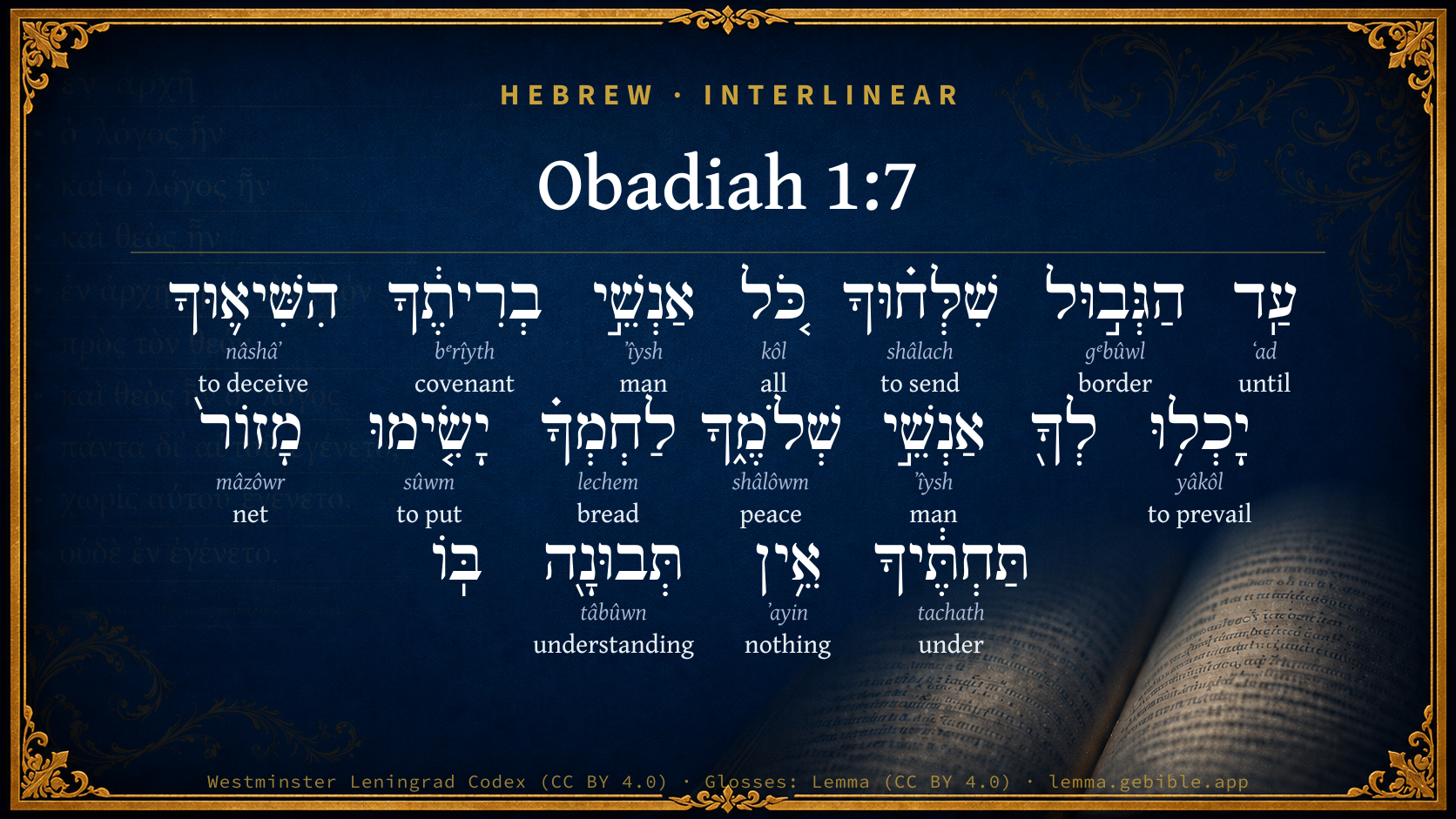
  1. עַֽד ʻad H5704 “until” Preposition
  2. הַגְּב֣וּל gᵉbûwl H1366 “the · border” Particle, Definite Article + Noun, Common, Masculine, Singular, Absolute
  3. שִׁלְּח֗וּךָ shâlach H7971 “to send · you” Verb, Piel, Perfect, 3rd Person, Common, Plural + Suffix, Personal, 2nd Person, Masculine, Singular
  4. כֹּ֚ל kôl H3605 “all of” Noun, Common, Masculine, Singular, Construct
  5. אַנְשֵׁ֣י ʼîysh H376 “men of” Noun, Common, Masculine, Plural, Construct
  6. בְרִיתֶ֔ךָ bᵉrîyth H1285 “covenant · your” Noun, Common, Feminine, Singular, Construct + Suffix, Personal, 2nd Person, Masculine, Singular
  7. הִשִּׁיא֛וּךָ nâshâʼ H5377 “to deceive · you” Verb, Hiphil, Perfect, 3rd Person, Common, Plural + Suffix, Personal, 2nd Person, Masculine, Singular
  8. יָכְל֥וּ yâkôl H3201 “to prevail” Verb, Qal, Perfect, 3rd Person, Common, Plural
  9. אַנְשֵׁ֣י ʼîysh H376 “men of” Noun, Common, Masculine, Plural, Construct
  10. שְׁלֹמֶ֑ךָ shâlôwm H7965 “peace · your” Noun, Common, Masculine, Singular, Construct + Suffix, Personal, 2nd Person, Masculine, Singular
  11. לַחְמְךָ֗ lechem H3899 “bread · your” Noun, Common, Both, Singular, Construct + Suffix, Personal, 2nd Person, Masculine, Singular
  12. יָשִׂ֤ימוּ sûwm H7760 “to put” Verb, Qal, Imperfect, 3rd Person, Masculine, Plural
  13. תַּחְתֶּ֔יךָ tachath H8478 “under · you” Preposition + Suffix, Personal, 2nd Person, Masculine, Singular
  14. אֵ֥ין ʼayin H369 “nothing” Particle, Negative
  15. תְּבוּנָ֖ה tâbûwn H8394 “understanding” Noun, Common, Feminine, Singular, Absolute

About this verse

These counts appear in no published source. They are computed here, from the morphology-tagged text and Lemma’s own curated glosses. What Lemma adds →

18
words
15
distinct lemmas
Prophets
section

Notable vocabulary

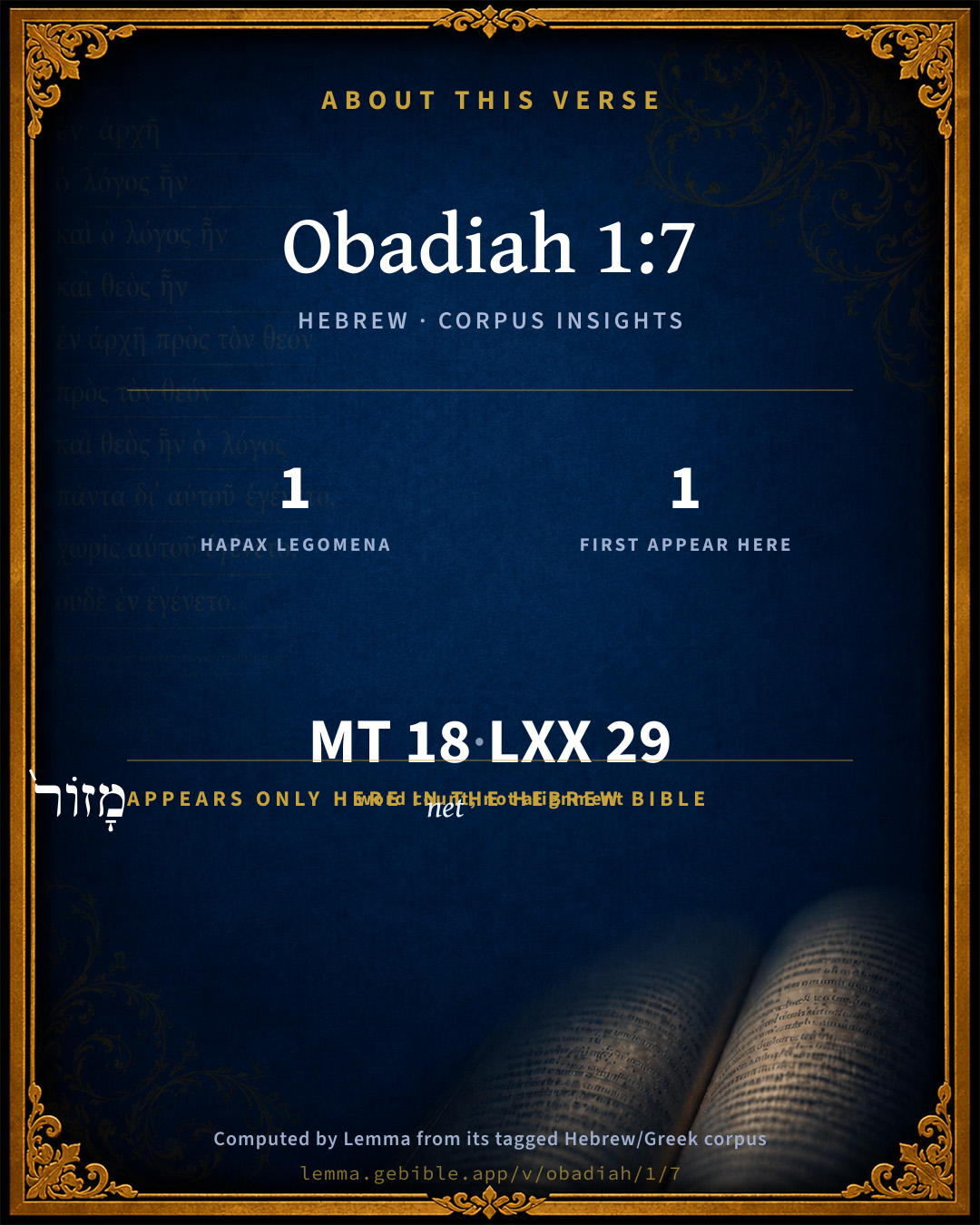
1 hapax legomenon — a word that appears only here in the entire Hebrew Bible:

  • מָזוֹר֙ net H4204

First appearance in Scripture

This word makes its first canonical appearance in the Hebrew Bible here:

  • מָזוֹר֙ net H4204

Shared distinctive vocabulary

הִשִּׁיא֛וּךָ to deceive H5377 occurs in 15 verses of the Hebrew Bible. Also found in:

Grammatical profile

  • 4 verbs
  • 9 nouns
  • 4 prepositions
  • 1 particle

Verb forms

  • שִׁלְּח֗וּךָ Piel · Perfect
  • הִשִּׁיא֛וּךָ Hiphil · Perfect
  • יָכְל֥וּ Qal · Perfect
  • יָשִׂ֤ימוּ Qal · Imperfect

Repetition

A word recurs within this verse — often emphatic in Hebrew:

  • אַנְשֵׁ֣י man H376 ×2

Hebrew & Septuagint length

In English translation the verse runs 47 words from the Hebrew and 31 from the Septuagint (LXX English) — the Septuagint runs noticeably shorter here. See the side-by-side →

A rough comparison of the two English renderings, which tokenize alike — not a word-level alignment.

Word counts can differ between the Hebrew and the Greek without any difference in meaning — e.g. the Hebrew direct-object marker אֵת has no separate Greek word, and Greek often adds the article ὁ.

In the original languages it is 18 Hebrew tokens and 29 Greek tokens — but the two are counted differently (Hebrew bundles its prefixes and suffixes into one token; the Greek is in lemma form), so that isn’t a like-for-like length.

Cross-references

14

Topical passages linked to Obadiah 1:7 in the Treasury of Scripture Knowledge — connected by theme and wording, ordered by reader-vote popularity; previews shown in the World English Bible.

  • Psalms 41:9 Yes, my own familiar friend, in whom I trusted, Who ate bread with me, Has lifted up his heel against me.
  • Jeremiah 30:14 All your lovers have forgotten you; they don't seek you: for I have wounded you with the wound of an enemy, with the chastisement of a cruel one, for the greatness of your iniquity, because your sins were increased.
  • Jeremiah 49:7 Of Edom. Thus says Yahweh of Hosts: Is wisdom no more in Teman? is counsel perished from the prudent? is their wisdom vanished?
  • John 13:18 I don't speak concerning all of you. I know whom I have chosen. But that the Scripture may be fulfilled, 'He who eats bread with me has lifted up his heel against me.'
  • Psalms 55:12–13 For it was not an enemy who insulted me, Then I could have endured it. Neither was it he who hated me who raised himself up against me, Then I would have hid myself from him.
  • Isaiah 19:11–14 The princes of Zoan are utterly foolish; the counsel of the wisest counselors of Pharaoh is become brutish: how do you say to Pharaoh, I am the son of the wise, the son of ancient kings?
  • Isaiah 27:11 When the boughs of it are withered, they shall be broken off; the women shall come, and set them on fire; for it is a people of no understanding: therefore he who made them will not have compassion on them, and he who formed them will show them no favor.
  • Jeremiah 4:30 You, when you are made desolate, what will you do? Though you clothe yourself with scarlet, though you deck you with ornaments of gold, though you enlarge your eyes with paint, in vain do you make yourself beautiful; [your] lovers despise you, they seek your life.
  • Jeremiah 20:10 For I have heard the defaming of many, terror on every side. Denounce, and we will denounce him, [say] all my familiar friends, those who watch for my fall; peradventure he will be persuaded, and we shall prevail against him, and we shall take our revenge on him.
  • Jeremiah 38:22 behold, all the women who are left in the king of Judah's house shall be brought forth to the king of Babylon's princes, and those women shall say, Your familiar friends have set you on, and have prevailed over you: [now that] your feet are sunk in the mire, they are turned away back.
  • Lamentations 1:19 I called for my lovers, [but] they deceived me: My priests and my elders gave up the spirit in the city, While they sought them food to refresh their souls.
  • Ezekiel 23:22–25 Therefore, Oholibah, thus says the Lord Yahweh: Behold, I will raise up your lovers against you, from whom your soul is alienated, and I will bring them against you on every side:
  • Hosea 13:13 The sorrows of a travailing woman will come on him. He is an unwise son; For when it is time, he doesn't come to the opening of the womb.
  • Revelation 17:12–17 The ten horns that you saw are ten kings who have received no kingdom as yet, but they receive authority as kings, with the beast, for one hour.

Cross-references courtesy of OpenBible.info (CC BY 4.0).

Hebrew and Greek witnesses Masoretic Hebrew ↔ Greek Septuagint

The same verse in the two great witnesses to the Old Testament, shown verse-for-verse.

Here the Septuagint runs noticeably shorter than the Hebrew — LXX2012 (modern English Septuagint) 31 words vs World English Bible 47. A rough length comparison of the two English translations, not a word-level alignment — read both below.

These are two independent witnesses, not word-aligned to each other, and the Septuagint is shown in lemma (dictionary) form.

Hebrew Obadiah 1:7 Masoretic · Westminster Leningrad Codex

עַֽד הַגְּב֣וּל שִׁלְּח֗וּךָ כֹּ֚ל אַנְשֵׁ֣י בְרִיתֶ֔ךָ הִשִּׁיא֛וּךָ יָכְל֥וּ לְךָ֖ אַנְשֵׁ֣י שְׁלֹמֶ֑ךָ לַחְמְךָ֗ יָשִׂ֤ימוּ מָזוֹר֙ תַּחְתֶּ֔יךָ אֵ֥ין תְּבוּנָ֖ה בּֽוֹ

All the men of your alliance have brought you on your way, even to the border. The men who were at peace with you have deceived you, and prevailed against you. Friends who eat your bread lay a snare under you. There is no understanding in him.

World English Bible · Public Domain

Greek LXX Obadiah 1:7 Septuagint · lemma form

ἕως ὁ ὅριον σύ ἐκ ἀποστέλλω σύ πᾶς ὁ ἀνήρ ὁ διαθήκη σύ ἀντιἵστημι σύ δύναμαι πρός σύ ἀνήρ εἰρηνικός σύ τίθημι ἔνεδρον ὑποκάτω σύ οὐ εἰμί σύνεσις αὐτός

They sent you to your coasts: all the men of your covenant have withstood you; your allies have prevailed against you, they have set snares under you: they have no understanding.

LXX2012 (modern English Septuagint) · Public Domain

On this verse, Whedon's Commentary on the Bible discusses the Septuagint’s reading. Read the note in Commentary ↓

Hebrew: Westminster Leningrad Codex (CC BY 4.0). Greek: Septuagint (public domain); English from LXX2012 (modern English Septuagint) (Public Domain). How the Septuagint differs from the Hebrew →

Targum (Aramaic paraphrase)

1

The Targum is the ancient Jewish Aramaic paraphrase of the Hebrew Scriptures — an interpretive translation, not the Hebrew text itself. Onkelos (literal) and Pseudo-Jonathan (expansive) render the Torah, and Jonathan the Prophets. Coverage is partial: where no permissively-licensed English translation exists for a verse, only the Aramaic is shown. This is verse-level text, not a word-by-word alignment to the Hebrew.

  1. Targum Jonathan Prophets (Joshua–Malachi)
    מִן תְּחוּמָךְ אַגְלְיוּךְ כֹּל אֱנָשָׁא קְיָמָךְ אַטְעֲיוּךְ יְכִילוּ לָךְ אַנְשֵׁי שְׁלָמָךְ אָכְלֵי פְתוֹרָךְ שַׁוִיאוּ תַקְלָא תְּחוֹתָךְ מִדְלֵית בָּךְ סוּכְלְתָנוּ:

    (no public-domain English translation for this verse)

    Targum Jonathan — Aramaic: “Mikraot Gedolot” (public domain). English: “Sefaria Community Translation” (CC0 1.0 (public-domain dedication)); “London "Chaldee Paraphrase," 1871” (public domain). Text via Sefaria.

Commentary

Notes on Obadiah 1:7 from classic Christian and Jewish commentators (each source and its license shown beneath its notes). The classic Christian expositions comment on the surrounding passage and are grouped to its opening verse, so a note may address several verses; the Jewish commentaries on the Tanakh (Rashi and others) are per-verse, so they appear only where the commentator wrote on this verse.

Lemma curates 59 commentaries, every one of them public domain or Creative Commons licensed, each selected and text-cleaned for this edition rather than reprinted as found. About our sources →

Trapp's Complete Commentary

John Trapp

Oba 1:7 All the men of thy confederacy have brought thee [even] to the border: the men that were at peace with thee have deceived thee, [and] prevailed against thee; [they that eat] thy bread have laid a wound under thee: [there is] none understanding in him.

Ver. 7. All the men of thy confederacy] Which therefore should be true to thee, but prove treacherous; so vain it is to trust to that broken reed of carnal combinations. Many friends are like deep ponds, clear at the top and all muddy at the bottom; the causes they will be, but not the companions of calamity. Like they are, saith one, to crows which flock to a dead carcass, not to defend it, but to devour it; and no sooner have they bared the bones but they are gone. David complaineth of such, Psa 55:13-15, and Jeremiah of his unkind countrymen of Anathoth, Jer 11:23. But for Edom it was no great pity, considering their perfidy both to God (because they had transgressed the laws, moral and municipal, changed the ordinances, that is, the law of nations, and broken the everlasting covenant, that is, the law of nature, which is that light that lighteneth every man that cometh into the world, Joh 1:9), and also to their brethren the Israelites, their extreme inhumanity, as it followeth, Oba 1:10-11. They had therefore but their own measure meted again to them; as they had forgotten the brotherly covenant, Amo 1:9; Amo 1:11, so they met with those that paid them home in their own coin; neither were they any more pitied than Haman, when the king frowned upon him, or Sejanus, when he fell into the displeasure of Tiberius; his friends showing themselves most passionate against him, saying, that if Caesar had clemency he ought to reserve it to men, and not cast it away upon monsters.

All brought thee even to the border] And there left thee at the worst; pretending to help thee, but betraying then indeed to the enemy, and helping to cast thee out of thy country, under a show of courtesy.

The men that were at peace with thee] Heb. the men of thy peace, the Ammonites, Moabites, and other neighbouring nations from whom thou fearedst no hurt; these to ingratiate with the king of the Chaldeans.

Have deceived thee] Tuta frequensque via est per amici fallere nomen (Ovid.). This made a certain heathen cry out, Friends, there is no friend to be found, φιλοι, ουδεις φιλος (Socr.); and another to pray God to deliver him from his friends; for, as for his enemies, he could better beware of them.

They that eat thy bread] Heb. thy bread men, thy fellow commoners, convictores et consalanei, others’ amici, they are seldom either satisfied or sure.

Have laid a wound under thee] The Hebrew word signifieth both a wound and a plaster; they would secretly wound them, lay a wound under them, and yet seem willing to bind up their wounds, and heal them by applying a plaster: such daubing there is in the world, Fide, diffide. Cavebis autem si pavebis.

There is none understanding in him] That is, in Edom, and this seemeth spoken by way of apostrophe to the Israelites, whose comfort is intended in this whole prophecy. It is as if it had been said, Edom holds himself wise, but will show himself a very sot, destitute of common sense; such as taketh not notice that these are the wounds with which he was wounded in the house of his friends: the wittol is either insensible of it or else well content with it, till he hath bought his wit, and begins to open his eyes but not till the pains of death are upon him, as it is said of the mole.

John Trapp, A Commentary or Exposition upon All the Books of the Old and New Testament (1647–1656) — public domain. Text from a community e-Sword module.

Whedon's Commentary on the Bible

Daniel D. Whedon

Oba_1:7 takes us back to Oba_1:1. There we are told that Edom attempted to instigate a conspiracy against Judah; Oba_1:7 states that her attempts will be futile; the allies in which she puts her trust will prove her ruin. The erroneous interpretation of Oba_1:1 (see above) is responsible for many wild statements concerning the meaning of Oba_1:7; if the interpretation suggested above is accepted the difficulties vanish. There certainly is no reason for separating Oba_1:7 from the preceding verses; Oba_1:1-9 form one continuous oracle.

All the men of thy confederacy — Those who joined or were expected to join the confederacy planned by Edom (Oba_1:1); hence identical with “the nations” (Oba_1:1).

Have brought thee even to the border — R.V., “on thy way, even to the border”; margin, “have driven thee out.” This marginal reading is accepted by several recent writers, and the driving out of the Edomites is interpreted of their expulsion from their borders by Arab tribes during the sixth or fifth century B.C. Others understand the words as signifying that the allies sent “their troops with them as far as the frontier and then ordered them to turn back.” Neither view is correct. The meaning is rather that the ambassadors whom Edom had sent to negotiate the alliance, and who thus represented the nation, were sent back to the frontier with due respect and ceremonies, with fair speeches and pleasing promises. In reality not one of the nations cared to entangle herself in such an alliance.

The men that were at peace with thee — The surrounding nations; identical with “men of thy confederacy” and “the nations” (Oba_1:1). The Edomites expected to experience no difficulty in persuading their friendly neighbors to join the conspiracy.

Have deceived thee — By making fair promises when they had no intention of keeping them.

Prevailed against thee — Standing by itself this expression might mean that “these very nations with whom they have hitherto been on terms of amity and peace shall turn their forces against them and prevail.” But this is not the meaning in this passage.

Jer_38:22, offers a good parallel. There R.V. margin reads, “The men of thy peace (the identical expression) have deceived thee, and have prevailed over thee: now that thy feet are sunk in the mire, they are turned away back.” The meaning of this passage is that the false advisers got the king into trouble and then left him to his fate. This is the thought of Obadiah. The nations made fair promises and thus encouraged the scheme of Edom; they overcame any scruples or hesitancy on the part of the latter; but when the real crisis arrives Edom will have to fight her battles alone.

They that eat thy bread have laid a wound under thee — R.V., “lay a snare under thee”; literally, thy bread they lay a snare under thee. A very difficult and much-discussed expression. Following the rather free renderings of A.V. and R.V., it is commonly interpreted in the sense that those who are bound to the Edomites by sacred ties of hospitality will make a treacherous assault upon them. Keil translates, “They make thy bread a wound under thee,” but his interpretation closely resembles the one just given (see below). Nowack considers the case hopeless, while other recent writers have suggested more or less radical emendations. Thus Marti reads, “they will settle in thy place”; Winckler, “thy flesh they will devour, thy sustenance they will take away.” Cheyne substitutes proper names in accord with his peculiar Yerachmeelite theory. The difference of opinion among scholars is due to uncertainty with regard to two points. In the first place, it is not certain what part of the sentence is “thy bread”; in the next, the meaning of masor cannot be fully determined. Does it mean snare or wound? Evidently “thy bread” is not the subject of the verb, for the former is in the singular while the latter is in the plural. Hence Keil takes it to be the first object of the verb. Then he continues: “And consequently the subject of the previous clause still continues in force: they who befriended thee make thy bread, that is, the bread which they ate from thee or with thee, into a wound under thee, that is, an occasion for destroying thee.” Recognizing the need of a more lucid interpretation, he adds: “We have not to think of common meals of hospitality here,… but the words are to be taken figuratively, after the analogy of Psa_41:10, which floated before the prophet’s mind,… as denoting conspiracies on the part of those who were allied to Edom, and drew their own sustenance from it, the rich trading nation, to destroy that very nation.” Keil thus understands masor to mean “wound,” and for this he finds support in such passages as Hos_5:13; Jer_30:13; compare Isa_1:6. Others supply from the preceding clause only “men,” and combining this with “thy bread” read. “men of thy bread” — that is, men who have eaten bread with thee and thus are bound to thee by the sacred ties of hospitality; or, men who draw their sustenance from thee (so A.V. and R.V.). Hitzig reaches the same result by supplying a participial form, “they that eat thy bread.” Whatever rendering we may give to the Hebrew, the expression remains peculiar. A smoother reading is offered by LXX., which omits the first troublesome word entirely, carries the subject over from the preceding clause, and translates masor “snare,” giving to it a meaning not found elsewhere in the Old Testament. Following the LXX. we may read, “The men that were at peace with thee have deceived thee, and have prevailed against thee; they have placed a snare under thee.”

Ordinary intelligence should have recognized the deception, but Edom was blind; hence the exclamation,

There is none understanding in him — That is, in Edom (masculine throughout, see on Oba_1:1). This does not mean, “in consequence of the calamity which thus bursts upon the Edomites they lose their wonted discernment, and know neither what to do nor how to help themselves”; nor is it equivalent to “all this is caused by thy want of understanding”; it is simply an exclamation of amazement that the Edomites should fail to see the evident deception. The change in the same address from the second person to the third is not uncommon in Hebrew prophecy, and in the present case it is quite natural, since the exclamation is not addressed directly to Edom, nor to anyone else in particular.

Daniel D. Whedon (gen. ed.), Commentary on the Old and New Testaments (1874–1909) — public domain. Text from a community e-Sword module.

The Preacher's Complete Homiletical Commentary

Joseph S. Exell (gen. ed.)

CRITICAL NOTES.]

Oba_1:7.] Edom would be forsaken by those in whom they put confidence. Confederates] Allies would drive back (brought) fugitives to the frontier. Men at peace with them, neighbouring states, would deceive them (Psa_41:9). They that eat bread, lit. men of bread, their dependents, lay snares to wound. Treachery everywhere. None] of the wisdom and tact for which Edom was famous is left to extricate himself.

Oba_1:8. Wise men] shall be bereft of discernment.

Oba_1:9. Thy mighty] heroes are dismayed, or fall into despair.

RELIANCE ON BROKEN REEDS.—Oba_1:7-9

The destruction threatened could not be warded off by dependence upon allied armies, renowned wisdom, and heroic valour. Every object of confidence is destroyed. Those very projects by which they seek to protect themselves and secure their treasures become the ruin of both.

I. Human alliances disappoint. Those who forsake God often flee in vain confidence to man. But as Edom had deceived and persecuted his brother Jacob, so in turn he is deceived and punished by his friends.

1. Confederates are worthless. When Edom seeks for help and support from them, ambassadors and fugitives are sent back to the frontier or delivered into the hands of the enemy. Allies will not entangle themselves in the fate of Edom.

2. Neighbours are treacherous. They deceive or overpower them. Men hide their malice under a pretence of peace. Their friendship is deceitful as a brook in summer, false and perfidious. Hence cried the heathen, “Friends! there is no friend to be found.” The man of my peace, with whom I had no difference, in whom I trusted, proved treacherous. “For it was not an enemy that reproached me; then I could have borne it” (Psa_55:12-13).

3. Dependents forsake them. Those who had bread with them; those entertained by them and who lived by them, laid plots for their overthrow. While they professed to aid they secretly desired to wound them. Unkind acts from those in whom we put confidence are most severe. To spurn those from whom we derive our bread and being is the height of ingratitude and malice. “All my friends have forsaken me,” cried a Prime Minister of England. “And thou, O Brutus!” said the dying Cæsar, “yea, mine own familiar friend, in whom I trusted, which did eat of my bread, hath lifted up his heel against me.” Thus the help of man proves to be vain. When nations are united in fear, they may be severed and turned against one another. “Every experiment by multitudes or by individuals that has a sensual and selfish aim will fail,” says Emerson. The giants in old time succeeded not in confederacy against the gods. The firmest friendship, the strongest armies, are broken reeds. “Cursed be the man that trusteth in man and maketh flesh his arm, and whose heart departeth from the Lord.”

II. Worldly wisdom failed. The prophet makes an appeal to Edom, “Shall I not?” God will turn their knowledge into ignorance, and their wisdom into folly.

1. Wise men will be destroyed. They will not have wit or wisdom enough to preserve themselves. A wise man, though poor, may defend a city (Pro_9:14-15). A woman’s wisdom defeated the purpose of Joab (2Sa_20:14-22). Archimedes saved Syracuse from Roman plunder. Wisdom is better than strength, and its merits often more brilliant. Sad therefore is the loss of wise men.

2. Wisdom itself shall perish. “And understanding out of the mount of Esau.” “Knowledge is power,” and in “the multitude of counsellors there is safety.” But “there is no wisdom, nor understanding, nor counsel against the Lord.” Pharaoh’s device, was frustrated. Ahithophel’s counsel was befooled when it was thought to be like “the oracle of God.” Worldly policy is weak, begets suspicion and leads to ruin. “The best-laid schemes” are often overturned by accident, and the wisdom of legislators “made foolish” by the providence of God. Trust not to human wisdom. It can neither prevent the treachery of men, nor ward off the judgment of God. When we seek protection in “the wisdom of men,” from national distress and personal evil, we shall be disappointed. “There is no understanding in them;” they are bereft of all prudence and help. “The wisdom of their wise men shall perish, and the understanding of their prudent men shall be hid.”

III. Martial valour availed not. “Thy mighty men, O Teman! shall be dismayed.” Their courage turned pale. Heroes and valiant men were cowards. Their last hope was cut off, brave warriors were dismayed and trembled in despair. If the mighty fall, what becomes of the weak? “Howl, fir-trees, if the cedars be shaken.” When armies and fleets fail, the people are defenceless, and “every one of the mount of Esau may be cut off by slaughter.” The nation is panic-stricken, and the rigour of death strikes them helpless (Psa_76:5). How terrible was the overthrow of Edom! Its wealth and confederacies, its renown and its valour, availed not in the day of calamity. “Cease ye from man, whose breath is in his nostrils: for wherein is he to be accounted of?”

HOMILETIC HINTS AND OUTLINES

Oba_1:7. Edom is a type of worldly wisdom and secular policy, as well as of unbrotherly enmity to God’s people. In both respects the punishment of Edom is a warning to all Machiavellian politicians in these latter days [Wordsworth].

Oba_1:8.

1. The judgment. I will “destroy the wise men.”

2. The time. “In that day.”

3. The certainty of it. “Saith the Lord.”

Edom’s destruction.

1. Its outward cause.

2. Its moral necessity in God’s purpose. “The prophet sums up briefly God’s end in all this. The immediate means were man’s treachery, man’s violence, the failure of wisdom in the wise, and of courage in the brave. The end of all in God’s will, was their destruction. All things work together to good to those who love God, and to evil to those who hate him” [Pusey].

Understanding out of Mount of Esau. God will justly deny those understanding to keep out of the way of danger, that will not use their understanding to keep out of the way of sin. He that will be foolish, let him be foolish still [Lange].

1. Carnal confidences of men. Good situations, abundant treasures, powerful allies, prudence, and mighty men to deliver in extremity.

2. The destruction of these confidences. Every one is threatened, and the terror is only the forerunner of the judgment of God. “The death or disunity of the mighty often proves the death and destruction of the many; and it is in vain to depend upon mighty men for our protection, if we have not an Almighty God for us, much less if we have an Almighty God against us” [Lange].

ILLUSTRATIONS TO THE CHAPTER

Oba_1:7. Fickleness. Clocks will go as they are set; but man, irregular man, is never certain [Massinger].

Oba_1:8. Many had proved themselves wise if they had not thought themselves so [Bp Hall]. He that is not wise will not be taught; but there is a wisdom which multiplieth bitterness (Sir_21:12).

“Heaven is for thee too high; be lowly wise.” [Milton.]

Oba_1:9.

“Wherefore should not strength and might

There fail where virtue fails?” [Milton.]

The Preacher's Complete Homiletical Commentary (gen. ed. Joseph S. Exell; Funk & Wagnalls, c. 1892) — public domain (pre-1929). A full-Bible homiletical/sermon-outline anthology covering 65 of 66 books (2 John is absent from the source module). Text from a community e-Sword module.

Tyndale Open Study Notes

Tyndale Open Resources

1:7 allies (literally men of the covenant): Edom should have been the ally of its brother Israel, but instead, Edom had made a covenant with Babylon. • promise you peace (literally men of peace, paralleling men of the covenant): It was poetic justice that Edom’s treachery with Israel was rewarded by Babylon’s treachery against Edom.

Tyndale Open Study Notes — © Tyndale Open Resources, licensed CC BY-SA 4.0. Text via the HelloAO Bible API.

Geneva Bible (1599)

Geneva Bible translators

They in whom thou didst trust for to have help and friendship of them, shall be thine enemies and destroy thee.

That is, thy familiar friends and guests have by secret practices destroyed thee.

Geneva Bible (1599) marginal notes — public domain. Text via Bolls.life.

Jamieson, Fausset & Brown

Robert Jamieson, A. R. Fausset & David Brown

Men of thy confederacy--that is, thy confederates.

brought thee . . . to the border--that is, when Idumean ambassadors shall go to confederate states seeking aid, these latter shall conduct them with due ceremony to their border, giving them empty compliments, but not the aid required [DRUSIUS]. This view agrees with the context, which speaks of false friends deceiving Edom: that is, failing to give help in need (compare ). CALVIN translates, "have driven," that is, shall drive thee; shall help to drive thee to thy border on thy way into captivity in foreign lands.

the men that were at peace with thee--literally, "the men of thy peace." Compare ; , Margin, where also the same formula occurs, "prevailed against thee."

they that eat thy bread--the poorer tribes of the desert who subsisted on the bounty of Edom. Compare again , which seems to have been before Obadiah's mind, as his words were before Jeremiah's.

have laid a wound under thee--"laid" implies that their intimacy was used as a SNARE laid with a view to wound; also, these guest friends of Edom, instead of the cushions ordinarily laid under guests at table, laid snares to wound, that is, had a secret understanding with Edom's foe for that purpose. MAURER translates, "a snare." But English Version agrees with the Hebrew, which means, literally, "a bandage for a wound."

none understanding--none of the wisdom for which Edom was famed (see ) to extricate him from his perilous position.

in him--instead of "in thee." The change implies the alienation of God from Edom: Edom has so estranged himself from God, that He speaks now of him, not to him.

Jamieson, Fausset & Brown — Commentary Critical and Explanatory on the Whole Bible (1871) — public domain (CC PDM 1.0). Text via the HelloAO Bible API.

Adam Clarke's Commentary

Verse 7. All the men of thy confederacy] The Chaldeans are here intended, to whom the Idumeans were attached, and whose agents they became in exercising cruelties upon the Jews.

Have brought thee even to the border] Have hemmed thee in on every side, and reduced thee to distress. Or, they have driven thee to thy border; cast thee out of thy own land into the hands of thine enemies.

The men that were at peace with thee] The men of thy covenant, with whom thou hadst made a league.

That eat thy bread] That professed to be thy firmest friends, have all joined together to destroy thee.

Have laid a wound] Placed a snare or trap under thee. See Newcome.

There is none understanding in him.] Private counsels and public plans are all in operation against thee; and yet thou art so foolish and infatuated as not to discern thy own danger.

Adam Clarke's Commentary on the Bible (1810–1826) — public domain. Text from a community e-Sword/MySword module.

John Calvin's Commentaries

Here the Prophet expresses the manner in which God would punish the Idumeans: trusting in their confederacies, they despised God, as we have already had to observe. The Prophet now shows that it is in the power of God to change the minds of men, so that they who were their friends being suddenly inflamed with rage, would go forth to destroy the Idumeans. Seeing then that they regarded the Assyrians not only as a shield to them, but also as a defense against God himself, the Prophet here declares that when it would be God’s purpose to punish them, there would be no need to send to a distance for agents or instruments to execute his vengeance; for he would arm the Assyrians themselves and the Chaldeans, inasmuch as he could turn the hearts of men as he pleased. We now see the Prophet’s meaning; for he here takes away and shakes off the vain confidence of the Idumeans, that they might not harden themselves for being fortified by confederacies and for having powerful friends, for the Lord would turn friends into enemies. To thy border, he says, have they driven thee שלח shilach is properly to send forth or to throw away; some render it, they have followed; as though the Prophet here spoke of the neighboring nations, and according to their view the meaning is, “However much thy neighbors may love thee, yet nothing will they show of this love, except that they will follow thee with feigned tears, when thine enemies shall lead thee away captive.” But this is a strained exposition, and corresponds not with the context. The Prophet then describes here, I doubt not, the change, such as would take place, that the Idumeans might know, that they trusted in vain in their power and defenses. The men of thy covenant, he says, have driven thee away; as though he said, “See what thou gainest in anxiously seeking the friendship of those who will yet be thy enemies; hadst thou remained quiet in thy clefts, it would have been much better for thee: but now thou runnest to Assyria and Chaldea, and this will be the cause of thy ruin. Hence the men of thy covenant shall banish thee to the border: but if thou hadst had no friendship nor commerce with them, thou mightest have lived safely in thy recesses, no one would have driven thee out: just, then, has been the reward of thy ambition, for having thus resorted to the Assyrians and Chaldeans.”

Continuing the same subject, the Prophet says, Deceived thee have the men of thy peace — friends and confederates; for the Hebrews call those men of peace, who are connected together by any kind of alliance. The men then of thy peace, that is those whom thou thoughtest thou mightest trust, and on whom thou midst rely; — these have deceived thee, even these have prevailed against thee, and oppressed thee through craft and treachery. The men of thy bread have placed under thee a wound: the men of bread were those who were guests or friends. Some give this rendering, “Who eat thy bread;” and it is an admissible interpretation, for the Assyrians and Chaldeans, as they were insatiable, had taken booty from the Idumeans; for whosoever then hunted for their friendship, must have brought them some gifts. Since then they thus sold their friendship, the Prophet rightly calls them the men of bread with regard to those whose substance and wealth they devoured. If then we take the men of bread in this sense, there is a probability in the meaning. But we may give another interpretation, as though he had said that they were guests and friends: these then have fixed under thee a wound, that is, they have been thy destruction, and that through guile and hidden artifices. When one attacks another openly, he who is attacked can avoid the stroke; but the Prophet says, that the Assyrians and Chaldeans would be perfidious to the Idumeans, so as to conquer them through treachery. Fix then shall they a wound under thee, as when one hides a dagger between the bed and the sheet, when a person intends to go to sleep. So also he says that a wound is placed underneath, when a feigned friend hides himself, that he may more easily hurt him whom he assails deceitfully and craftily.

He at length thus concludes, There is no intelligence in him. Here the Prophet no doubt derides in an indirect way the foolish confidence with which the Idumeans were blinded; for they thought themselves to be in a superlative degree wary, so that they had no reason to fear, as they could see afar off, and arrange their concerns with the utmost prudence. Since then they thought that they excelled in wisdom, and could not be surprised by any craft, the Prophet says here, that there would be in them no understanding.

But he immediately subjoins the reason, “Shall I not in that day, saith Jehovah, destroy, or extinguish, the wise from Edom?” While the Idumeans were prosperous, because they acted wisely, it was incredible that they could thus in a moment be overthrown: but the Prophet says, that even this was in the hand and power of God; “Can I not,” he says, “put an end to whatever there is of wisdom in the Idumeans? Cannot I destroy all their prudent men? This will I do.” We now then perceive the import of the words.

But this place deserves notice: the Prophet upbraids the Idumeans, and says, that their confederates and friends would prove their ruin, because they had conspired among themselves beyond what was just and right. When men thus mutually join together, there are none of them who do not greedily seek their own advantage; in the meantime, both sides are deceived; for God disconcerts their counsels, and blasts the issue, because they regard not the right end. And when the wicked seek friendships, they ever blend something that is wrong; they either try to injure the innocent, or they seek some advantage. All the compacts then which the ungodly and the despisers of God make with one another, have always something vicious intermixed; it is therefore no wonder that the Lord disappoints them of their hope, and curses their counsels. This is then the reason why the Prophet declares to the Idumeans, that those, whom they thought to be their best and most faithful friends, would be their ruin.

But here it may be objected and said, that the same thing happens to the children of God. For David, though he acted towards all with the utmost faithfulness and the greatest sincerity, yet complains, that the man of his peace and a friend had contrived against him many frauds,

‘Raised up his heel against me,’ he says, ‘has the man of my peace; eat bread together did I with him, and he with me,’ (Psalm 41:9)

It was necessary also that this should have been the case with Christ himself. Now, if the children of God must be conformed to the image of Christ, what the Prophet says is no more than what applies to the whole Church, and to every member of it. This may appear strange at the first view; but a solution may be easily given: for while we strive to maintain peace with all men, though they may perfidiously, through treachery, oppress us, yet the Lord himself will succor us; and in the meantime, however hard may this trial be, we yet know that our patience is tried by God, that he may at last deliver us, so that we may confidently flee to him and testify our sincerity. But while the ungodly mutually cheat one another, while with wicked and sideway artifices they oppress and circumvent each other, while they cast forth their hidden virulence, while they turn peace into war, they know that their recompense is just and merited: they cannot flee to God, for their conscience restrains them. They indeed understand that they have deserved what the Lord has justly repaid them. It is then no wonder that the conspiracy in which the Idumeans trusted, when they made the Chaldeans their friends, should have been accursed; for the Lord turned to their ruin whatever they thought useful to themselves.

This then is the import of the whole, — that if we wish not to be deceived, we must not attempt anything without an upright heart. Provided then we exceed not the limits of our calling, let us cultivate peace with all men, let us endeavor to do good to all men, that the Lord may bless us; but if it be his purpose to try our patience, he will be still present with us, though false friends try us by their treacheries, though we be led into danger by their malice, and be for a time trodden under their feet; if, on the contrary, we act with bad faith, and think that we have fortunate alliances, which have been obtained by wicked and nefarious artifices, the Lord will turn for our destruction whatever we think to be for our safety.

John Calvin's Commentaries (1540-1563) — public domain. Text from the Calvin Translation Society English edition (1840s-50s) via the Christian Classics Ethereal Library (ccel.org). Calvin's coverage is partial (roughly two-thirds of the Bible); uncommented books and verses are honest gaps, never fabricated. The 19th-century editor's footnotes and remarks are omitted so the notes are faithfully Calvin's own voice.

The Cambridge Bible for Schools and Colleges

gen. ed. J. J. S. Perowne

7. The general drift of this verse is plain. It introduces another particular in which the pride of Edom had deceived her. Her trust in the wisdom of her policy, in the sagacious alliances which she had formed, should fail her no less signally than her confidence in the natural security of her position. But the details of the verse, as regards both the alliances referred to and the meaning of some of the expressions used, are not without difficulty.

the men of thy confederacy] As regards the first of these points, the majority of commentators understand by “the men of thy confederacy,” “the men that were at peace with thee,” neighbouring nations, “probably Moab and Ammon, Tyre and Zidon” (Pusey); or, “Arabian tribes” (Speaker’s Comm.). But there is reason to believe that the Edomites shared a common fate with the Moabites and Ammonites at the hands of the Chaldean invader, when after the destruction of Jerusalem he was pushing his way towards Egypt. (See Introd. § 3, comp. Ezekiel 25.) It is of course possible that the Edomites were the first to suffer, and that when Nebuchadnezzar came upon them they were deserted and betrayed by their neighbours and allies in the manner described in this verse. But it is at least worthy of consideration (it is a view which Calvin appears to assume as a matter of course) whether the Chaldeans themselves are not intended by “the men of thy confederacy,” “the men that were at peace with thee,” of whom the prophet speaks. Well might Edom plume himself upon the “understanding” which led him, on the approach of Nebuchadnezzar towards Judea, to make alliance with him, and thus to seize an opportunity of at once venting his ancient spite upon Israel, and securing himself against the attack of the invader. But the wisdom of this astute policy should prove in the issue to be foolishness. It should justify and call forth on the part of the beholder the exclamation, “There is no understanding in him!” The Chaldean should use Edom for his purpose, and then take and destroy him in his own craftiness.

have brought thee even to the border] This has been taken to mean that the neighbouring nations, thy allies, to whom thou sentest for help in thy time of need, have conducted back to the border or frontier thy ambassadors with all the usual marks of respect, but have courteously declined to render thee assistance. The words, however, may mean, have “driven thee out,” R.V. margin (as in Gen_3:23, 1Ki_9:7, Isa_50:1, where the same verb is used), and may refer to the Chaldeans. This meaning is given to them by some commentators who understand the reference to be to neighbouring tribes, who are thus described, they think, as not merely refusing aid to Edom, but taking active part with the Chaldeans against him.

prevailed against thee] This may mean prevailed against thee in counsel, outwitted thee, but it is simpler to take it of actual violence and physical compulsion.

they that eat thy bread have laid a wound under thee] The words, “they that eat” are not in the Hebrew. Many commentators connect them with the preceding clause, an arrangement which the order of the words in the original facilitates: they have prevailed against thee, the men of thy peace, of thy bread, i.e. the men who were, at peace with thee and who ate thy bread. But it is better to take the clause, “thy bread they make a wound (or a net) under thee,” separately, and to understand it to mean that thy allies and confederates make thy bread which they eat (and the sacred obligation according to Eastern ideas of eating bread together must not here be lost sight of), or thy table at which they sit, an occasion to deal thee a secret and deadly wound, or to catch thee as it were in the snare of their insidious plots against thee. If the rendering “snare” be adopted, and it seems on the whole preferable, the passage receives elucidation from the words of the Psalmist (Psa_69:22):

“Let their table before them become a snare,

And when they are in peace (let it be) a trap;”

of which “perhaps the meaning may be: let them be like persons who while sitting at their meals ‘in peace,’ in security, unarmed, and unsuspecting, are suddenly surprised by their enemies. Their ‘table becomes a snare,’ as exposing them to certain destruction.” Dean Perowne, on the Psalms. The whole verse may then be paraphrased: “Thy confederates, the Chaldeans with whom thou didst enter into treaty, have driven thee to the border of thy country on every side, and expelled thee totally from it. Those that were at peace with thee have treated thee with mingled treachery and violence. The Chaldeans whom thou regardedst as friends have deceived thee, and prevailed against thee. Thy bread which they ate, they have used as a snare to entrap thee, taking advantage of the friendly relations which existed to work thy unlooked-for ruin. There is no understanding in him! To think that the vaunted penetration of Edom should have betrayed him into so humiliating and complete an overthrow!”

The Cambridge Bible for Schools and Colleges (gen. ed. J. J. S. Perowne; Cambridge University Press, 1878–1918) — public domain. Text from a community e-Sword module.

John Gill's Exposition

All the men of thy confederacy have brought thee even to the border,.... Or of "thy covenant" (r); that are in league with thee; thine allies, even all of them, prove treacherous to thee, in whom thou trustedst; when they sent their ambassadors to them, they received them kindly, promised great things to them, dismissed them honourably, accompanied them to the borders of their country, but never stood to their engagements: or those allies came and joined their forces with the Edomites, and went out with them to meet the enemy, as if they would fight with them, and them; but when they came to the border of the land they left them, and departed into their own country; or went over to the enemy; or these confederates were the instruments of expelling them out of their own land, and sending them to the border of it, and carrying them captive; or they followed them to the border of the land, when they were carried captive, as if they lamented their case, when they were assisting to the enemy, as Kimchi; so deceitful were they. The Targum is to the same purpose,

"from the border all thy confederates carried thee captive (s):''

the men that were at peace with thee have deceived thee, and prevailed against thee; outwitted them in their treaties of peace, and got the advantage of them; or they proved treacherous to them, and joined the enemy against them; or they persuaded them to declare themselves enemies to the Chaldeans, which proved their ruin; and so they prevailed against them:

they that eat thy bread: so the Targum and Kimchi supply it; or it may be supplied from the preceding clause, "the men of thy bread"; who received subsidies from them, were maintained by them, and quartered among them:

have laid a wound under thee; instead of supporting them, secretly did that which was wounding to them. The word signifies both a wound and a plaster; they pretended to lay a plaster to heal, but made a wound; or made the wound worse. The Targum is,

"they laid a stumbling block under thee;''

at which they stumbled and fell: or snares, as the Vulgate Latin version, whereby they brought them to ruin:

there is none understanding in him; in Esau, or the Edomites; they were so stupid, that they could not see into the designs of their pretended friends, and prevent the execution of them, and their ill effects.

(r) "viri foederis tui", V. L. Montanus, Vatablus, Burkius. (s) So R. Sol. Urbin. Ohel Moed, fol. 51. 2. and 52. 1.

John Gill's Exposition of the Whole Bible (1746–1763) — public domain (CC PDM 1.0). Text via the HelloAO Bible API.

Albert Barnes' Notes on the Bible

All the men of thy confederacy have brought thee even to the border - Destruction is more bitter, when friends aid in it. Edom had all along with unnatural hatred persecuted his brother, Jacob. So, in God’s just judgment, its friends should be among its destroyers. Those confederates were probably Moab and Ammon, Tyre and Zidon, with whom they united to resist Nebuchadnezzar Jer 27:3, and seduced Zedekiah to rebel, although Moab, Ammon, and Edom turned against him Zep 2:8; Ezek. 25. These then, he says, sent them “to the border.” “So will they take the adversary’s part, that, with him, they will drive thee forth from the borders, thrusting thee into captivity, to gain favor with the enemy.” This they would do, he adds, through mingled treachery and violence. “The men of thy peace have deceived, have prevailed against thee.” As Edom turned peace with Judah into war, so those at peace with Edom should use deceit and violence against them, being admitted, perhaps, as allies within their borders, and then betraying the secret of their fastnesses to the enemy, as the Thessalians dealt toward the Greeks at Thermopylae. It was to be no common deceit, no mere failure to help them.

The men of “thy bread have laid a wound” (better, a snare) “under thee.” Perhaps Obadiah thought of David’s words Psa 41:9, “mine own familiar friend, in whom I trusted, who did eat of my bread, hath lifted up his heel against me.” As they had done, so should it be done to them. “They that take the sword,” our Lord says Mat 26:52, “shall perish by the sword;” so they who show bad faith, are the objects of bad faith, as Isaiah says . The proverb which says, “there is honor among thieves,” attests how limited such mutual faith is. It lasts, while it seems useful. Obadiah’s description relates to one and the same class, the allies of Edom; but it heightens as it goes on; not confederates only, but those confederates, friends; not friends only, but friends indebted to them, familiar friends; those joined to them through that tie, so respected in the East, in that they had eaten of their bread. Those banded with them should, with signs of friendship, conduct them to their border, in order to expel them; those at peace should prevail against them in war; those who ate their bread should requite them with a snare.

There is none understanding in him - The brief words comprise both cause and effect. Had Edom not been without understanding, he had not been thus betrayed; and when betrayed in his security, be was as one stupefied. Pride and self-confidence betray man to his fall; when he is fallen, self-confidence betrayed passes readily into despair. In the sudden shock, the mind collapses. People do not use the resources which they yet have, because what they had overvalued, fails them. Undue confidence is the parent of undue fear. The Jewish historian relates, how, in the last dreadful siege, when the outer wall began to give way , “fear fell on the tyrants, more vehement than the occasion called for. For, before the enemy had mounted, they were paralyzed, and ready to flee. You might see men, aforetime stouthearted and insolent in their impiety, crouching and trembling, so that, wicked as they were, the change was pitiable in the extreme. Here, especially, one might learn the power of God upon the ungodly. For the tyrants bared themselves of all security, and, of their own accord, came down from the towers, where no force, but famine alone, could have taken them: For those three towers were stronger than any engines.”

Albert Barnes' Notes on the Bible (1834–1885) — public domain. Text from a community e-Sword/MySword module.

Haydock's Catholic Bible Commentary

Peace. The enemy had used their services against the Jews; but now they invade their confederates. (Calmet) --- Of this the Idumeans were not aware. (Haydock)

George Leo Haydock (1774–1849), Haydock's Catholic Family Bible and Commentary, 1859 edition — public domain. Excludes Psalms (Douay-Rheims chapter numbering differs from Protestant) and Deuterocanonical books (Catholic canon only).

Matthew Poole's English Annotations

All the men of thy confederacy; they who by league had bound themselves to assist with men and arms, who had made an offensive and defensive league.

Have brought thee even to the border; either have conducted in honourable manner through their country the ambassadors thou didst send, concluded first a confederacy, and next conveyed home the ambassadors who made it; or else have counselled thee to meet the war before it entereth thy country, and have marched as confederates with thee until thou weft come to the borders of thy country, as if they would there tight for thee against the enemy.

The men that were at peace with thee: this is ingemination, or repeating of the same thing before mentioned, unless men of thy peace be men that did make peace, and accept the terms thou didst propose for thy advantage.

Have deceived thee; proved treacherous, nay, designed to betray thee.

Prevailed against thee; either thus their plot took, or else they turned to the enemy, and under his colours destroyed thee.

They that eat thy bread; thy friends, those thou hast maintained, the soldiers thou keptest in pay.

Have laid a wound under thee; have laid a snare, armed with some sharp and piercing instrument, that wounds as soon as thou fallest on the snare.

There is none understanding in him; either no prudence to foresee and prevent this, or to manage and lessen it.

Matthew Poole's English Annotations on the Holy Bible (1683–1685) — public domain. Text from a community e-Sword/MySword module.

The Pulpit Commentary

In this dire calamity Eden shall be deserted by her friends and allies a punishment for her behaviour to her sister Judah. The men of thy confederacy. The LXX and the Vulgate annex these words to the following clause. The allies intended may be Moab, Ammon, Tyre, and Zidon, who joined together to resist Nebuchadnezzar, and were smitten by; (Jer_27:3) or, as Perowne thinks, the Chaldeans themselves, who, though the Edomites had aided in the attack on Jerusalem, afterwards turned against them. Have brought thee even to the border; Septuagint, Ewv twn oriwn exapesteilan se , "They sent thee forth unto thy borders;" Vulgate, Usque ad terminum emiserunt ii. Keil and others explain this to mean that the Edomites send ambassadors to their allies, asking help, but these messengers are conducted back to the frontier with their request not granted, because the allies are unwilling to entangle themselves in the fate of Eden. It is easier to understand the passage in this way Thy very allies have assisted the enemy in ex-polling thee from thy borders, and refusing to receive fugitives who came to them. The men that were at peace with thee. Either the same as "the men of thy confederacy," or the neighbouring Arabian tribes who resorted to Petra for commercial reasons. (comp. Jud_1:4:17) The phrase here, literally, the men of thy peace, is found in Psa_41:9 and Job_38:22. Have deceived thee, by not bringing the expected help; and have prevailed against thee, by actual violence. They that eat thy bread. The Hebrew is simply, "thy bread," i.e. the men of thy bread. Vulgate, qui comedunt tecum; the LXX omits the words. The expression (comp. Psa_41:9) implies the closest friendship, especially in Eastern lands, where such a tie is of general obligation. Have laid a wound under thee; rather, lay a snare under thee; Septuagint, eyhkan enera upokatw sou , "they set snares under thee;" Vulgate, ponent insidias subter te. (comp. Psa_69:22) Another interpretation is this: "As thy bread (which they as friends were bound to offer) they lay a sling under thee, i.e. prepare an ambush for thee, like Jael did for Sisera. Pusey notes the climax in this verse not confederates only, but friends; not friends only, but familiar friends, indebted to them. Those banded with them should expel them from their country; those at peace should prevail against them in war; those who ate their bread should requite them with treachery. There is none understanding in him; i.e. in Edom. The shock of this defection of allies and the sudden destruction that has overwhelmed them have deprived the Edomites of their wonted sagacity and prudence. They know not whither to turn or what to do. The following verse expands this thought.

The treacherous betrayed.

The Edomites had turned against their own kinsmen, the children of Israel, had leagued with Israel"s enemies, and aided in bringing about Israel"s calamities. They had chosen for their allies heathen nations in their own vicinity, relying upon their fidelity and support. The prophet is inspired to assure them that the confederacies they have formed shall fail them, that the friends in whom they have trusted shall prove false, and that Edom shall suffer the reward of perfidy in desertion and subjection.

I TO DESERT AND TO INJURE THE FRIENDS OF GOD IS TO INCUR THE DISPLEASURE OF GOD. The sons of Israel were the chosen and beloved people, and, notwithstanding their frequent unfaithfulness, they were the objects of Divine regard and interest and love. Those who attacked the Israelites attacked him who was in reality their King. Israel was a theocracy, and the anger of the King was enkindled against those who, like these Edomites, treated with injustice the beloved nation.

II TO FORM A LEAGUE WITH GOD"S ENEMIES WILL NEVER CONDUCE TO PROSPERITY: THEY WILL BECOME INSTRUMENTS OF DIVINE RETRIBUTION. The Edomites were attacked, wounded, disgraced, and despised by the very people whose friendship they had courted in preference to that of God"s own chosen nation. Their confidence was in vain; the prop upon which they leaned proved a spear to pierce them. Their fancied wisdom brought them to utter perplexity and ruin.

APPLICATION. No alliance with wicked men can serve any holy purpose. It may promise well, but the reality will not correspond with the promise. The friendship of sinners is illusive, seductive, and vain. "The companion of fools shall be destroyed.

Unholy alliances.

"All the men of thy confederacy have brought thee even to the border: the men that were at peace with thee have deceived thee, and prevailed against thee; they that eat thy bread have laid a wound under thee." Companionship is of Divine appointment. The Lord God chose it in his wisdom for himself, and so created angels and men. He might have lived in majestic solitude, in all the sublimity of his one eternal presence; but no, he created angels that excel in strength, hearkening to the voice of his word, and he made man in his own likeness. Companionship, then, is after the Divine mind. Of the first Adam God said, "It is not good for man to be alone." Of the second Adam it is written, "Of him the whole family in heaven and earth is named." So with wideness of meaning the psalmist declares that "he setteth the solitary in families." We know the value of association. Individuals make up households, households linked together make up kingdoms, and kingdoms united are a bulwark of society. But there are two kinds of companionship. "He that walketh with wise men shall be wise, but a companion of fools shall be destroyed." Our text tells us of Edom"s unholy alliance, which was probably with Arabian tribes. "The men that were at peace with thee have deceived thee; ... they that eat thy bread have laid a wound under thee." The marginal reading is more exact, "the men of thy peace..., the men of thy bread." Here, then, was a confederacy ruinous to Edom. "All the men of thy confederacy have brought thee even to the border: the men of thy peace have deceived thee; the men of thy bread have laid a wound under thee." Edom in extremity expected help, but, instead of that, the allies send his ambassadors back to the frontier, as much as to say, "Shift for yourselves. We are not going to help you. Look within your own borders." And thus, too late, Edom sees the folly of confederacy with Arab tribes. Now he is held up to us as a beacon of warning, assuring us of the disappointing character of worldly confederacy. "Cursed is the man that trusteth in man. and maketh flesh his arm, and whose heart departeth from the Lord". (Jer_17:5) Esau had been like s weak clematis clinging to a broken reed. In the time of the storm the feebleness of the support was manifest. They only are safe who can say, "The Lord is my Stay." Esau had rejected the Lord, and therefore, although exalted amongst the stars, was brought down to the ground. The men of his peace had deceived him. The men of his bread had laid a wound under him. Would that nations and individuals acknowledged in life and practice that salvation is of the Lord! All human alliances are poor and inadequate. In the time of our greatest need this will most be seen. Recall the dying words of Julius Caesar to Brutus, whose wound had been the worst of all. Recall the Earl of Strafford"s words, when he found the king (after many assurances that he would never do so) had signed his death warrant, "Put not your trust in princes, nor in any of the sons of men." Recall Cardinal Wolsey"s last words, "Had I but served God as faithfully as I have served my king, he would not, in mine old age, have abandoned me to my enemies;" "The men of thy peace," says the prophet, "have deceived thee; the men of thy bread have laid a wound under thee." Men who refuse the help and succour of the everlasting arms, of everlasting Love, and everlasting Strength, will find that wherein they trusted a festering wound, bringing pain, and anguish, stud dishonour, and shame. True union is strength, but it must be with right characters and on right principles. The ungodly are described in Pro_1:14 as saying, "Cast in thy lot among us; let us all have one purse." They allure to a false confederacy. Better have no purse at all than be allied to the ungodly. Look at the lonely Elijah. How sternly, how heroically, isolated! He refuses to share in the one purse of evildoer. He will trust God for food. He who feeds the ravens can make even the ravens feed his prophet. Elijah will not come into the secret of the wicked. Unflinching champion, he knows that the purse of the ungodly is a bag with holes, and their cisterns hold no water, and their hopes are bounded by time, and their joys are gilded and unreal; and beyond death all is darkness, darkness densest, deepest darkness. True wealth, true joy, true greatness, true glory, are for those who are heirs of God, joint heirs with Christ. "Woe to them that go down to Egypt for help... to strengthen themselves in the strength of Pharaoh, and to trust in the shadow of Egypt!" There are many who do so; but what is God"s message to Edom? "All the men of thy confederacy have brought thee even to the border: the men of thy peace have deceived thee; the men of thy bread have laid a wound under thee." How truly has even a heathen moralist, as well as an inspired apostle, warned us that "evil communications corrupt good manners"! In the Book of Kings we read of Jehoshaphat allying himself to Ahab in battle. It nearly cost Jehoshaphat his life. But afterwards we see that he had profited by the dear-bought experience. When he built ships to go to Ophir for gold, Ahaziah the son of Ahab said, "Let my servants go with thy servants in the ships," and Jehoshaphat would not. If we have been amongst those who have had worldly associates, let us learn wisdom. Let us walk with the wise. Let us choose for companions those who fear the Lord, and speak often one to another, to whom the Lord hearkens, and concerning whom he says, "They shall be mine in that day when I make up my jewels." In Ac 4 we read that the apostles, being released from prison, went to their own company. Their absence from the godly was by restraint. Prison walls and chains kept them. As won as ever they were free to choose they went to "their own company." That company was characterized by love to Christ. It was formed of the disciples of the Crucified. Men "took knowledge of them, that they had been with Jesus." That company had common hopes and joys and interests Their home was heaven. Their heritage was glory. Their Father was God. The company of the Lord"s people here on earth are destined to inherit everlasting felicity. The child of God, when he is set free from the last ties that bind him to earth, goes to his "own company;" he goes to heaven, where Christ is gathering to himself those who have made a covenant with him by sacrifice. Let us ask ourselves about the companions of our life"s pathway. Let us remember the folly of Edom, and let us remember the inspired counsel, "My son, if sinners entice thee, consent thou not." Let us remember, too, the feast at Enrogel. In 1Ki 1 we read of the splendid entertainment given by Adonijah to his distinguished guests. Amongst those present were some who held the highest positions, military and ecclesiastical. Very merry was the gathering; very loud were the flatteries; very gratifying was everything to the prince. Surely with Joab, Abiathar, and many others on his side, he would soon wear the crown. But the banqueting is suddenly stopped. A messenger in breathless haste makes an announcement. Those who had just been shouting, "God save King Adonijah!" now undergo a change of feeling. They all rise to their feet and hasten away. The prince is left alone. His so called friends think not of his safety, but only of their own. They all disappear. Adonijah, a short time before admired, praised, flattered, crowned, the centre of a thousand hopes, is now alone. His guests had no true affection for him They had no bond of love to bind them. The confederacy was for their selfish ends. They fawned for place. Now they see the prince cannot help them, and so they pass away. The Banquet hall is deserted; one solitary man is riveted to the spot. The men of his confederacy have deceived him; the men of his bread have laid a wound under him. Adonijah learns too late the folly and disappointment of worldly alliances. May we all profit by the Spirit"s warning! Let us resolve to follow Jesus, and unite our interests with those who are his. Once there came one to the Saviour, asking, "Master, where dwellest thou?" Jesus answered, "Come and see." Let us make for Christ"s home in glory. Let us cast in our lot with his people, who through grace "come up from the wilderness, clear as the sun, fair as the moon, and terrible as an army with banners." "Come, let us join our friends above That have obtained the prize, And on the eagle wings of love To joy celestial rise. "E"en now by faith we join our hands With those that went before, And greet the blood-besprinkled bands On that eternal shore. "Oh that we now might grasp our Guide! Oh that the word were given! Come, Lord of hosts, the waves divide, And land us all in heaven. (C. Wesley.) A.C.T.

The Pulpit Commentary (1880–1919), ed. H.D.M. Spence-Jones & Joseph S. Exell — public domain. Text from a community e-Sword module.

John Wesley's Explanatory Notes

Thy confederacy - Thy confederates have marched with thee until thou wert come to the borders of thy country. Deceived thee - Proved treacherous. Prevailed - Treacherously. A wound - A snare armed with sharp points. No understanding - Thou wast not aware of it.

John Wesley, Explanatory Notes Upon the Whole Bible (1754–1765) — public domain. Text via the GEBible commentary corpus.

Keil & Delitzsch

C. F. Keil & F. Delitzsch

In the midst of this calamity Edom will be forsaken and betrayed by its allies, and will also be unable to procure any deliverance for itself by its own understanding. The allies send Edom even to the border. The meaning of this is not that they will not receive the Edomitish fugitives, but drive them back to the frontier, so that they fall into the hands of the enemy (Hitzig and others); for the suffix ך cannot refer to the small number of fugitives from Edom who have escaped the massacre, but applies to Edom as a nation. The latter seeks for help and support from their allies, - namely, through the medium of ambassadors whom it sends to them. But the ambassadors, and in their persons the Edomites themselves, are sent back to the frontier by all the allies, because they will not entangle themselves in the fate of Edom. Sending to the frontier, however, is not to be understood as signifying that the allies "send their troops with them as far as the frontier, and then order them to turn back," as Michaelis supposes; for "if the allies were unwilling to help, they would hardly call out the army to march as far as the frontier" (Hitzig). Nor is this implied either in שׁלּחוּך or השּׁיאוּך; for shillēăch means to send away, to dismiss, and both here and in Gen 12:20 to send across the frontier. This was a deception of the expectation of the Edomites, although the words "have deceived thee" belong, strictly speaking, to what follows, and not to the conduct of the allies. אנשׁי שׁלמך, an expression taken from Psa 41:10, both here and in Jer 38:22 (cf. Jer 20:10), the men or people with whom thou didst live in peace, are probably neighbouring Arabian tribes, who had made commercial treaties with the Edomites. They deceived, or rather overpowered, Edom. יכלוּ is the practical explanation and more precise definition of השּׁיאוּ.

But the answer to the question whether the overpowering was carried out by cunning and deception (Jer 20:10; Jer 38:22), or by open violence (Gen 32:26; Psa 129:2), depends upon the explanation given to the next sentence, about which there are great diversities of opinion, partly on account of the different explanations given of לחמך, and partly on account of the different renderings given to מזור. The latter occurs in Hos 5:13 and Jer 30:13 in the sense of a festering wound or abscess, and the rabbinical commentators and lexicographers have retained this meaning in the passage before us. On the other hand, the older translators have here ἔνεδρα (lxx), תקלא, offence, σκάνδαλον (Chald.), kemi'nā', insidiae (Syr.), Aq. and Symm. σύνδεσμος and ἐπίδεσις, Vulg. insidiae; and hence the modern rendering, they lay a snare, or place a trap under thee. But this rendering cannot be vindicated etymologically, since zūr (= zârar) does not mean to bind, but to press together or squeeze out. Nor can the form mâzōr be taken as a contraction of mezōrâh, as Hitzig supposes, since this is derived from zârâh, to strew or scatter. And no weight is to be attached to the opinion of Aquila with his literal translation, for the simple reason that his rendering of Hos 5:13 is decidedly false. Ewald and Hitzig prefer the rendering "net;" but this, again, cannot be sustained either from the expression mezorâh hâresheth in Pro 1:17 (Hitzig), or from the Syriac, mezar, extendit (Ges. Addid. ad thes. p. 96). The only meaning that can be sustained as abscess or wound. We must therefore adhere to the rendering, "they make thy bread a wound under thee." For the proposal to take lachmekhâ (thy bread) as a second genitive dependent upon 'anshē (the men), is not only opposed to the accents and the parallelism of the members, according to which 'anshē shelōmekhâ (the men of thy peace) must conclude the second clause, just as 'anshē berı̄thekhâ (the men of thy covenant) closes the first; but it is altogether unexampled, and the expression 'anshē lachmekhâ is itself unheard of. For this reason we must not even supply 'anshē to lachmekhâ from the previous sentence, or make "the men of thy bread" the subject, notwithstanding the fact that the lxx, the Chald., the Syr., and Jerome have adopted this as the meaning. Still less can lachmekhâ stand in the place of אכלי לחמך (they that eat thy bread), as some suppose. Lachmekhâ can only be the first object to yâsı̄mū, and consequently the subject of the previous clause still continues in force: they who befriended thee make thy bread, i.e., the bread which they ate from thee or with thee, not "the bread which thou seekest from them" (Hitzig), into a wound under thee, i.e., an occasion for destroying thee. We have not to think of common meals of hospitality here, as Rashi, Rosenmller, and others do; but the words are to be taken figuratively, after the analogy of Psa 41:10, which floated before the prophet's mind, He that eateth bread with me hath lifted up the heel against me," as denoting conspiracies on the part of those who were allied to Edom, and drew their own sustenance from it, the rich trading nation, to destroy that very nation which was now oppressed by its foes. The only difficulty is in the word תּחתּיך, under thee, inasmuch as the meaning "without thy knowledge" (clam te), which Vatablus and Drusius adopt, cannot be sustained, and least of all from Sa2 3:12. We must connect תּחתּיך closely with מזור, in this sense, that the wound is inflicted upon the lower part of the body, to express its dangerous nature, inasmuch as wounds upon which one sits or lies are hard to heal. Consequently יכוּ לך (they prevail against thee) is to be understood as denoting conquest, not by an unexpected attack or open violence, but by cunning and deceit, or by secret treachery. The last clause, אין תּבוּנה וגו, does not give the reason why the thing described was to happen to the Edomites (Chald., Theod.); nor is it to be connected with mâzōr as a relative clause (Hitzig), or as explanatory of תּחתּיך, "to thee, without thy perceiving it, or before thou perceivest it" (Luther and L. de Dieu). The very change from the second person to the third ( בּו) is a proof that it introduces an independent statement, - namely, that in consequence of the calamity which thus bursts upon the Edomites, they lose their wonted discernment, and neither know what to do nor how to help themselves (Maurer and Caspari). This thought is expanded still further in Oba 1:8, Oba 1:9.

Keil & Delitzsch — Biblical Commentary on the Old Testament (1861–1891) — public domain (CC PDM 1.0). Text via the HelloAO Bible API. (Old Testament only.)

unfoldingWord translationNotes

Door43 World Missions Community

General Information:

Yahweh continues giving Obadiah his message to Edom.

All the men of your alliance ... The men who were at peace with you ... They who eat your bread

All three of these phrases refer to Edom's allies.

your alliance

The word "your" refers to the nation of Edom.

will send you on your way to the border

"will send you out of their land." The people of Edom will try to take refuge in the land of their allies, but their allies will not let the people of Edom stay in their land.

There is no understanding in him.

Possible meanings are 1) the allies say this about Edom. AT: "They say, 'Edom does not understand anything.'" or 2) this is a statement about the betrayal of the allies. AT: "No one can understand why they did this."

Will I not on that day," says Yahweh, "destroy ... mountain of Esau?

Yahweh uses this question to emphasize the certainty of the destruction of Edom. AT: "'On that day,' says Yahweh, 'I surely will destroy ... mountain of Esau." (See: Rhetorical Question)

the mountain of Esau

Most of the land of Esau was mountains, so this is one way of referring to the land of Edom.

Your mighty men will be dismayed

"Your strong warriors will be afraid"

Teman

This is the name of a region in the land of Edom. (See: How to Translate Names)

so that every man may be cut off from the mountain of Esau by slaughter

This can be stated in active form. AT: "so that there will be no more people in the mountains of Esau because enemies killed them" or "so that they will slaughter every person in the mountain of Esau" (See: Active or Passive)

be cut off

"be destroyed"

translationWords

peace

deceive

bread

Yahweh

wise

Edom

Esau

might

cut off

slaughter

unfoldingWord translationNotes — © Distant Shores Media and the Door43 World Missions Community, licensed CC BY-SA 4.0. Source: git.door43.org/Door43/en_tn.

Rashi

Rabbi Shlomo Yitzchaki (Rashi)

Until the border... escorted you—Those who promised to aid you, came with you and escorted you to the border of your land, to the boundary, whence they came upon you in war, and with this they enticed you and succeeded.

they prevailed against you—to entice you to leave, and they deserted you.

your food they lay as a wound under you—Even your food your brother Jacob made for you as a wound, for he gave you bread and a pottage of lentils, and thereby you despised the birthright.

wound Heb. מָזוֹר.

Rashi on the Tanakh — English translations: “The Judaica Press complete Tanach with Rashi, translated by A. J. Rosenberg” (CC BY 4.0); “Pentateuch with Rashi's commentary by M. Rosenbaum and A.M. Silbermann, 1929-1934” (public domain); “The Metsudah Tanach series, Lakewood, N.J” (CC BY 4.0); and “The Book of Joshua, Metsudah Publications, 1997” (CC BY 4.0). Text via Sefaria.

Lesson kit

Teaching starters — assembled from the data on this page, not authored interpretation. Every prompt links to the verse data it draws on. Edit before teaching.

Obadiah, in the Prophets, opens this verse with 18 words (15 distinct Hebrew lemmas). Its most distinctive word is mâzôwr (“net”). The Greek Septuagint runs shorter here. A historical commentator’s framing appears above. Read the whole chapter for the surrounding context.

Discussion questions

  1. How does “net” (mâzôwr) shape what this verse is saying?
  2. This verse holds 1 word here found nowhere else in the Hebrew Bible. What might the rare word draw attention to?
  3. The word “net” first appears here in Scripture. What is being introduced at this debut?
  4. Genesis 3:13 shares the word «to deceive» with this verse. How do the two illuminate each other?
  5. “man” occurs 2× in this one verse. What is the effect of the repetition?
  6. Compared with the Hebrew, the Septuagint runs shorter here. What questions does that raise?
  7. These translations render this verse differently; the difference is in the English rendering, not the original. What questions does that raise?
  8. The verb «שִׁלְּח֗וּךָ» is Piel Perfect. How does its form color the action?

Things to notice

  • 1 word in this verse appears nowhere else in the Hebrew Bible.
  • 1 word makes its first canonical appearance in Scripture here.
  • This verse counts 18 Hebrew ↔ 29 Greek words.
  • These translations choose different wording for 27 words in this verse.
  • “man” occurs 2× in this single verse.

Reading settings

Reading text

Shown beneath each verse's original-language words.

Old Testament
Old Testament edition

Read the OT as the Masoretic Hebrew (MT) or the Greek Septuagint (LXX).

English shown for the Greek Septuagint (in the Hebrew ↔ Greek comparison).

Comparing translations? Open the Compare panel on any verse page to stack up to four side by side.