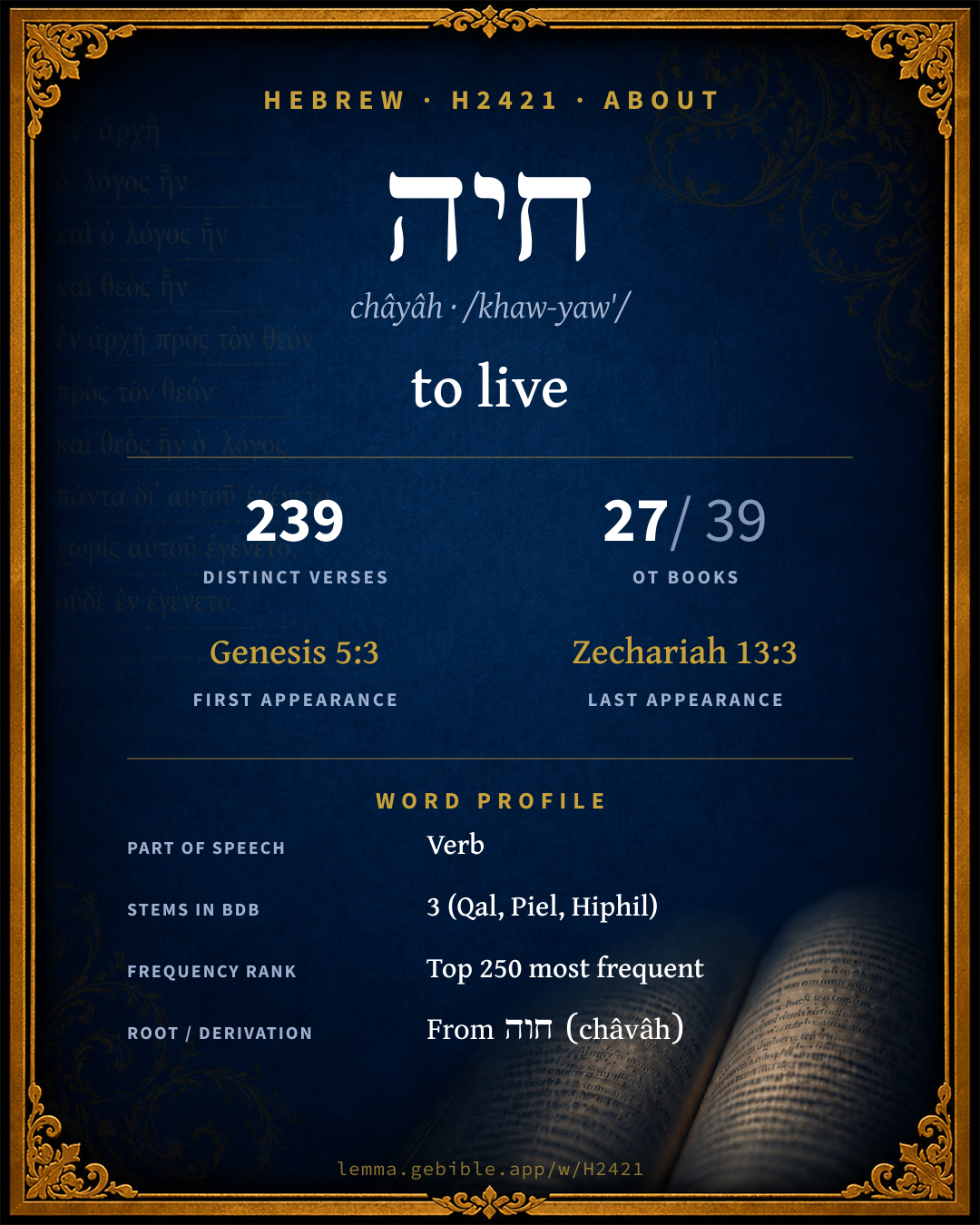
חָיָה
to live
also: have life, remain alive, sustain life, live prosperously fuller range ↓
Full lexicon entry — Brown-Driver-Briggs (BDB)
From Brown-Driver-Briggs (BDB)
Where this word appears
See every Qal verb in the Hebrew Bible →
Grammar key — what these labels mean
Part of speech
- Verb
- An action or state-of-being word.
Stem
- Qal
- The basic, simple active stem — the plain form of the verb (“he wrote”). Here: ‘live’
- Piel
- An intensive or resultative active stem. Here: ‘preserve alive’
- Hiphil
- The causative active stem (“he caused / brought about”). Here: ‘preserve alive’
Form
- Sequential Imperfect
- An imperfect with prefixed waw — the standard past-narrative form (waw-consecutive imperfect).
- Imperfect
- An incomplete, ongoing, or future action (“he will / would write”).
- Infinitive Absolute
- An unbound verbal noun, often intensifying or standing in for a finite verb.
- Jussive
- A third- or second-person volitional form expressing wish or command (“let him write”).
- Sequential Perfect
- A perfect with prefixed waw continuing a preceding imperfect or command (waw-consecutive perfect).
- Imperative
- A direct command (“write!”).
- Infinitive Construct
- A bound verbal noun, frequently with prepositions (“to write / in writing”).
- Perfect
- A completed action or state — Hebrew marks aspect (completeness) more than strict tense (“he wrote”).
- Participle Active
- A verbal adjective expressing ongoing or characteristic action (“writing / one who writes”).
- Cohortative
- A first-person volitional form expressing wish or resolve (“let me / let us write”).
State
- Absolute
- The independent form of a noun, not bound to a following word.
Person
- 3rd Person
- The one spoken about (“he / she / it / they”).
- 2nd Person
- The one addressed (“you”).
- 1st Person
- The speaker (“I / we”).
Gender
- Masculine
- Grammatically masculine.
- Common
- Either gender — not distinguished for this form.
- Feminine
- Grammatically feminine.
Number
- Singular
- One.
- Plural
- More than one (in Hebrew, generally three or more).
Grammatical forms 56 distinct
- Verb, Qal, Sequential Imperfect, 3rd Person, Masculine, Singular 43 times (16%)
- Verb, Qal, Imperfect, 3rd Person, Masculine, Singular 33 times (12%)
- Verb, Qal, Jussive, 3rd Person, Masculine, Singular 12 times (5%)
- Verb, Qal, Infinitive Absolute 11 times (4%)
- Verb, Piel, Imperative, 2nd Person, Masculine, Singular 10 times (4%)
- Verb, Hiphil, Infinitive Construct 10 times (4%)
- Verb, Qal, Sequential Perfect, 3rd Person, Masculine, Singular 9 times (3%)
- Verb, Piel, Imperfect, 3rd Person, Masculine, Singular 9 times (3%)
+48 more forms (128 occurrences)
Parsed forms decoded from the imported morphology (morphhb / Westminster Leningrad Codex — WLC text public domain, morphhb tagging CC BY 4.0), counted across 265 parsed occurrences — not distinct verses.
Page 1 of 2 — showing verses 1–200 of 239 distinct verses where H2421 appears, across 27 books. Click any verse to open its interlinear word-by-word view. Verse text shown in the World English Bible for context — . Each verse’s Hebrew form is shown with its reference; the English is not keyword-highlighted, since the data carries no word-level English alignment. Use “Compare translations” on any verse to read it across multiple English versions. This concordance covers the Hebrew Bible; Septuagint (Greek Old Testament) occurrences are not indexed here.
Genesis 56 verses
- Genesis 5:3 וַֽ/יְחִ֣י conj + Qal wimpf 3ms Adam lived one hundred thirty years, and became the father of a son in his own likeness, after his image, and named him Seth.
- Genesis 5:6 וַֽ/יְחִי conj + Qal wimpf 3ms Seth lived one hundred five years, and became the father of Enosh.
- Genesis 5:7 וַֽ/יְחִי conj + Qal wimpf 3ms Seth lived after he became the father of Enosh eight hundred seven years, and became the father of sons and daughters.
- Genesis 5:9 וַֽ/יְחִ֥י conj + Qal wimpf 3ms Enosh lived ninety years, and became the father of Kenan.
- Genesis 5:10 וַֽ/יְחִ֣י conj + Qal wimpf 3ms Enosh lived after he became the father of Kenan, eight hundred fifteen years, and became the father of sons and daughters.
- Genesis 5:12 וַֽ/יְחִ֥י conj + Qal wimpf 3ms Kenan lived seventy years, and became the father of Mahalalel.
- Genesis 5:13 וַ/יְחִ֣י conj + Qal wimpf 3ms Kenan lived after he became the father of Mahalalel eight hundred forty years, and became the father of sons and daughters
- Genesis 5:15 וַֽ/יְחִ֣י conj + Qal wimpf 3ms Mahalalel lived sixty-five years, and became the father of Jared.
- Genesis 5:16 וַֽ/יְחִ֣י conj + Qal wimpf 3ms Mahalalel lived after he became the father of Jared eight hundred thirty years, and became the father of sons and daughters.
- Genesis 5:18 וַֽ/יְחִי conj + Qal wimpf 3ms Jared lived one hundred sixty-two years, and became the father of Enoch.
- Genesis 5:19 וַֽ/יְחִי conj + Qal wimpf 3ms Jared lived after he became the father of Enoch eight hundred years, and became the father of sons and daughters.
- Genesis 5:21 וַֽ/יְחִ֣י conj + Qal wimpf 3ms Enoch lived sixty-five years, and became the father of Methuselah.
- Genesis 5:25 וַ/יְחִ֣י conj + Qal wimpf 3ms Methuselah lived one hundred eighty-seven years, and became the father of Lamech.
- Genesis 5:26 וַֽ/יְחִ֣י conj + Qal wimpf 3ms Methuselah lived after he became the father of Lamech seven hundred eighty-two years, and became the father of sons and daughters.
- Genesis 5:28 וַֽ/יְחִי conj + Qal wimpf 3ms Lamech lived one hundred eighty-two years, and became the father of a son,
- Genesis 5:30 וַֽ/יְחִי conj + Qal wimpf 3ms Lamech lived after he became the father of Noah five hundred ninety-five years, and became the father of sons and daughters.
- Genesis 6:19 לְ/הַחֲיֹ֣ת prep + Hiphil inf.cs Of every living thing of all flesh, you shall bring two of every sort into the ark, to keep them alive with you. They shall be male and female.
- Genesis 6:20 לְ/הַֽחֲיֽוֹת prep + Hiphil inf.cs Of the birds after their kind, of the cattle after their kind, of every creeping thing of the ground after its kind, two of every sort shall come to you, to keep them alive.
- Genesis 7:3 לְ/חַיּ֥וֹת prep + Piel inf.cs Also of the birds of the sky, seven and seven, male and female, to keep seed alive on the surface of all the earth.
- Genesis 9:28 וַֽ/יְחִי conj + Qal wimpf 3ms Noah lived three hundred fifty years after the flood.
- Genesis 11:11 וַֽ/יְחִי conj + Qal wimpf 3ms Shem lived after he became the father of Arpachshad five hundred years, and became the father of sons and daughters.
- Genesis 11:12 חַ֔י Qal pf 3ms Arpachshad lived thirty-five years, and became the father of Shelah.
- Genesis 11:13 וַֽ/יְחִ֣י conj + Qal wimpf 3ms Arpachshad lived after he became the father of Shelah four hundred three years, and became the father of sons and daughters.
- Genesis 11:14 חַ֖י Qal pf 3ms Shelah lived thirty years, and became the father of Eber:
- Genesis 11:15 וַֽ/יְחִי conj + Qal wimpf 3ms and Shelah lived after he became the father of Eber four hundred three years, and became the father of sons and daughters.
- Genesis 11:16 וַֽ/יְחִי conj + Qal wimpf 3ms Eber lived thirty-four years, and became the father of Peleg.
- Genesis 11:17 וַֽ/יְחִי conj + Qal wimpf 3ms Eber lived after he became the father of Peleg four hundred thirty years, and became the father of sons and daughters.
- Genesis 11:18 וַֽ/יְחִי conj + Qal wimpf 3ms Peleg lived thirty years, and became the father of Reu.
- Genesis 11:19 וַֽ/יְחִי conj + Qal wimpf 3ms Peleg lived after he became the father of Reu two hundred nine years, and became the father of sons and daughters.
- Genesis 11:20 וַ/יְחִ֣י conj + Qal wimpf 3ms Reu lived thirty-two years, and became the father of Serug.
- Genesis 11:21 וַ/יְחִ֣י conj + Qal wimpf 3ms Reu lived after he became the father of Serug two hundred seven years, and became the father of sons and daughters.
- Genesis 11:22 וַ/יְחִ֥י conj + Qal wimpf 3ms Serug lived thirty years, and became the father of Nahor.
- Genesis 11:23 וַ/יְחִ֣י conj + Qal wimpf 3ms Serug lived after he became the father of Nahor two hundred years, and became the father of sons and daughters.
- Genesis 11:24 וַ/יְחִ֣י conj + Qal wimpf 3ms Nahor lived twenty-nine years, and became the father of Terah.
- Genesis 11:25 וַ/יְחִ֣י conj + Qal wimpf 3ms Nahor lived after he became the father of Terah one hundred nineteen years, and became the father of sons and daughters.
- Genesis 11:26 וַֽ/יְחִי conj + Qal wimpf 3ms Terah lived seventy years, and became the father of Abram, Nahor, and Haran.
- Genesis 12:12 יְחַיּֽוּ Piel impf 3mp It will happen, when the Egyptians will see you, that they will say, 'This is his wife.' They will kill me, but they will save you alive.
- Genesis 12:13 וְ/חָיְתָ֥ה conj + Qal pf 3fs Please say that you are my sister, that it may be well with me for your sake, and that my soul may live because of you."
- Genesis 17:18 יִחְיֶ֥ה Qal impf 3ms Abraham said to God, "Oh that Ishmael might live before you!"
- Genesis 19:19 לְ/הַחֲי֖וֹת prep + Hiphil inf.cs See now, your servant has found favor in your sight, and you have magnified your loving kindness, which you have shown to me in saving my life. I can't escape to the mountain, lest evil overtake me, and I die.
- Genesis 19:20 וּ/תְחִ֥י conj + Qal impf 3fs See now, this city is near to flee to, and it is a little one. Oh let me escape there (isn't it a little one?), and my soul will live."
- Genesis 19:32 וּ/נְחַיֶּ֥ה conj + Piel impf 1cp Come, let's make our father drink wine, and we will lie with him, that we may preserve our father's seed."
- Genesis 19:34 וּ/נְחַיֶּ֥ה conj + Piel impf 1cp It came to pass on the next day, that the firstborn said to the younger, "Behold, I lay last night with my father. Let us make him drink wine again, tonight. You go in, and lie with him, that we may preserve our father's seed."
- Genesis 20:7 וֶֽ/חְיֵ֑ה conj + Qal impv 2ms Now therefore, restore the man's wife. For he is a prophet, and he will pray for you, and you will live. If you don't restore her, know for sure that you will die, you, and all who are yours."
- Genesis 27:40 תִֽחְיֶ֔ה Qal impf 2ms By your sword will you live, and you will serve your brother. It will happen, when you will break loose, That you shall shake his yoke from off your neck."
- Genesis 31:32 יִֽחְיֶה֒ Qal impf 3ms With whoever you find your gods, he shall not live. Before our relatives, discern what is yours with me, and take it." For Jacob didn't know that Rachel had stolen them.
- Genesis 42:2 וְ/נִחְיֶ֖ה conj + Qal impf 1cp He said, "Behold, I have heard that there is grain in Egypt. Go down there, and buy for us from there, so that we may live, and not die."
- Genesis 42:18 וִֽ/חְי֑וּ conj + Qal impv 2mp Joseph said to them the third day, "Do this, and live, for I fear God.
- Genesis 43:8 וְ/נִֽחְיֶה֙ conj + Qal impf 1cp Judah said to Israel, his father, "Send the boy with me, and we will arise and go, so that we may live, and not die, both we, and you, and also our little ones.
- Genesis 45:7 וּ/לְ/הַחֲי֣וֹת conj + prep + Hiphil inf.cs God sent me before you to preserve you a remnant in the earth, and to save you alive by a great deliverance.
- Genesis 45:27 וַ/תְּחִ֕י conj + Qal wimpf 3fs They told him all the words of Joseph, which he had said to them. When he saw the wagons which Joseph had sent to carry him, the spirit of Jacob, their father, revived.
- Genesis 47:19 וְ/נִֽחְיֶה֙ conj + Qal impf 1cp Why should we die before your eyes, both we and our land? Buy us and our land for bread, and we and our land will be servants to Pharaoh. Give us seed, that we may live, and not die, and that the land won't be desolate."
- Genesis 47:25 הֶחֱיִתָ֑/נוּ Hiphil pf 2ms + sfx pers 1cp They said, "You have saved our lives! Let us find favor in the sight of my lord, and we will be Pharaoh's servants."
- Genesis 47:28 וַ/יְחִ֤י conj + Qal wimpf 3ms Jacob lived in the land of Egypt seventeen years. So the days of Jacob, the years of his life, were one hundred forty-seven years.
- Genesis 50:20 לְ/הַחֲיֹ֥ת prep + Hiphil inf.cs As for you, you meant evil against me, but God meant it for good, to bring to pass, as it is this day, to save many people alive.
- Genesis 50:22 וַ/יְחִ֣י conj + Qal wimpf 3ms Joseph lived in Egypt, he, and his father's house. Joseph lived one hundred ten years.
Exodus 5 verses
- Exodus 1:17 וַ/תְּחַיֶּ֖יןָ conj + Piel wimpf 3fp But the midwives feared God, and didn't do what the king of Egypt commanded them, but saved the baby boys alive.
- Exodus 1:18 וַ/תְּחַיֶּ֖יןָ conj + Piel wimpf 2fp The king of Egypt called for the midwives, and said to them, "Why have you done this thing, and have saved the men-children alive?"
- Exodus 1:22 תְּחַיּֽוּ/ן Piel impf 2mp + sfx n Pharaoh charged all his people, saying, "You shall cast every son who is born into the river, and every daughter you shall save alive."
- Exodus 19:13 יִחְיֶ֑ה Qal impf 3ms No hand shall touch him, but he shall surely be stoned or shot through; whether it is animal or man, he shall not live.' When the trumpet sounds long, they shall come up to the mountain."
- Exodus 22:18 תְחַיֶּֽה Piel impf 2ms "You shall not allow a sorceress to live.
Leviticus 2 verses
- Leviticus 25:35 וָ/חַ֖י conj + Qal wpf 3ms "'If your brother has become poor, and his hand can't support him among you; then you shall uphold him. As a stranger and a sojourner he shall live with you.
- Leviticus 25:36 וְ/חֵ֥י conj + Qal wpf 3ms Take no interest from him or profit, but fear your God; that your brother may live among you.
Numbers 6 verses
- Numbers 4:19 וְ/חָיוּ֙ conj + Qal wpf 3cp but thus do to them, that they may live, and not die, when they approach to the most holy things: Aaron and his sons shall go in, and appoint them everyone to his service and to his burden;
- Numbers 14:38 חָיוּ֙ Qal pf 3cp But Joshua the son of Nun, and Caleb the son of Jephunneh, remained alive of those men who went to spy out the land.
- Numbers 22:33 הֶחֱיֵֽיתִי Hiphil pf 1cs and the donkey saw me, and turned aside before me these three times: unless she had turned aside from me, surely now I had even slain you, and saved her alive.
- Numbers 24:23 יִחְיֶ֖ה Qal impf 3ms He took up his parable, and said, Alas, who shall live when God does this?
- Numbers 31:15 הַֽ/חִיִּיתֶ֖ם ptcl inter + Piel pf 2mp Moses said to them, Have you saved all the women alive?
- Numbers 31:18 הַחֲי֖וּ Hiphil impv 2mp But all the girls, who have not known man by lying with him, keep alive for yourselves.
Deuteronomy 13 verses
- Deuteronomy 4:1 תִּֽחְי֗וּ Qal impf 2mp Now, Israel, listen to the statutes and to the ordinances, which I teach you, to do them; that you may live, and go in and possess the land which Yahweh, the God of your fathers, gives you.
- Deuteronomy 4:33 וַ/יֶּֽחִי conj + Qal wimpf 3ms Did ever a people hear the voice of God speaking out of the midst of the fire, as you have heard, and live?
- Deuteronomy 5:26 וַ/יֶּֽחִי conj + Qal wimpf 3ms For who is there of all flesh, that has heard the voice of the living God speaking out of the midst of the fire, as we have, and lived?
- Deuteronomy 5:33 תִּֽחְיוּ/ן֙ Qal impf 2mp + sfx n You shall walk in all the way which Yahweh your God has commanded you, that you may live, and that it may be well with you, and that you may prolong your days in the land which you shall possess.
- Deuteronomy 6:24 לְ/חַיֹּתֵ֖/נוּ prep + Piel inf.cs + sfx pers 1cp Yahweh commanded us to do all these statutes, to fear Yahweh our God, for our good always, that he might preserve us alive, as at this day.
- Deuteronomy 8:1 תִּֽחְי֜וּ/ן Qal impf 2mp + sfx n All the commandment which I command you this day shall you observe to do, that you may live, and multiply, and go in and possess the land which Yahweh swore to your fathers.
- Deuteronomy 8:3 יִחְיֶ֣ה יִחְיֶ֥ה Qal impf 3ms Qal impf 3ms He humbled you, and allowed you to hunger, and fed you with manna, which you didn't know, neither did your fathers know; that he might make you know that man does not live by bread only, but by everything that proceeds out of the mouth of Yahweh does man live.
- Deuteronomy 16:20 תִּֽחְיֶה֙ Qal impf 2ms That which is altogether just shall you follow, that you may live, and inherit the land which Yahweh your God gives you.
- Deuteronomy 20:16 תְחַיֶּ֖ה Piel impf 2ms But of the cities of these peoples, that Yahweh your God gives you for an inheritance, you shall save alive nothing that breathes;
- Deuteronomy 30:16 וְ/חָיִ֣יתָ conj + Qal wpf 2ms in that I command you this day to love Yahweh your God, to walk in his ways, and to keep his commandments and his statutes and his ordinances, that you may live and multiply, and that Yahweh your God may bless you in the land where you go in to possess it.
- Deuteronomy 30:19 תִּחְיֶ֖ה Qal impf 2ms I call heaven and earth to witness against you this day, that I have set before you life and death, the blessing and the curse: therefore choose life, that you may live, you and your seed;
- Deuteronomy 32:39 וַ/אֲחַיֶּ֗ה conj + Piel impf 1cs See now that I, even I, am he, There is no god with me: I kill, and I make alive; I wound, and I heal; There is none who can deliver out of my hand.
- Deuteronomy 33:6 יְחִ֥י Qal juss 3ms Let Reuben live, and not die; Nor let his men be few.
Joshua 8 verses
- Joshua 2:13 וְ/הַחֲיִתֶ֞ם conj + Hiphil wpf 2mp and that you will save alive my father, and my mother, and my brothers, and my sisters, and all that they have, and will deliver our lives from death.
- Joshua 5:8 חֲיוֹתָֽ/ם Qal inf.cs + sfx pers 3mp It happened, when they had done circumcising all the nation, that they abode in their places in the camp, until they were whole.
- Joshua 6:17 תִּֽחְיֶ֗ה Qal impf 3fs The city shall be devoted, even it and all that is therein, to Yahweh: only Rahab the prostitute shall live, she and all who are with her in the house, because she hid the messengers that we sent.
- Joshua 6:25 הֶחֱיָ֣ה Hiphil pf 3ms But Rahab the prostitute, and her father's household, and all that she had, did Joshua save alive; and she lived in the midst of Israel to this day, because she hid the messengers, whom Joshua sent to spy out Jericho.
- Joshua 9:15 לְ/חַיּוֹתָ֑/ם prep + Piel inf.cs + sfx pers 3mp Joshua made peace with them, and made a covenant with them, to let them live: and the princes of the congregation swore to them.
- Joshua 9:20 וְ/הַחֲיֵ֣ה conj + Hiphil inf.abs This we will do to them, and let them live; lest wrath be on us, because of the oath which we swore to them.
- Joshua 9:21 יִֽחְי֑וּ Qal impf 3mp The princes said to them, Let them live: so they became wood cutters and drawers of water to all the congregation, as the princes had spoken to them.
- Joshua 14:10 הֶחֱיָ֨ה Hiphil pf 3ms Now, behold, Yahweh has kept me alive, as he spoke, these forty-five years, from the time that Yahweh spoke this word to Moses, while Israel walked in the wilderness: and now, behold, I am this day eighty-five years old.
Judges 3 verses
- Judges 8:19 הַחֲיִתֶ֣ם Hiphil pf 2mp He said, They were my brothers, the sons of my mother: as Yahweh lives, if you had saved them alive, I would not kill you.
- Judges 15:19 וַ/יֶּ֑חִי conj + Qal wimpf 3ms But God split the hollow place that is in Lehi, and water came out of it. When he had drunk, his spirit came again, and he revived: therefore the name of it was called En Hakkore, which is in Lehi, to this day.
- Judges 21:14 חִיּ֔וּ Piel pf 3cp Benjamin returned at that time; and they gave them the women whom they had saved alive of the women of Jabesh Gilead: and yet so they weren't enough for them.
1 Samuel 4 verses
- 1 Samuel 2:6 וּ/מְחַיֶּ֑ה conj + Piel ptcp.act ms Yahweh kills, and makes alive: He brings down to Sheol, and brings up.
- 1 Samuel 10:24 יְחִ֥י Qal juss 3ms Samuel said to all the people, "You see him whom Yahweh has chosen, that there is none like him among all the people?" All the people shouted, and said, [Long] live the king.
- 1 Samuel 27:9 יְחַיֶּ֖ה Piel impf 3ms David struck the land, and saved neither man nor woman alive, and took away the sheep, and the oxen, and the donkeys, and the camels, and the clothing; and he returned, and came to Achish.
- 1 Samuel 27:11 יְחַיֶּ֣ה Piel impf 3ms David saved neither man nor woman alive, to bring them to Gath, saying, Lest they should tell of us, saying, So did David, and so has been his manner all the while he has lived in the country of the Philistines.
2 Samuel 4 verses
- 2 Samuel 1:10 יִֽחְיֶ֖ה Qal impf 3ms So I stood beside him, and killed him, because I was sure that he could not live after that he was fallen: and I took the crown that was on his head, and the bracelet that was on his arm, and have brought them here to my lord.
- 2 Samuel 8:2 לְ/הַחֲי֑וֹת prep + Hiphil inf.cs He struck Moab, and measured them with the line, making them to lie down on the ground; and he measured two lines to put to death, and one full line to keep alive. The Moabites became servants to David, and brought tribute.
- 2 Samuel 12:3 וַ/יְחַיֶּ֕/הָ conj + Piel wimpf 3ms + sfx pers 3fs but the poor man had nothing, except one little ewe lamb, which he had bought and raised. It grew up together with him, and with his children. It ate of his own food, drank of his own cup, and lay in his bosom, and was to him like a daughter.
- 2 Samuel 16:16 יְחִ֥י יְחִ֥י Qal juss 3ms Qal juss 3ms It happened, when Hushai the Archite, David's friend, was come to Absalom, that Hushai said to Absalom, [Long] live the king, [Long] live the king.
1 Kings 8 verses
- 1 Kings 1:25 יְחִ֖י Qal juss 3ms For he is gone down this day, and has slain oxen and fatlings and sheep in abundance, and has called all the king's sons, and the captains of the host, and Abiathar the priest; and, behold, they are eating and drinking before him, and say, [Long] live king Adonijah.
- 1 Kings 1:31 יְחִ֗י Qal juss 3ms Then Bathsheba bowed with her face to the earth, and did obeisance to the king, and said, Let my lord king David live forever.
- 1 Kings 1:34 יְחִ֖י Qal juss 3ms and let Zadok the priest and Nathan the prophet anoint him there king over Israel; and blow you the trumpet, and say, [Long] live king Solomon.
- 1 Kings 1:39 יְחִ֖י Qal juss 3ms Zadok the priest took the horn of oil out of the Tent, and anointed Solomon. They blew the trumpet; and all the people said, [Long] live king Solomon.
- 1 Kings 17:22 וַ/יֶּֽחִי conj + Qal wimpf 3ms Yahweh listened to the voice of Elijah; and the soul of the child came into him again, and he revived.
- 1 Kings 18:5 וּ/נְחַיֶּה֙ conj + Piel impf 1cp Ahab said to Obadiah, Go through the land, to all the springs of water, and to all the brooks: peradventure we may find grass and save the horses and mules alive, that we not lose all the animals.
- 1 Kings 20:31 יְחַיֶּ֥ה Piel impf 3ms His servants said to him, See now, we have heard that the kings of the house of Israel are merciful kings: let us, we pray you, put sackcloth on our loins, and ropes on our heads, and go out to the king of Israel: peradventure he will save your life.
- 1 Kings 20:32 תְּחִֽי Qal juss 3fs So they girded sackcloth on their loins, and [put] ropes on their heads, and came to the king of Israel, and said, Your servant Ben Hadad says, please let me live. He said, Is he yet alive? he is my brother.
2 Kings 17 verses
- 2 Kings 1:2 אֶחְיֶ֖ה Qal impf 1cs Ahaziah fell down through the lattice in his upper chamber that was in Samaria, and was sick: and he sent messengers, and said to them, Go, inquire of Baal Zebub, the god of Ekron, whether I shall recover of this sickness.
- 2 Kings 4:7 תִֽחְיִ֖י Qal impf 2fs Then she came and told the man of God. He said, Go, sell the oil, and pay your debt, and live you and your sons of the rest.
- 2 Kings 5:7 וּֽ/לְ/הַחֲי֔וֹת conj + prep + Hiphil inf.cs It happened, when the king of Israel had read the letter, that he tore his clothes, and said, Am I God, to kill and to make alive, that this man does send to me to recover a man of his leprosy? but consider, I pray you, and see how he seeks a quarrel against me.
- 2 Kings 7:4 יְחַיֻּ֣/נוּ נִֽחְיֶ֔ה Piel impf 3mp + sfx pers 1cp Qal impf 1cp If we say, We will enter into the city, then the famine is in the city, and we shall die there; and if we sit still here, we die also. Now therefore come, and let us fall to the host of the Syrians: if they save us alive, we shall live; and if they kill us, we shall but die.
- 2 Kings 8:1 הֶחֱיָ֨ה Hiphil pf 3ms Now Elisha had spoken to the woman, whose son he had restored to life, saying, Arise, and go you and your household, and sojourn wherever you can sojourn: for Yahweh has called for a famine; and it shall also come on the land seven years.
- 2 Kings 8:5 הֶחֱיָ֣ה הֶחֱיָ֤ה הֶחֱיָ֥ה Hiphil pf 3ms Hiphil pf 3ms Hiphil pf 3ms It happened, as he was telling the king how he had restored to life him who was dead, that behold, the woman, whose son he had restored to life, cried to the king for her house and for her land. Gehazi said, My lord, O king, this is the woman, and this is her son, whom Elisha restored to life.
- 2 Kings 8:8 הַ/אֶחְיֶ֖ה ptcl inter + Qal impf 1cs The king said to Hazael, Take a present in your hand, and go, meet the man of God, and inquire of Yahweh by him, saying, Shall I recover of this sickness?
- 2 Kings 8:9 הַ/אֶחְיֶ֖ה ptcl inter + Qal impf 1cs So Hazael went to meet him, and took a present with him, even of every good thing of Damascus, forty camels' burden, and came and stood before him, and said, Your son Benhadad king of Syria has sent me to you, saying, Shall I recover of this sickness?
- 2 Kings 8:10 חָיֹ֣ה תִחְיֶ֑ה Qal inf.abs Qal impf 2ms Elisha said to him, Go, tell him, You shall surely recover; however Yahweh has shown me that he shall surely die.
- 2 Kings 8:14 חָיֹ֥ה תִחְיֶֽה Qal inf.abs Qal impf 2ms Then he departed from Elisha, and came to his master; who said to him, What said Elisha to you? He answered, He told me that you would surely recover.
- 2 Kings 10:19 יִֽחְיֶ֑ה Qal impf 3ms Now therefore call to me all the prophets of Baal, all his worshippers, and all his priests; let none be wanting: for I have a great sacrifice [to do] to Baal; whoever shall be wanting, he shall not live. But Jehu did it in subtlety, to the intent that he might destroy the worshippers of Baal.
- 2 Kings 11:12 יְחִ֥י Qal juss 3ms Then he brought out the king's son, and put the crown on him, and [gave him] the testimony; and they made him king, and anointed him; and they clapped their hands, and said, [Long] live the king.
- 2 Kings 13:21 וַ/יְחִ֖י conj + Qal wimpf 3ms It happened, as they were burying a man, that behold, they spied a band; and they cast the man into the tomb of Elisha: and as soon as the man touched the bones of Elisha, he revived, and stood up on his feet.
- 2 Kings 14:17 וַ/יְחִ֨י conj + Qal wimpf 3ms Amaziah the son of Joash king of Judah lived after the death of Jehoash son of Jehoahaz king of Israel fifteen years.
- 2 Kings 18:32 וִֽ/חְי֖וּ conj + Qal impv 2mp Until I come and take you away to a land like your own land, a land of grain and new wine, a land of bread and vineyards, a land of olive trees and of honey, that you may live, and not die: and don't listen to Hezekiah, when he persuades you, saying, Yahweh will deliver us.
- 2 Kings 20:1 תִֽחְיֶֽה Qal impf 2ms In those days was Hezekiah sick to death. Isaiah the prophet the son of Amoz came to him, and said to him, Thus says Yahweh, Set your house in order: for you shall die, and not live.
- 2 Kings 20:7 וַ/יֶּֽחִי conj + Qal wimpf 3ms Isaiah said, Take a cake of figs. They took and laid it on the boil, and he recovered.
1 Chronicles 1 verse
2 Chronicles 2 verses
- 2 Chronicles 23:11 יְחִ֥י Qal juss 3ms Then they brought out the king's son, and put the crown on him, and [gave him] the testimony, and made him king: and Jehoiada and his sons anointed him; and they said, [Long] live the king.
- 2 Chronicles 25:25 וַ/יְחִ֨י conj + Qal wimpf 3ms Amaziah the son of Joash king of Judah lived after the death of Joash son of Jehoahaz king of Israel fifteen years.
Nehemiah 5 verses
- Nehemiah 2:3 יִחְיֶ֑ה Qal impf 3ms I said to the king, Let the king live forever: why should not my face be sad, when the city, the place of my fathers' tombs, lies waste, and the gates of it are consumed with fire?
- Nehemiah 4:2 הַ/יְחַיּ֧וּ ptcl inter + Piel impf 3mp He spoke before his brothers and the army of Samaria, and said, What are these feeble Jews doing? will they fortify themselves? will they sacrifice? will they make an end in a day? will they revive the stones out of the heaps of rubbish, seeing they are burned?
- Nehemiah 5:2 וְ/נִחְיֶֽה conj + Qal impf 1cp For there were that said, We, our sons and our daughters, are many: let us get grain, that we may eat and live.
- Nehemiah 9:6 מְחַיֶּ֣ה Piel ptcp.act ms You are Yahweh, even you alone; you have made heaven, the heaven of heavens, with all their host, the earth and all things that are thereon, the seas and all that is in them, and you preserve them all; and the host of heaven worships you.
- Nehemiah 9:29 וְ/חָיָ֣ה conj + Qal wpf 3ms and testified against them, that you might bring them again to your law. Yet they dealt proudly, and didn't listen to your commandments, but sinned against your ordinances, (which if a man do, he shall live in them), and withdrew the shoulder, and hardened their neck, and would not hear.
Esther 1 verse
Job 6 verses
- Job 7:16 אֶֽחְיֶ֑ה Qal impf 1cs I loathe my life. I don't want to live forever. Leave me alone; for my days are but a breath.
- Job 14:14 הֲ/יִ֫חְיֶ֥ה ptcl inter + Qal impf 3ms If a man dies, shall he live again? All the days of my warfare would I wait, Until my release should come.
- Job 21:7 יִחְי֑וּ Qal impf 3mp "Why do the wicked live, Become old, yes, and grow mighty in power?
- Job 33:4 תְּחַיֵּֽ/נִי Piel impf 3fs + sfx pers 1cs The Spirit of God has made me, And the breath of the Almighty gives me life.
- Job 36:6 יְחַיֶּ֥ה Piel impf 3ms He doesn't preserve the life of the wicked, But gives to the afflicted their right.
- Job 42:16 וַ/יְחִ֤י conj + Qal wimpf 3ms After this Job lived one hundred forty years, and saw his sons, and his sons' sons, to four generations.
Psalms 31 verses
- Psalms 22:26 יְחִ֖י Qal impf 3ms The humble shall eat and be satisfied. They shall praise Yahweh who seek after him. Let your hearts live forever.
- Psalms 22:29 חִיָּֽה Piel pf 3ms All the rich ones of the earth shall eat and worship. All those who go down to the dust shall bow before him, Even he who can't keep his soul alive.
- Psalms 30:3 חִ֝יִּיתַ֗/נִי Piel pf 2ms + sfx pers 1cs Yahweh, you have brought up my soul from Sheol. You have kept me alive, that I should not go down to the pit.
- Psalms 33:19 וּ֝/לְ/חַיּוֹתָ֗/ם conj + prep + Piel inf.cs + sfx pers 3mp To deliver their soul from death, To keep them alive in famine.
- Psalms 41:2 וִֽ֭/יחַיֵּ/הוּ conj + Piel impf 3ms + sfx pers 3ms Yahweh will preserve him, and keep him alive, He shall be blessed on the earth, And he will not surrender him to the will of his enemies.
- Psalms 49:9 וִֽ/יחִי conj + Qal juss 3ms That he should live on forever, That he should not see corruption.
- Psalms 69:32 וִ/יחִ֥י conj + Qal impf 3ms The humble have seen it, and are glad. You who seek after God, let your heart live.
- Psalms 71:20 תחיי/נו תְּחַיֵּ֑י/נִי Piel impf 2ms + sfx pers 1cp Piel impf 2ms + sfx pers 1cs You, who have shown us many and bitter troubles, You will let me live. You will bring us up again from the depths of the earth.
- Psalms 72:15 וִ/יחִ֗י conj + Qal juss 3ms They shall live, and to him shall be given of the gold of Sheba. Men shall pray for him continually. They shall bless him all day long.
- Psalms 80:18 תְּ֝חַיֵּ֗/נוּ Piel impf 2ms + sfx pers 1cp So we will not turn away from you. Revive us, and we will call on your name.
- Psalms 85:6 תְּחַיֵּ֑/נוּ Piel impf 2ms + sfx pers 1cp Won't you revive us again, That your people may rejoice in you?
- Psalms 89:48 יִֽ֭חְיֶה Qal impf 3ms What man is he who shall live and not see death, Who shall deliver his soul from the power of Sheol? Selah.
- Psalms 118:17 אֶֽחְיֶ֑ה Qal impf 1cs I will not die, but live, And declare Yah's works.
- Psalms 119:17 אֶֽחְיֶ֗ה Qal coh 1cs Do good to your servant. I will live and I will obey your word.
- Psalms 119:25 חַ֝יֵּ֗/נִי Piel impv 2ms + sfx pers 1cs My soul is laid low in the dust. Revive me according to your word!
- Psalms 119:37 חַיֵּֽ/נִי Piel impv 2ms + sfx pers 1cs Turn my eyes away from looking at worthless things. Revive me in your ways.
- Psalms 119:40 חַיֵּֽ/נִי Piel impv 2ms + sfx pers 1cs Behold, I long for your precepts! Revive me in your righteousness.
- Psalms 119:50 חִיָּֽתְ/נִי Piel pf 3fs + sfx pers 1cs This is my comfort in my affliction, For your word has revived me.
- Psalms 119:77 וְ/אֶֽחְיֶ֑ה conj + Qal impf 1cs Let your tender mercies come to me, that I may live; For your law is my delight.
- Psalms 119:88 חַיֵּ֑/נִי Piel impv 2ms + sfx pers 1cs Preserve my life according to your loving kindness, So I will obey the statutes of your mouth.
- Psalms 119:93 חִיִּיתָֽ/נִי Piel pf 2ms + sfx pers 1cs I will never forget your precepts, For with them, you have revived me.
- Psalms 119:107 חַיֵּ֥/נִי Piel impv 2ms + sfx pers 1cs I am afflicted very much. Revive me, Yahweh, according to your word.
- Psalms 119:116 וְ/אֶֽחְיֶ֑ה conj + Qal impf 1cs Uphold me according to your word, that I may live. Let me not be ashamed of my hope.
- Psalms 119:144 וְ/אֶחְיֶֽה conj + Qal impf 1cs Your testimonies are righteous forever. Give me understanding, that I may live.
- Psalms 119:149 חַיֵּֽ/נִי Piel impv 2ms + sfx pers 1cs Hear my voice according to your loving kindness. Revive me, Yahweh, according to your ordinances.
- Psalms 119:154 חַיֵּֽ/נִי Piel impv 2ms + sfx pers 1cs Plead my cause, and redeem me! Revive me according to your promise.
- Psalms 119:156 חַיֵּֽ/נִי Piel impv 2ms + sfx pers 1cs Great are your tender mercies, Yahweh. Revive me according to your ordinances.
- Psalms 119:159 חַיֵּֽ/נִי Piel impv 2ms + sfx pers 1cs Consider how I love your precepts. Revive me, Yahweh, according to your loving kindness.
- Psalms 119:175 תְּֽחִי Qal impf 3fs Let my soul live, that I may praise you. Let your ordinances help me.
- Psalms 138:7 תְּחַ֫יֵּ֥/נִי Piel impf 2ms + sfx pers 1cs Though I walk in the midst of trouble, you will revive me. You will stretch forth your hand against the wrath of my enemies. Your right hand will save me.
- Psalms 143:11 תְּחַיֵּ֑/נִי Piel impf 2ms + sfx pers 1cs Revive me, Yahweh, for your name's sake. In your righteousness, bring my soul out of trouble.
Proverbs 4 verses
- Proverbs 4:4 וֶֽ/חְיֵֽה conj + Qal impv 2ms He taught me, and said to me: "Let your heart retain my words. Keep my commandments, and live.
- Proverbs 7:2 וֶ/חְיֵ֑ה conj + Qal impv 2ms Keep my commandments and live; Guard my teaching as the apple of your eye.
- Proverbs 9:6 וִֽ/חְי֑וּ conj + Qal impv 2mp Leave your simple ways, and live. Walk in the way of understanding."
- Proverbs 15:27 יִחְיֶֽה Qal impf 3ms He who is greedy for gain troubles his own house, But he who hates bribes will live.
Ecclesiastes 4 verses
- Ecclesiastes 6:3 יִֽחְיֶ֜ה Qal impf 3ms If a man fathers a hundred children, and lives many years, so that the days of his years are many, but his soul is not filled with good, and moreover he has no burial; I say, that an untimely birth is better than he:
- Ecclesiastes 6:6 חָיָ֗ה Qal pf 3ms Yes, though he live a thousand years twice told, and yet fails to enjoy good, don't all go to one place?
- Ecclesiastes 7:12 תְּחַיֶּ֥ה Piel impf 3fs For wisdom is a defense, even as money is a defense; but the excellency of knowledge is that wisdom preserves the life of him who has it.
- Ecclesiastes 11:8 יִחְיֶ֥ה Qal impf 3ms Yes, if a man lives many years, let him rejoice in them all; But let him remember the days of darkness, for they shall be many. All that comes is vanity.
Isaiah 9 verses
- Isaiah 7:21 יְחַיֶּה Piel impf 3ms It shall happen in that day that a man shall keep alive a young cow, and two sheep;
- Isaiah 26:14 יִחְי֔וּ Qal impf 3mp [They are] dead, they shall not live; [they are] deceased, they shall not rise: therefore have you visited and destroyed them, and made all memory of them to perish.
- Isaiah 26:19 יִֽחְי֣וּ Qal impf 3mp Your dead shall live; my dead bodies shall arise. Awake and sing, you who dwell in the dust; for your dew is [as] the dew of herbs, and the earth shall cast forth the dead.
- Isaiah 38:1 תִֽחְיֶֽה Qal impf 2ms In those days was Hezekiah sick to death. Isaiah the prophet the son of Amoz came to him, and said to him, Thus says Yahweh, Set your house in order; for you shall die, and not live.
- Isaiah 38:9 וַ/יְחִ֖י conj + Qal wimpf 3ms The writing of Hezekiah king of Judah, when he had been sick, and was recovered of his sickness.
- Isaiah 38:16 יִֽחְי֑וּ וְ/הַחֲיֵֽ/נִי Qal impf 3mp conj + Hiphil impv 2ms + sfx pers 1cs Lord, by these things men live; Wholly therein is the life of my spirit: You restore me, and cause me to live.
- Isaiah 38:21 וְ/יֶֽחִי conj + Qal impf 3ms Now Isaiah had said, Let them take a cake of figs, and lay it for a plaster on the boil, and he shall recover.
- Isaiah 55:3 וּ/תְחִ֣י conj + Qal juss 3fs Turn your ear, and come to me; hear, and your soul shall live: and I will make an everlasting covenant with you, even the sure mercies of David.
- Isaiah 57:15 לְ/הַחֲיוֹת֙ וּֽ/לְ/הַחֲי֖וֹת prep + Hiphil inf.cs conj + prep + Hiphil inf.cs For thus says the high and lofty One who inhabits eternity, whose name is Holy: I dwell in the high and holy place, with him also who is of a contrite and humble spirit, to revive the spirit of the humble, and to revive the heart of the contrite.
Jeremiah 8 verses
- Jeremiah 21:9 יחיה וְ/חָיָ֔ה Qal impf 3ms conj + Qal wpf 3ms He who remains in this city shall die by the sword, and by the famine, and by the pestilence; but he who goes out, and passes over to the Chaldeans who besiege you, he shall live, and his life shall be to him for a prey.
- Jeremiah 27:12 וִֽ/חְיֽוּ conj + Qal impv 2mp I spoke to Zedekiah king of Judah according to all these words, saying, Bring your necks under the yoke of the king of Babylon, and serve him and his people, and live.
- Jeremiah 27:17 וִֽ/חְי֑וּ conj + Qal impv 2mp Don't listen to them; serve the king of Babylon, and live: why should this city become a desolation?
- Jeremiah 35:7 תִּֽחְי֜וּ Qal impf 2mp neither shall you build house, nor sow seed, nor plant vineyard, nor have any; but all your days you shall dwell in tents; that you may live many days in the land in which you sojourn.
- Jeremiah 38:2 יחיה וְ/חָיָ֔ה וָ/חָֽי Qal impf 3ms conj + Qal wpf 3ms conj + Qal wpf 3ms Thus says Yahweh, He who remains in this city shall die by the sword, by the famine, and by the pestilence; but he who goes forth to the Chaldeans shall live, and his life shall be to him for a prey, and he shall live.
- Jeremiah 38:17 וְ/חָיְתָ֣ה וְ/חָיִ֖תָה conj + Qal wpf 3fs conj + Qal wpf 2ms Then said Jeremiah to Zedekiah, Thus says Yahweh, the God of hosts, the God of Israel: If you will go forth to the king of Babylon's princes, then your soul shall live, and this city shall not be burned with fire; and you shall live, and your house.
- Jeremiah 38:20 וּ/תְחִ֥י conj + Qal juss 3fs But Jeremiah said, They shall not deliver you. Obey, I beg you, the voice of Yahweh, in that which I speak to you: so it shall be well with you, and your soul shall live.
- Jeremiah 49:11 אֲחַיֶּ֑ה Piel impf 1cs Leave your fatherless children, I will preserve them alive; and let your widows trust in me.
Lamentations 1 verse
Ezekiel 31 verses
- Ezekiel 3:18 לְ/חַיֹּת֑/וֹ prep + Piel inf.cs + sfx pers 3ms When I tell the wicked, You shall surely die; and you give him no warning, nor speak to warn the wicked from his wicked way, to save his life; the same wicked man shall die in his iniquity; but his blood will I require at your hand.
- Ezekiel 3:21 חָי֤וֹ יִֽחְיֶה֙ Qal inf.abs Qal impf 3ms Nevertheless if you warn the righteous man, that the righteous not sin, and he does not sin, he shall surely live, because he took warning; and you have delivered your soul.
About this entry
At a glance — auto-summarized from this page’s data, not written by a person. Every figure links to its source below. This summary describes the numbers; it doesn’t interpret them.
חיה (châyâh) is a Hebrew verb most often rendered “to live.” It first appears in Genesis 5:3. It turns up in 239 verses across 27 books, a common footprint. The verb spans 3 stems, from Qal to Piel. From the same root come חוה, אחוה and חוא. The sections below give every sense, occurrence, and version rendering.
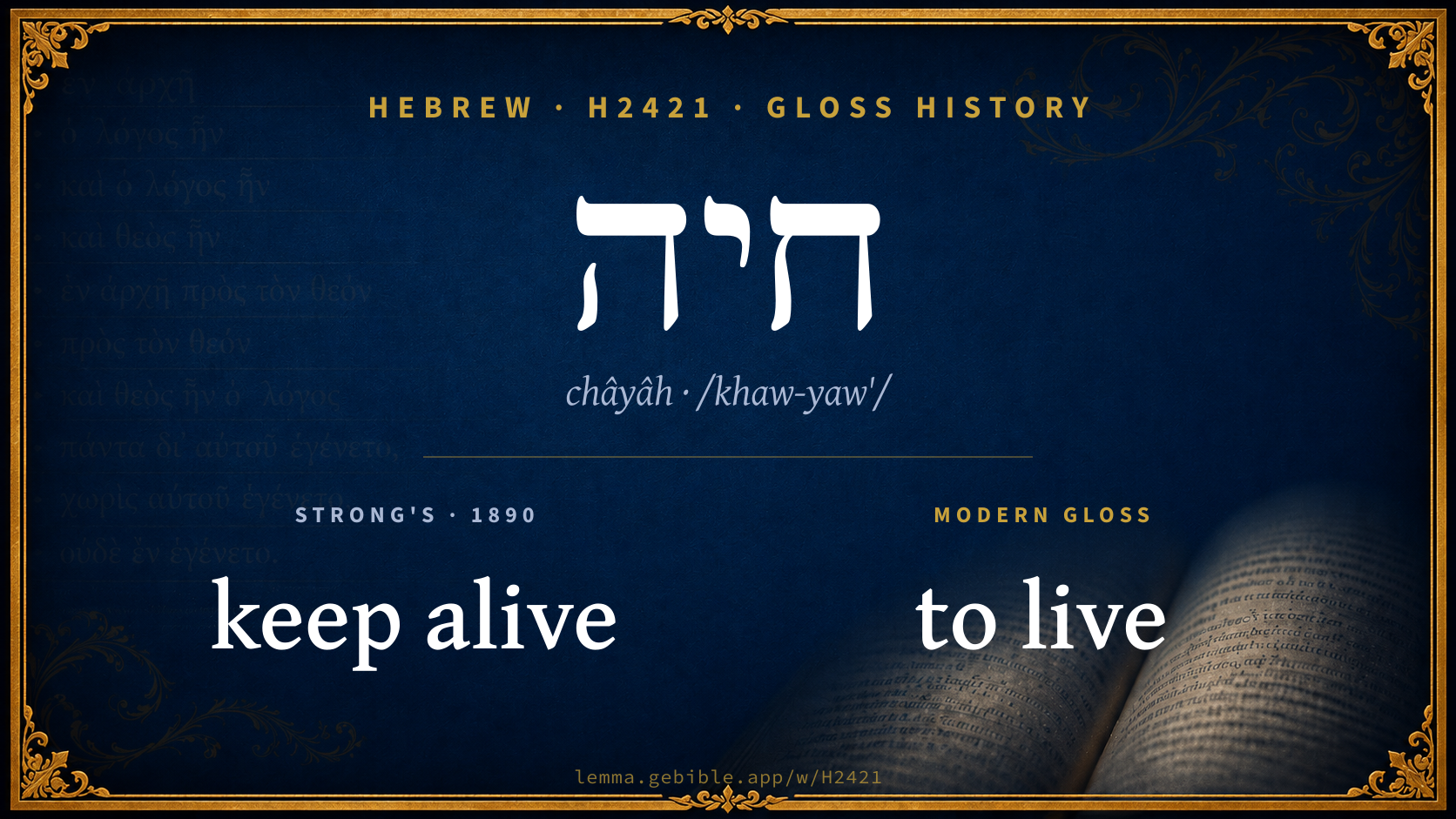
Gloss history
Strong's 1890 vs modern scholarship
About this word
Strong's H2421 catalogs a Hebrew word from the Hebrew Old Testament.
These counts are not copied from any lexicon or concordance. They are computed here, from the morphology-tagged Hebrew Old Testament. What Lemma adds →
- 239
- distinct verses
- The word appears in 239 distinct verses.
- 27 / 39
- OT books
- The word appears in 27 of 39 Old Testament books.
- #186
- by frequency
- Top 250 most frequent Hebrew words (rank 186 of 8,640 Hebrew words by occurrence).
View all 239 occurrences in the concordance →
By section of the Old Testament
By traditional corpus
Conventional, traditional groupings — biblical authorship is debated, so this is a traditional corpus grouping, not an authorship claim. Each share is this word’s portion of its verses in that division of the Hebrew canon. Each figure is a share of the word’s 239 distinct verses.
- Prophets (Nevi'im) 102 verses · 43%
- Torah (Pentateuch) 82 verses · 34%
- Writings (Ketuvim) 55 verses · 23%
How translations render this word
Counts come from each version’s own published word-to-Strong’s tagging or interlinear alignment — an approximate guide to how each version renders this word, not a word-level alignment the data otherwise carries. Because each total is that version’s own tagged count, the per-version totals vary from one another and need not match the appearance or distinct-verse counts above. These counts may also differ from a printed concordance because Lemma counts each distinctly tagged rendering and does not collapse phrase taggings into a single head-word total. This is a fixed set of word-tagged versions (KJV, ASV, BSB, ULT) and does not change with the reading translation you choose elsewhere. Each version’s license is shown beside its name below (and on Sources).
- King James Version: Lived 37×, Live 35×, Shall live 14×
- American Standard Version: Lived 36×, Live 31×, Alive 11×
- Berean Standard Bible: Live 28×, Lived 22×, Was 17×
- unfoldingWord Literal Text: Live 66×, Lived 40×, And 24×
King James Version Public Domain
Renders H2421 across 270 tagged occurrences — most commonly:
Plus other, less common renderings. Plus 91 renderings that appear only once — usually multi-word phrases or single function words the recovered tagging swept in, not distinct renderings. Not rendered by a distinct English word in 1 further occurrence.
American Standard Version Public Domain
Renders H2421 across 270 tagged occurrences — most commonly:
Plus other, less common renderings. Plus 91 renderings that appear only once — usually multi-word phrases or single function words the recovered tagging swept in, not distinct renderings.
Berean Standard Bible Public Domain
Renders H2421 across 265 tagged occurrences — most commonly:
Plus other, less common renderings. Plus 93 renderings that appear only once — usually multi-word phrases or single function words the recovered tagging swept in, not distinct renderings. Not rendered by a distinct English word in 17 further occurrences.
unfoldingWord Literal Text CC BY-SA 4.0
Renders H2421 across 346 tagged occurrences — most commonly:
Plus other, less common renderings. Plus 89 renderings that appear only once — usually multi-word phrases or single function words the recovered tagging swept in, not distinct renderings.
25 senses and sub-senses in the full BDB
Hebrew verbs can shift meaning by stem (binyan): Qal is the basic action, Niphal is often passive or reflexive, Piel often intensifies or makes it factitive, and Hiphil is typically causative. The senses below are grouped under the stem BDB assigns to each.
What do BDB’s symbols mean?
BDB uses these scholarly abbreviations:
| Symbol | Meaning |
|---|---|
| 𝔊 | the Septuagint (the ancient Greek translation, LXX) |
| 𝔙 | the Vulgate (the Latin translation) |
| 𝔖 | the Syriac version (the Peshitta) |
| 𝔗 | the Targum (the Aramaic translation) |
| ψ | the Psalms |
| √ | root (the underlying root or stem) |
| ‖ | parallel passage (a synonymous or contrasted parallel) |
| † | the dagger: every passage where the word occurs is cited |
The 25 senses and sub-senses the full Brown-Driver-Briggs lexicon distinguishes for this word, in lexicon order (not ranked by frequency), with BDB’s own verbatim wording and sub-sense lettering. Shown in Hebrew script with BDB’s own scholarly abbreviations. The condensed entry is in the Lexicon Entry tab. See also the Forms in the corpus table below.
Qal
- Pf. חָיָה Ec 6:6 + 4 times; יְ֯חָיָה Je 21:9; 38:2; חַי Gn 5:5 + 23 times (this and the following form are treated as ע״ע, the original weakness of the stem final י admitting of either ל״ה or ע״ע, Ges§ 761); וְחֵי Lv 25:36 (Bö§ 1181); 3 fs. חָֽיְתָה Gn 12:13 Je 38:17; וָחָ֑יָה Ex 1:16 (for חַיָּה Bö§ 1123 (3), Sam. חיתה); 2 ms. חָיִיתָ Dt 30:16, חָיִתָה Je 38:17; 3 m. pl. תָיוּ Nu 14:38, וְחָיוּ consec. Nu 4:19 + Zc 10:9 (where read Pi. וְתִיּוּ StaZAW i, 1881, 22 so 𝔊), וִחְיִיתֶם Ez 37:5 + 2 times; Impf. יִחְיֶה Gn 17:18 + 27 times; יְחִי Dt 33:6 + 10 times; וִיתִי ψ 49:10 + 2 times; וְיֶ֑חִי Is 38:21, וַיְחִי Gn 5:3 + 37 times; וַיֶּ֑חִי Dt 4:33 + 4 times; 3 fs. תִּחְיַה Jos 6:17, תְּחִי Gn 19:20 + 5 times; 2 ms. תִּחְיֶה Gn 27:40 + 7 times; 2 fs. תִּחְיִי 2 K 4:7; 1 s. אֶחְיֶה 2 K 1:2 + 8 times; 3 mpl. יִחְיוּ Jos 9:21 + 8 times; 3 fpl. תִּחְיֶינָה Ez 13:19; 37:3; 2 mpl. תִּחְיוּ Dt 4:1 + 2 times; תִּחְיוּן Dt 5:30; 8:1; 1 pl. נִחְיֶה 2 K 7:4 + 7 times; Imv. וֶחְיֵה Gn 20:7 Pr 4:4, וֶחְיֶ֯ה Pr 7:2; fs. חֲיִי Ez 16:6(×2); mpl. וִחְיוּ Gn 42:18 + 7 times; Inf. abs. חָיֹה 2 K 8:10 + 6 times; חָיוֹ Ez 3:21 + 3 times; cstr. לִחְיוֹת Ez 33:12, sf. חֲיוֹתָם Jos 5:8;— e.g. Ecclesiastes 6:6
- 1. live:
- a. have life, Gn 31:32(E), Ex 33:20(J), Nu 4:19 (P), Dt 30:16 +; also in phrase וַיְחִי and he lived (so many years) with acc. of time, Gn 5:3–30 (16 times) 9:28; 11:11–26 (14 times) 47:28 (all P), 50:22 (E), 2 K 14:17 = 2 Ch 25:25 Jb 42:16. e.g. Genesis 31:32
- b. continue in life, remain alive Gn 20:7 (E), Lv 25:36 2 S 12:22 +; also †ח׳ נפשׁ live, of the soul or the self Gn 12:13; 19:20 (J), 1 K 20:32 ψ 119:175 Je 38:2, 17, 20 Is 55:3; וְחַי הַיָּ֑לֶד and the boy may live 2 S 12:22; †ח׳ לִפְנֵי live in the presence of Gn 17:18 (P) Ho 6:2; †ח׳ ב׳ live among La 4:20. e.g. Genesis 20:7
- c. sustain life, live on or upon (על), of the animal life, by the sword Gn 27:40 (J), by bread Dt 8:3; elsewhere in pregnant sense of fulness of life in divine favour, sustained by (על) everything that issueth out of the mouth of י׳ Dt 8:3; his promises (?) Is 38:16; of wicked man, by repentance Ez 33:19; c. בְּ by the statutes and judgments of י׳ if a man do them, Lv 18:5 (H) Ez 20:11, 13, 21, 25 Ne 9:29; צַדִּיק בֶּאֱמוּנָתוֹ יִחְיֶה a righteous man by his faithfulness shall live Hb 2:4. e.g. Genesis 27:40
- d. live(prosperously) יְחִי הַמֶּלֶך may the king live 1 S 10:24 2 S 16:16(×2) 1 K 1:25, 31, 34, 39 2 K 11:12 2 Ch 23:11; יְחִי לְבַבְכֶם ψ 22:27; 69:33; המלך לעולם יחיה Ne 2:3. e.g. 1 Samuel 10:24
- 2. be quickened, revive:
- a. from sickness Nu 21:8, 9 Jos 5:8 (E) 2 K 1:2; 8:8, 9, 10, 14; 2 K 20:1, 7 = Is 38:1, 9, 21. e.g. Numbers 21:8
- b. from discouragement of the spirit Gn 45:27 (E). e.g. Genesis 45:27
- c. from faintness Ju 15:19. e.g. Judges 15:19
- d. from death 2 K 13:21 Jb 14:14 Is 26:14, 19; by return of נפשׁ 1 K 17:22, of רוּחַ Ez 37:3, 5, 6, 9, 10, 14 (and so Ju 15:19 c). e.g. 2 Kings 13:21
Piel
- Pf. 3 ms. חִיָּה ψ 22:30; 3 fs. sf. חִיָּ֑תְנִי ψ 119:50; 2 ms. sf. חִיִּיתַנִי ψ 30:4; חִיִּיתָ֑נִי ψ 119:93; 3 pl. חִיּוּ Ju 21:14, הַחִיִּיתֶם Nu 31:15; Impf. יְחַיֶּה 1 S 27:9 +, etc.; Imv. sf. חַיֵּנִי ψ 119:25 + 8 times, חַיֵּיהוּ Hb 3:2; Inf. cstr. חַיּוֹת Gn 7:3 Ez 13:19; sf. חַיֹּתֵנוּ Dt 6:24 +, etc.; Pt. מְחַיֶּה Ne 9:6 1 S 2:6;— e.g. Psalms 22:30
- 1. preserve alive, let live Ex 1:17, 18, 22; 22:17 Jos 9:15 (JE), Gn 12:12 (J), Nu 31:15 (P), Dt 6:24; 20:16 Ju 21:14 1 S 27:9, 11 1 K 18:5 2 K 7:4 Je 49:11 Ez 3:18 Hb 3:2 Jb 36:6 ψ 30:4; 33:19; 41:3; 138:7; ח׳ נפשׁ preserve oneself alive ψ 22:30 Ez 18:27, or preserve persons alive Ex 13:18, 19, or preserve life 1 K 20:31; ח׳ זרע preserve seed alive Gn 7:3; 19:32, 34 (J); keep in existence heaven and earth Ne 9:6; nourish, young cow Is 7:21, lamb 2 S 12:3. e.g. Exodus 1:17
- 2. give life, to man when created Jb 33:4. e.g. Job 33:4
- 3. quicken, revive, refresh:
- a. restore to life, the dead 1 S 2:6 Dt 32:39 Ho 6:2; the dying ψ 71:20. e.g. 1 Samuel 2:6
- b. cause to grow, grain Ho 14:8. e.g. Hosea 14:8
- c. restore, a ruined city 1 Ch 11:8, stones destroyed by fire Ne 3:34. e.g. 1 Chronicles 11:8
- d. revive, the people of י׳ by י׳ himself with fulness of life in his favour ψ 80:19; 85:7; 119:25, 37, 40, 50, 88, 93, 107, 149, 154, 156, 159; 143:11 Ec 7:12. e.g. Psalms 80:19
Hiphil
- Pf. הֶחֱיָה Jos 6:25 + 5 times; 2 ms. sf. הֶחֱיִתָנוּ Gn 47:25; 1 s. הֶחֱיֵיתִי Nu 22:33, הַחֲיִתֶם Jos 2:13 Ju 8:19; Imv. sf. הַחֲיֵינִי Is 38:16; הַחֲיוּ Nu 31:18; Inf. abs. הַחֲיֵה Jos 9:20; cstr. הַחֲיוֹת Gn 6:20 + 6 times; הַחֲיֹת Gn 6:19; 50:20; sf. הַחֲיֹתוֹ Ez 13:22;— e.g. Joshua 6:25
- 1. preserve alive, let live Gn 45:7; 50:20 (E) 47:25 Nu 22:33 Jos 2:13; 6:25 (all J), 14:10 (D); Gn 6:19, 20 Nu 31:18 Jos 9:20 (P), Ju 8:19 2 S 8:2 Ez 13:22; with נפשׁ Gn 19:19 (J). e.g. Genesis 45:7
- 2. quicken, revive:
- a. restore to health, a leper 2 K 5:7, Hezekiah Is 38:16. e.g. 2 Kings 5:7
- b. revive the לֵב and רוּחַ Is 57:15(×2). e.g. Isaiah 57:15
- c. restore to life, the dead 2 K 8:1, 5(×3). e.g. 2 Kings 8:1
Senses from the full Brown-Driver-Briggs lexicon (Brown, Driver, Briggs; Oxford 1906 — public domain), digitized via Sefaria, supplemented by the OpenScriptures HebrewLexicon (CC BY 4.0). Full attribution on Sources.
Word origin
vb. live (NH Ph. id.; Arabic حَىَّ, حَيِىَ; Sab. חיו MordtZMG 1876, 28; Ethiopic ሐይወ Aramaic ܚܝܳܐ, חֲיָא; Palm. חיי life, life-time, Vog 32, 74)—
— Brown-Driver-Briggs (Oxford 1906, public domain), digitized via Sefaria, supplemented by the OpenScriptures HebrewLexicon (CC BY 4.0). See Sources.
Derived from חוה (châvâh) (H2331) — to declare.
Jastrow Dictionary
A second Hebrew/Aramaic lexicon for comparison, covering Aramaic and post-biblical (Talmudic, Targumic, Midrashic) usage that the biblical-Hebrew BDB does not. Matched by lemma rather than by Strong’s number, so a lemma may carry more than one Jastrow headword (shown separately below), and the entries cover usage well beyond the Bible.
חָיָה
- , v. חיי
חַיָּה I
- 1. (adj.) v. חַי.
- 2. animal, esp. beast of chase, deer &c., contrad. to בְּהֵמָה. Ḥull. VI, 1 ונוהג בח׳ ובעוף and applies to beasts of chase and birds; a. fr.—Ab. V, 9, a. fr. ח׳ רעה the plague of wild beasts. Ex. R. s. 35 (ref. to Ps. LXVIII, 31) ח׳ הדרה וכ׳ the beast that lives between the reeds (Rome).—Sabb. 151ᵇ; Snh. 38ᵇ, a. e. אין ח׳ רעה שולטת וכ׳ no wild beast has power over man, unless he appears to it to resemble a brute creature; a. fr.—Pl. חַיּוֹת. Taan. 8ᵃ לע"ל … כל הח׳ וכ׳ in the future all the wild beasts shall gather and come to the serpent &c. Bets. 25ᵇ כלב בח׳ the dog (is the most irrepressible) among the wild beasts. Ber. 61ᵇ פקח שבח׳ the shrewdest of all animals; a. v. fr.—Esp. Ḥayoth, legendary celestial creatures (Ez. I, 5). Ḥag. 13ᵃ; a. fr. e.g. Psalms 68:31
חַיָּה II
- (חָיָה)
- 1. [recovering,] lying-in woman, woman in confinement. Yoma VIII, 1 הח׳ תנעול וכ׳ a woman after confinement may wear shoes (on the Day of Atonement). Ber. 54ᵇ חולה ח׳ וכ׳ a sick person, a lying-in &c.; a. fr.—Pl. חַיּוֹת. Y. Kil. IX, 32ᵇ bot.; Gen. R. s. 96, end אי לכם ח׳ וכ׳ woe to you, lying-in women in Palestine; a. fr.
- 2. [physician,] midwife. Tosef. B. Bath. VII, 2 נאמנת ח׳ וכ׳ the midwife is an admissible witness as to which (of twins) was the first-born; Y. Kidd. IV, 69ᵈ bot.; Y. B. Bath. III, beg. 13ᵈ הח׳ בשעה וכ׳ the midwife (is an admissible witness) only as long as she is seated by the obstetric chair (not after she left the mother). Y. Yeb. XVI, end, 16ᵃ עשו אותו כח׳ וכ׳ they place him in the same category as a midwife whose testimony is valid on the spot; a. e.—Pl. as ab. Cant. R. to IV, 5 מרים … חַיּוֹתֵיהֶן וכ׳ Miriam … were the midwives of Israel; a. fr.
חיי
- (b. h.)
- 1. to live. Tam. 32ᵃ מה … ויִחְיֶה what must man do in order to live (long)?; a. v. fr.—Part. חָי (v. חַי).—Keth. I, 6 לא מפיה אנו חָיִין we do not live on what comes from her lips, i.e. we do not go by her evidence. Y. ib. II, 26ᶜ bot. אנו כחיין מפיה we (the court) are again in the condition of dependence on her own evidence. Y. Shebi. II, 34ᵃ top שהן חָיִין מִמֵּי וכ׳ they live (draw nourishment) from the waters of last year; ib. (הוא חָיָיה) הוא חָיָה it draws &c.—Snh. 108ᵃ לא חיין ולא נידונין they have no share in the resurrection nor will they be judged; a. fr.
- 2. to heal; to recover, regain health. Keth. 6ᵃ, a. e. עד שתִּחְיֶה המכה until the wound is healed up. Ḥull. 7ᵇ וחָיָה and did recover; וחָיָת and it (the wound) healed up; a. fr. [Y. Maasr. I, 48ᵈ חיתה; Y. Shebi. IV, 35ᵇ bot. חייתה, v. חוּת.]
- to be recalled to life, to resurrect. Ab. IV, 22 והמתים להֵחָיוֹת and the dead are destined to be revived. Snh. 90ᵇ שעתיד להחיות that he (Aaron) will resurrect.
- 1. to keep alive, sustain. Tam. 32ᵃ יְחַיֶּה את עצמו let him feed himself (his passions, be selfish). Yoma 71ᵃ מְחַיֶּה חיים He who sustains the living; a. fr.
- 2. to recall to life, to revive. Snh. l. c. הקב"ה מְחַיֶּיה מתים the Lord revives the dead. Ib. מה שאני ממית אני מְחַיֶּה what I put to death, I revive again; a. fr.
- same. Ib. 92ᵇ מתים שה׳ יחזקאל the dead whom Ezekiel revived (Ez. XXXVII). Ib. והַחֲיֵיה מתים וכ׳ and revive the dead in the valley of Dura; a. fr.
A Dictionary of the Targumim, the Talmud Babli and Yerushalmi, and the Midrashic Literature (Marcus Jastrow; London, Luzac, 1903) — Public Domain. Digitized via Sefaria. Digitized via Sefaria. Full attribution on Sources.
Forms in the corpus
The 178 distinct written forms H2421 takes in the Hebrew Bible, most frequent first — each parse links to that stem’s occurrences in the concordance. Hebrew forms include their vowel points and cantillation, so a single lemma takes many written forms.
The 60 most common forms are shown; 118 rarer forms follow in the full concordance.
Same root — word family
Other BDB entries built from the same root as H2421, grouped by Strong’s listed origin. These share a root / origin per the lexicon — not necessarily a shared meaning. Each links to that word’s own entry.
Derives from
Shares the same root
Derived from this word
- חי chay H2416 living
- חיא chăyâʼ H2418 to live
- חיה châyeh H2422 lively
- חיות chayûwth H2424 living
- חיי châyay H2425 to live
- מחיה michyâh H4241 sustenance
Proper names from this root
People and places named from this root — a name, not an additional meaning of the word.
Compare all same-root words → Showing 4 of 13 — not the complete family. 3 of the same-root words are proper names (people or places). They share a root, not necessarily a meaning.
Septuagint verse parallels
This word appears in 211 verses that also exist in the Greek Old Testament (Septuagint), out of the 239 Hebrew verses it occurs in. You can read those verses in Greek by switching the Old Testament edition to the Septuagint.
Read these verses in the Septuagint
- Genesis 5:3
- Exodus 1:17
- Leviticus 25:35
- Numbers 4:19
- Deuteronomy 4:1
- Joshua 2:13
- Judges 8:19
- 1 Samuel 2:6
- 2 Samuel 1:10
- 1 Kings 1:25
- 2 Kings 1:2
- 1 Chronicles 11:8
This is a verse-level parallel only — the same verses exist in both the Hebrew and Greek Old Testaments. No word-level Hebrew↔Greek correspondence is claimed: the data carries no such alignment, so no Greek word is shown as this Hebrew word’s translation. Coverage is not total — the Septuagint omits the deuterocanon and renumbers the Psalms, so some Hebrew verses have no direct Greek parallel.