
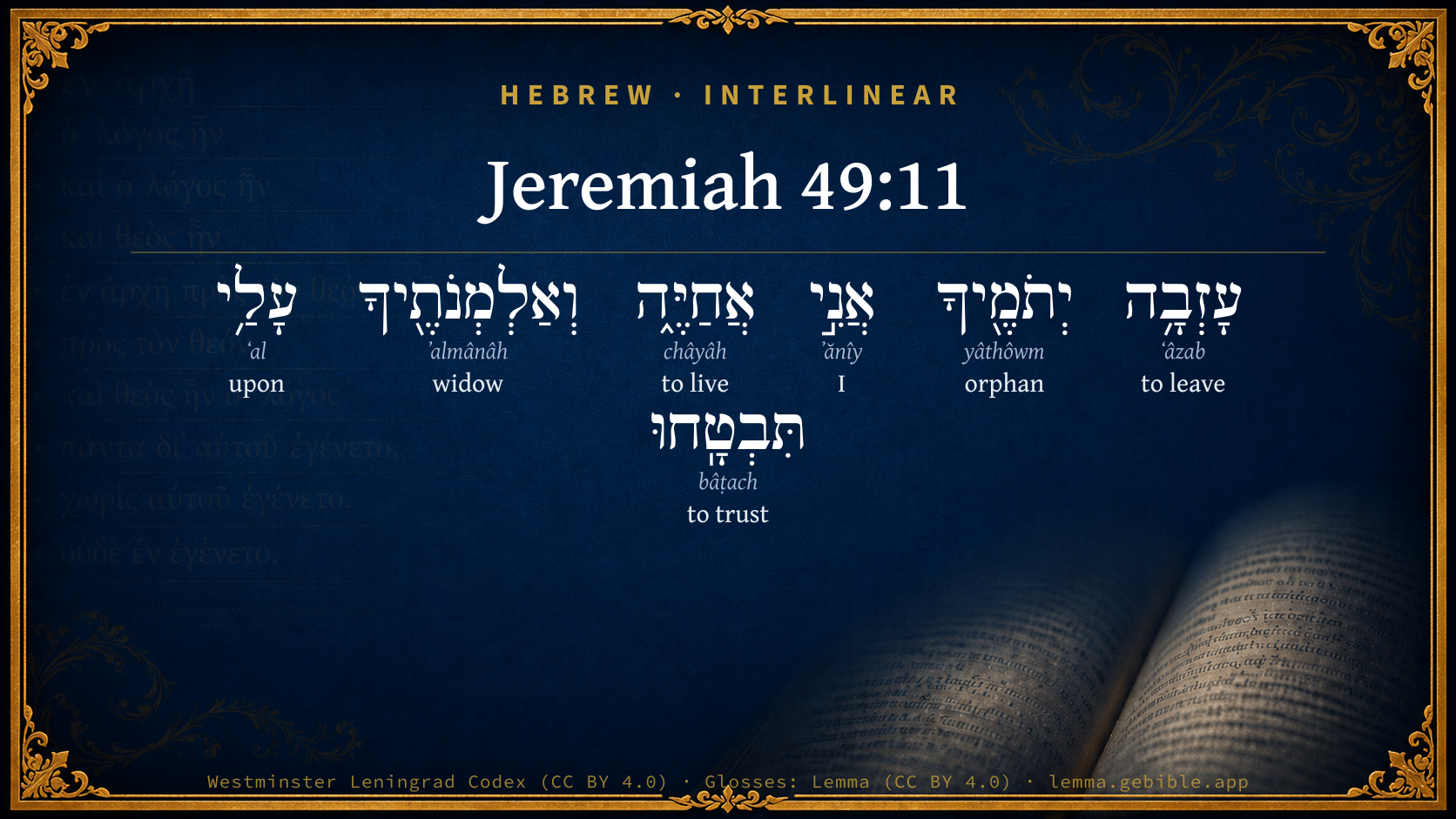
Jeremiah 49:11

Hebrew (Westminster Leningrad Codex) Jeremiah 49:11 appears in the Hebrew Old Testament. The text above is from the Westminster Leningrad Codex. Each word links to its Strong’s number, a concise gloss, and parsing drawn from the Open Scriptures Hebrew Bible morphology. Click any word for its full Brown-Driver-Briggs (BDB) entry.
Download image
Cite this verse

Jeremiah 49:11 (World English Bible). Public Domain. Lemma interlinear Bible study tool, https://lemma.gebible.app/v/jeremiah/49/11.

Show BibTeX & RIS
BibTeX
RIS
English Translation
Leave your fatherless children, I will preserve them alive; and let your widows trust in me.
World English Bible · Public Domain
Download a study sheet

One document with this verse’s original text, its word-by-word gloss line, the meaning frame, cross-references with their text, attributed commentary, and full source and license credits — printable, and it pastes into notes with its structure intact.

This verse Autodidact and up

Study sheet (.html) Plain text (.txt)

A passage Seminary Student

Up to 50 verses in one chapter. A passage sheet keeps up to 6 commentary sources and 12 cross-references per verse, in the order this page ranks them, and says so on the sheet whenever that leaves anything out. Ask for a single verse and you get the Autodidact verse sheet above.

Everything on this page stays free to read, with no account — the sheet is a download of what is already on screen, not access to it.

Want to remove ads? Support Godless Engineer
Compare translations 3

The same verse in 3 English versions, stacked beneath the original-language interlinear above. Click any original word for its lexicon entry.

Each is an independent rendering of the whole verse — the interlinear is not word-aligned to these translations.

Highlighted words mark where these versions differ — a whole-verse word diff, not a word-by-word alignment.

  • World English Bible Public Domain
    Leave your fatherless children, I will preserve them alive; and let your widows trust in me.
  • King James Version Public Domain
    Leave thy fatherless children, I will preserve them alive; and let thy widows trust in me.
  • unfoldingWord Literal Text CC BY-SA 4.0
    Leave your orphans behind. I will take care of their lives, and your widows can trust in me.”

unfoldingWord Literal Text — © unfoldingWord, licensed CC BY-SA 4.0. Word-aligned USFM3 via Door43 (git.door43.org/unfoldingWord/en_ult).

Versions to compare (up to 4)

3 of 4 selected

Show all 18 translations

Every available English version of this verse, each an independent rendering of the whole verse.

  • World English Bible Public Domain
    Leave your fatherless children, I will preserve them alive; and let your widows trust in me.
  • Berean Standard Bible Public Domain
    Abandon your orphans; I will preserve their lives. Let your widows trust in Me.”
  • Majority Standard Bible Public Domain
    Abandon your orphans; I will preserve their lives. Let your widows trust in Me.”
  • King James Version Public Domain
    Leave thy fatherless children, I will preserve them alive; and let thy widows trust in me.
  • American Standard Version (1901) Public Domain
    Leave thy fatherless children, I will preserve them alive; and let thy widows trust in me.
  • Revised Version (1885) Public Domain
    Leave thy fatherless children, I will preserve them alive; and let thy widows trust in me.
  • Geneva Bible (1599) Public Domain
    Leaue thy fathers children, and I will preserue them aliue, and let thy widowes trust in me.
  • Douay-Rheims (1899) Public Domain
    Leave thy fatherless children: I will make them live: and thy widows shall hope in me.
  • Young's Literal Translation Public Domain
    Leave thine orphans -- I do keep alive, And thy widows -- on Me trust ye,
  • Literal Standard Version CC BY-SA 4.0
    Leave your orphans—I keep alive, || And your widows—trust on Me,
  • Unlocked Literal Bible CC BY-SA 4.0
    Leave your orphans behind. I will take care of their lives, and your widows can trust in me.”
  • unfoldingWord Literal Text CC BY-SA 4.0
    Leave your orphans behind. I will take care of their lives, and your widows can trust in me.”
  • Darby Bible Public Domain
    Leave thine orphans, I will preserve them alive; and let thy widows trust in me.
  • World Messianic Bible Public Domain
    Leave your fatherless children. I will preserve them alive. Let your widows trust in me.”
  • Webster's Bible Public Domain
    Leave thy fatherless children, I will preserve them alive; and let thy widows trust in me.
  • Free Bible Version CC BY-SA 4.0
    However, you can leave your orphans to me because I will protect them. Have your widows put their trust in me.
  • Bible in Basic English Public Domain
    Put in my care your children who have no father, and I will keep them safe; and let your widows put their faith in me.
  • JPS Tanakh (1917) Public Domain
    Leave thy fatherless children, I will rear them, and let thy widows trust in Me.

Literal Standard Version (2020), Covenant Press — licensed CC BY-SA 4.0. Text via the HelloAO Bible API (eBible.org). Unlocked Literal Bible (unfoldingWord) — licensed CC BY-SA 4.0. Text via the HelloAO Bible API (eBible.org). unfoldingWord Literal Text — © unfoldingWord, licensed CC BY-SA 4.0. Word-aligned USFM3 via Door43 (git.door43.org/unfoldingWord/en_ult). Free Bible Version, Dr. Jonathan Gallagher — licensed CC BY-SA 4.0. Text via the HelloAO Bible API (eBible.org).

Word by word

More ways to search: Search by grammar → Find every occurrence → Compare this word →

Practice this passage: Drill this verse → Learn its vocabulary →

About this verse

These counts appear in no published source. They are computed here, from the morphology-tagged text and Lemma’s own curated glosses. What Lemma adds →

7
words
7
distinct lemmas
Prophets
section

Shared distinctive vocabulary

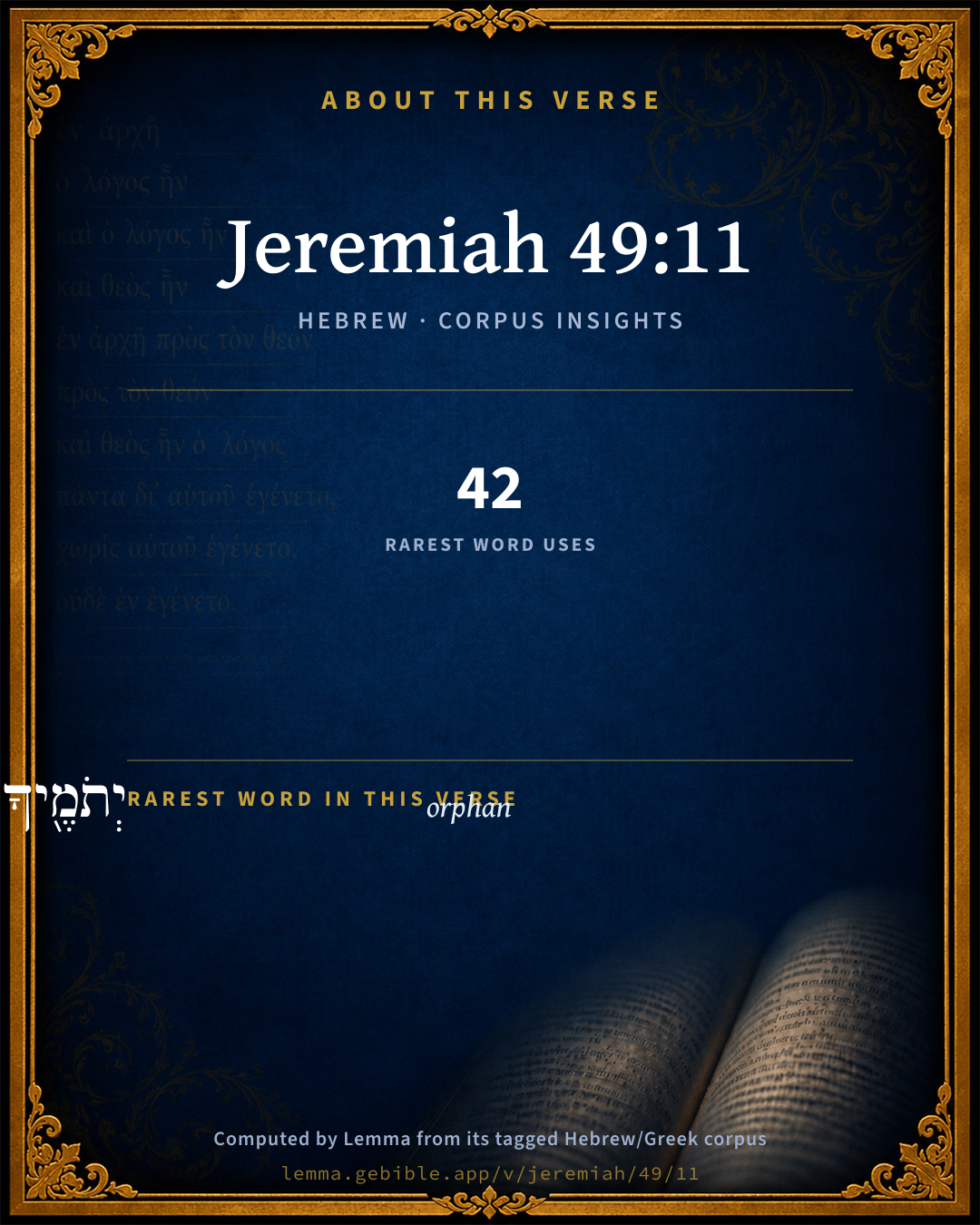
יְתֹמֶ֖יךָ orphan H3490 occurs in 42 verses of the Hebrew Bible. Also found in:

Grammatical profile

  • 3 verbs
  • 2 nouns
  • 1 pronoun
  • 1 preposition

Verb forms

  • עָזְבָ֥ה Qal · Imperative
  • אֲחַיֶּ֑ה Piel · Imperfect
  • תִּבְטָֽחוּ Qal · Jussive

Cross-references

11

Topical passages linked to Jeremiah 49:11 in the Treasury of Scripture Knowledge — connected by theme and wording, ordered by reader-vote popularity; previews shown in the World English Bible.

  • Psalms 68:5 A father of the fatherless, and a defender of the widows, Is God in his holy habitation.
  • Hosea 14:3 Assyria can't save us. We won't ride on horses; Neither will we say any more to the work of our hands, 'Our gods!' For in you the fatherless finds mercy."
  • James 1:27 Pure religion and undefiled before our God and Father is this: to visit the fatherless and widows in their affliction, and to keep oneself unstained by the world.
  • 1 Timothy 5:5 Now she who is a widow indeed, and desolate, has her hope set on God, and continues in petitions and prayers night and day.
  • Deuteronomy 10:18 He does execute justice for the fatherless and widow, and loves the foreigner, in giving him food and clothing.
  • Psalms 82:3 "Defend the weak, the poor, and the fatherless. Maintain the rights of the poor and oppressed.
  • Psalms 146:9 Yahweh preserves the foreigners. He upholds the fatherless and widow, But the way of the wicked he turns upside down.
  • Proverbs 23:10–11 Don't move the ancient boundary stone. Don't encroach on the fields of the fatherless:
  • Jonah 4:11 Shouldn't I be concerned for Nineveh, that great city, in which are more than one hundred twenty thousand persons who can't discern between their right hand and their left hand; and also much cattle?"
  • Malachi 3:5 I will come near to you to judgment; and I will be a swift witness against the sorcerers, and against the adulterers, and against the perjurers, and against those who oppress the hireling in his wages, the widow, and the fatherless, and who deprive the foreigner of justice, and don't fear me," says Yahweh of Hosts.
  • Psalms 10:14–18 But you do see trouble and grief; You consider it to take it into your hand. You help the victim and the fatherless.

Cross-references courtesy of OpenBible.info (CC BY 4.0).

Hebrew and Greek witnesses Masoretic Hebrew ↔ Greek Septuagint

The same verse in the two great witnesses to the Old Testament, shown verse-for-verse.

These are two independent witnesses, not word-aligned to each other, and the Septuagint is shown in lemma (dictionary) form.

Hebrew Jeremiah 49:11 Masoretic · Westminster Leningrad Codex

עָזְבָ֥ה יְתֹמֶ֖יךָ אֲנִ֣י אֲחַיֶּ֑ה וְאַלְמְנֹתֶ֖יךָ עָלַ֥י תִּבְטָֽחוּ

Leave your fatherless children, I will preserve them alive; and let your widows trust in me.

World English Bible · Public Domain

Greek LXX Structure differs

In the Septuagint, Jeremiah is about an eighth shorter than the Hebrew and arranges its material differently — the Oracles Against the Nations (Hebrew chapters 46–51) appear in the middle of the Greek book, after 25:13. Because the chapter and verse boundaries do not line up, a verse-for-verse comparison with the Hebrew is not shown.

A verse-for-verse comparison isn’t shown here because the chapters and verses don’t line up. Switch to the LXX edition with the MT / LXX toggle above to read the Greek directly.

Hebrew: Westminster Leningrad Codex (CC BY 4.0). Greek: Septuagint (public domain); English from a public-domain English Septuagint. How the Septuagint differs from the Hebrew →

Targum (Aramaic paraphrase)

1

The Targum is the ancient Jewish Aramaic paraphrase of the Hebrew Scriptures — an interpretive translation, not the Hebrew text itself. Onkelos (literal) and Pseudo-Jonathan (expansive) render the Torah, and Jonathan the Prophets. Coverage is partial: where no permissively-licensed English translation exists for a verse, only the Aramaic is shown. This is verse-level text, not a word-by-word alignment to the Hebrew.

  1. Targum Jonathan Prophets (Joshua–Malachi)
    אַתּוּן בֵּית יִשְׂרָאֵל לָא תִּשְׁבַּקְתּוּן יַתְמֵיכוֹן אֲנָא אֲקַיֵם וְאַרְמַלְתְּכוֹן עַל מֵימְרִי יִתְרַחֲצָן:

    (no public-domain English translation for this verse)

    Targum Jonathan — Aramaic: “Mikraot Gedolot” (public domain). English: “Sefaria Community Translation” (CC0 1.0 (public-domain dedication)); “London "Chaldee Paraphrase," 1871” (public domain). Text via Sefaria.

Commentary

Notes on Jeremiah 49:11 from classic Christian and Jewish commentators (each source and its license shown beneath its notes). The classic Christian expositions comment on the surrounding passage and are grouped to its opening verse, so a note may address several verses; the Jewish commentaries on the Tanakh (Rashi and others) are per-verse, so they appear only where the commentator wrote on this verse.

Lemma curates 59 commentaries, every one of them public domain or Creative Commons licensed, each selected and text-cleaned for this edition rather than reprinted as found. About our sources →

Trapp's Complete Commentary

John Trapp

Jer 49:11 Leave thy fatherless children, I will preserve [them] alive; and let thy widows trust in me.

Ver. 11. Leave thy fatherless children, &c.] Thus God speaketh to the profane Edomites in derision, but to all true Israelites in serious sadness: and so it is very comfortable, and must needs be a good stay of mind to a dying saint, as it was to Claviger, a dutch divine {a} He was held happy of whom Cassiodore saith, So many sons, so many counsellors to the state, {b} but he is happier that can say, So many children, so many of God’s clients, heaven’s heirs, &c.

{a} Selnec., Paedag. Christ., par. 2. p. 379.

{b} Quot dedit familiae iuvenes, tot reddidit Curiae consulares.

John Trapp, A Commentary or Exposition upon All the Books of the Old and New Testament (1647–1656) — public domain. Text from a community e-Sword module.

The Biblical Illustrator

Joseph S. Exell

Jer_49:11

Leave thy fatherless children, I will preserve them alive; and let thy widows trust in Me.

The compassion and beneficence of the Deity

No subject is more open to general observation, or more confirmed by manifold experience, than the goodness of God. In Scripture it is most frequently presented to us in the light of compassion to the distresses of mankind (Psa_102:17; Psa_10:17; Psa_58:5; Psa_69:33; Psa_146:7; Psa_22:24, &c.).

I. The discoveries of Divine compassion were purposely intended to furnish to us particular ground for trust in God amid all the vicissitudes of human life. Compassion is a principle which we all feel and know. We know that it is the strongest of all benevolent instincts in our nature, and that it tends directly to interest us in behalf of those who need our aid. We are taught to believe that a similar attribute belongs to the Divine nature; in order that, from that species of goodness which we are best acquainted with, and which we can most rely upon, we may be trained both to love our Almighty Benefactor, and, as long as we are in the practice of our duty, to trust to His protection amid every distress. Compassion to the unfortunate, as it is exerted among men, is indeed accompanied with certain disturbed and painful feelings, arising from sympathy with those whom we pity. But every such feeling we must remove from our thoughts when we ascribe an affection of this nature to the Deity. His compassion is such a regard as suits the perfection of the great Governor of the universe, whose benignity, undisturbed by any violent emotion, ever maintains the same tranquil tenor, like the unruffled and uninterrupted serenity of the highest heavens.

II. Such discoveries of the Divine nature were designed, not only to administer encouragement and consolation, but also to exhibit the pattern of that disposition which we are bound, in our measure, to imitate and follow. That hardness of heart which renders men insensible to the distresses of their brethren, that insolence of prosperity which inspires them with contempt of those who are fallen below them, are always represented in Scripture as dispositions most opposite to the nature of God, and most hateful in His sight. In order to make this appear in the strongest light, He has turned His goodness chiefly into the channel of compassionate regard to those whom the selfish and proud despise (Psa_12:5; Psa_10:17-18).

III. In the course of human life innumerable occasions present themselves for all the exercises of that humanity and benignity to which we are so powerfully prompted. The diversities of rank among men, the changes of fortune to which all, in every rank, are liable, the necessities of the poor, the wants of helpless youth, the infirmities of declining age, are always giving opportunities for the display of humane affections. (Hugh Blair, D. D.)

The God of orphans and widows

The Rev. J. Brown of Haddington, said that his epitaph might appropriately be: Here lies one of the cares of providence, who early wanted both father and mother, and yet never missed them.

The Biblical Illustrator, edited by Joseph S. Exell (c. 1880s–1900s) — public domain. Text from a community e-Sword module.

Joseph Benson's Commentary

Jer 49:11. Leave thy fatherless children, I will preserve them, &c. — The Chaldee paraphrast understands this of the Jews, to whom the following words do certainly belong, as if it contained God’s promise to take care of their families, in that distressed and forlorn state to which the captivity had reduced them. Some, who apply it to the Edomites, understand it as spoken by way of irony, in which light they understand Isa 16:4. “But there is nothing in the context,” says Houbigant, “which can lead to this interpretation. I rather understand it as a prophecy; nor was it any thing wonderful that the conquerors should spare the little children and widows, from whom they had nothing to fear; nor that the Edomites should forsake both the one and the other, when compelled to a precipitate flight.” Or, it is a promise that God would not wholly destroy the race of Esau, but protect and preserve a remnant of them; and that, at the time when he sent these his judgments on the proud and self-confident, and all their boasted strength was cast down, the weak and helpless should be remembered by him, the Father of mercies.

Joseph Benson's Commentary on the Old and New Testaments (1811–1818) — public domain. Text from a community e-Sword module.

Geneva Bible (1599)

Geneva Bible translators

The destruction shall be so great, that there shall be none left to take care over the widows and the fatherless.

Geneva Bible (1599) marginal notes — public domain. Text via Bolls.life.

Jamieson, Fausset & Brown

Robert Jamieson, A. R. Fausset & David Brown

Thy fatherless and widows must rest their hope in God alone, as none of the adult males shall be left alive, so desperate will be the affairs of Edom. The verse also, besides this threat, implies a promise of mercy to Esau in God's good time, as there was to Moab and Ammon (Jer 49:6; Jer 48:47); the extinction of the adult males is the prominent idea (compare Jer 49:12).

Jamieson, Fausset & Brown — Commentary Critical and Explanatory on the Whole Bible (1871) — public domain (CC PDM 1.0). Text via the HelloAO Bible API.

Adam Clarke's Commentary

Verse 11. Leave thy fatherless children] The connexion of this with the context is not easy to be discerned; but, as a general maxim, it is of great importance. Widows and orphans are the peculiar care of God. He is as the best of fathers to the one, and the most loving of husbands to the other. Even the widows and orphans of Esau, who escape the general destruction, shall be taken care of by the Lord.

Adam Clarke's Commentary on the Bible (1810–1826) — public domain. Text from a community e-Sword/MySword module.

John Calvin's Commentaries

With regard to the end of the verse, some give this explanation, “There will be none to say:” there is then a word to be understood, — “there will be none to say, Leave thy orphans to me, I will nourish or sustain them, or I will he a father to them; and thy widows, let them hope or trust in me, or rest on me.” For it is no small comfort to parents, when they know that their widows would have one to flee to, and also their orphans. When one dies and sees that his widow is destitute of every help, and sees that his orphans are miserable and needy, his paternal and conjugal love is grievously wounded. For is it more bitter than death itself, when the husband cannot provide any help for his widow, when he cannot provide any relief for his orphans. Hence some interpreters think that the ruin of this people is in this way exaggerated; that is, because no one would be found to bring comfort to parents, and to take as it were the place of the dead.

But the meaning would not be unsuitable, were the words deemed ironical, that the Prophet spoke in the person of God, Leave to me thy orphans, I will nourish them, and let thy widows rest on me, or trust in me: for it follows afterwards, Behold, they to whom there was no judgment, have drunk of the cup, etc. The passage then would not read amiss, if we consider that God taunts the Idumeans, and ironically declares that he would be a judge against them even after they were dead; for God’s vengeance, we know, reaches to the third and the fourth generation. As then he had before declared, that the Idumeans would be destroyed, their seed, their brethren, and their neighbors, so he now confirms the same thing, — “What! dost thou expect that I should be a father or a protector to thy orphans? that I should bring aid to thy widow? This thou expectest in vain from me.”

The Prophet, in a few words, very sharply goads the minds of the Idumeans, when God thus presents himself, and says by way of mockery, that he would be a protector to their orphans and widows; for they had indiscriminately vented their rage on orphans and women, and spared neither sex nor age. Then God shews here that there was no reason why they should expect any comfort as to their children, for he would be their avenger to the third and the fourth generation. And forced, no doubt, is what some say; at least I do not see how the words, I will nourish them, can comport with the rest of the context. This clause, then, I apply to God himself, because his vengeance would consume them with their brethren, their neighbors and their seed. And the irony is the most suitable to the whole passage; that is, that God meant to show, that he could bring no help to orphans or aid to widows, since they had been so cruel both to orphans and widows. Then follows a confirmation —

John Calvin's Commentaries (1540-1563) — public domain. Text from the Calvin Translation Society English edition (1840s-50s) via the Christian Classics Ethereal Library (ccel.org). Calvin's coverage is partial (roughly two-thirds of the Bible); uncommented books and verses are honest gaps, never fabricated. The 19th-century editor's footnotes and remarks are omitted so the notes are faithfully Calvin's own voice.

Ellicott's Commentary for English Readers

(11) Leave thy fatherless children . . .—Were the words uttered in the stern irony of one who veils & threat in the form of a promise, as some have thought, or was there even in the case of Edom a mingling of pity for the helpless? The latter view seems truer to the prophet’s character (Jer_48:36). If the sentence was passed which left the wives of Edom widows, and their children orphans, yet God had not forgotten that He was the God of the widow and the fatherless.

A Bible Commentary for English Readers, edited by Charles John Ellicott (1878–1897) — public domain. Text from a community e-Sword module.

The Cambridge Bible for Schools and Colleges

gen. ed. J. J. S. Perowne

11. A remarkable v. and decidedly Jeremianic in character, as compared with the attitude which later days would have assumed towards an enemy so bitterly hated. On the other hand, it is extremely abrupt in the midst of denunciation. We may take it as meaning, Fathers and husbands are dead, but Jehovah will protect children and widows.

The Cambridge Bible for Schools and Colleges (gen. ed. J. J. S. Perowne; Cambridge University Press, 1878–1918) — public domain. Text from a community e-Sword module.

John Gill's Exposition

Leave thy fatherless children, I will preserve them alive,.... Leave them with me; commit them to my care; I will provide for them; they shall have food and raiment, and want nothing to make them comfortable: to have such a friend or friends, promising such things to a man, when he is obliged to flee and leave his family, or is at the point of death, serves to make him easy; but there would be none left of the Edomites to say such kind words, or do such a friendly part. Some think they are the words of God, either spoken ironically or seriously; suggesting that they should have no children or widows to leave, all should be destroyed; or, if any left, they could not expect that he would take care of them, whom they had so provoked; or that such would be their miserable case, unless he had mercy on them, and took care of their fatherless children, there would be none to do it. Others think it respects a remnant of the Edomites that should be preserved, and be converted to Christ in Gospel times. The Targum takes them to be an address to the people of Israel, paraphrasing them thus:

"you, O house of Israel, your orphans shall not be left, I will sustain them, and your widows shall trust in my word:''

which last clause we render,

let your widows trust in me; which, could they be considered as the words of God, agree well with him, who is the Father of the fatherless, and Judge of the widows, Psa 68:5; and a great encouragement to persons, in such circumstances, to place their confidence in him; and it must be right so to do.

John Gill's Exposition of the Whole Bible (1746–1763) — public domain (CC PDM 1.0). Text via the HelloAO Bible API.

Matthew Poole's English Annotations

The only question upon this verse is, whether, in the whole of it, it be a promise or a threatening: if it be a promise, the sense is, that though this great destruction should come upon the body of the Edomites, yet God would take care of some of their

fatherless children, whose parents being carried into captivity, they had none to provide for them: if it be taken as an ironical threatening, it soundeth ruin to those as well as the rest, and

I will is as much as I will not. But others think that these are rather to be understood with the supply of some other words, There is not, or there shall be none to say, Leave thy fatherless children, &c.; and whoso considereth those words in the tenth verse, his seed shall be spoiled, will see reason to judge it rather a threatening (whether by way of irony or no) than a promise.

Matthew Poole's English Annotations on the Holy Bible (1683–1685) — public domain. Text from a community e-Sword/MySword module.

Whedon's Commentary on the Bible

Daniel D. Whedon

11. Thy fatherless children, I will preserve — God’s mercy then, is not taken away from them, but restrained. In this there is an impressive intimation of their swiftly coming helplessness and desolation, and at the same time of God’s pity and care.

Daniel D. Whedon (gen. ed.), Commentary on the Old and New Testaments (1874–1909) — public domain. Text from a community e-Sword module.

The Pulpit Commentary

Vers. 11-13. A merciful mitigation of the prophet"s stern threat. The true God will provide for the widows and orphans, if Edom will but commit them to him. And let not Edom think it strange that he is punished; for even Israel, the chosen people, has drunk of the bitter cup. Yea, Jehovah has sworn "by himself" that all Edom"s cities shall be laid waste.

Leave thy fatherless children, etc. The invitation means more than might be supposed. It is equivalent to a promise of the revival of the Edomitish people. (comp. on Jer_46:26 Jer_48:47)

A promise for orphans and widows.

I GOD BRINGS SOME MITIGATION TO THE SEVEREST CALAMITY. The merciful assurance of care for the helpless sufferers occurs in the midst of a stern denunciation of doom upon Edom, as a strange and startling relief to the terrible words that follow and precede. Here is a rift in the cloud through which a sunbeam of Divine love falls upon the dark scene of judgment. The thunderstorm of God"s wrath never so covers the whole heavens that no ray of mercy can penetrate to the wretched sufferers. Behind the stern frown there is always the melting heart of Divine pity. God"s anger is the anger of love, not that of hatred. Wherever it is possible to give relief he will do so.

II WHEN GOD SENDS TROUBLE HE ALSO SENDS A DELIVERANCE. Possibly the trouble is beyond escape; for a season it must be endured; but in the end there is a Divine salvation for those who will seek it aright. Repeatedly denunciations of woe against some guilty nation are followed by the promise that "in the latter day" God "will bring again the captivity" of it. (e.g. Jer_46:26 Jer_48:47; ver. 39) The promise to Edom of the preservation of the children implies a future for the race. The widows and children are helpless sufferers, and it is for these alone that the deliverance is promised. God has peculiar pity on the most needy.

III ORPHANS AND WIDOWS HAVE SPECIAL ENCOURAGEMENTS TO LOOK FOR HELP FROM GOD. If such a merciful promise as that of our text is made to a heathen nation, how much more assurance may the people of God feel! and if it is given to the families of the wicked and in the midst of the sentence of punishment, how much more must it apply to the families of true Christians! God is "a Father of the fatherless, and a Judge of widows"; (Psa_68:5) "He relieveth the fatherless and widows"; (Psa_146:9) "He will establish the border of the widow". (Pro_15:25) If God numbers the hairs of our head, will he neglect our children? If they who are desolate indeed cry unto him, can the All-merciful neglect their prayer?

IV GOD"S PROMISES FOR ORPHANS AND WIDOWS SHOULD ENCOURAGE FAITH IN HIM.

1. The father should trust his children to God. That is a terrible moment when the strong man feels the sentence of death within him, and bows his head, knowing that he must leave his helpless ones behind. Yes, must leave them. Then let him leave them to God. Here is a call to resignation and to trust. The promise is in a measure conditioned by it. If the dying man would have his little ones cared for when they are set adrift on the cold, homeless world, let him entrust them to God. Such a trust will never be broken. But if he refuse to do this, he cannot complain should they suffer harm after he has gone.

2. The widow must trust for herself. "Let thy widows trust in me." The children may be too young to seek refuge in God. Their father must do this for them. But the widow must exercise her own faith. Her husband"s faith will not avail for her. Let her trust, and then, but not till then, she shall find her consolation in the great Comforter.

Consolation for a father"s dying bed.

Perhaps there is no greater sorrow than is suggested here the husband and father leaving widow and helpless children apparently without a friend to support or aid them. If it were not for the beatific vision of God, the perfect persuasion of his wisdom and power and love, which the blessed dead enjoy, they would be entreating God piteously to allow them to return hither once more, and to shelter their loved ones from the cruel hardships of this pitiless world. We wonder, sometimes, how it is possible for a loving mother who was wont to lavish her heart"s deepest, tenderest affection upon her children, to find joy and to be happy in heaven, whither she has been suddenly translated, leaving her husband and children heart broken at losing her. Here she could never be happy without her children. How can she be happy there and they yet here? Because she is at the fountain of all love, from which all her love was but a rill; she is with God, who is Love, and who she knows will deal only in the best of ways ways far better than she herself could have devised, for those who are now weeping over her grave, and missing and mourning her every hour of the day. Now, of those told of in this verse we note

I THAT TO LEAVE THEM TO GOD IS ALL WE CAN DO. We may and we ought to make provision for them to the best of our power. That is but a spurious and miserable travesty of faith in God which would neglect all such aids as life insurance and the like, on the ground that making such provision shows distrust and unbelief in God. Some speak thus, but they speak foolishly. Might we not as well refuse to work for our daily bread, on the ground that it is written, "My God shall supply all your need"? But who does not know that God"s way of supplying our need is by giving us strength to work and minds to think, enduing us with the means of gaining our bread? And is it not so in this case also? Would not a man be most wrong who, because of what is here said, neglected to make all due provision in his power? But having done this, like Jacob and Joseph, we may safely leave our children, as they did, to the care of God, confident that he will care for them according to his word.

II AND GOD HONOURS SUCH TRUST. As a fact, and a very interesting one it is, how wonderfully such bereaved children and widows are cared for! How God raises up one friend here and another there, and probably, if a comparison could be made, it would be found that such children have been as well cared for as any others; life has been as bright to them as for those whose earlier years were clouded over by no such sore bereavement. There may be exceptions, but the rule is surely for God to honour such trust. Can he who has said, "Ask, and ye shall receive," refuse the prayer of a believing man at such a time?

III AND IT IS A REASONABLE TRUST. What would we desire more for our children than that they should be cared for by such a one who, so far as man can be, is like God? having the power and the will, the knowledge and wisdom, and, above all, the love, which are in God. Who would not crave for our dear ones a guardian like that?

IV THE CONDITIONS OF THE TRUST are that he who is about to leave behind widow and children should be himself one who trusts in God; that he have trained his children in the ways of the Lord, and sought to make his home a godly home. Verily such shall have their reward, yonder in heaven and here on earth, and especially at that supreme moment when he has to leave his loved ones and to lie down and die. Then for him shall the faith of this promise be precious indeed. C.

The Pulpit Commentary (1880–1919), ed. H.D.M. Spence-Jones & Joseph S. Exell — public domain. Text from a community e-Sword module.

Scofield Reference Notes

C. I. Scofield

trust

(See Scofield "Psa 2:12").

The Scofield Reference Bible (1917 edition), notes by C. I. Scofield — public domain. Text from a community e-Sword module.

Rashi

Rabbi Shlomo Yitzchaki (Rashi)

Leave your orphans whom you have orphaned of Israel.

Rashi on the Tanakh — English translations: “The Judaica Press complete Tanach with Rashi, translated by A. J. Rosenberg” (CC BY 4.0); “Pentateuch with Rashi's commentary by M. Rosenbaum and A.M. Silbermann, 1929-1934” (public domain); “The Metsudah Tanach series, Lakewood, N.J” (CC BY 4.0); and “The Book of Joshua, Metsudah Publications, 1997” (CC BY 4.0). Text via Sefaria.

Lesson kit

Teaching starters — assembled from the data on this page, not authored interpretation. Every prompt links to the verse data it draws on. Edit before teaching.

Jeremiah, in the Prophets, opens this verse with 7 words (7 distinct Hebrew lemmas). Its most distinctive word is yâthôwm (“orphan”). A historical commentator’s framing appears above. Read the whole chapter for the surrounding context.

Discussion questions

  1. The word yâthôwm carries the sense “orphan.” How does it shape the verse?
  2. Exodus 22:22 shares the word «orphan» with this verse. How do the two illuminate each other?
  3. These translations render this verse differently; the difference is in the English rendering, not the original. What questions does that raise?
  4. The verb «עָזְבָ֥ה» is Qal Imperative. How does its form color the action?
  5. Reading how Trapp's Complete Commentary and The Biblical Illustrator read this verse, where do the two commentators agree and where do they part?

Things to notice

Reading settings

Reading text

Shown beneath each verse's original-language words.

Old Testament
Old Testament edition

Read the OT as the Masoretic Hebrew (MT) or the Greek Septuagint (LXX).

English shown for the Greek Septuagint (in the Hebrew ↔ Greek comparison).

Comparing translations? Open the Compare panel on any verse page to stack up to four side by side.