Isaiah 38:21

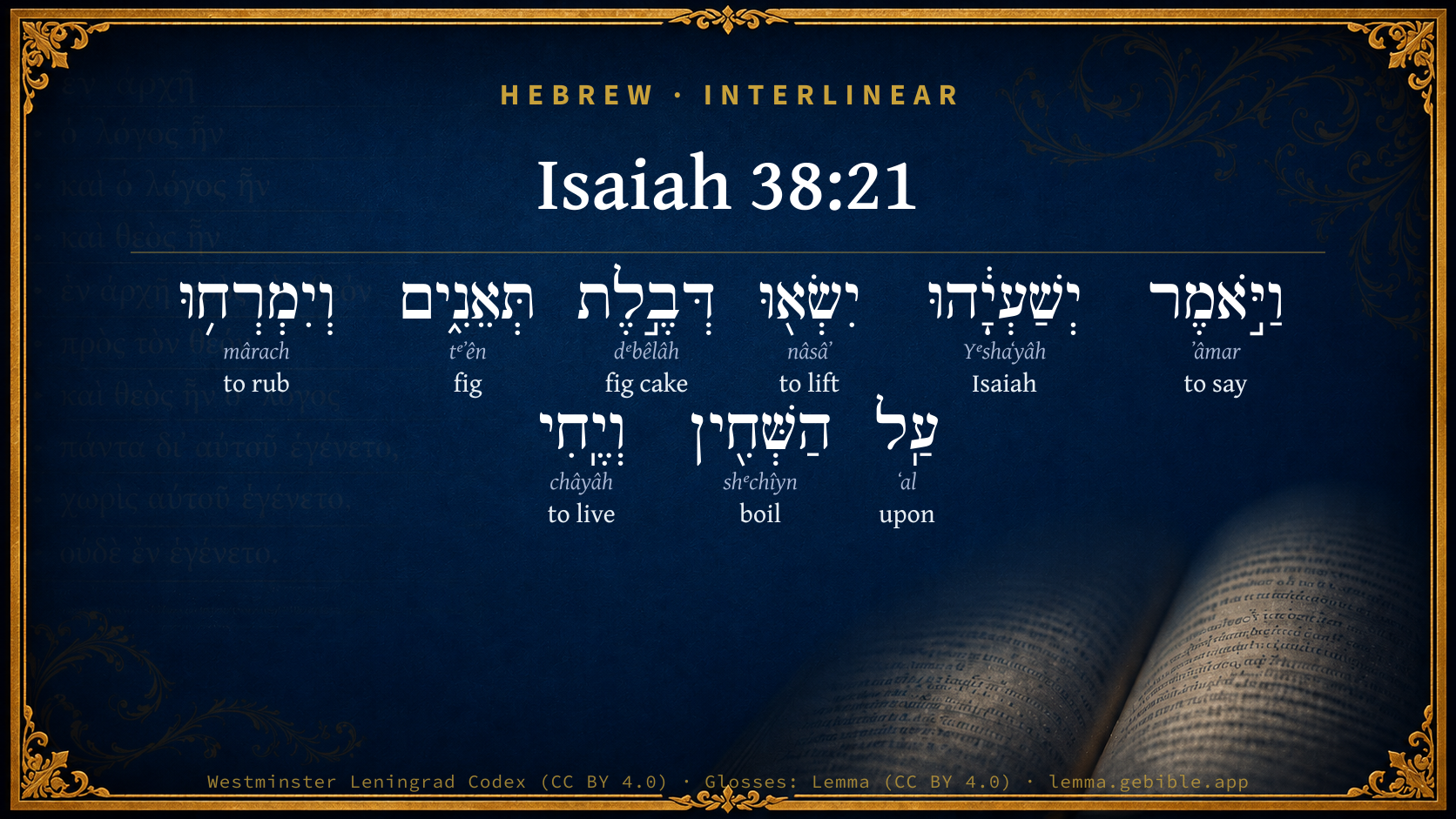
Hebrew (Westminster Leningrad Codex) Isaiah 38:21 appears in the Hebrew Old Testament. The text above is from the Westminster Leningrad Codex. Each word links to its Strong’s number, a concise gloss, and parsing drawn from the Open Scriptures Hebrew Bible morphology. Click any word for its full Brown-Driver-Briggs (BDB) entry.
Download image
Cite this verse

Isaiah 38:21 (World English Bible). Public Domain. Lemma interlinear Bible study tool, https://lemma.gebible.app/v/isaiah/38/21.

Show BibTeX & RIS
BibTeX
RIS
English Translation
Now Isaiah had said, Let them take a cake of figs, and lay it for a plaster on the boil, and he shall recover.
World English Bible · Public Domain
Highlights
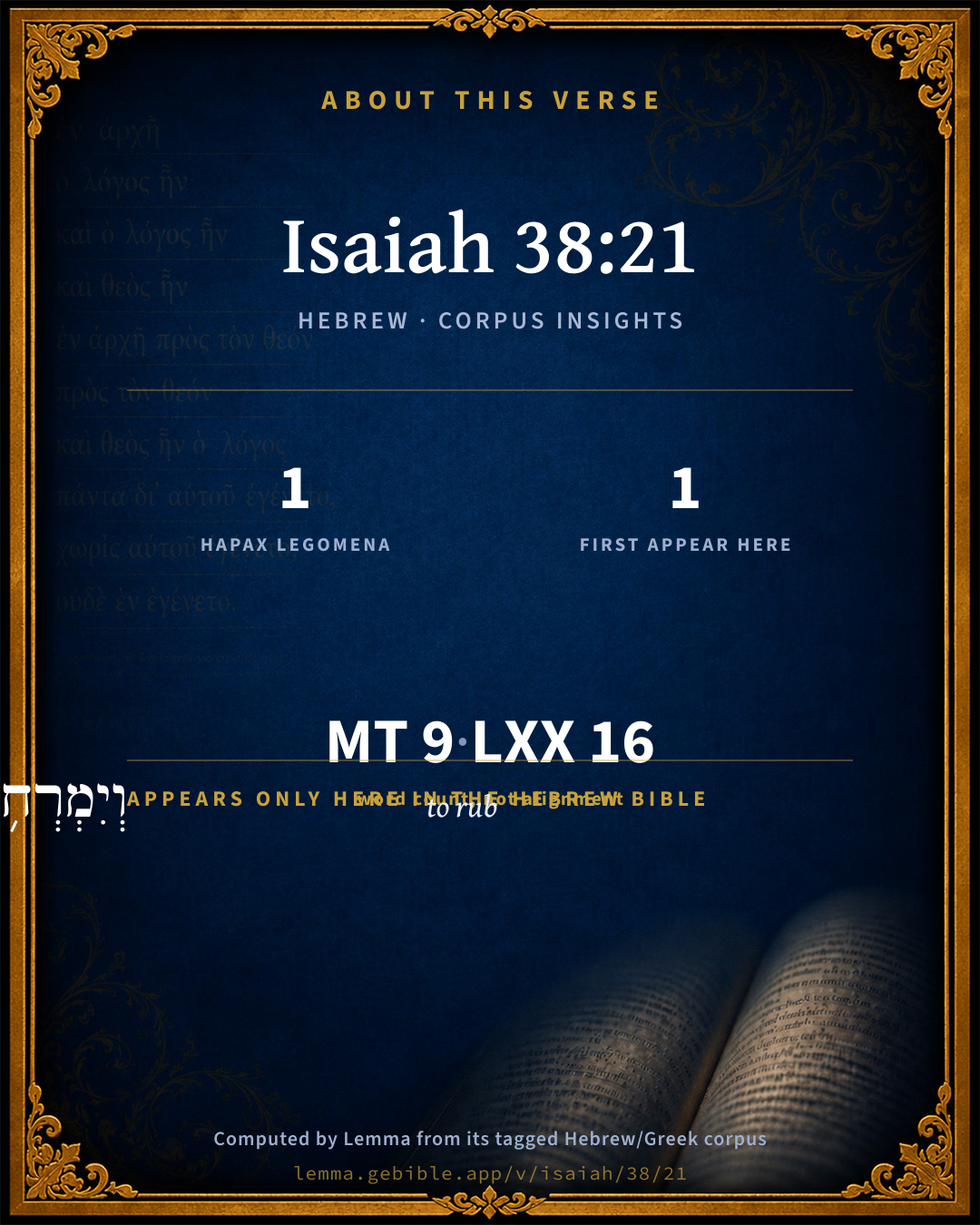
  • 1 hapax legomenon — only here in the Hebrew Bible
  • 1 first appearance in the Hebrew Bible
Full analysis ↓
Download a study sheet

One document with this verse’s original text, its word-by-word gloss line, the meaning frame, cross-references with their text, attributed commentary, and full source and license credits — printable, and it pastes into notes with its structure intact.

This verse Autodidact and up

Study sheet (.html) Plain text (.txt)

A passage Seminary Student

Up to 50 verses in one chapter. A passage sheet keeps up to 6 commentary sources and 12 cross-references per verse, in the order this page ranks them, and says so on the sheet whenever that leaves anything out. Ask for a single verse and you get the Autodidact verse sheet above.

Everything on this page stays free to read, with no account — the sheet is a download of what is already on screen, not access to it.

Want to remove ads? Support Godless Engineer
Compare translations 3

The same verse in 3 English versions, stacked beneath the original-language interlinear above. Click any original word for its lexicon entry.

Each is an independent rendering of the whole verse — the interlinear is not word-aligned to these translations.

Highlighted words mark where these versions differ — a whole-verse word diff, not a word-by-word alignment.

  • World English Bible Public Domain
    Now Isaiah had said, Let them take a cake of figs, and lay it for a plaster on the boil, and he shall recover.
  • King James Version Public Domain
    For Isaiah had said, Let them take a lump of figs, and lay it for a plaister upon the boil, and he shall recover.
  • unfoldingWord Literal Text CC BY-SA 4.0
    Now Isaiah had said, “Let them take a lump of figs and plaster on the boil, and he will live.”

unfoldingWord Literal Text — © unfoldingWord, licensed CC BY-SA 4.0. Word-aligned USFM3 via Door43 (git.door43.org/unfoldingWord/en_ult).

Versions to compare (up to 4)

3 of 4 selected

Show all 18 translations

Every available English version of this verse, each an independent rendering of the whole verse.

  • World English Bible Public Domain
    Now Isaiah had said, Let them take a cake of figs, and lay it for a plaster on the boil, and he shall recover.
  • Berean Standard Bible Public Domain
    Now Isaiah had said, “Prepare a lump of pressed figs and apply it to the boil, and he will recover.”
  • Majority Standard Bible Public Domain
    Now Isaiah had said, “Prepare a lump of pressed figs and apply it to the boil, and he will recover.”
  • King James Version Public Domain
    For Isaiah had said, Let them take a lump of figs, and lay it for a plaister upon the boil, and he shall recover.
  • American Standard Version (1901) Public Domain
    Now Isaiah had said, Let them take a cake of figs, and lay it for a plaster upon the boil, and he shall recover.
  • Revised Version (1885) Public Domain
    Now Isaiah had said, Let them take a cake of figs, and lay it for a plaister upon the boil, and he shall recover.
  • Geneva Bible (1599) Public Domain
    Then said Isaiah, Take a lumpe of drye figs and lay it vpon the boyle, and he shall recouer.
  • Douay-Rheims (1899) Public Domain
    Now Isaias had ordered that they should take a lump of figs, and lay it as it plaster upon the wound, and that he should be healed.
  • Young's Literal Translation Public Domain
    And Isaiah saith, `Let them take a bunch of figs, and plaster over the ulcer, and he liveth.'
  • Literal Standard Version CC BY-SA 4.0
    And Isaiah says, “Let them take a bunch of figs, and plaster over the ulcer, and he lives.”
  • Unlocked Literal Bible CC BY-SA 4.0
    Now Isaiah had said, “Let them take a lump of figs and put it on the boil, and he will recover.”
  • unfoldingWord Literal Text CC BY-SA 4.0
    Now Isaiah had said, “Let them take a lump of figs and plaster on the boil, and he will live.”
  • Darby Bible Public Domain
    Now Isaiah had said, Let them take a cake of figs, and lay it for a plaster upon the boil, and he shall recover.
  • World Messianic Bible Public Domain
    Now Isaiah had said, “Let them take a cake of figs, and lay it for a poultice on the boil, and he shall recover.”
  • Webster's Bible Public Domain
    For Isaiah had said, Let them take a lump of figs, and lay it for a plaster upon the boil, and he will recover.
  • Free Bible Version CC BY-SA 4.0
    Isaiah had said, “Prepare a dressing of figs and spread it on the skin sores so he may recover.”
  • Bible in Basic English Public Domain
    And Isaiah said, Let them take a cake of figs, and put it on the diseased place, and he will get well.
  • JPS Tanakh (1917) Public Domain
    And Isaiah said: 'Let them take a cake of figs, and lay it for a plaster upon the boil, and he shall recover.'

Literal Standard Version (2020), Covenant Press — licensed CC BY-SA 4.0. Text via the HelloAO Bible API (eBible.org). Unlocked Literal Bible (unfoldingWord) — licensed CC BY-SA 4.0. Text via the HelloAO Bible API (eBible.org). unfoldingWord Literal Text — © unfoldingWord, licensed CC BY-SA 4.0. Word-aligned USFM3 via Door43 (git.door43.org/unfoldingWord/en_ult). Free Bible Version, Dr. Jonathan Gallagher — licensed CC BY-SA 4.0. Text via the HelloAO Bible API (eBible.org).

Word by word

More ways to search: Search by grammar → Find every occurrence → Compare this word →

Practice this passage: Drill this verse → Learn its vocabulary →

About this verse

These counts appear in no published source. They are computed here, from the morphology-tagged text and Lemma’s own curated glosses. What Lemma adds →

9
words
9
distinct lemmas
Prophets
section

Notable vocabulary

1 hapax legomenon — a word that appears only here in the entire Hebrew Bible:

  • וְיִמְרְח֥וּ to rub H4799

First appearance in Scripture

This word makes its first canonical appearance in the Hebrew Bible here:

  • וְיִמְרְח֥וּ to rub H4799

Shared distinctive vocabulary

דְּבֶ֣לֶת fig cake H1690 occurs in 5 verses of the Hebrew Bible. Also found in:

Grammatical profile

  • 4 verbs
  • 4 nouns
  • 1 preposition

Verb forms

  • וַיֹּ֣אמֶר Qal · Sequential Imperfect
  • יִשְׂא֖וּ Qal · Imperfect
  • וְיִמְרְח֥וּ Qal · Imperfect
  • וְיֶֽחִי Qal · Imperfect

Hebrew & Septuagint length

In English translation the verse runs 24 words from the Hebrew and 25 from the Septuagint (LXX English) — closely comparable.

A rough comparison of the two English renderings, which tokenize alike — not a word-level alignment.

Word counts can differ between the Hebrew and the Greek without any difference in meaning — e.g. the Hebrew direct-object marker אֵת has no separate Greek word, and Greek often adds the article ὁ.

In the original languages it is 9 Hebrew tokens and 16 Greek tokens — but the two are counted differently (Hebrew bundles its prefixes and suffixes into one token; the Greek is in lemma form), so that isn’t a like-for-like length.

Cross-references

3

Topical passages linked to Isaiah 38:21 in the Treasury of Scripture Knowledge — connected by theme and wording, ordered by reader-vote popularity; previews shown in the World English Bible.

  • 2 Kings 20:7–8 Isaiah said, Take a cake of figs. They took and laid it on the boil, and he recovered.
  • Mark 7:33 He took him aside from the multitude, privately, and put his fingers into his ears, and he spat, and touched his tongue.
  • John 9:6 When he had said this, he spat on the ground, made mud with the saliva, anointed the blind man's eyes with the mud,

Cross-references courtesy of OpenBible.info (CC BY 4.0).

Hebrew and Greek witnesses Masoretic Hebrew ↔ Greek Septuagint

The same verse in the two great witnesses to the Old Testament, shown verse-for-verse.

These are two independent witnesses, not word-aligned to each other, and the Septuagint is shown in lemma (dictionary) form.

Hebrew Isaiah 38:21 Masoretic · Westminster Leningrad Codex

וַיֹּ֣אמֶר יְשַׁעְיָ֔הוּ יִשְׂא֖וּ דְּבֶ֣לֶת תְּאֵנִ֑ים וְיִמְרְח֥וּ עַֽל הַשְּׁחִ֖ין וְיֶֽחִי

Now Isaiah had said, Let them take a cake of figs, and lay it for a plaster on the boil, and he shall recover.

World English Bible · Public Domain

Greek LXX Isaiah 38:21 Septuagint · lemma form

καί εἶπον ησαιας πρός εζεκιας λαμβάνω παλάθης ἐκ συκῆ καί τρίβω καί καταπλάσσω καί ὑγιής εἰμί

Now Esaias had said to Ezekias; Take a cake of figs, and mash them, and apply them as a plaster, and you shall be well.

LXX2012 (modern English Septuagint) · Public Domain

Hebrew: Westminster Leningrad Codex (CC BY 4.0). Greek: Septuagint (public domain); English from LXX2012 (modern English Septuagint) (Public Domain). How the Septuagint differs from the Hebrew →

Targum (Aramaic paraphrase)

1

The Targum is the ancient Jewish Aramaic paraphrase of the Hebrew Scriptures — an interpretive translation, not the Hebrew text itself. Onkelos (literal) and Pseudo-Jonathan (expansive) render the Torah, and Jonathan the Prophets. Coverage is partial: where no permissively-licensed English translation exists for a verse, only the Aramaic is shown. This is verse-level text, not a word-by-word alignment to the Hebrew.

  1. Targum Jonathan Prophets (Joshua–Malachi)
    וַאֲמַר יְשַׁעְיָהוּ יִסְבוּן דְבֵילַת תֵּינִין וִישׁוֹרְטוּן עַל שִׁיחֲנָא וְאִתַּסֵי:

    For Isaiah had said, Let them take a lump of figs, and lay it on the boil, and he shall recover.

    Targum Jonathan — Aramaic: “Mikraot Gedolot” (public domain). English: “Sefaria Community Translation” (CC0 1.0 (public-domain dedication)); “London "Chaldee Paraphrase," 1871” (public domain). Text via Sefaria.

Commentary

Notes on Isaiah 38:21 from classic Christian and Jewish commentators (each source and its license shown beneath its notes). The classic Christian expositions comment on the surrounding passage and are grouped to its opening verse, so a note may address several verses; the Jewish commentaries on the Tanakh (Rashi and others) are per-verse, so they appear only where the commentator wrote on this verse.

Lemma curates 59 commentaries, every one of them public domain or Creative Commons licensed, each selected and text-cleaned for this edition rather than reprinted as found. About our sources →

Trapp's Complete Commentary

John Trapp

Isa 38:21 For Isaiah had said, Let them take a lump of figs, and lay [it] for a plaister upon the boil, and he shall recover.

Ver. 21. Let them take a lump of figs.] Commenciatur hic usus medicinae. The patient must pray, but withal make use of means; trust God, but not tempt him. {See Trapp on "2Ki 20:7"}

John Trapp, A Commentary or Exposition upon All the Books of the Old and New Testament (1647–1656) — public domain. Text from a community e-Sword module.

The Biblical Illustrator

Joseph S. Exell

Isa_38:21

He shall recover

Christ in the sick room

I.

The Holy Ghost shows us a king and ruler of men, a dweller in palaces, a possessor of all that money can obtain, a good man, a friend of God, laid low by disease like the poorest man in the kingdom.

1. This is the old story. After all there is nothing wonderful in this. The tabernacle in which our soul lives is a most frail and complicated machine. I do not wonder so much that we die as that we live so long.

2. But whence comes this liability to sickness, disease, and death? There is only one book that supplies an answer to this question. That book is the Bible, The fall of man at the beginning has brought sin into the world, and sin has brought with it the curse of sickness, suffering, and pain. Here lies one among many proofs that the Bible is given by inspiration of God. It accounts for many things which the Deist cannot explain.

II. Learn from this chapter that sickness is not an unmixed evil. Hezekiah received spiritual benefit from his illness. Sickness ought to do us good. And God sends it in order to do us good.

1. Sickness is meant to make us think, to remind us that we have an immortal soul; and that if this soul is not saved we had better never have been born.

2. Sickness is meant to teach us that there is a world beyond the grave, and that the world we now live in is only a training-place for another dwelling, where there will be no decay, no sorrow, no tears, no misery, and no sin.

3. Sickness is meant to make us look at our past lives honestly, fairly, and conscientiously.

4. Sickness is meant to make us see the emptiness of the world, and its utter inability to satisfy the highest and deepest wants of the soul.

5. Sickness is meant to send us to our Bibles.

6. Sickness is meant to make us pray.

7. Sickness is meant to make us repent and break off our sins.

8. Sickness is meant to draw us to Christ.

9. Sickness is meant to make us sympathising towards others. (Anon.)

A fig-plaster

The application of figs leaves it uncertain whether a boil (bubon) or a carbuncle (charbon) is to be supposed. Figs were a popular emolliens or maturans; they were used to hasten the rising of the swelling, and therefore the mattering-process. (F. Delitzsch, D. D.)

The Biblical Illustrator, edited by Joseph S. Exell (c. 1880s–1900s) — public domain. Text from a community e-Sword module.

Joseph Benson's Commentary

Isa 38:21-22. For Isaiah had said, Let them take a lump of figs — See note on 2Ki 20:7. Hezekiah also had said — Or, for Hezekiah had said; What is the sign that I shall go up — Namely, within three days, as is more fully related 2Ki 20:5; 2Ki 20:8; to the house of the Lord? — For thither he designed to go first, partly that he might pay his vows and thanksgivings to God, and partly that he might engage the people to praise God with him and for him.

Joseph Benson's Commentary on the Old and New Testaments (1811–1818) — public domain. Text from a community e-Sword module.

Keil & Delitzsch

C. F. Keil & F. Delitzsch

On Isa 38:21, Isa 38:22, see the notes at the close of Isa 38:4-6, where these two vv. belong.

Keil & Delitzsch — Biblical Commentary on the Old Testament (1861–1891) — public domain (CC PDM 1.0). Text via the HelloAO Bible API. (Old Testament only.)

Tyndale Open Study Notes

Tyndale Open Resources

38:21-22 Hezekiah received a sign, reminiscent of another sign the prophet had offered Ahaz (7:11). Ahaz and Hezekiah were two bookends to a long story. Ahaz represented the ungodly king and Hezekiah the godly king. The former brought disaster on his people, while the latter rescued his people (but see ch 39).

Tyndale Open Study Notes — © Tyndale Open Resources, licensed CC BY-SA 4.0. Text via the HelloAO Bible API.

Geneva Bible (1599)

Geneva Bible translators

Read 2 Kings 20:7.

Geneva Bible (1599) marginal notes — public domain. Text via Bolls.life.

Adam Clarke's Commentary

Verse 21. Let them take a lump of figs, c.] God, in effecting this miraculous cure, was pleased to order the use of means not improper for that end. "Folia, et, quae non maturuere, fici, strumis illinuntur omnibusque quae emollienda sunt discutiendave." - PLIN. Nat. Hist. xxiii. 7. "Ad discutienda ea, quae in corporis parte aliqua coierunt, maxime possunt-ficus arida," c. - CELSUS, v. 11. See the note on 2Kg 20:7. Philemon Holland translates the passage as a medical man: - "The milke or white juice that the figge tree yieldeth is of the same nature that vinegre: and therefore it will curddle milke as well as rennet, or rendles. The right season of gathering this milkie substance is before that the figs be ripe upon the tree and then it must be dried in the shadow: thus prepared, it is good to break impostumes, and keepe ulcer open."

Adam Clarke's Commentary on the Bible (1810–1826) — public domain. Text from a community e-Sword/MySword module.

Ellicott's Commentary for English Readers

(21) For Isaiah had said . . .—The direction implies some medical training on the part of Isaiah (see Note on Isa_1:6, and Introduction), such as entered naturally into the education of the prophet-priests. They were to Israel, especially in the case of leprosy and other kindred diseases, what the priests of Asclepios were to Greece. The Divine promise guaranteed success to the use of natural remedies, but did not dispense with them, and they, like the spittle laid on the eyes of the blind in the Gospel miracles (Mar_7:33, Joh_9:6), were also a help to the faith on which the miracle depended. Both this and the following verse seem, as has been said, to have been notes to Isa_38:8, supplied from the narrative of 2 Kings 20, and placed at the end of the chapter instead of at the foot of the page, as in modern MSS. or print. The word for “boil” appears in connection with leprosy in Exo_9:9, Lev_13:18, but is used generically for any kind of abscess, carbuncle, and the like. (Comp. Job_2:7.)

A Bible Commentary for English Readers, edited by Charles John Ellicott (1878–1897) — public domain. Text from a community e-Sword module.

The Cambridge Bible for Schools and Colleges

gen. ed. J. J. S. Perowne

21. lay it for a plaister] Lit. rub it. Lump should be cake, as in R.V. Many commentators suppose that the malady from which Hezekiah suffered was the plague; and Gesenius explains that the appearance of the “boil” would be a hopeful, though not a certain, symptom of recovery. He adds that the application of figs is resorted to by modern Arabian and Turkish physicians in cases of pestilence.

21, 22. Cf. 2Ki_20:7-8. The verses are obviously out of their true places here. The pluperfects in the English Translation are ungrammatical (Driver, Tenses, pp. 84 ff.), and we must render And Isaiah said … And Hezekiah said.

The Cambridge Bible for Schools and Colleges (gen. ed. J. J. S. Perowne; Cambridge University Press, 1878–1918) — public domain. Text from a community e-Sword module.

John Gill's Exposition

Hezekiah also had said,.... Unto Isaiah, as in Kg2 20:8,

what is the sign that I shall go up to the house of the Lord? both of his health, and of his going up to the temple with thanksgiving for it; though the former is not here mentioned, as it is elsewhere; partly because it is supposed in the latter, for without that he could not have gone up to the temple; and partly because he was more solicitous for the worship and honour of God in his house, the for his health. The Syriac version transposes these verses, "Hezekiah had said, what is the sign? &c. and Isaiah had answered, let them take a lump of figs", &c. as if this latter was the sign; whereas it was that of the sun's going down ten degrees on the dial of Ahaz, Isa 38:7; see Gill on Isa 38:7, Isa 38:8.

Next: Isaiah Chapter 39

John Gill's Exposition of the Whole Bible (1746–1763) — public domain (CC PDM 1.0). Text via the HelloAO Bible API.

Albert Barnes' Notes on the Bible

For Isaiah had said - In the parallel place in Kings the statement in these two verses is introduced before the account of the miracle on the sun-dial, and before the account of his recovery 2Ki 20:7-8. The order in which it is introduced, however, is not material.

Let them take a lump of figs - The word used here (דבלה debēlâh) denotes “a round cake” of dried figs pressed together in a mass 1Sa 25:18. Figs were thus pressed together for preservation, and for convenience of conveyance.

And lay it for a plaster - The word used here (מרח mârach) denotes properly to rub, bruise, crush by rubbing; then to rub, in, to anoint, to soften. Here it means they were to take dried figs and lay them softened on the ulcer.

Upon the boil - (משׁחין mashechı̂yn). This word means a burning sore or an inflamed ulcer Exo 9:9, Exo 9:11; Lev 13:18-20. The verb in Arabic means to be hot, inflamed; to ulcerate. The noun is used to denote a species of black leprosy in Egypt, called elephantiasis, distinguished by the black scales with which the skin is covered, and by the swelling of the legs. Here it probably denotes a pestilential boil; an eruption, or inflamed ulceration produced by the plague, that threatened immediate death. Jerome says that the plaster of figs was medicinal, and adapted to reduce the inflammation and restore health. There is no improbability in the supposition; nor does anything in the narrative prohibit us from supposing that natural means might have been used to restore him. The miracle consisted in the arrest of the shade on the sun-dial, and in the announcement of Isaiah that he would recover. That figs, when dried, were used in the Materia Medica of the ancients, is asserted by both Pliny and Celsus (see Pliny, Nat. Hist. xxiii. 7; Celsus, v. 2, quoted by Lowth.)

Albert Barnes' Notes on the Bible (1834–1885) — public domain. Text from a community e-Sword/MySword module.

Matthew Poole's English Annotations

This was rather a sign appointed by God, than a natural means of the cure; for if it had a natural faculty to ripen a sore, yet it could never cure such a dangerous and pestilential disease, at least in so little time.

Matthew Poole's English Annotations on the Holy Bible (1683–1685) — public domain. Text from a community e-Sword/MySword module.

Whedon's Commentary on the Bible

Daniel D. Whedon

21, 22. For Isaiah had said — Introduced thus, these verses give the occasion for the previous song of gratitude. But their proper place is between the sixth and seventh verses, and they are so arranged in the corresponding narrative in 2 Kings 20.

A lump of figs — A cake of bruised figs to be applied to the ulcer.

Boil — From a word implying heated, inflamed; thus quite likely denoting the disease to have been the remains of the pestilence in the land. This kind of plaster was not known, or is said to be not now known, as an efficacious remedy; but it was ordered and it did its work.

Hezekiah also had said — An additional reason for composing the above song of praise.

What is the sign — The sign of a divine interference in the use of natural agencies, effecting a most remarkable change of the apparent course of the sun on the dial of Ahaz. What is its import? That I shall go up to the house of the Lord? Communion with God, the first thought and design of the prolonged life.

Daniel D. Whedon (gen. ed.), Commentary on the Old and New Testaments (1874–1909) — public domain. Text from a community e-Sword module.

The Pulpit Commentary

For Isaiah had said; literally, and Isaiah said. It seems as if this verse and the next had been accidentally omitted from their proper place in the narrative, which was between vers. 6 and 7, and had then been appended by an after-thought. They reproduce nearly, but not exactly, the words of 2Ki_19:7, 2Ki_19:8. Let them take a lump of figs. This remedy is said to be one still employed in the East for the cure of ordinary boils; but it must have been quite insufficient for the cure of such a dangerous tumour, or carbuncle, as that from which Hezekiah was suffering. In miraculous cures, both the Old Testament prophets and our Lord himself frequently employed a means, insufficient in itself, but supernaturally rendered sufficient, to effect the intended purpose. (see 1Ki_17:21 2Ki_4:35, 2Ki_4:41, 2Ki_5:14 Joh_9:6 Mar_7:33 8:23, etc.) Upon the boil. The term hero translated "boil" is used in Exodus (Exo_9:9-11) for the affliction which constituted the sixth plague, in Leviticus (Lev_13:18-23) for an ulcer accompanying one of the worst forms of leprosy, in Deuteronomy (Deu_28:27, Deu_28:35) for "the botch of Egypt," and in Job (Job_2:7) for the last of the visitations from which he suffered. It is not unlikely that it was of a leprous character.

The Pulpit Commentary (1880–1919), ed. H.D.M. Spence-Jones & Joseph S. Exell — public domain. Text from a community e-Sword module.

J. A. Alexander on Isaiah

Joseph Addison Alexander

“And Isaiah said, Let them take a lump (or cake) of figs, and rub them (or lay them softened) on the boil (or inflammation), and he shall live” (or let him live), (i.e., recover). It is a common oriental practice to apply figs to pestilential pustules, for the purpose of maturing their discharge.

Joseph Addison Alexander, The Prophecies of Isaiah (1846–1847; New York: Scribner, 1870–1878) — public domain. Text from a community e-Sword module.

unfoldingWord translationNotes

Door43 World Missions Community

Now

This word is used here to mark a break in the main story line. This gives background information about Isaiah and Hezekiah. (See: Background Information)

Let them

"Let Hezekiah's servants"

a lump of figs

This was used as an ointment. The meaning of this can be made clear. AT: "use an ointment of mashed figs" (See: Assumed Knowledge and Implicit Information)

boil

a painful area on the skin that is infected

translationWords

Isaiah

fig

Hezekiah

sign

house of God

unfoldingWord translationNotes — © Distant Shores Media and the Door43 World Missions Community, licensed CC BY-SA 4.0. Source: git.door43.org/Door43/en_tn.

Rashi

Rabbi Shlomo Yitzchaki (Rashi)

a cake of pressed figs (דְּבֶלֶת) A pressed cake made from figs. When they are fresh, they are called תְּאֵנִים, and when they are pressed into a circular cake, they are called דְּבֵלָה.

and lay it for a plaster And they shall smooth it out to cause it to adhere to the boil, and this was a miracle within a miracle, for, even healthy flesh, upon which pressed figs are placed, decays. But the Holy One, blessed be He, places an injurious substance upon vulnerable tissue, and it heals.

Rashi on the Tanakh — English translations: “The Judaica Press complete Tanach with Rashi, translated by A. J. Rosenberg” (CC BY 4.0); “Pentateuch with Rashi's commentary by M. Rosenbaum and A.M. Silbermann, 1929-1934” (public domain); “The Metsudah Tanach series, Lakewood, N.J” (CC BY 4.0); and “The Book of Joshua, Metsudah Publications, 1997” (CC BY 4.0). Text via Sefaria.

Ibn Ezra

Rabbi Abraham ibn Ezra

Let them take a lump of figs, etc. This is a miracle, because the figs are injurious to him who suffers from the scab; and the reason that the future forms וימרחו,ישאו are used, is, that here only the command is reported.

דבלת תאנים A lump of figs. Figs, that are opened, pressed together, and form a mass which is cut with a knife.

וימרחו And lay it for a plaster. The word has a similar meaning in Arabic; what it means is well known.

Ibn Ezra on the Tanakh — English translations: “Sefaria Community Translation” (CC0 1.0 (public-domain dedication)); “Yalkut, Sifsei Chachomim Chumash, Metsudah Publications, 2009” (CC BY 4.0); and “Commentary of Ibn Ezra on Isaiah - trans. by M. Friedlander, 1873” (public domain). Text via Sefaria.

Lesson kit

Teaching starters — assembled from the data on this page, not authored interpretation. Every prompt links to the verse data it draws on. Edit before teaching.

Isaiah, in the Prophets, opens this verse with 9 words (9 distinct Hebrew lemmas). Its most distinctive word is mârach (“to rub”). A historical commentator’s framing appears above. Read the whole chapter for the surrounding context.

Discussion questions

  1. The word mârach carries the sense “to rub.” How does it shape the verse?
  2. 1 word here appears nowhere else in the Hebrew Bible. Why might the author reach for such rare wording?
  3. This is the first place “to rub” appears in Scripture (first appears here). What does its debut here establish?
  4. How does 1 Samuel 25:18, which shares the word «fig cake», read alongside this verse?
  5. The translations on this page render this verse differently — a whole-verse word diff, not a word-by-word alignment. What might account for the different wordings?
  6. «וַיֹּ֣אמֶר» is a Qal Sequential Imperfect verb. How does that grammatical form shape the action described?
  7. Compare how Trapp's Complete Commentary and The Biblical Illustrator read this verse. Where do they agree or differ?

Things to notice

Reading settings

Reading text

Shown beneath each verse's original-language words.

Old Testament
Old Testament edition

Read the OT as the Masoretic Hebrew (MT) or the Greek Septuagint (LXX).

English shown for the Greek Septuagint (in the Hebrew ↔ Greek comparison).

Comparing translations? Open the Compare panel on any verse page to stack up to four side by side.