
2 Chronicles 23:11

Hebrew (Westminster Leningrad Codex) 2 Chronicles 23:11 appears in the Hebrew Old Testament. The text above is from the Westminster Leningrad Codex. Each word links to its Strong’s number, a concise gloss, and parsing drawn from the Open Scriptures Hebrew Bible morphology. Click any word for its full Brown-Driver-Briggs (BDB) entry.
Download image
Cite this verse

2 Chronicles 23:11 (World English Bible). Public Domain. Lemma interlinear Bible study tool, https://lemma.gebible.app/v/2-chronicles/23/11.

Show BibTeX & RIS
BibTeX
RIS
English Translation
Then they brought out the king's son, and put the crown on him, and [gave him] the testimony, and made him king: and Jehoiada and his sons anointed him; and they said, [Long] live the king.
World English Bible · Public Domain
Download a study sheet

One document with this verse’s original text, its word-by-word gloss line, the meaning frame, cross-references with their text, attributed commentary, and full source and license credits — printable, and it pastes into notes with its structure intact.

This verse Autodidact and up

Study sheet (.html) Plain text (.txt)

A passage Seminary Student

Up to 50 verses in one chapter. A passage sheet keeps up to 6 commentary sources and 12 cross-references per verse, in the order this page ranks them, and says so on the sheet whenever that leaves anything out. Ask for a single verse and you get the Autodidact verse sheet above.

Everything on this page stays free to read, with no account — the sheet is a download of what is already on screen, not access to it.

Want to remove ads? Support Godless Engineer
Compare translations 3

The same verse in 3 English versions, stacked beneath the original-language interlinear above. Click any original word for its lexicon entry.

Each is an independent rendering of the whole verse — the interlinear is not word-aligned to these translations.

Highlighted words mark where these versions differ — a whole-verse word diff, not a word-by-word alignment.

  • World English Bible Public Domain
    Then they brought out the king's son, and put the crown on him, and [gave him] the testimony, and made him king: and Jehoiada and his sons anointed him; and they said, [Long] live the king.
  • King James Version Public Domain
    Then they brought out the king's son, and put upon him the crown, and gave him the testimony, and made him king. And Jehoiada and his sons anointed him, and said, God save the king.
  • unfoldingWord Literal Text CC BY-SA 4.0
    And they brought out the son of the king, and they placed on him the crown and the testimony. And they made him king. And Jehoiada and his sons anointed him. And they said, “May the king live!”

unfoldingWord Literal Text — © unfoldingWord, licensed CC BY-SA 4.0. Word-aligned USFM3 via Door43 (git.door43.org/unfoldingWord/en_ult).

Versions to compare (up to 4)

3 of 4 selected

Show all 18 translations

Every available English version of this verse, each an independent rendering of the whole verse.

  • World English Bible Public Domain
    Then they brought out the king's son, and put the crown on him, and [gave him] the testimony, and made him king: and Jehoiada and his sons anointed him; and they said, [Long] live the king.
  • Berean Standard Bible Public Domain
    Then Jehoiada and his sons brought out the king’s son, put the crown on him, presented him with the Testimony, and proclaimed him king. They anointed him and shouted, “Long live the king!”
  • Majority Standard Bible Public Domain
    Then Jehoiada and his sons brought out the king’s son, put the crown on him, presented him with the Testimony, and proclaimed him king. They anointed him and shouted, “Long live the king!”
  • King James Version Public Domain
    Then they brought out the king's son, and put upon him the crown, and gave him the testimony, and made him king. And Jehoiada and his sons anointed him, and said, God save the king.
  • American Standard Version (1901) Public Domain
    Then they brought out the king's son, and put the crown upon him, and `gave him' the testimony, and made him king: and Jehoiada and his sons anointed him; and they said, `Long' live the king.
  • Revised Version (1885) Public Domain
    Then they brought out the king’s son, and put the crown upon him, and gave him the testimony, and made him king: and Jehoiada and his sons anointed him; and they said, God save the king.
  • Geneva Bible (1599) Public Domain
    Then they brought out the Kings sonne, and put vpon him the crowne and gaue him the testimonie, and made him King. And Iehoiada and his sonnes anoynted him, and sayd, God saue the King.
  • Douay-Rheims (1899) Public Domain
    And they brought out the king's son, and put the crown upon him, and the testimony, and gave him the law to hold in his hand, and they made him king: and Joiada the high priest and his sons anointed him: and they prayed for him, and said: God save the king.
  • Young's Literal Translation Public Domain
    And they bring out the son of the king, and put upon him the crown, and the testimony, and cause him to reign; and Jehoiada and his sons anoint him, and say, `Let the king live!'
  • Literal Standard Version CC BY-SA 4.0
    And they bring out the son of the king, and put the crown on him, and [give him] the Testimony, and cause him to reign; and Jehoiada and his sons anoint him, and say, “Let the king live!”
  • Unlocked Literal Bible CC BY-SA 4.0
    Then they brought out the king's son, put the crown on him, and gave him the covenant decrees. Then they made him king, and Jehoiada and his sons anointed him. Then they said, “Long live the king.”
  • unfoldingWord Literal Text CC BY-SA 4.0
    And they brought out the son of the king, and they placed on him the crown and the testimony. And they made him king. And Jehoiada and his sons anointed him. And they said, “May the king live!”
  • Darby Bible Public Domain
    And they brought forth the king's son, and put the crown upon him, and [gave him] the testimony, and made him king. And Jehoiada and his sons anointed him, and said, Long live the king!
  • World Messianic Bible Public Domain
    Then they brought out the king’s son, put the crown on him, gave him the covenant, and made him king. Jehoiada and his sons anointed him, and they said, “Long live the king!”
  • Webster's Bible Public Domain
    Then they brought out the king's son, and put upon him the crown, and gave him the testimony, and made him king. And Jehoiada and his sons anointed him, and said, God save the king.
  • Free Bible Version CC BY-SA 4.0
    Jehoiada and his sons then brought out the king's son, placed the crown on him, presented him with a copy of God's law, and proclaimed him king. They anointed him, and shouted out, “Long live the king!”
  • Bible in Basic English Public Domain
    Then they made the king's son come out, and they put the crown on his head and gave him the arm-bands and made him king: and Jehoiada and his sons put the holy oil on him and said, Long life to the king.
  • JPS Tanakh (1917) Public Domain
    Then they brought out the king's son, and put upon him the crown and the insignia, and made him king; and Jehoiada and his sons anointed him; and they said: 'Long live the king.'

Literal Standard Version (2020), Covenant Press — licensed CC BY-SA 4.0. Text via the HelloAO Bible API (eBible.org). Unlocked Literal Bible (unfoldingWord) — licensed CC BY-SA 4.0. Text via the HelloAO Bible API (eBible.org). unfoldingWord Literal Text — © unfoldingWord, licensed CC BY-SA 4.0. Word-aligned USFM3 via Door43 (git.door43.org/unfoldingWord/en_ult). Free Bible Version, Dr. Jonathan Gallagher — licensed CC BY-SA 4.0. Text via the HelloAO Bible API (eBible.org).

Word by word

More ways to search: Search by grammar → Find every occurrence → Compare this word →

Practice this passage: Drill this verse → Learn its vocabulary →

הַנֵּ֨זֶר֙
nezer
H5145
“the · consecration”
Particle, Definite Article + Noun, Common, Masculine, Singular, Absolute
Part of Speech
Particle + Noun
Type
Common
Gender
Masculine
Number
Singular
State
Absolute
Full BDB Definition

Origin: from H5144

TWOT: 1340a

consecration, crown, separation, Nazariteship - crown (as sign of consecration), earring - stones of a crown, diadem, stones of charming - woman's hair - consecration - of high priest - of Nazarite
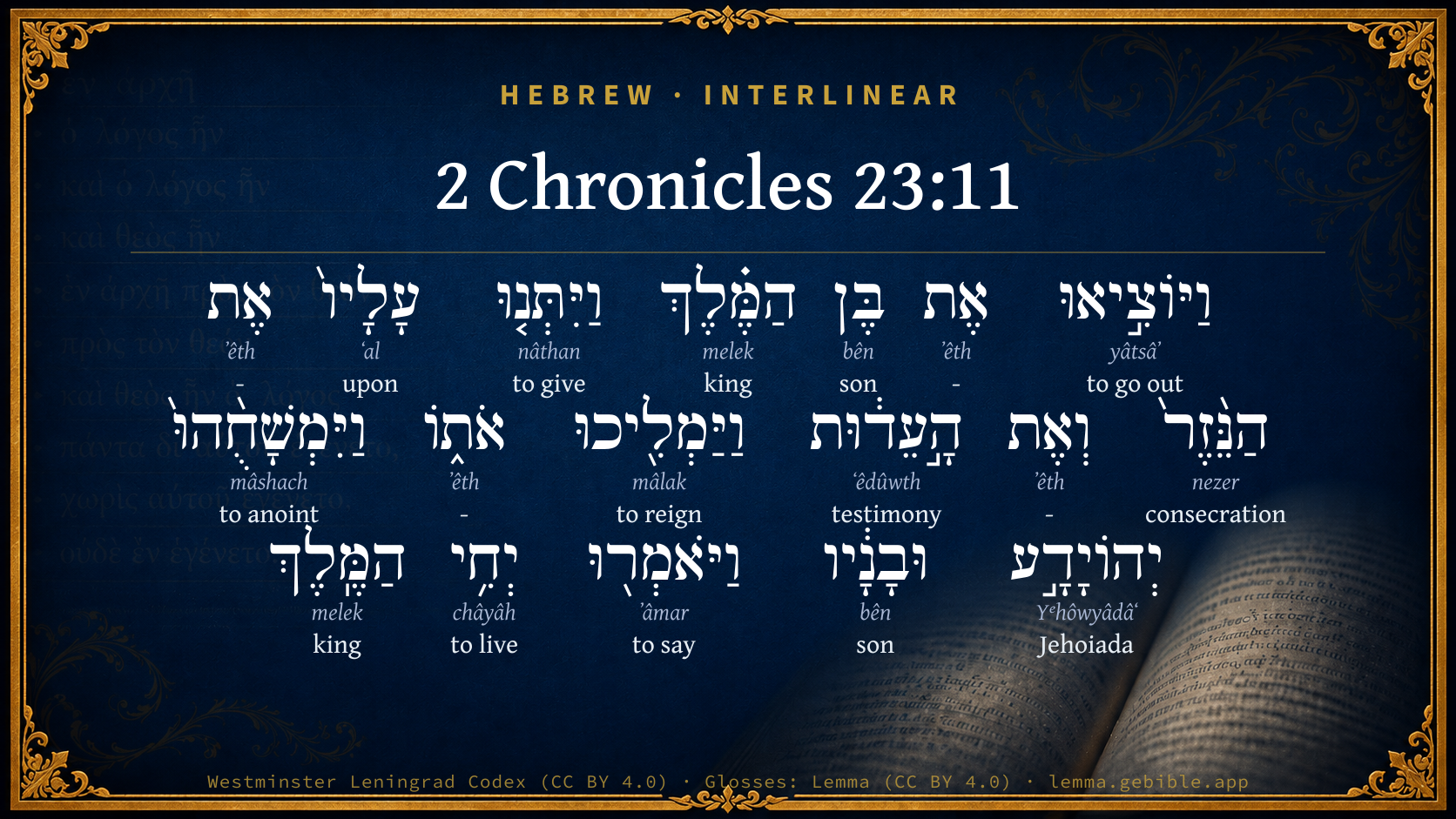
  1. וַיּוֹצִ֣יאוּ yâtsâʼ H3318 “and · to go out” Conjunction + Verb, Hiphil, Sequential Imperfect, 3rd Person, Masculine, Plural
  2. אֶת ʼêth H853 “-” Particle, Direct Object
  3. בֶּן bên H1121 “son of” Noun, Common, Masculine, Singular, Construct
  4. הַמֶּ֗לֶךְ melek H4428 “the · king” Particle, Definite Article + Noun, Common, Masculine, Singular, Absolute
  5. וַיִּתְּנ֤וּ nâthan H5414 “and · to give” Conjunction + Verb, Qal, Sequential Imperfect, 3rd Person, Masculine, Plural
  6. עָלָיו֙ ʻal H5921 “upon · him” Preposition + Suffix, Personal, 3rd Person, Masculine, Singular
  7. אֶת ʼêth H853 “-” Particle, Direct Object
  8. וְאֶת ʼêth H853 “and · -” Conjunction + Particle, Direct Object
  9. הָ֣עֵד֔וּת ʻêdûwth H5715 “the · testimony” Particle, Definite Article + Noun, Common, Feminine, Singular, Absolute
  10. וַיַּמְלִ֖יכוּ mâlak H4427 “and · to reign” Conjunction + Verb, Hiphil, Sequential Imperfect, 3rd Person, Masculine, Plural
  11. אֹת֑וֹ ʼêth H853 “- · him” Particle, Direct Object + Suffix, Personal, 3rd Person, Masculine, Singular
  12. וַיִּמְשָׁחֻ֨הוּ֙ mâshach H4886 “and · to anoint · him” Conjunction + Verb, Qal, Sequential Imperfect, 3rd Person, Masculine, Plural + Suffix, Personal, 3rd Person, Masculine, Singular
  13. יְהוֹיָדָ֣ע Yᵉhôwyâdâʻ H3077 “Jehoiada” Noun, Proper
  14. וּבָנָ֔יו bên H1121 “and · sons · his” Conjunction + Noun, Common, Masculine, Plural, Construct + Suffix, Personal, 3rd Person, Masculine, Singular
  15. וַיֹּאמְר֖וּ ʼâmar H559 “and · to say” Conjunction + Verb, Qal, Sequential Imperfect, 3rd Person, Masculine, Plural
  16. יְחִ֥י châyâh H2421 “to live” Verb, Qal, Jussive, 3rd Person, Masculine, Singular
  17. הַמֶּֽלֶךְ melek H4428 “the · king” Particle, Definite Article + Noun, Common, Masculine, Singular, Absolute

About this verse

These counts appear in no published source. They are computed here, from the morphology-tagged text and Lemma’s own curated glosses. What Lemma adds →

18
words
13
distinct lemmas
Historical
section

Notable vocabulary

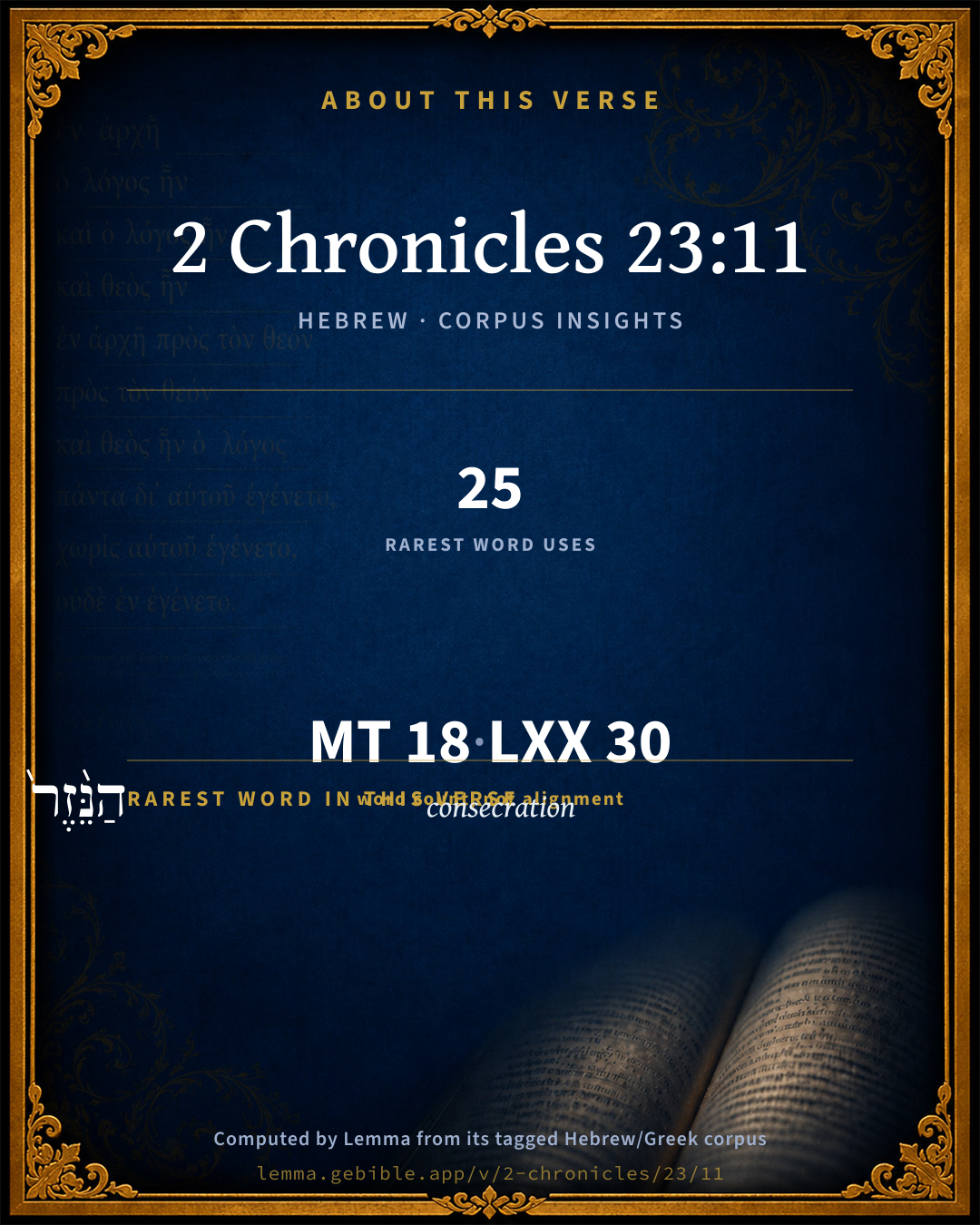
The rarest word here is הַנֵּ֨זֶר֙ consecration H5145 — appearing just 25 times in the whole Hebrew Bible.

Shared distinctive vocabulary

הַנֵּ֨זֶר֙ consecration H5145 occurs in 22 verses of the Hebrew Bible. Also found in:

Grammatical profile

  • 6 verbs
  • 7 nouns
  • 1 preposition
  • 4 particles

Verb forms

  • וַיּוֹצִ֣יאוּ Hiphil · Sequential Imperfect
  • וַיִּתְּנ֤וּ Qal · Sequential Imperfect
  • וַיַּמְלִ֖יכוּ Hiphil · Sequential Imperfect
  • וַיִּמְשָׁחֻ֨הוּ֙ Qal · Sequential Imperfect
  • וַיֹּאמְר֖וּ Qal · Sequential Imperfect
  • יְחִ֥י Qal · Jussive

Repetition

Words recur within this verse — often emphatic in Hebrew:

  • בֶּן son H1121 ×2
  • הַמֶּ֗לֶךְ king H4428 ×2

Hebrew & Septuagint length

In English translation the verse runs 36 words from the Hebrew and 35 from the Septuagint (LXX English) — closely comparable.

A rough comparison of the two English renderings, which tokenize alike — not a word-level alignment.

Word counts can differ between the Hebrew and the Greek without any difference in meaning — e.g. the Hebrew direct-object marker אֵת has no separate Greek word, and Greek often adds the article ὁ.

In the original languages it is 18 Hebrew tokens and 30 Greek tokens — but the two are counted differently (Hebrew bundles its prefixes and suffixes into one token; the Greek is in lemma form), so that isn’t a like-for-like length.

Cross-references

30

Topical passages linked to 2 Chronicles 23:11 in the Treasury of Scripture Knowledge — connected by theme and wording, ordered by reader-vote popularity; previews shown in the World English Bible.

  • 1 Samuel 10:24 Samuel said to all the people, "You see him whom Yahweh has chosen, that there is none like him among all the people?" All the people shouted, and said, [Long] live the king.
  • Exodus 25:16 You shall put the testimony which I shall give you into the ark.
  • Deuteronomy 17:18–20 It shall be, when he sits on the throne of his kingdom, that he shall write him a copy of this law in a book, out of [that which is] before the priests the Levites:
  • 2 Kings 11:12 Then he brought out the king's son, and put the crown on him, and [gave him] the testimony; and they made him king, and anointed him; and they clapped their hands, and said, [Long] live the king.
  • Psalms 89:39 You have renounced the covenant of your servant. You have defiled his crown in the dust.
  • Exodus 31:18 He gave to Moses, when he finished speaking with him on Mount Sinai, the two tablets of the testimony, stone tablets, written with God's finger.
  • 1 Samuel 10:1 Then Samuel took the vial of oil, and poured it on his head, and kissed him, and said, Isn't it that Yahweh has anointed you to be prince over his inheritance?
  • 2 Samuel 1:10 So I stood beside him, and killed him, because I was sure that he could not live after that he was fallen: and I took the crown that was on his head, and the bracelet that was on his arm, and have brought them here to my lord.
  • 2 Samuel 5:3 So all the elders of Israel came to the king to Hebron; and king David made a covenant with them in Hebron before Yahweh: and they anointed David king over Israel.
  • 2 Samuel 16:16 It happened, when Hushai the Archite, David's friend, was come to Absalom, that Hushai said to Absalom, [Long] live the king, [Long] live the king.
  • 1 Kings 1:34 and let Zadok the priest and Nathan the prophet anoint him there king over Israel; and blow you the trumpet, and say, [Long] live king Solomon.
  • 1 Kings 1:39 Zadok the priest took the horn of oil out of the Tent, and anointed Solomon. They blew the trumpet; and all the people said, [Long] live king Solomon.
  • 2 Chronicles 22:11 But Jehoshabeath, the daughter of the king, took Joash the son of Ahaziah, and stole him away from among the king's sons who were slain, and put him and his nurse in the bedchamber. So Jehoshabeath, the daughter of king Jehoram, the wife of Jehoiada the priest (for she was the sister of Ahaziah), hid him from Athaliah, so that she didn't kill him.
  • Psalms 2:10–12 Now therefore be wise, you kings. Be instructed, you judges of the earth.
  • Psalms 21:3 For you meet him with the blessings of goodness; You set a crown of fine gold on his head.
  • Psalms 78:5 For he established a testimony in Jacob, And appointed a law in Israel, Which he commanded our fathers, That they should make them known to their children;
  • Psalms 89:20 I have found David, my servant. I have anointed him with my holy oil,
  • Psalms 132:18 I will clothe his enemies with shame, But on himself, his crown will be resplendant."
  • Isaiah 8:16 Bind up the testimony, seal the law among my disciples.
  • Isaiah 8:20 To the law and to the testimony! if they don't speak according to this word, surely there is no morning for them.
  • Isaiah 49:23 Kings shall be your nursing fathers, and their queens your nursing mothers: they shall bow down to you with their faces to the earth, and lick the dust of your feet; and you shall know that I am Yahweh; and those who wait for me shall not be disappointed.
  • Matthew 21:9 The multitudes who went before him, and who followed kept shouting, "Hosanna to the son of David! Blessed is he who comes in the name of the Lord! Hosanna in the highest!"
  • Acts 4:26–27 The kings of the earth take a stand, And the rulers take council together, Against the Lord, and against his Christ.'
  • Hebrews 2:9 But we see him who has been made a little lower than the angels, Jesus, because of the suffering of death crowned with glory and honor, that by the grace of God he should taste of death for everyone.
  • James 1:12 Blessed is the man who endures temptation, for when he has been approved, he will receive the crown of life, which the Lord promised to those who love him.
  • James 2:5 Listen, my beloved brothers. Didn't God choose those who are poor in this world to be rich in faith, and heirs of the Kingdom which he promised to those who love him?
  • Revelation 4:4 Around the throne were twenty-four thrones. On the thrones were twenty-four elders sitting, dressed in white garments, with crowns of gold on their heads.
  • Revelation 4:10 the twenty-four elders fall down before him who sits on the throne, and worship him who lives forever and ever, and throw their crowns before the throne, saying,
  • Revelation 5:10 And made them kings and priests to our God, And they reign on earth."
  • Revelation 19:12 His eyes are a flame of fire, and on his head are many crowns. He has names written and a name written which no one knows but he himself.

Cross-references courtesy of OpenBible.info (CC BY 4.0).

Hebrew and Greek witnesses Masoretic Hebrew ↔ Greek Septuagint

The same verse in the two great witnesses to the Old Testament, shown verse-for-verse.

These are two independent witnesses, not word-aligned to each other, and the Septuagint is shown in lemma (dictionary) form.

Hebrew 2 Chronicles 23:11 Masoretic · Westminster Leningrad Codex

וַיּוֹצִ֣יאוּ אֶת בֶּן הַמֶּ֗לֶךְ וַיִּתְּנ֤וּ עָלָיו֙ אֶת הַנֵּ֨זֶר֙ וְאֶת הָ֣עֵד֔וּת וַיַּמְלִ֖יכוּ אֹת֑וֹ וַיִּמְשָׁחֻ֨הוּ֙ יְהוֹיָדָ֣ע וּבָנָ֔יו וַיֹּאמְר֖וּ יְחִ֥י הַמֶּֽלֶךְ

Then they brought out the king's son, and put the crown on him, and [gave him] the testimony, and made him king: and Jehoiada and his sons anointed him; and they said, [Long] live the king.

World English Bible · Public Domain

Greek LXX 2 Chronicles 23:11 Septuagint · lemma form

καί ἐκἄγω ὁ υἱός ὁ βασιλεύς καί δίδωμι ἐπί αὐτός ὁ βασίλειον καί ὁ μαρτύριον καί βασιλεύω καί χρίω αὐτός ιωδαε καί ὁ υἱός αὐτός καί εἶπον ζάω ὁ βασιλεύς

And he brought out the king's son, and put on him the crown and the testimony, and Jodae the priest and his sons proclaimed him king, and anointed him, and said, Long live the king!

LXX2012 (modern English Septuagint) · Public Domain

On this verse, The Cambridge Bible for Schools and Colleges discusses the Septuagint’s reading. Read the note in Commentary ↓

Hebrew: Westminster Leningrad Codex (CC BY 4.0). Greek: Septuagint (public domain); English from LXX2012 (modern English Septuagint) (Public Domain). How the Septuagint differs from the Hebrew →

Commentary

Notes on 2 Chronicles 23:11 from classic Christian and Jewish commentators (each source and its license shown beneath its notes). The classic Christian expositions comment on the surrounding passage and are grouped to its opening verse, so a note may address several verses; the Jewish commentaries on the Tanakh (Rashi and others) are per-verse, so they appear only where the commentator wrote on this verse.

Lemma curates 59 commentaries, every one of them public domain or Creative Commons licensed, each selected and text-cleaned for this edition rather than reprinted as found. About our sources →

Trapp's Complete Commentary

John Trapp

2Ch 23:11 Then they brought out the king’s son, and put upon him the crown, and [gave him] the testimony, and made him king. And Jehoiada and his sons anointed him, and said, God save the king.

Ver. 11. Then they brought out the king’s son.] See 2Ki 11:12.

And Jehoiada and his sons anointed him.] Good Zechariah among the rest, who was afterwards, for his faithful discharge of his duty, put to death by this ungrateful prince. {2Ch 24:21}

And said, God save the king.] This they said out of a good and upright heart; not as Squire the traitor, in Queen Elizabeth’s days, who said cheerfully, God save the queen, and at the same time poisoned the pummel of her saddle, when she was about to ride abroad, with intent to have destroyed her. {a}

{a} Speed.

John Trapp, A Commentary or Exposition upon All the Books of the Old and New Testament (1647–1656) — public domain. Text from a community e-Sword module.

Joseph Benson's Commentary

2Ch 23:11. Jehoiada and his sons anointed him — Among which sons was Zechariah, whom he afterward most ungratefully slew.

Joseph Benson's Commentary on the Old and New Testaments (1811–1818) — public domain. Text from a community e-Sword module.

Tyndale Open Study Notes

Tyndale Open Resources

23:11 When the seven-year-old Joash was anointed and crowned as king, he was given a copy of the law, as the law commanded (see Deut 17:18-20).

Tyndale Open Study Notes — © Tyndale Open Resources, licensed CC BY-SA 4.0. Text via the HelloAO Bible API.

Geneva Bible (1599)

Geneva Bible translators

That is, the book of the Law, or as some read, they put upon him his royal apparel.

Geneva Bible (1599) marginal notes — public domain. Text via Bolls.life.

Jamieson, Fausset & Brown

Robert Jamieson, A. R. Fausset & David Brown

Then they brought out the king's son, and put upon him the crown, and gave him the testimony--Some think that the original word rendered "testimony," as its derivation warrants, may signify here the regalia, especially the bracelet (Sa2 1:10); and this view they support on the ground that "gave him" being supplemented, the text properly runs thus, "put upon him the crown and testimony." At the same time, it seems equally pertinent to take "the testimony" in the usual acceptation of that term; and, accordingly, many are of opinion that a roll containing a copy of the law (Deu 17:18) was placed in the king's hands, which he held as a scepter or truncheon. Others, referring to a custom of Oriental people, who when receiving a letter or document from a highly respected quarter, lift it up to their heads before opening it, consider that Joash, besides the crown, had the book of the law laid upon his head (see Job 31:35-36).

God save the king--literally, "Long live the king."

Jamieson, Fausset & Brown — Commentary Critical and Explanatory on the Whole Bible (1871) — public domain (CC PDM 1.0). Text via the HelloAO Bible API.

Adam Clarke's Commentary

Verse 11. God save the king.] May the king live! See on 2Kg 11:12.

Adam Clarke's Commentary on the Bible (1810–1826) — public domain. Text from a community e-Sword/MySword module.

Ellicott's Commentary for English Readers

(11) Then.—And. So in 2Ch_23:14; 2Ch_23:17.

They brought out . . . and put.—2Ki_11:12 : “he (Jehoiada) brought out . . . and put.”

Put upon him the crown, and gave him the testimony.—Literally, put upon him the crown (nçzer; Exo_29:6; 2Sa_1:10) and the law (ha-’êdûth; Exo_25:21-22; Exo_31:18). Was a scroll of the ten words wrapped round the diadem, or laid on the king’s shoulder? (Comp. Vulg., “imposuerunt ei diadema testimonium dederuntque in manu ejus tenendam legem;” as if a copy of the law was solemnly presented to the newly-crowned king.)

Jehoiada and his sons.—The chronicler adds this to make it clear that it was the priests who anointed the king. (Comp. 1Ki_1:39.)

A Bible Commentary for English Readers, edited by Charles John Ellicott (1878–1897) — public domain. Text from a community e-Sword module.

The Cambridge Bible for Schools and Colleges

gen. ed. J. J. S. Perowne

11. put upon him the crown, and gave him the Testimony] So LXX. and Heb. both here and in 2Ki_11:12. It was the custom that the king at his accession should give a kind of charter to his people, and so “the testimony” mentioned here was probably some document testifying to the promises which had been thus made. When the crown was put upon the head of Joash this document was bound on with it, as a sign that his subjects’ allegiance to him depended on his faithfulness towards them. The wearing of an inscription or of a document on a solemn occasion, though strange to Western thought, is not alien from Eastern methods; cp. Exo_28:36 ff.; Deu_6:6-8; Job_31:35-36. Wellhausen has a brilliant but unconvincing conjectural emendation of this passage, viz., put upon him the crown and the bracelets; cp. 2Sa_1:10. The change in Heb. is a small one, but is it certain that bracelets formed part of the royal insignia? Rashi for “the testimony” gives “the ornaments.”

Jehoiada and his sons] In Kings, “they anointed him” (without specifying the actors).

God save the king] Lit., Let the king live!

The Cambridge Bible for Schools and Colleges (gen. ed. J. J. S. Perowne; Cambridge University Press, 1878–1918) — public domain. Text from a community e-Sword module.

Haydock's Catholic Bible Commentary

CHAPTER XXIII.

Crown. Literally, "diadem." --- Testimony. This is explained in the following sentence, (H.) which is not in Hebrew nor in many Latin MSS. The Jews understand the phylaceries, Deut. xvii. 18.

George Leo Haydock (1774–1849), Haydock's Catholic Family Bible and Commentary, 1859 edition — public domain. Excludes Psalms (Douay-Rheims chapter numbering differs from Protestant) and Deuterocanonical books (Catholic canon only).

Matthew Poole's English Annotations

Jehoiada and his sons; and Zechariah among the rest, whom afterwards he ungratefully slew, 2Ch 24:21.

Matthew Poole's English Annotations on the Holy Bible (1683–1685) — public domain. Text from a community e-Sword/MySword module.

The Pulpit Commentary

Then they brought out. The parallel (ver. 12) has, "he brought out," etc. The last clause of our verse harmonizes even this simple point, indicating that the "they" designates "Jehoiada and his sons;" of which group Jehoiada himself was, of course, the greatest part. It will be noted that it is not said from what exact place Joash was brought out. Put upon him the crown and the testimony. It is quite unnecessary, at any rate, to suppose that the testimony, as well as the crown, was put on the head of Joash. It may be taken for granted that the testimony was put into his hands. (Deu_17:18-20 Deu_31:24-29) If something new and so out of the way as resting the testimony (i.e. the book of the Law) on the head were purported, it is likely that a distincter point would have been made of it. God save the king! Hebrew, yijy: "Let the king live!" (1Sa_10:24; 2Sa_16:16; 1Ki_1:25, 1Ki_1:31, 1Ki_1:34, 1Ki_1:39)

Vers. 11-15.

Sin surprised at its rapture.

The success of this revolution, so long prepared and so admirably accomplished by Jehoiada, involved the ruin of one "wicked woman". (2Ch_24:7) It was inevitable that Athaliah must perish; here we have the account of her fall. We have before us

I SIN SURPRISED AT ITS OWN FAILURE. This coup detat evidently came upon Athaliah with surprise. The twelfth verse describes the action of one that is both astonished and alarmed, who takes hasty measures to learn what is happening, and to provide for her own interests. Suddenly and unexpectedly the blow fell upon her head. She was pursuing her evil course, reckoning on future years of power and possession, and in the very midst of her iniquity judgment overtook and overthrew her. How continually does this happen, though it may be on a smaller scale and in humbler spheres! Sin appears to succeed, holds up its head in triumph for a while, defies all justice, human and Divine; then suddenly the ground opens beneath its feet, and it is swallowed up. Its temporary success is only an incident in its abort-lived career; it is a stage on its way to failure and humiliation. The foolish man does not understand this; he thinks it is a proof that God is afar off or is quite indifferent; he takes it as a sign that he may safely disregard the solemn warnings of God"s Word. But he is foolish; he does not understand the course of things. "When the wicked spring as the grass, and when all the workers of iniquity do flourish; it is that they shall be destroyed for ever" (Psa_92:7; see also. (Psa_73:2-20) We may be surprised and pained at the prosperity of the wicked, at the enthronement of the sanguinary and the selfish. Where is God"s righteousness? where is the penalty of sin, we ask. Wait, and we shall see. The end will come before long. The shameless usurper, man or woman, will perish; the guilty empire will be overthrown. Suddenly or gradually their fate will fall upon them. "How are they brought into desolation, as in a moment!" Nor is it only the man or woman that rises to eminence and to a great estate who will prove the truth of this. Any one who hardens himself against God stands in the most serious danger of being "suddenly destroyed, and that without remedy," like the guilty woman at Jerusalem.

II ENTHUSIASM UNDER A WISE CONTROL. There must have been the greatest excitement raised and felt on this occasion. Everything contributed to kindle popular feeling and to raise it to its highest point. When they surrounded the little child and anointed him with the sacred oil, and put the crown on his young head and cried, "God save the king!" we may be sure that the emotion which on some supreme occasions fills and fires a multitude of people, was then as intense as it could be (see ver. 13); but Jehoiada held it under a wise control. And when Athaliah appeared, and when they looked at her, and remembered what she had done and what a blight and a curse she had been to the land, they might well have slain her on the spot. But the priest of Jehovah would not have the sacred place profaned with her blood, and he stayed their hand; they conducted her beyond the sacred precincts, and not till then did they inflict justice upon her. Feeling should never rise too high to be controlled by our judgment, especially strong feeling against any individual, man or woman. If we let our feelings carry our judgment along with them, we shall be sure to do that which we shall afterwards regret and which may be quite irreparable. Nor is any man at liberty to say that he is constitutionally impulsive and cannot control himself. It may be a more difficult duty in some natures than it is in others; but it is every man"s serious and sacred obligation to rule his own spirit, to maintain a mastery over his affections and his impulses and his resentments. This is to be the excellent result of daily discipline, cf strenuous endeavour, of constant prayer.

III THE SERVICE OF DESTRUCTION. "Then all the people went to the house of Baal, and brake it down," etc. (ver. 17). As a rule, the way in which we serve Christ wisely and permanently is the act of construction, of building up. Better to sow a seed than to pluck up a root; better to raise a Christian sanctuary than to knock down a heathen temple; better to implant thoughts of reverence and love than to rebuke and wither the profane word or the evil habit. But there is a time to plant and also to pluck up; a time to kill as well as to heal; a time to break down as well as to build up. (Ecc_3:2, Ecc_3:3) There are evil and hurtful people to be put out of the room, pernicious books and papers to be put into the fire, ruinous institutions to be suppressed by the strong hand of law, deadly practices to be sternly forbidden. There is a time when "slaughter is God"s daughter," when the destructive hand is the organ of the will of Jesus Christ. C.

The Pulpit Commentary (1880–1919), ed. H.D.M. Spence-Jones & Joseph S. Exell — public domain. Text from a community e-Sword module.

John Wesley's Explanatory Notes

His sons - And Zechariah among the rest, whom afterwards he ungratefully slew, chap. xxiv, 21.

John Wesley, Explanatory Notes Upon the Whole Bible (1754–1765) — public domain. Text via the GEBible commentary corpus.

Rashi

Rabbi Shlomo Yitzchaki (Rashi)

the crown This is the crown that David took from Rabbah of the children of Ammon, as it is written (I Chron 20:2): “And David took the crown of Malkam off his head, etc., and it was on David’s head.” From then on, the kings of Judah would wear that crown on their heads.

and the testimony This is a Sepher Torah, and so Scripture states (Deut. 17:19): “and he shall read from it as long as he lives.” Our Sages stated (Abodah Zarah 4a), however, that the crown itself was the testimony, for it would not fit anyone unfit for the throne.

Rashi on the Tanakh — English translations: “The Judaica Press complete Tanach with Rashi, translated by A. J. Rosenberg” (CC BY 4.0); “Pentateuch with Rashi's commentary by M. Rosenbaum and A.M. Silbermann, 1929-1934” (public domain); “The Metsudah Tanach series, Lakewood, N.J” (CC BY 4.0); and “The Book of Joshua, Metsudah Publications, 1997” (CC BY 4.0). Text via Sefaria.

Lesson kit

Teaching starters — assembled from the data on this page, not authored interpretation. Every prompt links to the verse data it draws on. Edit before teaching.

2 Chronicles, in the Historical, opens this verse with 18 words (13 distinct Hebrew lemmas). Its most distinctive word is nezer (“consecration”). A historical commentator’s framing appears above. Read the whole chapter for the surrounding context.

Discussion questions

  1. How does “consecration” (nezer) shape what this verse is saying?
  2. How does Exodus 29:6, which shares the word «consecration», read alongside this verse?
  3. What does the repetition of “son” (2× in this one verse) do in this verse?
  4. These translations render this verse differently; the difference is in the English rendering, not the original. What questions does that raise?
  5. «וַיּוֹצִ֣יאוּ» is a Hiphil Sequential Imperfect verb. How does that grammatical form shape the action described?
  6. Compare how Trapp's Complete Commentary and Joseph Benson's Commentary read this verse. Where do they agree or differ?

Things to notice

Reading settings

Reading text

Shown beneath each verse's original-language words.

Old Testament
Old Testament edition

Read the OT as the Masoretic Hebrew (MT) or the Greek Septuagint (LXX).

English shown for the Greek Septuagint (in the Hebrew ↔ Greek comparison).

Comparing translations? Open the Compare panel on any verse page to stack up to four side by side.