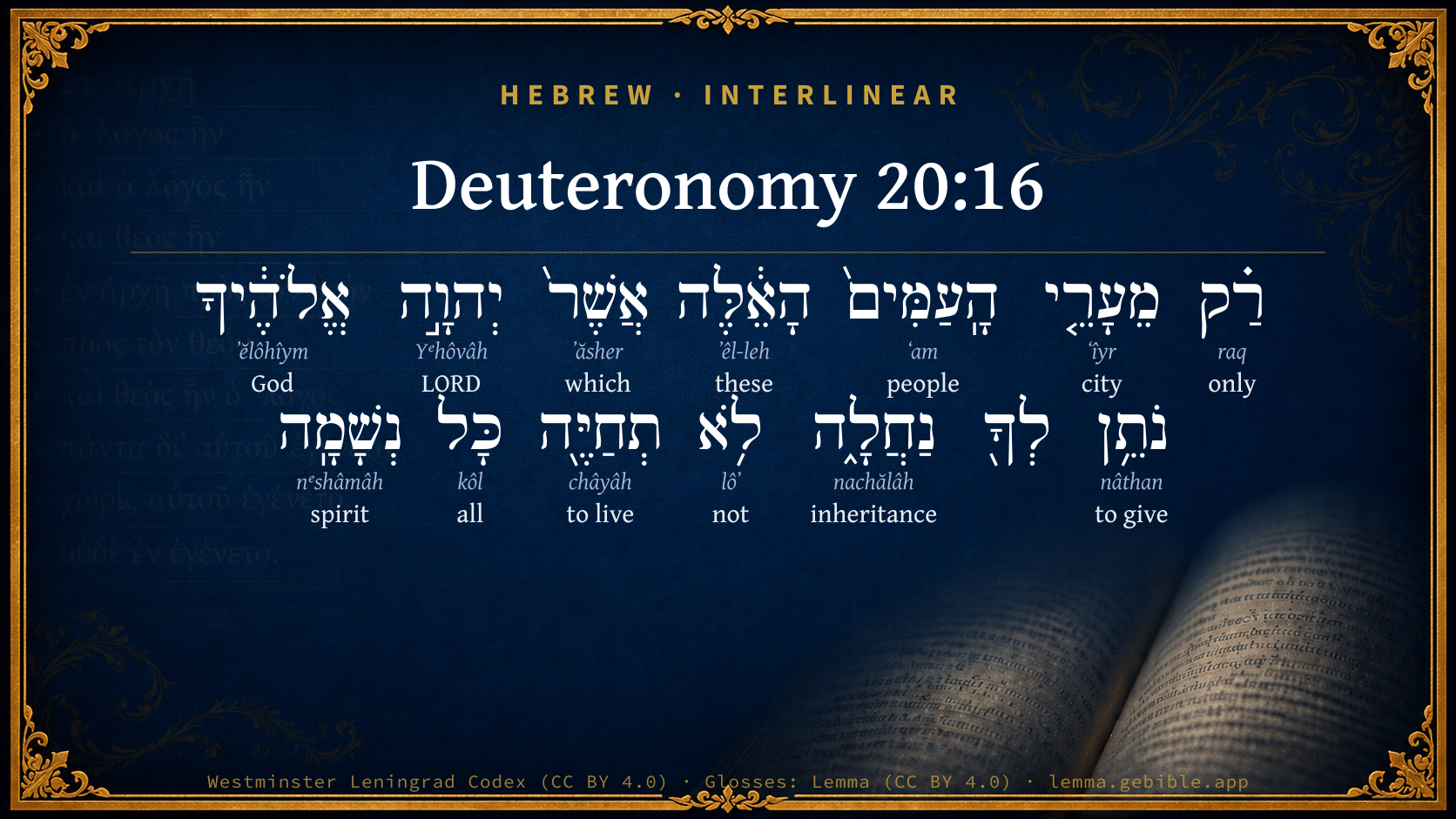
Deuteronomy 20:16

Hebrew (Westminster Leningrad Codex) Deuteronomy 20:16 appears in the Hebrew Old Testament. The text above is from the Westminster Leningrad Codex. Each word links to its Strong’s number, a concise gloss, and parsing drawn from the Open Scriptures Hebrew Bible morphology. Click any word for its full Brown-Driver-Briggs (BDB) entry.
Download image
Cite this verse

Deuteronomy 20:16 (World English Bible). Public Domain. Lemma interlinear Bible study tool, https://lemma.gebible.app/v/deuteronomy/20/16.

Show BibTeX & RIS
BibTeX
RIS
English Translation
But of the cities of these peoples, that Yahweh your God gives you for an inheritance, you shall save alive nothing that breathes;
World English Bible · Public Domain
Download a study sheet

One document with this verse’s original text, its word-by-word gloss line, the meaning frame, cross-references with their text, attributed commentary, and full source and license credits — printable, and it pastes into notes with its structure intact.

This verse Autodidact and up

Study sheet (.html) Plain text (.txt)

A passage Seminary Student

Up to 50 verses in one chapter. A passage sheet keeps up to 6 commentary sources and 12 cross-references per verse, in the order this page ranks them, and says so on the sheet whenever that leaves anything out. Ask for a single verse and you get the Autodidact verse sheet above.

Everything on this page stays free to read, with no account — the sheet is a download of what is already on screen, not access to it.

Want to remove ads? Support Godless Engineer
Compare translations 3

The same verse in 3 English versions, stacked beneath the original-language interlinear above. Click any original word for its lexicon entry.

Each is an independent rendering of the whole verse — the interlinear is not word-aligned to these translations.

Highlighted words mark where these versions differ — a whole-verse word diff, not a word-by-word alignment.

  • World English Bible Public Domain
    But of the cities of these peoples, that Yahweh your God gives you for an inheritance, you shall save alive nothing that breathes;
  • King James Version Public Domain
    But of the cities of these people, which the LORD thy God doth give thee for an inheritance, thou shalt save alive nothing that breatheth:
  • unfoldingWord Literal Text CC BY-SA 4.0
    Only from the cities of these peoples that Yahweh your God is giving to you an inheritance, all breathing things shall not live.

unfoldingWord Literal Text — © unfoldingWord, licensed CC BY-SA 4.0. Word-aligned USFM3 via Door43 (git.door43.org/unfoldingWord/en_ult).

Versions to compare (up to 4)

3 of 4 selected

Show all 18 translations

Every available English version of this verse, each an independent rendering of the whole verse.

  • World English Bible Public Domain
    But of the cities of these peoples, that Yahweh your God gives you for an inheritance, you shall save alive nothing that breathes;
  • Berean Standard Bible Public Domain
    However, in the cities of the nations that the LORD your God is giving you as an inheritance, you must not leave alive anything that breathes.
  • Majority Standard Bible Public Domain
    However, in the cities of the nations that the LORD your God is giving you as an inheritance, you must not leave alive anything that breathes.
  • King James Version Public Domain
    But of the cities of these people, which the LORD thy God doth give thee for an inheritance, thou shalt save alive nothing that breatheth:
  • American Standard Version (1901) Public Domain
    But of the cities of these peoples, that Jehovah thy God giveth thee for an inheritance, thou shalt save alive nothing that breatheth;
  • Revised Version (1885) Public Domain
    But of the cities of these peoples, which the LORD thy God giveth thee for an inheritance, thou shalt save alive nothing that breatheth:
  • Geneva Bible (1599) Public Domain
    But of the cities of this people, which the Lord thy God shall giue thee to inherite, thou shalt saue no person aliue,
  • Douay-Rheims (1899) Public Domain
    But of those cities that shall be given thee, thou shalt suffer none at all to live:
  • Young's Literal Translation Public Domain
    `Only, of the cities of these peoples which Jehovah thy God is giving to thee `for' an inheritance, thou dost not keep alive any breathing;
  • Literal Standard Version CC BY-SA 4.0
    Only, of the cities of these peoples which your God YHWH is giving to you [for] an inheritance, you do not keep alive any [that are] breathing;
  • Unlocked Literal Bible CC BY-SA 4.0
    In the cities of these peoples that Yahweh your God is giving you as an inheritance, you must save alive nothing that breathes.
  • unfoldingWord Literal Text CC BY-SA 4.0
    Only from the cities of these peoples that Yahweh your God is giving to you an inheritance, all breathing things shall not live.
  • Darby Bible Public Domain
    But of the cities of these peoples which Jehovah thy God giveth thee for an inheritance, thou shalt save alive nothing that breatheth,
  • World Messianic Bible Public Domain
    But of the cities of these peoples that the LORD your God gives you for an inheritance, you shall save alive nothing that breathes;
  • Webster's Bible Public Domain
    But of the cities of these people which the LORD thy God doth give thee for an inheritance, thou shalt save alive nothing that breatheth:
  • Free Bible Version CC BY-SA 4.0
    However, when it comes to the towns of those nations whose land the Lord your God is giving you to occupy, don't leave anything alive that breathes.
  • Bible in Basic English Public Domain
    But in the towns of these peoples whose land the Lord your God is giving you for your heritage, let no living thing be kept from death:
  • JPS Tanakh (1917) Public Domain
    Howbeit of the cities of these peoples, that the LORD thy God giveth thee for an inheritance, thou shalt save alive nothing that breatheth,

Literal Standard Version (2020), Covenant Press — licensed CC BY-SA 4.0. Text via the HelloAO Bible API (eBible.org). Unlocked Literal Bible (unfoldingWord) — licensed CC BY-SA 4.0. Text via the HelloAO Bible API (eBible.org). unfoldingWord Literal Text — © unfoldingWord, licensed CC BY-SA 4.0. Word-aligned USFM3 via Door43 (git.door43.org/unfoldingWord/en_ult). Free Bible Version, Dr. Jonathan Gallagher — licensed CC BY-SA 4.0. Text via the HelloAO Bible API (eBible.org).

Word by word

More ways to search: Search by grammar → Find every occurrence → Compare this word →

Practice this passage: Drill this verse → Learn its vocabulary →

נְשָׁמָֽה
nᵉshâmâh
H5397
“spirit”
Noun, Common, Feminine, Singular, Absolute
Part of Speech
Noun
Type
Common
Gender
Feminine
Number
Singular
State
Absolute
Full BDB Definition

Origin: from H5395

TWOT: 1433a

breath, spirit - breath (of God) - breath (of man) - every breathing thing - spirit (of man)
  1. רַ֗ק raq H7535 “only” Particle, Accusative
  2. מֵעָרֵ֤י ʻîyr H5892 “from · cities of” Preposition + Noun, Common, Feminine, Plural, Construct
  3. הָֽעַמִּים֙ ʻam H5971 “the · peoples” Particle, Definite Article + Noun, Common, Masculine, Plural, Absolute
  4. הָאֵ֔לֶּה ʼêl-leh H428 “the · these” Particle, Definite Article + Pronoun, Demonstrative, Common, Plural
  5. אֲשֶׁר֙ ʼăsher H834 “which” Particle, Relative
  6. יְהוָ֣ה Yᵉhôvâh H3068 “LORD” Noun, Proper
  7. אֱלֹהֶ֔יךָ ʼĕlôhîym H430 “God(s) · your” Noun, Common, Masculine, Plural, Construct + Suffix, Personal, 2nd Person, Masculine, Singular
  8. נֹתֵ֥ן nâthan H5414 “giving” Verb, Qal, Participle Active, Masculine, Singular, Absolute
  9. נַחֲלָ֑ה nachălâh H5159 “inheritance” Noun, Common, Feminine, Singular, Absolute
  10. לֹ֥א lôʼ H3808 “not” Particle, Negative
  11. תְחַיֶּ֖ה châyâh H2421 “to live” Verb, Piel, Imperfect, 2nd Person, Masculine, Singular
  12. כָּל kôl H3605 “all of” Noun, Common, Masculine, Singular, Construct

About this verse

These counts appear in no published source. They are computed here, from the morphology-tagged text and Lemma’s own curated glosses. What Lemma adds →

14
words
13
distinct lemmas
Pentateuch
section

Notable vocabulary

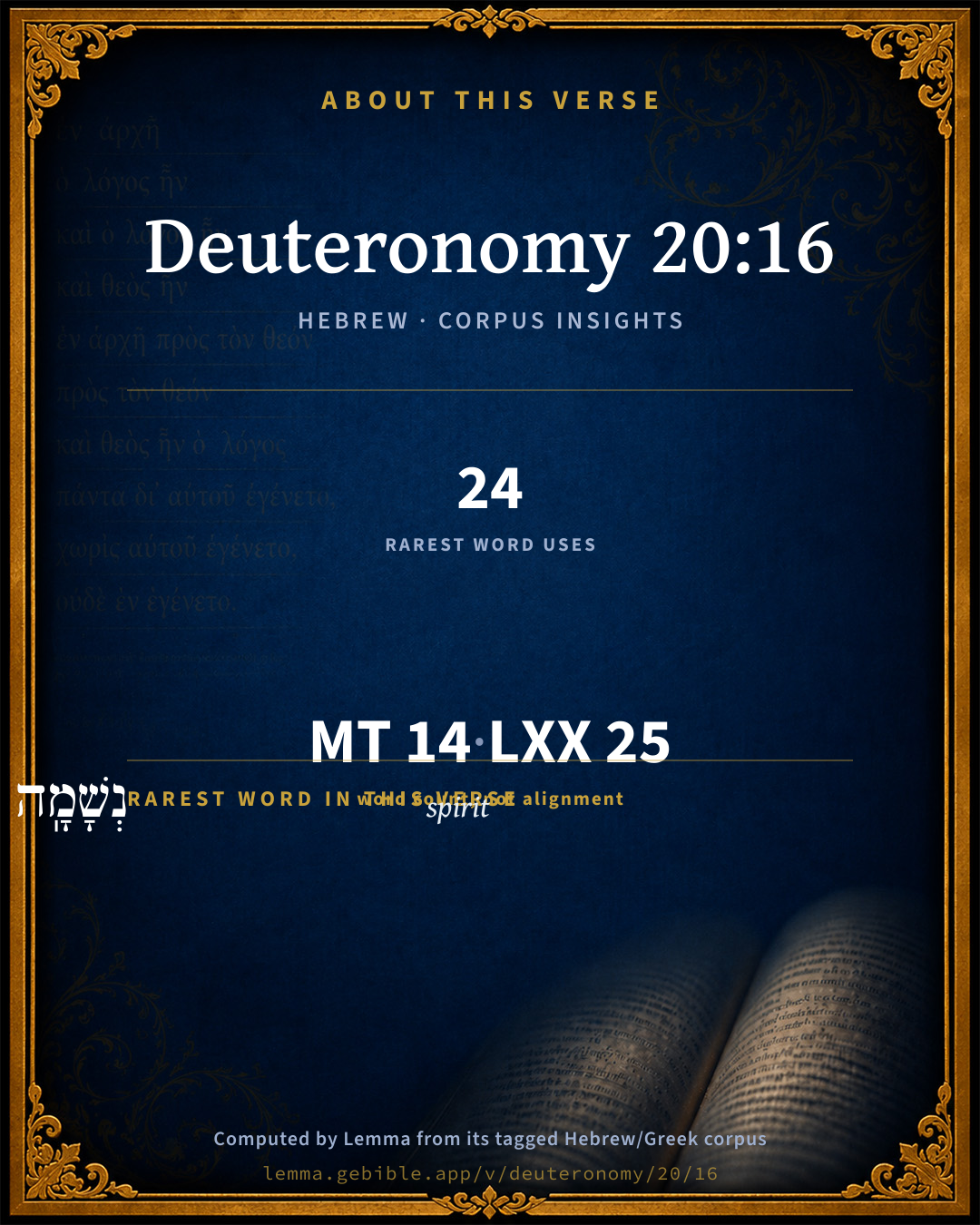
The rarest word here is נְשָׁמָֽה spirit H5397 — appearing just 24 times in the whole Hebrew Bible.

Shared distinctive vocabulary

נְשָׁמָֽה spirit H5397 occurs in 24 verses of the Hebrew Bible. Also found in:

Grammatical profile

  • 2 verbs
  • 7 nouns
  • 1 pronoun
  • 1 preposition
  • 3 particles

Verb forms

  • נֹתֵ֥ן Qal · Participle Active
  • תְחַיֶּ֖ה Piel · Imperfect

Hebrew & Septuagint length

In English translation the verse runs 23 words from the Hebrew and 9 from the Septuagint (LXX English) — the Septuagint runs noticeably shorter here. See the side-by-side →

A rough comparison of the two English renderings, which tokenize alike — not a word-level alignment.

Word counts can differ between the Hebrew and the Greek without any difference in meaning — e.g. the Hebrew direct-object marker אֵת has no separate Greek word, and Greek often adds the article ὁ.

In the original languages it is 14 Hebrew tokens and 25 Greek tokens — but the two are counted differently (Hebrew bundles its prefixes and suffixes into one token; the Greek is in lemma form), so that isn’t a like-for-like length.

Cross-references

13

Topical passages linked to Deuteronomy 20:16 in the Treasury of Scripture Knowledge — connected by theme and wording, ordered by reader-vote popularity; previews shown in the World English Bible.

  • Joshua 11:14 All the spoil of these cities, and the cattle, the children of Israel took for a prey to themselves; but every man they struck with the edge of the sword, until they had destroyed them, neither left they any who breathed.
  • Numbers 21:2–3 Israel vowed a vow to Yahweh, and said, If you will indeed deliver this people into my hand, then I will utterly destroy their cities.
  • Numbers 33:52 then you shall drive out all the inhabitants of the land from before you, and destroy all their figured [stones], and destroy all their molten images, and demolish all their high places:
  • Deuteronomy 7:1–4 When Yahweh your God shall bring you into the land where you go to possess it, and shall cast out many nations before you, the Hittite, and the Girgashite, and the Amorite, and the Canaanite, and the Perizzite, and the Hivite, and the Jebusite, seven nations greater and mightier than you;
  • Joshua 6:17–21 The city shall be devoted, even it and all that is therein, to Yahweh: only Rahab the prostitute shall live, she and all who are with her in the house, because she hid the messengers that we sent.
  • Exodus 23:31–33 I will set your border from the Red Sea even to the sea of the Philistines, and from the wilderness to the River; for I will deliver the inhabitants of the land into your hand, and you shall drive them out before you.
  • Numbers 21:35 So they struck him, and his sons and all his people, until there was none left him remaining: and they possessed his land.
  • Deuteronomy 7:16 You shall consume all the peoples who Yahweh your God shall deliver to you; your eye shall not pity them: neither shall you serve their gods; for that will be a snare to you.
  • Joshua 10:28 Joshua took Makkedah on that day, and struck it with the edge of the sword, and the king of it: he utterly destroyed them and all the souls who were therein; he left none remaining; and he did to the king of Makkedah as he had done to the king of Jericho.
  • Joshua 10:40 So Joshua struck all the land, the hill-country, and the South, and the lowland, and the slopes, and all their kings: he left none remaining, but he utterly destroyed all that breathed, as Yahweh, the God of Israel, commanded.
  • Joshua 11:11–12 They struck all the souls who were therein with the edge of the sword, utterly destroying them; there was none left who breathed: and he burnt Hazor with fire.
  • Joshua 9:24 They answered Joshua, and said, Because it was certainly told your servants, how that Yahweh your God commanded his servant Moses to give you all the land, and to destroy all the inhabitants of the land from before you; therefore we were sore afraid for our lives because of you, and have done this thing.
  • Joshua 9:27 That day Joshua made those wood cutters and drawers of water for the congregation, and for the altar of Yahweh, to this day, in the place which he should choose.

Cross-references courtesy of OpenBible.info (CC BY 4.0).

Hebrew and Greek witnesses Masoretic Hebrew ↔ Greek Septuagint

The same verse in the two great witnesses to the Old Testament, shown verse-for-verse.

Here the Septuagint runs noticeably shorter than the Hebrew — LXX2012 (modern English Septuagint) 9 words vs World English Bible 23. A rough length comparison of the two English translations, not a word-level alignment — read both below.

These are two independent witnesses, not word-aligned to each other, and the Septuagint is shown in lemma (dictionary) form.

Hebrew Deuteronomy 20:16 Masoretic · Westminster Leningrad Codex

רַ֗ק מֵעָרֵ֤י הָֽעַמִּים֙ הָאֵ֔לֶּה אֲשֶׁר֙ יְהוָ֣ה אֱלֹהֶ֔יךָ נֹתֵ֥ן לְךָ֖ נַחֲלָ֑ה לֹ֥א תְחַיֶּ֖ה כָּל נְשָׁמָֽה

But of the cities of these peoples, that Yahweh your God gives you for an inheritance, you shall save alive nothing that breathes;

World English Bible · Public Domain

Greek LXX Deuteronomy 20:16 Septuagint · lemma form

ἰδού δέ ἀπό ὁ πόλις ὁ ἔθνος οὗτος ὅς κύριος ὁ θεός σύ δίδωμι σύ κληρονομέω ὁ γῆ αὐτός οὐ ζωγρέω ἀπό αὐτός πᾶς ἐμπνέος

Of these you⌃ shall not take any thing alive;

LXX2012 (modern English Septuagint) · Public Domain

Hebrew: Westminster Leningrad Codex (CC BY 4.0). Greek: Septuagint (public domain); English from LXX2012 (modern English Septuagint) (Public Domain). How the Septuagint differs from the Hebrew →

Targum (Aramaic paraphrase)

2

The Targum is the ancient Jewish Aramaic paraphrase of the Hebrew Scriptures — an interpretive translation, not the Hebrew text itself. Onkelos (literal) and Pseudo-Jonathan (expansive) render the Torah, and Jonathan the Prophets. Coverage is partial: where no permissively-licensed English translation exists for a verse, only the Aramaic is shown. This is verse-level text, not a word-by-word alignment to the Hebrew.

  1. Targum Onkelos Torah (Genesis–Deuteronomy)
    לְחוֹד מִקִרְוֵי עַמְמַיָא הָאִלֵין דִי יְיָ אֱלָהָךְ יָהֵב לָךְ אַחֲסָנָא לָא תְקַיַם כָּל נִשְׁמָתָא

    (no public-domain English translation for this verse)

    Targum Onkelos — Aramaic: “Onkelos Genesis” (public domain); “Onkelos Exodus” (public domain); “Onkelos Leviticus” (public domain); “Onkelos Numbers” (public domain); “Onkelos Deuteronomy” (public domain). English: “Sefaria Community Translation” (CC0 1.0 (public-domain dedication)); “J.W. Etheridge. The Targums of Onkelos and Jonathan Ben Uzziel on the Pentateuch. London: Longmans, Green, 1862” (public domain). Text via Sefaria.

  2. Targum Pseudo-Jonathan Torah (Genesis–Deuteronomy)
    לְחוֹד מִקִּרְוֵי עַמְמַיָא הָאִילֵן דַּיְיָ אֱלָהָכוֹן יָהֵיב לְכוֹן אַחֲסָנָא לָא תְקַיְימוּן כָּל נִשְׁמָא

    but of the cities of these peoples, which the Lord your God giveth you to inherit, ye shall not spare alive any breathing thing:

    Targum Pseudo-Jonathan — Aramaic: “Targum Jonathan on Genesis” (public domain); “Targum Jonathan on Exodus” (public domain); “Targum Jonathan on Leviticus” (public domain); “Targum Jonathan on Numbers” (public domain); “Targum Jonathan on Deuteronomy” (public domain). English: “The Targum of Jonathan ben Uzziel, trans. J. W. Etheridge, London, 1862” (public domain). Text via Sefaria.

Commentary

Notes on Deuteronomy 20:16 from classic Christian and Jewish commentators (each source and its license shown beneath its notes). The classic Christian expositions comment on the surrounding passage and are grouped to its opening verse, so a note may address several verses; the Jewish commentaries on the Tanakh (Rashi and others) are per-verse, so they appear only where the commentator wrote on this verse.

Lemma curates 59 commentaries, every one of them public domain or Creative Commons licensed, each selected and text-cleaned for this edition rather than reprinted as found. About our sources →

The Biblical Illustrator

Joseph S. Exell

Deu_20:16-18

Thou shalt save alive nothing that breatheth.

Extermination of Canaanites

Is not this fierce irruption in Canaan with fire and sword precisely similar to the wave of Mahomedan conquest? Is it any way different from the most pitiless of heathen invasions? How can we justify such an acquisition of territory as this, whilst we are, at least in theory, so scrupulous about adding one acre of unjustly acquired land to our dominions, and cannot let one drop of blood be shed, even in a conquered race, without inquiry? The key to this difficulty was given in the very first confirmation of the grant made to Abraham. When the land of Canaan was made over to him and his descendants, he was told that they could not at once enter on possession, because the iniquity of the Amorites was not full. The transference of territory was thus from the first viewed and treated as a judicial transaction. God reserves to Himself the right which all sovereigns must and do reserve--the right of removing offenders from the earth, and of confiscating their goods. In other respects this invasion finds a parallel in almost every century of history, and in every part of the world. It is, in point of fact, by conquest that civilisation has spread and is spreading upon earth, and in the career of progress the nations whose iniquities are full--that is to say, which have fallen too low for national redemption--have been swept away by the purer and stronger races. In this, therefore, there is no difference between the conduct of Israel and the conduct of other great nations. The difference consists in this--that while other nations have pushed their conquests for love of gain or glory, or through pride in their leader or mere lust of adventure, Israel entered Canaan as Gods servant, again and again warned that they were merely Gods sword of justice, and that if they forgot this, and began to think it was their own might that had emptied the land for them, they should themselves suffer the like extermination. Between this and many other outwardly similar conquests there was, in short, all the difference which there is between a righteous execution which rejoices the hearts of all good men, and a murder which makes us ashamed of our nature. (Marcus Dods, D. D.)

Unselfish conquest

The difference between the Jews and other people is precisely this:--All the great nations that we read of have effected extensive and, on the whole, salutary conquests. Their triumphs have been the means of spreading law, government, civilisation, where they would otherwise not have reached. They have swept away feeble, corrupt, sensualised people, who had become animal worshippers or devil worshippers, and had lost all sense of their human dignity. But we feel that the nations who have done these works have done them in great part for their own glory, for the increase of their territory, at the instigation and for the gratification of particular leaders. All higher and more blessed results of their success, which it is impossible not to recognise, have been stained and corrupted by the ignoble and selfish tendencies which have mixed with them, and been the motives to them; so that we are continually perplexed with the question, what judgment we shall form of them, or what different causes we can find for such opposite effects. There is one nation which is taught from the very first that it is not to go out to win any prizes for itself, to bring home the silver or gold, the sheep or the oxen, the men servants or the women servants; that it is to be simply the instrument of the righteous Lord against those who were polluting His earth, and making it unfit for human habitation. (F. D. Maurice, M. A.)

The command to extirpate the Canaanites

This command to extirpate the Canaanites is regarded by many as one of the chief difficulties in the Old Testament. The difficulty lies not so much in the thing itself, as in our defective views of God, or of mails relation to Him, or of the supernatural character of the revelation made to Moses. The objection, it will be observed, is grounded (or it has no force) upon the supposed inconsistency of this command with the Divine righteousness and equity. Yet there are other acts of God, equally terrible and equally indiscriminate in their effects, which we never presume to call in question. When, for example, the Almighty sends an earthquake or a pestilence, there is no complaint of injustice; and yet earthquake and pestilence spare neither age nor sex nor rank, but involve all in the same ruin. Do fire or famine or cholera discriminate between the sexes, or spare the aged or the young? If the sword of Israel was commissioned to destroy all that breathed of the Canaanites, it certainly was not more indiscriminate than these other judgments of God. If we dare not assert or even insinuate injustice in the case of the one, neither can we rationally do so in the case of the other; nor can we deny to the Almighty the right to choose this or that method of chastising a guilty people, whether earthquake or famine, pestilence or war. We may further remember that the annihilation of a people is so far from being a new or an unexampled occurrence, that similar events in the overruling wisdom of God have been continually taking place ever since the dawn of history. For an example of it we need not travel beyond our own shores. Where are the original inhabitants of England? The Briton was subdued by the Saxon, the Saxon was driven out by the Norman and the Dane, each race leaving, however, some trace of itself in the stock and blood of the country. Yet the original race has been more completely extirpated than ever the Canaanitish races were during the Hebrew occupancy of Palestine. Still more complete has been the disappearance of the North American Indians. The red man has been driven farther and farther towards the setting sun, till the race seems threatened with absolute extermination, and is actually extinct over an area twenty times as great as that of Palestine. It appears to be an unvarying law, that the savage recedes before the civilised man. We cannot justify all the means by which this result is accomplished, or palliate the dark and monstrous crimes which have been perpetrated in the name of civilisation; yet it is an evident fact that the Ruler of nations is pleased to ordain, or to permit, that nations should be driven from their ancestral inheritance, and their places filled by others. Thus we see that what happened to the Canaanites is happening continually in the history of nations. In this view the phenomenon of the destruction of the Canaanite nations does not stand alone. It can be referred to a class. And there is no more ground for disputing the Divine justice in regard to the destruction of those people than in regard to the disappearance of scores and perhaps hundreds of other ancient races from the face of the earth; for it cannot be contended that there is any difference, as it regards justice and equity, whether a nation be extirpated by war, destroyed by famine or pestilence, or left to perish, like the aborigines of Australia, by hopeless and helpless exhaustion. (L. H. Wiseman M. A.)

The Biblical Illustrator, edited by Joseph S. Exell (c. 1880s–1900s) — public domain. Text from a community e-Sword module.

Joseph Benson's Commentary

Deu 20:16. Thou shalt save alive nothing — No human creature; for the beasts, some few excepted, were given for a prey. This slaughter of all the people is to be understood only in case they did not surrender when summoned, but rejected the conditions of peace when offered them. In which case their condition was worse than that of any other people, whose males only were to be slain, Deu 20:14.

Joseph Benson's Commentary on the Old and New Testaments (1811–1818) — public domain. Text from a community e-Sword module.

The Cambridge Bible for Schools and Colleges

gen. ed. J. J. S. Perowne

16. But] Heb. rak, introducing an opposite case, see Deu_10:15.

thou shalt save alive nothing that breatheth] Heb. any breath, i.e. human life (Gen_2:7, 1Ki_17:17, Isa_42:5), cp. the deuteronomic Jos_10:40; Jos_11:11; Jos_11:14. Only in Gen_7:22 does the phrase cover animals.

The Cambridge Bible for Schools and Colleges (gen. ed. J. J. S. Perowne; Cambridge University Press, 1878–1918) — public domain. Text from a community e-Sword module.

John Gill's Exposition

But of the cities of those people, which the Lord thy God doth give thee for an inheritance,.... The cities of the seven nations, six of which are mentioned by name in the next verse:

thou shalt save alive nothing that breatheth; the reason of this severity was because of their wickedness, the capital crimes and gross abominations they were guilty of, and for which they deserved to die; and on account whereof they were reserved to this destruction, when the measure of their iniquities was full, such as idolatry, incest, witchcraft, soothsaying, necromancy, &c. see Lev 18:3.

John Gill's Exposition of the Whole Bible (1746–1763) — public domain (CC PDM 1.0). Text via the HelloAO Bible API.

Haydock's Catholic Bible Commentary

Live. Hebrew, "thou shalt save alive nothing that breatheth." Josephus ([Antiquities?] iv. 8.) acknowledges that all were to be slain; though some of the Rabbins have supposed that they might be spared, if they would abandon idols, &c.

George Leo Haydock (1774–1849), Haydock's Catholic Family Bible and Commentary, 1859 edition — public domain. Excludes Psalms (Douay-Rheims chapter numbering differs from Protestant) and Deuterocanonical books (Catholic canon only).

Matthew Poole's English Annotations

Heb. no seed, i.e. no man, as that word is oft used. Compare Jos 10:40, with Deu 11:14. For the beasts, some few excepted as being under a special curse, were given them for a prey.

Matthew Poole's English Annotations on the Holy Bible (1683–1685) — public domain. Text from a community e-Sword/MySword module.

Whedon's Commentary on the Bible

Daniel D. Whedon

16. Of these people — The Canaanites and kindred nations.

Thou shalt save alive nothing — Not a human being was to be left alive. The abominations of these idolatrous nations were such that only by obliterating them wholly could the Israelites be exempt from their corruptions. The punishment of the Canaanites seems severe, but shall not the Judge of all the earth do right?

Daniel D. Whedon (gen. ed.), Commentary on the Old and New Testaments (1874–1909) — public domain. Text from a community e-Sword module.

The Pulpit Commentary

Vers. 16-20. This was for cities at a distance; it was to be otherwise with the cities of the Canaanites. To them no offer of peaceful submission was to be made, and when the city was taken, all the inhabitants without reserve were to be destroyed. This was in accordance with God"s command to Israel (Exo_23:31-33 Exo_34:11-16; Deu_7:1-3) and as a precaution against the risk of the people being seduced into idolatry by the heathen should they be allowed to remain in the land. But whilst engaged in besieging a town, they were not to destroy the fruit trees that were outside the walls; but trees that were not for food they might cut down and use in their operations against the city.

The Pulpit Commentary (1880–1919), ed. H.D.M. Spence-Jones & Joseph S. Exell — public domain. Text from a community e-Sword module.

John Wesley's Explanatory Notes

Nothing - No man. For the beasts, some few excepted, were given them for a prey.

John Wesley, Explanatory Notes Upon the Whole Bible (1754–1765) — public domain. Text via the GEBible commentary corpus.

unfoldingWord translationNotes

Door43 World Missions Community

General Information:

Moses continues speaking to the people of Israel.

In the cities of these peoples that Yahweh your God is giving you as an inheritance

The cities in Canaan that Yahweh is giving to the people is spoken of as if the cities were the people's inheritance. (See: Metaphor)

you must save alive nothing that breathes

"you must not let any living thing stay alive." This can be stated in positive form. AT: "you must kill every living thing" (See: Litotes)

you must completely destroy them

"you must completely destroy these people groups"

Do this so that they

"Destroy these nations so that they"

to act in any of their abominable ways ... their gods

"to act in abominable ways like the people in these nations have done with their gods"

If you do, you will sin against Yahweh your God

"If you act like these people, you will sin against Yahweh your God"

translationWords

people group

inherit

save

life

breath

Hittite

Amorite

Canaan

Perizzite

Hivite

Jebus

command

abomination

false god

sin

unfoldingWord translationNotes — © Distant Shores Media and the Door43 World Missions Community, licensed CC BY-SA 4.0. Source: git.door43.org/Door43/en_tn.

Lesson kit

Teaching starters — assembled from the data on this page, not authored interpretation. Every prompt links to the verse data it draws on. Edit before teaching.

Deuteronomy, in the Pentateuch, opens this verse with 14 words (13 distinct Hebrew lemmas). Its most distinctive word is nᵉshâmâh (“spirit”). The Greek Septuagint runs shorter here. A historical commentator’s framing appears above. Read the whole chapter for the surrounding context.

Discussion questions

  1. What does “spirit” (nᵉshâmâh) contribute to the verse as a whole?
  2. Genesis 2:7 shares the word «spirit» with this verse. How do the two illuminate each other?
  3. Compared with the Hebrew, the Septuagint runs shorter here. What questions does that raise?
  4. The translations on this page render this verse differently — a whole-verse word diff, not a word-by-word alignment. What might account for the different wordings?
  5. The verb «נֹתֵ֥ן» is Qal Participle Active. How does its form color the action?
  6. Reading how The Biblical Illustrator and Joseph Benson's Commentary read this verse, where do the two commentators agree and where do they part?

Things to notice

Reading settings

Reading text

Shown beneath each verse's original-language words.

Old Testament
Old Testament edition

Read the OT as the Masoretic Hebrew (MT) or the Greek Septuagint (LXX).

English shown for the Greek Septuagint (in the Hebrew ↔ Greek comparison).

Comparing translations? Open the Compare panel on any verse page to stack up to four side by side.