
Psalms 119:175

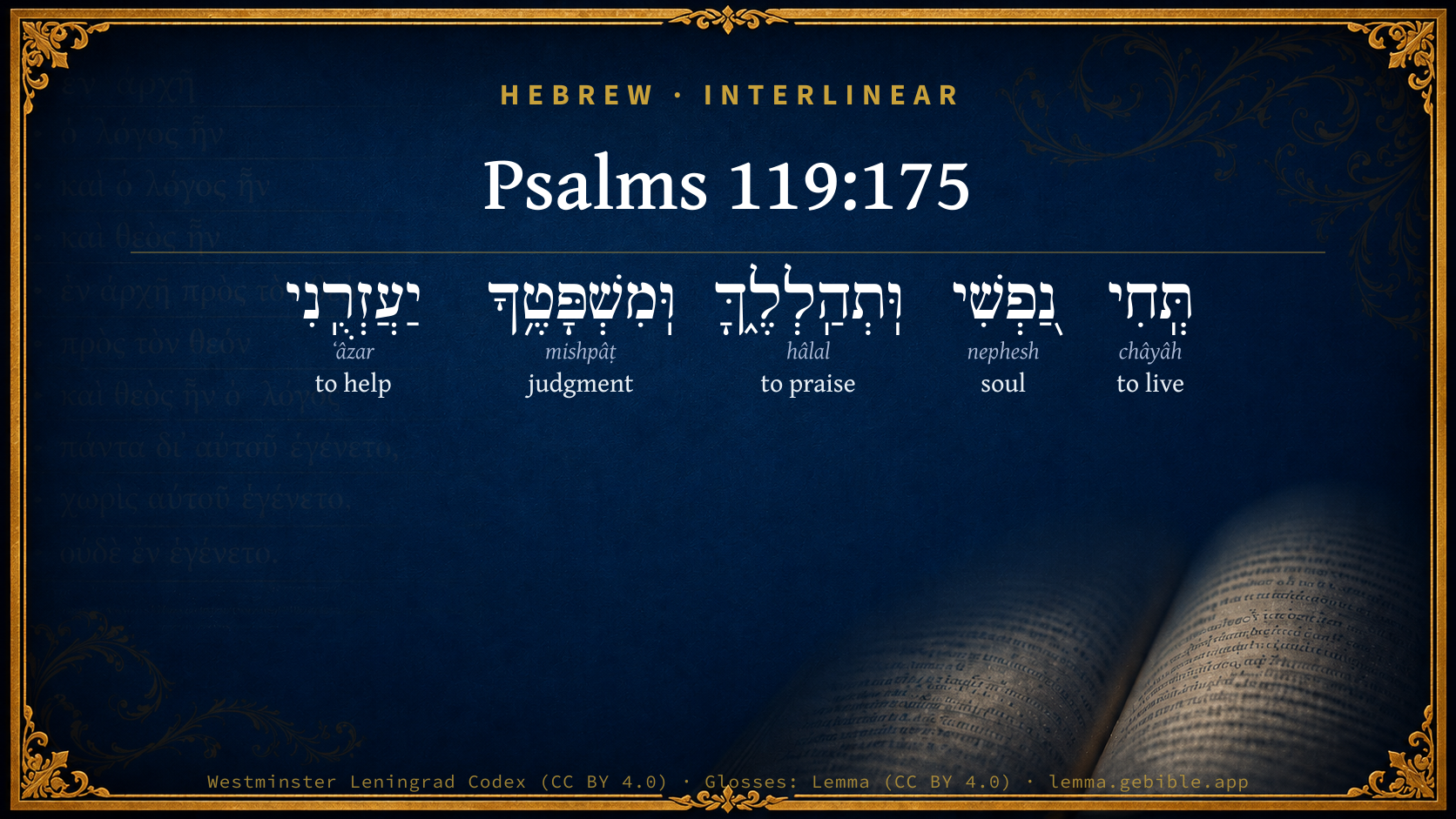
Hebrew (Westminster Leningrad Codex) Psalms 119:175 appears in the Hebrew Old Testament. The text above is from the Westminster Leningrad Codex. Each word links to its Strong’s number, a concise gloss, and parsing drawn from the Open Scriptures Hebrew Bible morphology. Click any word for its full Brown-Driver-Briggs (BDB) entry.
Download image
Cite this verse

Psalms 119:175 (World English Bible). Public Domain. Lemma interlinear Bible study tool, https://lemma.gebible.app/v/psalms/119/175.

Show BibTeX & RIS
BibTeX
RIS
English Translation
Let my soul live, that I may praise you. Let your ordinances help me.
World English Bible · Public Domain
Download a study sheet

One document with this verse’s original text, its word-by-word gloss line, the meaning frame, cross-references with their text, attributed commentary, and full source and license credits — printable, and it pastes into notes with its structure intact.

This verse Autodidact and up

Study sheet (.html) Plain text (.txt)

A passage Seminary Student

Up to 50 verses in one chapter. A passage sheet keeps up to 6 commentary sources and 12 cross-references per verse, in the order this page ranks them, and says so on the sheet whenever that leaves anything out. Ask for a single verse and you get the Autodidact verse sheet above.

Everything on this page stays free to read, with no account — the sheet is a download of what is already on screen, not access to it.

Want to remove ads? Support Godless Engineer
Compare translations 3

The same verse in 3 English versions, stacked beneath the original-language interlinear above. Click any original word for its lexicon entry.

Each is an independent rendering of the whole verse — the interlinear is not word-aligned to these translations.

Highlighted words mark where these versions differ — a whole-verse word diff, not a word-by-word alignment.

  • World English Bible Public Domain
    Let my soul live, that I may praise you. Let your ordinances help me.
  • King James Version Public Domain
    Let my soul live, and it shall praise thee; and let thy judgments help me.
  • unfoldingWord Literal Text CC BY-SA 4.0
    May my soul live, and may it praise you, and may your judgments help me.

unfoldingWord Literal Text — © unfoldingWord, licensed CC BY-SA 4.0. Word-aligned USFM3 via Door43 (git.door43.org/unfoldingWord/en_ult).

Versions to compare (up to 4)

3 of 4 selected

Show all 17 translations

Every available English version of this verse, each an independent rendering of the whole verse.

  • World English Bible Public Domain
    Let my soul live, that I may praise you. Let your ordinances help me.
  • Berean Standard Bible Public Domain
    Let me live to praise You; may Your judgments sustain me.
  • Majority Standard Bible Public Domain
    Let me live to praise You; may Your judgments sustain me.
  • King James Version Public Domain
    Let my soul live, and it shall praise thee; and let thy judgments help me.
  • American Standard Version (1901) Public Domain
    Let my soul live, and it shall praise thee; And let thine ordinances help me.
  • Revised Version (1885) Public Domain
    Let my soul live, and it shall praise thee; and let thy judgments help me.
  • Geneva Bible (1599) Public Domain
    Let my soule liue, and it shall praise thee, and thy iudgements shall helpe me.
  • Young's Literal Translation Public Domain
    My soul liveth, and it doth praise Thee, And Thy judgments do help me.
  • Literal Standard Version CC BY-SA 4.0
    My soul lives, and it praises You, || And Your judgments help me.
  • Unlocked Literal Bible CC BY-SA 4.0
    May I live and praise you, and may your righteous decrees help me.
  • unfoldingWord Literal Text CC BY-SA 4.0
    May my soul live, and may it praise you, and may your judgments help me.
  • Darby Bible Public Domain
    Let my soul live, and it shall praise thee; and let thy judgments help me.
  • World Messianic Bible Public Domain
    Let my soul live, that I may praise you. Let your ordinances help me.
  • Webster's Bible Public Domain
    Let my soul live, and it shall praise thee; and let thy judgments help me.
  • Free Bible Version CC BY-SA 4.0
    May I live my life in praise to you, and may your instructions help me.
  • Bible in Basic English Public Domain
    Give life to my soul so that it may give you praise; and let your decisions be my support.
  • JPS Tanakh (1917) Public Domain
    Let my soul live, and it shall praise Thee; and let Thine ordinances help me.

Literal Standard Version (2020), Covenant Press — licensed CC BY-SA 4.0. Text via the HelloAO Bible API (eBible.org). Unlocked Literal Bible (unfoldingWord) — licensed CC BY-SA 4.0. Text via the HelloAO Bible API (eBible.org). unfoldingWord Literal Text — © unfoldingWord, licensed CC BY-SA 4.0. Word-aligned USFM3 via Door43 (git.door43.org/unfoldingWord/en_ult). Free Bible Version, Dr. Jonathan Gallagher — licensed CC BY-SA 4.0. Text via the HelloAO Bible API (eBible.org).

Word by word

More ways to search: Search by grammar → Find every occurrence → Compare this word →

Practice this passage: Drill this verse → Learn its vocabulary →

About this verse

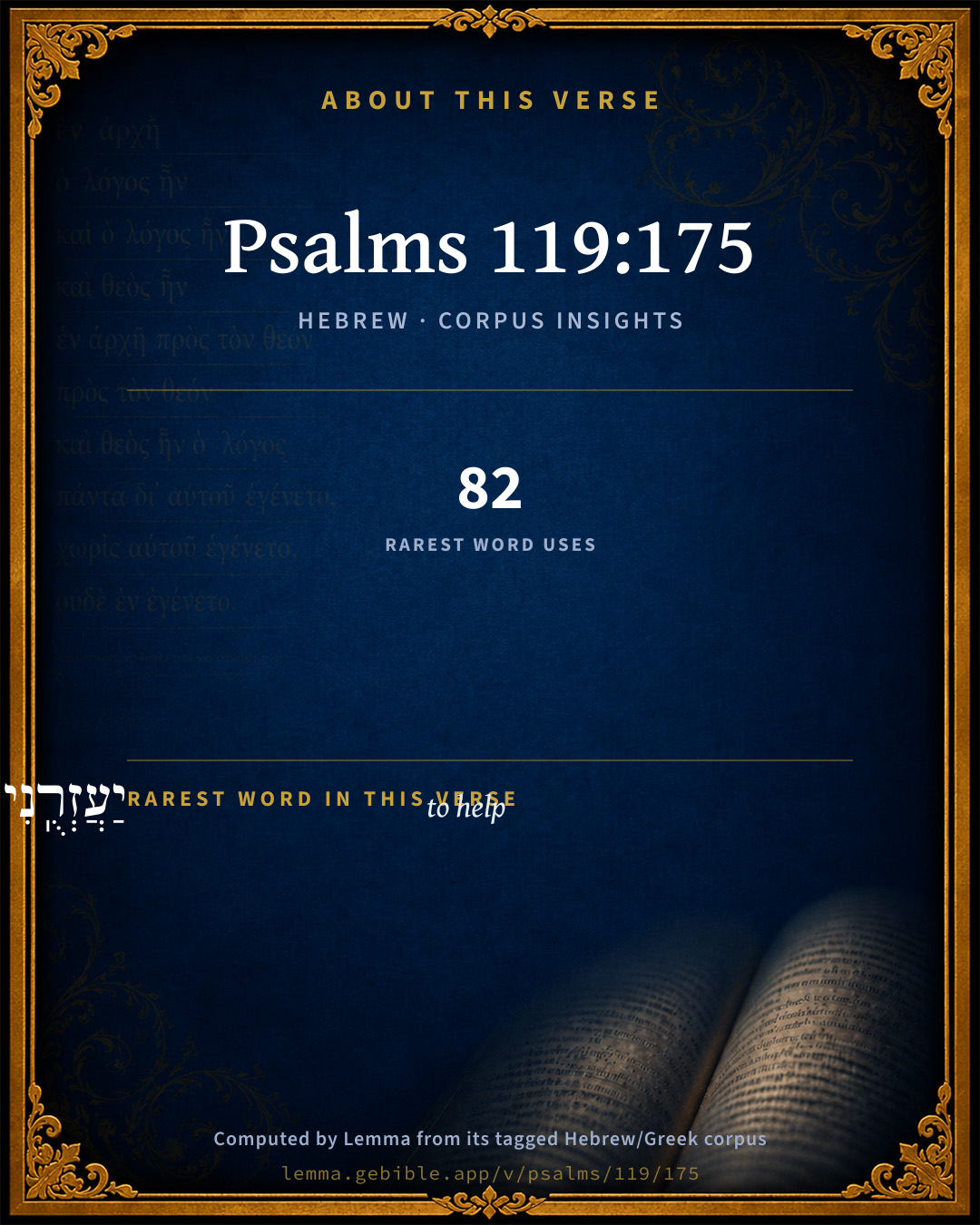
These counts appear in no published source. They are computed here, from the morphology-tagged text and Lemma’s own curated glosses. What Lemma adds →

5
words
5
distinct lemmas
Wisdom
section

Grammatical profile

  • 3 verbs
  • 2 nouns

Verb forms

  • תְּֽחִי Qal · Imperfect
  • וּֽתְהַֽלְלֶ֑ךָּ Piel · Jussive
  • יַעֲזְרֻֽנִי Qal · Imperfect

Hebrew & Septuagint length

In English translation the verse runs 14 words from the Hebrew and 14 from the Septuagint (LXX English) — the same length.

A rough comparison of the two English renderings, which tokenize alike — not a word-level alignment.

Word counts can differ between the Hebrew and the Greek without any difference in meaning — e.g. the Hebrew direct-object marker אֵת has no separate Greek word, and Greek often adds the article ὁ.

Cross-references

11

Topical passages linked to Psalms 119:175 in the Treasury of Scripture Knowledge — connected by theme and wording, ordered by reader-vote popularity; previews shown in the World English Bible.

  • Isaiah 55:3 Turn your ear, and come to me; hear, and your soul shall live: and I will make an everlasting covenant with you, even the sure mercies of David.
  • Psalms 51:14–15 Deliver me from bloodguiltiness, O God, the God of my salvation. My tongue shall sing aloud of your righteousness.
  • Psalms 118:18–19 Yah has punished me severely, But he has not given me over to death.
  • Isaiah 26:8–9 Yes, in the way of your judgments, Yahweh, have we waited for you; to your name, even to your memorial [name], is the desire of our soul.
  • Isaiah 38:19 The living, the living, he shall praise you, as I do this day: The father to the children shall make known your truth.
  • Psalms 30:9 "What profit is there in my destruction, if I go down to the pit? Shall the dust praise you? Shall it declare your truth?
  • Romans 8:28 We know that all things work together for good for those who love God, to those who are called according to his purpose.
  • 1 Corinthians 11:31–32 For if we discerned ourselves, we wouldn't be judged.
  • Psalms 9:13–14 Have mercy on me, Yahweh. See my affliction by those who hate me, And lift me up from the gates of death;
  • Psalms 119:75 Yahweh, I know that your judgments are righteous, That in faithfulness you have afflicted me.
  • 2 Corinthians 4:17 For our light affliction, which is for the moment, works for us more and more exceedingly an eternal weight of glory;

Cross-references courtesy of OpenBible.info (CC BY 4.0).

Hebrew and Greek witnesses Masoretic Hebrew ↔ Greek Septuagint

The same verse in the two great witnesses to the Old Testament, shown verse-for-verse.

You’re reading Greek Psalm 118 (Hebrew Psalm 119). The Septuagint counts the superscription, so verse numbers can differ from the Hebrew — chapter-level alignment, not verse-by-verse. Numbering follows Rahlfs.

These are two independent witnesses, not word-aligned to each other, and the Septuagint is shown in lemma (dictionary) form.

Hebrew Psalms 119:175 Masoretic · Westminster Leningrad Codex

תְּֽחִי נַ֭פְשִׁי וּֽתְהַֽלְלֶ֑ךָּ וּֽמִשְׁפָּטֶ֥ךָ יַעֲזְרֻֽנִי

Let my soul live, that I may praise you. Let your ordinances help me.

World English Bible · Public Domain

Greek LXX Greek Psalm 118:175 Septuagint · lemma form

ζάω ὁ ψυχή ἐγώ καί αἰνέω σύ καί ὁ κρίμα σύ βοηθέω ἐγώ

My soul shall live, and shall praise you; and your judgments shall help me.

LXX2012 (modern English Septuagint) · Public Domain

Hebrew: Westminster Leningrad Codex (CC BY 4.0). Greek: Septuagint (public domain); English from LXX2012 (modern English Septuagint) (Public Domain). How the Septuagint differs from the Hebrew →

Commentary

Notes on Psalms 119:175 from classic Christian and Jewish commentators (each source and its license shown beneath its notes). The classic Christian expositions comment on the surrounding passage and are grouped to its opening verse, so a note may address several verses; the Jewish commentaries on the Tanakh (Rashi and others) are per-verse, so they appear only where the commentator wrote on this verse.

Lemma curates 59 commentaries, every one of them public domain or Creative Commons licensed, each selected and text-cleaned for this edition rather than reprinted as found. About our sources →

Trapp's Complete Commentary

John Trapp

Psa 119:175 Let my soul live, and it shall praise thee; and let thy judgments help me.

Ver. 175. Let thy judgments help me] sc. To heaven: together with God’s word, there goeth forth a power.

John Trapp, A Commentary or Exposition upon All the Books of the Old and New Testament (1647–1656) — public domain. Text from a community e-Sword module.

The Biblical Illustrator

Joseph S. Exell

Psa_119:175

Let my soul live, and it shall praise Thee.

The love of life vindicated

Setting aside those who love life only for reasons which ought not to have such weight with them, and who would prolong it only to abuse it, I shall show you some better reasons for this attachment; derived from nature, from society, and from religion.

I. We naturally love life; and this argument alone is sufficient to prove the innocence of that love.

II. We love life for the sake of society, and the connections we have contracted in it. A husband and a wife,--living in the happiest union, and looking forward to a great length of days, and to many comforts,--are threatened with sudden separation by death. Can any one blame the tender and lively regrets which both of them experience at this unlooked-for parting? And again; a man whose high station enables him to render important services to society may, without presumption, wish on this account for a lengthening of his days.

III. We may love life from a principle of piety and religion.

1. Since life is a gift from Gods bounty, a favour which He grants to us, why should we not love it in this point of view? Why, when it pleases the great Disposer of our days to prolong the course of them, should we not testify our joy by the sincerest thanksgivings?

2. Religion attaches us to life by another consideration, in which all of us are greatly concerned: and that is, the imperfection of the great work of our salvation; the just awe and fear of appearing at Gods judgment-seat before we have set our accounts in order, and made our preparations for eternity.

3. One more consideration, very consistent with such true humility, is--that of our good example; the light of which we may innocently, and even holily, wish to shine still longer, in the midst of a crooked and perverse generation. (S. Partridge.)

The Biblical Illustrator, edited by Joseph S. Exell (c. 1880s–1900s) — public domain. Text from a community e-Sword module.

J. A. Alexander on Psalms

Joseph Addison Alexander

175. (Psa 119:175) Let my soul live and praise thee; and let thy judgments help me. This verse sums up in conclusion the petitions of the whole psalm. Save me, and thereby give me cause to praise thee, for the blessings which I have derived from the promises and precepts of the law. Let my soul live, because it is that which is in danger. Judgments, as in Psa 119:149; Psa 119:156.

Joseph Addison Alexander, The Psalms Translated and Explained (1850) — public domain. Text from a community e-Sword module.

Geneva Bible (1599)

Geneva Bible translators

That is, thy provident care over me, and wherewith thou wilt judge mine enemies.

Geneva Bible (1599) marginal notes — public domain. Text via Bolls.life.

Matthew Henry's Commentary

David's heart is still upon praising God; and therefore, 1. He prays that God would give him time to praise him: "Let my soul live, and it shall praise thee, that is, let my life be prolonged, that I may live to thy glory." The reason why a good man desires to live is that he may praise God in the land of the living, and do something to his honour. Not, "Let me live and serve my country, live and provide for my family;" but, "Let me live that, in doing this, I may praise God here in this world of conflict and opposition." When we die we hope to go to a better world to praise him, and that is more agreeable for us, though here there is more need of us. And therefore one would not desire to live any longer than we may do God some service here. Let my soul live, that is, let me be sanctified and comforted, for sanctification and comfort are the life of the soul, and then it shall praise thee. Our souls must be employed in praising God, and we must pray for grace and peace that we may be fitted to praise God. 2. He prays that God would give him strength to praise him: "Let thy judgments help me; let all ordinances and all providences" (both are God's judgments) "further me in glorifying God; let them be the matter of my praise and let them help to fit me for that work."

Matthew Henry's Commentary on the Whole Bible (1708–1710) — public domain (CC PDM 1.0). Text via the HelloAO Bible API.

Adam Clarke's Commentary

Verse 175. Let my soul live] Let my life be preserved, and my soul quickened!

Adam Clarke's Commentary on the Bible (1810–1826) — public domain. Text from a community e-Sword/MySword module.

John Calvin's Commentaries

175. Let my soul live and let it praise thee. As the verbs are in the future tense, shall live, shall praise, this sentence may be expounded thus: Lord, when thou shalt have bestowed life upon me, I will endeavor, by celebrating thy praises, to show that I am not ungrateful. If this sense is approved, the sentence will be a kind of rejoicing, in which the Prophet, depending upon the divine promises, confidently proclaims, that his life will continue in safety. And, certainly, although our life is hidden under the shadow of death, we may, nevertheless, boast that it is safe, because God is its faithful guardian; and this assured confidence proceeds from his quickening grace, which is offered to us in his word. Yet, as the majority of Commentators translate these words in the optative mood, let us follow the more generally received interpretation, which is, that David in asking to have his life prolonged, shows, at the same time, that the end for which he desired to live was, that he might exercise himself in singing the praises of God, even as it is said in Psalm 115:18, “We who shall remain in life shall praise Jehovah.” In the second clause it would be harsh to understand the word judgments of the commandments, to which it does not properly belong to give help. It seems then, that the Prophet, perceiving himself liable to numberless calamities — even as the faithful, by reason of the unbridled license of the wicked, dwell in this world as sheep among wolves, — calls upon God to protect him in the way of restraining, by his secret providence, the wicked from doing him harm. It is a very profitable doctrine, when things in the world are in a state of great confusion, and when our safety is in danger amidst so many and varied storms, to lift up our eyes to the judgments of God, and to seek a remedy in them. As, however, in this Psalm the word judgments is commonly referred to God’s commandments, we may also fitly interpret it of them in this place, so that the Prophet attributes to the word of God the office and charge of giving succor; for God does not feed us with delusive promises, but, whenever an emergency arises, confirms and ratifies his word by giving some palpable manifestation of the operation of his hand. Thus, when the Prophet calls the divine law to his help, he pronounces a singular encomium upon the efficacy of the divine word. If any would prefer expounding the sentence of the keeping of the law, I offer no objections. In this sense it is as if the Prophet had said, — O Lord, let the uprightness which I have practiced, and the zeal with which I have employed myself in keeping thy commandments, be a defense to me.

John Calvin's Commentaries (1540-1563) — public domain. Text from the Calvin Translation Society English edition (1840s-50s) via the Christian Classics Ethereal Library (ccel.org). Calvin's coverage is partial (roughly two-thirds of the Bible); uncommented books and verses are honest gaps, never fabricated. The 19th-century editor's footnotes and remarks are omitted so the notes are faithfully Calvin's own voice.

The Cambridge Bible for Schools and Colleges

gen. ed. J. J. S. Perowne

175. and it shall praise thee] Or, that it may praise thee. The object of the life for which he has prayed so often—life prolonged, revived, invigorated, freed from the persecutions and trials which impede and prevent the exercise of its full activities—is just this, that his whole self may praise God (Psa_146:2).

and let thy judgments help me] Either the ordinances which are the rule of his life (102, 106), or acts of judgement, by which his enemies are punished.

The Cambridge Bible for Schools and Colleges (gen. ed. J. J. S. Perowne; Cambridge University Press, 1878–1918) — public domain. Text from a community e-Sword module.

Albert Barnes' Notes on the Bible

Let my soul live, and it shall praise thee - I desire life that I may praise thee; if I do live, I will praise thee. My life is consecrated to thy service; if lengthened out, and as far as it shall be lengthened out, it shall be devoted to thee.

And let thy judgments help me - The dealings of thy hand; the interpositions of thy providence. Let them all be such as will be favorable to the great purpose of my soul - the service of my God.

Albert Barnes' Notes on the Bible (1834–1885) — public domain. Text from a community e-Sword/MySword module.

Matthew Poole's English Annotations

Either,

1. Thy providential dispensation, whereby thou judgest and rulest the world, punishing the wicked, and protecting and delivering the godly. Or,

2. Thy word or testimonies, as this word most commonly signifies in this Psalm, which are the only ground of my hope in thy help.

Matthew Poole's English Annotations on the Holy Bible (1683–1685) — public domain. Text from a community e-Sword/MySword module.

The Treasury of David

Charles H. Spurgeon

Ver. 175. Let my soul live. Fill it full of life, preserve it from wandering into the ways of death, give it to enjoy the indwelling of the Holy Ghost, let it live to the fulness of life, to the utmost possibilities of its new created being.

And it shall praise thee. It shall praise thee for life, for new life, for eternal life, for thou art the Lord and Giver of life. The more it shall live, the more it shall praise, and when it shall live in perfection it shall praise thee in perfection. Spiritual life is prayer and praise.

And let thy judgments help me. While I read the record of what thou hast done, in terror or in love, let me be quickened and developed. While I see thy hand actually at work upon me, and upon others, chastening sin, and smiling upon righteousness, let me be helped both to live aright and to praise thee. Let all thy deeds in providence instruct me, and aid me in the struggle to overcome sin and to practise holiness. This is the second time he has asked for help in this portion; he was always in need of it, and so are we.

Ver. 175. Let my soul live, and it shall praise thee, etc. This verse containeth three things, first, David's petition for life: "Let my soul live." "My soul; "that is, myself: the soul is put for the whole man. The contrary: "Let me die with the Philistines, "said Samson (Jud 21:30); Hebrew, margin, "Let my soul die." His life was sought after by the cruelty of his enemies; and he desireth God to keep him alive.

Secondly, His argument from the aim of his life; "And it shall praise thee." The glorifying of God was his aim. The fruit of all God's benefits to profit us, and praise God. David professes that all the days of his life he would live in the sense and acknowledgment of such a benefit.

Thirdly, The ground of his hope and confidence in the last clause: "And let thy judgments help me." Our hopes of help are grounded on God's judgments, whereby is meant his word. There are judgments decreed, judgments executed; doctrinal judgments, and providential judgments, That place intimates the distinction: "Because sentence against an evil work is not executed speedily, therefore the heart of the sons of men is fully set in them to do evil:" Ec 8:11. There is sententia lata et dilata. Here God's judgments are put for the sentence pronounced; and chiefly for one part of them, the promises of grace. As also, "I have hoped in thy judgments:" Ps 119:43. Promises are the objects of hope. Thomas Manton.

Ver. 175. Let my soul live. What is the life that the Psalmist is now praying for, but the salvation for which he had just expressed his longing? The taste that he has received makes him hunger for a higher and more continued enjoyment not for selfish gratification, but that he might employ himself in the praise of his God. Indeed, as we have drawn towards the close of this Psalm, we cannot but have observed that character of praise to pervade his experience, which has been generally remarked in the concluding Psalms of this sacred book. Much do we lose of spiritual strength for want of occupying ourselves more in the exercise of praise. Charles Bridges.

Ver. 175. Live and praise. The saint improves his earthly things for an heavenly end. Where layest thou up thy treasure? Dost thou bestow it on thy voluptuous appetite, thy hawks and thy hounds; or dost thou lock it up in the bosom of Christ's poor members? What use makest thou of thy honour and greatness? To strengthen the hands of the godly or the wicked? And so of all thy other temporal enjoyments. A gracious heart improves them for God; when a saint prays for these things, he hath an eye to some heavenly end. If David prays for life, it is not that he may live, but "live and praise God." When he was driven from his regal throne by the rebellious arms of Absalom see what his desire and hope were, 2Sa 15:25: "The king said unto Zadok, Carry back the ark of God into the city: if I shall find favour in the eyes of the LORD, he will bring me again, and shew me both it, and his habitation." Mark, not shew me my crown, my palace, but the ark, the house of God. William Guruall.

Ver. 175. Live and praise. Liveliness of soul is the Spirit's gift, and it will show itself in abounding praises. Henry Law.

Ver. 175. Let thy judgments help me. In the second clause it would be harsh to understand the word "judgments" of the commandments, to which it does not properly belong to give help. It seems, then, that the prophet, perceiving himself liable to numberless calamities even as the faithful, by reason of the unbridled license of the wicked, dwell in this world as sheep among wolves, calls upon God to protect him in the way of restraining, by his secret providence, the wicked from doing him harm. It is a very profitable doctrine, when things in the world are in a state of great confusion, and when our safety is in danger amid so many and varied storms, to lift up our eyes to the judgments of God, and to seek a remedy in them. John Calvin.

Ver. 175, 176.

Though like a sheep estranged I stray,

Yet have I not renounced thy way.

Thine hand extend; thine own reclaim;

Grant me to live, and praise thy name.

Richard Mant.

Ver. 175.

1. The highest life.

2. The highest occupation.

3. Both dependent on the highest aid.

Ver. 175. Praise.

1. The noblest employment of life to praise God.

2. The noblest presentation of praise the holy life.

3. The noblest application of divine judgments to inspire praise.

Psalms 119:176*

Charles H. Spurgeon's The Treasury of David (1869–1885) — public domain. Psalms only. Text from a community e-Sword/MySword module.

The Pulpit Commentary

Let my soul live, and it shall praise thee; i.e. "quicken me; give me true life in my soul and spirit my real self and then my praise shall be ever of thee." And let thy judgments help me. Let the course of thy providence be such as to help me to praise thee.

The Pulpit Commentary (1880–1919), ed. H.D.M. Spence-Jones & Joseph S. Exell — public domain. Text from a community e-Sword module.

John Wesley's Explanatory Notes

Judgments - Thy word or testimonies, which are the only ground of my hope in thy help.

John Wesley, Explanatory Notes Upon the Whole Bible (1754–1765) — public domain. Text via the GEBible commentary corpus.

unfoldingWord translationNotes

Door43 World Missions Community

may your righteous decrees help me

The psalmist speaks of Yahweh's decrees as if they were a person who could help him. AT: "may I listen to your righteous decrees and so become wise and strong" (See: Metaphor)

I have wandered off like a lost sheep

The psalmist compares his disobedience to Yahweh to a sheep that has wandered away from the flock. AT: "I have left your way like a sheep that has left its flock" (See: Simile)

seek your servant

"because I am your servant, come and search for me"

translationWords

life

praise

righteous

decree

ewe

servant

command

unfoldingWord translationNotes — © Distant Shores Media and the Door43 World Missions Community, licensed CC BY-SA 4.0. Source: git.door43.org/Door43/en_tn.

Lesson kit

Teaching starters — assembled from the data on this page, not authored interpretation. Every prompt links to the verse data it draws on. Edit before teaching.

Psalms, in the Wisdom, opens this verse with 5 words (5 distinct Hebrew lemmas). Its most distinctive word is ʻâzar (“to help”). A historical commentator’s framing appears above. Read the whole chapter for the surrounding context.

Discussion questions

  1. How does “to help” (ʻâzar) shape what this verse is saying?
  2. Isaiah 55:3 shares this passage’s theme. How do the two illuminate each other?
  3. These translations render this verse differently. What is at stake in choosing one wording over another?
  4. The verb «תְּֽחִי» is Qal Imperfect. How does its form color the action?
  5. Reading how Trapp's Complete Commentary and The Biblical Illustrator read this verse, where do the two commentators agree and where do they part?

Things to notice

Reading settings

Reading text

Shown beneath each verse's original-language words.

Old Testament
Old Testament edition

Read the OT as the Masoretic Hebrew (MT) or the Greek Septuagint (LXX).

English shown for the Greek Septuagint (in the Hebrew ↔ Greek comparison).

Comparing translations? Open the Compare panel on any verse page to stack up to four side by side.