
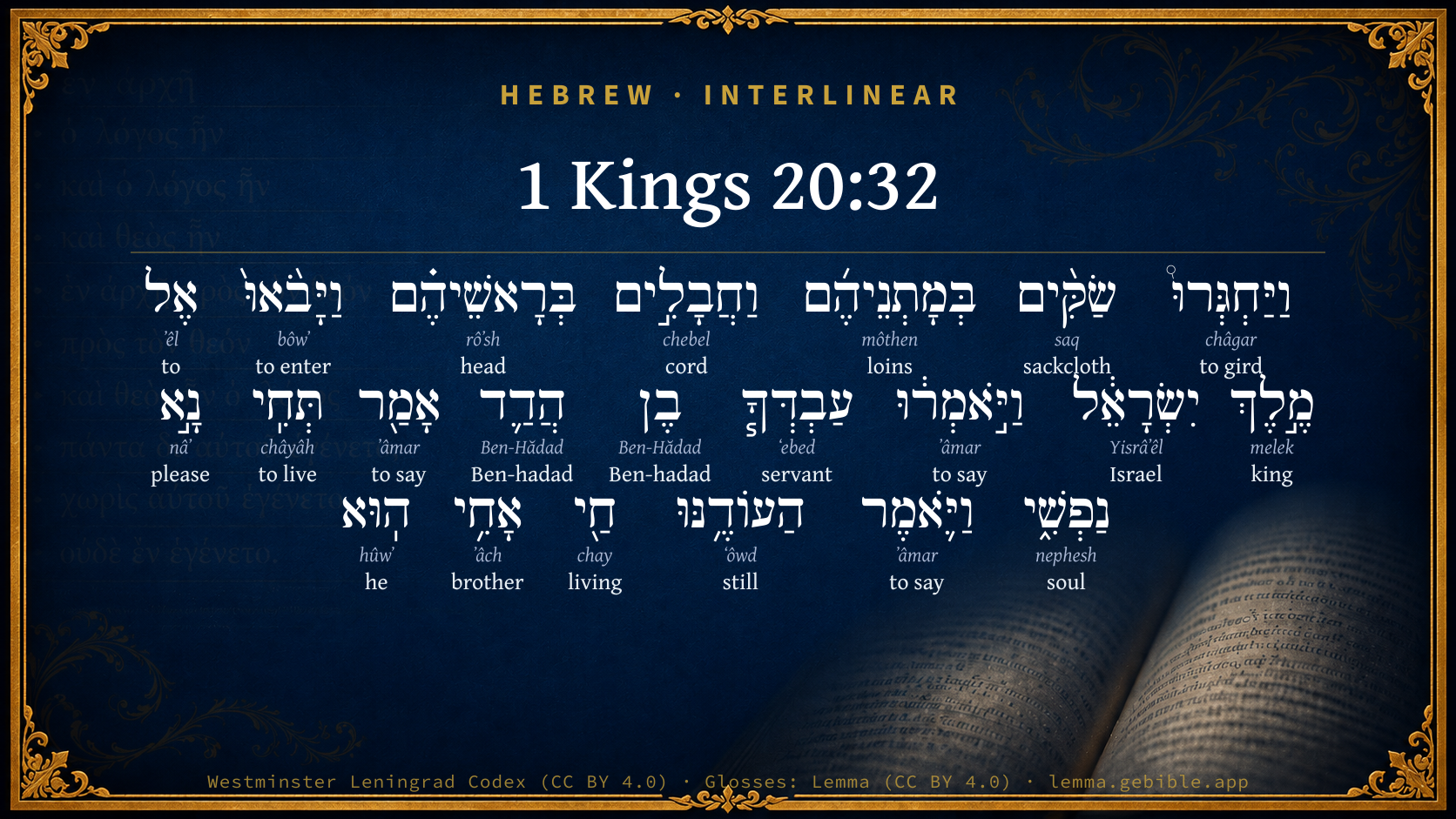
1 Kings 20:32

Hebrew (Westminster Leningrad Codex) 1 Kings 20:32 appears in the Hebrew Old Testament. The text above is from the Westminster Leningrad Codex. Each word links to its Strong’s number, a concise gloss, and parsing drawn from the Open Scriptures Hebrew Bible morphology. Click any word for its full Brown-Driver-Briggs (BDB) entry.
Download image
Cite this verse

1 Kings 20:32 (World English Bible). Public Domain. Lemma interlinear Bible study tool, https://lemma.gebible.app/v/1-kings/20/32.

Show BibTeX & RIS
BibTeX
RIS
English Translation
So they girded sackcloth on their loins, and [put] ropes on their heads, and came to the king of Israel, and said, Your servant Ben Hadad says, please let me live. He said, Is he yet alive? he is my brother.
World English Bible · Public Domain
Download a study sheet

One document with this verse’s original text, its word-by-word gloss line, the meaning frame, cross-references with their text, attributed commentary, and full source and license credits — printable, and it pastes into notes with its structure intact.

This verse Autodidact and up

Study sheet (.html) Plain text (.txt)

A passage Seminary Student

Up to 50 verses in one chapter. A passage sheet keeps up to 6 commentary sources and 12 cross-references per verse, in the order this page ranks them, and says so on the sheet whenever that leaves anything out. Ask for a single verse and you get the Autodidact verse sheet above.

Everything on this page stays free to read, with no account — the sheet is a download of what is already on screen, not access to it.

Want to remove ads? Support Godless Engineer
Compare translations 3

The same verse in 3 English versions, stacked beneath the original-language interlinear above. Click any original word for its lexicon entry.

Each is an independent rendering of the whole verse — the interlinear is not word-aligned to these translations.

Highlighted words mark where these versions differ — a whole-verse word diff, not a word-by-word alignment.

  • World English Bible Public Domain
    So they girded sackcloth on their loins, and [put] ropes on their heads, and came to the king of Israel, and said, Your servant Ben Hadad says, please let me live. He said, Is he yet alive? he is my brother.
  • King James Version Public Domain
    So they girded sackcloth on their loins, and put ropes on their heads, and came to the king of Israel, and said, Thy servant Benhadad saith, I pray thee, let me live. And he said, Is he yet alive? he is my brother.
  • unfoldingWord Literal Text CC BY-SA 4.0
    And they girded sackcloth on their waists and ropes on their heads, and they came to the king of Israel. And they said, “Your servant Ben Hadad says, ‘Please let my soul live.’” And he said, “ he still alive? He my brother.”

unfoldingWord Literal Text — © unfoldingWord, licensed CC BY-SA 4.0. Word-aligned USFM3 via Door43 (git.door43.org/unfoldingWord/en_ult).

Versions to compare (up to 4)

3 of 4 selected

Show all 18 translations

Every available English version of this verse, each an independent rendering of the whole verse.

  • World English Bible Public Domain
    So they girded sackcloth on their loins, and [put] ropes on their heads, and came to the king of Israel, and said, Your servant Ben Hadad says, please let me live. He said, Is he yet alive? he is my brother.
  • Berean Standard Bible Public Domain
    So with sackcloth around their waists and ropes around their heads, they went to the king of Israel and said, “Your servant Ben-hadad says, ‘Please spare my life.’” And the king answered, “Is he still alive? He is my brother.”
  • Majority Standard Bible Public Domain
    So with sackcloth around their waists and ropes around their heads, they went to the king of Israel and said, “Your servant Ben-hadad says, ‘Please spare my life.’” And the king answered, “Is he still alive? He is my brother.”
  • King James Version Public Domain
    So they girded sackcloth on their loins, and put ropes on their heads, and came to the king of Israel, and said, Thy servant Benhadad saith, I pray thee, let me live. And he said, Is he yet alive? he is my brother.
  • American Standard Version (1901) Public Domain
    So they girded sackcloth on their loins, and `put' ropes on their heads, and came to the king of Israel, and said, Thy servant Ben-hadad saith, I pray thee, let me live. And he said, Is he yet alive? he is my brother.
  • Revised Version (1885) Public Domain
    So they girded sackcloth on their loins, and put ropes on their heads, and came to the king of Israel, and said, Thy servant Ben-hadad saith, I pray thee, let me live. And he said, Is he yet alive? he is my brother.
  • Geneva Bible (1599) Public Domain
    Then they gyrded sackecloth about their loynes, and put ropes about their heads, and came to the King of Israel, and sayd, Thy seruant Ben-hadad sayth, I pray thee, let me liue: and he sayd, Is he yet aliue? he is my brother.
  • Douay-Rheims (1899) Public Domain
    So they girded sackcloth on their loins, and put ropes on their heads, and came to the king of Israel, and said to him: Thy servant Benadad saith: I beseech thee let me have my life. And he said: If he be yet alive he is my brother.
  • Young's Literal Translation Public Domain
    And they gird sackcloth on their loins, and ropes `are' on their heads, and they come in unto the king of Israel, and say, `Thy servant Ben-Hadad hath said, Let me live, I pray thee;' and he saith, `Is he yet alive? he `is' my brother.'
  • Literal Standard Version CC BY-SA 4.0
    And they gird sackcloth on their loins, and ropes [are] on their heads, and they come to the king of Israel, and say, “Your servant Ben-Hadad has said, Please let me live”; and he says, “Is he still alive? He [is] my brother.”
  • Unlocked Literal Bible CC BY-SA 4.0
    So they put sackcloth on their waists and ropes around their heads and then went to the king of Israel and said, “Your servant Ben Hadad said, 'Please let me live.'” Ahab said, “Is he still alive? He is my brother.”
  • unfoldingWord Literal Text CC BY-SA 4.0
    And they girded sackcloth on their waists and ropes on their heads, and they came to the king of Israel. And they said, “Your servant Ben Hadad says, ‘Please let my soul live.’” And he said, “ he still alive? He my brother.”
  • Darby Bible Public Domain
    And they girded sackcloth on their loins, and ropes on their heads, and came to the king of Israel, and said, Thy servant Ben-Hadad says, I pray thee, let me live. And he said, Is he yet alive? he is my brother.
  • World Messianic Bible Public Domain
    So they put sackcloth on their bodies and ropes on their heads, and came to the king of Israel, and said, “Your servant Ben Hadad says, ‘Please let me live.’” He said, “Is he still alive? He is my brother.”
  • Webster's Bible Public Domain
    So they girded sackcloth on their loins, and put ropes on their heads, and came to the king of Israel, and said, Thy servant Ben-hadad saith, I pray thee, let me live. And he said, Is he yet alive? he is my brother.
  • Free Bible Version CC BY-SA 4.0
    So wearing sackcloth around their waists and ropes on their heads, they went and surrendered to the king of Israel, and told him, “Your servant Ben-hadad asks, ‘Please let me live.’” The king replied “Is he still alive? I think of him as my brother.”
  • Bible in Basic English Public Domain
    So they put on haircloth, and cords on their heads, and came to the king of Israel and said, Your servant Ben-hadad says, Let me now keep my life. And he said, Is he still living? he is my brother.
  • JPS Tanakh (1917) Public Domain
    So they girded sackcloth on their loins, and put ropes on their heads, and came to the king of Israel, and said: 'Thy servant Ben-hadad saith: I pray thee, let me live.' And he said: 'Is he yet alive? he is my brother.'

Literal Standard Version (2020), Covenant Press — licensed CC BY-SA 4.0. Text via the HelloAO Bible API (eBible.org). Unlocked Literal Bible (unfoldingWord) — licensed CC BY-SA 4.0. Text via the HelloAO Bible API (eBible.org). unfoldingWord Literal Text — © unfoldingWord, licensed CC BY-SA 4.0. Word-aligned USFM3 via Door43 (git.door43.org/unfoldingWord/en_ult). Free Bible Version, Dr. Jonathan Gallagher — licensed CC BY-SA 4.0. Text via the HelloAO Bible API (eBible.org).

Word by word

More ways to search: Search by grammar → Find every occurrence → Compare this word →

Practice this passage: Drill this verse → Learn its vocabulary →

וַיַּחְגְּרוּ֩
châgar
H2296
“and · to gird”
Conjunction + Verb, Qal, Sequential Imperfect, 3rd Person, Masculine, Plural
Part of Speech
Conjunction + Verb
Stem
Qal
Form
Sequential Imperfect
Person
3rd Person
Gender
Masculine
Number
Plural
Full BDB Definition

Origin: a primitive root

TWOT: 604

to gird, gird on, gird oneself, put on a belt - (Qal) - to gird - to gird on, bind on - to gird oneself
  1. שַׂקִּ֨ים saq H8242 “sacks” Noun, Common, Masculine, Plural, Absolute
  2. בְּמָתְנֵיהֶ֜ם môthen H4975 “in/at · loins · their” Preposition + Noun, Common, Masculine, Dual, Construct + Suffix, Personal, 3rd Person, Masculine, Plural
  3. וַחֲבָלִ֣ים chebel H2256 “and · cords” Conjunction + Noun, Common, Both, Plural, Absolute
  4. בְּרָאשֵׁיהֶ֗ם rôʼsh H7218 “in/at · heads · their” Preposition + Noun, Common, Masculine, Plural, Construct + Suffix, Personal, 3rd Person, Masculine, Plural
  5. וַיָּבֹ֨אוּ֙ bôwʼ H935 “and · to enter” Conjunction + Verb, Qal, Sequential Imperfect, 3rd Person, Masculine, Plural
  6. אֶל ʼêl H413 “to” Preposition
  7. מֶ֣לֶךְ melek H4428 “king of” Noun, Common, Masculine, Singular, Construct
  8. יִשְׂרָאֵ֔ל Yisrâʼêl H3478 “Israel” Noun, Proper
  9. וַיֹּ֣אמְר֔וּ ʼâmar H559 “and · to say” Conjunction + Verb, Qal, Sequential Imperfect, 3rd Person, Masculine, Plural
  10. עַבְדְּךָ֧ ʻebed H5650 “servant · your” Noun, Common, Masculine, Singular, Construct + Suffix, Personal, 2nd Person, Masculine, Singular
  11. בֶן Ben-Hădad H1130 “Ben-hadad” Noun, Proper
  12. הֲדַ֛ד Ben-Hădad H1130 “Ben-hadad” Noun, Proper
  13. אָמַ֖ר ʼâmar H559 “to say” Verb, Qal, Perfect, 3rd Person, Masculine, Singular
  14. תְּחִֽי châyâh H2421 “to live” Verb, Qal, Jussive, 3rd Person, Feminine, Singular
  15. נָ֣א nâʼ H4994 “please” Particle, Exhortation
  16. נַפְשִׁ֑י nephesh H5315 “soul · my” Noun, Common, Both, Singular, Construct + Suffix, Personal, 1st Person, Common, Singular
  17. וַיֹּ֛אמֶר ʼâmar H559 “and · to say” Conjunction + Verb, Qal, Sequential Imperfect, 3rd Person, Masculine, Singular
  18. הַעוֹדֶ֥נּוּ ʻôwd H5750 “still · his” Particle, Interrogative + Adverb + Suffix, Personal, 3rd Person, Masculine, Singular
  19. חַ֖י chay H2416 “living” Adjective, Adjective, Masculine, Singular, Absolute
  20. אָחִ֥י ʼâch H251 “brother · my” Noun, Common, Masculine, Singular, Construct + Suffix, Personal, 1st Person, Common, Singular
  21. הֽוּא hûwʼ H1931 “he” Pronoun, Personal, 3rd Person, Masculine, Singular

About this verse

These counts appear in no published source. They are computed here, from the morphology-tagged text and Lemma’s own curated glosses. What Lemma adds →

22
words
19
distinct lemmas
Historical
section

Shared distinctive vocabulary

וַיַּחְגְּרוּ֩ to gird H2296 occurs in 41 verses of the Hebrew Bible. Also found in:

Grammatical profile

  • 6 verbs
  • 11 nouns
  • 1 adjective
  • 1 pronoun
  • 1 preposition
  • 1 adverb
  • 1 particle

Verb forms

  • וַיַּחְגְּרוּ֩ Qal · Sequential Imperfect
  • וַיָּבֹ֨אוּ֙ Qal · Sequential Imperfect
  • וַיֹּ֣אמְר֔וּ Qal · Sequential Imperfect
  • אָמַ֖ר Qal · Perfect
  • תְּחִֽי Qal · Jussive
  • וַיֹּ֛אמֶר Qal · Sequential Imperfect

Repetition

Words recur within this verse — often emphatic in Hebrew:

  • וַיֹּ֣אמְר֔וּ to say H559 ×3
  • בֶן Ben-hadad H1130 ×2

Cross-references

10

Topical passages linked to 1 Kings 20:32 in the Treasury of Scripture Knowledge — connected by theme and wording, ordered by reader-vote popularity; previews shown in the World English Bible.

  • 1 Kings 20:3–6 Your silver and your gold is mine; your wives also and your children, even the best, are mine.
  • 1 Samuel 15:8–20 He took Agag the king of the Amalekites alive, and utterly destroyed all the people with the edge of the sword.
  • 1 Kings 20:31 His servants said to him, See now, we have heard that the kings of the house of Israel are merciful kings: let us, we pray you, put sackcloth on our loins, and ropes on our heads, and go out to the king of Israel: peradventure he will save your life.
  • 1 Kings 20:42 He said to him, Thus says Yahweh, Because you have let go out of your hand the man whom I had devoted to destruction, therefore your life shall go for his life, and your people for his people.
  • Job 12:17–18 He leads counselors away stripped. He makes judges fools.
  • Job 40:11–12 Pour forth the fury of your anger. Look on everyone who is proud, and bring him low.
  • Isaiah 2:11–12 The lofty looks of man will be brought low, The haughtiness of men will be bowed down, And Yahweh alone will be exalted in that day.
  • Isaiah 10:12 Therefore it shall happen that, when the Lord has performed his whole work on Mount Zion and on Jerusalem, I will punish the fruit of the stout heart of the king of Assyria, and the glory of his high looks.
  • Daniel 5:20–23 But when his heart was lifted up, and his spirit was hardened so that he dealt proudly, he was deposed from his kingly throne, and they took his glory from him:
  • Obadiah 1:3–4 The pride of your heart has deceived you, you who dwell in the clefts of the rock, whose habitation is high, who says in his heart, 'Who will bring me down to the ground?'

Cross-references courtesy of OpenBible.info (CC BY 4.0).

Hebrew and Greek witnesses Masoretic Hebrew ↔ Greek Septuagint

The same verse in the two great witnesses to the Old Testament, shown verse-for-verse.

These are two independent witnesses, not word-aligned to each other, and the Septuagint is shown in lemma (dictionary) form.

Hebrew 1 Kings 20:32 Masoretic · Westminster Leningrad Codex

וַיַּחְגְּרוּ֩ שַׂקִּ֨ים בְּמָתְנֵיהֶ֜ם וַחֲבָלִ֣ים בְּרָאשֵׁיהֶ֗ם וַיָּבֹ֨אוּ֙ אֶל מֶ֣לֶךְ יִשְׂרָאֵ֔ל וַיֹּ֣אמְר֔וּ עַבְדְּךָ֧ בֶן הֲדַ֛ד אָמַ֖ר תְּחִֽי נָ֣א נַפְשִׁ֑י וַיֹּ֛אמֶר הַעוֹדֶ֥נּוּ חַ֖י אָחִ֥י הֽוּא

So they girded sackcloth on their loins, and [put] ropes on their heads, and came to the king of Israel, and said, Your servant Ben Hadad says, please let me live. He said, Is he yet alive? he is my brother.

World English Bible · Public Domain

Hebrew: Westminster Leningrad Codex (CC BY 4.0). Greek: Septuagint (public domain); English from a public-domain English Septuagint. How the Septuagint differs from the Hebrew →

Targum (Aramaic paraphrase)

1

The Targum is the ancient Jewish Aramaic paraphrase of the Hebrew Scriptures — an interpretive translation, not the Hebrew text itself. Onkelos (literal) and Pseudo-Jonathan (expansive) render the Torah, and Jonathan the Prophets. Coverage is partial: where no permissively-licensed English translation exists for a verse, only the Aramaic is shown. This is verse-level text, not a word-by-word alignment to the Hebrew.

  1. Targum Jonathan Prophets (Joshua–Malachi)
    וַאֲסָרוּ שַׂקִין בְּחַרְצֵיהוֹן וְאֵטוּנִין בְּרֵישֵׁיהוֹן וַאֲתוֹ לְוַת מַלְכָּא דְיִשְׂרָאֵל וַאֲמַרוּ עַבְדָךְ בַּר הֲדַד אֲמַר תִּתְקַיָם כְּעַן נַפְשִׁי וַאֲמַר הַעוֹד כְּעַן קַיָם אָחִי הוּא:

    (no public-domain English translation for this verse)

    Targum Jonathan — Aramaic: “Mikraot Gedolot” (public domain). English: “Sefaria Community Translation” (CC0 1.0 (public-domain dedication)); “London "Chaldee Paraphrase," 1871” (public domain). Text via Sefaria.

Commentary

Notes on 1 Kings 20:32 from classic Christian and Jewish commentators (each source and its license shown beneath its notes). The classic Christian expositions comment on the surrounding passage and are grouped to its opening verse, so a note may address several verses; the Jewish commentaries on the Tanakh (Rashi and others) are per-verse, so they appear only where the commentator wrote on this verse.

Lemma curates 59 commentaries, every one of them public domain or Creative Commons licensed, each selected and text-cleaned for this edition rather than reprinted as found. About our sources →

Trapp's Complete Commentary

John Trapp

1Ki 20:32 So they girded sackcloth on their loins, and [put] ropes on their heads, and came to the king of Israel, and said, Thy servant Benhadad saith, I pray thee, let me live. And he said, [Is] he yet alive? he [is] my brother.

Ver. 32. So they girded sackcloth.] See 1Ki 20:31.

Thy servant Benhadad saith.] Not long since it was, Thy lord Benhadad saith, All that thou hast is mine. Pride goeth before a fall. It was a great foretoken of Darius’s ruin, when in his proud embassy to Alexander he called himself king of kings, and cousin of the gods; but for Alexander, he called him his servant. Decent fortunas secundas superbiae, said he in Plautus, but without reason; Great men may well be proud. How much better Polybius, that grave historian, who by the example of M. Attilius Regulus, - haughty and merciless to the Carthaginians, of whom he was shortly after glad to crave mercy, - teacheth men to use their prosperity moderately; and not to look for any long continuance of it. {a}

I pray thee, let me live.] Life is a sweet mercy, {Est 7:3; Jer 39:18; Jer 45:5} and man is a life loving creature, said Aesop.

He is my brother.] Haec non clementia fuit, sed dementia, saith one. This was not courtsey, but foolery. {b} Brother Benhadad will ere long fight against Ahab with that life which he had given him. {1Ki 22:31}

{a} απιστειν τη τυχη και μαλιστα κατα τας ευπραγιαν.

{b} Chald. Paraph.

John Trapp, A Commentary or Exposition upon All the Books of the Old and New Testament (1647–1656) — public domain. Text from a community e-Sword module.

Joseph Benson's Commentary

1Ki 20:32. Thy servant Ben-hadad saith, I pray thee, let me live — He now as humbly petitions Ahab, as Ahab a little while ago had petitioned him, and begs of him his life. What a change from the height of prosperity to the depth of distress! Such is the uncertainty of human affairs! Such the strange turns which are continually taking place! The spoke of the wheel which is uppermost now, may soon be the lowest of all. And he said, is he yet alive? He is my brother — I do not only pardon him, but honour and love him as a brother. This was rather folly than mercifulness, or good nature; to treat a man thus, who had so lately used him with such extreme haughtiness, and brought so much confusion, terror, and damage, into his kingdom.

Joseph Benson's Commentary on the Old and New Testaments (1811–1818) — public domain. Text from a community e-Sword module.

Tyndale Open Study Notes

Tyndale Open Resources

20:32-33 my brother: Ahab spoke to Ben-hadad in terms that politely indicated the Aramean king’s royal authority and Ahab’s desire for good relations. Ahab welcomed Ben-hadad into his chariot to demonstrate his warm reception of the king, yet serving notice that he should recognize Ahab as his equal. Correspondence and parity agreements between kings of the ancient Near East used the language of brotherhood to express friendship, good relations, or formal equality.

Tyndale Open Study Notes — © Tyndale Open Resources, licensed CC BY-SA 4.0. Text via the HelloAO Bible API.

Jamieson, Fausset & Brown

Robert Jamieson, A. R. Fausset & David Brown

put ropes on their heads--Captives were dragged by ropes round their necks in companies, as is depicted on the monuments of Egypt. Their voluntary attitude and language of submission flattered the pride of Ahab, who, little concerned about the dishonor done to the God of Israel by the Syrian king, and thinking of nothing but victory, paraded his clemency, called the vanquished king "his brother," invited him to sit in the royal chariot, and dismissed him with a covenant of peace.

Jamieson, Fausset & Brown — Commentary Critical and Explanatory on the Whole Bible (1871) — public domain (CC PDM 1.0). Text via the HelloAO Bible API.

Adam Clarke's Commentary

Verse 32. Thy servant Ben-hadad] See the vicissitude of human affairs! A little before he was the haughtiest of all tyrants, and Ahab calls him his lord; now, so much is he humbled, that he will be glad to be reputed Ahab's slave!

Adam Clarke's Commentary on the Bible (1810–1826) — public domain. Text from a community e-Sword/MySword module.

The Cambridge Bible for Schools and Colleges

gen. ed. J. J. S. Perowne

32. Is he yet alive? he is my brother] Ahab could not know whether Ben-hadad had perished under the falling wall, but as soon as he hears that he is safe, his sympathy is stirred for one of his own rank, and he uses the kingly form of address in speaking of him ‘my brother’. Cf. above on 1Ki_9:13.

The Cambridge Bible for Schools and Colleges (gen. ed. J. J. S. Perowne; Cambridge University Press, 1878–1918) — public domain. Text from a community e-Sword module.

John Gill's Exposition

So they girded sackcloth on their loins, and put ropes on their heads,.... Signifying they came to surrender themselves to him as his captives and prisoners, and he might do with them as seemed good to him, hang them up if he pleased, for which they brought ropes with them, as a token that they deserved it, see Isa 20:2,

and came to the king of Israel, and said, thy servant Benhadad saith, I pray thee let me live: he that a little while ago insolently demanded his wives, and children, and silver, and gold, as his property, now is his humble servant, and begs, not for his crown and kingdom, but for his life:

and he said, is he yet alive? he is my brother; which was intimating at once, that not only they might expect he would spare his life, who seemed to be so glad that he was alive, but that he would show him more favour, having a great affection for him as his brother; this was a very foolish expression from a king in his circumstances, with respect to one who had given him so much trouble and distress, and had behaved with so much haughtiness and contempt towards him.

John Gill's Exposition of the Whole Bible (1746–1763) — public domain (CC PDM 1.0). Text via the HelloAO Bible API.

Albert Barnes' Notes on the Bible

Ben-hadad is now as humble as Ahab had been a year before 1Ki 20:9. He professes himself the mere “slave” of his conqueror.

Albert Barnes' Notes on the Bible (1834–1885) — public domain. Text from a community e-Sword/MySword module.

Matthew Poole's English Annotations

I do not only freely pardon him, but honour and love him as my brother.

Matthew Poole's English Annotations on the Holy Bible (1683–1685) — public domain. Text from a community e-Sword/MySword module.

Whedon's Commentary on the Bible

Daniel D. Whedon

32. He is my brother — Ahab’s vanity was flattered by this humiliation of his royal foe; and the king, who is subject to such vanity, will be likely to do many foolish things.

Daniel D. Whedon (gen. ed.), Commentary on the Old and New Testaments (1874–1909) — public domain. Text from a community e-Sword module.

The Pulpit Commentary

So they girded sackcloth on their loins, and put ropes on their heads, and came to the king of Israel, and said, Thy servant Benhadad saith, I pray thee, let me live. Compare with this abject petition for life the arrogant insolence of vers. 6, 10. The tables are indeed turned. And he said, Is he yet alive? he is my brother.

The Pulpit Commentary (1880–1919), ed. H.D.M. Spence-Jones & Joseph S. Exell — public domain. Text from a community e-Sword module.

John Wesley's Explanatory Notes

My brother - I do not only pardon him, but honour and love him as my brother. What a change is here! From the height of prosperity, to the depth of distress. See the uncertainty of human affairs! Such turns are they subject to, that the spoke of the wheel which is uppermost now, may soon be the lowest of all.

John Wesley, Explanatory Notes Upon the Whole Bible (1754–1765) — public domain. Text via the GEBible commentary corpus.

Lesson kit

Teaching starters — assembled from the data on this page, not authored interpretation. Every prompt links to the verse data it draws on. Edit before teaching.

1 Kings, in the Historical, opens this verse with 22 words (19 distinct Hebrew lemmas). Its most distinctive word is châgar (“to gird”). A historical commentator’s framing appears above. Read the whole chapter for the surrounding context.

Discussion questions

  1. What does “to gird” (châgar) contribute to the verse as a whole?
  2. Exodus 12:11 shares the word «to gird» with this verse. How do the two illuminate each other?
  3. “to say” occurs 3× in this one verse. What is the effect of the repetition?
  4. These translations render this verse differently. What is at stake in choosing one wording over another?
  5. The verb «וַיַּחְגְּרוּ֩» is Qal Sequential Imperfect. How does its form color the action?
  6. Reading how Trapp's Complete Commentary and Joseph Benson's Commentary read this verse, where do the two commentators agree and where do they part?

Things to notice

Reading settings

Reading text

Shown beneath each verse's original-language words.

Old Testament
Old Testament edition

Read the OT as the Masoretic Hebrew (MT) or the Greek Septuagint (LXX).

English shown for the Greek Septuagint (in the Hebrew ↔ Greek comparison).

Comparing translations? Open the Compare panel on any verse page to stack up to four side by side.