Genesis 47:25

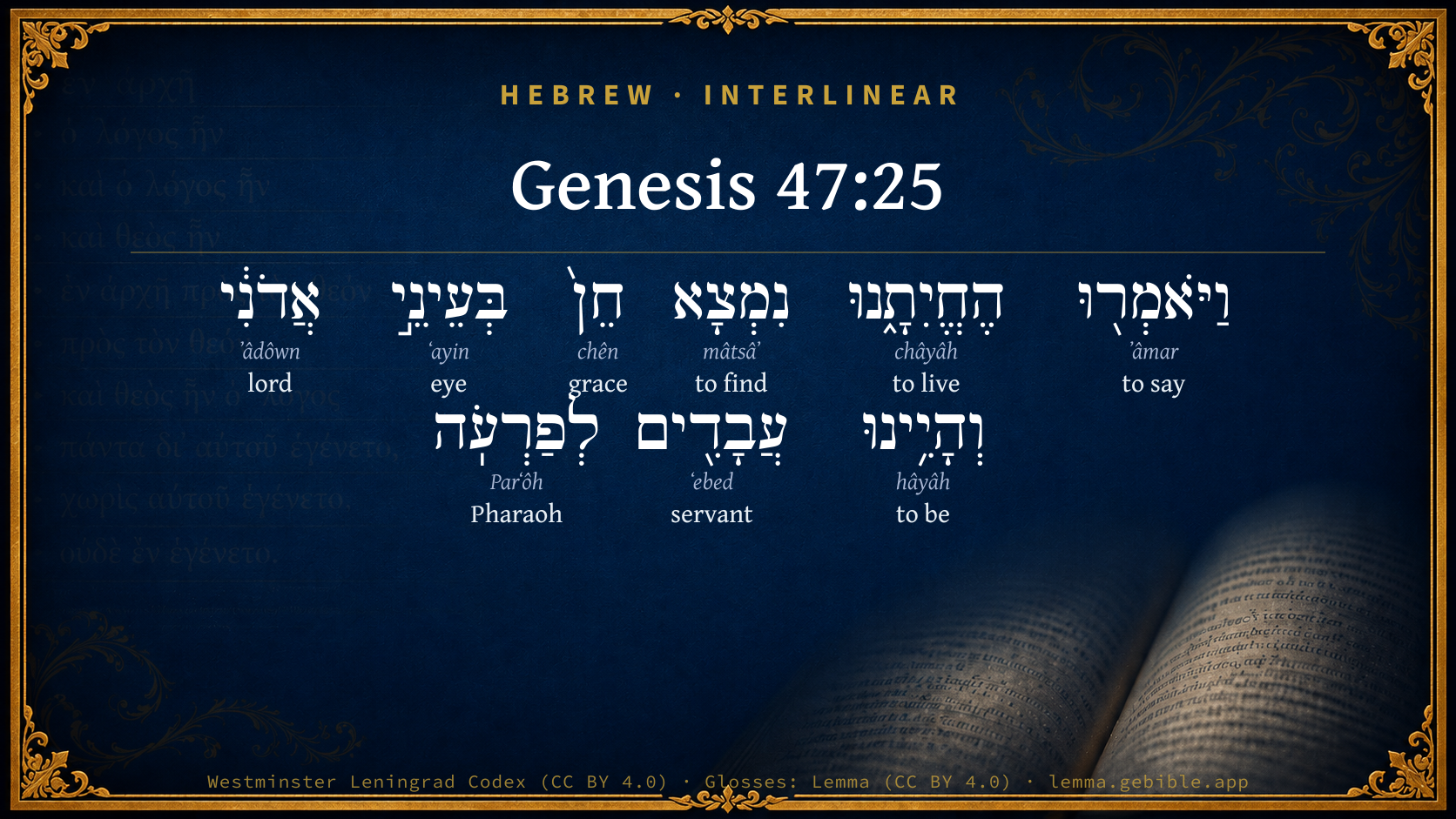
Hebrew (Westminster Leningrad Codex) Genesis 47:25 appears in the Hebrew Old Testament. The text above is from the Westminster Leningrad Codex. Each word links to its Strong’s number, a concise gloss, and parsing drawn from the Open Scriptures Hebrew Bible morphology. Click any word for its full Brown-Driver-Briggs (BDB) entry.
Download image
Cite this verse

Genesis 47:25 (World English Bible). Public Domain. Lemma interlinear Bible study tool, https://lemma.gebible.app/v/genesis/47/25.

Show BibTeX & RIS
BibTeX
RIS
English Translation
They said, "You have saved our lives! Let us find favor in the sight of my lord, and we will be Pharaoh's servants."
World English Bible · Public Domain
Download a study sheet

One document with this verse’s original text, its word-by-word gloss line, the meaning frame, cross-references with their text, attributed commentary, and full source and license credits — printable, and it pastes into notes with its structure intact.

This verse Autodidact and up

Study sheet (.html) Plain text (.txt)

A passage Seminary Student

Up to 50 verses in one chapter. A passage sheet keeps up to 6 commentary sources and 12 cross-references per verse, in the order this page ranks them, and says so on the sheet whenever that leaves anything out. Ask for a single verse and you get the Autodidact verse sheet above.

Everything on this page stays free to read, with no account — the sheet is a download of what is already on screen, not access to it.

Want to remove ads? Support Godless Engineer
Compare translations 3

The same verse in 3 English versions, stacked beneath the original-language interlinear above. Click any original word for its lexicon entry.

Each is an independent rendering of the whole verse — the interlinear is not word-aligned to these translations.

Highlighted words mark where these versions differ — a whole-verse word diff, not a word-by-word alignment.

  • World English Bible Public Domain
    They said, "You have saved our lives! Let us find favor in the sight of my lord, and we will be Pharaoh's servants."
  • King James Version Public Domain
    And they said, Thou hast saved our lives: let us find grace in the sight of my lord, and we will be Pharaoh's servants.
  • unfoldingWord Literal Text CC BY-SA 4.0
    And they said, “You have kept us alive! Let us find favor in the eyes of my lord, and we will be slaves for Pharaoh.”

unfoldingWord Literal Text — © unfoldingWord, licensed CC BY-SA 4.0. Word-aligned USFM3 via Door43 (git.door43.org/unfoldingWord/en_ult).

Versions to compare (up to 4)

3 of 4 selected

Show all 18 translations

Every available English version of this verse, each an independent rendering of the whole verse.

  • World English Bible Public Domain
    They said, "You have saved our lives! Let us find favor in the sight of my lord, and we will be Pharaoh's servants."
  • Berean Standard Bible Public Domain
    “You have saved our lives,” they said. “We have found favor in our lord’s eyes, and we will be Pharaoh’s servants.”
  • Majority Standard Bible Public Domain
    “You have saved our lives,” they said. “We have found favor in our lord’s eyes, and we will be Pharaoh’s servants.”
  • King James Version Public Domain
    And they said, Thou hast saved our lives: let us find grace in the sight of my lord, and we will be Pharaoh's servants.
  • American Standard Version (1901) Public Domain
    And they said, Thou hast saved our lives: let us find favor in the sight of my lord, and we will be Pharaoh's servants.
  • Revised Version (1885) Public Domain
    And they said, Thou hast saved our lives: let us find grace in the sight of my lord, and we will be Pharaoh’s servants.
  • Geneva Bible (1599) Public Domain
    Then they answered, Thou hast saued our liues: let vs finde grace in the sight of my Lord, and we will be Pharaohs seruants.
  • Douay-Rheims (1899) Public Domain
    And they answered: Our life is in thy hand: only let my lord look favourably upon us, and we will gladly serve the king.
  • Young's Literal Translation Public Domain
    And they say, `Thou hast revived us; we find grace in the eyes of my lord, and have been servants to Pharaoh;'
  • Literal Standard Version CC BY-SA 4.0
    And they say, “You have revived us; we find grace in the eyes of my lord, and have been servants to Pharaoh”;
  • Unlocked Literal Bible CC BY-SA 4.0
    They said, “You have saved our lives. May we find favor in your eyes. We will be Pharaoh's servants.”
  • unfoldingWord Literal Text CC BY-SA 4.0
    And they said, “You have kept us alive! Let us find favor in the eyes of my lord, and we will be slaves for Pharaoh.”
  • Darby Bible Public Domain
    And they said, Thou hast saved us alive. Let us find favour in the eyes of my lord, and we will be Pharaoh's bondmen.
  • World Messianic Bible Public Domain
    They said, “You have saved our lives! Let us find favor in the sight of my lord, and we will be Pharaoh’s servants.”
  • Webster's Bible Public Domain
    And they said, Thou hast saved our lives: let us find grace in the sight of my lord, and we will be Pharaoh's servants.
  • Free Bible Version CC BY-SA 4.0
    “You've saved our lives,” they declared. “May you continue to treat us well, my lord, and we'll be Pharaoh's slaves.”
  • Bible in Basic English Public Domain
    And they said to him, Truly you have kept us from death; may we have grace in your eyes, and we will be Pharaoh's servants.
  • JPS Tanakh (1917) Public Domain
    And they said: 'Thou hast saved our lives. Let us find favour in the sight of my lord, and we will be Pharaoh's bondmen.'

Literal Standard Version (2020), Covenant Press — licensed CC BY-SA 4.0. Text via the HelloAO Bible API (eBible.org). Unlocked Literal Bible (unfoldingWord) — licensed CC BY-SA 4.0. Text via the HelloAO Bible API (eBible.org). unfoldingWord Literal Text — © unfoldingWord, licensed CC BY-SA 4.0. Word-aligned USFM3 via Door43 (git.door43.org/unfoldingWord/en_ult). Free Bible Version, Dr. Jonathan Gallagher — licensed CC BY-SA 4.0. Text via the HelloAO Bible API (eBible.org).

Word by word

More ways to search: Search by grammar → Find every occurrence → Compare this word →

Practice this passage: Drill this verse → Learn its vocabulary →

חֵן֙
chên
H2580
“grace”
Noun, Common, Masculine, Singular, Absolute
Part of Speech
Noun
Type
Common
Gender
Masculine
Number
Singular
State
Absolute
Full BDB Definition

Origin: from H2603

TWOT: TWOT- 694a

favour, grace, charm - favour, grace, elegance - favour, acceptance
  1. וַיֹּאמְר֖וּ ʼâmar H559 “and · to say” Conjunction + Verb, Qal, Sequential Imperfect, 3rd Person, Masculine, Plural
  2. הֶחֱיִתָ֑נוּ châyâh H2421 “to live · us” Verb, Hiphil, Perfect, 2nd Person, Masculine, Singular + Suffix, Personal, 1st Person, Common, Plural
  3. נִמְצָא mâtsâʼ H4672 “to find” Verb, Qal, Imperfect, 1st Person, Common, Plural
  4. בְּעֵינֵ֣י ʻayin H5869 “in/at · eyes of” Preposition + Noun, Common, Both, Dual, Construct
  5. אֲדֹנִ֔י ʼâdôwn H113 “lord · my” Noun, Common, Masculine, Singular, Construct + Suffix, Personal, 1st Person, Common, Singular
  6. וְהָיִ֥ינוּ hâyâh H1961 “and · to be” Conjunction + Verb, Qal, Sequential Perfect, 1st Person, Common, Plural
  7. עֲבָדִ֖ים ʻebed H5650 “servants” Noun, Common, Masculine, Plural, Absolute
  8. לְפַרְעֹֽה Parʻôh H6547 “to/for · Pharaoh” Preposition + Noun, Proper

About this verse

These counts appear in no published source. They are computed here, from the morphology-tagged text and Lemma’s own curated glosses. What Lemma adds →

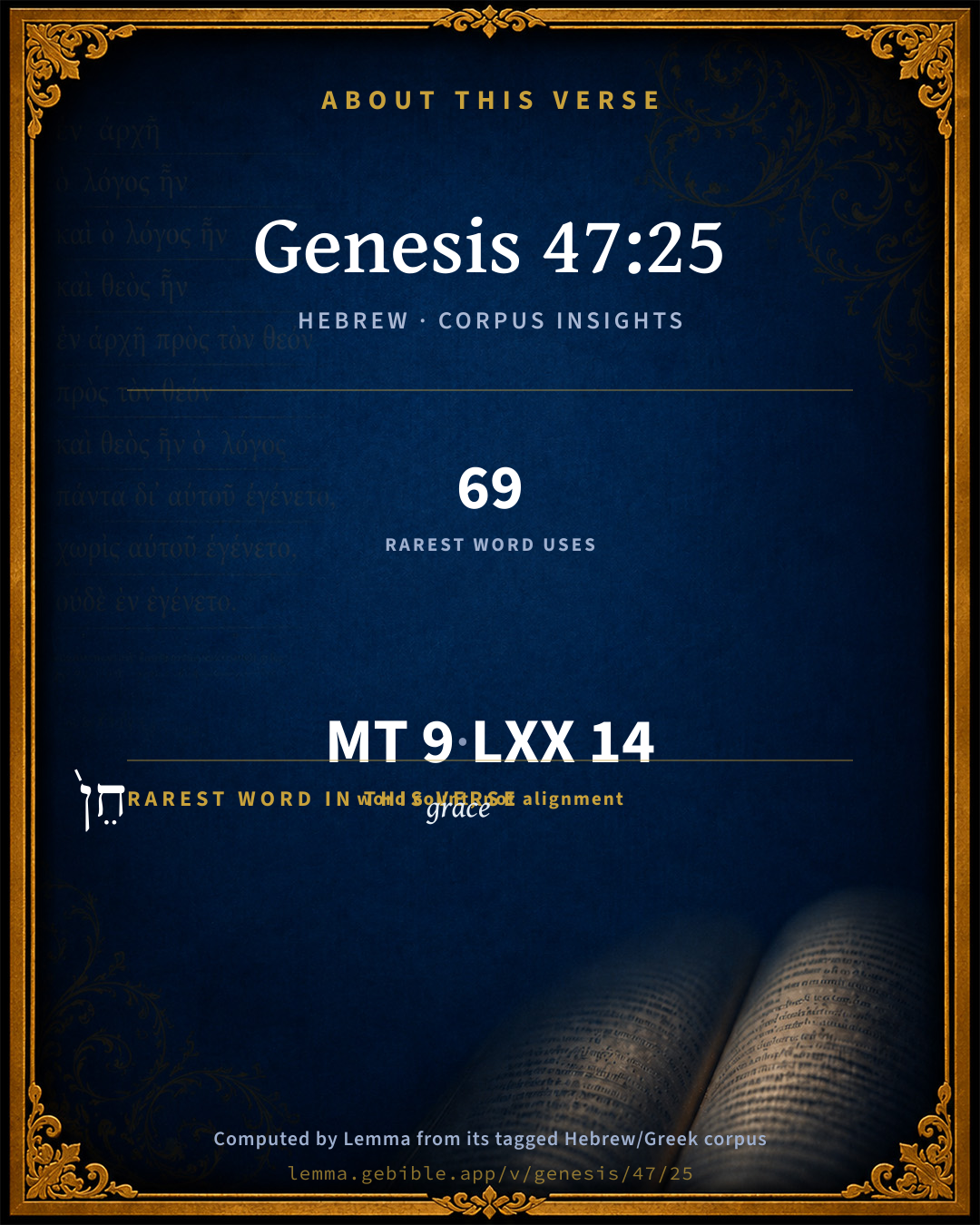
9
words
9
distinct lemmas
Pentateuch
section

Grammatical profile

  • 4 verbs
  • 5 nouns

Verb forms

  • וַיֹּאמְר֖וּ Qal · Sequential Imperfect
  • הֶחֱיִתָ֑נוּ Hiphil · Perfect
  • נִמְצָא Qal · Imperfect
  • וְהָיִ֥ינוּ Qal · Sequential Perfect

Hebrew & Septuagint length

In English translation the verse runs 23 words from the Hebrew and 21 from the Septuagint (LXX English) — closely comparable.

A rough comparison of the two English renderings, which tokenize alike — not a word-level alignment.

Word counts can differ between the Hebrew and the Greek without any difference in meaning — e.g. the Hebrew direct-object marker אֵת has no separate Greek word, and Greek often adds the article ὁ.

In the original languages it is 9 Hebrew tokens and 14 Greek tokens — but the two are counted differently (Hebrew bundles its prefixes and suffixes into one token; the Greek is in lemma form), so that isn’t a like-for-like length.

Cross-references

8

Topical passages linked to Genesis 47:25 in the Treasury of Scripture Knowledge — connected by theme and wording, ordered by reader-vote popularity; previews shown in the World English Bible.

  • Genesis 33:15 Esau said, "Let me now leave with you some of the folk who are with me." He said, "Why? Let me find favor in the sight of my lord."
  • Genesis 6:19 Of every living thing of all flesh, you shall bring two of every sort into the ark, to keep them alive with you. They shall be male and female.
  • Genesis 18:3 and said, "My lord, if now I have found favor in your sight, please don't go away from your servant.
  • Genesis 41:45 Pharaoh called Joseph's name Zaphenath-paneah; and he gave him Asenath, the daughter of Potiphera priest of On as a wife. Joseph went out over the land of Egypt.
  • Genesis 45:6–8 For these two years the famine has been in the land, and there are yet five years, in which there will be neither plowing nor harvest.
  • Genesis 50:20 As for you, you meant evil against me, but God meant it for good, to bring to pass, as it is this day, to save many people alive.
  • Ruth 2:13 Then she said, Let me find favor in your sight, my lord, because you have comforted me, and because you have spoken kindly to your handmaid, though I am not as one of your handmaidens.
  • Proverbs 11:26–27 People curse someone who withholds grain, But blessing will be on the head of him who sells it.

Cross-references courtesy of OpenBible.info (CC BY 4.0).

Hebrew and Greek witnesses Masoretic Hebrew ↔ Greek Septuagint

The same verse in the two great witnesses to the Old Testament, shown verse-for-verse.

These are two independent witnesses, not word-aligned to each other, and the Septuagint is shown in lemma (dictionary) form.

Hebrew Genesis 47:25 Masoretic · Westminster Leningrad Codex

וַיֹּאמְר֖וּ הֶחֱיִתָ֑נוּ נִמְצָא חֵן֙ בְּעֵינֵ֣י אֲדֹנִ֔י וְהָיִ֥ינוּ עֲבָדִ֖ים לְפַרְעֹֽה

They said, "You have saved our lives! Let us find favor in the sight of my lord, and we will be Pharaoh's servants."

World English Bible · Public Domain

Greek LXX Genesis 47:25 Septuagint · lemma form

καί εἶπον σώζω ἐγώ εὑρίσκω χάρις ἐναντίον ὁ κύριος ἐγώ καί εἰμί παῖς φαραώ

And they said, You have saved us; we have found favor before our lord, and we will be servants to Pharao.

LXX2012 (modern English Septuagint) · Public Domain

Hebrew: Westminster Leningrad Codex (CC BY 4.0). Greek: Septuagint (public domain); English from LXX2012 (modern English Septuagint) (Public Domain). How the Septuagint differs from the Hebrew →

Targum (Aramaic paraphrase)

2

The Targum is the ancient Jewish Aramaic paraphrase of the Hebrew Scriptures — an interpretive translation, not the Hebrew text itself. Onkelos (literal) and Pseudo-Jonathan (expansive) render the Torah, and Jonathan the Prophets. Coverage is partial: where no permissively-licensed English translation exists for a verse, only the Aramaic is shown. This is verse-level text, not a word-by-word alignment to the Hebrew.

  1. Targum Onkelos Torah (Genesis–Deuteronomy)
    וַאֲמָרוּ קַיִּמְתָּנָא נִשְׁכַּח רַחֲמִין בְּעֵינֵי רִבּוֹנִי וּנְהֵי עַבְדִּין לְפַרְעֹה

    (no public-domain English translation for this verse)

    Targum Onkelos — Aramaic: “Onkelos Genesis” (public domain); “Onkelos Exodus” (public domain); “Onkelos Leviticus” (public domain); “Onkelos Numbers” (public domain); “Onkelos Deuteronomy” (public domain). English: “Sefaria Community Translation” (CC0 1.0 (public-domain dedication)); “J.W. Etheridge. The Targums of Onkelos and Jonathan Ben Uzziel on the Pentateuch. London: Longmans, Green, 1862” (public domain). Text via Sefaria.

  2. Targum Pseudo-Jonathan Torah (Genesis–Deuteronomy)
    וַאֲמָרוּ קִיַימְתָּנָא נִשְׁכַּח רַחֲמִין בְּעֵינֵי רִבּוֹנִי וּנְהֵי עַבְדִין לְפַרְעה

    And they said, Thou hast preserved us: let us find favour in the eyes of my lord, and we will be Pharoh's servants.

    Targum Pseudo-Jonathan — Aramaic: “Targum Jonathan on Genesis” (public domain); “Targum Jonathan on Exodus” (public domain); “Targum Jonathan on Leviticus” (public domain); “Targum Jonathan on Numbers” (public domain); “Targum Jonathan on Deuteronomy” (public domain). English: “The Targum of Jonathan ben Uzziel, trans. J. W. Etheridge, London, 1862” (public domain). Text via Sefaria.

Commentary

Notes on Genesis 47:25 from classic Christian and Jewish commentators (each source and its license shown beneath its notes). The classic Christian expositions comment on the surrounding passage and are grouped to its opening verse, so a note may address several verses; the Jewish commentaries on the Tanakh (Rashi and others) are per-verse, so they appear only where the commentator wrote on this verse.

Lemma curates 59 commentaries, every one of them public domain or Creative Commons licensed, each selected and text-cleaned for this edition rather than reprinted as found. About our sources →

Trapp's Complete Commentary

John Trapp

Gen 47:25 And they said, Thou hast saved our lives: let us find grace in the sight of my lord, and we will be Pharaoh’s servants.

Ver. 25. Let us find grace.] That is, Do us the favour to intercede for us to Pharaoh, that we may be his perpetual farmers, and hold of him. It seems that Pharaoh was no proper name, but common to the kings of Egypt; as Caesar, to the emperors of Rome; a title of honour, as His Majesty amongst us. Otherwise these poor people had been too bold with his name.

John Trapp, A Commentary or Exposition upon All the Books of the Old and New Testament (1647–1656) — public domain. Text from a community e-Sword module.

Ellicott's Commentary for English Readers

(25) Thou hast saved our lives.—The people were more than satisfied with Joseph’s regulations; and if he had made them dependent upon the Pharaoh, apparently he had broken the yoke of the smaller lords, the hereditary princes of the districts into which Egypt was parcelled out; and they were more likely to be well-treated by the ruler of the whole land than by men of inferior rank. On these hereditary principalities at the period of the twelfth dynasty, see Maspero, Hist. Anc, p. 121.

A Bible Commentary for English Readers, edited by Charles John Ellicott (1878–1897) — public domain. Text from a community e-Sword module.

John Gill's Exposition

And Joseph made it a law over the land of Egypt unto this day,.... With the consent of Pharaoh, his nobles, and all the people of the land, who readily came into it; and so it became, a fundamental law of their constitution, and which continued to the times of Moses, the writer of this history:

that Pharaoh should have the fifth part; that is, of the increase the whole land of Egypt produced:

except the land of the priests only, which became not Pharaoh's; it not being bought by him; so Diodorus Siculus (m), as he assigns the first part of the land to the priests, so he says they were free from all taxes and tribute, and next to the king were possessed of honour and authority.

(m) Ut supra. (Bibliothec. l. 1. p. 47.)

John Gill's Exposition of the Whole Bible (1746–1763) — public domain (CC PDM 1.0). Text via the HelloAO Bible API.

Matthew Poole's English Annotations

Without thy care and providence we had all been dead men; and therefore if thou hadst kept us to the first bargain, thou hadst done us more kindness than wrong, much more when thou hast used us with so much equity and clemency. Be thou our friend with Pharaoh in this and upon all other occasions.

We will be Pharaoh’s servants, to manage his land for him upon the terms which thou hast proposed.

Matthew Poole's English Annotations on the Holy Bible (1683–1685) — public domain. Text from a community e-Sword/MySword module.

The Pulpit Commentary

And they said, Thou hast saved our lives (literally, thou hast kept us alive): let us find grace in the sight of my lord (i.e. let us have the land on these favorable terms), and we will be Pharaoh"s servants. "That a sort of feudal service is here intended the service of free laborers, not bondmen we may learn from the relationship of the Israelites to God, which was formed after the plan of this Egyptian model" (Gerlach).

The Pulpit Commentary (1880–1919), ed. H.D.M. Spence-Jones & Joseph S. Exell — public domain. Text from a community e-Sword module.

unfoldingWord translationNotes

Door43 World Missions Community

May we find favor in your eyes

The phrase "find favor" is an idiom which means to be approved of by someone. Also, the eyes represent seeing, and seeing represents thoughts or judgment. AT: "May you be pleased with us" (See: Idiom and Metaphor)

in the land of Egypt

"over the land of Egypt" or "throughout the land of Egypt"

to this day

This means to the time that the author was writing this.

one-fifth

See how you translated "a fifth" in Genesis 47:24.

translationWords

save

favor

Pharaoh

servant

statute

Egypt

priest

unfoldingWord translationNotes — © Distant Shores Media and the Door43 World Missions Community, licensed CC BY-SA 4.0. Source: git.door43.org/Door43/en_tn.

Rashi

Rabbi Shlomo Yitzchaki (Rashi)

נמצא חן LET US FIND FAVOUR — [IN THE EYES OF MY LORD] in that you should do for us as you have said.

והיינו עבדים לפרעה AND WE SHALL BE PHARAOH’S SERVANTS, paying him this tax annually.

Rashi on the Tanakh — English translations: “The Judaica Press complete Tanach with Rashi, translated by A. J. Rosenberg” (CC BY 4.0); “Pentateuch with Rashi's commentary by M. Rosenbaum and A.M. Silbermann, 1929-1934” (public domain); “The Metsudah Tanach series, Lakewood, N.J” (CC BY 4.0); and “The Book of Joshua, Metsudah Publications, 1997” (CC BY 4.0). Text via Sefaria.

Lesson kit

Teaching starters — assembled from the data on this page, not authored interpretation. Every prompt links to the verse data it draws on. Edit before teaching.

Genesis, in the Pentateuch, opens this verse with 9 words (9 distinct Hebrew lemmas). Its most distinctive word is chên (“grace”). A historical commentator’s framing appears above. Read the whole chapter for the surrounding context.

Discussion questions

  1. What does “grace” (chên) contribute to the verse as a whole?
  2. Genesis 33:15 shares this passage’s theme. How do the two illuminate each other?
  3. The translations on this page render this verse differently — a whole-verse word diff, not a word-by-word alignment. What might account for the different wordings?
  4. The verb «וַיֹּאמְר֖וּ» is Qal Sequential Imperfect. How does its form color the action?
  5. Reading how Trapp's Complete Commentary and Ellicott's Commentary for English Readers read this verse, where do the two commentators agree and where do they part?

Things to notice

Reading settings

Reading text

Shown beneath each verse's original-language words.

Old Testament
Old Testament edition

Read the OT as the Masoretic Hebrew (MT) or the Greek Septuagint (LXX).

English shown for the Greek Septuagint (in the Hebrew ↔ Greek comparison).

Comparing translations? Open the Compare panel on any verse page to stack up to four side by side.