Isaiah 26:14

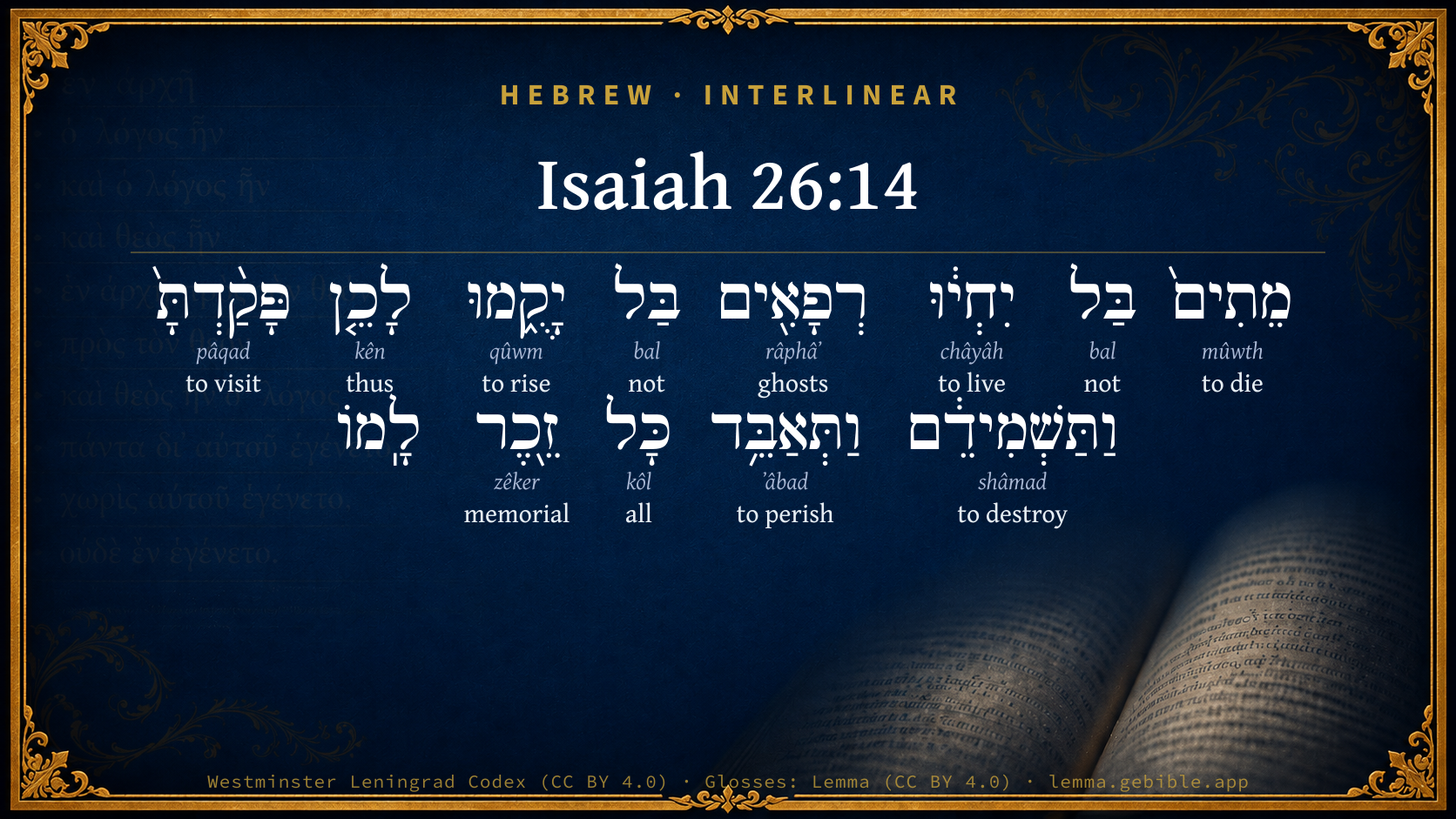
Hebrew (Westminster Leningrad Codex) Isaiah 26:14 appears in the Hebrew Old Testament. The text above is from the Westminster Leningrad Codex. Each word links to its Strong’s number, a concise gloss, and parsing drawn from the Open Scriptures Hebrew Bible morphology. Click any word for its full Brown-Driver-Briggs (BDB) entry.
Download image
Cite this verse

Isaiah 26:14 (World English Bible). Public Domain. Lemma interlinear Bible study tool, https://lemma.gebible.app/v/isaiah/26/14.

Show BibTeX & RIS
BibTeX
RIS
English Translation
[They are] dead, they shall not live; [they are] deceased, they shall not rise: therefore have you visited and destroyed them, and made all memory of them to perish.
World English Bible · Public Domain
Download a study sheet

One document with this verse’s original text, its word-by-word gloss line, the meaning frame, cross-references with their text, attributed commentary, and full source and license credits — printable, and it pastes into notes with its structure intact.

This verse Autodidact and up

Study sheet (.html) Plain text (.txt)

A passage Seminary Student

Up to 50 verses in one chapter. A passage sheet keeps up to 6 commentary sources and 12 cross-references per verse, in the order this page ranks them, and says so on the sheet whenever that leaves anything out. Ask for a single verse and you get the Autodidact verse sheet above.

Everything on this page stays free to read, with no account — the sheet is a download of what is already on screen, not access to it.

Want to remove ads? Support Godless Engineer
Compare translations 3

The same verse in 3 English versions, stacked beneath the original-language interlinear above. Click any original word for its lexicon entry.

Each is an independent rendering of the whole verse — the interlinear is not word-aligned to these translations.

Highlighted words mark where these versions differ — a whole-verse word diff, not a word-by-word alignment.

  • World English Bible Public Domain
    [They are] dead, they shall not live; [they are] deceased, they shall not rise: therefore have you visited and destroyed them, and made all memory of them to perish.
  • King James Version Public Domain
    They are dead, they shall not live; they are deceased, they shall not rise: therefore hast thou visited and destroyed them, and made all their memory to perish.
  • unfoldingWord Literal Text CC BY-SA 4.0
    Having died, they will not live; Raphaites, they will not arise, because you visited and destroyed them, and you made all of the memory of them perish.

unfoldingWord Literal Text — © unfoldingWord, licensed CC BY-SA 4.0. Word-aligned USFM3 via Door43 (git.door43.org/unfoldingWord/en_ult).

Versions to compare (up to 4)

3 of 4 selected

Show all 18 translations

Every available English version of this verse, each an independent rendering of the whole verse.

  • World English Bible Public Domain
    [They are] dead, they shall not live; [they are] deceased, they shall not rise: therefore have you visited and destroyed them, and made all memory of them to perish.
  • Berean Standard Bible Public Domain
    The dead will not live; the departed spirits will not rise. Therefore You have punished and destroyed them; You have wiped out all memory of them.
  • Majority Standard Bible Public Domain
    The dead will not live; the departed spirits will not rise. Therefore You have punished and destroyed them; You have wiped out all memory of them.
  • King James Version Public Domain
    They are dead, they shall not live; they are deceased, they shall not rise: therefore hast thou visited and destroyed them, and made all their memory to perish.
  • American Standard Version (1901) Public Domain
    `They are' dead, they shall not live; `they are' deceased, they shall not rise: therefore hast thou visited and destroyed them, and made all remembrance of them to perish.
  • Revised Version (1885) Public Domain
    They are dead, they shall not live; they are deceased, they shall not rise: therefore hast thou visited and destroyed them, and made all their memory to perish.
  • Geneva Bible (1599) Public Domain
    The dead shall not liue, neither shall the dead arise, because thou hast visited and scattered them, and destroyed all their memorie.
  • Douay-Rheims (1899) Public Domain
    Let not the dead live, let not the giants rise again: therefore hast thou visited and destroyed them, and best destroyed all their memory.
  • Young's Literal Translation Public Domain
    Dead -- they live not, Rephaim, they rise not, Therefore Thou hast inspected and dost destroy them, Yea, thou destroyest all their memory.
  • Literal Standard Version CC BY-SA 4.0
    Dead—they do not live, || Rephaim, they do not rise, || Therefore You have inspected and destroy them, || Indeed, you destroy all their memory.
  • Unlocked Literal Bible CC BY-SA 4.0
    They are dead, they will not live; they are deceased, they will not arise. Indeed, you came in judgment and destroyed them, and made every memory of them to perish.
  • unfoldingWord Literal Text CC BY-SA 4.0
    Having died, they will not live; Raphaites, they will not arise, because you visited and destroyed them, and you made all of the memory of them perish.
  • Darby Bible Public Domain
    [They are] dead, they shall not live; deceased, they shall not rise: for thou hast visited and destroyed them, and made all memory of them to perish.
  • World Messianic Bible Public Domain
    The dead shall not live. The departed spirits shall not rise. Therefore you have visited and destroyed them, and caused all memory of them to perish.
  • Webster's Bible Public Domain
    They are dead, they shall not live; they are deceased, they shall not rise: therefore hast thou visited and destroyed them, and made all their memory to perish.
  • Free Bible Version CC BY-SA 4.0
    They are dead, they will not live again; they will not rise from the grave. Lord, you punished them and destroyed them—even wiping out every memory about them.
  • Bible in Basic English Public Domain
    The dead will not come back to life: their spirits will not come back to earth; for this cause you have sent destruction on them, so that the memory of them is dead.
  • JPS Tanakh (1917) Public Domain
    The dead live not, the shades rise not; to that end hast Thou punished and destroyed them, and made all their memory to perish.

Literal Standard Version (2020), Covenant Press — licensed CC BY-SA 4.0. Text via the HelloAO Bible API (eBible.org). Unlocked Literal Bible (unfoldingWord) — licensed CC BY-SA 4.0. Text via the HelloAO Bible API (eBible.org). unfoldingWord Literal Text — © unfoldingWord, licensed CC BY-SA 4.0. Word-aligned USFM3 via Door43 (git.door43.org/unfoldingWord/en_ult). Free Bible Version, Dr. Jonathan Gallagher — licensed CC BY-SA 4.0. Text via the HelloAO Bible API (eBible.org).

Word by word

More ways to search: Search by grammar → Find every occurrence → Compare this word →

Practice this passage: Drill this verse → Learn its vocabulary →

רְפָאִ֖ים
râphâʼ
H7496
“ghosts”
Noun, Common, Masculine, Plural, Absolute
Part of Speech
Noun
Type
Common
Gender
Masculine
Number
Plural
State
Absolute
Full BDB Definition

Origin: from H7495 in the sense of H7503

TWOT: 2198c

ghosts of the dead, shades, spirits
  1. מֵתִים֙ mûwth H4191 “dying” Verb, Qal, Participle Active, Masculine, Plural, Absolute
  2. בַּל bal H1077 “not” Particle, Negative
  3. יִחְי֔וּ châyâh H2421 “to live” Verb, Qal, Imperfect, 3rd Person, Masculine, Plural
  4. בַּל bal H1077 “not” Particle, Negative
  5. יָקֻ֑מוּ qûwm H6965 “to rise” Verb, Qal, Imperfect, 3rd Person, Masculine, Plural
  6. לָכֵ֤ן kên H3651 “to/for · thus” Preposition + Adverb
  7. פָּקַ֨דְתָּ֙ pâqad H6485 “to visit” Verb, Qal, Perfect, 2nd Person, Masculine, Singular
  8. וַתַּשְׁמִידֵ֔ם shâmad H8045 “and · to destroy · them” Conjunction + Verb, Hiphil, Sequential Imperfect, 2nd Person, Masculine, Singular + Suffix, Personal, 3rd Person, Masculine, Plural
  9. וַתְּאַבֵּ֥ד ʼâbad H6 “and · to perish” Conjunction + Verb, Piel, Sequential Imperfect, 2nd Person, Masculine, Singular
  10. כָּל kôl H3605 “all of” Noun, Common, Masculine, Singular, Construct
  11. זֵ֖כֶר zêker H2143 “memorial” Noun, Common, Masculine, Singular, Absolute

About this verse

These counts appear in no published source. They are computed here, from the morphology-tagged text and Lemma’s own curated glosses. What Lemma adds →

13
words
11
distinct lemmas
Prophets
section

Notable vocabulary

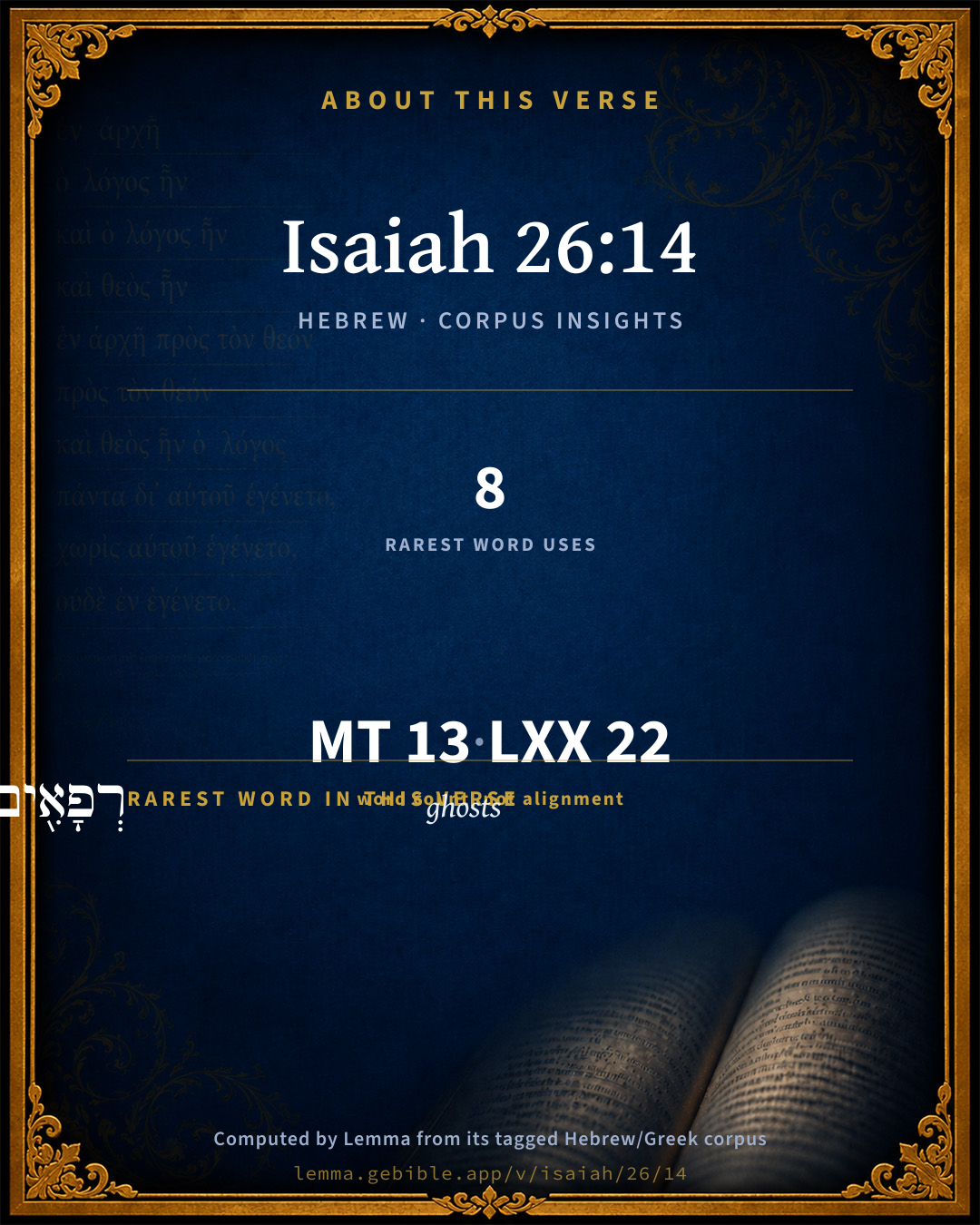
The rarest word here is רְפָאִ֖ים ghosts H7496 — appearing just 8 times in the whole Hebrew Bible.

Shared distinctive vocabulary

רְפָאִ֖ים ghosts H7496 occurs in 8 verses of the Hebrew Bible. Also found in:

Grammatical profile

  • 6 verbs
  • 3 nouns
  • 1 preposition
  • 1 adverb
  • 2 particles

Verb forms

  • מֵתִים֙ Qal · Participle Active
  • יִחְי֔וּ Qal · Imperfect
  • יָקֻ֑מוּ Qal · Imperfect
  • פָּקַ֨דְתָּ֙ Qal · Perfect
  • וַתַּשְׁמִידֵ֔ם Hiphil · Sequential Imperfect
  • וַתְּאַבֵּ֥ד Piel · Sequential Imperfect

Repetition

A word recurs within this verse — often emphatic in Hebrew:

Hebrew & Septuagint length

In English translation the verse runs 29 words from the Hebrew and 41 from the Septuagint (LXX English) — the Septuagint runs noticeably longer here. See the side-by-side →

A rough comparison of the two English renderings, which tokenize alike — not a word-level alignment.

Word counts can differ between the Hebrew and the Greek without any difference in meaning — e.g. the Hebrew direct-object marker אֵת has no separate Greek word, and Greek often adds the article ὁ.

In the original languages it is 13 Hebrew tokens and 22 Greek tokens — but the two are counted differently (Hebrew bundles its prefixes and suffixes into one token; the Greek is in lemma form), so that isn’t a like-for-like length.

Cross-references

16

Topical passages linked to Isaiah 26:14 in the Treasury of Scripture Knowledge — connected by theme and wording, ordered by reader-vote popularity; previews shown in the World English Bible.

  • Proverbs 10:7 The memory of the righteous is blessed, But the name of the wicked will rot.
  • Revelation 18:2–3 He cried with a mighty voice, saying, "Fallen, fallen is Babylon the great, and she has become a habitation of demons, a prison of every unclean spirit, and a prison of every unclean and hateful bird!
  • Psalms 106:28 They joined themselves also to Baal Peor, And ate the sacrifices of the dead.
  • Isaiah 8:19 When they shall tell you, "Consult with those who have familiar spirits and with the wizards, who chirp and who mutter:" shouldn't a people consult with their God? on behalf of the living [should they consult] with the dead?
  • Isaiah 14:19–22 But you are cast forth away from your tomb like an abominable branch, clothed with the slain, who are thrust through with the sword, who go down to the stones of the pit; as a dead body trodden under foot.
  • Isaiah 51:12–13 I, even I, am he who comforts you: who are you, that you are afraid of man who shall die, and of the son of man who shall be made as grass;
  • Habakkuk 2:18–20 "What value does the engraved image have, that its maker has engraved it; the molten image, even the teacher of lies, that he who fashions its form trusts in it, to make mute idols?
  • Exodus 14:30 Thus Yahweh saved Israel that day out of the hand of the Egyptians; and Israel saw the Egyptians dead on the seashore.
  • Deuteronomy 4:28 There you shall serve gods, the work of men's hands, wood and stone, which neither see, nor hear, nor eat, nor smell.
  • Psalms 9:6 The enemy is overtaken by endless ruin. The very memory of the cities which you have overthrown has perished.
  • Psalms 109:13 Let his posterity be cut off. In the generation following let their name be blotted out.
  • Isaiah 10:3 What will you do in the day of visitation, and in the desolation which shall come from far? to whom will you flee for help? and where will you leave your glory?
  • Matthew 2:20 "Arise and take the young child and his mother, and go into the land of Israel, for those who sought the young child's life are dead."
  • Revelation 20:5 The rest of the dead didn't live until the thousand years were finished. This is the first resurrection.
  • Isaiah 26:19 Your dead shall live; my dead bodies shall arise. Awake and sing, you who dwell in the dust; for your dew is [as] the dew of herbs, and the earth shall cast forth the dead.
  • Revelation 19:19–21 I saw the beast, and the kings of the earth, and their armies, gathered together to make war against him who sat on the horse, and against his army.

Cross-references courtesy of OpenBible.info (CC BY 4.0).

Hebrew and Greek witnesses Masoretic Hebrew ↔ Greek Septuagint

The same verse in the two great witnesses to the Old Testament, shown verse-for-verse.

Here the Septuagint runs noticeably longer than the Hebrew — LXX2012 (modern English Septuagint) 41 words vs World English Bible 29. A rough length comparison of the two English translations, not a word-level alignment — read both below.

These are two independent witnesses, not word-aligned to each other, and the Septuagint is shown in lemma (dictionary) form.

Hebrew Isaiah 26:14 Masoretic · Westminster Leningrad Codex

מֵתִים֙ בַּל יִחְי֔וּ רְפָאִ֖ים בַּל יָקֻ֑מוּ לָכֵ֤ן פָּקַ֨דְתָּ֙ וַתַּשְׁמִידֵ֔ם וַתְּאַבֵּ֥ד כָּל זֵ֖כֶר לָֽמוֹ

[They are] dead, they shall not live; [they are] deceased, they shall not rise: therefore have you visited and destroyed them, and made all memory of them to perish.

World English Bible · Public Domain

Greek LXX Isaiah 26:14 Septuagint · lemma form

ὁ δέ νεκρός ζωή οὐ μή ὁράω οὐδέ ἰατρός οὐ μή ἀναἵστημι διά οὗτος ἐπιἄγω καί ἀποὀλλύω καί αἴρω πᾶς ἄρσην αὐτός

But the dead shall not see life, neither shall physicians by any means raise them up: therefore you have brought wrath upon them, and slain them, and have taken away every male of them. Bring more evils upon them, O Lord;

LXX2012 (modern English Septuagint) · Public Domain

On this verse, Ellicott's Commentary for English Readers discusses the Septuagint’s reading. Read the note in Commentary ↓

Hebrew: Westminster Leningrad Codex (CC BY 4.0). Greek: Septuagint (public domain); English from LXX2012 (modern English Septuagint) (Public Domain). How the Septuagint differs from the Hebrew →

Targum (Aramaic paraphrase)

1

The Targum is the ancient Jewish Aramaic paraphrase of the Hebrew Scriptures — an interpretive translation, not the Hebrew text itself. Onkelos (literal) and Pseudo-Jonathan (expansive) render the Torah, and Jonathan the Prophets. Coverage is partial: where no permissively-licensed English translation exists for a verse, only the Aramaic is shown. This is verse-level text, not a word-by-word alignment to the Hebrew.

  1. Targum Jonathan Prophets (Joshua–Malachi)
    אִינוּן פַּלְחִין לְמֵתִין דְלָא יֵחוּן לִגְבָּרֵהוֹן דְלָא יְקוּמוּן בְּכֵן כַּד תַּסְעַר עֲלֵיהוֹן חוֹבֵיהוֹן וּתְשֵׁיצִינוּן וְתוֹבִיד כָּל דָכְרָנְהוֹן:

    They worship idols, who do not live, their heroes, who shall not rise; therefore, when thou “shalt visit their sins, thou wilt make an end of them, and make all memorial of them to perish.

    Targum Jonathan — Aramaic: “Mikraot Gedolot” (public domain). English: “Sefaria Community Translation” (CC0 1.0 (public-domain dedication)); “London "Chaldee Paraphrase," 1871” (public domain). Text via Sefaria.

Commentary

Notes on Isaiah 26:14 from classic Christian and Jewish commentators (each source and its license shown beneath its notes). The classic Christian expositions comment on the surrounding passage and are grouped to its opening verse, so a note may address several verses; the Jewish commentaries on the Tanakh (Rashi and others) are per-verse, so they appear only where the commentator wrote on this verse.

Lemma curates 59 commentaries, every one of them public domain or Creative Commons licensed, each selected and text-cleaned for this edition rather than reprinted as found. About our sources →

Trapp's Complete Commentary

John Trapp

Isa 26:14 [They are] dead, they shall not live; [they are] deceased, they shall not rise: therefore hast thou visited and destroyed them, and made all their memory to perish.

Ver. 14. They are dead.] Those "other lords" of ours are. {Isa 26:13} But seldom lieth the devil dead in a dike, saith our proverb: yet he and his agents have their deadly wound, and shall be trodden under our feet shortly. {Rom 16:20} Oh groan in spirit after that sweet day of full redemption, &c.

Therefore thou hast visited.] Or, Because thou hast visited. Woe be to a person or people when God taketh them to do.

John Trapp, A Commentary or Exposition upon All the Books of the Old and New Testament (1647–1656) — public domain. Text from a community e-Sword module.

The Expositor's Bible

CHAPTER XXX

THE RESURRECTION

Isa_26:14-19; Isa_25:6-9

GRANTED the pardon, the justice, the Temple and the God, which the returning exiles now enjoyed, the possession of these only makes more painful the shortness of life itself. This life is too shallow and too frail a vessel to hold peace and righteousness and worship and the love of God. St. Paul has said, "If in this life only we have hope in Christ, we are of all men most miserable." What avails it to have been pardoned, to have regained the Holy Land and the face of God, if the dear dead are left behind in graves of exile, and all the living must soon pass into that captivity, from which there is no return?

It must have been thoughts like these, which led to the expression of one of the most abrupt and powerful of the few hopes of the resurrection which the Old Testament contains. This hope, which lightens Isa_25:7-8, bursts through again-without logical connection with the context-in Isa_26:14-19.

The English version makes Isa_26:14 to continue the reference to the "lords," whom in Isa_26:13 Israel confesses to have served instead of Jehovah. "They are dead; they shall not live: they are deceased; they shall not rise." Our translators have thus intruded into their version the verb "they are," of which the original is without a trace. In the original, "dead" and "deceased" (literally "shades") are themselves the subject of the sentence-a new subject and without logical connection with what has gone before. The literal translation of Isa_26:14 therefore runs: "Dead men do not live; shades do not rise: wherefore Thou visitest them and destroyest them, and perisheth all memory of them." The prophet states a fact and draws an inference. The fact is, that no one has ever returned from the dead; the inference, that it is Gods own visitation or sentence which has gone forth upon them, and they have really ceased to exist. But how intolerable a thought is this in presence of the other fact that God has here on earth above gloriously enlarged and established His people (Isa_26:15). "Thou hast increased the nation, Jehovah; Thou hast increased the nation. Thou hast covered Thyself with glory; Thou hast expanded all the boundaries of the land." To this follows a verse (Isa_26:16), the sense of which is obscure, but palpable. It "feels" to mean that the contrast which the prophet has just painted between the absolute perishing of the dead and the glory of the Church above ground is the cause of great despair and groaning: "O Jehovah, in The Trouble they supplicate Thee; they pour out incantations when Thy discipline is upon them." In face of The Trouble and The Discipline par excellence of God, what else can man do but betake himself to God? God sent death; in death He is the only resource. Israels feelings in presence of The Trouble are now expressed in Isa_26:17: "Like as a woman with child that draweth near the time of her delivery writheth and crieth out in her pangs, so have we been before Thee, O Jehovah." Thy Church on earth is pregnant with a life, which death does not allow to come to the birth. "We have been with child; we have been in the pangs, as it were; we have brought forth wind; we make not the earth," in spite of all we have really accomplished upon it in our return, our restoration and our enjoyment of Thy presence-"we make not the earth salvation, neither are the inhabitants of the world born."

The figures are bold. Israel achieves, through Gods grace, everything but the recovery of her dead; this, which alone is worth calling salvation, remains wanting to her great record of deliverances. The living Israel is restored, but how meagre a proportion of the people it is! The graves of home and of exile do not give up their dead. These are not born again to be inhabitants of the upper world.

The figures are bold, but bolder is the hope that breaks from them. Like as when the Trumpet shall sound, Isa_26:19 peals forth the promise of the resurrection-peals the promise forth, in spite of all experience, unsupported by any argument, and upon the strength of its own inherent music. "Thy dead shall live! my dead bodies shall arise!" The change of the personal pronoun is singularly dramatic. Returned Israel is the speaker, first speaking to herself: "thy dead," as if upon the depopulated land, in face of all its homes in ruin, and only the sepulchres of ages standing grim and steadfast, she addressed some despairing double of herself; and secondly speaking of herself: "my dead bodies," as if all the inhabitants of these tombs, though dead, were still her own, still part of her, the living Israel, and able to arise and bless with their numbers their bereaved mother. These she now addresses: "Awake and sing, ye dwellers in the dust, for a dew of lights is Thy dew, and the land bringeth forth the dead."

If one has seen a place of graves in the East, he will appreciate the elements of this figure, which takes "dust" for death and "dew" for life. With our damp graveyards "mould" has become the traditional trappings of death; but where under the hot Eastern sun things do not rot into lower forms of life, but crumble into sapless powder, that will not keep a worm in life, "dust" is the natural symbol of death. When they die, men go not to feed fat the mould, but "down into the dust"; and there the foot of the living falls silent, and his voice is choked, and the light is thickened and in retreat, as if it were creeping away to die. The only creatures the visitor starts are timid, unclean bats, that flutter and whisper about him like the ghosts of the dead. There are no flowers in an Eastern cemetery; and the withered branches and other ornaments are thickly powdered with the same dust that chokes, and silences, and darkens all.

Hence the Semitic conception of the underworld was dominated by dust. It was not water nor fire nor frost nor altogether darkness, which made the infernal prison horrible, but that upon its floor and rafters, hewn from the roots and ribs of the primeval mountains, dust lay deep and choking. Amid all the horrors he imagined for the dead, Dante did not include one more awful than the horror of dust. The picture which the northern Semites had before them when they turned their faces to the wall was of this kind.

The house of darkness

The house men enter, but cannot depart from,

The road men go, but cannot return.

The house from whose dwellers the light is withdrawn,

The place where dust is their food, their nourishment clay.

The light they behold not; in darkness they dwell.

They are clothed like birds, all fluttering wings.

On the door and the gateposts, the dust lieth deep.

Either, then, an Eastern sepulchre, or this its infernal double, was gaping before the prophets eyes. What more final and hopeless than the dust and the dark of it?

But for dust there is dew, and even to graveyards the morning comes that brings dew and light together. The wonder of dew is that it is given from a clear heaven, and that it comes to sight with the dawn. If the Oriental looks up when dew is falling, he sees nothing to thank for it between him and the stars. If he sees dew in the morning, it is equal liquid and lustre; it seems to distil from the beams of the sun-"the sun, which riseth with healing under his wings." The dew is thus doubly "dew of light." But our prophet ascribes the dew of God, that is to raise the dead, neither to stars nor dawn, but, because of its Divine power, to that higher supernal glory which the Hebrews conceived to have existed before the sun, and which they styled, as they styled their God, by the plural of majesty: "A dew of lights is Thy dew." {Cf. Jam_1:17} As, when the dawn comes, the drooping flowers of yesterday are seen erect and lustrous with the dew, every spike a crown of glory, so also shall be the resurrection of the dead. There is no shadow of a reason for limiting this promise to that to which some other passages of resurrection in the Old Testament have been limited: a corporate restoration of the holy State or Church. This is the resurrection of its individual members to a community which is already restored, the recovery by Israel of her dead men and women from their separate graves, each with his own freshness and beauty, in that glorious morning when the Sun of righteousness shall arise, with healing under His wings-"Thy dew, O Jehovah!"

Attempts are so often made to trace the hopes of resurrection, which break the prevailing silence of the Old Testament on a future life, to foreign influences experienced in the Exile, that it is well to emphasise the origin and occasion of the hopes that utter themselves so abruptly in this passage. Surely nothing could be more inextricably woven with the national fortunes of Israel, as nothing could be more native and original to Israels temper, than the verses just expounded. We need not deny that their residence among a people, accustomed as the Babylonians were to belief in the resurrection, may have thawed in the Jews that reserve which the Old Testament clearly shows that they exhibited towards a future life. The Babylonians themselves had received most of their suggestions of the next world from a non-Semitic race; and therefore it would not be to imagine anything alien to the ascertained methods of Providence if we were to suppose that the Hebrews, who showed what we have already called the Semitic want of interest in a future life, were intellectually tempered by their foreign associations to a readiness to receive any suggestions of immortality, which the Spirit of God might offer them through their own religious experience. That it was this last, which was the effective cause of Israels hopes for the resurrection of her dead, our passage puts beyond doubt. Chapter 26 shows us that the occasion of these hopes was what is not often noticed: the returned exiles disappointment with the meagre repopulation of the holy territory. A restoration of the State or community was not enough: the heart of Israel wanted back in their numbers her dead sons and daughters.

If the occasion of these hopes was thus an event in Israels own national history, and if the impulse to them was given by so natural an instinct of her own heart, Israel was equally indebted to herself for the convictions that the instinct was not in vain. Nothing is more clear in our passage than that Israels first ground of hope in a future life was her simple, untaught reflection upon the power of her God. Death was His chastening. Death came from Him, and remained in His power. Surely He would deliver from it. This was a very old belief in Israel. "The Lord killeth and maketh alive; He bringeth down to Sheol and bringeth up." Such words, of course, might be only an extreme figure for recovery from disease, and the silence of so great a saint as Hezekiah about any other issue into life than by convalescence from mortal sickness staggers us into doubt whether an Israelite ever did think of a resurrection. But still there was Jehovahs almightiness; a man could rest his future on that, even if he had not light to think out what sort of a future it would be. So mark in our passage, how confidence is chiefly derived from the simple utterance of the name of Jehovah, and how He is hailed as "our God." It seems enough to the prophet to connect life with Him and to say merely, "Thy dew." As death is Gods own discipline, so life, "Thy dew," is with Him also.

Thus in its foundation the Old Testament doctrine of the resurrection is but the conviction of the sufficiency of God Himself, a conviction which Christ turned upon Himself when He said, "I am the Resurrection and the Life. Because I live, ye shall live also."

If any object that in this picture of a resurrection we have no real persuasion of immortality, but simply the natural, though impossible, wish of a bereaved people that their dead should today rise from their graves to share todays return and glory-a revival as special and extraordinary as that appearing of the dead in the streets of Jerusalem when the Atonement was accomplished, but by no means that general resurrection at the last day which is an article of the Christian faith-if any one should bring this objection, then let him be referred to the previous promise of immortality in chapter 25. The universal and final character of the promise made there is as evident as of that for which Paul borrowed its terms in order to utter the absolute consequences of the resurrection of the Son of God: "Death is swallowed up in victory." For the prophet, having in Isa_25:6 described the restoration of the people, whom exile had starved with a famine of ordinances, to "a feast in Zion of fat things and wines on the lees well refined," intimates that as certainly as exile has been abolished, with its dearth of spiritual intercourse, so certainly shall God Himself destroy death: "And He shall swallow up in this mountain" (perhaps it is imagined, as the sun devours the morning mist on the hills) "the mask of the veil, the veil that is upon all the peoples, and the film spun upon all the nations. He hath swallowed up death for ever, and the Lord Jehovah shall wipe away tears from off all faces, and the reproach of His people shall He remove from off all the earth, for Jehovah hath spoken it. And they shall say in that day, Behold, this is our God: we have waited for Him, and He shall save us; this is Jehovah: we have waited for Him; we will rejoice and be glad in His salvation." Thus over all doubts, and in spite of universal human experience, the prophet depends for immortality on God Himself. In Isa_26:3 our version beautifully renders, "Thou wilt keep him inperfect peace whose mind is stayed on Thee, because he trusteth in Thee." This is a confidence valid for the next life as well as for this. "Therefore trust ye in the Lord forever." Amen.

Almighty God, we praise Thee that, in the weakness of all our love and the darkness of all our knowledge before death, Thou hast placed assurance of eternal life in simple faith upon Thyself. Let this faith be richly ours. By Thine omnipotence, by Thy righteousness, by the love Thou hast vouchsafed, we lift ourselves and rest upon Thy word, "Because I live, ye shall live also." Oh, keep us steadfast in union with Thyself, through Jesus Christ our Lord. Amen.

William Robertson Nicoll, ed., The Expositor's Bible (London: Hodder & Stoughton, 1887–1910) — public domain. 65 of 66 books (1 Corinthians is not separately keyed, as that volume carries no machine-parseable verse references); section-level commentary keyed to the opening verse. Introductory and overview sections not keyed to a specific passage are excluded.

Geneva Bible (1599)

Geneva Bible translators

Meaning, that the reprobate, even in this life shall have the beginning of everlasting death.

Geneva Bible (1599) marginal notes — public domain. Text via Bolls.life.

Jamieson, Fausset & Brown

Robert Jamieson, A. R. Fausset & David Brown

They--The "other lords" or tyrants (Isa 26:13).

shall not live--namely, again.

deceased--Hebrew, "Rephaim"; powerless, in the land of shades (Isa 14:9-10).

therefore--that is, inasmuch as. Compare "therefore" (Gen 18:5; Gen 19:8).

Jamieson, Fausset & Brown — Commentary Critical and Explanatory on the Whole Bible (1871) — public domain (CC PDM 1.0). Text via the HelloAO Bible API.

Ellicott's Commentary for English Readers

(14) They are dead . . .—We get a more vivid rendering by omitting the words in italics, Dead, they live not; shadows (Rephaim, as in Psa_88:10), they rise not. Those of whom the prophet speaks are the rulers of the great world-empires, who, as in Isa_14:9; Eze_32:21, have passed into the gloomy world of Hades, out of which there was, for them at least, no escape. Their very names should perish from the memories of men. The LXX., adopting another etymology of the word Rephaim, gives the singular rendering, “Physicians shall not raise them up to life.”

A Bible Commentary for English Readers, edited by Charles John Ellicott (1878–1897) — public domain. Text from a community e-Sword module.

The Cambridge Bible for Schools and Colleges

gen. ed. J. J. S. Perowne

14. Render: The dead shall not live, the Shades (Rìphâ’ îm, as in Isa_14:9) shall not rise, &c. In the form of a general proposition the writer expresses Israel’s sense of security with regard to those “other lords” who have now vanished from the earth. The idea is probably suggested by ch. Isa_14:9 ff. There is no contradiction between this verse and Isa_26:19, nor is there any evidence of a merely nascent belief in the possibility of a resurrection; because the subjects in the two verses are different. The resurrection of Isa_26:19 is distinctly represented as miraculous, and is limited to members of the covenant people; over those who are unvisited by the life-giving “dew” of Jehovah, the sway of death is absolute.

therefore …] i.e. in token that they shall never reappear, all traces of their supremacy have been obliterated.

all their memory] every memorial of them.

The Cambridge Bible for Schools and Colleges (gen. ed. J. J. S. Perowne; Cambridge University Press, 1878–1918) — public domain. Text from a community e-Sword module.

John Gill's Exposition

They are dead, they shall not live; they are deceased, they shall not rise,.... The above tyrannical lords, the kings of the earth and their mighty men, associates of the Romish antichrist, who shall be gathered together, and slain at the battle at Armageddon; these shall not live again in this world, nor rise from their graves, and return to their former state, power, and authority; or tyrannise over, molest, disturb, oppress, and persecute the people of God any more; though they shall live again at the end of the thousand years, and shall awake to everlasting shame and contempt, and come forth to the resurrection of damnation. The Targum is,

"they worship the dead, who do not live; and their mighty men, who shall not rise;''

and are opposed to the worshippers of the only Lord God:

therefore hast thou visited and destroyed them, and made all their memory to perish; or, "because thou hast visited", &c. (d); for these words are a reason why they are irrecoverably lost, and shall not live in eternal life, or rise in the resurrection of the just; because God has visited them in wrath, destroyed them in and for their sins, with such an utter destruction, that they shall be remembered no more. This visitation will be at Armageddon, when the kings, and captains and great men will be slain; the beast and false prophet taken, and cast alive into the furnace of fire; and the rest will be killed by the sword, proceeding out of the mouth of Christ, Rev 19:18. The Targum interprets it of God's casting the wicked into hell.

(d) "propterea", V. L. Junius & Tremellius; "propterea quod", Piscator, De Dieu.

John Gill's Exposition of the Whole Bible (1746–1763) — public domain (CC PDM 1.0). Text via the HelloAO Bible API.

Albert Barnes' Notes on the Bible

They are dead - That is, the kings and tyrants to whom reference is made in Isa 26:13. The principal enemies of the Jews, who had oppressed them, were slain when Babylon was taken by Cyrus (see the notes at Isa. 13; 14)

They shall not live - They shall not again live, and be permitted to harass and enslave us.

They are deceased - Hebrew, רפאים repâ'iym - a name given to the shades or manes of the dead, from an idea that they were weak and powerless (see the notes at Isa 14:9-10; compare Psa 88:11; Pro 2:18; Pro 9:18; Pro 21:16). The sense here is, that they had died and gone to the land of shades, and were now unable anymore to reach or injure the people of God.

Therefore - Or rather, “for”; the word לכן lākên being used evidently in the sense of because that, as in Gen 38:26; Num 11:31; Num 14:13; Psa 42:7; Psa 45:3. The declaration that follows is given as the reason why they were dead, and incapable of again injuring or annoying them.

Hast thou visited ... - (see the note at Isa 24:22) The word ‘visit’ here is used in the sense of to punish.

And made all their memory to perish - Hast blotted out their name; hast caused their celebrity to cease.

Albert Barnes' Notes on the Bible (1834–1885) — public domain. Text from a community e-Sword/MySword module.

Haydock's Catholic Bible Commentary

Giants; the proud emperors of Babylon, whom thou wilt destroy. Septuagint, "physicians;" as Rephaim has also this meaning.

George Leo Haydock (1774–1849), Haydock's Catholic Family Bible and Commentary, 1859 edition — public domain. Excludes Psalms (Douay-Rheims chapter numbering differs from Protestant) and Deuterocanonical books (Catholic canon only).

Matthew Poole's English Annotations

They shall not rise; those tyrants and enemies are utterly and irrecoverably destroyed, so as they shall never live or rise again to molest us. Possibly he speaks of the miraculous destruction of Sennacherib’s army before Jerusalem.

Therefore, that they might be so effectually destroyed, thou didst undertake the work. Or rather, because (as this particle is used, Num 14:43; Psa 42:6)

thou hast, & c., as it follows.

Destroyed them, and made all their memory to perish; thou hast destroyed both them and theirs, and all the monuments or memorials of their greatness and glory.

Matthew Poole's English Annotations on the Holy Bible (1683–1685) — public domain. Text from a community e-Sword/MySword module.

Whedon's Commentary on the Bible

Daniel D. Whedon

14. They are dead — That is, kings and tyrants just referred to.

They shall not rise — That civil state, that God-defying power, shall have no resurrection.

Therefore — Equivalent to so then. The result is certain, that all celebrity of that base people shall be blotted out. This is expressed in high figure, but its intention merely is an eternal, ethical truth; nothing can succeed against God.

Daniel D. Whedon (gen. ed.), Commentary on the Old and New Testaments (1874–1909) — public domain. Text from a community e-Sword module.

The Pulpit Commentary

They are dead, etc.; literally. Dead, they shall not live (i.e. return to life); deceased, they shall not arise. The power of the idol-gods is altogether passed away. It was for this end therefore that God had visited and destroyed them, and made their very memory to perish. How strange it seems that the "great gods" whom so many millions worshipped in former times Bel, and Asshur, and Ammon, and Zeus, and Jupiter should have passed so completely away as to be almost wholly forgotten!

The Pulpit Commentary (1880–1919), ed. H.D.M. Spence-Jones & Joseph S. Exell — public domain. Text from a community e-Sword module.

John Wesley's Explanatory Notes

Rise - Those tyrants are destroyed; they shall never live or rise again to molest us.

John Wesley, Explanatory Notes Upon the Whole Bible (1754–1765) — public domain. Text via the GEBible commentary corpus.

Keil & Delitzsch

C. F. Keil & F. Delitzsch

The tyrants who usurped the rule over Israel have now utterly disappeared. "Dead men live not again, shades do not rise again: so hast Thou visited and destroyed them, and caused all their memory to perish." The meaning is not that Jehovah had put them to death because there was no resurrection at all after death; for, as we shall see further on, the prophet was acquainted with such a resurrection. In mēthim (dead men) and rephâ'im (shades) he had directly in mind the oppressors of Israel, who had been thrust down into the region of the shades (like the king of Babylon in chapter 14), so that there was no possibility of their being raised up or setting themselves up again. The לכן is not argumentative (which would be very freezing in this highly lyrical connection), but introduces what must have occurred eo ipso when the other had taken place (it corresponds to the Greek ἄρα, and is used here in the same way as in Isa 61:7; Jer 5:2; Jer 2:33; Zac 11:7; Job 34:25; Job 42:3). They had fallen irrevocably into Sheol (Psa 49:15), and consequently God had swept them away, so that not even their name was perpetuated.

Keil & Delitzsch — Biblical Commentary on the Old Testament (1861–1891) — public domain (CC PDM 1.0). Text via the HelloAO Bible API. (Old Testament only.)

J. A. Alexander on Isaiah

Joseph Addison Alexander

“Dead, they shall not live: ghosts, they shall not rise: therefore Thou hast visited and destroyed them, and made all memory to perish with respect to them.” Those whom we lately served are now no more; Thou hast destroyed them and consigned them to oblivion, for the very purpose of securing our freedom and devotion to Thy service. It seems best to refer this verse to the strange lords of the foregoing verse, (i.e., the idols themselves), but with some allusion, as in that case, to the idolatrous oppressors of the Jews. The sense is correctly given in the English Version: ‘they are dead, they shall not live; they are deceased, they shall not rise.’ An attempt, however, has been made above to imitate more closely the concise and compact form of the original. For the meaning of ghosts see above, Isa 14:9. It is here a poetical equivalent to dead, and may be variously rendered, shades, shadows, spirits, or the like. The common version (deceased) leaves too entirely out of view the figurative character of the expression. Therefore may be used to introduce, not only the cause, but the design of an action. Though the words cannot mean, Thou hast destroyed them because they are dead and powerless, they may naturally mean, Thou hast destroyed them that they might be dead and powerless. The same two meanings are attached to the English phrase for this reason, which may either denote cause or purpose. The meaning of the verse, as connected with the one before it, is that the strange lords who had ruled them should not only cease to do so, but, so far as they were concerned, should cease to exist or be remembered.

Joseph Addison Alexander, The Prophecies of Isaiah (1846–1847; New York: Scribner, 1870–1878) — public domain. Text from a community e-Sword module.

Rashi

Rabbi Shlomo Yitzchaki (Rashi)

The dead shall not live May it be Your will that these wicked men shall not live in the World to Come, and that these slackers who slackened their hands from Your commandments shall not have restoration.

therefore, You visited [upon them] and You destroyed them Have You not already visited upon them and destroyed them with the words of Your mouth, like the matter that is stated (Exodus 17:14): “For I will surely erase the memory of Amalek.”

Rashi on the Tanakh — English translations: “The Judaica Press complete Tanach with Rashi, translated by A. J. Rosenberg” (CC BY 4.0); “Pentateuch with Rashi's commentary by M. Rosenbaum and A.M. Silbermann, 1929-1934” (public domain); “The Metsudah Tanach series, Lakewood, N.J” (CC BY 4.0); and “The Book of Joshua, Metsudah Publications, 1997” (CC BY 4.0). Text via Sefaria.

Ibn Ezra

Rabbi Abraham ibn Ezra

They are dead. Those our masters, that have owned us, are now dead.

Ibn Ezra on the Tanakh — English translations: “Sefaria Community Translation” (CC0 1.0 (public-domain dedication)); “Yalkut, Sifsei Chachomim Chumash, Metsudah Publications, 2009” (CC BY 4.0); and “Commentary of Ibn Ezra on Isaiah - trans. by M. Friedlander, 1873” (public domain). Text via Sefaria.

Lesson kit

Teaching starters — assembled from the data on this page, not authored interpretation. Every prompt links to the verse data it draws on. Edit before teaching.

Isaiah, in the Prophets, opens this verse with 13 words (11 distinct Hebrew lemmas). Its most distinctive word is râphâʼ (“ghosts”). The Greek Septuagint runs longer here. A historical commentator’s framing appears above. Read the whole chapter for the surrounding context.

Discussion questions

  1. How does “ghosts” (râphâʼ) shape what this verse is saying?
  2. Job 26:5 shares the word «ghosts» with this verse. How do the two illuminate each other?
  3. “not” occurs 2× in this one verse. What is the effect of the repetition?
  4. Compared with the Hebrew, the Septuagint runs longer here. What questions does that raise?
  5. These translations render this verse differently; the difference is in the English rendering, not the original. What questions does that raise?
  6. The verb «מֵתִים֙» is Qal Participle Active. How does its form color the action?
  7. Reading how Trapp's Complete Commentary and The Expositor's Bible read this verse, where do the two commentators agree and where do they part?

Things to notice

Reading settings

Reading text

Shown beneath each verse's original-language words.

Old Testament
Old Testament edition

Read the OT as the Masoretic Hebrew (MT) or the Greek Septuagint (LXX).

English shown for the Greek Septuagint (in the Hebrew ↔ Greek comparison).

Comparing translations? Open the Compare panel on any verse page to stack up to four side by side.