1 Chronicles 11:8

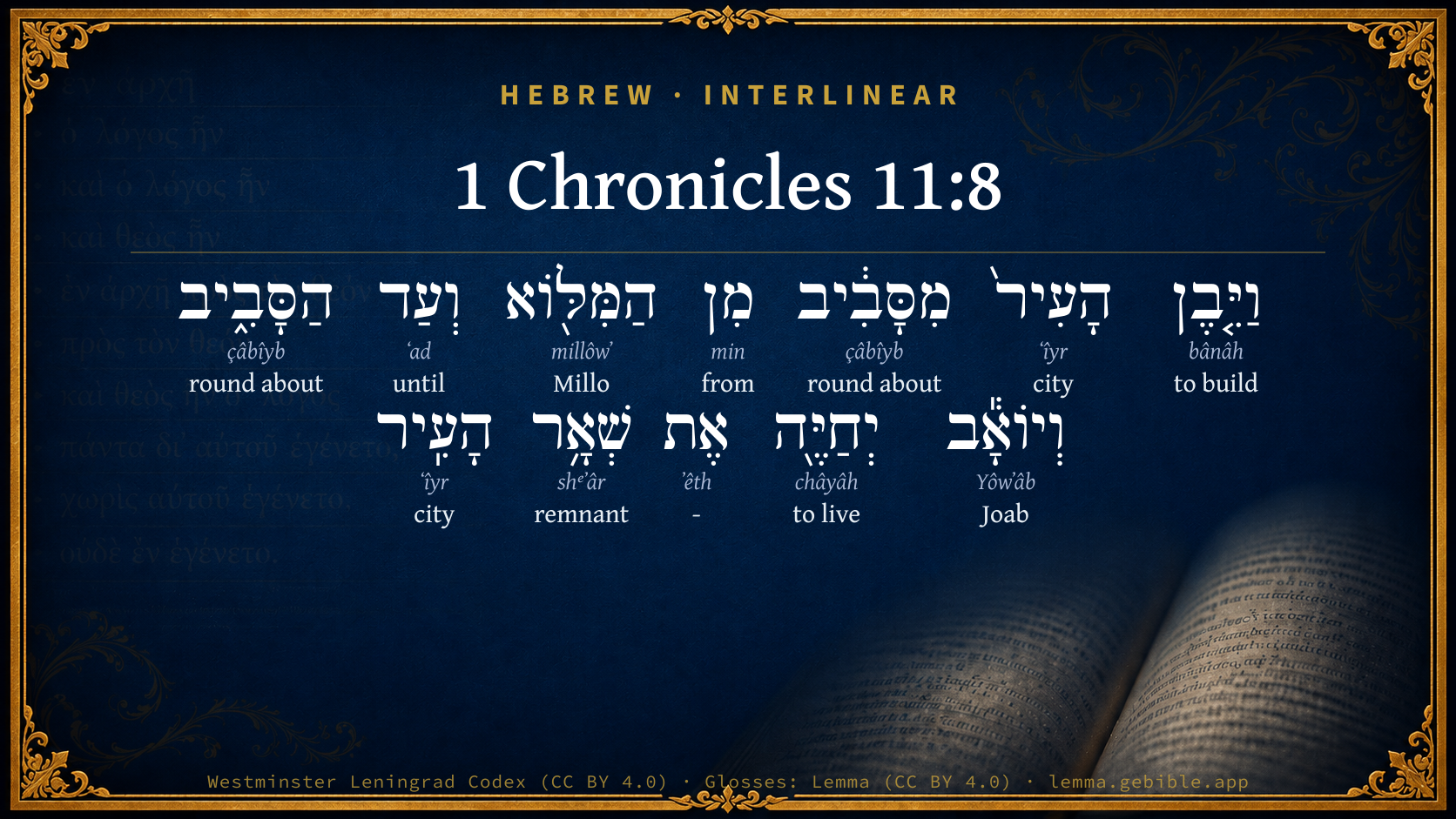
Hebrew (Westminster Leningrad Codex) 1 Chronicles 11:8 appears in the Hebrew Old Testament. The text above is from the Westminster Leningrad Codex. Each word links to its Strong’s number, a concise gloss, and parsing drawn from the Open Scriptures Hebrew Bible morphology. Click any word for its full Brown-Driver-Briggs (BDB) entry.
Download image
Cite this verse

1 Chronicles 11:8 (World English Bible). Public Domain. Lemma interlinear Bible study tool, https://lemma.gebible.app/v/1-chronicles/11/8.

Show BibTeX & RIS
BibTeX
RIS
English Translation
He built the city round about, from Millo even round about; and Joab repaired the rest of the city.
World English Bible · Public Domain
Highlights Full analysis ↓
Download a study sheet

One document with this verse’s original text, its word-by-word gloss line, the meaning frame, cross-references with their text, attributed commentary, and full source and license credits — printable, and it pastes into notes with its structure intact.

This verse Autodidact and up

Study sheet (.html) Plain text (.txt)

A passage Seminary Student

Up to 50 verses in one chapter. A passage sheet keeps up to 6 commentary sources and 12 cross-references per verse, in the order this page ranks them, and says so on the sheet whenever that leaves anything out. Ask for a single verse and you get the Autodidact verse sheet above.

Everything on this page stays free to read, with no account — the sheet is a download of what is already on screen, not access to it.

Want to remove ads? Support Godless Engineer
Compare translations 3

The same verse in 3 English versions, stacked beneath the original-language interlinear above. Click any original word for its lexicon entry.

Each is an independent rendering of the whole verse — the interlinear is not word-aligned to these translations.

Highlighted words mark where these versions differ — a whole-verse word diff, not a word-by-word alignment.

  • World English Bible Public Domain
    He built the city round about, from Millo even round about; and Joab repaired the rest of the city.
  • King James Version Public Domain
    And he built the city round about, even from Millo round about: and Joab repaired the rest of the city.
  • unfoldingWord Literal Text CC BY-SA 4.0
    And he built the city from around, from the Millo and to around. And Joab restored the rest of the city.

unfoldingWord Literal Text — © unfoldingWord, licensed CC BY-SA 4.0. Word-aligned USFM3 via Door43 (git.door43.org/unfoldingWord/en_ult).

Versions to compare (up to 4)

3 of 4 selected

Show all 18 translations

Every available English version of this verse, each an independent rendering of the whole verse.

  • World English Bible Public Domain
    He built the city round about, from Millo even round about; and Joab repaired the rest of the city.
  • Berean Standard Bible Public Domain
    He built up the city around it, from the supporting terraces to the surrounding wall, while Joab restored the rest of the city.
  • Majority Standard Bible Public Domain
    He built up the city around it, from the supporting terraces to the surrounding wall, while Joab restored the rest of the city.
  • King James Version Public Domain
    And he built the city round about, even from Millo round about: and Joab repaired the rest of the city.
  • American Standard Version (1901) Public Domain
    And he built the city round about, from Millo even round about; and Joab repaired the rest of the city.
  • Revised Version (1885) Public Domain
    And he built the city round about, from Millo even round about: and Joab repaired the rest of the city.
  • Geneva Bible (1599) Public Domain
    And he built the citie on euery side, from Millo euen round about, and Ioab repaired the rest of the citie.
  • Douay-Rheims (1899) Public Domain
    And he built the city round about from Mello all round, and Joab built the rest of the city.
  • Young's Literal Translation Public Domain
    and he buildeth the city round about, from Millo, and unto the circumference, and Joab restoreth the rest of the city.
  • Literal Standard Version CC BY-SA 4.0
    and he builds the city all around, from Millo, and to the circumference, and Joab restores the rest of the city.
  • Unlocked Literal Bible CC BY-SA 4.0
    He built the city all around from the Millo and back to the surrounding wall. Joab restored the rest of the city.
  • unfoldingWord Literal Text CC BY-SA 4.0
    And he built the city from around, from the Millo and to around. And Joab restored the rest of the city.
  • Darby Bible Public Domain
    And he built the city round about, even from the Millo round about; and Joab renewed the rest of the city.
  • World Messianic Bible Public Domain
    He built the city all around, from Millo even around; and Joab repaired the rest of the city.
  • Webster's Bible Public Domain
    And he built the city around, even from Millo around: and Joab repaired the rest of the city.
  • Free Bible Version CC BY-SA 4.0
    He built up the city all around it, from the Millo in a circuit all around, while Joab repaired the rest of the city.
  • Bible in Basic English Public Domain
    And he took in hand the building of the town all round, starting from the Millo; and Joab put the rest of the town in order.
  • JPS Tanakh (1917) Public Domain
    And he built the city round about, from Millo even round about; and Joab repaired the rest of the city.

Literal Standard Version (2020), Covenant Press — licensed CC BY-SA 4.0. Text via the HelloAO Bible API (eBible.org). Unlocked Literal Bible (unfoldingWord) — licensed CC BY-SA 4.0. Text via the HelloAO Bible API (eBible.org). unfoldingWord Literal Text — © unfoldingWord, licensed CC BY-SA 4.0. Word-aligned USFM3 via Door43 (git.door43.org/unfoldingWord/en_ult). Free Bible Version, Dr. Jonathan Gallagher — licensed CC BY-SA 4.0. Text via the HelloAO Bible API (eBible.org).

Word by word

More ways to search: Search by grammar → Find every occurrence → Compare this word →

Practice this passage: Drill this verse → Learn its vocabulary →

הַמִּלּ֖וֹא
millôwʼ
H4407
“the · Millo”
Particle, Definite Article + Noun, Proper
Part of Speech
Particle + Noun
Type
Proper
Full BDB Definition

Origin: from H4390

TWOT: None

Millo = "rampart" or " mound" - a place near Shechem; site unknown - a part of the fortifications of Jerusalem
  1. וַיִּ֤בֶן bânâh H1129 “and · to build” Conjunction + Verb, Qal, Sequential Imperfect, 3rd Person, Masculine, Singular
  2. הָעִיר֙ ʻîyr H5892 “the · city” Particle, Definite Article + Noun, Common, Feminine, Singular, Absolute
  3. מִסָּבִ֔יב çâbîyb H5439 “from · round about” Preposition + Noun, Common, Both, Singular, Absolute
  4. מִן min H4480 “from” Preposition
  5. וְעַד ʻad H5704 “and · until” Conjunction + Preposition
  6. הַסָּבִ֑יב çâbîyb H5439 “the · round about” Particle, Definite Article + Noun, Common, Both, Singular, Absolute
  7. וְיוֹאָ֕ב Yôwʼâb H3097 “and · Joab” Conjunction + Noun, Proper
  8. יְחַיֶּ֖ה châyâh H2421 “to live” Verb, Piel, Imperfect, 3rd Person, Masculine, Singular
  9. אֶת ʼêth H853 “-” Particle, Direct Object
  10. שְׁאָ֥ר shᵉʼâr H7605 “remnant of” Noun, Common, Masculine, Singular, Construct
  11. הָעִֽיר ʻîyr H5892 “the · city” Particle, Definite Article + Noun, Common, Feminine, Singular, Absolute

About this verse

These counts appear in no published source. They are computed here, from the morphology-tagged text and Lemma’s own curated glosses. What Lemma adds →

12
words
10
distinct lemmas
Historical
section

Notable vocabulary

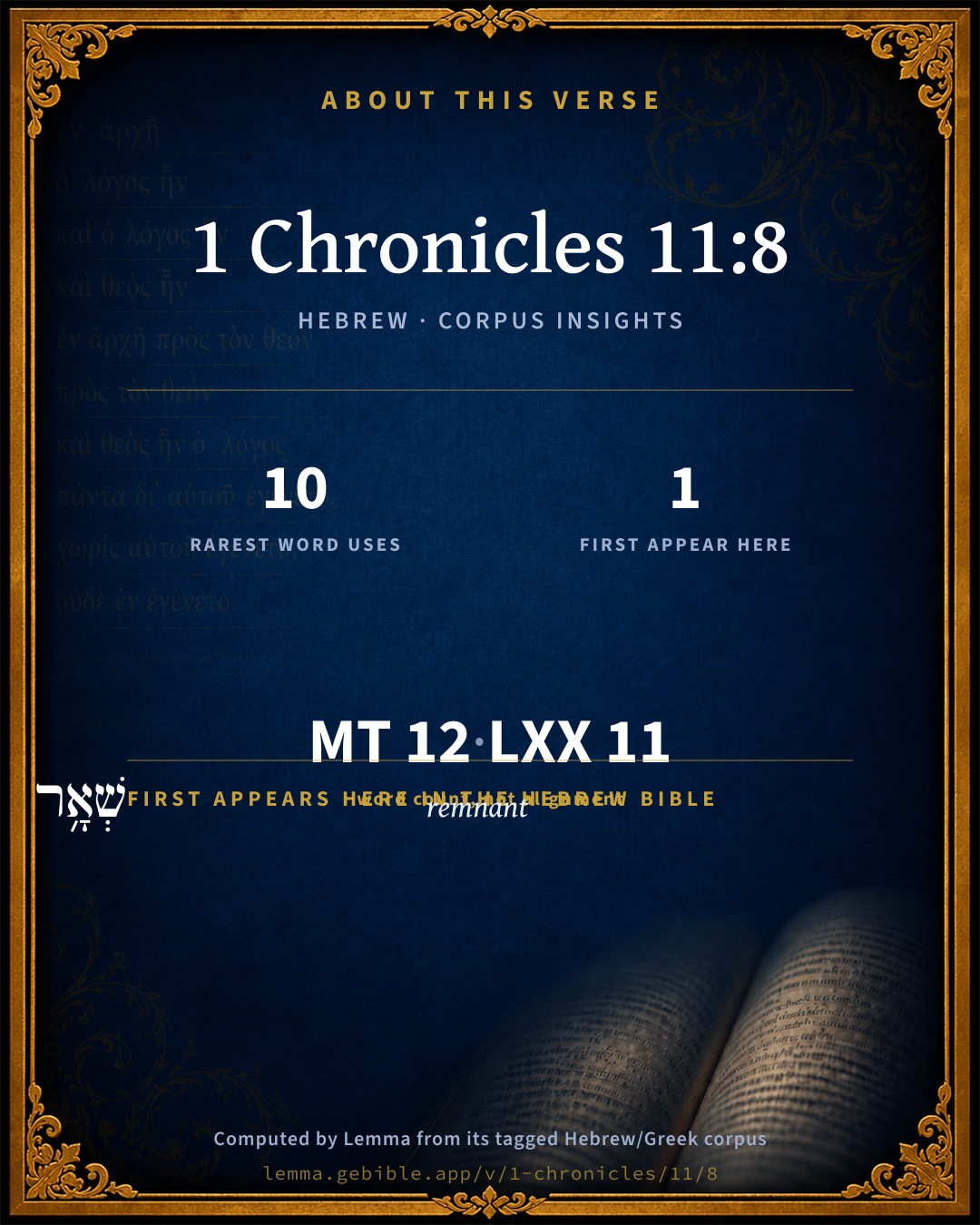
The rarest word here is הַמִּלּ֖וֹא Millo H4407 — appearing just 10 times in the whole Hebrew Bible.

First appearance in Scripture

This word makes its first canonical appearance in the Hebrew Bible here:

  • שְׁאָ֥ר remnant H7605

Shared distinctive vocabulary

הַמִּלּ֖וֹא Millo H4407 occurs in 9 verses of the Hebrew Bible. Also found in:

Grammatical profile

  • 2 verbs
  • 7 nouns
  • 2 prepositions
  • 1 particle

Verb forms

  • וַיִּ֤בֶן Qal · Sequential Imperfect
  • יְחַיֶּ֖ה Piel · Imperfect

Repetition

Words recur within this verse — often emphatic in Hebrew:

  • הָעִיר֙ city H5892 ×2
  • מִסָּבִ֔יב round about H5439 ×2

Hebrew & Septuagint length

In English translation the verse runs 19 words from the Hebrew and 7 from the Septuagint (LXX English) — the Septuagint runs noticeably shorter here. See the side-by-side →

A rough comparison of the two English renderings, which tokenize alike — not a word-level alignment.

Word counts can differ between the Hebrew and the Greek without any difference in meaning — e.g. the Hebrew direct-object marker אֵת has no separate Greek word, and Greek often adds the article ὁ.

In the original languages it is 12 Hebrew tokens and 11 Greek tokens — but the two are counted differently (Hebrew bundles its prefixes and suffixes into one token; the Greek is in lemma form), so that isn’t a like-for-like length.

Cross-references

6

Topical passages linked to 1 Chronicles 11:8 in the Treasury of Scripture Knowledge — connected by theme and wording, ordered by reader-vote popularity; previews shown in the World English Bible.

  • 1 Kings 11:27 This was the reason why he lifted up his hand against the king: Solomon built Millo, and repaired the breach of the city of David his father.
  • Judges 9:6 All the men of Shechem assembled themselves together, and all the house of Millo, and went and made Abimelech king, by the oak of the pillar that was in Shechem.
  • Judges 9:20 but if not, let fire come out from Abimelech, and devour the men of Shechem, and the house of Millo; and let fire come out from the men of Shechem, and from the house of Millo, and devour Abimelech.
  • 1 Kings 9:15 This is the reason of the levy which king Solomon raised, to build the house of Yahweh, and his own house, and Millo, and the wall of Jerusalem, and Hazor, and Megiddo, and Gezer.
  • 2 Kings 12:20 His servants arose, and made a conspiracy, and struck Joash at the house of Millo, [on the way] that goes down to Silla.
  • Nehemiah 4:2 He spoke before his brothers and the army of Samaria, and said, What are these feeble Jews doing? will they fortify themselves? will they sacrifice? will they make an end in a day? will they revive the stones out of the heaps of rubbish, seeing they are burned?

Cross-references courtesy of OpenBible.info (CC BY 4.0).

Hebrew and Greek witnesses Masoretic Hebrew ↔ Greek Septuagint

The same verse in the two great witnesses to the Old Testament, shown verse-for-verse.

Here the Septuagint runs noticeably shorter than the Hebrew — LXX2012 (modern English Septuagint) 7 words vs World English Bible 19. A rough length comparison of the two English translations, not a word-level alignment — read both below.

These are two independent witnesses, not word-aligned to each other, and the Septuagint is shown in lemma (dictionary) form.

Hebrew 1 Chronicles 11:8 Masoretic · Westminster Leningrad Codex

וַיִּ֤בֶן הָעִיר֙ מִסָּבִ֔יב מִן הַמִּלּ֖וֹא וְעַד הַסָּבִ֑יב וְיוֹאָ֕ב יְחַיֶּ֖ה אֶת שְׁאָ֥ר הָעִֽיר

He built the city round about, from Millo even round about; and Joab repaired the rest of the city.

World English Bible · Public Domain

Greek LXX 1 Chronicles 11:8 Septuagint · lemma form

καί οἰκοδομέω ὁ πόλις κύκλος καί πολεμέω καί λαμβάνω ὁ πόλις

And he fortified the city round about.

LXX2012 (modern English Septuagint) · Public Domain

On this verse, The Cambridge Bible for Schools and Colleges discusses the Septuagint’s reading. Read the note in Commentary ↓

Hebrew: Westminster Leningrad Codex (CC BY 4.0). Greek: Septuagint (public domain); English from LXX2012 (modern English Septuagint) (Public Domain). How the Septuagint differs from the Hebrew →

Commentary

Notes on 1 Chronicles 11:8 from classic Christian and Jewish commentators (each source and its license shown beneath its notes). The classic Christian expositions comment on the surrounding passage and are grouped to its opening verse, so a note may address several verses; the Jewish commentaries on the Tanakh (Rashi and others) are per-verse, so they appear only where the commentator wrote on this verse.

Lemma curates 59 commentaries, every one of them public domain or Creative Commons licensed, each selected and text-cleaned for this edition rather than reprinted as found. About our sources →

Trapp's Complete Commentary

John Trapp

1Ch 11:8 And he built the city round about, even from Millo round about: and Joab repaired the rest of the city.

Ver. 8. From Millo.] This was a fair street, saith Vatablus; wherein were public meetings, and speeches made.

And Joab repaired.] Heb., Revived, vivificavit vel sanavit, as 2Ch 24:13.

The rest of the city.] To re-ingratiate with David, who was justly offended at him for the death of Abner.

John Trapp, A Commentary or Exposition upon All the Books of the Old and New Testament (1647–1656) — public domain. Text from a community e-Sword module.

Jamieson, Fausset & Brown

Robert Jamieson, A. R. Fausset & David Brown

Joab repaired the rest of the city--David built a new town to the north of the old one on Mount Zion; but Joab was charged with a commission to restore the part that had been occupied by the ancient Jebus, to repair the breaches made during the siege, to rebuild the houses which had been demolished or burned in the sacking of the town, and to preserve all that had escaped the violence of the soldiery. This work of reconstruction is not noticed elsewhere [CALMET].

Jamieson, Fausset & Brown — Commentary Critical and Explanatory on the Whole Bible (1871) — public domain (CC PDM 1.0). Text via the HelloAO Bible API.

Ellicott's Commentary for English Readers

(8) And he built the city round about.—Literally, and he built (or rebuilt or fortified) the city all round, from the Millo even unto the (complete) round. The Millo was probably a tower or citadel, like the Arx Antonia of later times. According to the chronicler David started from that point, and brought his line of defences round to it again. Samuel has simply, “And David built around, from the Millo, and inward.” This seems to mean that he carried his buildings from the fortress towards the interior of the city. Both statements may, of course, be true.

A Bible Commentary for English Readers, edited by Charles John Ellicott (1878–1897) — public domain. Text from a community e-Sword module.

The Cambridge Bible for Schools and Colleges

gen. ed. J. J. S. Perowne

8. even from Millo round about] R.V. from Millo even round about. Millo, usually “the Millo,” meaning perhaps “The filling up,” was some part of the defences of the “city of David,” either a solid tower or perhaps an armoury, or a piece of supplementary work intended to strengthen an existing wall (LXX. 2Ch_32:5, ἀνάλημμα, “support”).

repaired] Render spared or kept alive; cp. Exo_1:17. Pesh. translates: “Joab gave his right hand to the rest of the men who were in the city.” The “rest (remnant) of the city” included Benjamites as well as Jebusites (Jdg_1:21).

The Cambridge Bible for Schools and Colleges (gen. ed. J. J. S. Perowne; Cambridge University Press, 1878–1918) — public domain. Text from a community e-Sword module.

Haydock's Catholic Bible Commentary

Round. He made a complete inclosure or fortification, as Mello denotes perfection, or completion, (Haydock) by building houses from the castle to the town beneath it. David begun at the very house (or citadel, 4 Kings xii. 20.) from which the blind and the lame thought to have excluded him, and built all round, so as to make an entire communication. (Kennicott) --- Built. Protestants, "repaired." Hebrew yechaye, (Haydock) "saved alive." (Syriac, &c.; Poole’s Synop.) But probably shear is now written instead of shor, and jeje ought to be jeje. The long and the short e are easily confounded, (Haydock) and a is frequently thus inserted. (Watson) --- "He built....round to the beginning of that circuit. And Joab was made governor of the city." (Kennicott) --- "And surrounding it with a wall, he appointed Joab superintendant of the walls." (Josephus, [Antiquities?] vii. 3.) --- The position of the vowel points in these words, might naturally cause this mistake, (Haydock) as it seems to have done on other occasions. Thus shor, "an ox," should be sar, "a prince," Genesis xlix. 6., and Osee xii. 11. Shevarim, "oxen," has been read sarim, "princes," by the Septuagint. The former passage might admit of some corrections. "In their anger they slew the men, and in their fury (vabrothom; instead of vabrotsnom, which is always explained in a good sense) they destroyed the princes. Cursed be their anger, for it was fierce; and their fury, for it was inflexible."

George Leo Haydock (1774–1849), Haydock's Catholic Family Bible and Commentary, 1859 edition — public domain. Excludes Psalms (Douay-Rheims chapter numbering differs from Protestant) and Deuterocanonical books (Catholic canon only).

The Pulpit Commentary

Millo. There is great uncertainty as to the derivation and the meaning of this word. It is probably not really of Hebrew extraction, but of the oldest Canaanitish origin. In the Hebrew it is always used with the article, and would presumably come from the Hebrew root "to fill." Josephus seems to use, as synonymous expression for Davids wall round Millo," this, viz. "buildings round about the lower city" ("Jud. Ant.," 3:2, compared with 5; "Wars," 6:1, where he identifies those "buildings," etc., with Acra). As the name of a family, it is mentioned in connection with Shechem, known specially as a place of the Canaanites. (Jud_1:9:6, 20) The Septuagint represents it by the word hJa. In the remarkable passage, 2Ki_12:20, the word "Silla" is even a greater enigma, which, however, may designate the "steps from the city of David", (Neh_3:15) or "the causeway of going up" to the west of the temple. (1Ch_22:16) The likeliest view of Mille is that it was a very strong point of fortification in the surrounding defences of the hill of. (1Ki_9:24 1Ki_11:27) Inkra 2Ch_32:5 the otherwise unvarying translation (hJ a) of the Septuagint is superseded by tolhmma, a word itself of doubtful signification. For while some would render it by the word "foundation," Schleusner translates it "height." Grove (in Smith"s "Bible Dictionary," 2:367) puts it in "the neighbourhood of the Tyropaean valley at the foot of Zion." Some clue may lie in the word "inward," applied to the building by David. Does it imply a covering by edifices of the space, or some portion of it, that lay between Zion and the rest of the city? (See also Keil on Kings, vol. 2:163.)

The Pulpit Commentary (1880–1919), ed. H.D.M. Spence-Jones & Joseph S. Exell — public domain. Text from a community e-Sword module.

Rashi

Rabbi Shlomo Yitzchaki (Rashi)

and Joab restored the rest of the city Heb. יְחַיֶּה. He built and strengthened [it] by building [i.e., repairing] the cracks in the wall. A similar instance [is found] with Ezra (Neh. 3:34): “Will they revive (הַיְּחַיּוּ) the stones from the heaps of dust?”

Rashi on the Tanakh — English translations: “The Judaica Press complete Tanach with Rashi, translated by A. J. Rosenberg” (CC BY 4.0); “Pentateuch with Rashi's commentary by M. Rosenbaum and A.M. Silbermann, 1929-1934” (public domain); “The Metsudah Tanach series, Lakewood, N.J” (CC BY 4.0); and “The Book of Joshua, Metsudah Publications, 1997” (CC BY 4.0). Text via Sefaria.

Lesson kit

Teaching starters — assembled from the data on this page, not authored interpretation. Every prompt links to the verse data it draws on. Edit before teaching.

1 Chronicles, in the Historical, opens this verse with 12 words (10 distinct Hebrew lemmas). Its most distinctive word is millôwʼ (“Millo”). The Greek Septuagint runs shorter here. A historical commentator’s framing appears above. Read the whole chapter for the surrounding context.

Discussion questions

  1. The word millôwʼ carries the sense “Millo.” How does it shape the verse?
  2. This is the first place “remnant” appears in Scripture (first appears here). What does its debut here establish?
  3. How does Judges 9:6, which shares the word «Millo», read alongside this verse?
  4. What does the repetition of “city” (2× in this one verse) do in this verse?
  5. The Septuagint runs shorter here than the Hebrew. What might account for the difference?
  6. These translations render this verse differently; the difference is in the English rendering, not the original. What questions does that raise?
  7. «וַיִּ֤בֶן» is a Qal Sequential Imperfect verb. How does that grammatical form shape the action described?
  8. Compare how Trapp's Complete Commentary and Jamieson, Fausset & Brown read this verse. Where do they agree or differ?

Things to notice

Reading settings

Reading text

Shown beneath each verse's original-language words.

Old Testament
Old Testament edition

Read the OT as the Masoretic Hebrew (MT) or the Greek Septuagint (LXX).

English shown for the Greek Septuagint (in the Hebrew ↔ Greek comparison).

Comparing translations? Open the Compare panel on any verse page to stack up to four side by side.