Genesis 45:7

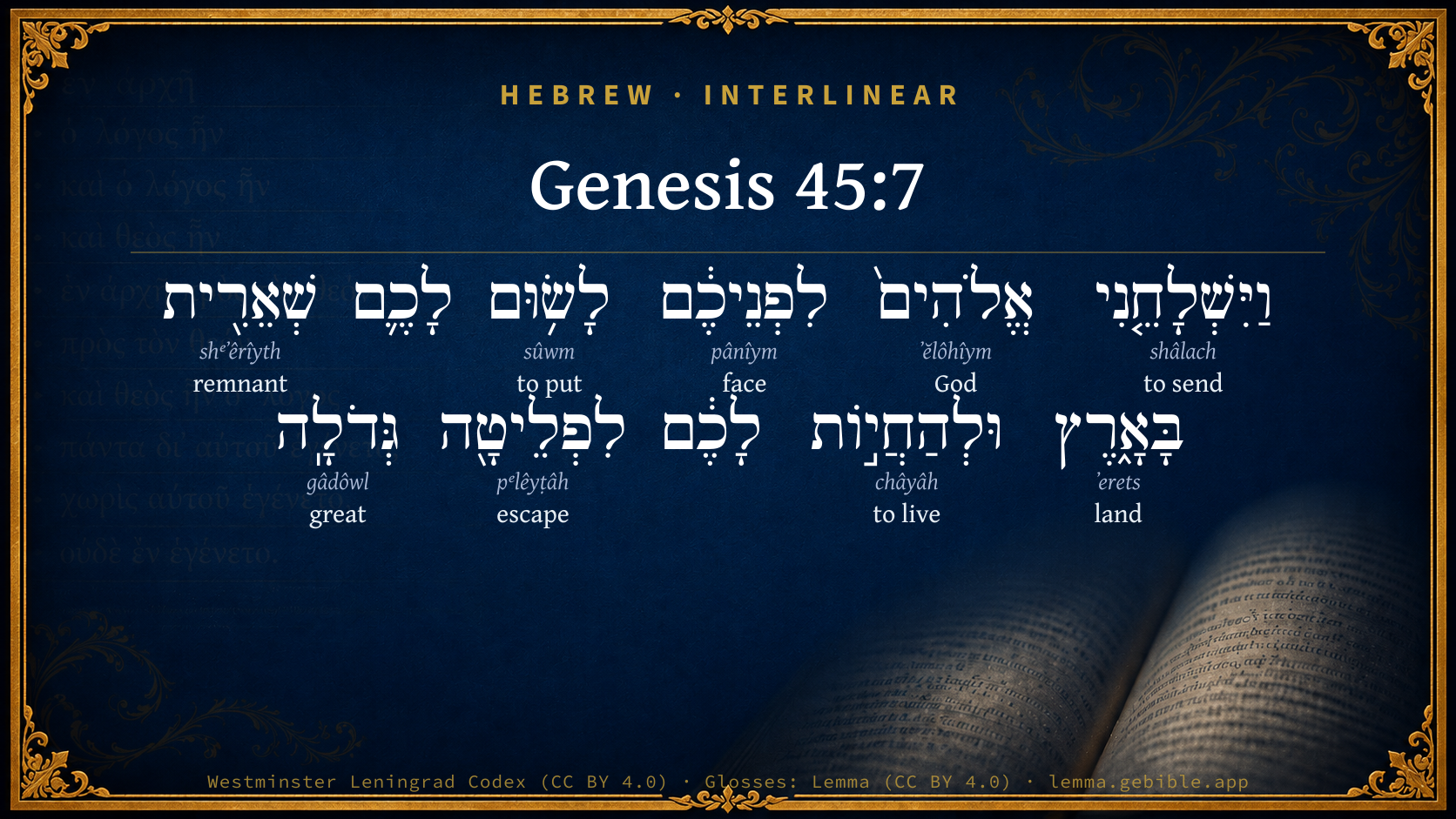
Hebrew (Westminster Leningrad Codex) Genesis 45:7 appears in the Hebrew Old Testament. The text above is from the Westminster Leningrad Codex. Each word links to its Strong’s number, a concise gloss, and parsing drawn from the Open Scriptures Hebrew Bible morphology. Click any word for its full Brown-Driver-Briggs (BDB) entry.
Download image
Cite this verse

Genesis 45:7 (World English Bible). Public Domain. Lemma interlinear Bible study tool, https://lemma.gebible.app/v/genesis/45/7.

Show BibTeX & RIS
BibTeX
RIS
English Translation
God sent me before you to preserve you a remnant in the earth, and to save you alive by a great deliverance.
World English Bible · Public Domain
Highlights
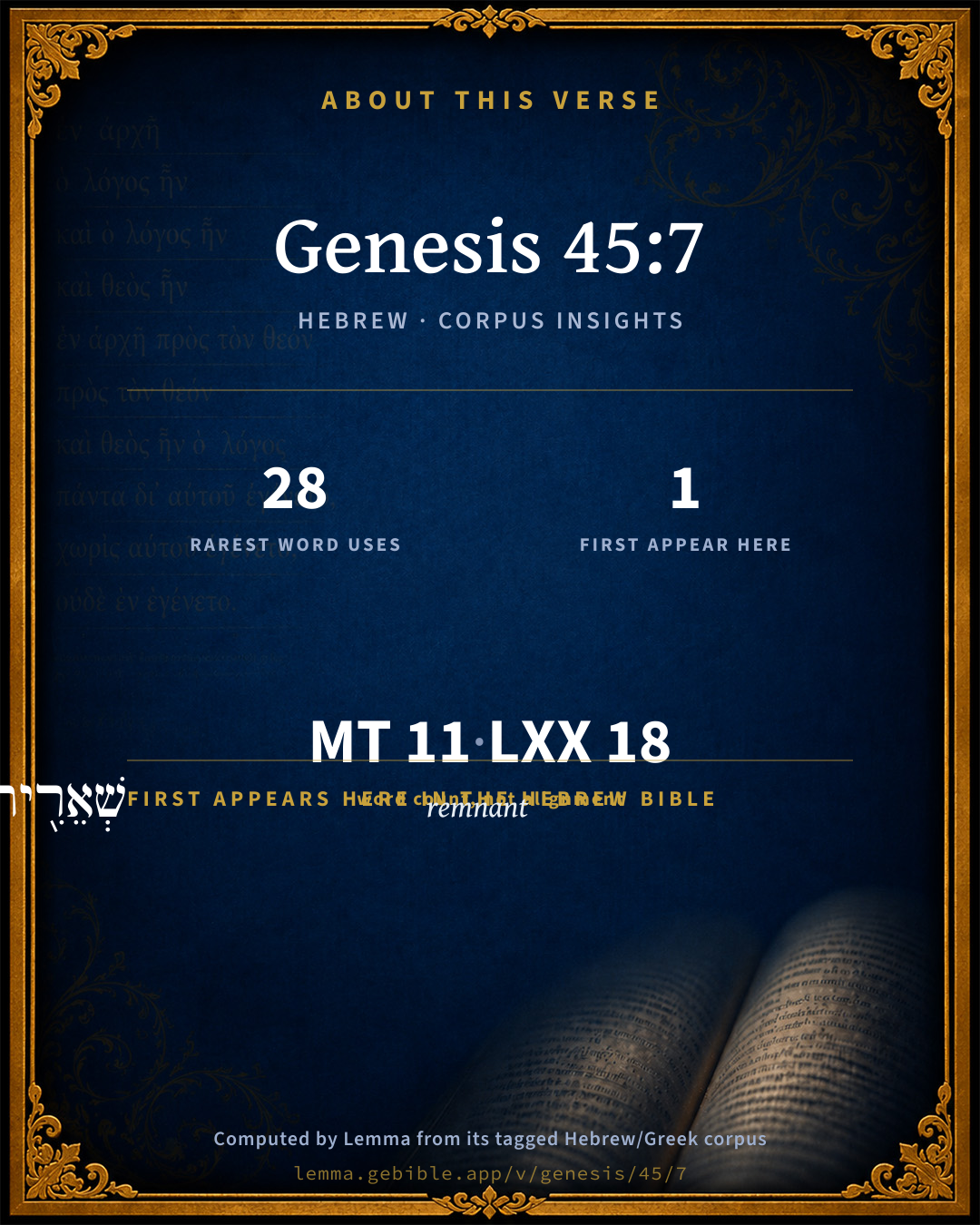
  • 1 first appearance in the Hebrew Bible
Full analysis ↓
Download a study sheet

One document with this verse’s original text, its word-by-word gloss line, the meaning frame, cross-references with their text, attributed commentary, and full source and license credits — printable, and it pastes into notes with its structure intact.

This verse Autodidact and up

Study sheet (.html) Plain text (.txt)

A passage Seminary Student

Up to 50 verses in one chapter. A passage sheet keeps up to 6 commentary sources and 12 cross-references per verse, in the order this page ranks them, and says so on the sheet whenever that leaves anything out. Ask for a single verse and you get the Autodidact verse sheet above.

Everything on this page stays free to read, with no account — the sheet is a download of what is already on screen, not access to it.

Want to remove ads? Support Godless Engineer
Compare translations 3

The same verse in 3 English versions, stacked beneath the original-language interlinear above. Click any original word for its lexicon entry.

Each is an independent rendering of the whole verse — the interlinear is not word-aligned to these translations.

Highlighted words mark where these versions differ — a whole-verse word diff, not a word-by-word alignment.

  • World English Bible Public Domain
    God sent me before you to preserve you a remnant in the earth, and to save you alive by a great deliverance.
  • King James Version Public Domain
    And God sent me before you to preserve you a posterity in the earth, and to save your lives by a great deliverance.
  • unfoldingWord Literal Text CC BY-SA 4.0
    But God sent me ahead of you to preserve a remnant for you on the earth, and to keep you alive by a great deliverance.

unfoldingWord Literal Text — © unfoldingWord, licensed CC BY-SA 4.0. Word-aligned USFM3 via Door43 (git.door43.org/unfoldingWord/en_ult).

Versions to compare (up to 4)

3 of 4 selected

Show all 18 translations

Every available English version of this verse, each an independent rendering of the whole verse.

  • World English Bible Public Domain
    God sent me before you to preserve you a remnant in the earth, and to save you alive by a great deliverance.
  • Berean Standard Bible Public Domain
    God sent me before you to preserve you as a remnant on the earth and to save your lives by a great deliverance.
  • Majority Standard Bible Public Domain
    God sent me before you to preserve you as a remnant on the earth and to save your lives by a great deliverance.
  • King James Version Public Domain
    And God sent me before you to preserve you a posterity in the earth, and to save your lives by a great deliverance.
  • American Standard Version (1901) Public Domain
    And God sent me before you to preserve you a remnant in the earth, and to save you alive by a great deliverance.
  • Revised Version (1885) Public Domain
    And God sent me before you to preserve you a remnant in the earth, and to save you alive by a great deliverance.
  • Geneva Bible (1599) Public Domain
    Wherefore God sent me before you to preserue your posteritie in this land, and to saue you aliue by a great deliuerance.
  • Douay-Rheims (1899) Public Domain
    And God sent me before, that you may be preserved upon the earth, and may have food to live.
  • Young's Literal Translation Public Domain
    and God sendeth me before you, to place of you a remnant in the land, and to give life to you by a great escape;
  • Literal Standard Version CC BY-SA 4.0
    and God sends me before you, to place a remnant of you in the land, and to give life to you by a great escape;
  • Unlocked Literal Bible CC BY-SA 4.0
    God sent me ahead of you to preserve you as a remnant in the earth, and to keep you alive by a great deliverance.
  • unfoldingWord Literal Text CC BY-SA 4.0
    But God sent me ahead of you to preserve a remnant for you on the earth, and to keep you alive by a great deliverance.
  • Darby Bible Public Domain
    So God sent me before you to preserve you a remnant in the earth, and to save you alive by a great deliverance.
  • World Messianic Bible Public Domain
    God sent me before you to preserve for you a remnant in the earth, and to save you alive by a great deliverance.
  • Webster's Bible Public Domain
    And God sent me before you, to preserve for you a posterity in the earth, and to save your lives by a great deliverance.
  • Free Bible Version CC BY-SA 4.0
    God sent me ahead of you to make sure you would still have descendants, to save your lives in this miraculous way.
  • Bible in Basic English Public Domain
    God sent me before you to keep you and yours living on earth so that you might become a great nation.
  • JPS Tanakh (1917) Public Domain
    And God sent me before you to give you a remnant on the earth, and to save you alive for a great deliverance.

Literal Standard Version (2020), Covenant Press — licensed CC BY-SA 4.0. Text via the HelloAO Bible API (eBible.org). Unlocked Literal Bible (unfoldingWord) — licensed CC BY-SA 4.0. Text via the HelloAO Bible API (eBible.org). unfoldingWord Literal Text — © unfoldingWord, licensed CC BY-SA 4.0. Word-aligned USFM3 via Door43 (git.door43.org/unfoldingWord/en_ult). Free Bible Version, Dr. Jonathan Gallagher — licensed CC BY-SA 4.0. Text via the HelloAO Bible API (eBible.org).

Word by word

More ways to search: Search by grammar → Find every occurrence → Compare this word →

Practice this passage: Drill this verse → Learn its vocabulary →

לִפְלֵיטָ֖ה
pᵉlêyṭâh
H6413
“to/for · escape”
Preposition + Noun, Common, Feminine, Singular, Absolute
Part of Speech
Preposition + Noun
Type
Common
Gender
Feminine
Number
Singular
State
Absolute
Full BDB Definition

Origin: from H6412

TWOT: 1774d

escape, deliverance - escape, deliverance - escaped remnant
  1. וַיִּשְׁלָחֵ֤נִי shâlach H7971 “and · to send · me” Conjunction + Verb, Qal, Sequential Imperfect, 3rd Person, Masculine, Singular + Suffix, Personal, 1st Person, Common, Singular
  2. אֱלֹהִים֙ ʼĕlôhîym H430 “God(s)” Noun, Common, Masculine, Plural, Absolute
  3. לִפְנֵיכֶ֔ם pânîym H6440 “to/for · face(s) · your” Preposition + Noun, Common, Both, Plural, Construct + Suffix, Personal, 2nd Person, Masculine, Plural
  4. לָשׂ֥וּם sûwm H7760 “to put” Preposition + Verb, Qal, Infinitive Construct
  5. שְׁאֵרִ֖ית shᵉʼêrîyth H7611 “remnant” Noun, Common, Feminine, Singular, Absolute
  6. בָּאָ֑רֶץ ʼerets H776 “in/at the · land” Preposition, Determined + Noun, Common, Both, Singular, Absolute
  7. וּלְהַחֲי֣וֹת châyâh H2421 “and · to live” Conjunction + Preposition + Verb, Hiphil, Infinitive Construct
  8. גְּדֹלָֽה gâdôwl H1419 “great” Adjective, Adjective, Feminine, Singular, Absolute

About this verse

These counts appear in no published source. They are computed here, from the morphology-tagged text and Lemma’s own curated glosses. What Lemma adds →

11
words
9
distinct lemmas
Pentateuch
section

First appearance in Scripture

This word makes its first canonical appearance in the Hebrew Bible here:

  • שְׁאֵרִ֖ית remnant H7611

Shared distinctive vocabulary

לִפְלֵיטָ֖ה escape H6413 occurs in 28 verses of the Hebrew Bible. Also found in:

Grammatical profile

  • 3 verbs
  • 5 nouns
  • 1 adjective
  • 2 prepositions

Verb forms

  • וַיִּשְׁלָחֵ֤נִי Qal · Sequential Imperfect
  • לָשׂ֥וּם Qal · Infinitive Construct
  • וּלְהַחֲי֣וֹת Hiphil · Infinitive Construct

Hebrew & Septuagint length

In English translation the verse runs 22 words from the Hebrew and 26 from the Septuagint (LXX English) — closely comparable.

A rough comparison of the two English renderings, which tokenize alike — not a word-level alignment.

Word counts can differ between the Hebrew and the Greek without any difference in meaning — e.g. the Hebrew direct-object marker אֵת has no separate Greek word, and Greek often adds the article ὁ.

In the original languages it is 11 Hebrew tokens and 18 Greek tokens — but the two are counted differently (Hebrew bundles its prefixes and suffixes into one token; the Greek is in lemma form), so that isn’t a like-for-like length.

Cross-references

5

Topical passages linked to Genesis 45:7 in the Treasury of Scripture Knowledge — connected by theme and wording, ordered by reader-vote popularity; previews shown in the World English Bible.

  • Psalms 44:4 You are my King, God. Command victories for Jacob!
  • Acts 7:35 "This Moses, whom they refused, saying, 'Who made you a ruler and a judge?'--God has sent him as both a ruler and a deliverer by the hand of the angel who appeared to him in the bush.
  • Judges 15:18 He was very thirsty, and called on Yahweh, and said, You have given this great deliverance by the hand of your servant; and now shall I die for thirst, and fall into the hand of the uncircumcised.
  • Psalms 18:50 He gives great deliverance to his king, And shows loving kindness to his anointed, To David and to his seed, forevermore.
  • 1 Chronicles 11:14 They stood in the midst of the plot, and defended it, and killed the Philistines; and Yahweh saved them by a great victory.

Cross-references courtesy of OpenBible.info (CC BY 4.0).

Hebrew and Greek witnesses Masoretic Hebrew ↔ Greek Septuagint

The same verse in the two great witnesses to the Old Testament, shown verse-for-verse.

These are two independent witnesses, not word-aligned to each other, and the Septuagint is shown in lemma (dictionary) form.

Hebrew Genesis 45:7 Masoretic · Westminster Leningrad Codex

וַיִּשְׁלָחֵ֤נִי אֱלֹהִים֙ לִפְנֵיכֶ֔ם לָשׂ֥וּם לָכֶ֛ם שְׁאֵרִ֖ית בָּאָ֑רֶץ וּלְהַחֲי֣וֹת לָכֶ֔ם לִפְלֵיטָ֖ה גְּדֹלָֽה

God sent me before you to preserve you a remnant in the earth, and to save you alive by a great deliverance.

World English Bible · Public Domain

Greek LXX Genesis 45:7 Septuagint · lemma form

ἀποστέλλω γάρ ἐγώ ὁ θεός ἔμπροσθεν σύ ὑπολείπω σύ καταλείμμα ἐπί ὁ γῆ καί ἐκτρέφω σύ κατάλειψις μέγας

For God sent me before you, that there might be left to you a remnant upon the earth, even to nourish a great remnant of you.

LXX2012 (modern English Septuagint) · Public Domain

Hebrew: Westminster Leningrad Codex (CC BY 4.0). Greek: Septuagint (public domain); English from LXX2012 (modern English Septuagint) (Public Domain). How the Septuagint differs from the Hebrew →

Targum (Aramaic paraphrase)

2

The Targum is the ancient Jewish Aramaic paraphrase of the Hebrew Scriptures — an interpretive translation, not the Hebrew text itself. Onkelos (literal) and Pseudo-Jonathan (expansive) render the Torah, and Jonathan the Prophets. Coverage is partial: where no permissively-licensed English translation exists for a verse, only the Aramaic is shown. This is verse-level text, not a word-by-word alignment to the Hebrew.

  1. Targum Onkelos Torah (Genesis–Deuteronomy)
    וְשַׁלְחַנִּי יְיָ קֳדָמֵיכוֹן לְשַׁוָּאָה לְכוֹן שְׁאָרָא בְּאַרְעָא וּלְקַיָּמָא לְכוֹן לְשֵׁיזָבָא רַבָּא

    (no public-domain English translation for this verse)

    Targum Onkelos — Aramaic: “Onkelos Genesis” (public domain); “Onkelos Exodus” (public domain); “Onkelos Leviticus” (public domain); “Onkelos Numbers” (public domain); “Onkelos Deuteronomy” (public domain). English: “Sefaria Community Translation” (CC0 1.0 (public-domain dedication)); “J.W. Etheridge. The Targums of Onkelos and Jonathan Ben Uzziel on the Pentateuch. London: Longmans, Green, 1862” (public domain). Text via Sefaria.

  2. Targum Pseudo-Jonathan Torah (Genesis–Deuteronomy)
    וְשַׁדְרַנִי יְיָ קֳדָמֵיכוֹן לְשַׁוָאָה לְכוֹן שִׁיוֹרָא בְּאַרְעָא וּלְקַיְימָא לְכוֹן לְשֵׁיזְבָא רַבָּא

    But the Lord sent me before you to set you a remnant in the land, and to preserve you by a great deliverance.

    Targum Pseudo-Jonathan — Aramaic: “Targum Jonathan on Genesis” (public domain); “Targum Jonathan on Exodus” (public domain); “Targum Jonathan on Leviticus” (public domain); “Targum Jonathan on Numbers” (public domain); “Targum Jonathan on Deuteronomy” (public domain). English: “The Targum of Jonathan ben Uzziel, trans. J. W. Etheridge, London, 1862” (public domain). Text via Sefaria.

Commentary

Notes on Genesis 45:7 from classic Christian and Jewish commentators (each source and its license shown beneath its notes). The classic Christian expositions comment on the surrounding passage and are grouped to its opening verse, so a note may address several verses; the Jewish commentaries on the Tanakh (Rashi and others) are per-verse, so they appear only where the commentator wrote on this verse.

Lemma curates 59 commentaries, every one of them public domain or Creative Commons licensed, each selected and text-cleaned for this edition rather than reprinted as found. About our sources →

Trapp's Complete Commentary

John Trapp

Gen 45:7 And God sent me before you to preserve you a posterity in the earth, and to save your lives by a great deliverance.

Ver. 7. God sent me before you.] He it is that by a powerful providence orders all the disorders of the world, by a certain counsel, to his own ends, and at length to his own glory. The hands that nailed Christ to the cross were "wicked hands." {Act 2:23} And Judas was sent to "his own place," for being "guide to them that took Jesus." {Act 1:16} And yet they did no more than what "God’s hand and counsel determined before to be done" {Act 4:28} for his glory, and the salvation of his elect. This Pliny derides as a strange doctrine, {a} but Plato hammers at it, when he saith, that God doth always φεωμετρειν. Indeed he doth all, in number, weight, and measure, as the wise man saith. He alters the property of his people’s afflictions, and by an almighty alchemy turns dross to gold, &c. As a skilful apothecary, he makes of a poisoness viper a wholesome antidote.

{a} Irridendum vero curam agere rerum humanarum illud quicquid est summum. - Plin., lib. ii. cap. 7.

John Trapp, A Commentary or Exposition upon All the Books of the Old and New Testament (1647–1656) — public domain. Text from a community e-Sword module.

Ellicott's Commentary for English Readers

(7) To preserve you a posterity in the earth.—Heb., To put for you a remnant in the land, that is, to preserve a remainder for you, as the word is translated in 2Sa_14:7. During the seven years’ famine many races probably dwindled away, and the Hebrews, as mere sojourners in Canaan, would have been in danger of total extinction.

By a great deliverance.—That is, by a signal interference on your behalf. But the word rendered “deliverance,” more exactly signifies that which escapes (see 2Ki_19:31, where, as here, it is joined with the word remnant, and 2Ki_19:30, where it is itself rendered remnant). The two nouns really signify the same thing; but whereas in the first clause the words seem to forebode that only few would escape, in the second there is the assurance of their surviving in such numbers as to be able to grow into a great nation.

A Bible Commentary for English Readers, edited by Charles John Ellicott (1878–1897) — public domain. Text from a community e-Sword module.

The Cambridge Bible for Schools and Colleges

gen. ed. J. J. S. Perowne

7. to preserve you a remnant] Lit. “to set for you a remnant,” i.e. descendants; cf. Jer_44:7.

by a great deliverance] R.V. marg. to be a great company that escape. The two clauses are very nearly identical. In the first the emphasis is on the fact of survival; in the second, on the act of preservation.

The Cambridge Bible for Schools and Colleges (gen. ed. J. J. S. Perowne; Cambridge University Press, 1878–1918) — public domain. Text from a community e-Sword module.

John Gill's Exposition

And God sent me before you,.... This he repeats to impress the minds of his brethren with a sense of the good providence of God in bringing him to Egypt before them, to make provision for their future welfare, and to alleviate their grief, and prevent an excessive sorrow for their selling him into Egypt, when by the overruling hand of God it proved so salutary to them:

to preserve you a posterity in the earth; that they and theirs might not perish, which otherwise, in all human probability, must have been the case; and that the promise of the multiplication of Abraham's seed might not be made of none effect, but continue to take place, from whence the Messiah was to spring:

and to save your lives by a great deliverance; from the extreme danger they were exposed unto, through the terrible famine, and in which deliverance were to be observed the great wisdom, goodness, power, and providence of God.

John Gill's Exposition of the Whole Bible (1746–1763) — public domain (CC PDM 1.0). Text via the HelloAO Bible API.

Matthew Poole's English Annotations

That you and your children might be sustained and preserved in this time of famine, and afterwards abundantly multiplied, as God hath promised.

By a great deliverance, or, for a great remnant, or escaping, i.e. that you who are now but a handful, escaping this danger, may grow into a vast multitude. The word evasion, or escaping, is here put for the persons that do escape, as it is 2Ch 30:6; Isa 10:20; and as captivity is oft put for the captives, as it is Num 21:1; Deu 21:10. And so what was said in the former clause is repeated in this with all emphatical addition.

Matthew Poole's English Annotations on the Holy Bible (1683–1685) — public domain. Text from a community e-Sword/MySword module.

Scofield Reference Notes

C. I. Scofield

preserve Heb. to make you a remnant. Isa 1:9; Rom 11:5. (See Scofield "Rom 11:5").

The Scofield Reference Bible (1917 edition), notes by C. I. Scofield — public domain. Text from a community e-Sword module.

unfoldingWord translationNotes

Door43 World Missions Community

to preserve you as a remnant in the earth

"so that you and your families would not completely perish from the earth" or "to make sure your descendants would survive"

to keep you alive by a great deliverance

The abstract noun "deliverance" can be stated as "rescuing." AT: "to keep you alive by rescuing you in a mighty way" (See: Abstract Nouns)

he has made me a father to Pharaoh

Joseph advising and helping Pharaoh is spoken of as if Joseph were Pharaoh's father. AT: "he has made me a guide to Pharaoh" or "he has made me the chief adviser to Pharaoh" (See: Metaphor)

of all his house

Here "house" stands for the people who live in his palace. AT: "of all his household" or "of all his palace" (See: Metonymy)

ruler of all the land of Egypt

Here "land" stands for the people. AT: "ruler over all the people of Egypt" (See: Metonymy)

ruler

Here Joseph means that he is ruler in second place to Pharaoh, the king of Egypt. This understood information can be made clear. (See: Assumed Knowledge and Implicit Information)

translationWords

remnant

ancestor

Pharaoh

lord

house

rule

Egypt

unfoldingWord translationNotes — © Distant Shores Media and the Door43 World Missions Community, licensed CC BY-SA 4.0. Source: git.door43.org/Door43/en_tn.

Lesson kit

Teaching starters — assembled from the data on this page, not authored interpretation. Every prompt links to the verse data it draws on. Edit before teaching.

Genesis, in the Pentateuch, opens this verse with 11 words (9 distinct Hebrew lemmas). Its most distinctive word is pᵉlêyṭâh (“escape”). A historical commentator’s framing appears above. Read the whole chapter for the surrounding context.

Discussion questions

  1. How does “escape” (pᵉlêyṭâh) shape what this verse is saying?
  2. The word “remnant” first appears here in Scripture. What is being introduced at this debut?
  3. Genesis 32:8 shares the word «escape» with this verse. How do the two illuminate each other?
  4. These translations render this verse differently; the difference is in the English rendering, not the original. What questions does that raise?
  5. The verb «וַיִּשְׁלָחֵ֤נִי» is Qal Sequential Imperfect. How does its form color the action?
  6. Reading how Trapp's Complete Commentary and Ellicott's Commentary for English Readers read this verse, where do the two commentators agree and where do they part?

Things to notice

Reading settings

Reading text

Shown beneath each verse's original-language words.

Old Testament
Old Testament edition

Read the OT as the Masoretic Hebrew (MT) or the Greek Septuagint (LXX).

English shown for the Greek Septuagint (in the Hebrew ↔ Greek comparison).

Comparing translations? Open the Compare panel on any verse page to stack up to four side by side.