
Jeremiah 27:12

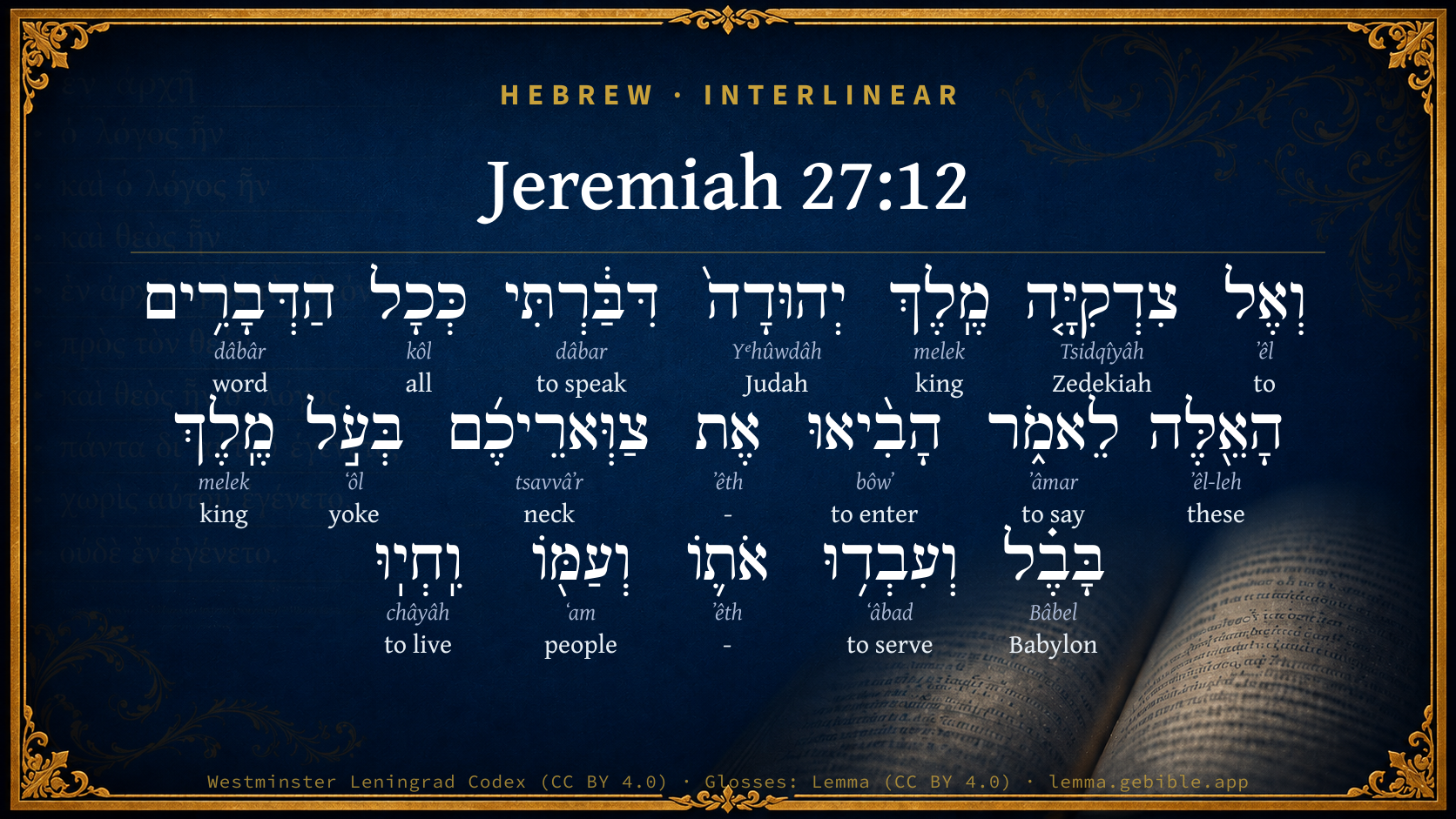
Hebrew (Westminster Leningrad Codex) Jeremiah 27:12 appears in the Hebrew Old Testament. The text above is from the Westminster Leningrad Codex. Each word links to its Strong’s number, a concise gloss, and parsing drawn from the Open Scriptures Hebrew Bible morphology. Click any word for its full Brown-Driver-Briggs (BDB) entry.
Download image
Cite this verse

Jeremiah 27:12 (World English Bible). Public Domain. Lemma interlinear Bible study tool, https://lemma.gebible.app/v/jeremiah/27/12.

Show BibTeX & RIS
BibTeX
RIS
English Translation
I spoke to Zedekiah king of Judah according to all these words, saying, Bring your necks under the yoke of the king of Babylon, and serve him and his people, and live.
World English Bible · Public Domain
Download a study sheet

One document with this verse’s original text, its word-by-word gloss line, the meaning frame, cross-references with their text, attributed commentary, and full source and license credits — printable, and it pastes into notes with its structure intact.

This verse Autodidact and up

Study sheet (.html) Plain text (.txt)

A passage Seminary Student

Up to 50 verses in one chapter. A passage sheet keeps up to 6 commentary sources and 12 cross-references per verse, in the order this page ranks them, and says so on the sheet whenever that leaves anything out. Ask for a single verse and you get the Autodidact verse sheet above.

Everything on this page stays free to read, with no account — the sheet is a download of what is already on screen, not access to it.

Want to remove ads? Support Godless Engineer
Compare translations 3

The same verse in 3 English versions, stacked beneath the original-language interlinear above. Click any original word for its lexicon entry.

Each is an independent rendering of the whole verse — the interlinear is not word-aligned to these translations.

Highlighted words mark where these versions differ — a whole-verse word diff, not a word-by-word alignment.

  • World English Bible Public Domain
    I spoke to Zedekiah king of Judah according to all these words, saying, Bring your necks under the yoke of the king of Babylon, and serve him and his people, and live.
  • King James Version Public Domain
    I spake also to Zedekiah king of Judah according to all these words, saying, Bring your necks under the yoke of the king of Babylon, and serve him and his people, and live.
  • unfoldingWord Literal Text CC BY-SA 4.0
    And to Zedekiah king of Judah I spoke according to all these words, saying, “Bring your necks into the yoke of the king of Babylon and serve him and his people, and live.

unfoldingWord Literal Text — © unfoldingWord, licensed CC BY-SA 4.0. Word-aligned USFM3 via Door43 (git.door43.org/unfoldingWord/en_ult).

Versions to compare (up to 4)

3 of 4 selected

Show all 18 translations

Every available English version of this verse, each an independent rendering of the whole verse.

  • World English Bible Public Domain
    I spoke to Zedekiah king of Judah according to all these words, saying, Bring your necks under the yoke of the king of Babylon, and serve him and his people, and live.
  • Berean Standard Bible Public Domain
    And to Zedekiah king of Judah I spoke the same message: “Put your necks under the yoke of the king of Babylon; serve him and his people, and live!
  • Majority Standard Bible Public Domain
    And to Zedekiah king of Judah I spoke the same message: “Put your necks under the yoke of the king of Babylon; serve him and his people, and live!
  • King James Version Public Domain
    I spake also to Zedekiah king of Judah according to all these words, saying, Bring your necks under the yoke of the king of Babylon, and serve him and his people, and live.
  • American Standard Version (1901) Public Domain
    And I spake to Zedekiah king of Judah according to all these words, saying, Bring your necks under the yoke of the king of Babylon, and serve him and his people, and live.
  • Revised Version (1885) Public Domain
    And I spake to Zedekiah king of Judah according to all these words, saying, Bring your necks under the yoke of the king of Babylon, and serve him and his people, and live.
  • Geneva Bible (1599) Public Domain
    I spake also to Zedekiah king of Iudah according to all these wordes, saying, Put your neckes vnder the yoke of the King of Babel, and serue him and his people, that ye may liue.
  • Douay-Rheims (1899) Public Domain
    And I spoke to Sedecias the king of Juda according to all these words, saying: Bend down your necks under the yoke of the king of Babylon, and serve him, and his people, and you shall live.
  • Young's Literal Translation Public Domain
    And unto Zedekiah king of Judah I have spoken according to all these words, saying, `Cause your necks to enter into the yoke of the king of Babylon, and serve him and his people, and live.
  • Literal Standard Version CC BY-SA 4.0
    And I have spoken to Zedekiah king of Judah according to all these words, saying, “Cause your necks to enter into the yoke of the king of Babylon, and serve him and his people, and live.
  • Unlocked Literal Bible CC BY-SA 4.0
    So I spoke to Zedekiah king of Judah and gave him this message, “Place your necks under the yoke of the king of Babylon and serve him and his people, and you will live.
  • unfoldingWord Literal Text CC BY-SA 4.0
    And to Zedekiah king of Judah I spoke according to all these words, saying, “Bring your necks into the yoke of the king of Babylon and serve him and his people, and live.
  • Darby Bible Public Domain
    And I spoke to Zedekiah king of Judah according to all these words, saying, bring your necks under the yoke of the king of Babylon, and serve him and his people, and live.
  • World Messianic Bible Public Domain
    I spoke to Zedekiah king of Judah according to all these words, saying, “Bring your necks under the yoke of the king of Babylon, and serve him and his people, and live.
  • Webster's Bible Public Domain
    I spoke also to Zedekiah king of Judah according to all these words, saying, Bring your necks under the yoke of the king of Babylon, and serve him and his people, and live.
  • Free Bible Version CC BY-SA 4.0
    I gave the same message to Zedekiah king of Judah: Submit to the king of Babylon; serve him and his people, and live!
  • Bible in Basic English Public Domain
    And I said all this to Zedekiah, king of Judah, saying, Put your necks under the yoke of the king of Babylon and become his servants and his people, so that you may keep your lives.
  • JPS Tanakh (1917) Public Domain
    And I spoke to Zedekiah king of Judah according to all these words, saying: 'Bring your necks under the yoke of the king of Babylon, and serve him and his people, and live.

Literal Standard Version (2020), Covenant Press — licensed CC BY-SA 4.0. Text via the HelloAO Bible API (eBible.org). Unlocked Literal Bible (unfoldingWord) — licensed CC BY-SA 4.0. Text via the HelloAO Bible API (eBible.org). unfoldingWord Literal Text — © unfoldingWord, licensed CC BY-SA 4.0. Word-aligned USFM3 via Door43 (git.door43.org/unfoldingWord/en_ult). Free Bible Version, Dr. Jonathan Gallagher — licensed CC BY-SA 4.0. Text via the HelloAO Bible API (eBible.org).

Word by word

More ways to search: Search by grammar → Find every occurrence → Compare this word →

Practice this passage: Drill this verse → Learn its vocabulary →

בְּעֹ֣ל
ʻôl
H5923
“in/at · yoke of”
Preposition + Noun, Common, Masculine, Singular, Construct
Part of Speech
Preposition + Noun
Type
Common
Gender
Masculine
Number
Singular
State
Construct
Full BDB Definition

Origin: from H5953

TWOT: 1628a

yoke
  1. וְאֶל ʼêl H413 “and · to” Conjunction + Preposition
  2. צִדְקִיָּ֤ה Tsidqîyâh H6667 “Zedekiah” Noun, Proper
  3. מֶֽלֶךְ melek H4428 “king of” Noun, Common, Masculine, Singular, Construct
  4. יְהוּדָה֙ Yᵉhûwdâh H3063 “Judah” Noun, Proper
  5. דִּבַּ֔רְתִּי dâbar H1696 “to speak” Verb, Piel, Perfect, 1st Person, Common, Singular
  6. כְּכָל kôl H3605 “like/as · all of” Preposition + Noun, Common, Masculine, Singular, Construct
  7. הַדְּבָרִ֥ים dâbâr H1697 “the · words” Particle, Definite Article + Noun, Common, Masculine, Plural, Absolute
  8. הָאֵ֖לֶּה ʼêl-leh H428 “the · these” Particle, Definite Article + Pronoun, Demonstrative, Common, Plural
  9. לֵאמֹ֑ר ʼâmar H559 “to say” Preposition + Verb, Qal, Infinitive Construct
  10. הָבִ֨יאוּ bôwʼ H935 “enter” Verb, Hiphil, Imperative, 2nd Person, Masculine, Plural
  11. אֶת ʼêth H853 “-” Particle, Direct Object
  12. צַוְּארֵיכֶ֜ם tsavvâʼr H6677 “necks · your” Noun, Common, Masculine, Plural, Construct + Suffix, Personal, 2nd Person, Masculine, Plural
  13. מֶֽלֶךְ melek H4428 “king of” Noun, Common, Masculine, Singular, Construct
  14. בָּבֶ֗ל Bâbel H894 “Babylon” Noun, Proper
  15. וְעִבְד֥וּ ʻâbad H5647 “and · serve” Conjunction + Verb, Qal, Imperative, 2nd Person, Masculine, Plural
  16. אֹת֛וֹ ʼêth H853 “- · him” Particle, Direct Object + Suffix, Personal, 3rd Person, Masculine, Singular
  17. וְעַמּ֖וֹ ʻam H5971 “and · people · his” Conjunction + Noun, Common, Masculine, Singular, Construct + Suffix, Personal, 3rd Person, Masculine, Singular
  18. וִֽחְיֽוּ châyâh H2421 “and · live” Conjunction + Verb, Qal, Imperative, 2nd Person, Masculine, Plural

About this verse

These counts appear in no published source. They are computed here, from the morphology-tagged text and Lemma’s own curated glosses. What Lemma adds →

19
words
17
distinct lemmas
Prophets
section

Shared distinctive vocabulary

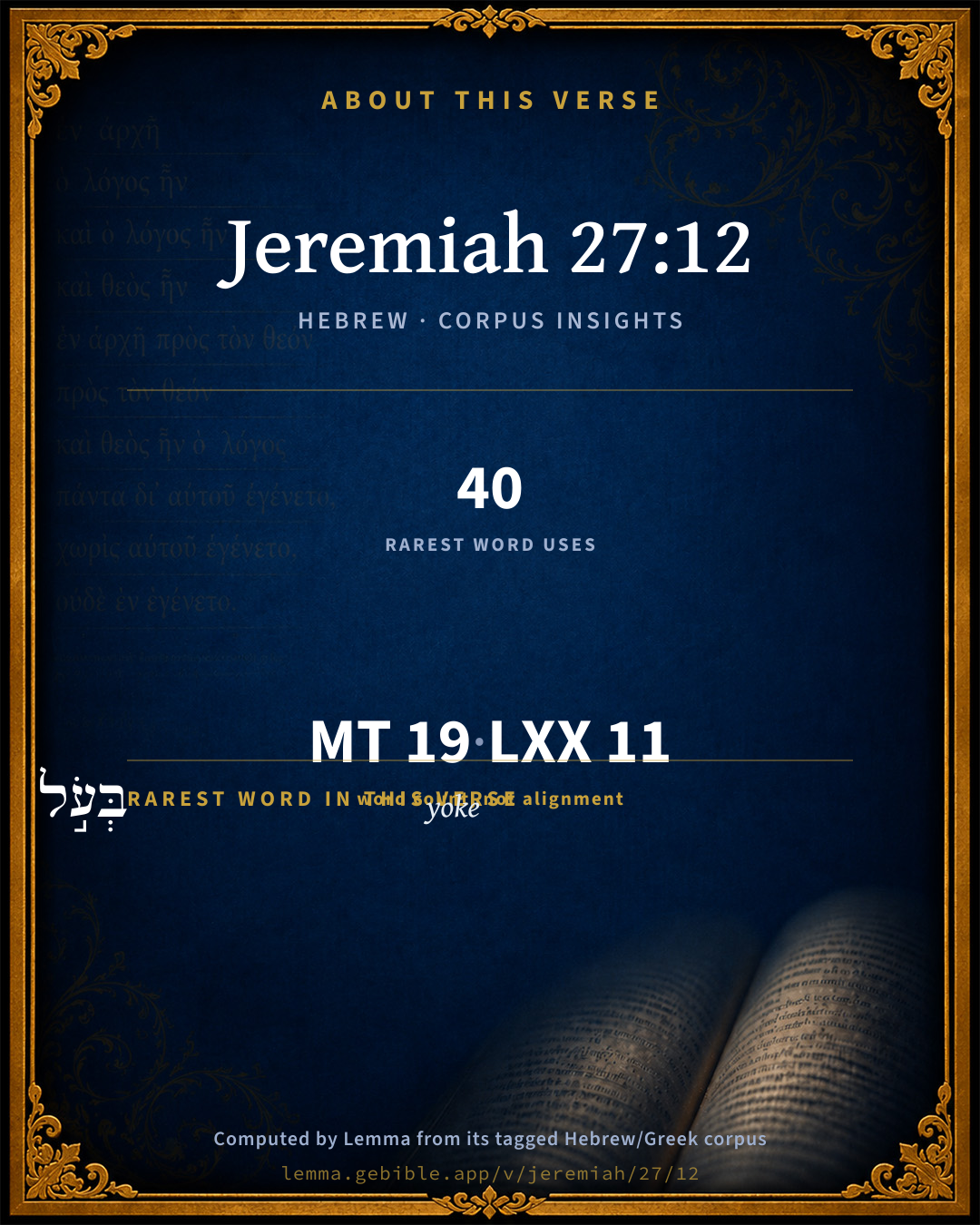
בְּעֹ֣ל yoke H5923 occurs in 34 verses of the Hebrew Bible. Also found in:

Grammatical profile

  • 5 verbs
  • 10 nouns
  • 1 pronoun
  • 1 preposition
  • 2 particles

Verb forms

  • דִּבַּ֔רְתִּי Piel · Perfect
  • לֵאמֹ֑ר Qal · Infinitive Construct
  • הָבִ֨יאוּ Hiphil · Imperative
  • וְעִבְד֥וּ Qal · Imperative
  • וִֽחְיֽוּ Qal · Imperative

Repetition

A word recurs within this verse — often emphatic in Hebrew:

  • מֶֽלֶךְ king H4428 ×2

Hebrew & Septuagint length

In the original languages it is 19 Hebrew tokens and 11 Greek tokens — but the two are counted differently (Hebrew bundles its prefixes and suffixes into one token; the Greek is in lemma form), so that isn’t a like-for-like length.

Cross-references

7

Topical passages linked to Jeremiah 27:12 in the Treasury of Scripture Knowledge — connected by theme and wording, ordered by reader-vote popularity; previews shown in the World English Bible.

  • Jeremiah 28:1 It happened the same year, in the beginning of the reign of Zedekiah king of Judah, in the fourth year, in the fifth month, that Hananiah the son of Azzur, the prophet, who was of Gibeon, spoke to me in the house of Yahweh, in the presence of the priests and of all the people, saying,
  • Jeremiah 38:17 Then said Jeremiah to Zedekiah, Thus says Yahweh, the God of hosts, the God of Israel: If you will go forth to the king of Babylon's princes, then your soul shall live, and this city shall not be burned with fire; and you shall live, and your house.
  • 2 Chronicles 36:11–13 Zedekiah was twenty-one years old when he began to reign; and he reigned eleven years in Jerusalem:
  • Proverbs 1:33 But whoever listens to me will dwell securely, And will be at ease, without fear of harm."
  • Jeremiah 27:2–3 Thus says Yahweh to me: Make you bonds and bars, and put them on your neck;
  • Jeremiah 27:8 It shall happen, that the nation and the kingdom which will not serve the same Nebuchadnezzar king of Babylon, and that will not put their neck under the yoke of the king of Babylon, that nation will I punish, says Yahweh, with the sword, and with the famine, and with the pestilence, until I have consumed them by his hand.
  • Ezekiel 17:11–21 Moreover the word of Yahweh came to me, saying,

Cross-references courtesy of OpenBible.info (CC BY 4.0).

Hebrew and Greek witnesses Masoretic Hebrew ↔ Greek Septuagint

The same verse in the two great witnesses to the Old Testament, shown verse-for-verse.

These are two independent witnesses, not word-aligned to each other, and the Septuagint is shown in lemma (dictionary) form.

Hebrew Jeremiah 27:12 Masoretic · Westminster Leningrad Codex

וְאֶל צִדְקִיָּ֤ה מֶֽלֶךְ יְהוּדָה֙ דִּבַּ֔רְתִּי כְּכָל הַדְּבָרִ֥ים הָאֵ֖לֶּה לֵאמֹ֑ר הָבִ֨יאוּ אֶת צַוְּארֵיכֶ֜ם בְּעֹ֣ל מֶֽלֶךְ בָּבֶ֗ל וְעִבְד֥וּ אֹת֛וֹ וְעַמּ֖וֹ וִֽחְיֽוּ

I spoke to Zedekiah king of Judah according to all these words, saying, Bring your necks under the yoke of the king of Babylon, and serve him and his people, and live.

World English Bible · Public Domain

Greek LXX Structure differs

In the Septuagint, Jeremiah is about an eighth shorter than the Hebrew and arranges its material differently — the Oracles Against the Nations (Hebrew chapters 46–51) appear in the middle of the Greek book, after 25:13. Because the chapter and verse boundaries do not line up, a verse-for-verse comparison with the Hebrew is not shown.

A verse-for-verse comparison isn’t shown here because the chapters and verses don’t line up. Switch to the LXX edition with the MT / LXX toggle above to read the Greek directly.

On this verse, The Cambridge Bible for Schools and Colleges discusses the Septuagint’s reading. Read the note in Commentary ↓

Hebrew: Westminster Leningrad Codex (CC BY 4.0). Greek: Septuagint (public domain); English from a public-domain English Septuagint. How the Septuagint differs from the Hebrew →

Targum (Aramaic paraphrase)

1

The Targum is the ancient Jewish Aramaic paraphrase of the Hebrew Scriptures — an interpretive translation, not the Hebrew text itself. Onkelos (literal) and Pseudo-Jonathan (expansive) render the Torah, and Jonathan the Prophets. Coverage is partial: where no permissively-licensed English translation exists for a verse, only the Aramaic is shown. This is verse-level text, not a word-by-word alignment to the Hebrew.

  1. Targum Jonathan Prophets (Joshua–Malachi)
    וְעִם צִדְקִיָה מְלַךְ שִׁבְטָא דְבֵית יְהוּדָה מַלְלֵית יַת כָּל פִתְגָמַיָא הָאִלֵין לְמֵימָר אָעִילוּ יַת צַוָארֵיכוֹן בְּנִיר מַלְכָּא דְבָבֶל וּפְלָחוּ יָתֵיהּ וְעַמֵיהּ וְאִתְקַיִימוּ:

    (no public-domain English translation for this verse)

    Targum Jonathan — Aramaic: “Mikraot Gedolot” (public domain). English: “Sefaria Community Translation” (CC0 1.0 (public-domain dedication)); “London "Chaldee Paraphrase," 1871” (public domain). Text via Sefaria.

Commentary

Notes on Jeremiah 27:12 from classic Christian and Jewish commentators (each source and its license shown beneath its notes). The classic Christian expositions comment on the surrounding passage and are grouped to its opening verse, so a note may address several verses; the Jewish commentaries on the Tanakh (Rashi and others) are per-verse, so they appear only where the commentator wrote on this verse.

Lemma curates 59 commentaries, every one of them public domain or Creative Commons licensed, each selected and text-cleaned for this edition rather than reprinted as found. About our sources →

Matthew Henry's Commentary

What was said to all the nations is here with a particular tenderness applied to the nation of the Jews, for whom Jeremiah was sensibly concerned. The case at present stood thus: Judah and Jerusalem had often contested with the king of Babylon, and still were worsted; many both of their valuable persons and their valuable goods were carried to Babylon already, and some of the vessels of the Lord's house particularly. Now how this struggle would issue was the question. They had those among them at Jerusalem who pretended to be prophets, who bade them hold out and they should, in a little time, be too hard for the king of Babylon and recover all that they had lost. Now Jeremiah is sent to bid them yield and knock under, for that, instead of recovering what they had lost, they should otherwise lose all that remained; and to press them to this is the scope of these verses.

I. Jeremiah humbly addresses the king of Judah, to persuade him to surrender to the king of Babylon. His act would be the people's and would determine them, and therefore he speaks to him as to them all (Jer 27:12): Bring your necks under the yoke of the king of Babylon and live. Is it their wisdom to submit to the heavy iron yoke of a cruel tyrant, that they may secure the lives of their bodies? And is it not much more our wisdom to submit to the sweet and easy yoke of our rightful Lord and Master Jesus Christ, that we may secure the lives of our souls? Bring down your spirits to repentance and faith, and that is the way to bring up your spirits to heaven and glory. And with much more cogency and compassion may we expostulate with perishing souls than Jeremiah here expostulates with a perishing people: "Why will you die by the sword and the famine - miserable deaths, which you inevitably run yourselves upon, under pretence of avoiding miserable lives?" What God had spoken, in general, of all those that would not submit to the king of Babylon, he would have them to apply to themselves and be afraid of. It were well if sinners would, in like manner, be afraid of the destruction threatened against all those that will not have Christ to reign over them, and reason thus with themselves, "Why should we die the second death, which is a thousand times worse than that by sword and famine, when we might submit and live?"

II. He addresses himself likewise to the priests and the people (Jer 27:16), to persuade them to serve the king of Babylon, that they might live, and might prevent the desolation of the city (Jer 27:17): "Wherefore should it be laid waste, as certainly it will be if you stand it out?" The priests had been Jeremiah's enemies, and had sought his life to destroy it, yet he approves himself their friend, and seeks their lives, to preserve and secure them, which is an example to us to render good for evil. When the blood-thirsty hate the upright, yet the just seek his soul, and the welfare of it, Pro 29:10. The matter was far gone here; they were upon the brink of ruin, which they would not have been brought to if they would have taken Jeremiah's counsel; yet he continues his friendly admonitions to them, to save the last stake and manage that wisely, and now at length in this their day to understand the things that belong to their peace, when they had but one day to turn them in.

III. In both these addresses he warns them against giving credit to the false prophets that rocked them asleep in their security, because they saw that they loved to slumber: "Hearken not to the words of the prophets (Jer 27:14), your prophets, Jer 27:16. They are not God's prophets; he never sent them; they do not serve him, nor seek to please him; they are yours, for they say what you would have them say, and aim at nothing but to please you." Two things their prophets flattered them into the belief of: - 1. That the power which the king of Babylon had gained over them should now shortly be broken. They said (Jer 27:14), "You shall not serve the king of Babylon; you need not submit voluntarily, for you shall not be compelled to submit." This they prophesied in the name of the Lord (Jer 27:15), as if God had sent them to the people on this errand, in kindness to them, that they might not disparage themselves by an inglorious surrender. But it was a lie. They said that God sent them; but that was false; he disowns it: I have not sent them, saith the Lord. They said that they should never be brought into subjection to the king of Babylon; but that was false too, the event proved it so. They said that to hold out to the last would be the way to secure themselves and their city; but that was false, for it would certainly end in their being driven out and perishing. So that it was all a lie, from first to last; and the prophets that deceived the people with these lies did, in the issue, but deceive themselves; the blind leaders and the blind followers fell together into the ditch: That you might perish, you, and the prophets that prophesy unto you, who will be so far from warranting your security that they cannot secure themselves. Note, Those that encourage sinners to go on in their sinful ways will in the end perish with them. 2. They prophesied that the vessels of the temple, which the king of Babylon had already carried away, should now shortly be brought back (Jer 27:16); this they fed the priests with the hopes of, knowing how acceptable it would be to them, who loved the gold of the temple better than the temple that sanctified the gold. These vessels were taken away when Jeconiah was carried captive into Babylon, Jer 27:20. We have the story, and it is a melancholy one, Kg2 24:13, Kg2 24:15; Ch2 36:10. All the goodly vessels (that is, all the vessels of gold that were in the house of the Lord), with all the treasures, were taken as prey, and brought to Babylon. This was grievous to them above any thing; for the temple was their pride and confidence, and the stripping of that was too plain an indication of that which the true prophet told them, that their God had departed from them. Their false prophets therefore had no other way to make them easy than by telling them that the king of Babylon should be forced to restore them in a little while. Now here, (1.) Jeremiah bids them think of preserving the vessels that remained by their prayers, rather than of bringing back those that were gone by their prophecies (Jer 27:18): If they be prophets, as they pretend, and if the word of the Lord be with them - if they have any intercourse with heaven and any interest there, let them improve it for the stopping of the progress of the judgment; let them step into the gap, and stand with their censer between the living and the dead, between that which is carried away and that which remains, that the plague may be stayed; let them make intercession with the Lord of hosts, that the vessels which are left go not after the rest. [1.] Instead of prophesying, let them pray. Note, Prophets must be praying men; by being much in prayer they must make it to appear that they keep up a correspondence with heaven. We cannot think that those do, as prophets, ever hear thence, who do not frequently by prayer send thither. By praying for the safety and prosperity of the sanctuary they must make it to appear that, as becomes prophets, they are of a public spirit; and by the success of their prayers it will appear that God favours them. [2.] Instead of being concerned for the retrieving of what they had lost, they must bestir themselves for the securing of what was left, and take it as a great favour if they can gain that point. When God's judgments are abroad we must not seek great things, but be thankful for a little. (2.) He assures them that even this point should not be gained, but the brazen vessels should go after the golden ones, Jer 27:19, Jer 27:22. Nebuchadnezzar had found so good a booty once that he would be sure to come again and take all he could find, not only in the house of the Lord, but in the king's house. They shall all be carried to Babylon in triumph, and there shall they be. But he concludes with a gracious promise that the time should come when they should all be returned: Until the day that I visit them in mercy, according to appointment, and then I will bring those vessels up again, and restore them to this place, to their place. Surely they were under the protection of a special Providence, else they would have been melted down and put to some other use; but there was to be a second temple, for which they were to be reserved. We read particularly of the return of them, Ezr 1:8. Note, Though the return of the church's prosperity do not come in our time, we must not therefore despair of it, for it will come in God's time. Though those who said, The vessels of the Lord's house shall shortly be brought again, prophesied a lie (Jer 27:16), yet he that said, They shall at length be brought again, prophesied the truth. We are apt to set our clock before God's dial, and then to quarrel because they do not agree; but the Lord is a God of judgment, and it is fit that we should wait for him.

Matthew Henry's Commentary on the Whole Bible (1708–1710) — public domain (CC PDM 1.0). Text via the HelloAO Bible API.

Trapp's Complete Commentary

John Trapp

Jer 27:12 I spake also to Zedekiah king of Judah according to all these words, saying, Bring your necks under the yoke of the king of Babylon, and serve him and his people, and live.

Ver. 12. I spake also to Zedekiah.] See on Jer 27:1.

Bring your necks under the yoke.] Better do so than worse: if ye will not be active in it, ye shall be passive; and that because ye would not take upon you the lighter yoke of mine obedience.

“ Deus crudelius urit

Quos videt invitos succubuisse sibi. ”

- Tibul. Eleg. 1.

John Trapp, A Commentary or Exposition upon All the Books of the Old and New Testament (1647–1656) — public domain. Text from a community e-Sword module.

Joseph Benson's Commentary

Jer 27:12-13. I spake also to Zedekiah, &c. — What the prophet here says to Zedekiah has a particular weight in it, because he was made king of Judea by Nebuchadnezzar, and had taken an oath to be faithful to him, and never to resist his authority. Why will ye die, thou and thy people? — That is, why wilt thou wilfully ruin, not only thyself, but thy people, by the sword, the famine, and the pestilence? by which judgments the Lord hath declared, that all nations who will not willingly yield to the king of Babylon shall be destroyed.

Joseph Benson's Commentary on the Old and New Testaments (1811–1818) — public domain. Text from a community e-Sword module.

Tyndale Open Study Notes

Tyndale Open Resources

27:12-15 The terms of God’s decree (27:4-11) applied to Judah as much as to the surrounding nations.

Tyndale Open Study Notes — © Tyndale Open Resources, licensed CC BY-SA 4.0. Text via the HelloAO Bible API.

Jamieson, Fausset & Brown

Robert Jamieson, A. R. Fausset & David Brown

I spake also--translate, "And I spake," &c. Special application of the subject to Zedekiah.

Jamieson, Fausset & Brown — Commentary Critical and Explanatory on the Whole Bible (1871) — public domain (CC PDM 1.0). Text via the HelloAO Bible API.

John Calvin's Commentaries

This verse proves with sufficient clearness that what we have hitherto explained was spoken especially to the chosen people; for Jeremiah tells us here, that he spoke to the King Zedekiah, and in the sixteenth verse he adds that he spoke to the priests and to the people. He was not then sent as a teacher to the Moabites, the Tyrians, and other foreign nations; but God had prescribed to him his limits, within which he was to keep. He therefore says, that he spoke to the king

We hence learn what he had before said, that he was set over kingdoms and nations; for the doctrine taught by the prophets is higher than all earthly elevations. Jeremiah was, indeed, one of the people, and did not exempt himself from the authority of the king, nor did he pretend that he was released from the laws, because he possessed that high dignity by which he was superior to kings, as the Papal clergy do, who vauntingly boast of their immunity, which is nothing else but a license to live in wickedness. The Prophet then kept himself in his own rank like others; and yet when he had to exercise his spiritual jurisdiction in God’s name, he spared not the king nor his counsellors; for he knew that his doctrine was above all kings; the prophetic office, then, is eminent above all the elevations of kings.

And skilfully no less than wisely did the Prophet exercise his office by first assailing the king, as he had been sent to him. At the same time he addressed him in the plural number, Bring ye your neck, he says; and he did so, because the greater part of the people depended on the will of their king. Then he adds, Serve ye his people It was, indeed, a thing very unpleasant to be heard, when the Prophet commanded the Jews to submit, not only to the king of Babylon, but also to all his subjects; it was an indignity that must have greatly exasperated them. But he added this designedly, because he saw that he had to do with men refractory and untamable. As, then, they were not pliant, he dealt the more sharply with them, as though he wished to break down their foolish pride. It was not therefore a superfluous expression, when he bade the Jews to obey all the Chaldeans; for they had been so blinded by perverse haughtiness, that for a long time they had resisted God and his prophets, and continued untamable.

There is afterwards added a promise, and ye shall live, which confirms the truth to which I have referred, — that it is the best remedy for alleviating evils, to acknowledge that we are justly smitten, and to humble ourselves under the mighty hand of God; for thus it happens, that evils are turned into medicines, and thus become salutary to us. Whatever punishment is inflicted on us for our sins, as it is a sign of God’s wrath, so in a manner it places death before our eyes. Punishment, then, in itself can do nothing but fill us with dread, nay, overwhelm us with despair; and I speak of punishment even the slightest; for we suffer nothing which does not remind us of our sin and guilt, as though God summoned us to his tribunal. How dreadful surely it must be to sustain this, and to fall into the hands of the living God? Hence, when God touches us as it were with his little finger, we cannot but fall down through fear. But this comfort is given to us, that punishment, though in itself grievous and as it were fatal, becomes profitable to us, when we allow God to be our judge, and are prepared to endure whatever seems good to him.

This is what the Prophet means, when he promises that the Jews would live, if they submitted to the king of Babylon; not that they could merit life by their obedience; but the only way by which we can obtain God’s favor and be reconciled to him, is willingly to condemn ourselves; for we anticipate extreme judgment, as Paul says, when we condemn ourselves; and then we shall not be condemned by God. (1 Corinthians 11:31.) For how is it, that God is so angry with the wicked, except that they wish to be forgiven while in their sins? But this is to pull him down from his throne, for he is not the judge of the world, if the ungodly escape unpunished and laugh at all his threatenings. So also on the other hand, when in true humility we suffer ourselves to be chastised by God, he becomes immediately reconciled to us. This, then, is the life mentioned here. It follows, —

John Calvin's Commentaries (1540-1563) — public domain. Text from the Calvin Translation Society English edition (1840s-50s) via the Christian Classics Ethereal Library (ccel.org). Calvin's coverage is partial (roughly two-thirds of the Bible); uncommented books and verses are honest gaps, never fabricated. The 19th-century editor's footnotes and remarks are omitted so the notes are faithfully Calvin's own voice.

Ellicott's Commentary for English Readers

(12) I spake also to Zedekiah . . .—There was, as we see in Jer_28:13, a party of resistance in Judah also, and they, too, were trusting in delusive prophecies of the overthrow of the Chaldæan monarchy. Sadly and earnestly the prophet pleads with them in the question, “Why will ye die, thou and thy people, by the sword . . .?

A Bible Commentary for English Readers, edited by Charles John Ellicott (1878–1897) — public domain. Text from a community e-Sword module.

The Cambridge Bible for Schools and Colleges

gen. ed. J. J. S. Perowne

12–15. The warning to Zedekiah. The LXX, apparently through an accident in copying, omit much of these vv. They correspond in the main to the previous passage, the warning against the false prophets in Jer_27:14-15 answering to that of Jer_27:9-10. The plural is used throughout on account of many sympathisers among all ranks.

The Cambridge Bible for Schools and Colleges (gen. ed. J. J. S. Perowne; Cambridge University Press, 1878–1918) — public domain. Text from a community e-Sword module.

John Gill's Exposition

I spake also to Zedekiah king of Judah,.... At the same time that he delivered the above message from the Lord to the ambassadors of several nations, who were then residents in Zedekiah's court, or however in Jerusalem:

according to all these words; the same things, and much in the same language, he said to the king of Judah, as to the messengers of the nations:

saying; as follows:

bring your necks under the yoke of the king of Babylon; you, O king, your nobles, and your people. Zedekiah was set upon the throne by the king of Babylon, was a tributary to him, and had took an oath to be faithful to him; and yet was now meditating rebellion against him; and was consulting and entering into a confederacy with the neighbouring nations to throw off the yoke, and be independent on him: wherefore the sense of this advice must be to bring themselves, he and his people, to a cheerful submission to it, and a patient bearing it, and not attempt to shake it off:

and serve him and his people, and live: the king of Babylon, and the Chaldeans, by faithfully paying the tribute, and acknowledging subjection to him; and so "live" in their own land, enjoying all other civil and religious privileges.

John Gill's Exposition of the Whole Bible (1746–1763) — public domain (CC PDM 1.0). Text via the HelloAO Bible API.

Matthew Poole's English Annotations

Some think this was at another time, but it is most probable it was the same time.

Matthew Poole's English Annotations on the Holy Bible (1683–1685) — public domain. Text from a community e-Sword/MySword module.

Whedon's Commentary on the Bible

Daniel D. Whedon

12. To Zedekiah… bring your necks — The plural form shows that Zedekiah is addressed in his representative capacity, and that the people are included.

Daniel D. Whedon (gen. ed.), Commentary on the Old and New Testaments (1874–1909) — public domain. Text from a community e-Sword module.

The Pulpit Commentary

Vers. 12-15. But the warnings of Jeremiah were not confined, far from it, to the neighboring kings. Zedekiah had received a precisely similar message. Bring your necks. The plural is used, for Zedekiah was but an individual among a number of much more vigorous personalities. (comp. on Jer_22:2)

The Pulpit Commentary (1880–1919), ed. H.D.M. Spence-Jones & Joseph S. Exell — public domain. Text from a community e-Sword module.

Keil & Delitzsch

C. F. Keil & F. Delitzsch

To King Zedekiah Jeremiah addressed words of like import, saying: "Bring your necks into the yoke of the king of Babylon, and serve him and his people, and ye shall live. Jer 27:13. Why will ye die, thou and thy people, by sword, famine, and pestilence, as Jahveh hath spoken concerning the people that will not serve the king of Babylon? Jer 27:14. And hearken not unto the words of the prophets that speak unto you: Ye shall not serve the king of Babylon; for they prophesy a lie unto you. Jer 27:15. For I have not sent them, saith Jahveh, and they prophesy in my name falsely, that I might drive you out and ye might perish, ye and the prophets that prophesy unto you." - The discourse addressed to the king in the plural, "bring your necks," etc., is explained by the fact that, as Jer 27:13 shows, in and along with the king of his people are addressed. The imperative וחיוּ intimates the consequence of the preceding command. Jer 27:13 gives the application of the threat in Jer 27:8 to King Zedekiah and his people; and Jer 27:14. gives the warning corresponding to Jer 27:9 and Jer 27:10 against the sayings of the lying prophets; cf. Jer 14:14 and Jer 23:16, Jer 23:21.

Keil & Delitzsch — Biblical Commentary on the Old Testament (1861–1891) — public domain (CC PDM 1.0). Text via the HelloAO Bible API. (Old Testament only.)

Kretzmann's Popular Commentary

Paul E. Kretzmann

The Special Message to Zedekiah

v. 12. I spake to Zedekiah, king of Judah, applying the statements of the first part of the chapter to him and Judah in particular, according to all these words, saying, Bring your necks under the yoke of the king of Babylon and serve him and his people and live, maintaining their national existence.

v. 13. Why will ye die, thou and thy people, by the sword, by the famine, and by the pestilence, deliberately inviting these scourges by their disobedience, as the Lord hath spoken against the nation that will not serve the king of Babylon?

v. 14. Therefore hearken not unto the words of the prophets, those that bore this name by their own choice, not by God’s appointment, that speak unto you, saying, Ye shall not serve the king of Babylon; for they prophesy a lie unto you.

v. 15. For I have not sent them, saith the Lord, yet they prophesy a lie in My name, adorning their false doctrine with the tag of His revelation, that I might drive you out, and that ye might perish, ye and the prophets that prophesy unto you, the latter being swept away in the same calamity which their false statements had brought upon Judah.

v. 16. Also I spake to the priests and to all this people, saying, Thus saith the Lord, Hearken not to the words of your prophets that prophesy unto you, saying, Behold, the vessels of the Lord’s house, which had been taken to Babylon at the time of Jchoiakim, 2Ch 36:5-7, and Jeconiah, 2Ki 24:13, shall now shortly be brought again from Babylon, in the near future; for they prophesy a lie unto you, deceiving the people of Judah also in this case.

v. 17. Hearken not unto them; serve the king of Babylon and live, retaining their homes and maintaining their national existence; wherefore should this city be laid waste? Why simply challenge the calamity by their obstinacy?

v. 18. But if they be prophets, servants of the Lord by His appointment, and if the Word of the Lord be with them, as they insisted that it was, let them now make intercession to the Lord of hosts that the vessels which are left in the house of the Lord, which the Chaldeans had not yet carried away, and in the house of the king of Judah and at Jerusalem go not to Babylon, that the final act of the drama might not be staged. If they were true prophets, their intercession would carry enough weight to influence the Lord, so that He would avert the catastrophe which despoiled the nation entirely.

v. 19. For thus saith the Lord of hosts concerning the pillars, the two brass or bronze towers known as Jachin and Boaz, 1Ki 7:15 ff. and concerning the sea, 1Ki 7:23 ff. and concerning the bases, 1Ki 7:27 ff. and concerning the residue of the vessels that remain in this city, the vessels and instruments of worship which had not yet been taken away by the conquerors,

v. 20. which Nebuchadnezzar, king of Babylon, took not when he carried away captive Jeconiah, the son of Jehoiakim, king of Judah, from Jerusalem to Babylon, and all the nobles of Judah and Jerusalem, as related in 2Ki 25:13 ff.

v. 21. Yea, thus saith the Lord of hosts, the God of Israel, concerning the vessels that remain in the house of the Lord and in the house of the king of Judah and of Jerusalem, the repetition serving to increase the impression of inevitable calamity and disaster:

v. 22. They shall be carried to Babylon, as a welcome booty, and there shall they be until the day I visit them, saith the Lord, namely, when Cyrus overthrew the Babylonian power. Then will I bring them up and restore them to this place. This prophecy was fulfilled in every detail, although only a minor prediction, whereas the greater prophecies concerning the Messiah found an even more glorious fulfillment.

Paul E. Kretzmann, Popular Commentary of the Bible (1921–1924) — public domain. Text from a community e-Sword module.

unfoldingWord translationNotes

Door43 World Missions Community

General Information:

Yahweh continues to speak through Jeremiah to the king of Judah.

Place your necks under the yoke of the king of Babylon

Being the king's slave is spoken of as being an animal onto the shoulders of which the king puts a yoke so it can do heavy work. See how similar words were translated in Jeremiah 27:8.

Place your necks

The word "your" refers to Zedekiah and the people of Judah and so is plural. (See: Forms of You)

Why will you die ... king of Babylon?

Jeremiah uses this question to warn the king that his actions will lead to his death. AT: "For if you do not do this, you will surely die ... king." (See: Rhetorical Question)

translationWords

Zedekiah

king

Judah

Babylon

people group

life

unfoldingWord translationNotes — © Distant Shores Media and the Door43 World Missions Community, licensed CC BY-SA 4.0. Source: git.door43.org/Door43/en_tn.

Rashi

Rabbi Shlomo Yitzchaki (Rashi)

And to Zedekiah the king of Judah have I spoken, etc. All this Jeremiah said to the ambassadors of the kings.

Rashi on the Tanakh — English translations: “The Judaica Press complete Tanach with Rashi, translated by A. J. Rosenberg” (CC BY 4.0); “Pentateuch with Rashi's commentary by M. Rosenbaum and A.M. Silbermann, 1929-1934” (public domain); “The Metsudah Tanach series, Lakewood, N.J” (CC BY 4.0); and “The Book of Joshua, Metsudah Publications, 1997” (CC BY 4.0). Text via Sefaria.

Lesson kit

Teaching starters — assembled from the data on this page, not authored interpretation. Every prompt links to the verse data it draws on. Edit before teaching.

Jeremiah, in the Prophets, opens this verse with 19 words (17 distinct Hebrew lemmas). Its most distinctive word is ʻôl (“yoke”). A historical commentator’s framing appears above. Read the whole chapter for the surrounding context.

Discussion questions

  1. How does “yoke” (ʻôl) shape what this verse is saying?
  2. How does Genesis 27:40, which shares the word «yoke», read alongside this verse?
  3. What does the repetition of “king” (2× in this one verse) do in this verse?
  4. These translations render this verse differently. What is at stake in choosing one wording over another?
  5. «דִּבַּ֔רְתִּי» is a Piel Perfect verb. How does that grammatical form shape the action described?
  6. Compare how Matthew Henry's Commentary and Trapp's Complete Commentary read this verse. Where do they agree or differ?

Things to notice

Reading settings

Reading text

Shown beneath each verse's original-language words.

Old Testament
Old Testament edition

Read the OT as the Masoretic Hebrew (MT) or the Greek Septuagint (LXX).

English shown for the Greek Septuagint (in the Hebrew ↔ Greek comparison).

Comparing translations? Open the Compare panel on any verse page to stack up to four side by side.