
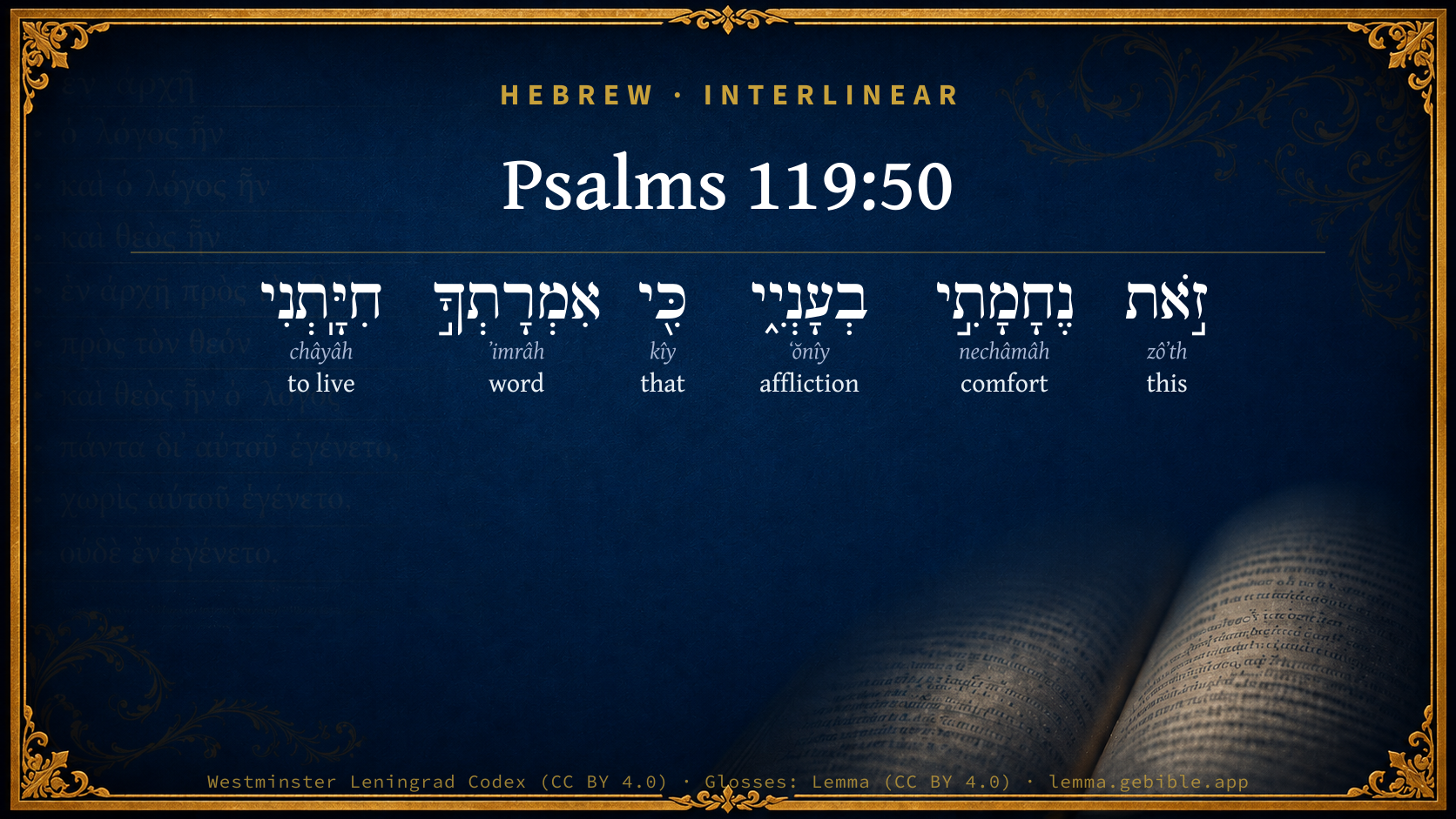
Psalms 119:50

Hebrew (Westminster Leningrad Codex) Psalms 119:50 appears in the Hebrew Old Testament. The text above is from the Westminster Leningrad Codex. Each word links to its Strong’s number, a concise gloss, and parsing drawn from the Open Scriptures Hebrew Bible morphology. Click any word for its full Brown-Driver-Briggs (BDB) entry.
Download image
Cite this verse

Psalms 119:50 (World English Bible). Public Domain. Lemma interlinear Bible study tool, https://lemma.gebible.app/v/psalms/119/50.

Show BibTeX & RIS
BibTeX
RIS
English Translation
This is my comfort in my affliction, For your word has revived me.
World English Bible · Public Domain
Download a study sheet

One document with this verse’s original text, its word-by-word gloss line, the meaning frame, cross-references with their text, attributed commentary, and full source and license credits — printable, and it pastes into notes with its structure intact.

This verse Autodidact and up

Study sheet (.html) Plain text (.txt)

A passage Seminary Student

Up to 50 verses in one chapter. A passage sheet keeps up to 6 commentary sources and 12 cross-references per verse, in the order this page ranks them, and says so on the sheet whenever that leaves anything out. Ask for a single verse and you get the Autodidact verse sheet above.

Everything on this page stays free to read, with no account — the sheet is a download of what is already on screen, not access to it.

Want to remove ads? Support Godless Engineer
Compare translations 3

The same verse in 3 English versions, stacked beneath the original-language interlinear above. Click any original word for its lexicon entry.

Each is an independent rendering of the whole verse — the interlinear is not word-aligned to these translations.

Highlighted words mark where these versions differ — a whole-verse word diff, not a word-by-word alignment.

  • World English Bible Public Domain
    This is my comfort in my affliction, For your word has revived me.
  • King James Version Public Domain
    This is my comfort in my affliction: for thy word hath quickened me.
  • unfoldingWord Literal Text CC BY-SA 4.0
    This my comfort in my affliction because your promise revives me.

unfoldingWord Literal Text — © unfoldingWord, licensed CC BY-SA 4.0. Word-aligned USFM3 via Door43 (git.door43.org/unfoldingWord/en_ult).

Versions to compare (up to 4)

3 of 4 selected

Show all 17 translations

Every available English version of this verse, each an independent rendering of the whole verse.

  • World English Bible Public Domain
    This is my comfort in my affliction, For your word has revived me.
  • Berean Standard Bible Public Domain
    This is my comfort in affliction, that Your promise has given me life.
  • Majority Standard Bible Public Domain
    This is my comfort in affliction, that Your promise has given me life.
  • King James Version Public Domain
    This is my comfort in my affliction: for thy word hath quickened me.
  • American Standard Version (1901) Public Domain
    This is my comfort in my affliction; For thy word hath quickened me.
  • Revised Version (1885) Public Domain
    This is my comfort in my affliction: for thy word hath quickened me.
  • Geneva Bible (1599) Public Domain
    It is my comfort in my trouble: for thy promise hath quickened me.
  • Young's Literal Translation Public Domain
    This `is' my comfort in mine affliction, That Thy saying hath quickened me.
  • Literal Standard Version CC BY-SA 4.0
    This [is] my comfort in my affliction, || That Your saying has quickened me.
  • Unlocked Literal Bible CC BY-SA 4.0
    This is my comfort in my affliction: that your promise has kept me alive.
  • unfoldingWord Literal Text CC BY-SA 4.0
    This my comfort in my affliction because your promise revives me.
  • Darby Bible Public Domain
    This is my comfort in mine affliction; for thy ùword hath quickened me.
  • World Messianic Bible Public Domain
    This is my comfort in my affliction, for your word has revived me.
  • Webster's Bible Public Domain
    This is my comfort in my affliction: for thy word hath revived me.
  • Free Bible Version CC BY-SA 4.0
    This is what brings me encouragement in my misery—your promise keeps me going!
  • Bible in Basic English Public Domain
    This is my comfort in my trouble; that your sayings have given me life.
  • JPS Tanakh (1917) Public Domain
    This is my comfort in my affliction, that Thy word hath quickened me.

Literal Standard Version (2020), Covenant Press — licensed CC BY-SA 4.0. Text via the HelloAO Bible API (eBible.org). Unlocked Literal Bible (unfoldingWord) — licensed CC BY-SA 4.0. Text via the HelloAO Bible API (eBible.org). unfoldingWord Literal Text — © unfoldingWord, licensed CC BY-SA 4.0. Word-aligned USFM3 via Door43 (git.door43.org/unfoldingWord/en_ult). Free Bible Version, Dr. Jonathan Gallagher — licensed CC BY-SA 4.0. Text via the HelloAO Bible API (eBible.org).

Word by word

More ways to search: Search by grammar → Find every occurrence → Compare this word →

Practice this passage: Drill this verse → Learn its vocabulary →

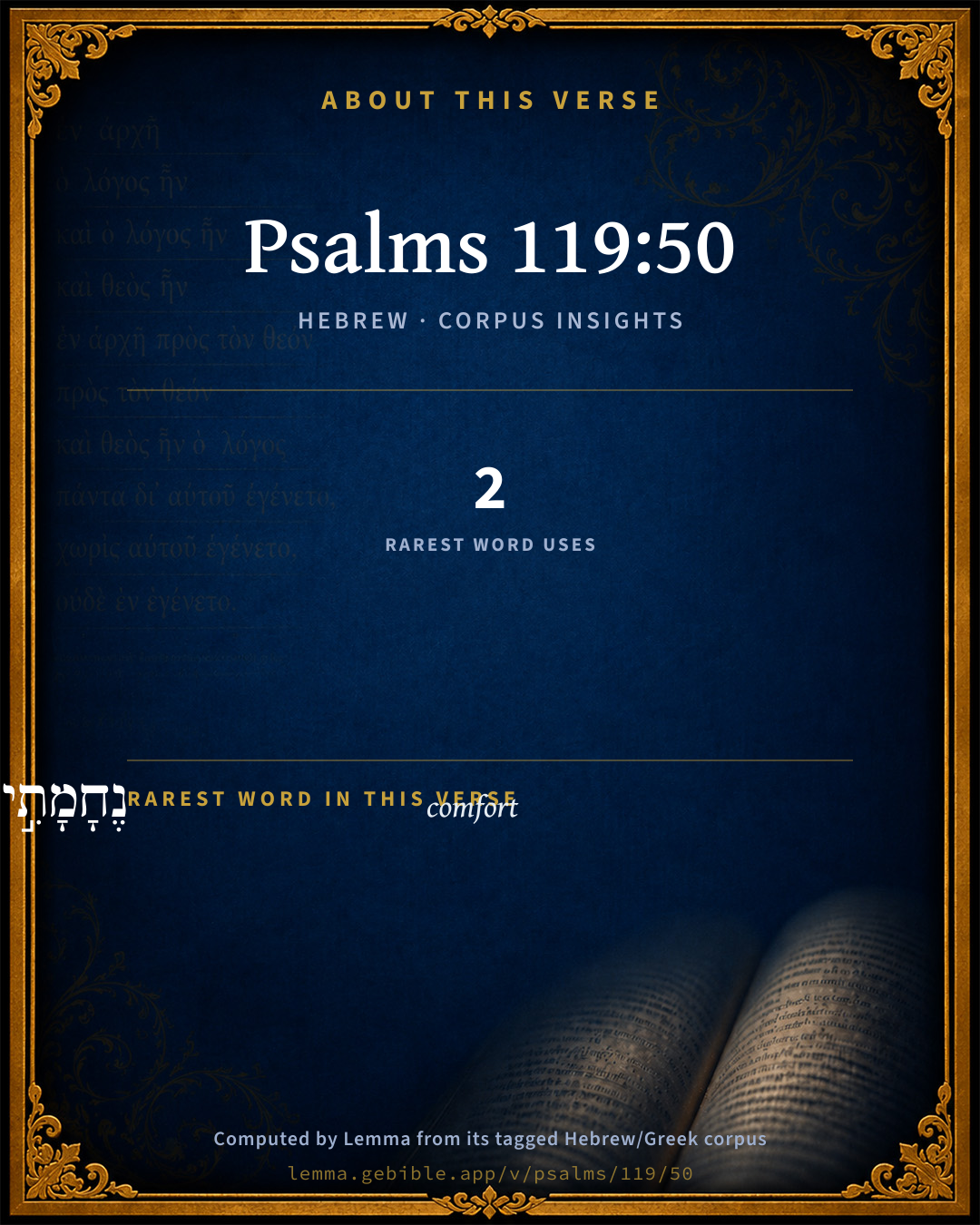
About this verse

These counts appear in no published source. They are computed here, from the morphology-tagged text and Lemma’s own curated glosses. What Lemma adds →

6
words
6
distinct lemmas
Wisdom
section

Notable vocabulary

The rarest word here is נֶחָמָתִ֣י comfort H5165 — appearing just 2 times in the whole Hebrew Bible.

Shared distinctive vocabulary

נֶחָמָתִ֣י comfort H5165 occurs in 2 verses of the Hebrew Bible. Also found in:

Grammatical profile

  • 1 verb
  • 3 nouns
  • 1 pronoun
  • 1 conjunction

Verb forms

  • חִיָּֽתְנִי Piel · Perfect

Hebrew & Septuagint length

In English translation the verse runs 13 words from the Hebrew and 13 from the Septuagint (LXX English) — the same length.

A rough comparison of the two English renderings, which tokenize alike — not a word-level alignment.

Word counts can differ between the Hebrew and the Greek without any difference in meaning — e.g. the Hebrew direct-object marker אֵת has no separate Greek word, and Greek often adds the article ὁ.

Cross-references

16

Topical passages linked to Psalms 119:50 in the Treasury of Scripture Knowledge — connected by theme and wording, ordered by reader-vote popularity; previews shown in the World English Bible.

  • Romans 15:4 For whatever things were written before were written for our learning, that through patience and through encouragement of the Scriptures we might have hope.
  • John 6:63 It is the spirit who gives life. The flesh profits nothing. The words that I speak to you are spirit, and are life.
  • Psalms 94:19 In the multitude of my thoughts within me, Your comforts delight my soul.
  • Psalms 28:7 Yahweh is my strength and my shield. My heart has trusted in him, and I am helped. Therefore my heart greatly rejoices. With my song I will thank him.
  • Psalms 42:11 Why are you in despair, my soul? Why are you disturbed within me? Hope in God! For I shall still praise him, The saving help of my countenance, and my God.
  • Hebrews 6:17–19 In this way God, being determined to show more abundantly to the heirs of the promise the immutability of his counsel, interposed with an oath;
  • Jeremiah 15:16 Your words were found, and I ate them; and your words were to me a joy and the rejoicing of my heart: for I am called by your name, Yahweh, God of hosts.
  • Psalms 27:13 I am still confident of this: I will see the goodness of Yahweh in the land of the living.
  • Psalms 119:25 My soul is laid low in the dust. Revive me according to your word!
  • Psalms 42:8 Yahweh will command his loving kindness in the daytime. In the night his song shall be with me: A prayer to the God of my life.
  • Romans 5:3–5 Not only this, but we also rejoice in our sufferings, knowing that suffering works perseverance;
  • Ezekiel 37:10 So I prophesied as he commanded me, and the breath came into them, and they lived, and stood up on their feet, an exceeding great army.
  • James 1:18 Of his own will he brought us forth by the word of truth, that we should be a kind of first fruits of his creatures.
  • Hebrews 12:11–12 All chastening seems for the present to be not joyous but grievous; yet afterward it yields the peaceful fruit of righteousness to those who have been exercised thereby.
  • 1 Peter 1:3 Blessed be the God and Father of our Lord Jesus Christ, who according to his great mercy became our father again to a living hope through the resurrection of Jesus Christ from the dead,
  • 1 Peter 2:2 as newborn babes, long for the pure milk of the Word, that you may grow thereby,

Cross-references courtesy of OpenBible.info (CC BY 4.0).

Hebrew and Greek witnesses Masoretic Hebrew ↔ Greek Septuagint

The same verse in the two great witnesses to the Old Testament, shown verse-for-verse.

You’re reading Greek Psalm 118 (Hebrew Psalm 119). The Septuagint counts the superscription, so verse numbers can differ from the Hebrew — chapter-level alignment, not verse-by-verse. Numbering follows Rahlfs.

These are two independent witnesses, not word-aligned to each other, and the Septuagint is shown in lemma (dictionary) form.

Hebrew Psalms 119:50 Masoretic · Westminster Leningrad Codex

זֹ֣את נֶחָמָתִ֣י בְעָנְיִ֑י כִּ֖י אִמְרָתְךָ֣ חִיָּֽתְנִי

This is my comfort in my affliction, For your word has revived me.

World English Bible · Public Domain

Greek LXX Greek Psalm 118:50 Septuagint · lemma form

οὗτος ἐγώ παρακαλέω ἐν ὁ ταπείνωσις ἐγώ ὅτι ὁ λόγιον σύ ζάω ἐγώ

This has comforted me in my affliction: for your oracle has quickened me.

LXX2012 (modern English Septuagint) · Public Domain

Hebrew: Westminster Leningrad Codex (CC BY 4.0). Greek: Septuagint (public domain); English from LXX2012 (modern English Septuagint) (Public Domain). How the Septuagint differs from the Hebrew →

Commentary

Notes on Psalms 119:50 from classic Christian and Jewish commentators (each source and its license shown beneath its notes). The classic Christian expositions comment on the surrounding passage and are grouped to its opening verse, so a note may address several verses; the Jewish commentaries on the Tanakh (Rashi and others) are per-verse, so they appear only where the commentator wrote on this verse.

Lemma curates 59 commentaries, every one of them public domain or Creative Commons licensed, each selected and text-cleaned for this edition rather than reprinted as found. About our sources →

Trapp's Complete Commentary

John Trapp

Psa 119:50 This [is] my comfort in my affliction: for thy word hath quickened me.

Ver. 50. This is my comfort] The promises yield strong consolation. Philosophical comforts are of little force, as Plato acknowledgeth, and Cicero bewaileth in his Epistle to Octavius

For thy word hath quickened me] When I was at last cast, and drawing my last breath, as it were.

John Trapp, A Commentary or Exposition upon All the Books of the Old and New Testament (1647–1656) — public domain. Text from a community e-Sword module.

The Biblical Illustrator

Joseph S. Exell

Psa_119:50

This is my comfort in my affliction: for Thy Word hath quickened me.

Comfort and quickening

I. In our affliction, the word of God quickens to comfort.

1. By leading us to God, who is able to bless.

2. By showing us that God is willing and waiting to bless.

3. By throwing a mild and beautiful light on Providence.

4. By spreading before us exceeding great and precious promises, which adapt themselves with a fine flexibility to all the varieties of our experience.

5. By establishing in our hearts the anticipation of another and a sorrowless life.

II. In our affliction the word of God not only quickens to comfort, but also comforts to quicken. First the Word becomes life, and then comfort; and then, through the comfort, the Word becomes further and fuller life. How?

1. By confirming our faith.

2. By giving new scope and ardour to gratitude and love. The Divine Word helps us to see that the Divine chastening is the sign and manifestation of the Divine mercy.

3. By stimulating the spirit of prayer.

4. By spiritualizing our tastes and aspirations.

5. By restraining our tendencies to wander from God. (J. P. Barnett.)

What is your comfort?

In some respects the same event happens to us all: to good men, to great men, to well-instructed men, as well as to the wicked, the obscure, and the ignorant. Each of these can speak of my affliction (Pro_14:10). It is a grand matter when my affliction is in each case balanced by my comfort. It was so in Davids case, and he is a fair representative of all believers.

I. Believers have their peculiar comfort. Each tried child of God can say, This is my comfort.

1. This, as different from others. Worldly men get their drops of comfort from such sources as they prefer; but the godly man looks to his experience of the Word, and says, This is my comfort (Psa_4:6).

2. This, as understanding what it is. He knew his consolation as well as he knew his tribulation. He was not like Hagar, who could not see the well which was so near her (Gen_21:19). This, as having it near at hand. He does not say that, as if he pointed it out in the distance; but this, as grasping it.

4. This, as pleading in prayer that which he had enjoyed; urging upon the Lord the mercy already received.

II. That comfort comes from a peculiar source. Thy Word hath quickened me.

1. In part it is outward.

(1) The Word of God, full of promises, is our comfort (Rom_15:4).

(2) The Word of God, full of records of His goodness, is the confirmation of our confidence (Psa_77:5-10).

(3) The Word of God, full of power, is our strength (Ecc_8:4).

2. In part it is inward: Thy Word hath quickened me.

(1) In past experience he had felt the power of the Word in raising him--Into life from death (Psa_116:8). Into energy from lethargy (Son_6:12). Into higher life from lower (Psa_119:67).

(2) In all things it had been a source of quickening to him.

(3) In present experience he was then feeling its power in making his mind less worldly. His heart more prayerful. His spirit more tender. His faith more simple.

III. That comfort is valuable under peculiar trials.

1. Hope deferred. Quickening enables us to hope on.

2. Trial endured (verse 50). Comfort is most needed in trouble, and there is no comfort like quickening.

3. Scorn suffered (verse 51). We care nothing for mockers when we are lively in spiritual things.

4. Sin of others (verse 53). More grace will enable us to bear up under abounding sin.

5. Changes (verse 54). The Bible has a song for all seasons, and a psalm for all places.

6. Darkness (verse 55). There is no night-light like the Word, enlightening and enlivening the heart.

IV. That the form of our comfort is a test of character.

1. Some look to wealth: when their corn and their wine are increased, they say, This is my comfort. They mind the main chance: they are worldly (Luk_12:19).

2. Some seek to dreams and visions, omens and fancies, impressions and presentiments: they are superstitious.

3. Some run to sin, drink, gaming, worldly company, dissipation, opium: they are wicked.

4. Some resort to their fellow-men for advice and assistance: they are unwise, and will be disappointed (Jer_17:5).

(1) What is your comfort?

(2) Has this blessed volume quickened you?

(3) If so, look to it under all trials, for it wilt never fail you. (C. H. Spurgeon.)

Spiritual quickening

I. Effected by the Divine word. How does Gods Word quicken the soul into supreme love? By presenting Him--

1. As the supremely Kind. This quickens it into gratitude.

2. As the supremely Beautiful. This quickens it into admiration.

3. As the supremely Great. This quickens it into adoration.

II. Supplying comfort under trial. The soul quickened into supreme love for God can bear up under all the trials of life. Whom have I in heaven but Thee? (Homilist.)

Quickening by the Word

What energy a text will breathe into a man l There is more in one Divine sentence than in huge folios of human composition. There are tinctures of which one drop is more powerful than large doses of the common dilutions. The Bible is the essence of truth; it is the mind of God, the wisdom of the Eternal. By every word of God men are made to live, and are kept in life. (C. H. Spurgeon.)

The Biblical Illustrator, edited by Joseph S. Exell (c. 1880s–1900s) — public domain. Text from a community e-Sword module.

J. A. Alexander on Psalms

Joseph Addison Alexander

50. (Psa 119:50) This (is) my comfort in my seering, and thy word quickens me. The reference to continued suffering in the first clause, and to its partial cessation in the second, agrees well with the condition of the chosen people when restored from exile. The terms, however, are so chosen as to be equally appropriate to personal afflictions, restorations, and deliverances. The word for comfort occurs elsewhere only in Job 6:10, where it has precisely the same form. Thy word includes thy decree or order and thy promise. Quickens, saves alive, or restores to life, according to the prayer in Psa 119:25; Psa 119:37; Psa 119:40. The past tense (has quickened) implies that the conservative or restorative effect has already been experienced, though not yet perfected.

Joseph Addison Alexander, The Psalms Translated and Explained (1850) — public domain. Text from a community e-Sword module.

Matthew Henry's Commentary

Here is David's experience of benefit by the word. 1. As a means of his sanctification: "Thy word has quickened me. It made me alive when I was dead in sin; it has many a time made me lively when I was dead in duty; it has quickened me to that which is good when I was backward and averse to it, and it has quickened me in that which is good when I was cold and indifferent." 2. Therefore as a means of his consolation when he was in affliction and needed something to support him: "Because thy word has quickened my at other times, it has comforted me then." The word of God has much in it that speaks comfort in affliction; but those only may apply it to themselves who have experienced in some measure the quickening power of the word. If through grace it make us holy, there is enough in it to make us easy, in all conditions, under all events.

Matthew Henry's Commentary on the Whole Bible (1708–1710) — public domain (CC PDM 1.0). Text via the HelloAO Bible API.

Adam Clarke's Commentary

Verse 50. This is my comfort] While enduring our harsh captivity, we anticipated our enlargement; and thy word of promise was the means of keeping our souls alive.

Adam Clarke's Commentary on the Bible (1810–1826) — public domain. Text from a community e-Sword/MySword module.

Ellicott's Commentary for English Readers

ZAIN.

(50) Comfort.—As in Job_6:10, where the same noun occurs, its only other use. We might render, “This is my comfort, that thy word quickeneth me.”

A Bible Commentary for English Readers, edited by Charles John Ellicott (1878–1897) — public domain. Text from a community e-Sword module.

The Cambridge Bible for Schools and Colleges

gen. ed. J. J. S. Perowne

50. This] i.e. Thy word, if the rendering for is retained in the next line. But it is better to render, This is my comfort … that thy word &c. Past experience of the life-giving sustaining power of God’s promise is his comfort in affliction.

The Cambridge Bible for Schools and Colleges (gen. ed. J. J. S. Perowne; Cambridge University Press, 1878–1918) — public domain. Text from a community e-Sword module.

John Gill's Exposition

I remembered thy judgments of old, O Lord,.... Either the judgments of God executed on wicked men; as the bringing a flood on the world of the ungodly; the burning of Sodom and Gomorrah; the destruction of Pharaoh and his host in the Red sea; the cutting off of the Canaanites, and dispossessing them of their land: or the providential dispensations of God towards his own people; who sometimes chastises and corrects them, and brings them very low, and then raises them up again, as in the case of Job. These things the psalmist called to remembrance, and revolved them in his mind, which gave him pleasure and comfort:

and have comforted myself; with such thoughts as these, that that God, who had cast down the mighty from their seats, and had scattered the proud in the imaginations of their hearts, and destroyed them, could easily rebuke the proud that had him in derision; and he that had shown himself so good and gracious to his people, when brought low, could raise him out of his afflictions and distresses.

John Gill's Exposition of the Whole Bible (1746–1763) — public domain (CC PDM 1.0). Text via the HelloAO Bible API.

Albert Barnes' Notes on the Bible

This is my comfort in my affliction - Compare Rom 15:4. The word here rendered “comfort” occurs only here and in Job 6:10. The obvious meaning is, that his only consolation in his affliction was derived from the word of God; the word which had caused him to hope, and the word by which he had been quickened or made alive. The particular design of this is to show the value of the word of God as a source of comfort in trouble.

For thy word hath quickened me - Has made me alive; or, caused me to live. That is, the word, the truth of God, had been the instrument of calling him from the death of sin, and of imparting to him new life, or had been the means of his regeneration. Compare Jam 1:18; 1Co 4:15; Heb 4:12; 1Pe 1:23. As it was by this “word” that he had been made alive, so his only comfort was in that word, and it was to him a just ground of consolation that God had brought him from the death of sin, and had imparted to him spiritual life.

Albert Barnes' Notes on the Bible (1834–1885) — public domain. Text from a community e-Sword/MySword module.

Matthew Poole's English Annotations

This, to wit, thy word, as is evident both from the foregoing and following words.

Hath quickened me; hath preserved my life in manifold dangers, and hath revived and cheered my spirit.

Matthew Poole's English Annotations on the Holy Bible (1683–1685) — public domain. Text from a community e-Sword/MySword module.

The Treasury of David

Charles H. Spurgeon

Ver. 50. This is my comfort in my affliction: for thy word hath quickened me. He means, Thy word is my comfort, or the fact that thy word has brought quickening to me is my comfort. Or he means that the hope which had given him was his comfort, for God had quickened him thereby ever may be the exact sense, it is clear that the Psalmist had affliction affliction peculiar to himself, which he calls "my affliction"; that he had comfort in it, comfort specially his own, for he styles it "my comfort"; and that he knew what the comfort was, and where it came from, for exclaims "this is my comfort". The worldling clutches his money bag and says, "this is my comfort"; the spendthrift points to his gaiety, shouts, "this is my comfort"; the drunkard lifts his glass, and sings, "this is my comfort"; but the man whose hope comes from God feels the giving power of the word of the Lord, and he testifies, "this is my fort." Paul said, "I know whom I have believed." Comfort is desirable all times; but comfort in affliction is like a lamp in a dark place. Some unable to find comfort at such times; but it is not so with believers, their Savour has said to them, "I will not leave you comfortless." have comfort and no affliction, others have affliction and no comfort; the saints have comfort in their affliction.

The word frequently comforts us by increasing the force of our inner "this is my comfort; thy word hath quickened me." To quicken the is to cheer the whole man. Often the near way to consolation is sanctification and invigoration. If we cannot clear away the fog, it may be to rise to a higher level, and so to get above it. Troubles which weigh down while we are half dead become mere trifles when we are full of Thus have we often been raised in spirit by quickening grace, and the thing will happen again, for the Comforter is still with us, the Consolation of Israel ever liveth, and the very God of peace is evermore our Father. Looking back upon our past life there is one ground of comfort as to state the word of God has made us alive, and kept us so. We were but we are dead no longer. From this we gladly infer that if the had meant to destroy he would not have quickened us. If we were only hypocrites worthy of derision, as the proud ones say, he would not revived us by his grace. An experience of quickening is a fountain of cheer.

See how this verse is turned into a prayer in Ps 119:107. "Quicken me, O Lord, according unto thy word." Experience teaches us how to pray, and furnishes arguments in prayer.

Ver. 50. This is my comfort, etc. The word of promise was David's comfort, because the word had quickened him to receive comfort. The original is capable of another modification of thought "This is my consolation that thy word hath quickened me." He had the happy experience within him; he felt the reviving, restoring, life giving power of the word, as he read, as he dwelt upon it, as he meditated therein, and as he gave himself up to the way of the word. The believer has all God's unfailing promises to depend upon, and as he depends he gains strength by his own happy experiences of the faithfulness of the word. John Stephen.

Ver. 50. My comfort. "Thy word." God hath given us his Scriptures, his word; and the comforts that are fetched from thence are strong ones, because they are his comforts, since they come from his word. The word of a prince comforts, though he be not there to speak it. Though it be by a letter, or by a messenger, yet he whose word it is, is one that is able to make his word good. He is Lord and Master of his word. The word of God is comfortable, and all the reasons that are in it, and that are deduced from it, upon good ground and consequence, are comfortable, because it is God's word. Those comforts in God's word, and reasons from thence, are wonderful in variety. There is comfort from the liberty of a Christian, that he hath free access to the throne of grace; comfort from the prerogatives of a Christian, that he is the child of God, that he is justified, that he is the heir of heaven, and such like; comforts from the promises of grace, of the presence of God, of assistance by his presence. Richard Sibbes.

Ver. 50. Comfort. 'Nechamah', consolation; whence the name of Nehemiah was derived. The word occurs only in Job 6:9.

Ver. 50. Comfort. The Hebrew verb rendered 'to comfort' signifies, first, to repent, and then to comfort. And certainly the sweetest joy is from the surest tears. Tears are the breeders of spiritual joy. When Hannah had wept, she went away, and was no more sad. The bee gathers the best honey from the bitterest herbs. Christ made the best wine of water.

Gospel comforts are, first, unutterable comforts, 1Pe 1:8; Php 4:4. Secondly, they are real, Joh 14:27; all others are but seeming comforts, but painted comforts. Thirdly, they are holy comforts, Isa 64:5 Ps 138:5; they flow from a Holy Spirit, and nothing can come from the Holy Spirit but that which is holy. Fourthly, they are the greatest and strongest comforts, Eph 6:17. Few heads and hearts are able to bear them, as few heads are able to bear strong wines. Fifthly, they reach to the inward man, to the soul, 2Th 2:17, the noble part of man. "My soul rejoiceth in God my Saviour." Our other comforts only reach the face; they sink not so deep as the heart. Sixthly, they are the most soul filling and soul satisfying comforts, Ps 16:11 So 4:3. Other comforts cannot reach the soul, and therefore they cannot fill nor satisfy the soul. Seventhly, they comfort in saddest distresses, in the darkest night, and in the most stormy day, Ps 94:19 Heb 3:7-8. Eighthly, they are everlasting, 2Th 2:16. The joy of the wicked is but as a glass, bright and brittle, and evermore in danger of breaking; but the joy of the saints is lasting. Thomas Brooks.

Ver. 50. Thy word hath quickened me. It is a reviving comfort which quickeneth the soul. Many times we seem to be dead to all spiritual operations, our affections are damped and discouraged; but the word of God puts life into the dead, and relieveth us in our greatest distresses. Sorrow worketh death, but joy is the life of the soul. Now, when dead in all sense and feeling, "the just shall live by faith" (Heb 4:4), and the hope wrought in us by the Scriptures is "a lively hope" (1Pe 1:8). Other things skin the wound but our sore breaketh out again, and runneth; faith penetrates into the inwards of a man, doth good to the heart; and the soul revives by waiting upon God, and gets life and strength. Thomas Manton.

Ver. 50. Thy word hath quickened me. Here, as is evident from the mention of "affliction" and indeed throughout the psalm the verb "quicken" is used not merely in an external sense of "preservation from death" (Hupfeld), but of "reviving the heart, " "imparting fresh courage, "etc. J.J. Stewart Perowne.

Ver. 50. Thy word hath quickened me. It made me alive when I was dead in sin; it has many a time made me lively when I was dead in duty; it has quickened me to that which is good, when. I was backward and averse to it; and it has quickened me in that which is good, when I was cold and indifferent. Matthew Henry.

Ver. 50. (Second Clause). Adore God's distinguishing grace, if you have felt the power and authority of the word upon your conscience; if you can say as David, "Thy word hath quickened me." Christian, bless God that he has not only given thee his word to be a rule of holiness, but his grace to be a principle of holiness. Bless God that he has not only written his word, but sealed it upon thy heart, and made it effectual. Canst thou say it is of divine inspiration, because thou hast felt it to be of lively operation? Oh free grace! That God should send out his word, and heal thee; that he should heal thee and not others! That the Same Scripture which to them is a dead letter, should be to thee a savour of life. Thomas Watson.

Ver. 50. Each man has his own affliction and his own consolation. Quickened piety the best comfort. The word the means of

it.

Ver. 50.

1. The need of consolation.

2. The consolation needed. G.R.

Psalms 119:51*

Ver. 51 The proud have had me greatly in derision. Proud men never love gracious men, and as they fear them they veil their fear under a pretended contempt. In this case their hatred revealed itself in ridicule, and that ridicule was loud and long. When they wanted sport they made sport of David because he was God's servant. Men must have strange eyes to be able to see a farce in faith, and a comedy in holiness; yet it is sadly the case that men who are short of wit can generally provoke a broad grin by jesting at a saint. Conceited sinners make footballs of godly men. They call it roaring fun to caricature a faithful member of "The Holy Club"; his methods of careful living are the material for their jokes about "the Methodist"; and his hatred of sin sets their tongues wagging at long faced Puritanism, and straitlaced hypocrisy. If David was greatly derided, we may not expect to escape the scorn of the ungodly. There are hosts of proud men still upon the lace of the earth, and if they find a believer in affliction they will be mean enough and cruel enough to make jests at his expense. It is the nature of the son of the bondwoman to mock the child of the promise.

Yet have I not declined from thy law. Thus the deriders missed their aim: they laughed, but they did not win. The godly man, so far from turning aside from the right way, did not even slacken his pace, or in any sense fall off from his holy habits. Many would have declined, many have declined, but David did not do so. It is paying too much honour to fools to yield half a point to them. Their unhallowed mirth will not harm us if dogs pay no attention to it, even as the moon suffers nothing from the dogs that bay at her. God's law is our highway of peace and safety, and those who would laugh us out of it wish us no good.

From Ps 119:61 we note that David was not overcome by the spoiling of his goods any more than by these cruel mockings. See also Ps 119:157, where the multitude of persecutors and enemies were baffled in their attempts to make him decline from God's ways.

Ver. 50-51. The life and rigour infused into me by the promise which "quickened me, "caused me "not to decline from thy law, "even though "the proud did iniquitously altogether"; doing all in their power, through their jeering at me, to deter me from its observance. Robert Bellarmine.

Charles H. Spurgeon's The Treasury of David (1869–1885) — public domain. Psalms only. Text from a community e-Sword/MySword module.

The Pulpit Commentary

This is my comfort in my affliction. Nekhamah, "comfort," occurs only here and in Job_6:10; but the meaning is well ascertained.

For thy Word hath quickened me; or, "thy promise." The "word," whatever it was, referred to in ver. 49. This had given the psalmist new life.

The Pulpit Commentary (1880–1919), ed. H.D.M. Spence-Jones & Joseph S. Exell — public domain. Text from a community e-Sword module.

Lesson kit

Teaching starters — assembled from the data on this page, not authored interpretation. Every prompt links to the verse data it draws on. Edit before teaching.

Psalms, in the Wisdom, opens this verse with 6 words (6 distinct Hebrew lemmas). Its most distinctive word is nechâmâh (“comfort”). A historical commentator’s framing appears above. Read the whole chapter for the surrounding context.

Discussion questions

  1. The word nechâmâh carries the sense “comfort.” How does it shape the verse?
  2. Job 6:10 shares the word «comfort» with this verse. How do the two illuminate each other?
  3. These translations render this verse differently; the difference is in the English rendering, not the original. What questions does that raise?
  4. The verb «חִיָּֽתְנִי» is Piel Perfect. How does its form color the action?
  5. Reading how Trapp's Complete Commentary and The Biblical Illustrator read this verse, where do the two commentators agree and where do they part?

Things to notice

Reading settings

Reading text

Shown beneath each verse's original-language words.

Old Testament
Old Testament edition

Read the OT as the Masoretic Hebrew (MT) or the Greek Septuagint (LXX).

English shown for the Greek Septuagint (in the Hebrew ↔ Greek comparison).

Comparing translations? Open the Compare panel on any verse page to stack up to four side by side.