
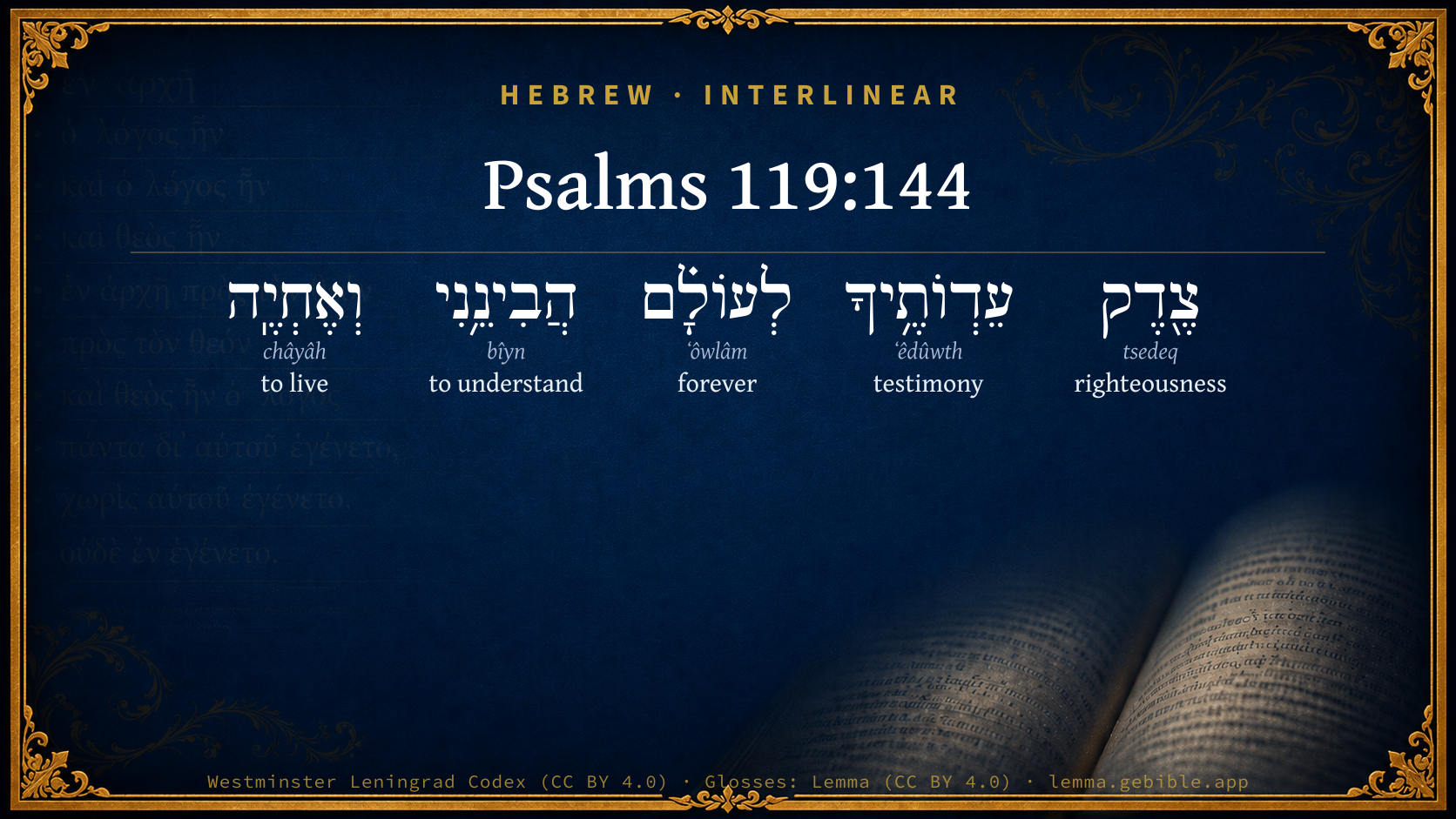
Psalms 119:144

Hebrew (Westminster Leningrad Codex) Psalms 119:144 appears in the Hebrew Old Testament. The text above is from the Westminster Leningrad Codex. Each word links to its Strong’s number, a concise gloss, and parsing drawn from the Open Scriptures Hebrew Bible morphology. Click any word for its full Brown-Driver-Briggs (BDB) entry.
Download image
Cite this verse

Psalms 119:144 (World English Bible). Public Domain. Lemma interlinear Bible study tool, https://lemma.gebible.app/v/psalms/119/144.

Show BibTeX & RIS
BibTeX
RIS
English Translation
Your testimonies are righteous forever. Give me understanding, that I may live.
World English Bible · Public Domain
Download a study sheet

One document with this verse’s original text, its word-by-word gloss line, the meaning frame, cross-references with their text, attributed commentary, and full source and license credits — printable, and it pastes into notes with its structure intact.

This verse Autodidact and up

Study sheet (.html) Plain text (.txt)

A passage Seminary Student

Up to 50 verses in one chapter. A passage sheet keeps up to 6 commentary sources and 12 cross-references per verse, in the order this page ranks them, and says so on the sheet whenever that leaves anything out. Ask for a single verse and you get the Autodidact verse sheet above.

Everything on this page stays free to read, with no account — the sheet is a download of what is already on screen, not access to it.

Want to remove ads? Support Godless Engineer
Compare translations 3

The same verse in 3 English versions, stacked beneath the original-language interlinear above. Click any original word for its lexicon entry.

Each is an independent rendering of the whole verse — the interlinear is not word-aligned to these translations.

Highlighted words mark where these versions differ — a whole-verse word diff, not a word-by-word alignment.

  • World English Bible Public Domain
    Your testimonies are righteous forever. Give me understanding, that I may live.
  • King James Version Public Domain
    The righteousness of thy testimonies is everlasting: give me understanding, and I shall live.
  • unfoldingWord Literal Text CC BY-SA 4.0
    The righteousness of your testimonies forever; give me understanding, so that I may live. QOPH

unfoldingWord Literal Text — © unfoldingWord, licensed CC BY-SA 4.0. Word-aligned USFM3 via Door43 (git.door43.org/unfoldingWord/en_ult).

Versions to compare (up to 4)

3 of 4 selected

Show all 17 translations

Every available English version of this verse, each an independent rendering of the whole verse.

  • World English Bible Public Domain
    Your testimonies are righteous forever. Give me understanding, that I may live.
  • Berean Standard Bible Public Domain
    Your testimonies are righteous forever. Give me understanding, that I may live.
  • Majority Standard Bible Public Domain
    Your testimonies are righteous forever. Give me understanding, that I may live.
  • King James Version Public Domain
    The righteousness of thy testimonies is everlasting: give me understanding, and I shall live.
  • American Standard Version (1901) Public Domain
    Thy testimonies are righteous for ever: Give me understanding, and I shall live.
  • Revised Version (1885) Public Domain
    Thy testimonies are righteous for ever: give me understanding, and I shall live.
  • Geneva Bible (1599) Public Domain
    The righteousnes of thy testimonies is euerlasting: graunt me vnderstanding, and I shall liue.
  • Young's Literal Translation Public Domain
    The righteousness of Thy testimonies `is' to Cause me to understand, and I live!
  • Literal Standard Version CC BY-SA 4.0
    The righteousness of Your testimonies || [Is] to cause me to understand, and I live!
  • Unlocked Literal Bible CC BY-SA 4.0
    Your covenant decrees are righteous forever; give me understanding that I may live.
  • unfoldingWord Literal Text CC BY-SA 4.0
    The righteousness of your testimonies forever; give me understanding, so that I may live. QOPH
  • Darby Bible Public Domain
    The righteousness of thy testimonies is for ever: give me understanding, and I shall live.
  • World Messianic Bible Public Domain
    Your testimonies are righteous forever. Give me understanding, that I may live. QOPH
  • Webster's Bible Public Domain
    The righteousness of thy testimonies is everlasting: give me understanding, and I shall live.
  • Free Bible Version CC BY-SA 4.0
    Your laws are always right; help me to understand what they mean so I can live. Qoph
  • Bible in Basic English Public Domain
    The righteousness of your unchanging word is eternal; give me wisdom so that I may have life.
  • JPS Tanakh (1917) Public Domain
    Thy testimonies are righteous for ever; give me understanding, and I shall live.

Literal Standard Version (2020), Covenant Press — licensed CC BY-SA 4.0. Text via the HelloAO Bible API (eBible.org). Unlocked Literal Bible (unfoldingWord) — licensed CC BY-SA 4.0. Text via the HelloAO Bible API (eBible.org). unfoldingWord Literal Text — © unfoldingWord, licensed CC BY-SA 4.0. Word-aligned USFM3 via Door43 (git.door43.org/unfoldingWord/en_ult). Free Bible Version, Dr. Jonathan Gallagher — licensed CC BY-SA 4.0. Text via the HelloAO Bible API (eBible.org).

Word by word

More ways to search: Search by grammar → Find every occurrence → Compare this word →

Practice this passage: Drill this verse → Learn its vocabulary →

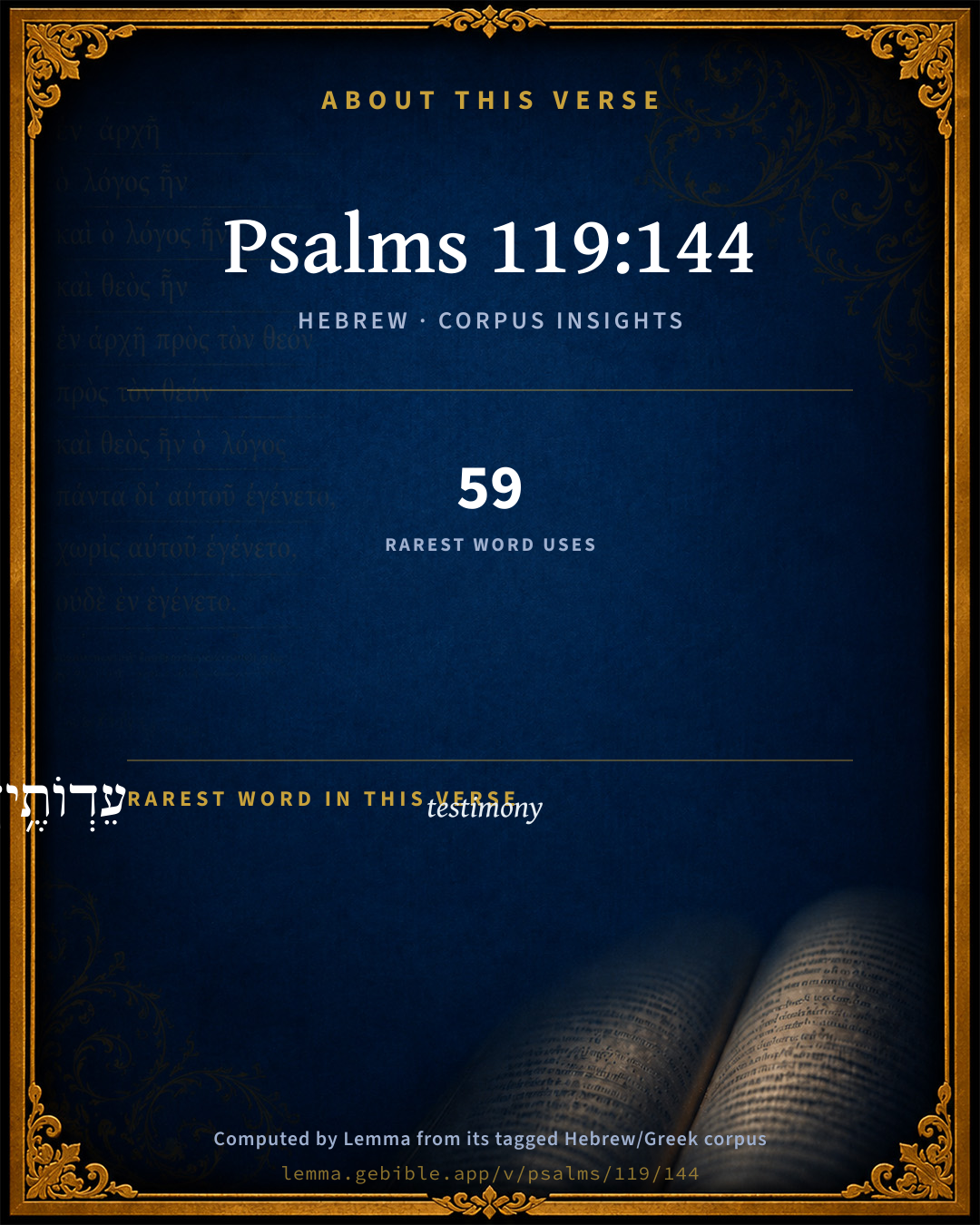
About this verse

These counts appear in no published source. They are computed here, from the morphology-tagged text and Lemma’s own curated glosses. What Lemma adds →

5
words
5
distinct lemmas
Wisdom
section

Shared distinctive vocabulary

עֵדְוֺתֶ֥יךָ testimony H5715 occurs in 57 verses of the Hebrew Bible. Also found in:

Grammatical profile

  • 2 verbs
  • 3 nouns

Verb forms

  • הֲבִינֵ֥נִי Hiphil · Imperative
  • וְאֶחְיֶֽה Qal · Imperfect

Hebrew & Septuagint length

In English translation the verse runs 12 words from the Hebrew and 12 from the Septuagint (LXX English) — the same length.

A rough comparison of the two English renderings, which tokenize alike — not a word-level alignment.

Word counts can differ between the Hebrew and the Greek without any difference in meaning — e.g. the Hebrew direct-object marker אֵת has no separate Greek word, and Greek often adds the article ὁ.

Cross-references

19

Topical passages linked to Psalms 119:144 in the Treasury of Scripture Knowledge — connected by theme and wording, ordered by reader-vote popularity; previews shown in the World English Bible.

  • Psalms 119:169 Let my cry come before you, Yahweh. Give me understanding according to your word.
  • Jeremiah 4:22 For my people are foolish, they don't know me; they are foolish children, and they have no understanding; they are wise to do evil, but to do good they have no knowledge.
  • Daniel 12:10 Many shall purify themselves, and make themselves white, and be refined; but the wicked shall do wickedly; and none of the wicked shall understand; but those who are wise shall understand.
  • 2 Corinthians 4:6 seeing it is God who said, "Light will shine out of darkness," who has shone in our hearts, to give the light of the knowledge of the glory of God in the face of Jesus Christ.
  • 1 Peter 1:23–25 having been born again, not of corruptible seed, but of incorruptible, through the word of God, which lives and remains forever.
  • Psalms 119:73 Your hands have made me and formed me. Give me understanding, that I may learn your commandments.
  • Proverbs 10:21 The lips of the righteous feed many, But the foolish die for lack of understanding.
  • Isaiah 27:11 When the boughs of it are withered, they shall be broken off; the women shall come, and set them on fire; for it is a people of no understanding: therefore he who made them will not have compassion on them, and he who formed them will show them no favor.
  • 1 John 5:20–21 We know that the Son of God has come, and has given us an understanding, that we know him who is true, and we are in him who is true, in his Son Jesus Christ. This is the true God, and eternal life.
  • Psalms 19:9 The fear of Yahweh is clean, enduring forever. Yahweh's ordinances are true, and righteous altogether.
  • Psalms 119:66 Teach me good judgment and knowledge, For I believe in your commandments.
  • Psalms 119:138 You have commanded your statutes in righteousness. They are fully trustworthy.
  • Psalms 119:152 Of old I have known from your testimonies, That you have founded them forever.
  • Isaiah 6:9–10 He said, "Go, and tell this people, 'You hear indeed, But don't understand; And you see indeed, But don't perceive.'
  • Matthew 5:18 For most assuredly, I tell you, until heaven and earth pass away, not even one smallest letter or one tiny pen stroke shall in any way pass away from the law, until all things are accomplished.
  • Matthew 13:19 When anyone hears the word of the Kingdom, and doesn't understand it, the evil one comes, and snatches away that which has been sown in his heart. This is what was sown by the roadside.
  • Psalms 119:34 Give me understanding, and I will keep your law. Yes, I will obey it with my whole heart.
  • Hosea 4:6 My people are destroyed for lack of knowledge. Because you have rejected knowledge, I will also reject you, That you may be no priest to me. Because you have your God's law, I will also forget your children.
  • John 17:3 This is eternal life, that they should know you, the only true God, and him whom you sent, Jesus Christ.

Cross-references courtesy of OpenBible.info (CC BY 4.0).

Hebrew and Greek witnesses Masoretic Hebrew ↔ Greek Septuagint

The same verse in the two great witnesses to the Old Testament, shown verse-for-verse.

You’re reading Greek Psalm 118 (Hebrew Psalm 119). The Septuagint counts the superscription, so verse numbers can differ from the Hebrew — chapter-level alignment, not verse-by-verse. Numbering follows Rahlfs.

These are two independent witnesses, not word-aligned to each other, and the Septuagint is shown in lemma (dictionary) form.

Hebrew Psalms 119:144 Masoretic · Westminster Leningrad Codex

צֶ֖דֶק עֵדְוֺתֶ֥יךָ לְעוֹלָ֗ם הֲבִינֵ֥נִי וְאֶחְיֶֽה

Your testimonies are righteous forever. Give me understanding, that I may live.

World English Bible · Public Domain

Greek LXX Greek Psalm 118:144 Septuagint · lemma form

δικαιοσύνη ὁ μαρτύριον σύ εἰς ὁ αἰών συνέτιζω ἐγώ καί ζάω

Your testimonies are an everlasting righteousness: instruct me, and I shall live.

LXX2012 (modern English Septuagint) · Public Domain

Hebrew: Westminster Leningrad Codex (CC BY 4.0). Greek: Septuagint (public domain); English from LXX2012 (modern English Septuagint) (Public Domain). How the Septuagint differs from the Hebrew →

Commentary

Notes on Psalms 119:144 from classic Christian and Jewish commentators (each source and its license shown beneath its notes). The classic Christian expositions comment on the surrounding passage and are grouped to its opening verse, so a note may address several verses; the Jewish commentaries on the Tanakh (Rashi and others) are per-verse, so they appear only where the commentator wrote on this verse.

Lemma curates 59 commentaries, every one of them public domain or Creative Commons licensed, each selected and text-cleaned for this edition rather than reprinted as found. About our sources →

Trapp's Complete Commentary

John Trapp

Psa 119:144 The righteousness of thy testimonies [is] everlasting: give me understanding, and I shall live.

Ver. 144. The righteousness of thy testimonies, &c.] This is the same with Psa 119:142.

Give me understanding] An ignorant life is a lifeless life. Fuit non vixit. The life of God is the only life. But from this men are alienated by the ignorance that is in them, Eph 4:18.

John Trapp, A Commentary or Exposition upon All the Books of the Old and New Testament (1647–1656) — public domain. Text from a community e-Sword module.

The Biblical Illustrator

Joseph S. Exell

Psa_119:144

The righteousness of Thy testimonies is everlasting: give me understanding, and I shall live.

Alive

I. Consider this prayer in its simplicity.

1. It is a suitable prayer for the awakened sinner. Christ is our life; but we need understanding, or we shall miss it.

2. It is equally applicable to one who is a Christian, and who is struggling against temptation.

3. It will often well up from the heart of the suffering believer.

4. It is suitable for workers. I want to get alive to the utmost; not only having life, but having it more abundantly. I have some life in me, thank God; but I want it to quicken me more completely.

5. It is a very proper and blessed prayer for aspiring minds in the Church of God.

6. Last of all, when we shall not be so much aspiring saints as expiring saints,--when we come to lie upon our last bed, and to look into the unseen, then may we still pray after the same fashion.

II. The prayer is to be more fully opened up.

1. Here is a want confessed, because it is deeply felt.

2. The prayer is evidently put upon the footing of free grace. Understanding must be a gift from God.

3. The psalmist speaks of understanding in a general way--Give me understanding--as if he wanted the faculty for use in many directions. We bear within our own natures so much to confuse, and confound, and entangle, that if we are not taught prudence and understanding we shall certainly never escape from the mischief that is within us.

4. Still, while the understanding sought for in the prayer is evidently of a general character, the former portion of the verse links it with a special understanding of the Word of God; and, oh, beloved, we need above all things to understand what God has revealed. Take care first that you know it.

III. Now we will go deeper, laying bare the argument of this prayer.

1. I think he means this--that the Word of God, when it is practically and experimentally understood by the mind, is a pledge of life. Do you think that God would take one of us to be His child and teach us His Word, and then after all permit us to be condemned to die? Is that His fashion?

2. The understanding of the Word of God is life, because we are told that the Word of God is the living and incorruptible seed which liveth and abideth for ever. Very well, then, if that seed is sown in my heart, my heart must live for ever. There can be no death where the seed is incorruptible. If the Word of the Lord be living within us, then there is within us a life eternal.

3. The Word of God is not only the seed of life, but it is the food of life. Man shall not live by bread alone, but by every word that proceedeth out of the mouth of God shall man live; and if you live on the word that cometh out of Gods mouth you cannot die.

4. The understanding of Gods Word is the very flower, and crown, and glory of true life. When a man so understands Gods Word as to experience it, and to practise it, he has reached a high point of spiritual culture, and his life will be loaded, like Aarons rod, with buds, and blossoms, and fruit unto Gods glory. He will be such a man that he shall only need to take one step and be in heaven. (C. H. Spurgeon.)

The Biblical Illustrator, edited by Joseph S. Exell (c. 1880s–1900s) — public domain. Text from a community e-Sword module.

J. A. Alexander on Psalms

Joseph Addison Alexander

144. (Psa 119:144) Right (are) thy testimonies to eternity; make me understand, and I shall live. Right, righteousness, the second of the nouns used in Psa 119:142. Make me understand (them), i.e. these thy testimonies. And (then) I shall live, which includes let me live and that 1 may live. See above, on Psa 119:17; Psa 119:116. Three of the verses in this stanza begin with derivatives of the root Hebrew word.

Joseph Addison Alexander, The Psalms Translated and Explained (1850) — public domain. Text from a community e-Sword module.

Geneva Bible (1599)

Geneva Bible translators

So that the life of man without the knowledge of God, is death.

Geneva Bible (1599) marginal notes — public domain. Text via Bolls.life.

Adam Clarke's Commentary

Verse 144. The righteousness of thy testimonies is everlasting] Thy moral law was not made for one people, or for one particular time; it is as imperishable as thy nature, and of endless obligation. It is that law by which all the children of Adam shall be judged.

Give me understanding] To know and practise it.

And I shall live.] Shall glorify thee, and live eternally; not for the merit of having done it, but because thou didst fulfil the work of the law in my heart, having saved me from condemnation by it.

ANALYSIS OF LETTER TSADDI. - Eighteenth Division

In this division the psalmist -

I. Commends the law of God, from its Author, its equity, its purity, and its perpetuity.

II. A consideration of which led him to love and delight in it, though opposed by many enemies.

I. 1. "Righteous art thou." Thou alterest not with times, thou changest not with persons, thou art ever the same.

2. Thy judgments, in giving rewards and dispensing punishments, are upright.

3. Thy testimonies, that declare this, are righteous and faithful.

He consequently felt an ardent zeal for God's glory.

1. This "zeal consumed him," and he expresses the cause.

2. Men "forgot God's words." He pined away for grief on this account. He turns to another character of God's law.

"Thy word is very pure."

1. It is pure in itself, and the purifier of the heart.

2. On this account he loved it; and we know that "love is the fulfilling of the law."

A third effect was a careful remembrance of it, though tried by his enemies.

1. "I am small." Of no weight nor authority; have no secular power.

2. "Despised." Have no credit nor respect.

3. "Yet do I not forget thy precepts." Nothing can move me while upheld by thee; and thou wilt uphold me while I cleave unto thee.

A fourth commendation of God's law is its immutability.

1. It is immutable, and can never be dispensed with. It is a righteousness that is everlasting.

2. It is the truth: 1. It has priority of all laws; 2. Contains no falsehood.

3. Its promises and threatenings shall all be punctually fulfilled.

II. He loved and delighted in it, notwithstanding he had trouble and anguish.

1. Trouble and anguish. The righteous are often under the cross.

2. Yet "thy commandments are my delights." While faithful to thee, all my afflictions are sanctified to me, so that I can rejoice while I suffer.

He speaks again about the immutability of God's word.

1. "The righteousness of thy testimonies," Thy word is like thyself, for it comes from thee.

2. "Give me understanding." I always stand in need of teaching.

3. "And I shall live." All is death without thee. Live in me, that I may live by thee.

Adam Clarke's Commentary on the Bible (1810–1826) — public domain. Text from a community e-Sword/MySword module.

John Calvin's Commentaries

144. The righteousness of thy testimonies endureth forever. The Psalmist repeats what he had already before stated, that there is a great dissimilarity between the righteousness of God’s testimonies and man’s inventions; the splendor of the last quickly vanishing away, whereas the other continues steadfast for ever. He repeats this twice; for although the world is forced to attribute the praise of righteousness to the law of God, yet the majority of mankind are carried away after their own speculations, so that there is nothing more difficult than to hold us fast in our obedience to God. David’s drift is to show that everlasting righteousness is not comprehended elsewhere than in God’s law, and that it is in vain to seek for it anywhere else; and there is accordingly here laid down a clearer definition of righteousness, which is, that righteousness consists in our keeping ourselves within the bounds of the law. As to the last clause of the verse, Give me understanding and I shall live, I read it in connection with the preceding clause; for although David desires to have his mind enlightened by God, yet he does not conceive of any other way by which he was to obtain an enlightened understanding than by his profiting aright in the study of the law. Farther, he here teaches, that men cannot, properly speaking, be said to live when they are destitute of the light of heavenly wisdom; and as the end for which men are created is not that, like swine or asses, they may stuff their bellies, but that they may exercise themselves in the knowledge and service of God, when they turn away from such employment, their life is worse than a thousand deaths. David therefore protests that for him to live was not merely to be fed with meat and drink, and to enjoy earthly comforts, but to aspire after a better life, which he could not do save under the guidance of faith. This is a very necessary warning; for although it is universally acknowledged that man is born with this distinction, that he excels the lower animals in intelligence, yet the great bulk of mankind, as if with deliberate purpose: stifle whatever light God pours into their understandings. I indeed admit that all men desire to be sharp-witted; but how few aspire to heaven, and consider that the fear of,God is the beginning of wisdom. Since then meditation upon the celestial life is buried by earthly cares, men do nothing else than plunge into the grave, so that while living to the world, they die to God. Under the term life, however, as I have elsewhere said, the Prophet denotes the utmost he could wish. Lord, as if he had said, although I am already dead, yet if thou art pleased to illumine my mind with the knowledge of heavenly truth, this grace alone will be sufficient to revive me.

John Calvin's Commentaries (1540-1563) — public domain. Text from the Calvin Translation Society English edition (1840s-50s) via the Christian Classics Ethereal Library (ccel.org). Calvin's coverage is partial (roughly two-thirds of the Bible); uncommented books and verses are honest gaps, never fabricated. The 19th-century editor's footnotes and remarks are omitted so the notes are faithfully Calvin's own voice.

The Cambridge Bible for Schools and Colleges

gen. ed. J. J. S. Perowne

144. The righteousness of thy testimonies is everlasting] Righteous (lit. righteousness) are thy testimonies for ever, reflecting Thine own eternal righteousness. They are neither imperfect nor temporary. Cp. Mat_5:17 ff.

give me understanding &c.] He ends this contemplation of the character of God’s law with a prayer for fuller understanding of it, for through knowledge of it and obedience to it man really lives, truly realises the purpose of his being. Cp. Psa_119:17; Psa_119:77; Psa_119:116; Pro_4:4; Pro_4:13; Deu_32:47.

The Cambridge Bible for Schools and Colleges (gen. ed. J. J. S. Perowne; Cambridge University Press, 1878–1918) — public domain. Text from a community e-Sword module.

John Gill's Exposition

Mine eyes prevent the night watches,.... The Targum is,

"the morning and evening watches.''

There were three of them; Kimchi interprets it of the second and third; the meaning is, that the psalmist was awake and employed in one religious exercise or another, praying, reading, or meditating; either before the watches were set, or however before the time that some of them took place, or at least before they were all over;

that I might meditate in thy word; he rose so early, in order to give himself up to meditation on the word of God; that he might be better instructed in the knowledge of divine things; that he might have solace and comfort from thence under his afflictions; and that he might be better furnished for the work of prayer; for the more familiar the word of God is to us, the better able we are to speak to God in his own language.

John Gill's Exposition of the Whole Bible (1746–1763) — public domain (CC PDM 1.0). Text via the HelloAO Bible API.

Albert Barnes' Notes on the Bible

The righteousness of thy testimonies - The principles of righteousness on which they are founded. Those testimonies - those laws - are not arbitrary, or the mere expressions of will. They are founded on right and justice as seen by God, and his laws are his testimony as to what truth and justice are.

Is everlasting - See the notes at Psa 119:142.

Give me understanding, and I shall live - Give me a right view of thy law, and thy truth, and I shall have real life. See the notes at Psa 119:34.

Albert Barnes' Notes on the Bible (1834–1885) — public domain. Text from a community e-Sword/MySword module.

Matthew Poole's English Annotations

I shall be kept from those sins which deserve and bring death.

Matthew Poole's English Annotations on the Holy Bible (1683–1685) — public domain. Text from a community e-Sword/MySword module.

The Treasury of David

Charles H. Spurgeon

Ver. 144. The righteousness of thy testimonies is everlasting. First he had said that God's testimonies were righteous, then that they were everlasting, and now that their righteousness is everlasting. Thus he gives us a larger and more detailed account of the word of God the longer he is engaged in writing upon it. The more we say in praise of holy writ, the more we may say and the more we can say. God's testimonies to man cannot be assailed, they are righteous from beginning to end; and though ungodly men have opposed the divine justice, especially in the plan of salvation, they have always failed to establish any charge against the Most High. Long as the earth shall stand, long as there shall be a single intelligent creature in the universe, it will be confessed that God's plans of mercy are in all respects marvellous proofs of his love of justice: even that he may be gracious Jehovah will not be unjust.

Give me understanding, and I shall live. This is a prayer which he is constantly praying, that God will give him understanding. Here he evidently considers that such a gift is essential to his lifting. To live without understanding is not to live the life of a man, but to be dead while we live. Only as we know and apprehend the things of God can we be said to enter into life. The more the Lord teaches us to admire the eternal rightness of his word, and the more he quickens us to the love of such lightness, the happier and the better we shall be. As we love life, and seek many days that we may see good, it behooves us to seek immortality in the everlasting word which liveth and abideth for ever, and to seek good in that renewal of our entire nature which begins with the enlightenment of the understanding and passes on to the regeneration of the entire man. Here is our need of the Holy Spirit, the Lord and giver of life, and the guide of all the quickened ones, who shall lead us into all truth. O for the visitations of his grace at this good hour!

Ver. 144. The righteousness of thy testimonies is everlasting. Thy moral law was not made for one people, or for one particular time; it is as imperishable as thy nature, and of endless obligation. It is that law by which all the children of Adam shall be judged. "Give me understanding." To know and practise it. "And I shall live." Shall glorify thee, and live eternally; not for the merit of having done it, but because thou didst fulfil the work of the law in my heart, having saved me from condemnation by it. Adam Clarke.

Ver. 144. Give me understanding, and I shall live. I read it in connection with the preceding clause; for although David desires to have his mind enlightened by God, yet he does not conceive of any other way by which he was to obtain an enlightened understanding than by his profiting aright in the study of the law. Further, he here teaches that men cannot, properly speaking, be said to live when they are destitute of the light of heavenly wisdom; and as the end for which men are created is not that, like swine or asses, they may stuff their bellies, but that they may exercise themselves in the knowledge and service of God, when they turn away from such employment their life is worse than a thousand deaths. David therefore protests that for him to live was not merely to be fed with meat and drink, and to enjoy earthly comforts, but to aspire after a better life, which he could not do save under the guidance of faith. This is a very necessary warning; for although it is universally acknowledged that man is born with this distinction, that he excels the lower animals in intelligence, yet the great bulk of mankind, as if with deliberate purpose, stifle whatever light God pours into their understandings. I indeed admit that all men desire to be sharp witted; but how few aspire to heaven, and consider that the fear of God is the beginning of wisdom. Since, then, meditation upon the celestial life is buried by earthly care, men do nothing else than plunge into the grave, so that while living to the world, they die to God. Under the term life, however, the prophet denotes the utmost he could wish. Lord, as if he had said, although I am already dead, yet if thou art pleased to illumine my mind with the knowledge of heavenly truth, this grace alone will be sufficient to revive me. John Calvin.

Ver. 144. Give me understanding, and I shall live. The saving knowledge of God's testimonies is the only way to live. There is a threefold life. 1. Life natural. 2. Life spiritual, and, 3. Life eternal. In all these considerations may the point be made good.

First. Life is taken for the life of nature, or the life of the body, or life temporal, called "this life" in Scripture: 1Co 15:19; 1Ti 4:8. Life is better preserved in a way of obedience than by evil doing; that provoketh God to cast us off, and exposes us to dangers. It is not in the power of the world to make us live or die a day sooner or longer than God pleaseth. If God will make us happy, they cannot make us miserable: therefore, "Give me understanding, and I shall live"; that is, lead a comfortable and happy life for the present. Prevent sin, and you prevent danger. Obedience is the best way to preserve life temporal: as great a paradox as it seems to the world, it is a Scripture truth, "Keep my commandments, and live" (Pr 4:4); and, "Take fast hold of instruction; let her not go: keep her; for she is thy life" (verse 13); and, "Length of days is in her right hand; and in her left hand riches and honour" (Pr 3:16); and, "She is a tree of life" (verse 18). The knowledge and practice of the word is the only means to live comfortably and happily here, as well as for ever hereafter.

Secondly. Life spiritual;that is twofold, the life of justification, and the life of sanctification.

1. The life of justification: "The free gift came upon all men unto justification of life": Ro 5:18. He is dead, not only on whom the hangman hath done his work, but also he on whom the judge hath passed sentence, and the law pronounces him dead. In this sense we were all dead, and justification is called justification to life; there is no living in this sense without knowledge: "By his knowledge shall my righteous servant justify many": Isa 43:11. We live by faith, and faith cometh by hearing, and hearing doeth no good unless the Lord giveth understanding; as meats nourish not unless received and digested.

2. The life of sanctification: "And you hath he quickened, who were dead in trespasses and sins": Eph 2:. And men live not properly till they live the life of grace; they live a false, counterfeit life, not a blessed, happy, certain, and true life. Now, this life is begun and carried on by saying knowledge: "The new man which is renewed in knowledge": Col 3:10. Again, men are said to be "alienated from the life of God through the ignorance that is in them": Eph 4:18. They that are ignorant are dead in sin: life spiritual cometh by knowledge. Hence begins the change of the inward man, and thenceforth we live. "Give me understanding, "ut vere in te vivare, that the true life began in me may grow and increase daily, but never be quenched by sin.

Thirdly. Life everlasting, or our blessed estate in heaven. So it is Said of the saints departed, they all live unto God: Lu 20:38. And this is called the water of life, the tree of life, the crown of life; properly this is life. What is the present life in comparison of everlasting life? The present life, it is "mars vitalis", a living death; or "mortalis vita", a dying life, a kind of death; it is always in flux, like a stream: it runneth from us as fast as it cometh to us: "He fleeth also as a shadow, and continueth not": Joh 14:2. We die as fast as we live: it differeth but as the point from the line where it terminates. It is not one and the same, no permanent thing; it is like the shadow of a star in a flowing stream. Its contentments are base and low, called "the life of thine hand": Isa 57:10. It is patched up of several creatures, fain to ransack the storehouses of nature to support a ruinous fabric. And compare it with the life of grace here, it doth not exempt us from sin, nor miseries. Our capacities are narrow. We are full of fears, and doubts, and dangers; but in the life of glory we shall neither sin nor sorrow any more. This is meant here: "The righteousness of thy testimonies is everlasting: give me understanding, and I shall live"; it is chiefly meant of the life of glory. This is the fruit of saving knowledge, when we so know God and Christ as to come to God by him. Thomas Manton.

Ver. 144. I shall live. I shall be kept from those sins which deserve and bring death. Matthew Pool.

Ver. 144. Everlasting righteousness revealed in the word, and producing everlasting life in believers.

Ver. 144.

1. Eternal truths.

2. Eternal life dependent upon them.

3. A cry from amid these everlasting hills. W.B.H.

Ver. 144 (last clause).

1. Consider the prayer in its simplicity.

(a) It is suitable for the awakened sinner.

(b) For the Christian struggling against temptation.

(c) For the suffering believer.

(d) For the worker

(e) For aspiring minds in the church of God.

(f) For expiring saints.

2. The prayer more fully opened up.

(a) Here is want confessed.

(b) The prayer is evidently put upon the footing of free

grace: "Give."

3. Lay bare the argument in the prayer.

1. The word of God, when practically and experimentally understood, is a pledge of life.

2. The word of God is the incorruptible "seed" which liveth and abideth for ever.

3. It is the food of life.

4. It is the very flower and crown and glory of true life.

5. It is righteous.

6. It is everlasting. See "Spurgeon's Sermons, "No. 1572: "Alive."

Psalms 119:145*

This section is given up to memories of prayer. The Psalmist describes the time and the manner of his devotions, and pleads with God for deliverance from his troubles. He who has been with God in the closet will find God with him in the furnace. If we have cried we shall be answered. Delayed answers may drive us to importunity; but we need not fear the ultimate result, since God's promises are not uncertain, but are founded for ever. The whole passage shows us: How he prayed (Ps 119:145). What he prayed for (Ps 119:146). When he prayed (Ps 119:147). How long he prayed (Ps 119:148). What he pleaded (Ps 119:149). What happened (Ps 119:150). How he was rescued (Ps 119:151). What was his witness as to the whole matter (Ps 119:152).

Charles H. Spurgeon's The Treasury of David (1869–1885) — public domain. Psalms only. Text from a community e-Sword/MySword module.

The Pulpit Commentary

The righteousness of thy testimonies is everlasting (comp. vers. 138, 142, 152). Give me understanding, and I shall live; i.e. "give me full understanding of thy commandments, of their depth and breadth and exceeding excellence." Then shall I truly "live." My spirit will shake off its torpor, and be quickened into a "life" that will deserve the name.

The Pulpit Commentary (1880–1919), ed. H.D.M. Spence-Jones & Joseph S. Exell — public domain. Text from a community e-Sword module.

Lesson kit

Teaching starters — assembled from the data on this page, not authored interpretation. Every prompt links to the verse data it draws on. Edit before teaching.

Psalms, in the Wisdom, opens this verse with 5 words (5 distinct Hebrew lemmas). Its most distinctive word is ʻêdûwth (“testimony”). A historical commentator’s framing appears above. Read the whole chapter for the surrounding context.

Discussion questions

  1. How does “testimony” (ʻêdûwth) shape what this verse is saying?
  2. Exodus 16:34 shares the word «testimony» with this verse. How do the two illuminate each other?
  3. The translations on this page render this verse differently — a whole-verse word diff, not a word-by-word alignment. What might account for the different wordings?
  4. The verb «הֲבִינֵ֥נִי» is Hiphil Imperative. How does its form color the action?
  5. Reading how Trapp's Complete Commentary and The Biblical Illustrator read this verse, where do the two commentators agree and where do they part?

Things to notice

Reading settings

Reading text

Shown beneath each verse's original-language words.

Old Testament
Old Testament edition

Read the OT as the Masoretic Hebrew (MT) or the Greek Septuagint (LXX).

English shown for the Greek Septuagint (in the Hebrew ↔ Greek comparison).

Comparing translations? Open the Compare panel on any verse page to stack up to four side by side.