2 Kings 8:10

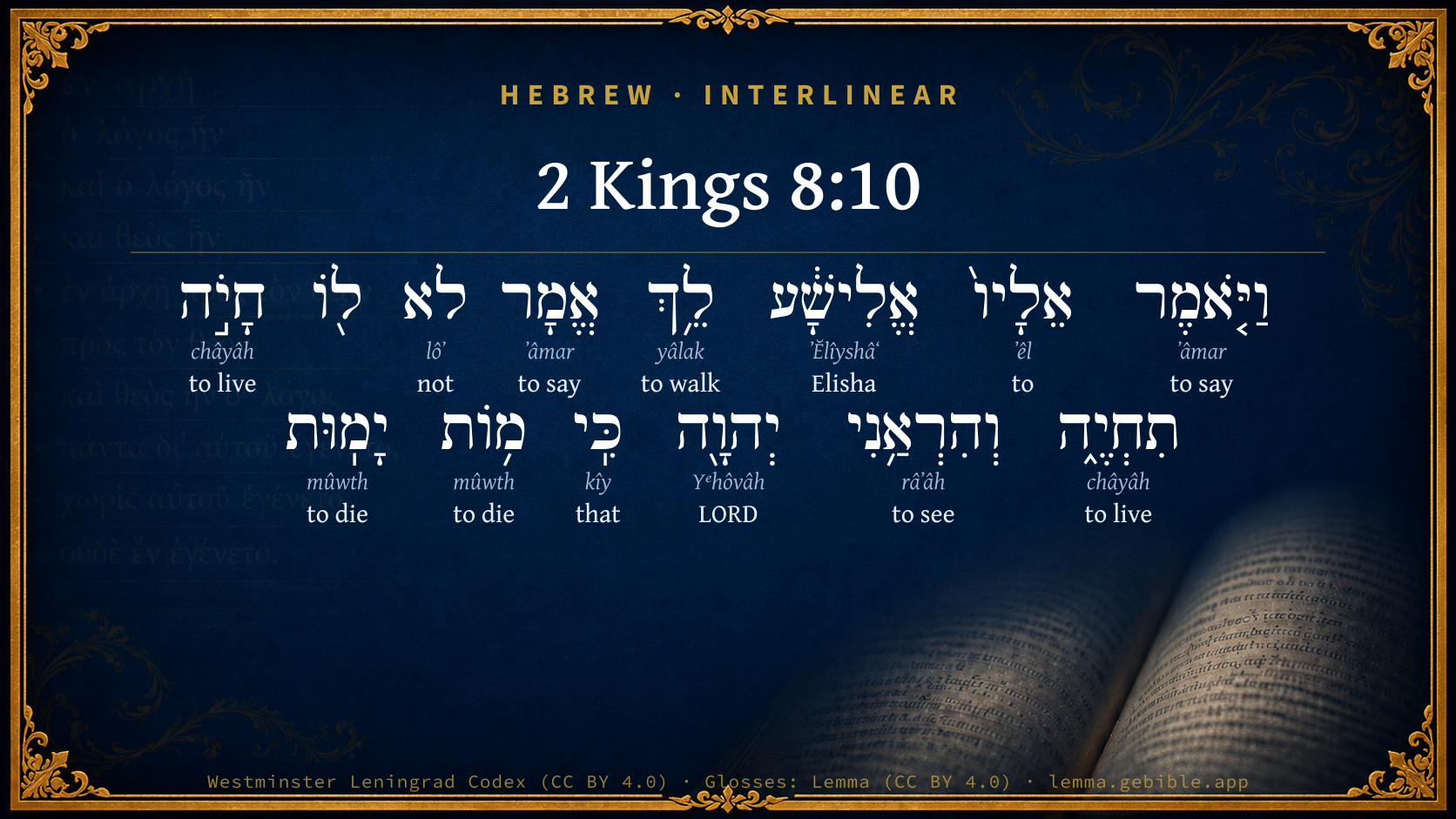
Hebrew (Westminster Leningrad Codex) 2 Kings 8:10 appears in the Hebrew Old Testament. The text above is from the Westminster Leningrad Codex. Each word links to its Strong’s number, a concise gloss, and parsing drawn from the Open Scriptures Hebrew Bible morphology. Click any word for its full Brown-Driver-Briggs (BDB) entry.
Download image
Cite this verse

2 Kings 8:10 (World English Bible). Public Domain. Lemma interlinear Bible study tool, https://lemma.gebible.app/v/2-kings/8/10.

Show BibTeX & RIS
BibTeX
RIS
English Translation
Elisha said to him, Go, tell him, You shall surely recover; however Yahweh has shown me that he shall surely die.
World English Bible · Public Domain
Download a study sheet

One document with this verse’s original text, its word-by-word gloss line, the meaning frame, cross-references with their text, attributed commentary, and full source and license credits — printable, and it pastes into notes with its structure intact.

This verse Autodidact and up

Study sheet (.html) Plain text (.txt)

A passage Seminary Student

Up to 50 verses in one chapter. A passage sheet keeps up to 6 commentary sources and 12 cross-references per verse, in the order this page ranks them, and says so on the sheet whenever that leaves anything out. Ask for a single verse and you get the Autodidact verse sheet above.

Everything on this page stays free to read, with no account — the sheet is a download of what is already on screen, not access to it.

Want to remove ads? Support Godless Engineer
Compare translations 3

The same verse in 3 English versions, stacked beneath the original-language interlinear above. Click any original word for its lexicon entry.

Each is an independent rendering of the whole verse — the interlinear is not word-aligned to these translations.

Highlighted words mark where these versions differ — a whole-verse word diff, not a word-by-word alignment.

  • World English Bible Public Domain
    Elisha said to him, Go, tell him, You shall surely recover; however Yahweh has shown me that he shall surely die.
  • King James Version Public Domain
    And Elisha said unto him, Go, say unto him, Thou mayest certainly recover: howbeit the LORD hath showed me that he shall surely die.
  • unfoldingWord Literal Text CC BY-SA 4.0
    And Elisha said to him, “Go, say to him, ‘Reviving, you will revive.’ But Yahweh has made me see that dying, he will die.”

unfoldingWord Literal Text — © unfoldingWord, licensed CC BY-SA 4.0. Word-aligned USFM3 via Door43 (git.door43.org/unfoldingWord/en_ult).

Versions to compare (up to 4)

3 of 4 selected

Show all 18 translations

Every available English version of this verse, each an independent rendering of the whole verse.

  • World English Bible Public Domain
    Elisha said to him, Go, tell him, You shall surely recover; however Yahweh has shown me that he shall surely die.
  • Berean Standard Bible Public Domain
    Elisha answered, “Go and tell him, ‘You will surely recover.’ But the LORD has shown me that in fact he will die.”
  • Majority Standard Bible Public Domain
    Elisha answered, “Go and tell him, ‘You will surely recover.’ But the LORD has shown me that in fact he will die.”
  • King James Version Public Domain
    And Elisha said unto him, Go, say unto him, Thou mayest certainly recover: howbeit the LORD hath showed me that he shall surely die.
  • American Standard Version (1901) Public Domain
    And Elisha said unto him, Go, say unto him, Thou shalt surely recover; howbeit Jehovah hath showed me that he shall surely die.
  • Revised Version (1885) Public Domain
    And Elisha said unto him, Go, say unto him, Thou shalt surely recover; howbeit the LORD hath shewed me that he shall surely die.
  • Geneva Bible (1599) Public Domain
    And Elisha sayd to him, Goe, and say vnto him, Thou shalt recouer: howbeit the Lord hath shewed me, that he shall surely dye.
  • Douay-Rheims (1899) Public Domain
    And Eliseus said to him: Go tell him: Thou shalt recover: bat the Lord hath shewn me that he shall surely die.
  • Young's Literal Translation Public Domain
    And Elisha saith unto him, `Go, say, Thou dost certainly not revive, seeing Jehovah hath shewed me that he doth surely die.'
  • Literal Standard Version CC BY-SA 4.0
    And Elisha says to him, “Go, say, You certainly do not revive, seeing [that] YHWH has showed me that he surely dies.”
  • Unlocked Literal Bible CC BY-SA 4.0
    Elisha said to him, “Go, say to Ben Hadad, 'You will surely recover,' but Yahweh has shown me that he will surely die.”
  • unfoldingWord Literal Text CC BY-SA 4.0
    And Elisha said to him, “Go, say to him, ‘Reviving, you will revive.’ But Yahweh has made me see that dying, he will die.”
  • Darby Bible Public Domain
    And Elisha said to him, Go, say to him, Thou wilt certainly recover. But Jehovah has shewn me that he shall certainly die.
  • World Messianic Bible Public Domain
    Elisha said to him, “Go, tell him, ‘You will surely recover;’ however the LORD has shown me that he will surely die.”
  • Webster's Bible Public Domain
    And Elisha said to him, Go, say to him, Thou mayest certainly recover: but the LORD hath showed me, that he shall surely die.
  • Free Bible Version CC BY-SA 4.0
    “Go and tell him, ‘You will definitely recover.’ But the Lord has shown me that definitely he is going to die,” Elisha replied.
  • Bible in Basic English Public Domain
    And Elisha said to him, Go, say to him, You will certainly get better; but the Lord has made it clear to me that only death is before him.
  • JPS Tanakh (1917) Public Domain
    And Elisha said unto him: 'Go, say unto him: Thou shalt surely recover; howbeit the LORD hath shown me that he shall surely die.'

Literal Standard Version (2020), Covenant Press — licensed CC BY-SA 4.0. Text via the HelloAO Bible API (eBible.org). Unlocked Literal Bible (unfoldingWord) — licensed CC BY-SA 4.0. Text via the HelloAO Bible API (eBible.org). unfoldingWord Literal Text — © unfoldingWord, licensed CC BY-SA 4.0. Word-aligned USFM3 via Door43 (git.door43.org/unfoldingWord/en_ult). Free Bible Version, Dr. Jonathan Gallagher — licensed CC BY-SA 4.0. Text via the HelloAO Bible API (eBible.org).

Word by word

More ways to search: Search by grammar → Find every occurrence → Compare this word →

Practice this passage: Drill this verse → Learn its vocabulary →

אֱלִישָׁ֔ע
ʼĔlîyshâʻ
H477
“Elisha”
Noun, Proper
Part of Speech
Noun
Type
Proper
Full BDB Definition

Origin: contracted for H474

TWOT: None

Elisha = "God is salvation" - the great prophet who succeeded Elijah
  1. וַיֹּ֤אמֶר ʼâmar H559 “and · to say” Conjunction + Verb, Qal, Sequential Imperfect, 3rd Person, Masculine, Singular
  2. אֵלָיו֙ ʼêl H413 “to · him” Preposition + Suffix, Personal, 3rd Person, Masculine, Singular
  3. לֵ֥ךְ yâlak H3212 “walk” Verb, Qal, Imperative, 2nd Person, Masculine, Singular
  4. אֱמָר ʼâmar H559 “say” Verb, Qal, Imperative, 2nd Person, Masculine, Singular
  5. לא lôʼ H3808 “not” Particle, Negative
  6. חָיֹ֣ה châyâh H2421 “to live” Verb, Qal, Infinitive Absolute
  7. תִחְיֶ֑ה châyâh H2421 “to live” Verb, Qal, Imperfect, 2nd Person, Masculine, Singular
  8. וְהִרְאַ֥נִי râʼâh H7200 “and · to see · me” Conjunction + Verb, Hiphil, Perfect, 3rd Person, Masculine, Singular + Suffix, Personal, 1st Person, Common, Singular
  9. יְהוָ֖ה Yᵉhôvâh H3068 “LORD” Noun, Proper
  10. כִּֽי kîy H3588 “that” Conjunction
  11. מ֥וֹת mûwth H4191 “to die” Verb, Qal, Infinitive Absolute
  12. יָמֽוּת mûwth H4191 “to die” Verb, Qal, Imperfect, 3rd Person, Masculine, Singular

About this verse

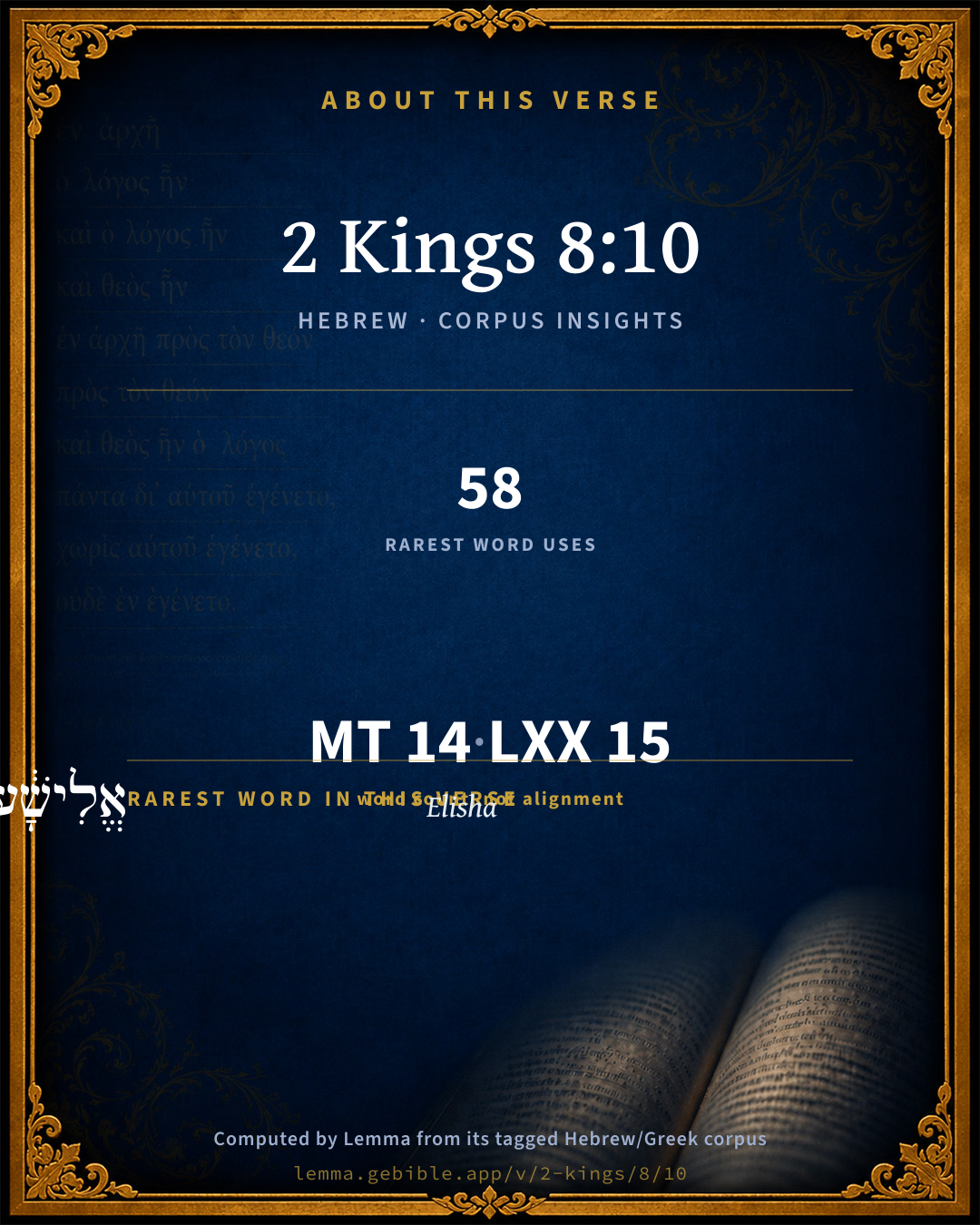
These counts appear in no published source. They are computed here, from the morphology-tagged text and Lemma’s own curated glosses. What Lemma adds →

14
words
10
distinct lemmas
Historical
section

Shared distinctive vocabulary

אֱלִישָׁ֔ע Elisha H477 occurs in 52 verses of the Hebrew Bible. Also found in:

Grammatical profile

  • 8 verbs
  • 2 nouns
  • 2 prepositions
  • 1 conjunction
  • 1 particle

Verb forms

  • וַיֹּ֤אמֶר Qal · Sequential Imperfect
  • לֵ֥ךְ Qal · Imperative
  • אֱמָר Qal · Imperative
  • חָיֹ֣ה Qal · Infinitive Absolute
  • תִחְיֶ֑ה Qal · Imperfect
  • וְהִרְאַ֥נִי Hiphil · Perfect
  • מ֥וֹת Qal · Infinitive Absolute
  • יָמֽוּת Qal · Imperfect

Repetition

Words recur within this verse — often emphatic in Hebrew:

  • וַיֹּ֤אמֶר to say H559 ×2
  • חָיֹ֣ה to live H2421 ×2
  • מ֥וֹת to die H4191 ×2

Hebrew & Septuagint length

In English translation the verse runs 21 words from the Hebrew and 20 from the Septuagint (LXX English) — closely comparable.

A rough comparison of the two English renderings, which tokenize alike — not a word-level alignment.

Word counts can differ between the Hebrew and the Greek without any difference in meaning — e.g. the Hebrew direct-object marker אֵת has no separate Greek word, and Greek often adds the article ὁ.

In the original languages it is 14 Hebrew tokens and 15 Greek tokens — but the two are counted differently (Hebrew bundles its prefixes and suffixes into one token; the Greek is in lemma form), so that isn’t a like-for-like length.

Cross-references

16

Topical passages linked to 2 Kings 8:10 in the Treasury of Scripture Knowledge — connected by theme and wording, ordered by reader-vote popularity; previews shown in the World English Bible.

  • Genesis 2:17 but of the tree of the knowledge of good and evil, you shall not eat of it: for in the day that you eat of it you will surely die."
  • Genesis 41:39 Pharaoh said to Joseph, "Because God has shown you all of this, there is none so discreet and wise as you.
  • 1 Kings 22:15 When he was come to the king, the king said to him, Micaiah, shall we go to Ramoth-gilead to battle, or shall we forbear? He answered him, Go up and prosper; and Yahweh will deliver it into the hand of the king.
  • 2 Kings 1:4 Now therefore thus says Yahweh, You shall not come down from the bed where you are gone up, but shall surely die. Elijah departed.
  • 2 Kings 1:16 He said to him, Thus says Yahweh, Because you have sent messengers to inquire of Baal Zebub, the god of Ekron, is it because there is no God in Israel to inquire of his word? therefore you shall not come down from the bed where you are gone up, but shall surely die.
  • 2 Kings 8:13–15 Hazael said, But what is your servant, who is but a dog, that he should do this great thing? Elisha answered, Yahweh has shown me that you shall be king over Syria.
  • Jeremiah 38:21 But if you refuse to go forth, this is the word that Yahweh has shown me:
  • Ezekiel 11:25 Then I spoke to them of the captivity all the things that Yahweh had shown me.
  • Ezekiel 18:13 has given forth on interest, and has taken increase; shall he then live? he shall not live: he has done all these abominations; he shall surely die; his blood shall be on him.
  • Amos 3:7 Surely the Lord Yahweh will do nothing, Unless he reveals his secret to his servants the prophets.
  • Amos 7:1 Thus the Lord Yahweh showed me: and, behold, he formed locusts in the beginning of the shooting up of the latter growth; and, behold, it was the latter growth after the king's harvest.
  • Amos 7:4 Thus the Lord Yahweh showed me and, behold, the Lord Yahweh called for judgment by fire; and it dried up the great deep, and would have devoured the land.
  • Amos 7:7 Thus he showed me and, behold, the Lord stood beside a wall made by a plumb line, with a plumb line in his hand.
  • Amos 8:1 Thus the Lord Yahweh showed me: behold, a basket of summer fruit.
  • Zechariah 1:20 Yahweh showed me four craftsmen.
  • Revelation 22:1 He showed me a river of water of life, clear as crystal, proceeding out of the throne of God and of the Lamb,

Cross-references courtesy of OpenBible.info (CC BY 4.0).

Hebrew and Greek witnesses Masoretic Hebrew ↔ Greek Septuagint

The same verse in the two great witnesses to the Old Testament, shown verse-for-verse.

These are two independent witnesses, not word-aligned to each other, and the Septuagint is shown in lemma (dictionary) form.

Hebrew 2 Kings 8:10 Masoretic · Westminster Leningrad Codex

וַיֹּ֤אמֶר אֵלָיו֙ אֱלִישָׁ֔ע לֵ֥ךְ אֱמָר לא ל֖וֹ חָיֹ֣ה תִחְיֶ֑ה וְהִרְאַ֥נִי יְהוָ֖ה כִּֽי מ֥וֹת יָמֽוּת

Elisha said to him, Go, tell him, You shall surely recover; however Yahweh has shown me that he shall surely die.

World English Bible · Public Domain

Greek LXX 2 Kings 8:10 Septuagint · lemma form

καί εἶπον ελισαιε δεῦρο εἶπον αὐτός ζωή ζάω καί δεικνύω ἐγώ κύριος ὅτι θάνατος ἀποθνήσκω

And Elisaie said, Go, say, You shall certainly live; yet the Lord has showed me that you shall surely die.

LXX2012 (modern English Septuagint) · Public Domain

On this verse, Haydock's Catholic Bible Commentary discusses the Septuagint’s reading. Read the note in Commentary ↓

Hebrew: Westminster Leningrad Codex (CC BY 4.0). Greek: Septuagint (public domain); English from LXX2012 (modern English Septuagint) (Public Domain). How the Septuagint differs from the Hebrew →

Targum (Aramaic paraphrase)

1

The Targum is the ancient Jewish Aramaic paraphrase of the Hebrew Scriptures — an interpretive translation, not the Hebrew text itself. Onkelos (literal) and Pseudo-Jonathan (expansive) render the Torah, and Jonathan the Prophets. Coverage is partial: where no permissively-licensed English translation exists for a verse, only the Aramaic is shown. This is verse-level text, not a word-by-word alignment to the Hebrew.

  1. Targum Jonathan Prophets (Joshua–Malachi)
    וַאֲמַר לֵיהּ אֱלִישָׁע אֱזֵיל אֱמַר לֵיהּ מֵיחָא תֵיחֵי וְאַחֲזִינַנִי יְיָ אֲרֵי מֵמַת יְמוּת:

    (no public-domain English translation for this verse)

    Targum Jonathan — Aramaic: “Mikraot Gedolot” (public domain). English: “Sefaria Community Translation” (CC0 1.0 (public-domain dedication)); “London "Chaldee Paraphrase," 1871” (public domain). Text via Sefaria.

Commentary

Notes on 2 Kings 8:10 from classic Christian and Jewish commentators (each source and its license shown beneath its notes). The classic Christian expositions comment on the surrounding passage and are grouped to its opening verse, so a note may address several verses; the Jewish commentaries on the Tanakh (Rashi and others) are per-verse, so they appear only where the commentator wrote on this verse.

Lemma curates 59 commentaries, every one of them public domain or Creative Commons licensed, each selected and text-cleaned for this edition rather than reprinted as found. About our sources →

Trapp's Complete Commentary

John Trapp

2Ki 8:10 And Elisha said unto him, Go, say unto him, Thou mayest certainly recover: howbeit the LORD hath shewed me that he shall surely die.

Ver. 10. Thou mayest certainly recover:] Responsum ειρωνικον, saith one: Vult Propheta impium illum vana spe deludi, saith another; that is, the prophet mocketh this wicked king, and deludeth him with vain hopes of health again. But Tremellius rendereth it, Non omnino revalesces, Thou shait in no wise recover: so that Hazael manifestly lied, saith Lyra, in returning his answer. Others make this the sense, Thy disease is not deadly; howbeit thou shalt die at this bout by another mean. {2Ki 8:15}

John Trapp, A Commentary or Exposition upon All the Books of the Old and New Testament (1647–1656) — public domain. Text from a community e-Sword module.

The Biblical Illustrator

Joseph S. Exell

2Ki_8:10

Thou mayest certainly recover.

Ignorance of the future

The subject which I propose to discuss is the moral effect of ignorance of the future.

I. The avidity with which men seek to know the future. People are almost always ready to believe that something unusually good is to befall them; that their lot is to be exceptional; that their future is somewhere to be discovered by divination, by the lines on their hands, by the courses of the heavenly bodies. Take your stand by the fortune-teller, to whom has betaken herself a young girl, who, in her ignorance and simplicity, wants to know what human lot is coming to her; whether she is to marry or not; whether her husband is to be rich or poor; what is his complexion, the colour of his hair and eyes, his occupation, and all those minutiae about him with which her teeming fancy busies itself. Recall the little simple devices, such as pulling in pieces a daisy as certain sentences are repeated, to which children and young folks resort; they all arise from a curiosity about the future, and an impression that lodged somewhere in the earth, or air, in daisy or constellation, is the secret that we wish to know. There is no doubt about the influence of good and evil supernatural agencies in our lives; there is no doubt, too, that the events of our lives are closely watched by the inhabitants of two worlds. If good spirits, why not bad? There are two ways in which a man may confront the future; one, looking into Gods face, trusting in Gods promises, asking the support of the Everlasting Arms; and the other, turning to invoke the spirits of darkness; making a league with the devil to get counsel and help from the infernal world. And I look upon all this desire to penetrate the veil of mystery which encompasses the future--except as we walk by faith with the Invisible One, as we believe in God and link our destiny with God by keeping His laws--as immoral and unchristian.

II. Ignorance of the future, if that future is to be disastrous, is always a blessing to us; while, if it is to be advantageous, it is an inspiration. And it is between this possible disaster and advantage that men make all the progress, whether intellectual or spiritual. In all motion which is artificially produced, such as the movement of a carriage or land, or on rails, or the movement of a vessel through the water, there are always two elements; two forces acting and reacting. There is that which propels--the motive power; and that which resists it, and the result is motion. When the driving-wheels of a locomotive do not take hold of the rail--that is, when the rail is covered with frost or ice so that there is no resistance to their revolution--there can be no progress: the great iron sinewed horse is but a plaything, whirling his wheels like a top. These two elements are in the flight of the bird: the stroke of the wing and the resistance of the air. When inventors are making efforts to find some machine which will navigate the air, they seek first lightness. But it is the weight of the bird, as well as the stroke of the wing, that gives it power to make such beautiful evolutions in the air. The air is to the body of the bird what the water is to the hull of the vessel--a medium of resistance. As the wheels of the steamer, as the screw of the propeller, as the oar or the paddle of the rower is resisted by the water, progress is made. It is just so in human life. The patriarch Job says: What! shall we receive good at the hand of God, and shall we not receive evil? It is encountering a mixture of good and evil that makes character. It is the contingency of good and evil; the uncertainty whether it shall be one or the other, that is the mainspring of human action. People ask, why did not God make man so that he could not sin? It is like asking why God did not make matter so that an object could move without meeting resistance; why God did not make the bird so that it could fly without breasting the powers of the air. Walking is only falling forward and regaining ones self. The regaining prevents the accident. The babe begins with the first motion, but is not yet competent to the second. And no man walks with God without finding a leverage for his soul in the evil that is in the world; only he wants none of it in him. In one sense we are forewarned respecting the future. We have general principles given us. These principles are often cast into the form of maxims. For example, we say that Honesty is the best policy, with primary reference to business; that let a man make ever so much money by dishonest dealing, he is injuring his business all the time; he is only getting rope to hang himself. The young lad who is studying at school hears this; he does not think it applies to his relations to his teacher and his books, but it does. When, in after life, he confronts business questions or business interests, and finds he cannot solve queries which were solved by his neglected text-books, or his faithful teacher, he discovers it. It is no time to dismount and tighten the saddle-girth when the battle is on us. There is not one of us who would not have been a sadder man in life to know beforehand the calamities that came to him the last twelvemonths. Let him take up his cross daily, it is not to-morrows cross that we can take up to-day, even if we would take it up. And what is called borrowing trouble is taking up to-morrows cross--always an imaginary one--before to.morrow comes. The Saviour says, Sufficient unto the day is the evil thereof, meaning that if we manage to grapple with the evil of to-day and overcome that, it is all God expects of us; it is victory. And then, on the other hand, the certainty of good fortune is always enervating. God helps the men who help themselves. They fall into the line of His purposes; they see the tide which, taken at its flood, leads on to fortune. Tell a young man that at the age of forty he will be worth a million dollars, and you have done him an injury.

III. Ignorance of the future is a protection against temptation to employ indirect and sinful methods of securing what we have been assured will take place. Take this case of Hazael to illustrate the temptation that comes to a man who knows that he is to occupy a high position. You would say he would argue in this manner: Well, if I am to be King of Syria, let the God, whose prophet predicts it, make me king; I will not lift a finger; least of all will I try to find a short cut to the throne. This was the way Macbeth deliberated:--

If chance will make me king,

why chance may crown me,

Without my stir.

A mans aspirations and capacities are often prophecies of what God means to do by him. If he should say to himself, I deserve such and such position, and it matters not how I get it; if then he should address himself to the work of supplanting such another occupant of the place, or aspirant for it, he may secure the position indeed, but he has introduced into his cup of life that which will embitter it for ever. There is no moral greatness in having place. Place without fitness for it; place with the recollection of dishonour or misdirection in seeking it, is really a disgrace to a man. Hazael became King of Syria as Macbeth became King of Scotland, by attempting to accomplish by crime what was already written down in the future. But what was Hazael as King of Syria, what was Macbeth as King of Scotland, with the predecessor of each assassinated to make open the path to the throne? The very night of Duncans death, while he still lay there, the murder undiscovered, and there came some one knocking at the castle gate, Macbeth says:--

Wake Duncan with thy knocking;

I would thou couldst!

For example: there is an achievement, a possession that I wish, I think I deserve it, have fitness for it, could honour my Maker if I were gratified in my desire, could benefit my fellow-men. Now comes the test of my character. If I am willing to fulfil the conditions of merit, to serve God where He has placed me, up to my best ability; to wait His time for recognition and promotion; if promotion should come, then it has sought me; I have entered into no unholy alliances, I have not broken the golden rule. I have coveted no mans silver, gold, or place. If, on the other hand, I say to myself, God intended this for me, and I mean to have it, and I begin to clamber over the heads of people, as men sometimes try to get out of a crowd, I carry with me the sense of my own unworthiness.

IV. Ignorance of the future on our part does not interfere with Gods certainty respecting it. It should bring us to confide in that certainty. Only certainty somewhere can bring us security. It is usual to put this in the other way, as though Gods certainty respecting a future event might possibly prevent the exercise of our freedom when putting out our force to compass or defeat it. But in mans sphere, man is just as free as God is in His sphere. And without some certainty, what is the use of freedom? Hazael is to be King of Syria. This should content him, But being an unscrupulous man, and the King of Syria being sick, and in that particular to him, his confidential servant, an easy victim, as Duncan came conveniently--the devils opportunity--to the castle of Macbeth, Hazael spreads a wet cloth over the kings face, smothers him, and he dies, and the vacant throne is ready for himself. The certainty that he was to be King of Syria did not affect his conduct. Mark that. His knowledge of the certainty did. It tempted him to compass, by foul means, that which, if he had waited, would have happened so, as we express it. God is no less in the future events of this nation than he was in the future events of the Syrian kingdom, or the kingdom of Israel; Hazael was no more certain, historically certain, certain in the mind of God to succeed Ben-hadad than some man is to succeed the present President. But the certainty of God is on another plane from the contingency that is in the affairs of men. The storm of rain and sleet which encases the woods as with armour of silver, which makes every branch like a spear which the winds poise and tilt as though for some encounter in knight-errantry, was predicted by the weather bureau twenty-four hours before it came; was fore-known and fore-recorded and published to the nation. But the certainty did not affect the action of the atmosphere combinations needful to produce the storm. The atmospheric forces north, south, east, west, were held in hand or let loose according as was needful to the result. Up in His own sphere God presides, insuring human freedom, touching the springs of action, carrying out His own plans, making all things work together for the good of His children and for His own glory. Our ignorance of the future does not disturb His affairs. God makes the wrath of man to praise Him, and the remainder of wrath He restrains. He lets wicked men go just as far as they need to prove their freedom, and then He stops them and takes the advantage, not of what they thought to do, but of what they did. This is the most wonderful kind of alchemy. (J. E. Rankin, D. D.)

The Biblical Illustrator, edited by Joseph S. Exell (c. 1880s–1900s) — public domain. Text from a community e-Sword module.

Joseph Benson's Commentary

2Ki 8:10. Say unto him, Thou mayest certainly recover: howbeit, &c. — Here is no contradiction: for the first words contain an answer to Ben- hadad’s question, Shall I recover? To which the answer is, Thou mayest, notwithstanding thy disease, which is not mortal. The latter words contain the prophet’s addition to that answer, which is, that he should die, not by the power of his disease, but by some other cause. But it must be observed, that this is according, not to the Hebrew text, but the marginal reading of the Jewish rabbins, who have substituted the pronoun לו, lo, to him, for the adverb לא, lo, not. In the text it is, Go say, Thou shalt not recover; or, as Dr. Waterland renders it, Thou shalt certainly not live; for the Lord hath showed me that he shall surely die. Dr. Kennicott is clearly of opinion that this is the true reading and sense of the passage. See his first Dissert., p. 163. Houbigant, however, prefers our translation, and thinks that the words contain a silent reproof from Elisha, who well knew that a courtier, like Hazael, would certainly flatter his king: he therefore understands the meaning to be, “Go thou, and, courtier-like, say to him, Thou wilt certainly recover; howbeit, the Lord hath, shown me very much the contrary; he will surely die, and die by thy traitorous hand.”

Joseph Benson's Commentary on the Old and New Testaments (1811–1818) — public domain. Text from a community e-Sword module.

Tyndale Open Study Notes

Tyndale Open Resources

8:10 Elisha instructed Hazael to tell the king that he would surely recover because his illness was not life-threatening. Yet Elisha knew that Ben-hadad would surely die.

Tyndale Open Study Notes — © Tyndale Open Resources, licensed CC BY-SA 4.0. Text via the HelloAO Bible API.

Geneva Bible (1599)

Geneva Bible translators

Meaning, that he should recover of this disease: but he knew that this messenger Hazael should slay him to obtain the kingdom.

Geneva Bible (1599) marginal notes — public domain. Text via Bolls.life.

Jamieson, Fausset & Brown

Robert Jamieson, A. R. Fausset & David Brown

Go, say . . . Thou mayest certainly recover--There was no contradiction in this message. This part was properly the answer to Ben-hadad's inquiry [Kg2 8:9]. The second part was intended for Hazael, who, like an artful and ambitious courtier, reported only as much of the prophet's statement as suited his own views (compare Kg2 8:14).

Jamieson, Fausset & Brown — Commentary Critical and Explanatory on the Whole Bible (1871) — public domain (CC PDM 1.0). Text via the HelloAO Bible API.

Adam Clarke's Commentary

Verse 10. Thou mayest certainly recover: howbeit the Lord hath showed me that he shall surely die.] That is, God has not determined thy death, nor will it be a necessary consequence of the disease by which thou art now afflicted; but this wicked man will abuse the power and trust thou hast reposed in him, and take away thy life. Even when God has not designed nor appointed the death of a person, he may nevertheless die, though not without the permission of God. This is a farther proof of the doctrine of contingent events: he might live for all his sickness, but thou wilt put an end to his life.

Adam Clarke's Commentary on the Bible (1810–1826) — public domain. Text from a community e-Sword/MySword module.

Ellicott's Commentary for English Readers

(10) Unto him.—The reading of some Hebrew MSS., of the Hebrew margin, and of all the versions, as well as of Josephus.

The ordinary Hebrew text has “not” (lô’, instead of lô), so that the meaning would be, “Thou shalt not recover.” But (1) the position of the negative before the adverbial infinitive is anomalous; and (2) Hazaes report of Elisha’s words, in 2Ki_8:14, is without the negative particle. (See the Note there.) The Authorised Version is, therefore, right.

Thou mayest certainly recover.—Rather. Thou wilt certainly live. Elisha sees through Hazaes character and designs, and answers him in the tone of irony which he used to Gehazi in 2Ki_5:26, “Go, tell thy lord—as thou, the supple and unscrupulous courtier wilt be sure to do—he will certainly recover. I know, however, that he will assuredly die, and by thy hand.” Others interpret, “Thou mightest recover” (i.e., thy disease is not mortal); and make the rest of the prophes reply a confidential communication to Hazael. But this is to represent the prophet as deceiving Benhadad, and guilty of complicity with Hazael, which agrees neither with Elisha’s character nor with what follows in 2Ki_8:11-12. The Syriac and Arabic, with some MSS., read, “thou wilt die” for “he will die.”

A Bible Commentary for English Readers, edited by Charles John Ellicott (1878–1897) — public domain. Text from a community e-Sword module.

The Cambridge Bible for Schools and Colleges

gen. ed. J. J. S. Perowne

10. Go, say unto him, Thou mayest certainly [R.V. shalt surely] recover] This is not the translation of the Hebrew text (Kethib) but of the marginal reading [Keri]. The variation is between לא the negative and לו the pronoun and preposition. The text would be rendered ‘Go say; Thou shalt not recover’. This does not suit with what follows, ‘Howbeit the Lord hath shewed me that he shall surely die’. We should expect ‘For the Lord &c.’ The meaning of the prophet’s words is, ‘Go and carry him such a message as a courtier is likely to carry, a message of good promise, for this I know you are likely to do, yet the Lord has made known to me that he will die’. The R.V. has given the translation of the Kethib on the margin, but as that is so little in harmony with the context, has translated the Keri in the text, though this is contrary to the usual rule of the Revisers.

Another way of explaining the language of Elisha has been adopted by some. It is pointed out that the king’s question was ‘Shall I recover of this disease?’ Elisha, forewarned of the events that were coming, gives as answer to that enquiry ‘Thou shalt surely recover’, meaning thereby that the disease would not kill Benhadad, but suppresses that other source whence danger and death threatened, viz., the murderous hands of Hazael, which he knew would soon slay his master. This seems very unlike the manner of a prophet of the Lord. The explanation previously given is therefore to be preferred. Bp Hall takes the later explanation, ‘The Lord hath shewed me that he shall surely die, by another means, though not by the disease’.

The Cambridge Bible for Schools and Colleges (gen. ed. J. J. S. Perowne; Cambridge University Press, 1878–1918) — public domain. Text from a community e-Sword module.

John Gill's Exposition

And Elisha said unto him, go, say unto him, thou mayest certainly recover,.... That is, of the disease; and there was not only a probability that he might recover of it, it not being a mortal one, but a certainty that he should not die of it, as he did not, but die a violent death, which the prophet predicts in the next clause; though some take these words not as a command, what he should say, but as a prediction of what he would say; that he would go and tell him he should certainly recover, because he would not discourage him, though the prophet assures him in the next clause that he should die: there is a various reading of these words; we follow the marginal reading, but the textual reading is, "say, thou shall not certainly recover", or "in living live"; which agrees with what follows:

howbeit or "for"

the Lord hath showed me, that he shall surely die; though not of that sickness, nor a natural death, but a violent one, and that by the hand of this his servant, though he does not express it.

John Gill's Exposition of the Whole Bible (1746–1763) — public domain (CC PDM 1.0). Text via the HelloAO Bible API.

Albert Barnes' Notes on the Bible

Translate - “Go, say unto him, Thou shalt certainly live: howbeit the Lord hath showed me that he shall certainly die.” i. e.,” Say to him, what thou hast already determined to say, what a courtier is sure to say (compare 1Ki 22:15), but know that the fact will be otherwise.”

Albert Barnes' Notes on the Bible (1834–1885) — public domain. Text from a community e-Sword/MySword module.

Haydock's Catholic Bible Commentary

Tell him: Thou shalt recover. By these words the prophet signified that the king’s disease was not mortal: and that he would recover, if no violence were used. Or he might only express himself in this manner, by way of giving Hazael to understand that he knew both what he would say and do; that he would indeed tell the king he should recover, but would be himself the instrument of his death. (Challoner) -- The imperative is often used for the future tense. (Gloss iii. 3.) (John ii. 19.) The present Hebrew reads, "Thou shalt not live: for," &c., which removes the difficulty. But the Chaldean, Septuagint, Syriac, &c., agree with the Vulgate, (Calmet) as the Protestant version also does. "Thou mayst certainly recover, howbeit the Lord," &c. (Haydock) --- Lo, "not," in the Hebrew text, seems however preferable to the marginal reading, lu, "to him." This mistake has been sometimes made elsewhere, and ought to be carefully examined. (Kennicott, 1 Paralipomenon xi. 20.)

George Leo Haydock (1774–1849), Haydock's Catholic Family Bible and Commentary, 1859 edition — public domain. Excludes Psalms (Douay-Rheims chapter numbering differs from Protestant) and Deuterocanonical books (Catholic canon only).

Matthew Poole's English Annotations

Here is no contradiction; for the first words contain an answer to Ben-hadad’s question, 2Ki 8:8,

Shall I recover of this disease? To which the answer is, Thou mayest or shalt recover, i.e. notwithstanding thy disease, which is not mortal, and shall not take away thy life. The latter words contain the prophet’s explication of or addition to that answer, which is, that he should die, not by the power of his disease, but by some other cause. But it is observable, that in the Hebrew text it is lo, the adverb, which signifies not; which though most affirm to be put for to, the pronoun, signifying to him; yet others take it as it lies, and translate the words thus, Say, Thou shalt not recover; for the Lord hath showed me that he shall surely die. Or, according to the former reading, the first words may be taken interrogatively, Say unto him, Shalt thou indeed recover? (as thou dost flatter thyself:) no; (which negation is implied in the very question, and gathered from the following words;) for the Lord hath showed me that he shall surely die.

Matthew Poole's English Annotations on the Holy Bible (1683–1685) — public domain. Text from a community e-Sword/MySword module.

Whedon's Commentary on the Bible

Daniel D. Whedon

10. Thou mayest certainly recover — The Hebrew text, in accordance with a majority of Hebrew MSS., reads thus: Go, say, thou certainly shalt not live; or more literally, living thou shalt not live. Instead of לא, not, the Keri has לו, to him, and this reading our English translators, as well as the Septuagint, Vulgate, Syriac, Arabic, and Chaldee versions, have followed. The external evidence would seem to favour this latter reading, but the internal is certainly against it. In the very next sentence Elisha says, The Lord has shown me that he shall certainly die. The howbeit of the English version is in the Hebrew simply the copulative ו, and. The translation, thou mayest certainly recover, (that is, as some explain, it is possible for thee to recover from thy sickness, this disease shall not cause thy death,) is only a lame effort to escape the obvious inconsistency and contradiction that exists in the reading adopted by most of the versions. How unnatural and inexplicable that Elisha should order Hazael to go, and, in a matter of so solemn moment as death, deceive his king by uttering a positive falsehood! It is much more natural to suppose that Hazael, informed that he is destined to be king, went and deceived Ben-hadad by misconstruing Elisha’s words. See on 2Ki_8:14. We therefore adopt the reading of the Hebrew text, and translate Elisha’s words thus: Go, say, Thou surely shalt not live. And Jehovah has shown me that he shall surely die. These words were doubtless uttered with much emotion, and this fact sufficiently explains the change from the second to the third person in the two sentences, and the insertion of the copulative and.

Daniel D. Whedon (gen. ed.), Commentary on the Old and New Testaments (1874–1909) — public domain. Text from a community e-Sword module.

The Pulpit Commentary

And Elisha said unto him; Go, say unto him; Thou mayest certainly recover. The existing Masoretic text (alArm; a" hy; jti hyij;) is untranslatable, since emar-lo cannot mean, "say not," on account of the order of the words; and lo cannot he joined with khayiah thikhyah, first on account of the makkeph whick attaches it to emar, and secondly because the emphatic infinitive is in itself affirmative, and does not admit of a negative prefix. The emendation in the Hebrew margin (wOl for al), accepted by all the versions, and by almost all commentators, is thus certain. Our translators are therefore, so far, in the right; but they were not entitled to tone down the strong affirmative, khayih thikhyah, living thou shalt live," or "thou shalt surely live," into the weak potential, "thou mayest certainly recover." What Elisha says to Hazael is, "Go, say unto him, Thou shalt surely live;" i.e. "Go, say unto him, what thou hast already made up thy mind to say, what a courtier is sure to say, Thou shalt recover." Howbeit the Lord hath showed me that he shall surely die. If Hazael had reported the whole answer to Benhadad, he would have told no lie, and thus Elisha is not responsible for his lie.

Vers. 10-15. Hazael and Elisha.

The contrast is striking between the two characters here brought for the first and last time into contact. In Hazael we have

I THE CRAFTY SCHEMER, cunning and treacherous, who sees in his master"s calamity his own opportunity; who feels no gratitude for past favors, no pity for present weakness and suffering, no compunction at playing a double part; who has no horror of crime, no dread of the enduring infamy which attaches to the assassin and the traitor. Hazael is wise in a certain sense he is clever, audacious, skilful in devising means to ends, secret, determined, unscrupulous. He contrives a mode of death which will leave no trace of violence, and may appear accidental, if suspicion arises that it has not happened in the ordinary course of nature.

II THE MAN OF BLOOD. Hazael is altogether cruel and unsparing. He reaches the throne through blood. As king, he deluges Israel in blood, "cutting the nation short, and smiting them in all their coasts"; (2Ki_10:32) "destroying them, and making them like the dust by threshing". (2Ki_13:7) We must view him as a born soldier, never so happy as when engaged in a campaign, now resisting the attacks of Assyria on his northern border ("Ancient Monarchies," vol. it. p. 364), now attacking the Philistines, (2Ki_12:17) almost constantly warring with his immediate neighbors the kings of Israel, once even threatening Judah, and "setting his face to go up to Jerusalem" (2Ki_12:17) in the hope of taking it.

III THE SUCCESSFUL WARRIOR. Hazael succeeded in repulsing the Assyrians, and maintaining his independence, notwithstanding all their efforts to conquer him. He reduced Israel to a species of semi-subjection. (2Ki_13:7) He compelled even Judaea to purchase peace at his. (2Ki_12:18) He was, on the whole, the most warlike of all the early kings of Syria; and, though he suffered one great defeat at the hands of the Assyrian king, Shalmaneser II, yet he issued from the struggle unsubdued, and left his dominions intact to his son and successor, Benhadad III.

In Elisha, on the other hand, we have

I THE WISE, CLEAR-SIGHTED, SINGLE-MINDED, HONEST ADVISER. Elisha has no cunning, no art, no special cleverness. But he can read character; he can see through Hazael"s designs. Whether king, or noble, or common person applies to him for advice, he uses the same simplicity, counsels each as seems to him for the best, and seeks to gain nothing for himself by the advice which he gives them. His plainness offends Naaman; (2Ki_5:12) his firmness enrages Jehoram; (2Ki_6:31) his penetration disconcerts Hazael; (2Ki_8:11) but he cares nothing how men may receive his words. It is a Divine message that he delivers, and deliver the message he must and will, in simple plain language, whether men will hear or whether they will forbear.

II THE MAN OF PEACE. Elisha"s character is eminently peaceful and conciliatory. He weeps at the thought of those horrors which war causes almost of necessity. (2Ki_8:11) Once only do his counsels lead on to an engagement; (2Ki_3:16-24) mostly he contrives that perils shall be averted without the shedding of blood. (2Ki_6:18-22 2Ki_7:6-15) He will not allow the prisoners that he has made to be put to death, or in any way ill treated. (2Ki_6:22, 2Ki_6:23) He seeks to check Hazael"s murderous propensities by a look which he cannot misunderstand. (2Ki_8:11)

III THE PROPHET AND TEACHER. The office of the prophet was to rebuke sin, as Elisha did, (2Ki_3:13, 2Ki_3:14) to sustain faith, to train up fresh prophets, to teach the faithful, (2Ki_4:23) to announce God"s will to king and people, and to execute commissions with which God specially entrusted him. Elisha never failed in the performance of any of these duties. Cast upon a dark time, when a debasing superstition, imported from a foreign country, had full possession of the court and had laid a strong hold upon the country, he faithfully upheld Jehovah and Jehovah"s laws before backsliding kings and "a disobedient and gainsaying people." To Elisha principally it was owing that true religion still maintained itself in the land against the persecutions of Jezebel and her sons, and that, when the dynasty of Omri came to an end, there was still a faithful remnant left, which had not bowed the knee to Baal, but had clung to Jehovah under all manner of difficulties. If Elisha left no great prophet to succeed him, it was probably because great men are not made to order, and God"s providence did not see fit to continue the succession of first-rate prophetical teachers, which had been raised up to meet the extreme danger of the introduction and maintenance of a false state religion by apostate kings. When two such characters are brought into contact, the natural result is mutual repulsion. Hazael is ashamed that Elisha should read him so well; and Elisha weeps when he thinks of the woes that Hazael will inflict upon Israel Outward respect is maintained; But the two must have felt, when they parted, that they were adversaries for life, bent on opposite courses, with opposed principles, aims, motives; not only the servants of different gods, but antagonistic in their whole conception of life and its objects, sure to clash if ever they should meet again, and, even if they should not meet, sure to be ever working for different ends, and engaged in thwarting one the other.

The Pulpit Commentary (1880–1919), ed. H.D.M. Spence-Jones & Joseph S. Exell — public domain. Text from a community e-Sword module.

John Wesley's Explanatory Notes

Howbeit - Here is no contradiction: for the first words contain an answer to Benhadad's question, shall I recover? To which the answer is, thou mayest, notwithstanding thy disease, which is not mortal. The latter words contain the prophet's addition to that answer, which is, that he should die, not by the power of his disease, but by some other cause.

John Wesley, Explanatory Notes Upon the Whole Bible (1754–1765) — public domain. Text via the GEBible commentary corpus.

Keil & Delitzsch

C. F. Keil & F. Delitzsch

According to the Chethb חיה לא, Elisha's answer was, "Thou wilt not live, and (for) Jehovah has shown me that he will die;" according to the Keri חיה לו, "tell him: Thou wilt live, but Jehovah," etc. Most of the commentators follow the ancient versions, and the Masoretes, who reckon our לא among the fifteen passages of the O.T. in which it stands for the pronoun לו (vid., Hilleri Arcan. Keri, p. 62f.), and some of the codices, and decide in favour of the Keri. (1) because the conjecture that לו was altered into לא in order that Elisha might not be made to utter an untruth, is a very natural one; and (2) on account of the extreme rarity with which a negative stands before the inf. abs. with the finite verb following. But there is not much force in either argument. The rarity of the position of לא before the inf. abs. followed by a finite verb, in connection with the omission of the pronoun לו after אמר, might be the very reason why לא was taken as a pronoun; and the confirmation of this opinion might be found in the fact that Hazael brought back this answer to the king: "Thou wilt live" (Kg2 8:14). The reading in the text לא (non) is favoured by the circumstance that it is the more difficult of the two, partly because of the unusual position of the negative, and partly because of the contradiction to Kg2 8:14. But the לא is found in the same position in other passages (Gen 3:4; Psa 49:8, and Amo 9:8), where the emphasis lies upon the negation; and the contradiction to Kg2 8:14 may be explained very simply, from the fact that Hazael did not tell his king the truth, because he wanted to put him to death and usurp the throne. We therefore prefer the reading in the text, since it is not in harmony with the character of the prophets to utter an untruth; and the explanation, "thou wilt not die of thine illness, but come to a violent death," puts into the words a meaning which they do not possess. For even if Benhadad did not die of his illness, he did not recover from it.

Keil & Delitzsch — Biblical Commentary on the Old Testament (1861–1891) — public domain (CC PDM 1.0). Text via the HelloAO Bible API. (Old Testament only.)

unfoldingWord translationNotes

Door43 World Missions Community

until he was ashamed

"until Hazael felt uncomfortable"

my master

Hazael refers to Elisha this way to honor him.

Because I know

God has shown Elisha what will take place in the future.

you will do

The word "you" represents Hazael and refers to himself and the soldiers under his control when he is king. AT: "you will cause to happen" or "you will order your soldiers" (See: Synecdoche)

You will set ... you will kill

The word "you" represents Hazel but here refers to his soldiers and not to Hazael personally. AT: "You soldiers will set ... your soldiers will kill" (See: Metonymy)

dash in pieces their little ones

"crush their little children." This is a brutal description of the soldiers killing children.

kill their young men with the sword

This means that the men will be killed in battle. The sword was the main weapon used in battle. AT: "kill their young men in battle" (See: Metonymy)

rip open their pregnant women

Specifically this refers to tear open their stomachs. AT: "rip open the stomachs of their pregnant women with swords" (See: Assumed Knowledge and Implicit Information)

translationWords

Elisha

shame

evil

stronghold

sword

unfoldingWord translationNotes — © Distant Shores Media and the Door43 World Missions Community, licensed CC BY-SA 4.0. Source: git.door43.org/Door43/en_tn.

Rashi

Rabbi Shlomo Yitzchaki (Rashi)

‘You will surely live.’ Pertaining to Chazoeil he said that he would live instead of Ben-Hadad [and occupy] the throne.

Rashi on the Tanakh — English translations: “The Judaica Press complete Tanach with Rashi, translated by A. J. Rosenberg” (CC BY 4.0); “Pentateuch with Rashi's commentary by M. Rosenbaum and A.M. Silbermann, 1929-1934” (public domain); “The Metsudah Tanach series, Lakewood, N.J” (CC BY 4.0); and “The Book of Joshua, Metsudah Publications, 1997” (CC BY 4.0). Text via Sefaria.

Lesson kit

Teaching starters — assembled from the data on this page, not authored interpretation. Every prompt links to the verse data it draws on. Edit before teaching.

2 Kings, in the Historical, opens this verse with 14 words (10 distinct Hebrew lemmas). Its most distinctive word is ʼĔlîyshâʻ (“Elisha”). A historical commentator’s framing appears above. Read the whole chapter for the surrounding context.

Discussion questions

  1. How does “Elisha” (ʼĔlîyshâʻ) shape what this verse is saying?
  2. How does 1 Kings 19:16, which shares the word «Elisha», read alongside this verse?
  3. What does the repetition of “to say” (2× in this one verse) do in this verse?
  4. These translations render this verse differently. What is at stake in choosing one wording over another?
  5. «וַיֹּ֤אמֶר» is a Qal Sequential Imperfect verb. How does that grammatical form shape the action described?
  6. Compare how Trapp's Complete Commentary and The Biblical Illustrator read this verse. Where do they agree or differ?

Things to notice

Reading settings

Reading text

Shown beneath each verse's original-language words.

Old Testament
Old Testament edition

Read the OT as the Masoretic Hebrew (MT) or the Greek Septuagint (LXX).

English shown for the Greek Septuagint (in the Hebrew ↔ Greek comparison).

Comparing translations? Open the Compare panel on any verse page to stack up to four side by side.