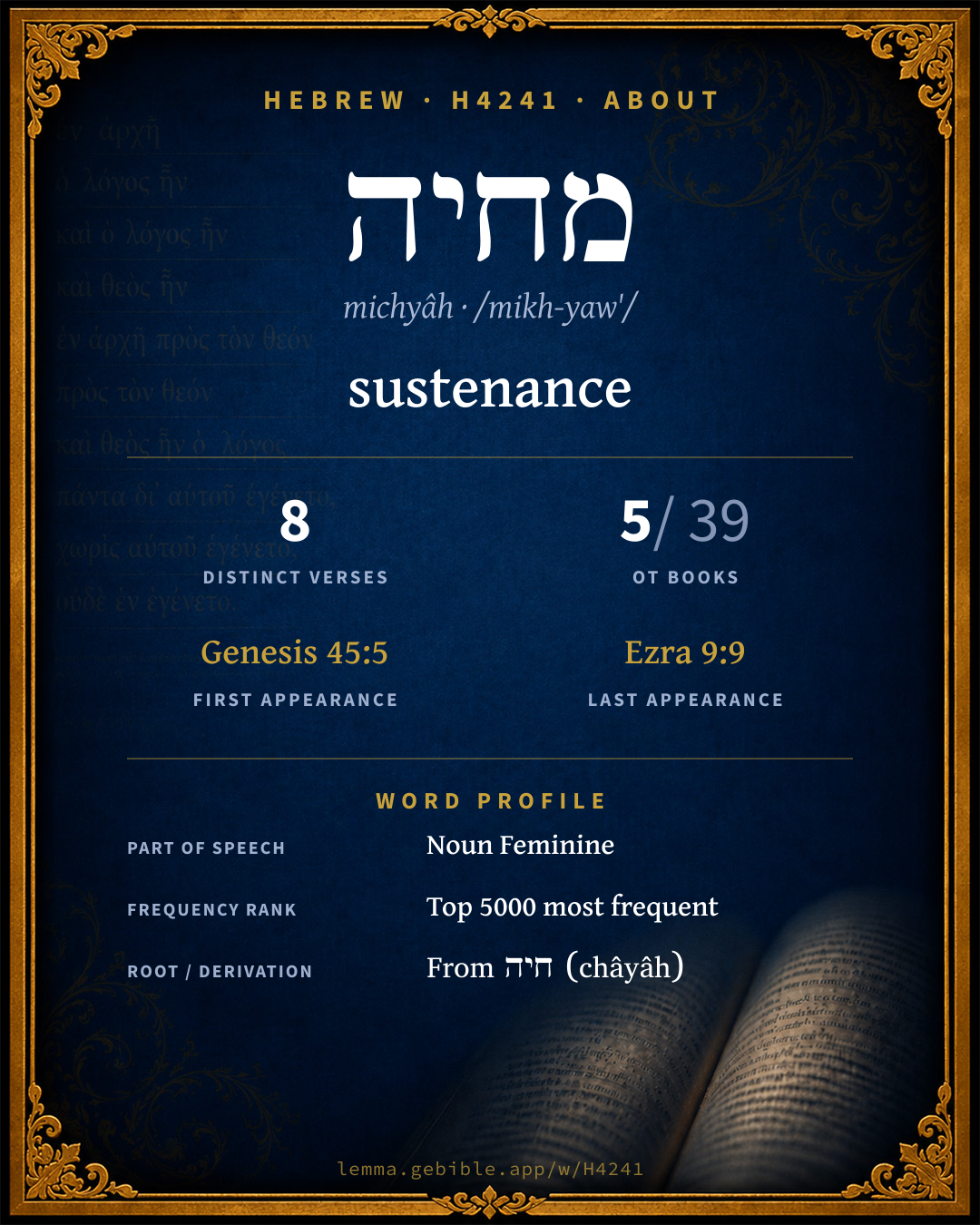
מִחְיָה
sustenance
‘sustenance’ is one of 5 main senses fuller range ↓
Full lexicon entry — Brown-Driver-Briggs (BDB)
From Brown-Driver-Briggs (BDB)
Where this word appears
See every Absolute-state word in the Hebrew Bible →
Grammar key — what these labels mean
Part of speech
- Noun
- A naming word — a person, place, thing, or idea.
Noun type
- Common
- A common noun — a general class of person, place, or thing (“king,” “city,” “water”), not a specific name.
State
- Absolute
- The independent form of a noun, not bound to a following word.
- Construct
- A noun bound to a following noun in a possessive / “of” relationship (the construct chain).
Gender
- Feminine
- Grammatically feminine.
Number
- Singular
- One.
Grammatical forms
- Noun, Common, Feminine, Singular, Absolute 5 times (63%)
- Noun, Common, Feminine, Singular, Construct 3 times (38%)
Parsed forms decoded from the imported morphology (morphhb / Westminster Leningrad Codex — WLC text public domain, morphhb tagging CC BY 4.0), counted across 8 parsed occurrences — not distinct verses.
Every verse where H4241 appears — 8 distinct verses across 5 books. Click any verse to open its interlinear word-by-word view. Verse text shown in the World English Bible for context — . Each verse’s Hebrew form is shown with its reference; the English is not keyword-highlighted, since the data carries no word-level English alignment. Use “Compare translations” on any verse to read it across multiple English versions. This concordance covers the Hebrew Bible; Septuagint (Greek Old Testament) occurrences are not indexed here.
Genesis 1 verse
Leviticus 2 verses
- Leviticus 13:10 וּ/מִֽחְיַ֛ת conj + n c fs cs and the priest shall examine him. Behold, if there is a white rising in the skin, and it has turned the hair white, and there is raw flesh in the rising,
- Leviticus 13:24 מִֽחְיַ֣ת n c fs cs "Or when the body has a burn from fire on its skin, and the raw flesh of the burn becomes a bright spot, reddish-white, or white,
Judges 2 verses
- Judges 6:4 מִֽחְיָה֙ n c fs and they encamped against them, and destroyed the increase of the earth, until you come to Gaza, and left no sustenance in Israel, neither sheep, nor ox, nor donkey.
- Judges 17:10 וּ/מִחְיָתֶ֑/ךָ conj + n c fs cs + sfx pers 2ms Micah said to him, Dwell with me, and be to me a father and a priest, and I will give you ten [pieces] of silver by the year, and a suit of clothing, and your food. So the Levite went in.
2 Chronicles 1 verse
Ezra 2 verses
- Ezra 9:8 מִֽחְיָ֥ה n c fs Now for a little moment grace has been shown from Yahweh our God, to leave us a remnant to escape, and to give us a nail in his holy place, that our God may lighten our eyes, and give us a little reviving in our bondage.
- Ezra 9:9 מִֽחְיָ֗ה n c fs For we are bondservants; yet our God has not forsaken us in our bondage, but has extended loving kindness to us in the sight of the kings of Persia, to give us a reviving, to set up the house of our God, and to repair the ruins of it, and to give us a wall in Judah and in Jerusalem.
About this entry
At a glance — auto-summarized from this page’s data, not written by a person. Every figure links to its source below. This summary describes the numbers; it doesn’t interpret them.
“sustenance” is the headline sense of the Hebrew noun מחיה (michyâh). It is not a single-sense word — see its full sense range. It turns up in 8 verses across 5 books, an uncommon footprint. More than a quarter of its appearances fall in Leviticus. It first appears in Genesis 45:5. Each statement above links to its evidence; the full detail follows below.
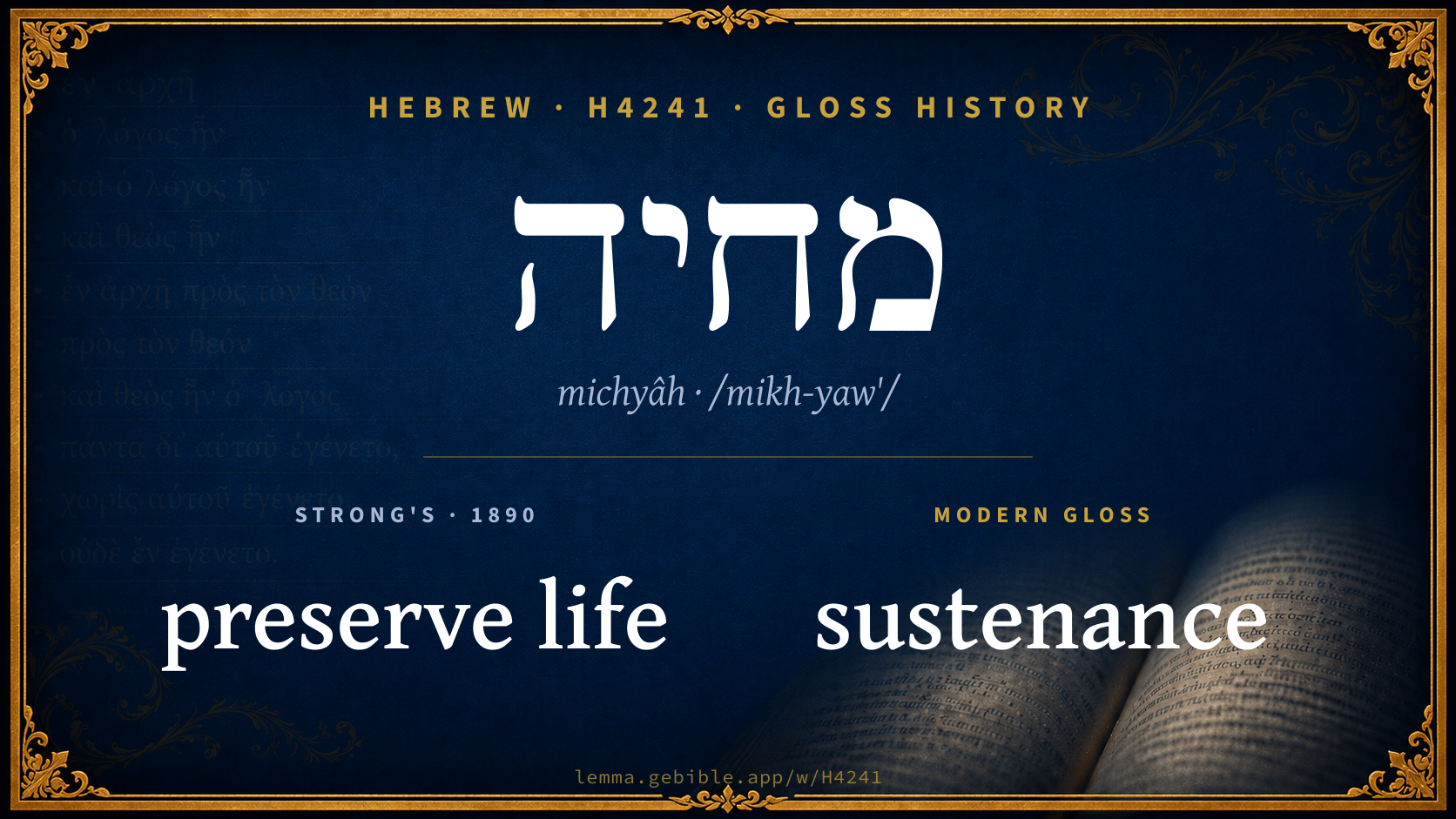
Gloss history
Strong's 1890 vs modern scholarship
About this word
Strong's H4241 catalogs a Hebrew word from the Hebrew Old Testament.
These counts are not copied from any lexicon or concordance. They are computed here, from the morphology-tagged Hebrew Old Testament. What Lemma adds →
- 8
- distinct verses
- The word appears in 8 distinct verses.
- 5 / 39
- OT books
- The word appears in 5 of 39 Old Testament books.
- #2,625
- by frequency
- Top 5000 most frequent Hebrew words (rank 2,625 of 8,640 Hebrew words by occurrence).
View all 8 occurrences in the concordance →
By section of the Old Testament
By traditional corpus
Conventional, traditional groupings — biblical authorship is debated, so this is a traditional corpus grouping, not an authorship claim. Each share is this word’s portion of its verses in that division of the Hebrew canon. Each figure is a share of the word’s 8 distinct verses.
- Torah (Pentateuch) 3 verses · 38%
- Writings (Ketuvim) 3 verses · 38%
- Prophets (Nevi'im) 2 verses · 25%
How translations render this word
Counts come from each version’s own published word-to-Strong’s tagging or interlinear alignment — an approximate guide to how each version renders this word, not a word-level alignment the data otherwise carries. Because each total is that version’s own tagged count, the per-version totals vary from one another and need not match the appearance or distinct-verse counts above. These counts may also differ from a printed concordance because Lemma counts each distinctly tagged rendering and does not collapse phrase taggings into a single head-word total. This is a fixed set of word-tagged versions (KJV, ASV, BSB, ULT) and does not change with the reading translation you choose elsewhere. Each version’s license is shown beside its name below (and on Sources).
- King James Version: Reviving 2×
- American Standard Version: Reviving 2×
- Berean Standard Bible: New life 2×
- unfoldingWord Literal Text: Reviving 2×, Sustenance 2×
King James Version Public Domain
Renders H4241 across 8 tagged occurrences — most commonly:
Plus 6 renderings that appear only once — usually multi-word phrases or single function words the recovered tagging swept in, not distinct renderings.
American Standard Version Public Domain
Renders H4241 across 8 tagged occurrences — most commonly:
Plus 6 renderings that appear only once — usually multi-word phrases or single function words the recovered tagging swept in, not distinct renderings.
Berean Standard Bible Public Domain
Renders H4241 across 7 tagged occurrences — most commonly:
Plus 5 renderings that appear only once — usually multi-word phrases or single function words the recovered tagging swept in, not distinct renderings. Not rendered by a distinct English word in 1 further occurrence.
unfoldingWord Literal Text CC BY-SA 4.0
Renders H4241 across 9 tagged occurrences — most commonly:
Plus 5 renderings that appear only once — usually multi-word phrases or single function words the recovered tagging swept in, not distinct renderings.
Senses in the full BDB
What do BDB’s symbols mean?
BDB uses these scholarly abbreviations:
| Symbol | Meaning |
|---|---|
| 𝔊 | the Septuagint (the ancient Greek translation, LXX) |
| 𝔙 | the Vulgate (the Latin translation) |
| 𝔖 | the Syriac version (the Peshitta) |
| 𝔗 | the Targum (the Aramaic translation) |
| ψ | the Psalms |
| √ | root (the underlying root or stem) |
| ‖ | parallel passage (a synonymous or contrasted parallel) |
| † | the dagger: every passage where the word occurs is cited |
The 4 senses and sub-senses the full Brown-Driver-Briggs lexicon distinguishes for this word, in lexicon order (not ranked by frequency), with BDB’s own verbatim wording and sub-sense lettering. Shown in Hebrew script with BDB’s own scholarly abbreviations. The condensed entry is in the Lexicon Entry tab. See also the Forms in the corpus table below.
- 1. preservation of life Gn 45:5 (E), 2 Ch 14:12. e.g. Genesis 45:5
- 2. sustenance Ju 6:4; 17:10. e.g. Judges 6:4
- 3. reviving, Ezr 9:8, 9. e.g. Ezra 9:8
- 4. the quick (בָּשָׂר) מִחְיַת the quick (or raw spot) of the flesh Lv 13:10, 24 (P). e.g. Leviticus 13:10
Senses from the full Brown-Driver-Briggs lexicon (Brown, Driver, Briggs; Oxford 1906 — public domain), digitized via Sefaria, supplemented by the OpenScriptures HebrewLexicon (CC BY 4.0). Full attribution on Sources.
Word origin
n.f. preservation of life, sustenance, מ׳ Gn 45:5 + 4 times; cstr. מִחְיַת Lv 13:10, 24; sf. מִחְיָתֶ֑ךָ Ju 17:10;—
— Brown-Driver-Briggs (Oxford 1906, public domain), digitized via Sefaria, supplemented by the OpenScriptures HebrewLexicon (CC BY 4.0). See Sources.
Derived from חיה (châyâh) (H2421) — to live.
Jastrow Dictionary
A second Hebrew/Aramaic lexicon for comparison, covering Aramaic and post-biblical (Talmudic, Targumic, Midrashic) usage that the biblical-Hebrew BDB does not. Matched by lemma rather than by Strong’s number, so a lemma may carry more than one Jastrow headword (shown separately below), and the entries cover usage well beyond the Bible.
חָיָה
- , v. חיי
חַיָּה I
- 1. (adj.) v. חַי.
- 2. animal, esp. beast of chase, deer &c., contrad. to בְּהֵמָה. Ḥull. VI, 1 ונוהג בח׳ ובעוף and applies to beasts of chase and birds; a. fr.—Ab. V, 9, a. fr. ח׳ רעה the plague of wild beasts. Ex. R. s. 35 (ref. to Ps. LXVIII, 31) ח׳ הדרה וכ׳ the beast that lives between the reeds (Rome).—Sabb. 151ᵇ; Snh. 38ᵇ, a. e. אין ח׳ רעה שולטת וכ׳ no wild beast has power over man, unless he appears to it to resemble a brute creature; a. fr.—Pl. חַיּוֹת. Taan. 8ᵃ לע"ל … כל הח׳ וכ׳ in the future all the wild beasts shall gather and come to the serpent &c. Bets. 25ᵇ כלב בח׳ the dog (is the most irrepressible) among the wild beasts. Ber. 61ᵇ פקח שבח׳ the shrewdest of all animals; a. v. fr.—Esp. Ḥayoth, legendary celestial creatures (Ez. I, 5). Ḥag. 13ᵃ; a. fr. e.g. Psalms 68:31
חַיָּה II
- (חָיָה)
- 1. [recovering,] lying-in woman, woman in confinement. Yoma VIII, 1 הח׳ תנעול וכ׳ a woman after confinement may wear shoes (on the Day of Atonement). Ber. 54ᵇ חולה ח׳ וכ׳ a sick person, a lying-in &c.; a. fr.—Pl. חַיּוֹת. Y. Kil. IX, 32ᵇ bot.; Gen. R. s. 96, end אי לכם ח׳ וכ׳ woe to you, lying-in women in Palestine; a. fr.
- 2. [physician,] midwife. Tosef. B. Bath. VII, 2 נאמנת ח׳ וכ׳ the midwife is an admissible witness as to which (of twins) was the first-born; Y. Kidd. IV, 69ᵈ bot.; Y. B. Bath. III, beg. 13ᵈ הח׳ בשעה וכ׳ the midwife (is an admissible witness) only as long as she is seated by the obstetric chair (not after she left the mother). Y. Yeb. XVI, end, 16ᵃ עשו אותו כח׳ וכ׳ they place him in the same category as a midwife whose testimony is valid on the spot; a. e.—Pl. as ab. Cant. R. to IV, 5 מרים … חַיּוֹתֵיהֶן וכ׳ Miriam … were the midwives of Israel; a. fr.
חיי
- (b. h.)
- 1. to live. Tam. 32ᵃ מה … ויִחְיֶה what must man do in order to live (long)?; a. v. fr.—Part. חָי (v. חַי).—Keth. I, 6 לא מפיה אנו חָיִין we do not live on what comes from her lips, i.e. we do not go by her evidence. Y. ib. II, 26ᶜ bot. אנו כחיין מפיה we (the court) are again in the condition of dependence on her own evidence. Y. Shebi. II, 34ᵃ top שהן חָיִין מִמֵּי וכ׳ they live (draw nourishment) from the waters of last year; ib. (הוא חָיָיה) הוא חָיָה it draws &c.—Snh. 108ᵃ לא חיין ולא נידונין they have no share in the resurrection nor will they be judged; a. fr.
- 2. to heal; to recover, regain health. Keth. 6ᵃ, a. e. עד שתִּחְיֶה המכה until the wound is healed up. Ḥull. 7ᵇ וחָיָה and did recover; וחָיָת and it (the wound) healed up; a. fr. [Y. Maasr. I, 48ᵈ חיתה; Y. Shebi. IV, 35ᵇ bot. חייתה, v. חוּת.]
- to be recalled to life, to resurrect. Ab. IV, 22 והמתים להֵחָיוֹת and the dead are destined to be revived. Snh. 90ᵇ שעתיד להחיות that he (Aaron) will resurrect.
- 1. to keep alive, sustain. Tam. 32ᵃ יְחַיֶּה את עצמו let him feed himself (his passions, be selfish). Yoma 71ᵃ מְחַיֶּה חיים He who sustains the living; a. fr.
- 2. to recall to life, to revive. Snh. l. c. הקב"ה מְחַיֶּיה מתים the Lord revives the dead. Ib. מה שאני ממית אני מְחַיֶּה what I put to death, I revive again; a. fr.
- same. Ib. 92ᵇ מתים שה׳ יחזקאל the dead whom Ezekiel revived (Ez. XXXVII). Ib. והַחֲיֵיה מתים וכ׳ and revive the dead in the valley of Dura; a. fr.
מִחְיָה
- 1. support, provision. Y. Peah III, 17ᵈ bot. יש לו מ׳ he has left for himself something to live on (a permanent source of income). Sifré Num. 159; Yalk. Num. 787 שווקים ובית המ׳ markets and a provision store (v. חֵיוְתָא).
- 2. [healing,] light cicatrization. Y. Pes. VII, 34ᵃ bot., expl. מִחְיַת (Lev. XIII, 24) חייתה ולא חייתה it is and is not healed up (has only a thin covering). Neg. I, 5. Sifra Thazr., Neg., ch. II, Par. 2 מִחְיָתָהּ כגריס if the half-healed part of it is as large as a bean. Ib. Par. 5, ch. XI; a. fr.— e.g. Leviticus 13:24
- *3. creatures; מִחְיַת הים sea-animals. Gen. R. s. 7, end; Yalk. ib. 12 המרביע מ׳ הים he who causes the cross-breeding of sea-animals (Tosaf. to B. Kam. 55ᵃ quotes: מין חיית הים); Y. Kil. I, 27ᵃ bot. בחיות. (corr. acc.).
A Dictionary of the Targumim, the Talmud Babli and Yerushalmi, and the Midrashic Literature (Marcus Jastrow; London, Luzac, 1903) — Public Domain. Digitized via Sefaria. Digitized via Sefaria. Full attribution on Sources.
Forms in the corpus
The 8 distinct written forms H4241 takes in the Hebrew Bible, most frequent first — each parse links to that state’s occurrences in the concordance. Hebrew forms include their vowel points and cantillation, so a single lemma takes many written forms.
| Form | Parsing | Example | Uses |
|---|---|---|---|
| וּ/מִֽחְיַ֛ת | Noun, Common, Feminine, Singular, Construct | Leviticus 13:10 | 1 |
| וּ/מִחְיָתֶ֑/ךָ | Noun, Common, Feminine, Singular, Construct | Judges 17:10 | 1 |
| לְ/מִֽחְיָ֔ה | Noun, Common, Feminine, Singular, Absolute | Genesis 45:5 | 1 |
| מִֽחְיַ֣ת | Noun, Common, Feminine, Singular, Construct | Leviticus 13:24 | 1 |
| מִֽחְיָ֔ה | Noun, Common, Feminine, Singular, Absolute | 2 Chronicles 14:13 | 1 |
| מִֽחְיָ֗ה | Noun, Common, Feminine, Singular, Absolute | Ezra 9:9 | 1 |
| מִֽחְיָ֥ה | Noun, Common, Feminine, Singular, Absolute | Ezra 9:8 | 1 |
| מִֽחְיָה֙ | Noun, Common, Feminine, Singular, Absolute | Judges 6:4 | 1 |
Same root — word family
Other BDB entries built from the same root as H4241, grouped by Strong’s listed origin. These share a root / origin per the lexicon — not necessarily a shared meaning. Each links to that word’s own entry.
Derives from
Shares the same root
- חי chay H2416 living
- חיא chăyâʼ H2418 to live
- חיה châyeh H2422 lively
- חיות chayûwth H2424 living
- חיי châyay H2425 to live
Proper names from this root
People and places named from this root — a name, not an additional meaning of the word.
Compare all same-root words → Showing 4 of 9 — not the complete family. 2 of the same-root words are proper names (people or places). They share a root, not necessarily a meaning.
Septuagint verse parallels
This word appears in 8 verses that also exist in the Greek Old Testament (Septuagint), out of the 8 Hebrew verses it occurs in. You can read those verses in Greek by switching the Old Testament edition to the Septuagint.
Read these verses in the Septuagint
This is a verse-level parallel only — the same verses exist in both the Hebrew and Greek Old Testaments. No word-level Hebrew↔Greek correspondence is claimed: the data carries no such alignment, so no Greek word is shown as this Hebrew word’s translation. Coverage is not total — the Septuagint omits the deuterocanon and renumbers the Psalms, so some Hebrew verses have no direct Greek parallel.