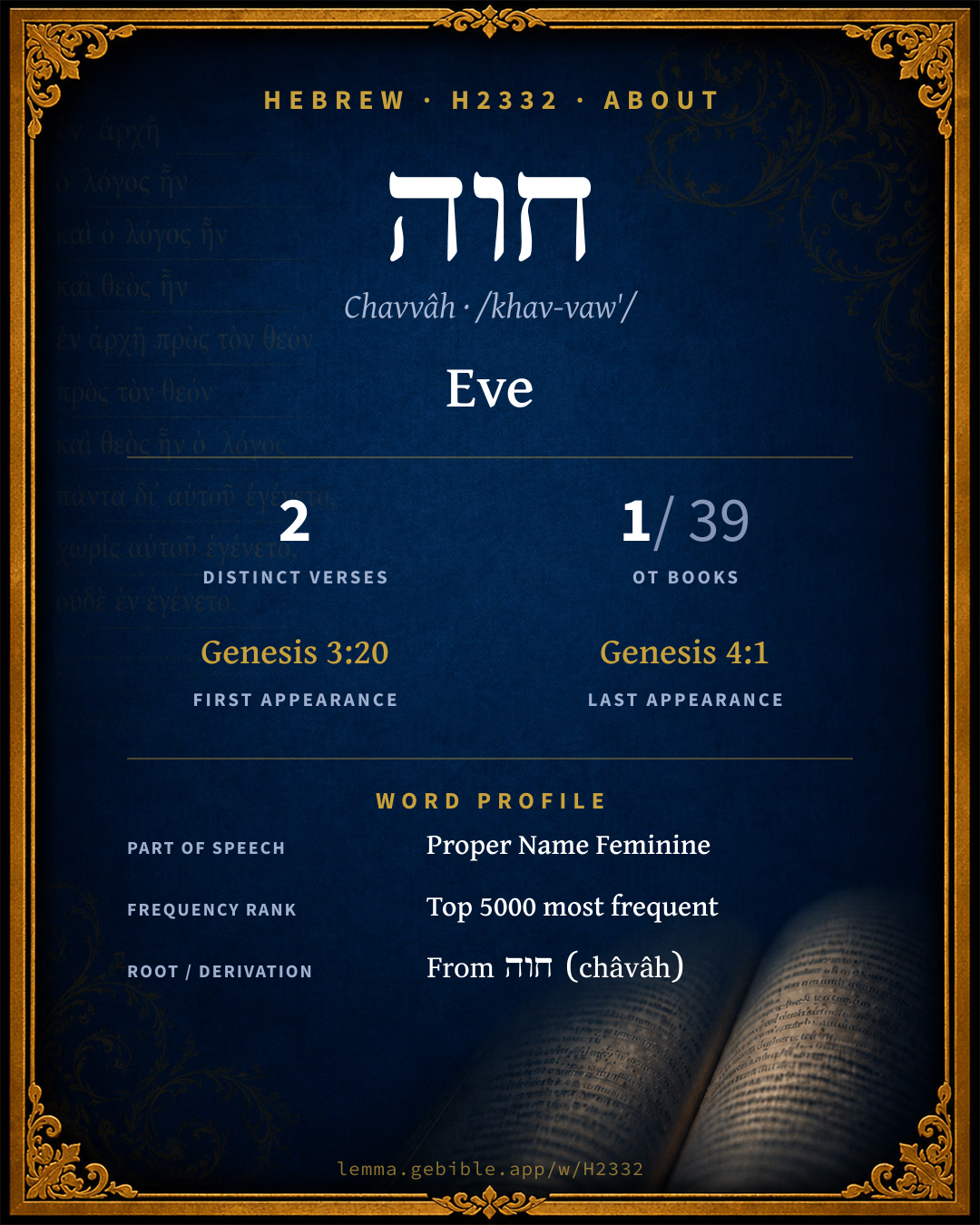
חַוָּה
Eve
BDB lists 2 entries for ‘Eve’ fuller range ↓
Full lexicon entry — Brown-Driver-Briggs (BDB)
From Brown-Driver-Briggs (BDB)
Where this word appears
Grammar key — what these labels mean
Part of speech
- Noun
- A naming word — a person, place, thing, or idea.
Noun type
- Proper
- A name of a specific person, place, or people (e.g. Abraham, Zion, Israel).
Every verse where H2332 appears — 2 distinct verses across 1 book. Click any verse to open its interlinear word-by-word view. Verse text shown in the World English Bible for context — . Each verse’s Hebrew form is shown with its reference; the English is not keyword-highlighted, since the data carries no word-level English alignment. Use “Compare translations” on any verse to read it across multiple English versions. This concordance covers the Hebrew Bible; Septuagint (Greek Old Testament) occurrences are not indexed here.
Genesis 2 verses
About this entry
At a glance — auto-summarized from this page’s data, not written by a person. Every figure links to its source below. This summary describes the numbers; it doesn’t interpret them.
At its core, חוה (Chavvâh) means “Eve.” The Hebrew Bible uses it only 2 verses. Its uses cluster heavily in Genesis (100% of all occurrences). It first appears in Genesis 3:20. Each statement above links to its evidence; the full detail follows below.
Gloss history
Strong's 1890 vs modern scholarship
About this word
Strong's H2332 catalogs a Hebrew word from the Hebrew Old Testament.
These counts are not copied from any lexicon or concordance. They are computed here, from the morphology-tagged Hebrew Old Testament. What Lemma adds →
- 2
- distinct verses
- The word appears in 2 distinct verses.
- 1 / 39
- OT books
- The word appears in 1 of 39 Old Testament books.
- #4,807
- by frequency
- Top 5000 most frequent Hebrew words (rank 4,807 of 8,640 Hebrew words by occurrence).
View all 2 occurrences in the concordance →
Most concentrated in
- Genesis 2 verses 100%
By section of the Old Testament
By traditional corpus
Conventional, traditional groupings — biblical authorship is debated, so this is a traditional corpus grouping, not an authorship claim. Each share is this word’s portion of its verses in that division of the Hebrew canon. Each figure is a share of the word’s 2 distinct verses.
- Torah (Pentateuch) 2 verses · 100%
How translations render this word
Counts come from each version’s own published word-to-Strong’s tagging or interlinear alignment — an approximate guide to how each version renders this word, not a word-level alignment the data otherwise carries. Because each total is that version’s own tagged count, the per-version totals vary from one another and need not match the appearance or distinct-verse counts above. These counts may also differ from a printed concordance because Lemma counts each distinctly tagged rendering and does not collapse phrase taggings into a single head-word total. This is a fixed set of word-tagged versions (KJV, ASV, BSB, ULT) and does not change with the reading translation you choose elsewhere. Each version’s license is shown beside its name below (and on Sources).
BDB lists this Strong’s number as 2 distinct words (homographs). Each count above pools all of them and is not split by sense — see the Senses section below. A low-frequency rendering may belong to a different one of those words, not the primary meaning.
- King James Version†: Eve 2×
- American Standard Version†: Eve 2×
- Berean Standard Bible†: Eve 2×
- unfoldingWord Literal Text†: Eve 2×
King James Version Public Domain
Renders H2332 across 2† tagged occurrences — most commonly:
American Standard Version Public Domain
Renders H2332 across 2† tagged occurrences — most commonly:
Berean Standard Bible Public Domain
Renders H2332 across 2† tagged occurrences — most commonly:
unfoldingWord Literal Text CC BY-SA 4.0
Renders H2332 across 2† tagged occurrences — most commonly:
Senses in the full BDB
What do BDB’s symbols mean?
BDB uses these scholarly abbreviations:
| Symbol | Meaning |
|---|---|
| 𝔊 | the Septuagint (the ancient Greek translation, LXX) |
| 𝔙 | the Vulgate (the Latin translation) |
| 𝔖 | the Syriac version (the Peshitta) |
| 𝔗 | the Targum (the Aramaic translation) |
| ψ | the Psalms |
| √ | root (the underlying root or stem) |
| ‖ | parallel passage (a synonymous or contrasted parallel) |
| † | the dagger: every passage where the word occurs is cited |
The 0 senses and sub-senses the full Brown-Driver-Briggs lexicon distinguishes for this word, in lexicon order (not ranked by frequency), with BDB’s own verbatim wording and sub-sense lettering. Shown in Hebrew script with BDB’s own scholarly abbreviations. The condensed entry is in the Lexicon Entry tab. See also the Forms in the corpus table below.
חוה I f. (life, vid. Di Gn 3
חוה II tent-village
Senses from the full Brown-Driver-Briggs lexicon (Brown, Driver, Briggs; Oxford 1906 — public domain), digitized via Sefaria, supplemented by the OpenScriptures HebrewLexicon (CC BY 4.0). Full attribution on Sources.
Word origin
I. n.pr.f. (life, vid. Di Gn 3:20; > WeProl. 1886, 322; Skizzen iii. 217 after Nö who suggests serpent as poss. meaning, cf. Arabic حَيَّةٌ; but RSK 177 ‘mother of every ḥayy,’ v. ii. חַי sub חיה)—Gn 3:20 and the man called his wife חַוָּ֑ה, because she was אֵם כָּל־חָֽי׃; cf. ח׳ אִשְׁתּוֹ 4:1 (both J).—ii. חַוָּה village, v. infr. sub ii.חוה.
II. n.f. tent-village—Pl. חַוֹּתֵיהֶם Nu 32:41 (JE), cf. Di. Elsewhere in cpd. appellative, almost = n.pr. חַוֹּת יָאִיר Dt 3:14 Jos 13:30 (D), Ju 10:4 1 K 4:13 1 Ch 2:23.—i. חַוָּה n.pr.f. v. supr.
— Brown-Driver-Briggs (Oxford 1906, public domain), digitized via Sefaria, supplemented by the OpenScriptures HebrewLexicon (CC BY 4.0). See Sources.
Derived from חוה (châvâh) (H2331) — to declare.
Jastrow Dictionary
A second Hebrew/Aramaic lexicon for comparison, covering Aramaic and post-biblical (Talmudic, Targumic, Midrashic) usage that the biblical-Hebrew BDB does not. Matched by lemma rather than by Strong’s number, so a lemma may carry more than one Jastrow headword (shown separately below), and the entries cover usage well beyond the Bible.
חַוָּהּ
- (b. h.) pr. n. f. Ḥavvah, Eve, Adam’s wife. Gen. R. s. 22 ח׳ הראשונה the original Eve. Sabb. 95ᵃ; a. fr.
חוי
- , Pi. חִיוָּה (b. h.)
- 1. to point. Meg. 16ᵃ היתה מְחַוָּוה וכ׳ she was pointing at Ahasver.
- 2. to show, teach, tell. Gen. R. s. 20 (play on חַוָּה) ח׳ לה אדם וכ׳ Adam told her &c.
A Dictionary of the Targumim, the Talmud Babli and Yerushalmi, and the Midrashic Literature (Marcus Jastrow; London, Luzac, 1903) — Public Domain. Digitized via Sefaria. Digitized via Sefaria. Full attribution on Sources.
Forms in the corpus
The 2 distinct written forms H2332 takes in the Hebrew Bible, most frequent first — each parse links to that state’s occurrences in the concordance. Hebrew forms include their vowel points and cantillation, so a single lemma takes many written forms.
| Form | Parsing | Example | Uses |
|---|---|---|---|
| חַוָּ֑ה | Noun, Proper | Genesis 3:20 | 1 |
| חַוָּ֣ה | Noun, Proper | Genesis 4:1 | 1 |
Same root — word family
Other BDB entries built from the same root as H2332, grouped by Strong’s listed origin. These share a root / origin per the lexicon — not necessarily a shared meaning. Each links to that word’s own entry.
Derives from
Shares the same root
Derived from this word
Proper names from this root
People and places named from this root — a name, not an additional meaning of the word.
Compare all same-root words → Showing 4 of 7 — not the complete family. 1 of the same-root words is a proper name (a person or place). They share a root, not necessarily a meaning.
Bible dictionary
Public-domain dictionary articles matched to this entry by name (Eve). A biblical name can be shared by more than one person or place, so an article may treat several.
Easton's Bible Dictionary · M. G. Easton, 1897
Life; living, the name given by Adam to his wife (Gen. 3:20; 4:1). The account of her creation is given in Gen. 2:21, 22. The Creator, by declaring that it was not good for man to be alone, and by creating for him a suitable companion, gave sanction to monogamy. The commentator Matthew Henry says: "This companion was taken from his side to signify that she was to be dear unto him as his own flesh. Not from his head, lest she should rule over him; nor from his feet, lest he should tyrannize over her; but from his side, to denote that species of equality which is to subsist in the marriage state." And again, "That wife that is of God's making by special grace, and of God's bringing by special providence, is likely to prove a helpmeet to her husband." Through the subtle temptation of the serpent she violated the commandment of God by taking of the forbidden fruit, which she gave also unto her husband (1 Tim. 2:13-15; 2 Cor. 11:3). When she gave birth to her first son, she said, "I have gotten a man from the Lord" (R.V., "I have gotten a man with the help of the Lord," Gen. 4:1). Thus she welcomed Cain, as some think, as if he had been the Promised One the "Seed of the woman."
Smith's Bible Dictionary · William Smith, 1863
(life), the name given in Scripture to the first woman. The account of Eve's creation is found at (Genesis 2:21,22) Perhaps that which we are chiefly intended to learn from the narrative is the foundation upon which the union between man and wife is built, viz., identity of nature and oneness of origin. Through the subtlety of the serpent Eve was beguiled into a violation of the one commandment which had been imposed upon her and Adam. The Scripture account of Eve closes with the birth of Seth.
Hitchcock's Bible Names Dictionary · Roswell D. Hitchcock, 1869
living; enlivening
Classic public-domain reference works; full attribution on Sources.
Septuagint verse parallels
This word appears in 2 verses that also exist in the Greek Old Testament (Septuagint), out of the 2 Hebrew verses it occurs in. You can read those verses in Greek by switching the Old Testament edition to the Septuagint.
Read these verses in the Septuagint
This is a verse-level parallel only — the same verses exist in both the Hebrew and Greek Old Testaments. No word-level Hebrew↔Greek correspondence is claimed: the data carries no such alignment, so no Greek word is shown as this Hebrew word’s translation. Coverage is not total — the Septuagint omits the deuterocanon and renumbers the Psalms, so some Hebrew verses have no direct Greek parallel.