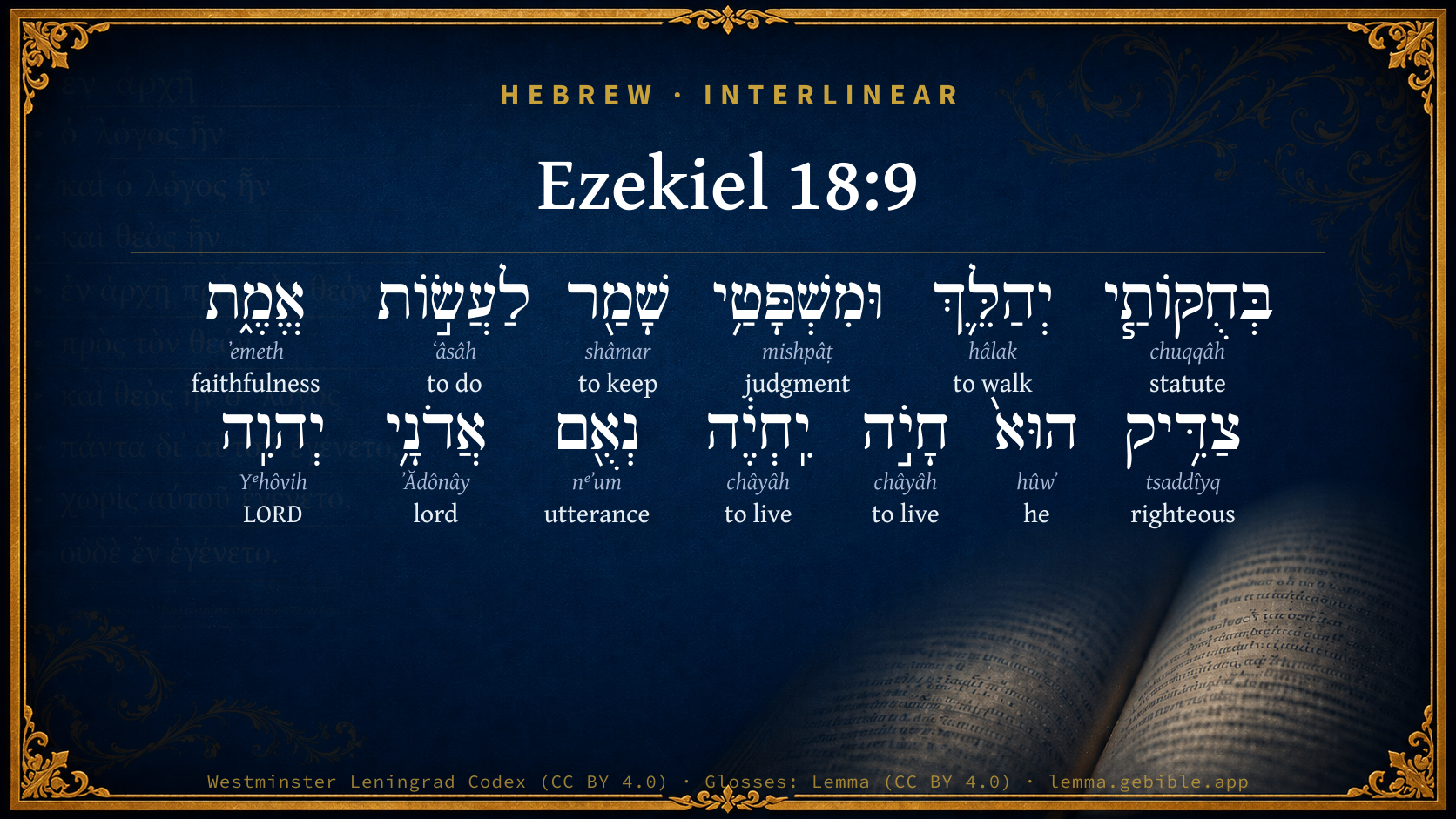
Ezekiel 18:9

Hebrew (Westminster Leningrad Codex) Ezekiel 18:9 appears in the Hebrew Old Testament. The text above is from the Westminster Leningrad Codex. Each word links to its Strong’s number, a concise gloss, and parsing drawn from the Open Scriptures Hebrew Bible morphology. Click any word for its full Brown-Driver-Briggs (BDB) entry.
Download image
Cite this verse

Ezekiel 18:9 (World English Bible). Public Domain. Lemma interlinear Bible study tool, https://lemma.gebible.app/v/ezekiel/18/9.

Show BibTeX & RIS
BibTeX
RIS
English Translation
has walked in my statutes, and has kept my ordinances, to deal truly; he is just, he shall surely live, says the Lord Yahweh.
World English Bible · Public Domain
Download a study sheet

One document with this verse’s original text, its word-by-word gloss line, the meaning frame, cross-references with their text, attributed commentary, and full source and license credits — printable, and it pastes into notes with its structure intact.

This verse Autodidact and up

Study sheet (.html) Plain text (.txt)

A passage Seminary Student

Up to 50 verses in one chapter. A passage sheet keeps up to 6 commentary sources and 12 cross-references per verse, in the order this page ranks them, and says so on the sheet whenever that leaves anything out. Ask for a single verse and you get the Autodidact verse sheet above.

Everything on this page stays free to read, with no account — the sheet is a download of what is already on screen, not access to it.

Want to remove ads? Support Godless Engineer
Compare translations 3

The same verse in 3 English versions, stacked beneath the original-language interlinear above. Click any original word for its lexicon entry.

Each is an independent rendering of the whole verse — the interlinear is not word-aligned to these translations.

Highlighted words mark where these versions differ — a whole-verse word diff, not a word-by-word alignment.

  • World English Bible Public Domain
    has walked in my statutes, and has kept my ordinances, to deal truly; he is just, he shall surely live, says the Lord Yahweh.
  • King James Version Public Domain
    Hath walked in my statutes, and hath kept my judgments, to deal truly; he is just, he shall surely live, saith the Lord GOD.
  • unfoldingWord Literal Text CC BY-SA 4.0
    If that man walks in my statutes and keeps my decrees to act faithfully, then the promise for this righteous man is this: He will surely live!—this is the Lord Yahweh’s declaration.

unfoldingWord Literal Text — © unfoldingWord, licensed CC BY-SA 4.0. Word-aligned USFM3 via Door43 (git.door43.org/unfoldingWord/en_ult).

Versions to compare (up to 4)

3 of 4 selected

Show all 18 translations

Every available English version of this verse, each an independent rendering of the whole verse.

  • World English Bible Public Domain
    has walked in my statutes, and has kept my ordinances, to deal truly; he is just, he shall surely live, says the Lord Yahweh.
  • Berean Standard Bible Public Domain
    He follows My statutes and faithfully keeps My ordinances. That man is righteous; surely he will live, declares the Lord GOD.
  • Majority Standard Bible Public Domain
    He follows My statutes and faithfully keeps My ordinances. That man is righteous; surely he will live, declares the Lord GOD.
  • King James Version Public Domain
    Hath walked in my statutes, and hath kept my judgments, to deal truly; he is just, he shall surely live, saith the Lord GOD.
  • American Standard Version (1901) Public Domain
    hath walked in my statutes, and hath kept mine ordinances, to deal truly; he is just, he shall surely live, saith the Lord Jehovah.
  • Revised Version (1885) Public Domain
    hath walked in my statutes, and hath kept my judgments, to deal truly; he is just, he shall surely live, saith the Lord GOD.
  • Geneva Bible (1599) Public Domain
    And hath walked in my statutes, and hath kept my iudgements to deale truely, he is iust, he shall surely liue, sayth the Lord God.
  • Douay-Rheims (1899) Public Domain
    Hath walked in my commandments, and kept my judgments, to do truth: he is just, he shall surely live, saith the Lord God.
  • Young's Literal Translation Public Domain
    In My statutes he doth walk, And My judgments he hath kept -- to deal truly, Righteous `is' he, he surely liveth, An affirmation of the Lord Jehovah.
  • Literal Standard Version CC BY-SA 4.0
    He walks in My statutes, || And he has kept My judgments—to deal truly, || He [is] righteous—he surely lives,” || A declaration of Lord YHWH.
  • Unlocked Literal Bible CC BY-SA 4.0
    If that man walks in my statutes and keeps my decrees to act faithfully, then the promise for this righteous man is this: He will surely live!—this is the Lord Yahweh's declaration.
  • unfoldingWord Literal Text CC BY-SA 4.0
    If that man walks in my statutes and keeps my decrees to act faithfully, then the promise for this righteous man is this: He will surely live!—this is the Lord Yahweh’s declaration.
  • Darby Bible Public Domain
    hath walked in my statutes, and kept mine ordinances, to deal faithfully: he is righteous, he shall certainly live, saith the Lord Jehovah.
  • World Messianic Bible Public Domain
    has walked in my statutes, and has kept my ordinances, to deal truly; he is just, he shall surely live,” says the Lord GOD.
  • Webster's Bible Public Domain
    Hath walked in my statutes, and hath kept my judgments, to deal truly; he is just, he shall surely live, saith the Lord GOD.
  • Free Bible Version CC BY-SA 4.0
    He follows my rules and keeps my regulations faithfully. Such a man lives by what's right and he will certainly live, declares the Lord God.
  • Bible in Basic English Public Domain
    And has been guided by my rules and has kept my laws and done them: he is upright, life will certainly be his, says the Lord.
  • JPS Tanakh (1917) Public Domain
    hath walked in My statutes, and hath kept Mine ordinances, to deal truly; he is just, he shall surely live, saith the Lord GOD.

Literal Standard Version (2020), Covenant Press — licensed CC BY-SA 4.0. Text via the HelloAO Bible API (eBible.org). Unlocked Literal Bible (unfoldingWord) — licensed CC BY-SA 4.0. Text via the HelloAO Bible API (eBible.org). unfoldingWord Literal Text — © unfoldingWord, licensed CC BY-SA 4.0. Word-aligned USFM3 via Door43 (git.door43.org/unfoldingWord/en_ult). Free Bible Version, Dr. Jonathan Gallagher — licensed CC BY-SA 4.0. Text via the HelloAO Bible API (eBible.org).

Word by word

More ways to search: Search by grammar → Find every occurrence → Compare this word →

Practice this passage: Drill this verse → Learn its vocabulary →

בְּחֻקּוֹתַ֧י
chuqqâh
H2708
“in/at · statutes · my”
Preposition + Noun, Common, Both, Plural, Construct + Suffix, Personal, 1st Person, Common, Singular
Part of Speech
Preposition + Noun
Type
Common
Gender
Both
Number
Plural
State
Construct
Full BDB Definition

Origin: from H2706

TWOT: 728b

statute, ordinance, limit, enactment, something prescribed - statute
  1. יְהַלֵּ֛ךְ hâlak H1980 “to walk” Verb, Piel, Imperfect, 3rd Person, Masculine, Singular
  2. וּמִשְׁפָּטַ֥י mishpâṭ H4941 “and · judgments · my” Conjunction + Noun, Common, Masculine, Plural, Construct + Suffix, Personal, 1st Person, Common, Singular
  3. שָׁמַ֖ר shâmar H8104 “to keep” Verb, Qal, Perfect, 3rd Person, Masculine, Singular
  4. לַעֲשׂ֣וֹת ʻâsâh H6213 “to do” Preposition + Verb, Qal, Infinitive Construct
  5. אֱמֶ֑ת ʼemeth H571 “faithfulness” Noun, Common, Feminine, Singular, Absolute
  6. צַדִּ֥יק tsaddîyq H6662 “righteous” Adjective, Adjective, Masculine, Singular, Absolute
  7. הוּא֙ hûwʼ H1931 “he” Pronoun, Personal, 3rd Person, Masculine, Singular
  8. חָיֹ֣ה châyâh H2421 “to live” Verb, Qal, Infinitive Absolute
  9. יִֽחְיֶ֔ה châyâh H2421 “to live” Verb, Qal, Imperfect, 3rd Person, Masculine, Singular
  10. נְאֻ֖ם nᵉʼum H5002 “utterance of” Noun, Common, Masculine, Singular, Construct
  11. אֲדֹנָ֥י ʼĂdônây H136 “Lord · my” Noun, Common, Masculine, Plural, Construct + Suffix, Personal, 1st Person, Common, Singular
  12. יְהוִֽה Yᵉhôvih H3069 “LORD” Noun, Proper

About this verse

These counts appear in no published source. They are computed here, from the morphology-tagged text and Lemma’s own curated glosses. What Lemma adds →

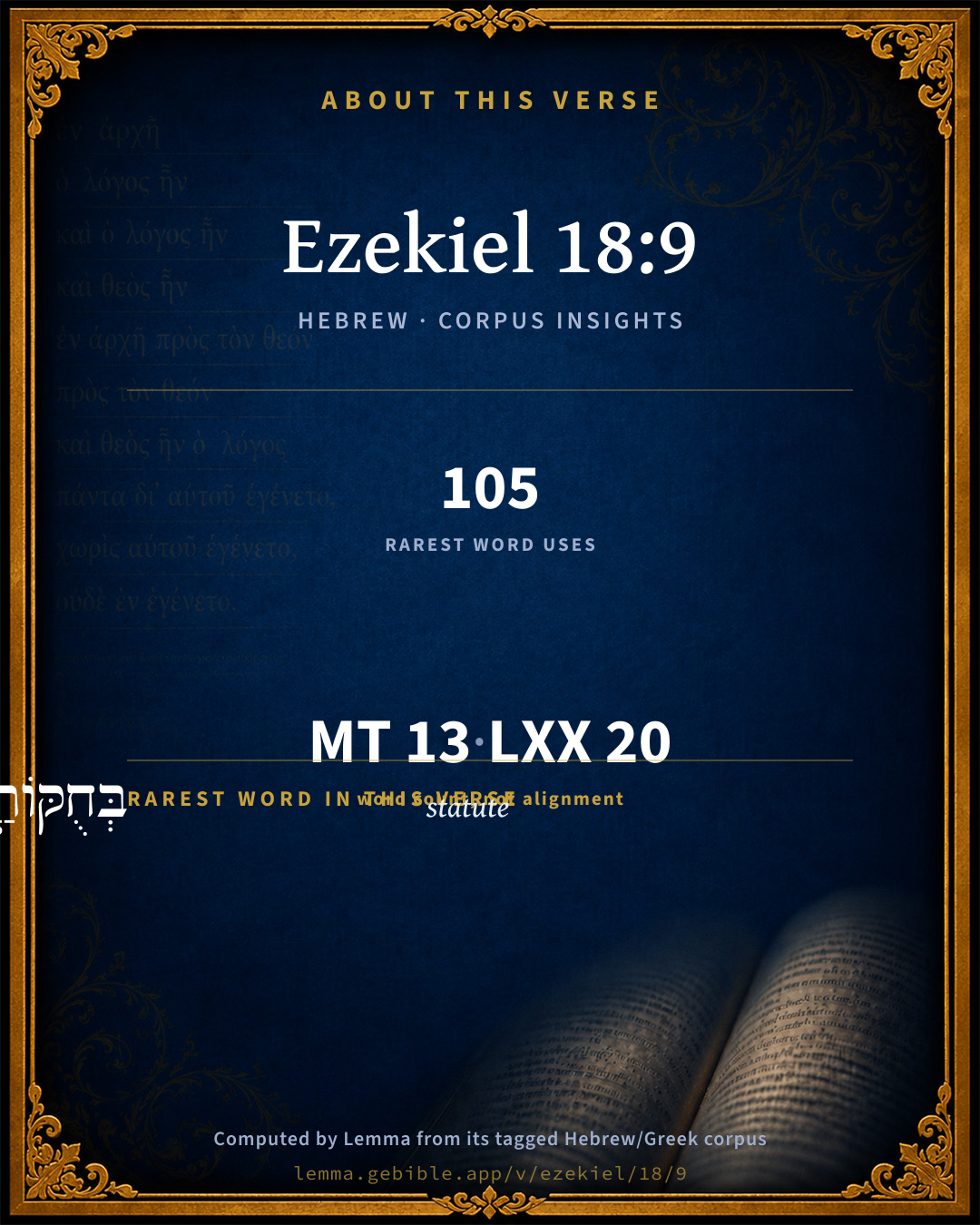
13
words
12
distinct lemmas
Prophets
section

Grammatical profile

  • 5 verbs
  • 6 nouns
  • 1 adjective
  • 1 pronoun

Verb forms

  • יְהַלֵּ֛ךְ Piel · Imperfect
  • שָׁמַ֖ר Qal · Perfect
  • לַעֲשׂ֣וֹת Qal · Infinitive Construct
  • חָיֹ֣ה Qal · Infinitive Absolute
  • יִֽחְיֶ֔ה Qal · Imperfect

Repetition

A word recurs within this verse — often emphatic in Hebrew:

  • חָיֹ֣ה to live H2421 ×2

Hebrew & Septuagint length

In English translation the verse runs 24 words from the Hebrew and 23 from the Septuagint (LXX English) — closely comparable.

A rough comparison of the two English renderings, which tokenize alike — not a word-level alignment.

Word counts can differ between the Hebrew and the Greek without any difference in meaning — e.g. the Hebrew direct-object marker אֵת has no separate Greek word, and Greek often adds the article ὁ.

In the original languages it is 13 Hebrew tokens and 20 Greek tokens — but the two are counted differently (Hebrew bundles its prefixes and suffixes into one token; the Greek is in lemma form), so that isn’t a like-for-like length.

Cross-references

30

Topical passages linked to Ezekiel 18:9 in the Treasury of Scripture Knowledge — connected by theme and wording, ordered by reader-vote popularity; previews shown in the World English Bible.

  • Ezekiel 20:11 I gave them my statutes, and shown them my ordinances, which if a man do, he shall live in them.
  • Habakkuk 2:4 Behold, his soul is puffed up. It is not upright in him, but the righteous will live by his faith.
  • Amos 5:4 For thus says Yahweh to the house of Israel: "Seek me, and you will live;
  • Deuteronomy 10:12–13 Now, Israel, what does Yahweh your God require of you, but to fear Yahweh your God, to walk in all his ways, and to love him, and to serve Yahweh your God with all your heart and with all your soul,
  • Romans 1:17 For in it is revealed God's righteousness from faith to faith. As it is written, "But the righteous shall live by faith."
  • 1 John 2:29 If you know that he is righteous, you know that everyone who practices righteousness is born of him.
  • Ezekiel 18:17 who has withdrawn his hand from the poor, who has not received interest nor increase, has executed my ordinances, has walked in my statutes; he shall not die for the iniquity of his father, he shall surely live.
  • 1 John 3:7 Little children, let no one lead you astray. He who does righteousness is righteous, even as he is righteous.
  • Leviticus 18:5 You shall therefore keep my statutes and my ordinances; which if a man does, he shall live in them: I am Yahweh.
  • Deuteronomy 4:1 Now, Israel, listen to the statutes and to the ordinances, which I teach you, to do them; that you may live, and go in and possess the land which Yahweh, the God of your fathers, gives you.
  • Deuteronomy 5:1 Moses called to all Israel, and said to them, Hear, Israel, the statutes and the ordinances which I speak in your ears this day, that you may learn them, and observe to do them.
  • Deuteronomy 6:1–2 Now this is the commandment, the statutes, and the ordinances, which Yahweh your God commanded to teach you, that you might do them in the land where you go over to possess it;
  • Deuteronomy 11:1 Therefore you shall love Yahweh your God, and keep his charge, and his statutes, and his ordinances, and his commandments, always.
  • Nehemiah 9:13–14 You came down also on Mount Sinai, and spoke with them from heaven, and gave them right ordinances and true laws, good statutes and commandments,
  • Psalms 19:7–11 Yahweh's law is perfect, restoring the soul. Yahweh's testimony is sure, making wise the simple.
  • Psalms 24:4–6 He who has clean hands and a pure heart; Who has not lifted up his soul to falsehood, And has not sworn deceitfully.
  • Psalms 105:44–45 He gave them the lands of the nations. They took the labor of the peoples in possession,
  • Psalms 119:1–6 Blessed are those whose ways are blameless, Who walk according to Yahweh's law.
  • Ezekiel 20:13 But the house of Israel rebelled against me in the wilderness: they didn't walk in my statutes, and they rejected my ordinances, which if a man keep, he shall live in them; and my Sabbaths they greatly profaned. Then I said I would pour out my wrath on them in the wilderness, to consume them.
  • Ezekiel 33:15 if the wicked restore the pledge, give again that which he had taken by robbery, walk in the statutes of life, committing no iniquity; he shall surely live, he shall not die.
  • Ezekiel 36:27 I will put my Spirit within you, and cause you to walk in my statutes, and you shall keep my ordinances, and do them.
  • Ezekiel 37:24 My servant David shall be king over them; and they all shall have one shepherd: they shall also walk in my ordinances, and observe my statutes, and do them.
  • Amos 5:14 Seek good, and not evil, That you may live; And so Yahweh, the God of hosts, will be with you, As you say.
  • Amos 5:24 But let justice roll on like rivers, And righteousness like a mighty stream.
  • Luke 1:6 They were both righteous before God, walking blamelessly in all the commandments and ordinances of the Lord.
  • Luke 10:27–29 He answered, "You shall love the Lord your God with all your heart, with all your soul, with all your strength, and with all your mind; and your neighbor as yourself."
  • John 14:21 One who has my commandments, and keeps them, that person is one who loves me. One who loves me will be loved by my Father, and I will love him, and will reveal myself to him."
  • Acts 24:16 Herein I also practice always having a conscience void of offense toward God and men.
  • James 1:22–25 But be doers of the word, and not only hearers, deluding your own selves.
  • James 2:18–26 Yes, a man will say, "You have faith, and I have works." Show me your faith from your works, and I by my works will show you my faith.

Cross-references courtesy of OpenBible.info (CC BY 4.0).

Hebrew and Greek witnesses Masoretic Hebrew ↔ Greek Septuagint

The same verse in the two great witnesses to the Old Testament, shown verse-for-verse.

These are two independent witnesses, not word-aligned to each other, and the Septuagint is shown in lemma (dictionary) form.

Hebrew Ezekiel 18:9 Masoretic · Westminster Leningrad Codex

בְּחֻקּוֹתַ֧י יְהַלֵּ֛ךְ וּמִשְׁפָּטַ֥י שָׁמַ֖ר לַעֲשׂ֣וֹת אֱמֶ֑ת צַדִּ֥יק הוּא֙ חָיֹ֣ה יִֽחְיֶ֔ה נְאֻ֖ם אֲדֹנָ֥י יְהוִֽה

has walked in my statutes, and has kept my ordinances, to deal truly; he is just, he shall surely live, says the Lord Yahweh.

World English Bible · Public Domain

Greek LXX Ezekiel 18:9 Septuagint · lemma form

καί ὁ πρόσταγμα ἐγώ πορεύομαι καί ὁ δικαίωμα ἐγώ φυλάσσω ὁ ποιέω αὐτός δίκαιος οὗτος εἰμί ζωή ζάω λέγω κύριος

and has walked in my commandments and kept my ordinances, to do them; he is righteous, he shall surely live, says the Lord.

LXX2012 (modern English Septuagint) · Public Domain

On this verse, The Cambridge Bible for Schools and Colleges discusses the Septuagint’s reading. Read the note in Commentary ↓

Hebrew: Westminster Leningrad Codex (CC BY 4.0). Greek: Septuagint (public domain); English from LXX2012 (modern English Septuagint) (Public Domain). How the Septuagint differs from the Hebrew →

Targum (Aramaic paraphrase)

1

The Targum is the ancient Jewish Aramaic paraphrase of the Hebrew Scriptures — an interpretive translation, not the Hebrew text itself. Onkelos (literal) and Pseudo-Jonathan (expansive) render the Torah, and Jonathan the Prophets. Coverage is partial: where no permissively-licensed English translation exists for a verse, only the Aramaic is shown. This is verse-level text, not a word-by-word alignment to the Hebrew.

  1. Targum Jonathan Prophets (Joshua–Malachi)
    בִּקְיָמַי הַלִיךְ וְדִינַי נְטַר לְמֶעְבַּד קְשׁוֹט צַדִיקָא הוּא מֵיחָא יֵחֵי אֲמַר יְיָ אֱלֹהִים:

    (no public-domain English translation for this verse)

    Targum Jonathan — Aramaic: “Mikraot Gedolot” (public domain). English: “Sefaria Community Translation” (CC0 1.0 (public-domain dedication)); “London "Chaldee Paraphrase," 1871” (public domain). Text via Sefaria.

Commentary

Notes on Ezekiel 18:9 from classic Christian and Jewish commentators (each source and its license shown beneath its notes). The classic Christian expositions comment on the surrounding passage and are grouped to its opening verse, so a note may address several verses; the Jewish commentaries on the Tanakh (Rashi and others) are per-verse, so they appear only where the commentator wrote on this verse.

Lemma curates 59 commentaries, every one of them public domain or Creative Commons licensed, each selected and text-cleaned for this edition rather than reprinted as found. About our sources →

The Cambridge Bible for Schools and Colleges

gen. ed. J. J. S. Perowne

9. The man who acts thus (Eze_18:5-8) hath walked in God’s statutes and he shall live. For “to deal truly,” LXX. reads: to do them, by transposition of two letters, which is more natural.

With the ideal of a righteous man here given may be compared these others: Job’s, ch. 31, perhaps the most inward in the Old Testament, Psalms 15; Isa_58:5-7. Such ideals differ from ours principally in that they seem to consist of conduct exclusively external, while we express our ideal in terms of the thought and feelings. But first, when these external actions are enumerated it is always assumed that they proceed from a right condition of mind, of which they are the natural fruit. Hence the prophet says, “Make you a new heart, and a new spirit” (Eze_18:31). The same assumption is made when God is spoken of as making men righteous by forgiveness, or by bestowing on them prosperity, the sign of righteousness. The mental state corresponding to this right relation to God is always regarded as present. And in point of fact the righteousness of God himself consists in righteous acts, just as the righteousness of man. The ancient mind fastened on the outward acts as revealing the inward state, while the modern mind goes directly to the internal condition. And secondly, moral conduct was never thought of as the result of a happy or pure disposition, or as the fruit of prevalent social custom, or obedience to laws called moral or natural; it was always regarded as obedience to divine commandment. Morals was part of religion. Every moral law was fulfilled in obedience to God; hence Jehovah says of this moral man, “he hath walked in my statutes, he shall live” (Eze_18:9).

The Cambridge Bible for Schools and Colleges (gen. ed. J. J. S. Perowne; Cambridge University Press, 1878–1918) — public domain. Text from a community e-Sword module.

Trapp's Complete Commentary

John Trapp

Eze 18:9 Hath walked in my statutes, and hath kept my judgments, to deal truly; he [is] just, he shall surely live, saith the Lord GOD.

Ver. 9. Hath walked in my statutes.] Qui leges iuraque servat. It is as if the prophet had said There are many more characters of a righteous man, but I shall shut up all with this: He that is right in his obedience for matter, manner, motive, and end, he is the man I mean; "He shall surely live."

John Trapp, A Commentary or Exposition upon All the Books of the Old and New Testament (1647–1656) — public domain. Text from a community e-Sword module.

Jamieson, Fausset & Brown

Robert Jamieson, A. R. Fausset & David Brown

truly--with integrity.

surely live--literally, "live in life." Prosper in this life, but still more in the life to come (Pro 3:1-2; Amo 5:4).

Jamieson, Fausset & Brown — Commentary Critical and Explanatory on the Whole Bible (1871) — public domain (CC PDM 1.0). Text via the HelloAO Bible API.

Adam Clarke's Commentary

Verse 9. Hath walked in my statutes] Not only acknowledging them to be right, but acting according to them. Especially in every thing that relates to my worship, changing nothing, neglecting nothing.

And hath kept my judgments, to deal truly] Has attended to my Divine direction, both with respect to things forbidden, and things commanded. These concern men in their religious conduct.

He is just] צדיק הוא tsaddik hu. He is a righteous man; he has given to all their due; he has abstained from every appearance of evil, and done that which was lawful and right in the sight of God.

He shall surely live] He has lived to me, and he shall live with me.

Adam Clarke's Commentary on the Bible (1810–1826) — public domain. Text from a community e-Sword/MySword module.

John Calvin's Commentaries

We yesterday explained why the Prophet says that no one is just unless he withdraw his hands from iniquity, because many occasions tempt us to injure others: unless we restrain ourselves in a middle course we often hurt our neighbors. Now among the virtues of a just man he puts, to judge according to truth: to act truthfully, says he, between man and man. This seems indeed to be the proper duty of judges who discharge a public office, but yet it is suitable to private persons; for although no one argues his own cause except before some one endued with power to decide it, yet we see that the inclinations of men often pervert equity and rectitude in judgments. Again, many are chosen arbitrators who do not hold any public office. The meaning is, that what Ezekiel previously sought concerning equity is extended to the causes of others, that no one should turn aside from right and equity through private friendship. Afterwards it follows, if he has walked in my statutes and kept my judgments, in acting with truthfulness. Again, the Prophet returns to general remarks: for he has recorded certain kinds of justice, as we said yesterday, whence its nature may be more clearly perceived. Besides, because God’s law contains within it more than the prophet has thus far mentioned; hence it was necessary to add this clause, who has walked in my decrees, says he. It is too cold to restrict this to ceremonies, as is sometimes done; hence I interpret it of edicts or decrees. The metaphor of walking does not require a long explanation, as it is very common in Scripture. Hence, to walk in God’s precepts is nothing else than to form his life and morals according to the rule which has been prescribed by God; or, what is the same thing, so to conduct oneself, that in desiring to be deemed just a man should attempt nothing but what is agreeable to God’s precepts. But since the observance of the law is difficult, first, because we are not only of a frail disposition, but prone to sin; hence the word “serving” is added, by which the Prophet commends diligence. Whoever wishes to direct his life according to God’s precepts should attentively keep them, since nothing is more natural than to transgress and fall. He now adds, for acting truthfully. Integrity is here denoted by the word truthfulness. We gather, then, from this word the fruitful teaching, that the object of God’s whole law is to conduct ourselves without deceit or fraud, and study to assist one another in simplicity, and to conduct ourselves with sincerity in every duty. If any one, then, asks the object of the law, the Prophet here describes it to us — the performance of truth; and this is said rightly of the second table. But this may be adapted to the former table, since the Scripture teaches us that no dissembling can be pleasing to God. And we see also what Paul says when he briefly defines the end of the law to be charity out of any pure heart, and faith unfeigned. (1 Timothy 1:5.) But the word truth in this passage is, in my judgment, referred to that sincerity which we must cultivate, so that no one should deceive another, nor act fraudulently or knowingly, but be really simple and sincere. He adds, he is just, and in living he shall live, says the Lord Jehovah. At length he pronounces, as we said, that he is just who has faithfully observed God’s law; then that a recompense is prepared for all the just who thus sincerely worship God. Now let us come to the second example.

John Calvin's Commentaries (1540-1563) — public domain. Text from the Calvin Translation Society English edition (1840s-50s) via the Christian Classics Ethereal Library (ccel.org). Calvin's coverage is partial (roughly two-thirds of the Bible); uncommented books and verses are honest gaps, never fabricated. The 19th-century editor's footnotes and remarks are omitted so the notes are faithfully Calvin's own voice.

John Gill's Exposition

And that doeth not any of those duties,.... Before mentioned, which his father did, but the reverse of them; and so the Septuagint and Arabic versions render it, "and in the way of his righteous father does not walk"; does not tread in his steps, and work righteousness as he did:

but even hath eaten upon the mountains, and defiled his neighbour's wife; has been guilty of idolatry and adultery; See Gill on Eze 18:6.

John Gill's Exposition of the Whole Bible (1746–1763) — public domain (CC PDM 1.0). Text via the HelloAO Bible API.

Albert Barnes' Notes on the Bible

Live ... die - In the writings of Ezekiel there is a development of the meaning of “life” and “death.” In the holy land the sanctions of divine government were in great degree temporal; so that the promise of “life” for “obedience,” the threatening of “death” for “disobedience,” in the Books of Moses, were regarded simply as temporal and national. In their exile this could not continue in its full extent, and the universality of the misfortune necessarily made men look deeper into the words of God. The word “soul” denotes a “person” viewed as an “individual,” possessing the “life” which God breathed into man when he became a “living soul” Gen 2:7; i. e., it distinguishes “personality” from “nationality,” and this introduces that fresh and higher idea of “life” and “death,” which is not so much “life” and “death” in a future state, as “life” and “death” as equivalent to communion with or separation from God - that idea of life and death which was explained by our Lord in the Gospel of John John 8, and by Paul in Rom. 8.

Albert Barnes' Notes on the Bible (1834–1885) — public domain. Text from a community e-Sword/MySword module.

Matthew Poole's English Annotations

Walked; framed his life, and managed his conversation, conformed to the good, just, and holy ordinances of God. In my statutes; in matters of religion, hath kept to the direction of God’s law.

Kept my judgments, in matters of civil concern between man and man.

To deal truly; to act sincerely, with an honest heart, according to the best of his knowledge and judgment.

He is just; is just comparatively, so far righteous that he shall not feel, nor need he fear, to suffer what others’ sins bring upon them, he shall not suffer what he hath not deserved.

Shall surely live; shall be delivered from famine, pestilence, and sword, shall see good days, as Psa 34:12,13; his teeth shall not be set on edge, whatever quarrelling sinners say or think, but the righteousness of the righteous shall be upon him.

Matthew Poole's English Annotations on the Holy Bible (1683–1685) — public domain. Text from a community e-Sword/MySword module.

Whedon's Commentary on the Bible

Daniel D. Whedon

9. He is just — No man can truly obey God’s commandments without having an inner spirit of righteousness. This is expressed by the great Teacher and his apostles as emphatically as by Ezekiel (Mat_25:35; Mat_25:42; Jas_2:14-24; 1Jn_2:3; 1Jn_2:5; 1Jn_2:10).

Daniel D. Whedon (gen. ed.), Commentary on the Old and New Testaments (1874–1909) — public domain. Text from a community e-Sword module.

John Wesley's Explanatory Notes

Shall live - Shall be delivered from famine, pestilence, and sword, and shall see good days.

John Wesley, Explanatory Notes Upon the Whole Bible (1754–1765) — public domain. Text via the GEBible commentary corpus.

Lesson kit

Teaching starters — assembled from the data on this page, not authored interpretation. Every prompt links to the verse data it draws on. Edit before teaching.

Ezekiel, in the Prophets, opens this verse with 13 words (12 distinct Hebrew lemmas). Its most distinctive word is chuqqâh (“statute”). A historical commentator’s framing appears above. Read the whole chapter for the surrounding context.

Discussion questions

  1. The word chuqqâh carries the sense “statute.” How does it shape the verse?
  2. How does Ezekiel 20:11, which shares this passage’s theme, read alongside this verse?
  3. What does the repetition of “to live” (2× in this one verse) do in this verse?
  4. These translations render this verse differently; the difference is in the English rendering, not the original. What questions does that raise?
  5. «יְהַלֵּ֛ךְ» is a Piel Imperfect verb. How does that grammatical form shape the action described?
  6. Compare how The Cambridge Bible for Schools and Colleges and Trapp's Complete Commentary read this verse. Where do they agree or differ?

Things to notice

Reading settings

Reading text

Shown beneath each verse's original-language words.

Old Testament
Old Testament edition

Read the OT as the Masoretic Hebrew (MT) or the Greek Septuagint (LXX).

English shown for the Greek Septuagint (in the Hebrew ↔ Greek comparison).

Comparing translations? Open the Compare panel on any verse page to stack up to four side by side.