
Jeremiah 21:9

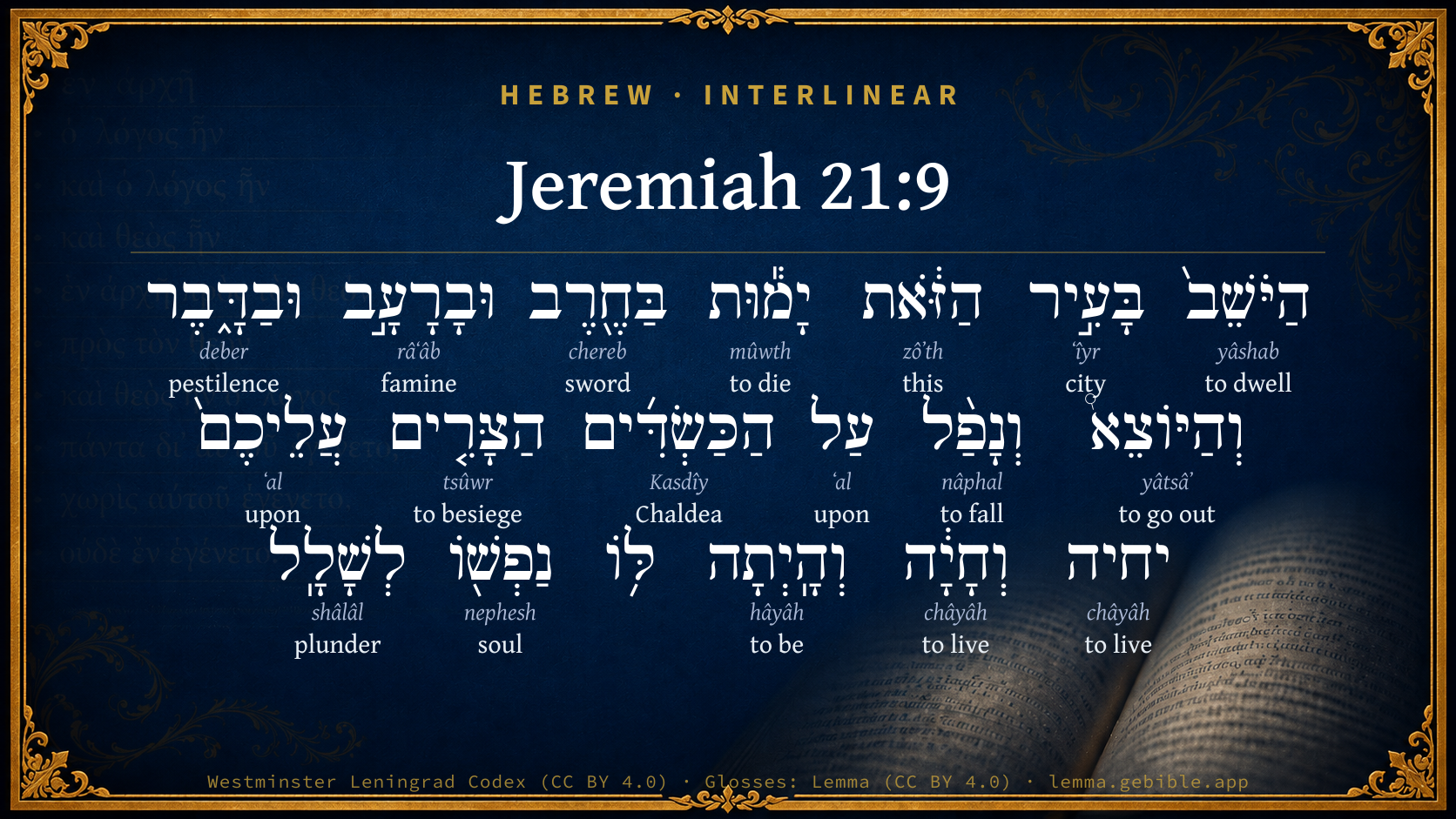
Hebrew (Westminster Leningrad Codex) Jeremiah 21:9 appears in the Hebrew Old Testament. The text above is from the Westminster Leningrad Codex. Each word links to its Strong’s number, a concise gloss, and parsing drawn from the Open Scriptures Hebrew Bible morphology. Click any word for its full Brown-Driver-Briggs (BDB) entry.
Download image
Cite this verse

Jeremiah 21:9 (World English Bible). Public Domain. Lemma interlinear Bible study tool, https://lemma.gebible.app/v/jeremiah/21/9.

Show BibTeX & RIS
BibTeX
RIS
English Translation
He who remains in this city shall die by the sword, and by the famine, and by the pestilence; but he who goes out, and passes over to the Chaldeans who besiege you, he shall live, and his life shall be to him for a prey.
World English Bible · Public Domain
Download a study sheet

One document with this verse’s original text, its word-by-word gloss line, the meaning frame, cross-references with their text, attributed commentary, and full source and license credits — printable, and it pastes into notes with its structure intact.

This verse Autodidact and up

Study sheet (.html) Plain text (.txt)

A passage Seminary Student

Up to 50 verses in one chapter. A passage sheet keeps up to 6 commentary sources and 12 cross-references per verse, in the order this page ranks them, and says so on the sheet whenever that leaves anything out. Ask for a single verse and you get the Autodidact verse sheet above.

Everything on this page stays free to read, with no account — the sheet is a download of what is already on screen, not access to it.

Want to remove ads? Support Godless Engineer
Compare translations 3

The same verse in 3 English versions, stacked beneath the original-language interlinear above. Click any original word for its lexicon entry.

Each is an independent rendering of the whole verse — the interlinear is not word-aligned to these translations.

Highlighted words mark where these versions differ — a whole-verse word diff, not a word-by-word alignment.

  • World English Bible Public Domain
    He who remains in this city shall die by the sword, and by the famine, and by the pestilence; but he who goes out, and passes over to the Chaldeans who besiege you, he shall live, and his life shall be to him for a prey.
  • King James Version Public Domain
    He that abideth in this city shall die by the sword, and by the famine, and by the pestilence: but he that goeth out, and falleth to the Chaldeans that besiege you, he shall live, and his life shall be unto him for a prey.
  • unfoldingWord Literal Text CC BY-SA 4.0
    The one dwelling in this city will die by the sword and by the famine and by the plague. But the one going out and falling upon the Chaldeans who are besieging against you will live, and his life will be to him for spoil.

unfoldingWord Literal Text — © unfoldingWord, licensed CC BY-SA 4.0. Word-aligned USFM3 via Door43 (git.door43.org/unfoldingWord/en_ult).

Versions to compare (up to 4)

3 of 4 selected

Show all 18 translations

Every available English version of this verse, each an independent rendering of the whole verse.

  • World English Bible Public Domain
    He who remains in this city shall die by the sword, and by the famine, and by the pestilence; but he who goes out, and passes over to the Chaldeans who besiege you, he shall live, and his life shall be to him for a prey.
  • Berean Standard Bible Public Domain
    Whoever stays in this city will die by sword and famine and plague, but whoever goes out and surrenders to the Chaldeans who besiege you will live; he will retain his life like a spoil of war.
  • Majority Standard Bible Public Domain
    Whoever stays in this city will die by sword and famine and plague, but whoever goes out and surrenders to the Chaldeans who besiege you will live; he will retain his life like a spoil of war.
  • King James Version Public Domain
    He that abideth in this city shall die by the sword, and by the famine, and by the pestilence: but he that goeth out, and falleth to the Chaldeans that besiege you, he shall live, and his life shall be unto him for a prey.
  • American Standard Version (1901) Public Domain
    He that abideth in this city shall die by the sword, and by the famine, and by the pestilence; but he that goeth out, and passeth over to the Chaldeans that besiege you, he shall live, and his life shall be unto him for a prey.
  • Revised Version (1885) Public Domain
    He that abideth in this city shall die by the sword, and by the famine, and by the pestilence: but he that goeth out, and falleth away to the Chaldeans that besiege you, he shall live, and his life shall be unto him for a prey.
  • Geneva Bible (1599) Public Domain
    He that abideth in this citie, shall dye by the sword and by the famine, and by the pestilence: but he that goeth out, and falleth to the Caldeans, that besiege you, he shall liue, and his life shalbe vnto him for a pray.
  • Douay-Rheims (1899) Public Domain
    He that shall abide in this city, shall die by the sword, and by the famine, and by the pestilence: but he that shall go out and flee over to the Chaldeans, that besiege you, shall live, and his life shall be to him as a spoil.
  • Young's Literal Translation Public Domain
    Whoso is abiding in this city -- dieth, By sword, and by famine, and by pestilence, And whoso is going forth, And hath fallen unto the Chaldeans, Who are laying siege against you -- liveth, And his life hath been to him for a spoil.
  • Literal Standard Version CC BY-SA 4.0
    Whoever is abiding in this city—dies, || By sword, and by famine, and by pestilence, || And whoever is going forth, || And has fallen to the Chaldeans, || Who are laying siege against you—lives, || And his life has been for a spoil to him.
  • Unlocked Literal Bible CC BY-SA 4.0
    Anyone staying in this city will die by the sword, famine, and plague; but anyone going out and falling on his knees before the Chaldeans who have closed in against you will live. He will escape with his life.
  • unfoldingWord Literal Text CC BY-SA 4.0
    The one dwelling in this city will die by the sword and by the famine and by the plague. But the one going out and falling upon the Chaldeans who are besieging against you will live, and his life will be to him for spoil.
  • Darby Bible Public Domain
    He that abideth in this city shall die by the sword, and by the famine, and by the pestilence; but he that goeth out, and deserteth to the Chaldeans that besiege you, he shall live, and his life shall be unto him for a prey.
  • World Messianic Bible Public Domain
    He who remains in this city will die by the sword, by the famine, and by the pestilence, but he who goes out and passes over to the Kasdim who besiege you, he will live, and he will escape with his life.
  • Webster's Bible Public Domain
    He that abideth in this city shall die by the sword, and by the famine, and by the pestilence: but he that goeth out, and falleth to the Chaldeans that besiege you, he shall live, and his life shall be to him for a prey.
  • Free Bible Version CC BY-SA 4.0
    If you stay in this city you'll die either by sword or famine or plague, but if you leave and surrender to the Babylonians who are besieging you, you will live. In fact it will be like gaining your life as plunder from a war.
  • Bible in Basic English Public Domain
    He who keeps in this town will come to his death by the sword and through need of food and through disease; but he who goes out and gives himself up to the Chaldaeans who are shutting you in, will go on living, and will keep his life safe.
  • JPS Tanakh (1917) Public Domain
    He that abideth in this city shall die by the sword, and by the famine, and by the pestilence; but he that goeth out, and falleth away to the Chaldeans that besiege you, he shall live, and his life shall be unto him for a prey.

Literal Standard Version (2020), Covenant Press — licensed CC BY-SA 4.0. Text via the HelloAO Bible API (eBible.org). Unlocked Literal Bible (unfoldingWord) — licensed CC BY-SA 4.0. Text via the HelloAO Bible API (eBible.org). unfoldingWord Literal Text — © unfoldingWord, licensed CC BY-SA 4.0. Word-aligned USFM3 via Door43 (git.door43.org/unfoldingWord/en_ult). Free Bible Version, Dr. Jonathan Gallagher — licensed CC BY-SA 4.0. Text via the HelloAO Bible API (eBible.org).

Word by word

More ways to search: Search by grammar → Find every occurrence → Compare this word →

Practice this passage: Drill this verse → Learn its vocabulary →

הַצָּרִ֤ים
tsûwr
H6696
“the · besieging”
Particle, Definite Article + Verb, Qal, Participle Active, Masculine, Plural, Absolute
Part of Speech
Particle + Verb
Stem
Qal
Form
Participle Active
Gender
Masculine
Number
Plural
State
Absolute
Full BDB Definition

Origin: a primitive root

TWOT: 1898 , 1899 , 1900

to bind, besiege, confine, cramp - (Qal) - to confine, secure - to shut in, beseige - to shut up, enclose - (Qal) to show hostility to, be an adversary, treat as foe - (Qal) to form, fashion, delineate
  1. הַיֹּשֵׁב֙ yâshab H3427 “the · dwelling” Particle, Definite Article + Verb, Qal, Participle Active, Masculine, Singular, Absolute
  2. בָּעִ֣יר ʻîyr H5892 “in/at the · city” Preposition, Determined + Noun, Common, Feminine, Singular, Absolute
  3. הַזֹּ֔את zôʼth H2063 “the · this” Particle, Definite Article + Pronoun, Demonstrative, Feminine, Singular
  4. יָמ֕וּת mûwth H4191 “to die” Verb, Qal, Imperfect, 3rd Person, Masculine, Singular
  5. בַּחֶ֖רֶב chereb H2719 “in/at the · sword” Preposition, Determined + Noun, Common, Feminine, Singular, Absolute
  6. וּבָרָעָ֣ב râʻâb H7458 “and · in/at the · famine” Conjunction + Preposition, Determined + Noun, Common, Masculine, Singular, Absolute
  7. וּבַדָּ֑בֶר deber H1698 “and · in/at the · pestilence” Conjunction + Preposition, Determined + Noun, Common, Masculine, Singular, Absolute
  8. וְהַיּוֹצֵא֩ yâtsâʼ H3318 “and · the · going out” Conjunction + Particle, Definite Article + Verb, Qal, Participle Active, Masculine, Singular, Absolute
  9. וְנָפַ֨ל nâphal H5307 “and · to fall” Conjunction + Verb, Qal, Sequential Perfect, 3rd Person, Masculine, Singular
  10. עַל ʻal H5921 “upon” Preposition
  11. הַכַּשְׂדִּ֜ים Kasdîy H3778 “the · Chaldea” Particle, Definite Article + Noun, Proper
  12. עֲלֵיכֶם֙ ʻal H5921 “upon · you” Preposition + Suffix, Personal, 2nd Person, Masculine, Plural
  13. יחיה châyâh H2421 “to live” Verb, Qal, Imperfect, 3rd Person, Masculine, Singular
  14. וְחָיָ֔ה châyâh H2421 “and · to live” Conjunction + Verb, Qal, Sequential Perfect, 3rd Person, Masculine, Singular
  15. וְהָֽיְתָה hâyâh H1961 “and · to be” Conjunction + Verb, Qal, Sequential Perfect, 3rd Person, Feminine, Singular
  16. נַפְשׁ֖וֹ nephesh H5315 “soul · his” Noun, Common, Both, Singular, Construct + Suffix, Personal, 3rd Person, Masculine, Singular
  17. לְשָׁלָֽל shâlâl H7998 “to/for · plunder” Preposition + Noun, Common, Masculine, Singular, Absolute

About this verse

These counts appear in no published source. They are computed here, from the morphology-tagged text and Lemma’s own curated glosses. What Lemma adds →

19
words
16
distinct lemmas
Prophets
section

Shared distinctive vocabulary

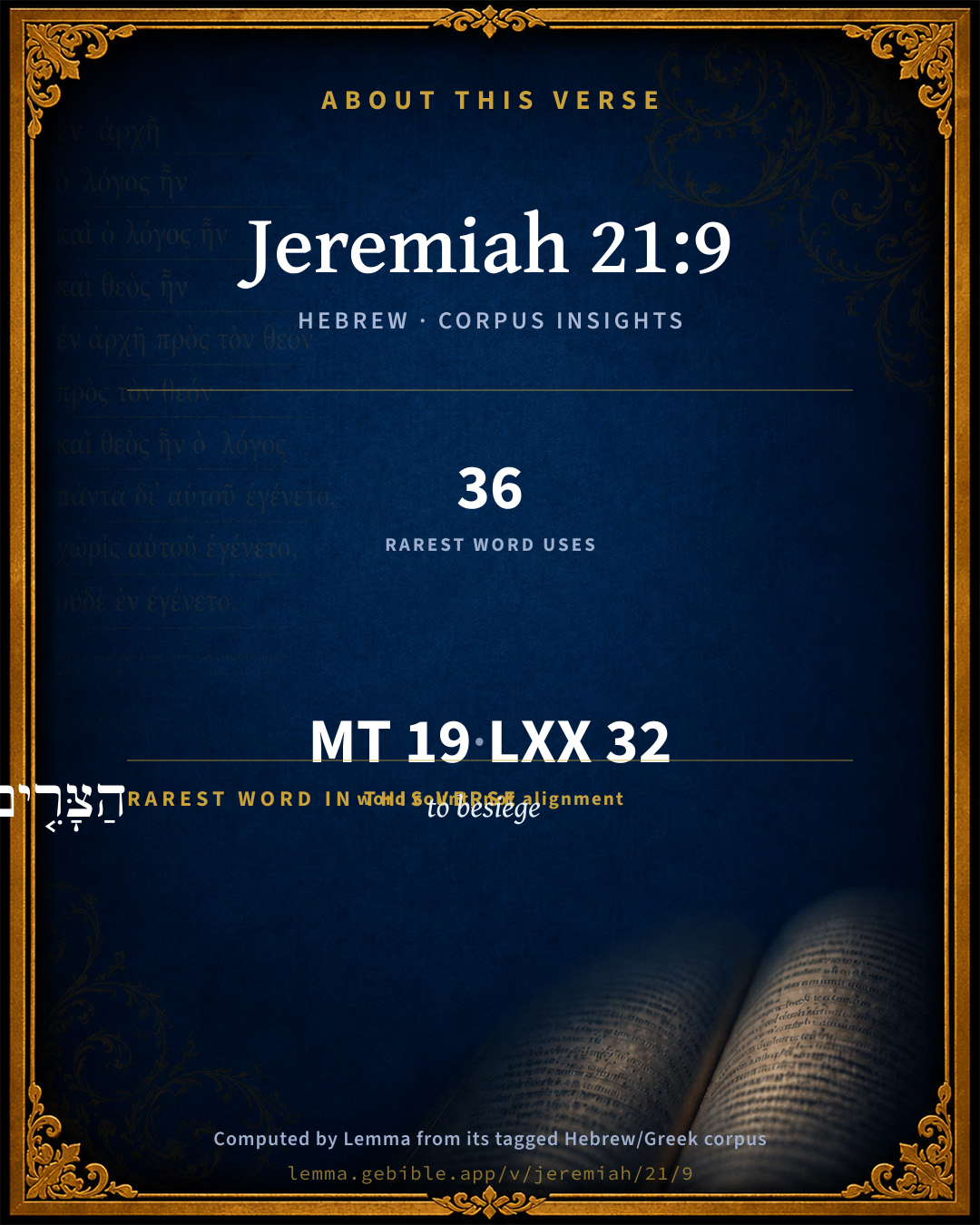
הַצָּרִ֤ים to besiege H6696 occurs in 36 verses of the Hebrew Bible. Also found in:

Grammatical profile

  • 8 verbs
  • 7 nouns
  • 1 pronoun
  • 3 prepositions

Verb forms

  • הַיֹּשֵׁב֙ Qal · Participle Active
  • יָמ֕וּת Qal · Imperfect
  • וְהַיּוֹצֵא֩ Qal · Participle Active
  • וְנָפַ֨ל Qal · Sequential Perfect
  • הַצָּרִ֤ים Qal · Participle Active
  • יחיה Qal · Imperfect
  • וְחָיָ֔ה Qal · Sequential Perfect
  • וְהָֽיְתָה Qal · Sequential Perfect

Repetition

Words recur within this verse — often emphatic in Hebrew:

  • עַל upon H5921 ×2
  • יחיה to live H2421 ×2

Hebrew & Septuagint length

In the original languages it is 19 Hebrew tokens and 32 Greek tokens — but the two are counted differently (Hebrew bundles its prefixes and suffixes into one token; the Greek is in lemma form), so that isn’t a like-for-like length.

Cross-references

7

Topical passages linked to Jeremiah 21:9 in the Treasury of Scripture Knowledge — connected by theme and wording, ordered by reader-vote popularity; previews shown in the World English Bible.

  • Jeremiah 38:2 Thus says Yahweh, He who remains in this city shall die by the sword, by the famine, and by the pestilence; but he who goes forth to the Chaldeans shall live, and his life shall be to him for a prey, and he shall live.
  • Jeremiah 39:18 For I will surely save you, and you shall not fall by the sword, but your life shall be for a prey to you; because you have put your trust in me, says Yahweh.
  • Jeremiah 45:5 Seek you great things for yourself? Don't seek them; for, behold, I will bring evil on all flesh, says Yahweh; but your life will I give to you for a prey in all places where you go.
  • Jeremiah 14:12 When they fast, I will not hear their cry; and when they offer burnt offering and meal-offering, I will not accept them; but I will consume them by the sword, and by the famine, and by the pestilence.
  • Jeremiah 38:17–23 Then said Jeremiah to Zedekiah, Thus says Yahweh, the God of hosts, the God of Israel: If you will go forth to the king of Babylon's princes, then your soul shall live, and this city shall not be burned with fire; and you shall live, and your house.
  • Jeremiah 21:7 Afterward, says Yahweh, I will deliver Zedekiah king of Judah, and his servants, and the people, even such as are left in this city from the pestilence, from the sword, and from the famine, into the hand of Nebuchadrezzar king of Babylon, and into the hand of their enemies, and into the hand of those who seek their life: and he shall strike them with the edge of the sword; he shall not spare them, neither have pity, nor have mercy.
  • Jeremiah 27:13 Why will you die, you and your people, by the sword, by the famine, and by the pestilence, as Yahweh has spoken concerning the nation that will not serve the king of Babylon?

Cross-references courtesy of OpenBible.info (CC BY 4.0).

Hebrew and Greek witnesses Masoretic Hebrew ↔ Greek Septuagint

The same verse in the two great witnesses to the Old Testament, shown verse-for-verse.

These are two independent witnesses, not word-aligned to each other, and the Septuagint is shown in lemma (dictionary) form.

Hebrew Jeremiah 21:9 Masoretic · Westminster Leningrad Codex

הַיֹּשֵׁב֙ בָּעִ֣יר הַזֹּ֔את יָמ֕וּת בַּחֶ֖רֶב וּבָרָעָ֣ב וּבַדָּ֑בֶר וְהַיּוֹצֵא֩ וְנָפַ֨ל עַל הַכַּשְׂדִּ֜ים הַצָּרִ֤ים עֲלֵיכֶם֙ יחיה וְחָיָ֔ה וְהָֽיְתָה לּ֥וֹ נַפְשׁ֖וֹ לְשָׁלָֽל

He who remains in this city shall die by the sword, and by the famine, and by the pestilence; but he who goes out, and passes over to the Chaldeans who besiege you, he shall live, and his life shall be to him for a prey.

World English Bible · Public Domain

Greek LXX Structure differs

In the Septuagint, Jeremiah is about an eighth shorter than the Hebrew and arranges its material differently — the Oracles Against the Nations (Hebrew chapters 46–51) appear in the middle of the Greek book, after 25:13. Because the chapter and verse boundaries do not line up, a verse-for-verse comparison with the Hebrew is not shown.

A verse-for-verse comparison isn’t shown here because the chapters and verses don’t line up. Switch to the LXX edition with the MT / LXX toggle above to read the Greek directly.

Hebrew: Westminster Leningrad Codex (CC BY 4.0). Greek: Septuagint (public domain); English from a public-domain English Septuagint. How the Septuagint differs from the Hebrew →

Targum (Aramaic paraphrase)

1

The Targum is the ancient Jewish Aramaic paraphrase of the Hebrew Scriptures — an interpretive translation, not the Hebrew text itself. Onkelos (literal) and Pseudo-Jonathan (expansive) render the Torah, and Jonathan the Prophets. Coverage is partial: where no permissively-licensed English translation exists for a verse, only the Aramaic is shown. This is verse-level text, not a word-by-word alignment to the Hebrew.

  1. Targum Jonathan Prophets (Joshua–Malachi)
    דְיָתֵיב בְּקַרְתָּא הָדָא יִתְקְטֵיל בְּחַרְבָּא וּבְכַפְנָא וּבְמוֹתָא וּדְיִפּוֹק וְיִשְׁתְּמַע לְכַשְׂדָאֵי דְצָיְרִין עֲלֵיכוֹן וִיחֵי וּתְהִי לֵיהּ נַפְשֵׁיהּ לְשֵׁיזָבָא:

    (no public-domain English translation for this verse)

    Targum Jonathan — Aramaic: “Mikraot Gedolot” (public domain). English: “Sefaria Community Translation” (CC0 1.0 (public-domain dedication)); “London "Chaldee Paraphrase," 1871” (public domain). Text via Sefaria.

Commentary

Notes on Jeremiah 21:9 from classic Christian and Jewish commentators (each source and its license shown beneath its notes). The classic Christian expositions comment on the surrounding passage and are grouped to its opening verse, so a note may address several verses; the Jewish commentaries on the Tanakh (Rashi and others) are per-verse, so they appear only where the commentator wrote on this verse.

Lemma curates 59 commentaries, every one of them public domain or Creative Commons licensed, each selected and text-cleaned for this edition rather than reprinted as found. About our sources →

Trapp's Complete Commentary

John Trapp

Jer 21:9 He that abideth in this city shall die by the sword, and by the famine, and by the pestilence: but he that goeth out, and falleth to the Chaldeans that besiege you, he shall live, and his life shall be unto him for a prey.

Ver. 9. His life shall be unto him for a prey.] And lawful prey or booty is counted good purchase. {Isa 49:24} He shall save his life, though he lose his goods. And it should not be grievous to any man to sacrifice his estate to the service of his life. Why else did Solomon make so many hundreds of targets and shields of gold?

John Trapp, A Commentary or Exposition upon All the Books of the Old and New Testament (1647–1656) — public domain. Text from a community e-Sword module.

Geneva Bible (1599)

Geneva Bible translators

As a thing recovered from extreme danger, Jer. 37:2, 39:18 and 45:5.

Geneva Bible (1599) marginal notes — public domain. Text via Bolls.life.

Jamieson, Fausset & Brown

Robert Jamieson, A. R. Fausset & David Brown

(Jer 38:2, Jer 38:17-18).

falleth to--deserts to.

life . . . a prey--proverbial, to make one's escape with life, like a valuable spoil or prey that one carries off; the narrowness of the escape, and the joy felt at it, are included in the idea (Jer 39:18).

Jamieson, Fausset & Brown — Commentary Critical and Explanatory on the Whole Bible (1871) — public domain (CC PDM 1.0). Text via the HelloAO Bible API.

John Calvin's Commentaries

Thou shalt say to this people, Thus saith Jehovah, Behold I set before you the way of life and the way of death. Which was the way of death? Whosoever, he says, abides in this city, shall die by the sword, or by famine, or by pestilence This was incredible to the Jews, and they were no doubt inflamed with rage when they heard that they were to perish in the holy city which God protected; for there he had his sanctuary, and there his rest was. But the Prophet had already dissipated all these delusions; he could, therefore, boldly threaten them, though they still alleged their vain pretences: he had shewed reasons enough why they could hope for nothing less than exile from God, for they had so many times, and so obstinately, and in such various ways provoked him. This, then, he says, is the way of death, it is by remaining in the city. And he mentions several kinds of evils, and shews that God was armed not only with a hostile sword, but would also employ famine and pestilence, so that he would kill some with the sword, consume some with famine, and destroy some with pestilence. Hence he shews that they would be so assailed on every side, that it would be in vain to attempt to escape; for when they shunned the sword, pestilence would meet them; and when they were preserved from the pestilence, the famine would consume them.

He then adds, But he who went out to the Chaldeans, who besieged the city, etc., that is, who willingly surrendered himself; for it was a sign of obedience when the Jews with a resigned mind received correction; and it was also an evidence of repentance, for they thus confessed that they were worthy of the heaviest punishment. This is the reason why the Prophet represents it as the way of life to go out willingly, and to make a surrender of themselves of their own accord to their enemies. And by saying, who besiege you, הצרים עליכם, etserim olicam, he wished to anticipate objections which any one of the people might have alleged, — “How can I dare thus to expose myself? for the Chaldeans besiege us, and it will be all over with me as to my life if I go forth as a suppliant to them.” By no means, says the Prophet, for though they carry on a deadly war with the city, yet every one who of his own accord goes forth to them shall be safe, and shall find them ready to shew mercy. God would not have promised this had he not the Chaldeans in his own power, so that he could turn their minds as he pleased.

As to the verb נפל, nuphel, it means strictly to fall; but I consider that it signifies here to dwell, as in Genesis 25:27, where it is said that Ishmael dwelt in the sight of, or over against his brethren. They who render it “died” touch neither heaven nor earth. Some read, “his lot fell among his brethren;” but this is an unnatural rendering. There is, then, no doubt but that the verb means often to lie down, and hence to dwell; and yet I allow that the Prophet alludes to subjection; for we must remember what must have been their condition when they went over to the Chaldeans; they must have been subjected to great reproach. It was then no small humiliation; but yet we may properly render the verb to dwell. He, then, who went out to the Chaldeans and dwelt with them, that is, who suffered himself to be led into exile, or who migrated according to their will from his own country to a foreign land — he, he says, shall live, and his life shall be for a prey, that is, he shall save his life, as when any one finds a prey and takes it as his own by stealth; for prey is to be taken here as an accidental gain. Whosoever, then, he says, shall not deem it too grievous a thing to submit to the Chaldeans, shall at least save his life.

In short, God intimates that the wickedness of the people had advanced so far, that it was not right to forgive them. What, then, was to be done by them? to submit with resignation and humility to a temporal punishment, and thus to cease to shut up the door of God’s mercy. He, however, teaches them at the same time that no salvation could be hoped for by them until they were chastised. And hence we may learn a useful doctrine, and that is, that whenever we provoke God’s wrath by our perverseness, we cannot be exempt from all punishment; and that we ought not to be impatient, especially when he punishes us moderately; and that provided we obtain eternal mercy, we ought submissively to bear paternal corrections. It follows, —

John Calvin's Commentaries (1540-1563) — public domain. Text from the Calvin Translation Society English edition (1840s-50s) via the Christian Classics Ethereal Library (ccel.org). Calvin's coverage is partial (roughly two-thirds of the Bible); uncommented books and verses are honest gaps, never fabricated. The 19th-century editor's footnotes and remarks are omitted so the notes are faithfully Calvin's own voice.

Ellicott's Commentary for English Readers

(9) And falleth to the Chaldeans.—The words must have seemed to the messengers to counsel treachery and desertion, and were remembered against the prophet in the taunt of Jer_37:13. They were, however, acted on by not a few (Jer_39:9; Jer_52:15).

His life shall be unto him for a prey.—The phrase is characteristic of Jeremiah, and forcibly illustrates the misery of the time. Life itself was not a secure possession, but as the spoil which a man seizes on the field of battle, and with which he hastens away, lest another should deprive him of it. It occurs again in Jer_39:18; Jer_45:5.

A Bible Commentary for English Readers, edited by Charles John Ellicott (1878–1897) — public domain. Text from a community e-Sword module.

The Cambridge Bible for Schools and Colleges

gen. ed. J. J. S. Perowne

9. for a prey] something snatched up hurriedly and borne away with him rather than his secure possession. For the phrase cp. Jer_38:2, Jer_39:18, Jer_45:5.

The Cambridge Bible for Schools and Colleges (gen. ed. J. J. S. Perowne; Cambridge University Press, 1878–1918) — public domain. Text from a community e-Sword module.

John Gill's Exposition

He that abideth in this city,.... Imagining himself safe there; not fearing its being taken by the king of Babylon; though it was so often foretold by the prophet of the Lord that it should:

shall die by the sword, and by the famine, and by the pestilence: by the first of these, in sallying out against the enemy; and by the other two, which raged within the city:

but he that goeth out, and falleth to the Chaldeans that besiege you,

he shall live; not fall upon them, as the words may be literally rendered; so it would describe such that went out of the city and sallied upon them; whereas it designs such who should go out of the city, and surrender themselves unto the Chaldeans; submit to them, so as to obey them, as the Targum adds; such shall have their lives spared:

and his life shall be unto him for a prey; it shall be like a spoil or booty taken out of an enemy's hands; it shall be with difficulty obtained, and with joy possessed, as a prey or spoil is.

John Gill's Exposition of the Whole Bible (1746–1763) — public domain (CC PDM 1.0). Text via the HelloAO Bible API.

Albert Barnes' Notes on the Bible

He that ... falleth to the Chaldeans - This was to counsel desertion, and would have been treason in an ordinary man: but the prophets Spoke with an authority above that even of the king, and constantly interfered in political matters with summary decisiveness. Compare Mat 24:16-18.

A prey - Something not a man’s own, upon which he seizes in the midst of danger, and hurries away with it. So must the Jews hurry away with their lives as something more than they had a right to, and place them in the Chaldaean camp as in a place of safety.

Albert Barnes' Notes on the Bible (1834–1885) — public domain. Text from a community e-Sword/MySword module.

Haydock's Catholic Bible Commentary

Spoil. He shall be happy to escape naked, chap. xxxviii. 3. (Calmet)

George Leo Haydock (1774–1849), Haydock's Catholic Family Bible and Commentary, 1859 edition — public domain. Excludes Psalms (Douay-Rheims chapter numbering differs from Protestant) and Deuterocanonical books (Catholic canon only).

Matthew Poole's English Annotations

But certainly, if ever any man spake high treason, this prophet now did it, when there was an enemy besieging them, telling them, that if they would save their lives, they must revolt from their king, and join with their enemies. All that can be said in excuse for the prophet is, that this was a Divine revelation to him, and a message sent to the king himself.

His life shall be given him for a prey, appeareth to have been a proverbial expression, either signifying.

1. A man’s possession of his life, as a prey or booty recovered from death, or the hand of the enemy; or,

2. A man’s rejoicing in the saving of his life, as if he had got some notable booty.

Matthew Poole's English Annotations on the Holy Bible (1683–1685) — public domain. Text from a community e-Sword/MySword module.

Whedon's Commentary on the Bible

Daniel D. Whedon

9. Falleth to the Chaldeans — That is, goes over to them. This apparently most treasonable intimation is but another way of saying that all resistance is useless. The city is doomed. Inevitable defeat is before them.

Life shall be unto him for a prey — The ingenious note of Dean Smith on this phrase is hardly warranted: “A prey is something not a man’s own, upon which he seizes in the midst of danger, and hurries away with it. So must the Jews hurry away with their lives, as something more than they had a right to, and place them in the Chaldean camp as a place of safety.” The simple idea is, he shall preserve this most precious of all his treasures from the rapacious ruin.

Daniel D. Whedon (gen. ed.), Commentary on the Old and New Testaments (1874–1909) — public domain. Text from a community e-Sword module.

The Pulpit Commentary

He that abideth in this city, etc. No doubt Jeremiah often gave this counsel to his fellow-citizens, (comp. Jer_38:1, Jer_38:17) and it appears from Jer_38:19 Jer_39:9 Jer_52:15, that many of the Jews acted in accordance with it. Falleth; more distinctly, falleth away; (as Jer_37:14, Authorized Version) i.e. goeth over to.

The Pulpit Commentary (1880–1919), ed. H.D.M. Spence-Jones & Joseph S. Exell — public domain. Text from a community e-Sword module.

John Wesley's Explanatory Notes

His life - This is a proverbial expression, signifying a man's possession of his life as a prey, or booty recovered from the enemy.

John Wesley, Explanatory Notes Upon the Whole Bible (1754–1765) — public domain. Text via the GEBible commentary corpus.

Rashi

Rabbi Shlomo Yitzchaki (Rashi)

and he will have his life as a prey As a man who plunders booty, and he seizes and goes away, so will his life be plundered from death by the slayers.

Rashi on the Tanakh — English translations: “The Judaica Press complete Tanach with Rashi, translated by A. J. Rosenberg” (CC BY 4.0); “Pentateuch with Rashi's commentary by M. Rosenbaum and A.M. Silbermann, 1929-1934” (public domain); “The Metsudah Tanach series, Lakewood, N.J” (CC BY 4.0); and “The Book of Joshua, Metsudah Publications, 1997” (CC BY 4.0). Text via Sefaria.

Lesson kit

Teaching starters — assembled from the data on this page, not authored interpretation. Every prompt links to the verse data it draws on. Edit before teaching.

Jeremiah, in the Prophets, opens this verse with 19 words (16 distinct Hebrew lemmas). Its most distinctive word is tsûwr (“to besiege”). A historical commentator’s framing appears above. Read the whole chapter for the surrounding context.

Discussion questions

  1. How does “to besiege” (tsûwr) shape what this verse is saying?
  2. How does Exodus 23:22, which shares the word «to besiege», read alongside this verse?
  3. What does the repetition of “upon” (2× in this one verse) do in this verse?
  4. The translations on this page render this verse differently — a whole-verse word diff, not a word-by-word alignment. What might account for the different wordings?
  5. «הַיֹּשֵׁב֙» is a Qal Participle Active verb. How does that grammatical form shape the action described?
  6. Compare how Trapp's Complete Commentary and Geneva Bible (1599) read this verse. Where do they agree or differ?

Things to notice

Reading settings

Reading text

Shown beneath each verse's original-language words.

Old Testament
Old Testament edition

Read the OT as the Masoretic Hebrew (MT) or the Greek Septuagint (LXX).

English shown for the Greek Septuagint (in the Hebrew ↔ Greek comparison).

Comparing translations? Open the Compare panel on any verse page to stack up to four side by side.