
Psalms 30:3

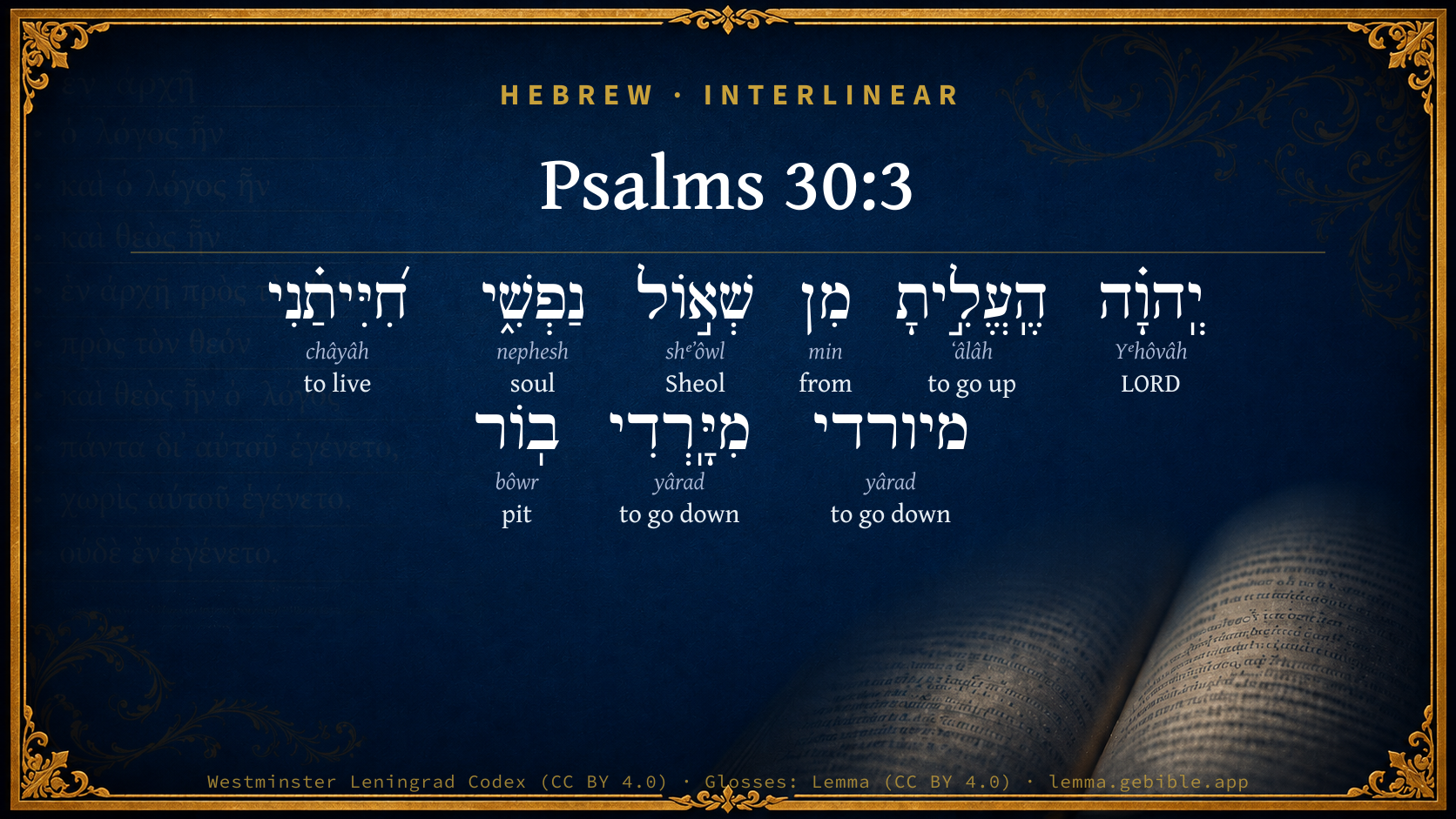
Hebrew (Westminster Leningrad Codex) Psalms 30:3 appears in the Hebrew Old Testament. The text above is from the Westminster Leningrad Codex. Each word links to its Strong’s number, a concise gloss, and parsing drawn from the Open Scriptures Hebrew Bible morphology. Click any word for its full Brown-Driver-Briggs (BDB) entry.
Download image
Cite this verse

Psalms 30:3 (World English Bible). Public Domain. Lemma interlinear Bible study tool, https://lemma.gebible.app/v/psalms/30/3.

Show BibTeX & RIS
BibTeX
RIS
English Translation
Yahweh, you have brought up my soul from Sheol. You have kept me alive, that I should not go down to the pit.
World English Bible · Public Domain
Download a study sheet

One document with this verse’s original text, its word-by-word gloss line, the meaning frame, cross-references with their text, attributed commentary, and full source and license credits — printable, and it pastes into notes with its structure intact.

This verse Autodidact and up

Study sheet (.html) Plain text (.txt)

A passage Seminary Student

Up to 50 verses in one chapter. A passage sheet keeps up to 6 commentary sources and 12 cross-references per verse, in the order this page ranks them, and says so on the sheet whenever that leaves anything out. Ask for a single verse and you get the Autodidact verse sheet above.

Everything on this page stays free to read, with no account — the sheet is a download of what is already on screen, not access to it.

Want to remove ads? Support Godless Engineer
Compare translations 3

The same verse in 3 English versions, stacked beneath the original-language interlinear above. Click any original word for its lexicon entry.

Each is an independent rendering of the whole verse — the interlinear is not word-aligned to these translations.

Highlighted words mark where these versions differ — a whole-verse word diff, not a word-by-word alignment.

  • World English Bible Public Domain
    Yahweh, you have brought up my soul from Sheol. You have kept me alive, that I should not go down to the pit.
  • King James Version Public Domain
    O LORD, thou hast brought up my soul from the grave: thou hast kept me alive, that I should not go down to the pit.
  • unfoldingWord Literal Text CC BY-SA 4.0
    Yahweh, you have brought up my soul from Sheol; you have kept me alive from the ones going down to the pit.

unfoldingWord Literal Text — © unfoldingWord, licensed CC BY-SA 4.0. Word-aligned USFM3 via Door43 (git.door43.org/unfoldingWord/en_ult).

Versions to compare (up to 4)

3 of 4 selected

Show all 18 translations

Every available English version of this verse, each an independent rendering of the whole verse.

  • World English Bible Public Domain
    Yahweh, you have brought up my soul from Sheol. You have kept me alive, that I should not go down to the pit.
  • Berean Standard Bible Public Domain
    O LORD, You pulled me up from Sheol; You spared me from descending into the Pit.
  • Majority Standard Bible Public Domain
    O LORD, You pulled me up from Sheol; You spared me from descending into the Pit.
  • King James Version Public Domain
    O LORD, thou hast brought up my soul from the grave: thou hast kept me alive, that I should not go down to the pit.
  • American Standard Version (1901) Public Domain
    O Jehovah, thou hast brought up my soul from Sheol; Thou hast kept me alive, that I should not go down to the pit.
  • Revised Version (1885) Public Domain
    O LORD, thou hast brought up my soul from Sheol: thou hast kept me alive, that I should not go down to the pit.
  • Geneva Bible (1599) Public Domain
    O Lord, thou hast brought vp my soule out of the graue: thou hast reuiued me from them that goe downe into the pit.
  • Douay-Rheims (1899) Public Domain
    O Lord my God, I have cried to thee, and then hast healed me.
  • Young's Literal Translation Public Domain
    Jehovah, Thou hast brought up from Sheol my soul, Thou hast kept me alive, From going down `to' the pit.
  • Literal Standard Version CC BY-SA 4.0
    YHWH, You have brought up my soul from Sheol, || You have kept me alive, || From going down [to] the pit.
  • Unlocked Literal Bible CC BY-SA 4.0
    Yahweh, you have brought up my soul from Sheol; you have kept me alive from going down to the grave.
  • unfoldingWord Literal Text CC BY-SA 4.0
    Yahweh, you have brought up my soul from Sheol; you have kept me alive from the ones going down to the pit.
  • Darby Bible Public Domain
    Jehovah, thou hast brought up my soul from Sheol, thou hast quickened me from among those that go down to the pit.
  • World Messianic Bible Public Domain
    LORD, you have brought up my soul from Sheol. You have kept me alive, that I should not go down to the pit.
  • Webster's Bible Public Domain
    \\30:2\\O LORD my God, I cried to thee, and thou hast healed me.
  • Free Bible Version CC BY-SA 4.0
    Lord, you rescued me from the grave, you brought me back to life, saving me from going down into the pit of death.
  • Bible in Basic English Public Domain
    O Lord, you have made my soul come again from the underworld: you have given me life and kept me from going down among the dead.
  • JPS Tanakh (1917) Public Domain
    (30-4) O LORD, Thou broughtest up my soul from the nether-world; Thou didst keep me alive, that I should not go down to the pit.

Literal Standard Version (2020), Covenant Press — licensed CC BY-SA 4.0. Text via the HelloAO Bible API (eBible.org). Unlocked Literal Bible (unfoldingWord) — licensed CC BY-SA 4.0. Text via the HelloAO Bible API (eBible.org). unfoldingWord Literal Text — © unfoldingWord, licensed CC BY-SA 4.0. Word-aligned USFM3 via Door43 (git.door43.org/unfoldingWord/en_ult). Free Bible Version, Dr. Jonathan Gallagher — licensed CC BY-SA 4.0. Text via the HelloAO Bible API (eBible.org).

Word by word

More ways to search: Search by grammar → Find every occurrence → Compare this word →

Practice this passage: Drill this verse → Learn its vocabulary →

שְׁא֣וֹל
shᵉʼôwl
H7585
“Sheol”
Noun, Proper
Part of Speech
Noun
Type
Proper
Full BDB Definition

Origin: from H7592

TWOT: 2303c

sheol, underworld, grave, hell, pit - the underworld - Sheol - the OT designation for the abode of the dead - place of no return - without praise of God - wicked sent there for punishment - righteous not abandoned to it - of the place of exile (figuratively) - of extreme degradation in sin
  1. יְֽהוָ֗ה Yᵉhôvâh H3068 “LORD” Noun, Proper
  2. הֶֽעֱלִ֣יתָ ʻâlâh H5927 “to go up” Verb, Hiphil, Perfect, 2nd Person, Masculine, Singular
  3. מִן min H4480 “from” Preposition
  4. נַפְשִׁ֑י nephesh H5315 “soul · my” Noun, Common, Both, Singular, Construct + Suffix, Personal, 1st Person, Common, Singular
  5. חִ֝יִּיתַ֗נִי châyâh H2421 “to live · me” Verb, Piel, Perfect, 2nd Person, Masculine, Singular + Suffix, Personal, 1st Person, Common, Singular
  6. מיורדי yârad H3381 “from · going down” Preposition + Verb, Qal, Participle Active, Masculine, Plural, Construct
  7. מִיָּֽרְדִי yârad H3381 “from · to go down · me” Preposition + Verb, Qal, Infinitive Construct + Suffix, Personal, 1st Person, Common, Singular
  8. בֽוֹר bôwr H953 “pit” Noun, Common, Masculine, Singular, Absolute

About this verse

These counts appear in no published source. They are computed here, from the morphology-tagged text and Lemma’s own curated glosses. What Lemma adds →

9
words
8
distinct lemmas
Wisdom
section

Grammatical profile

  • 4 verbs
  • 4 nouns
  • 1 preposition

Verb forms

  • הֶֽעֱלִ֣יתָ Hiphil · Perfect
  • חִ֝יִּיתַ֗נִי Piel · Perfect
  • מיורדי Qal · Participle Active
  • מִיָּֽרְדִי Qal · Infinitive Construct

Repetition

A word recurs within this verse — often emphatic in Hebrew:

  • מיורדי to go down H3381 ×2

Hebrew & Septuagint length

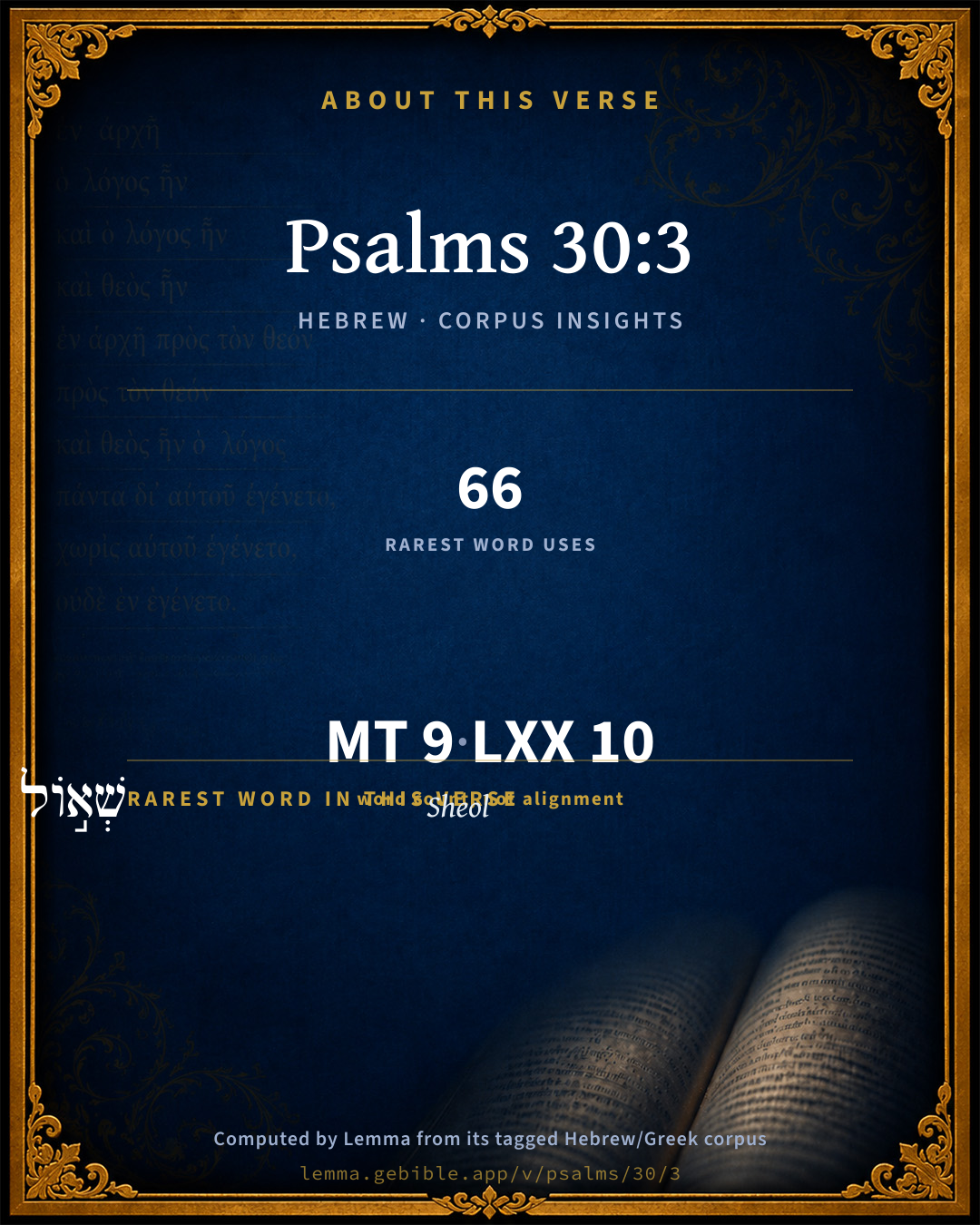
In English translation the verse runs 23 words from the Hebrew and 23 from the Septuagint (LXX English) — the same length.

A rough comparison of the two English renderings, which tokenize alike — not a word-level alignment.

Word counts can differ between the Hebrew and the Greek without any difference in meaning — e.g. the Hebrew direct-object marker אֵת has no separate Greek word, and Greek often adds the article ὁ.

In the original languages it is 9 Hebrew tokens and 10 Greek tokens — but the two are counted differently (Hebrew bundles its prefixes and suffixes into one token; the Greek is in lemma form), so that isn’t a like-for-like length.

Cross-references

11

Topical passages linked to Psalms 30:3 in the Treasury of Scripture Knowledge — connected by theme and wording, ordered by reader-vote popularity; previews shown in the World English Bible.

  • Psalms 16:10 For you will not leave my soul in Sheol, Neither will you allow your holy one to see corruption.
  • Psalms 86:13 For your loving kindness is great toward me. You have delivered my soul from the lowest Sheol.
  • Psalms 28:1 To you, Yahweh, I call. My rock, don't be deaf to me; Lest, if you are silent to me, I would become like those who go down into the pit.
  • Isaiah 38:17–18 Behold, [it was] for [my] peace [that] I had great bitterness: But you have in love to my soul delivered it from the pit of corruption; For you have cast all my sins behind your back.
  • Jonah 2:4–6 I said, 'I have been banished from your sight; Yet I will look again toward your holy temple.'
  • Psalms 40:1–2 I waited patiently for Yahweh. He turned to me, and heard my cry.
  • Psalms 71:20 You, who have shown us many and bitter troubles, You will let me live. You will bring us up again from the depths of the earth.
  • Job 33:19–22 He is chastened also with pain on his bed, With continual strife in his bones;
  • Job 33:28 He has redeemed my soul from going into the pit, My life shall see the light.'
  • Psalms 56:13 For you have delivered my soul from death, And prevented my feet from falling, That I may walk before God in the light of the living.
  • Psalms 116:8 For you have delivered my soul from death, My eyes from tears, And my feet from falling.

Cross-references courtesy of OpenBible.info (CC BY 4.0).

Hebrew and Greek witnesses Masoretic Hebrew ↔ Greek Septuagint

The same verse in the two great witnesses to the Old Testament, shown verse-for-verse.

You’re reading Greek Psalm 29 (Hebrew Psalm 30). The Septuagint counts the superscription, so verse numbers can differ from the Hebrew — chapter-level alignment, not verse-by-verse. Numbering follows Rahlfs.

These are two independent witnesses, not word-aligned to each other, and the Septuagint is shown in lemma (dictionary) form.

Hebrew Psalms 30:3 Masoretic · Westminster Leningrad Codex

יְֽהוָ֗ה הֶֽעֱלִ֣יתָ מִן שְׁא֣וֹל נַפְשִׁ֑י חִ֝יִּיתַ֗נִי מיורדי מִיָּֽרְדִי בֽוֹר

Yahweh, you have brought up my soul from Sheol. You have kept me alive, that I should not go down to the pit.

World English Bible · Public Domain

Greek LXX Greek Psalm 29:3 Septuagint · lemma form

κύριος ὁ θεός ἐγώ κράζω πρός σύ καί ἰάομαι ἐγώ

O Lord, you have brought up my soul from Hades, you have delivered me from among them that go down to the pit.

LXX2012 (modern English Septuagint) · Public Domain

On this verse, Ellicott's Commentary for English Readers discusses the Septuagint’s reading. Read the note in Commentary ↓

Hebrew: Westminster Leningrad Codex (CC BY 4.0). Greek: Septuagint (public domain); English from LXX2012 (modern English Septuagint) (Public Domain). How the Septuagint differs from the Hebrew →

Commentary

Notes on Psalms 30:3 from classic Christian and Jewish commentators (each source and its license shown beneath its notes). The classic Christian expositions comment on the surrounding passage and are grouped to its opening verse, so a note may address several verses; the Jewish commentaries on the Tanakh (Rashi and others) are per-verse, so they appear only where the commentator wrote on this verse.

Lemma curates 59 commentaries, every one of them public domain or Creative Commons licensed, each selected and text-cleaned for this edition rather than reprinted as found. About our sources →

Trapp's Complete Commentary

John Trapp

Psa 30:3 O LORD, thou hast brought up my soul from the grave: thou hast kept me alive, that I should not go down to the pit.

Ver. 3. O Lord, thou hast brought up, &c.] Here he saith the same again as before; the better to set forth the greatness of the benefit, and so to excite himself to due thankfulness. The uttermost extremity of a calamity is to be acknowledged after we are delivered out of it, Isa 38:10.

Thou hast kept me alive] Thou hast rescued me from instant death; and this I look upon as a resurrection from the dead.

John Trapp, A Commentary or Exposition upon All the Books of the Old and New Testament (1647–1656) — public domain. Text from a community e-Sword module.

J. A. Alexander on Psalms

Joseph Addison Alexander

4. (Psa 30:3) Jehovah, thou hast brought up out of hell my soul, thou hast made me alive from (among those) going down (into the) pit. The extremity of his danger is described in the strongest terms afforded by the language. The essential meaning of both clauses is, that God had saved him from what seemed to be inevitable and irrecoverable ruin.—Hell, sheol, the state of the dead. See above, on Psa 6:6 (5).—Going down into the pit, i.e. dying. See above, on Psa 22:30 (29).—Made me alive from them, i. e. separated me from them by restoring or preserving my life, so that I no longer can be numbered with them.

Joseph Addison Alexander, The Psalms Translated and Explained (1850) — public domain. Text from a community e-Sword module.

Geneva Bible (1599)

Geneva Bible translators

Meaning, that he escaped death most narrowly.

Geneva Bible (1599) marginal notes — public domain. Text via Bolls.life.

Jamieson, Fausset & Brown

Robert Jamieson, A. R. Fausset & David Brown

The terms describe extreme danger.

soul--or, "myself."

grave--literally, "hell," as in Psa 16:10.

hast kept me . . . pit--quickened or revived me from the state of dying (compare Psa 28:1).

Jamieson, Fausset & Brown — Commentary Critical and Explanatory on the Whole Bible (1871) — public domain (CC PDM 1.0). Text via the HelloAO Bible API.

Adam Clarke's Commentary

Verse 3. Thou hast brought up my soul from the grave] I and my people were both about to be cut off; but thou hast spared us in mercy, and given us a most glorious respite.

Adam Clarke's Commentary on the Bible (1810–1826) — public domain. Text from a community e-Sword/MySword module.

Ellicott's Commentary for English Readers

(3) Grave.—Sheôl (See Note to Psa_6:5.)

That I should not go down to the pit.—This follows a reading which is considered by modern scholars ungrammatical. The ordinary reading, rightly kept by the LXX. and Vulg., means from these going down to the pit, i.e., from the dead. (Comp. Psa_28:1.)

A Bible Commentary for English Readers, edited by Charles John Ellicott (1878–1897) — public domain. Text from a community e-Sword module.

The Cambridge Bible for Schools and Colleges

gen. ed. J. J. S. Perowne

3. So desperate was his sickness that his recovery was as life from the dead, a veritable resurrection from the grave.

from the grave] R.V. from Sheol. See note on Psa_6:5. Cp. 1Sa_2:6.

thou hast kept me alive that I should not go down to the pit] Better, thou hast restored me to life from among them that go down to the pit. He was already as good as dead, when Jehovah raised him up again. Cp. Psa_9:13; Psa_88:4 ff. This is the reading of the Kthîbh, which is supported by the LXX and Syr., and by Psa_28:1. The A.V. that I should not go down follows the Qrç, which is supported by the Targ. and Jer., but involves an anomalous grammatical form, and gives a less vigorous sense.

The Cambridge Bible for Schools and Colleges (gen. ed. J. J. S. Perowne; Cambridge University Press, 1878–1918) — public domain. Text from a community e-Sword module.

John Gill's Exposition

O Lord, thou hast brought up my soul from the grave,.... When his life being in danger, was near unto it, Job 33:22; otherwise the soul dies not, nor does it lie and sleep in the grave; or "thou hast brought up my soul from hell" (m); that is, delivered him from those horrors of conscience and terrors of mind, by reason of sin, which were as hell itself unto him; see Psa 116:3;

thou hast kept me alive: preserved his corporeal life when in danger, and maintained his spiritual life; and quickened him by his word, under all his afflictions, and kept him from utter and black despair;

that I should not go down to the pit; either of the grave or hell. There is in this clause a "Keri" and a "Cetib"; a marginal reading, and a textual writing: according to the latter it is, "from them that go down to the pit"; which some versions (n) follow; that is, thou hast preserved me from going along with them, and being where and as they are: our version follows the former; the sense is the same.

(m) "ab inferno", V. L. Pagninus, Montanus, Gejerus, Michaelis; so Ainsworth. (n) So Sept. V. L. Pagninus, Musculus, Gejerus, Michaelis, Ainsworth.

John Gill's Exposition of the Whole Bible (1746–1763) — public domain (CC PDM 1.0). Text via the HelloAO Bible API.

Albert Barnes' Notes on the Bible

O, Lord, thou hast brought up my soul from the grave - My life; me. The meaning is, that he had been in imminent danger of death, and had been brought from the borders of the grave. The word here rendered “grave” is “Sheol” - a word which, properly used, commonly denotes the region of the dead; the underworld which is entered through the grave. Compare Isa 14:9, note; Psa 6:5, note.

Thou hast kept me alive, that I should not go down to the pit - More literally, “thou hast caused me to live from them which go down to the pit;” that is, thou hast distinguished me from them by keeping me alive. The word “pit” here means the same as the grave. See the notes at Psa 28:1.

Albert Barnes' Notes on the Bible (1834–1885) — public domain. Text from a community e-Sword/MySword module.

Matthew Poole's English Annotations

Thou hast brought up my soul from the grave; my deliverance is a kind of resurrection from the grave, upon the very brink whereof I was.

Thou hast kept me alive: this he adds to explain the former phrase, which was ambiguous.

To the pit, i.e. into the grave, which is oft called the pit, as Psa 28:1; 69:15; 88:4; Isa 38:17.

Matthew Poole's English Annotations on the Holy Bible (1683–1685) — public domain. Text from a community e-Sword/MySword module.

The Treasury of David

Charles H. Spurgeon

Ver. 3. O Lord, thou hast brought up my soul from the grave. Mark, it is not "I hope so; "but it is, "Thou hast; thou hast; thou hast" three times over. David is quite sure, beyond a doubt, that God has done great things for him, whereof he is exceeding glad. He had descended to the brink of the sepulchre, and yet was restored to tell of the forbearance of God; nor was this all, he owned that nothing but grace had kept him from the lowest hell, and this made him doubly thankful. To be spared from the grave is much; to be delivered from the pit is more; hence there is growing cause for praise, since both deliverances are alone traceable to the glorious right hand of the Lord, who is the only preserver of life, and the only Redeemer of our souls from hell.

None.

Ver. 3. Upbringing and preservation, two choice mercies; made the more illustrious by two terrible evils, grave, and pit; traced immediately to the Lord, thou hast.

Psalms 30:4*

Charles H. Spurgeon's The Treasury of David (1869–1885) — public domain. Psalms only. Text from a community e-Sword/MySword module.

Whedon's Commentary on the Bible

Daniel D. Whedon

3. Brought up… from the grave… the pit—The sweeping pestilence had brought him and the nation to the grave’s mouth. See 2Sa_24:15-17

Daniel D. Whedon (gen. ed.), Commentary on the Old and New Testaments (1874–1909) — public domain. Text from a community e-Sword module.

The Pulpit Commentary

O Lord, thou hast brought up my soul from the grave; i.e. when I was on the verge of the grave, just ready to depart to the unseen world, thy interposition saved me, and brought me, as it were, back to life. Thou hast kept me alive. Lest the hyperbole of the preceding clause should be misunderstood, the writer appends a prosaic account of what had happened. God had "kept him alive" when he was in peril of death, and saved him, that he should not go down to the pit.

The Pulpit Commentary (1880–1919), ed. H.D.M. Spence-Jones & Joseph S. Exell — public domain. Text from a community e-Sword module.

Scofield Reference Notes

C. I. Scofield

grave

Heb. "Sheol," (See Scofield "Hab 2:5").

The Scofield Reference Bible (1917 edition), notes by C. I. Scofield — public domain. Text from a community e-Sword module.

Rashi

Rabbi Shlomo Yitzchaki (Rashi)

and You have healed me That is the forgiving of iniquity, as (in Isa. 6:10), “and he repent and be healed.”

Rashi on the Tanakh — English translations: “The Judaica Press complete Tanach with Rashi, translated by A. J. Rosenberg” (CC BY 4.0); “Pentateuch with Rashi's commentary by M. Rosenbaum and A.M. Silbermann, 1929-1934” (public domain); “The Metsudah Tanach series, Lakewood, N.J” (CC BY 4.0); and “The Book of Joshua, Metsudah Publications, 1997” (CC BY 4.0). Text via Sefaria.

Lesson kit

Teaching starters — assembled from the data on this page, not authored interpretation. Every prompt links to the verse data it draws on. Edit before teaching.

Psalms, in the Wisdom, opens this verse with 9 words (8 distinct Hebrew lemmas). Its most distinctive word is shᵉʼôwl (“Sheol”). A historical commentator’s framing appears above. Read the whole chapter for the surrounding context.

Discussion questions

  1. The word shᵉʼôwl carries the sense “Sheol.” How does it shape the verse?
  2. Psalms 16:10 shares this passage’s theme. How do the two illuminate each other?
  3. “to go down” occurs 2× in this one verse. What is the effect of the repetition?
  4. The translations on this page render this verse differently — a whole-verse word diff, not a word-by-word alignment. What might account for the different wordings?
  5. The verb «הֶֽעֱלִ֣יתָ» is Hiphil Perfect. How does its form color the action?
  6. Reading how Trapp's Complete Commentary and J. A. Alexander on Psalms read this verse, where do the two commentators agree and where do they part?

Things to notice

Reading settings

Reading text

Shown beneath each verse's original-language words.

Old Testament
Old Testament edition

Read the OT as the Masoretic Hebrew (MT) or the Greek Septuagint (LXX).

English shown for the Greek Septuagint (in the Hebrew ↔ Greek comparison).

Comparing translations? Open the Compare panel on any verse page to stack up to four side by side.