Ecclesiastes 7:12

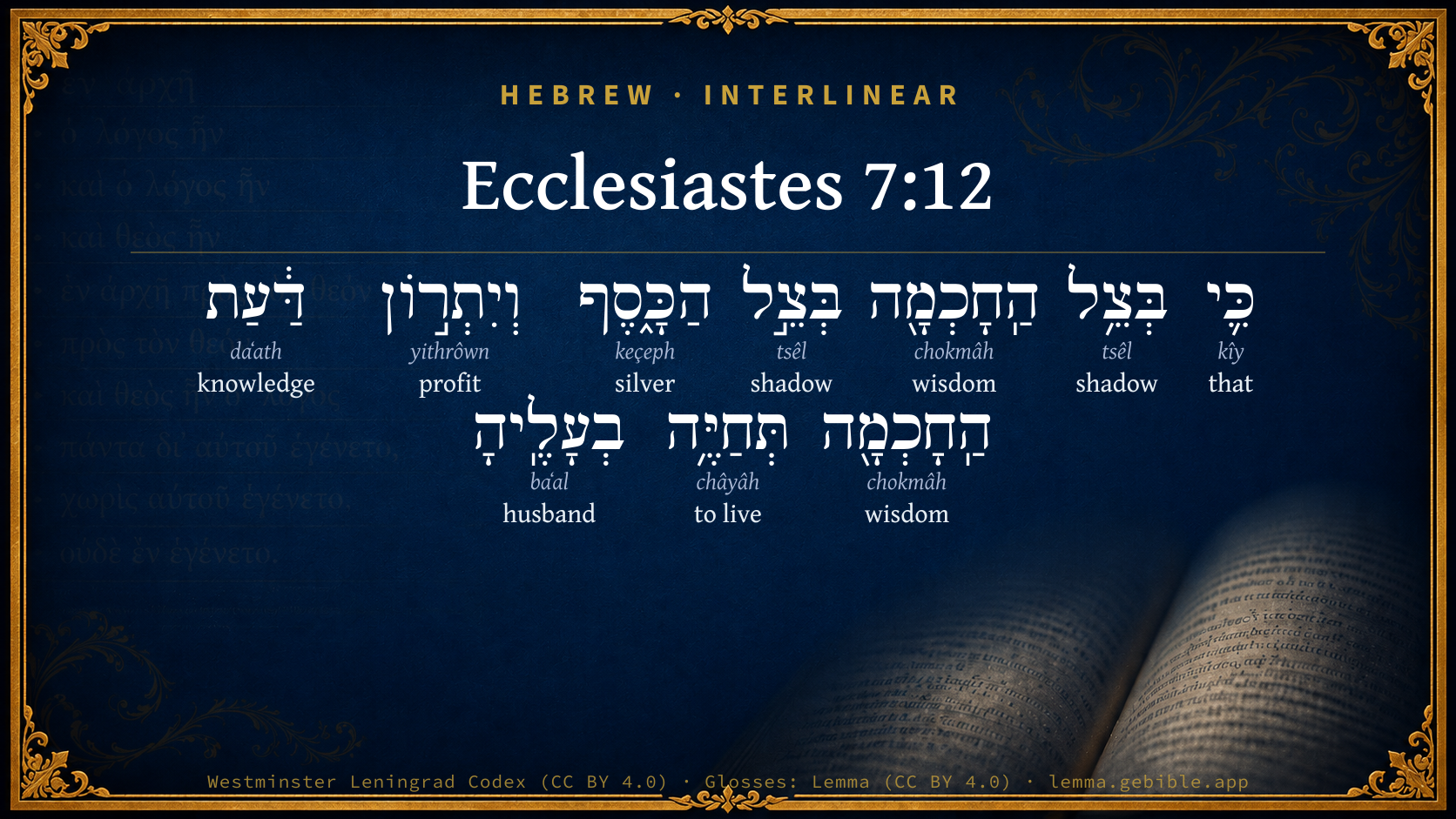
Hebrew (Westminster Leningrad Codex) Ecclesiastes 7:12 appears in the Hebrew Old Testament. The text above is from the Westminster Leningrad Codex. Each word links to its Strong’s number, a concise gloss, and parsing drawn from the Open Scriptures Hebrew Bible morphology. Click any word for its full Brown-Driver-Briggs (BDB) entry.
Download image
Cite this verse

Ecclesiastes 7:12 (World English Bible). Public Domain. Lemma interlinear Bible study tool, https://lemma.gebible.app/v/ecclesiastes/7/12.

Show BibTeX & RIS
BibTeX
RIS
English Translation
For wisdom is a defense, even as money is a defense; but the excellency of knowledge is that wisdom preserves the life of him who has it.
World English Bible · Public Domain
Download a study sheet

One document with this verse’s original text, its word-by-word gloss line, the meaning frame, cross-references with their text, attributed commentary, and full source and license credits — printable, and it pastes into notes with its structure intact.

This verse Autodidact and up

Study sheet (.html) Plain text (.txt)

A passage Seminary Student

Up to 50 verses in one chapter. A passage sheet keeps up to 6 commentary sources and 12 cross-references per verse, in the order this page ranks them, and says so on the sheet whenever that leaves anything out. Ask for a single verse and you get the Autodidact verse sheet above.

Everything on this page stays free to read, with no account — the sheet is a download of what is already on screen, not access to it.

Want to remove ads? Support Godless Engineer
Compare translations 3

The same verse in 3 English versions, stacked beneath the original-language interlinear above. Click any original word for its lexicon entry.

Each is an independent rendering of the whole verse — the interlinear is not word-aligned to these translations.

Highlighted words mark where these versions differ — a whole-verse word diff, not a word-by-word alignment.

  • World English Bible Public Domain
    For wisdom is a defense, even as money is a defense; but the excellency of knowledge is that wisdom preserves the life of him who has it.
  • King James Version Public Domain
    For wisdom is a defence, and money is a defence: but the excellency of knowledge is, that wisdom giveth life to them that have it.
  • unfoldingWord Literal Text CC BY-SA 4.0
    For in the shadow of wisdom, in the shadow of silver. And an advantage of knowledge: Wisdom preserves her owners.

unfoldingWord Literal Text — © unfoldingWord, licensed CC BY-SA 4.0. Word-aligned USFM3 via Door43 (git.door43.org/unfoldingWord/en_ult).

Versions to compare (up to 4)

3 of 4 selected

Show all 18 translations

Every available English version of this verse, each an independent rendering of the whole verse.

  • World English Bible Public Domain
    For wisdom is a defense, even as money is a defense; but the excellency of knowledge is that wisdom preserves the life of him who has it.
  • Berean Standard Bible Public Domain
    For wisdom, like money, is a shelter, and the advantage of knowledge is that wisdom preserves the life of its owner.
  • Majority Standard Bible Public Domain
    For wisdom, like money, is a shelter, and the advantage of knowledge is that wisdom preserves the life of its owner.
  • King James Version Public Domain
    For wisdom is a defence, and money is a defence: but the excellency of knowledge is, that wisdom giveth life to them that have it.
  • American Standard Version (1901) Public Domain
    For wisdom is a defence, even as money is a defence; but the excellency of knowledge is, that wisdom preserveth the life of him that hath it.
  • Revised Version (1885) Public Domain
    For wisdom is a defence, even as money is a defence: but the excellency of knowledge is, that wisdom preserveth the life of him that hath it.
  • Geneva Bible (1599) Public Domain
    Say not thou, Why is it that the former dayes were better then these? for thou doest not enquire wisely of this thing.
  • Douay-Rheims (1899) Public Domain
    Wisdom with riches is more profitable, and bringeth more advantage to them that see the sun.
  • Young's Literal Translation Public Domain
    For wisdom `is' a defense, money `is' a defence, And the advantage of the knowledge of wisdom `is', She reviveth her possessors.
  • Literal Standard Version CC BY-SA 4.0
    For wisdom [is] a defense, money [is] a defense, || And the advantage of the knowledge of wisdom [is], || She revives her possessors.
  • Unlocked Literal Bible CC BY-SA 4.0
    For wisdom provides protection as money can provide protection, but the advantage of knowledge is that wisdom gives life to whoever has it.
  • unfoldingWord Literal Text CC BY-SA 4.0
    For in the shadow of wisdom, in the shadow of silver. And an advantage of knowledge: Wisdom preserves her owners.
  • Darby Bible Public Domain
    For wisdom is a defence [as] money is a defence; but the excellency of knowledge is, [that] wisdom maketh them that possess it to live.
  • World Messianic Bible Public Domain
    For wisdom is a defense, even as money is a defense; but the excellency of knowledge is that wisdom preserves the life of him who has it.
  • Webster's Bible Public Domain
    For wisdom is a defense, and money is a defense: but the excellence of knowledge is, that wisdom giveth life to them that have it.
  • Free Bible Version CC BY-SA 4.0
    For wisdom provides security, as does money, but the advantage for those who have wisdom is that they are kept safe and sound!
  • Bible in Basic English Public Domain
    Wisdom keeps a man from danger even as money does; but the value of knowledge is that wisdom gives life to its owner.
  • JPS Tanakh (1917) Public Domain
    For wisdom is a defence, even as money is a defence; but the excellency of knowledge is, that wisdom preserveth the life of him that hath it.

Literal Standard Version (2020), Covenant Press — licensed CC BY-SA 4.0. Text via the HelloAO Bible API (eBible.org). Unlocked Literal Bible (unfoldingWord) — licensed CC BY-SA 4.0. Text via the HelloAO Bible API (eBible.org). unfoldingWord Literal Text — © unfoldingWord, licensed CC BY-SA 4.0. Word-aligned USFM3 via Door43 (git.door43.org/unfoldingWord/en_ult). Free Bible Version, Dr. Jonathan Gallagher — licensed CC BY-SA 4.0. Text via the HelloAO Bible API (eBible.org).

Word by word

More ways to search: Search by grammar → Find every occurrence → Compare this word →

Practice this passage: Drill this verse → Learn its vocabulary →

וְיִתְר֣וֹן
yithrôwn
H3504
“and · profit of”
Conjunction + Noun, Common, Masculine, Singular, Construct
Part of Speech
Conjunction + Noun
Type
Common
Gender
Masculine
Number
Singular
State
Construct
Full BDB Definition

Origin: from H3498

TWOT: 936f

advantage, profit, excellency
  1. כִּ֛י kîy H3588 “that” Conjunction
  2. בְּצֵ֥ל tsêl H6738 “in/at · shadow” Preposition + Noun, Common, Masculine, Singular, Absolute
  3. הַֽחָכְמָ֖ה chokmâh H2451 “the · wisdom” Particle, Definite Article + Noun, Common, Feminine, Singular, Absolute
  4. בְּצֵ֣ל tsêl H6738 “in/at · shadow” Preposition + Noun, Common, Masculine, Singular, Absolute
  5. הַכָּ֑סֶף keçeph H3701 “the · silver” Particle, Definite Article + Noun, Common, Masculine, Singular, Absolute
  6. דַּ֔עַת daʻath H1847 “knowledge” Noun, Common, Feminine, Singular, Absolute
  7. הַֽחָכְמָ֖ה chokmâh H2451 “the · wisdom” Particle, Definite Article + Noun, Common, Feminine, Singular, Absolute
  8. תְּחַיֶּ֥ה châyâh H2421 “to live” Verb, Piel, Imperfect, 3rd Person, Feminine, Singular
  9. בְעָלֶֽיהָ baʻal H1167 “husbands · her” Noun, Common, Masculine, Plural, Construct + Suffix, Personal, 3rd Person, Feminine, Singular

About this verse

These counts appear in no published source. They are computed here, from the morphology-tagged text and Lemma’s own curated glosses. What Lemma adds →

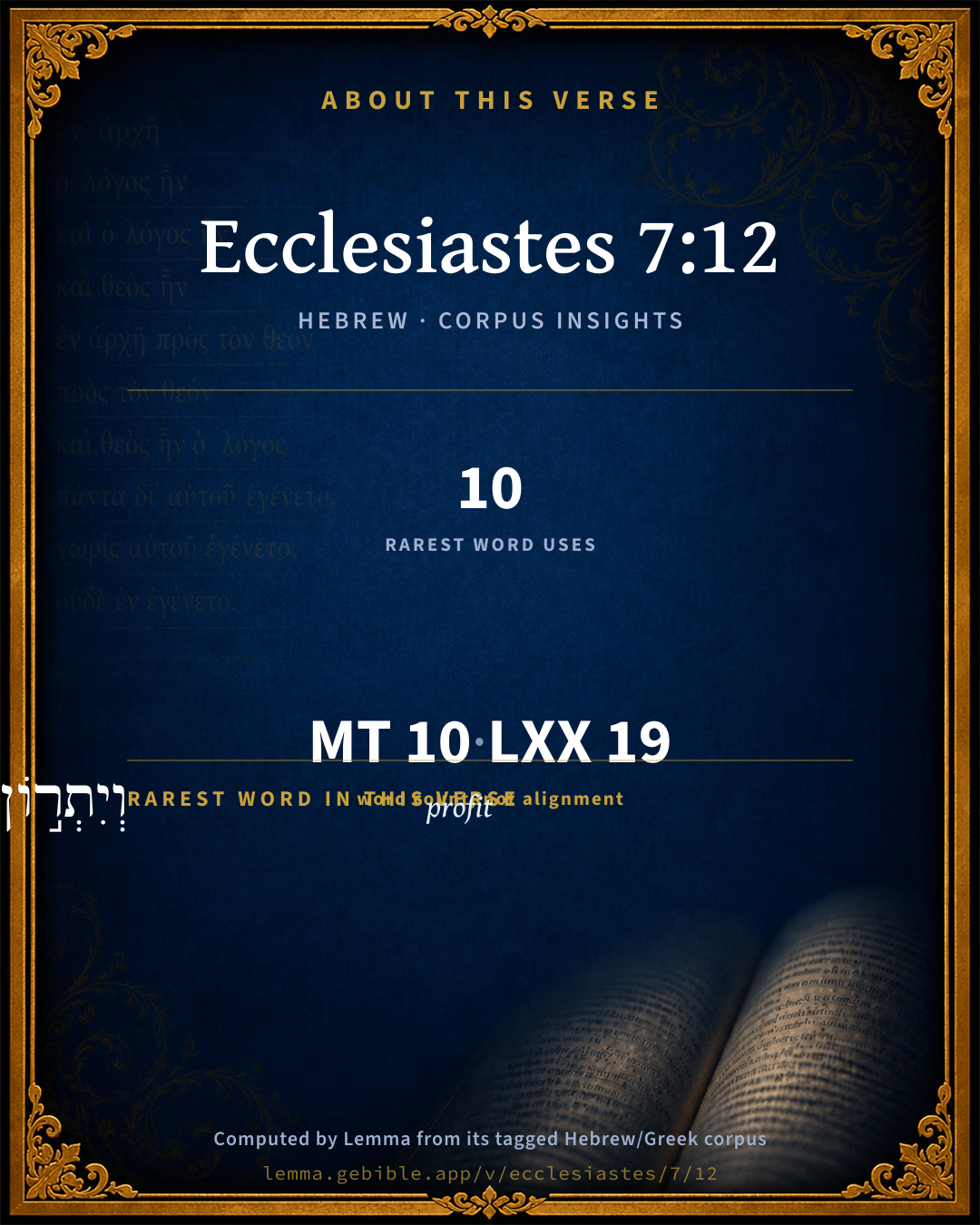
10
words
8
distinct lemmas
Wisdom
section

Notable vocabulary

The rarest word here is וְיִתְר֣וֹן profit H3504 — appearing just 10 times in the whole Hebrew Bible.

Shared distinctive vocabulary

וְיִתְר֣וֹן profit H3504 occurs in 9 verses of the Hebrew Bible. Also found in:

Grammatical profile

  • 1 verb
  • 8 nouns
  • 1 conjunction

Verb forms

  • תְּחַיֶּ֥ה Piel · Imperfect

Repetition

Words recur within this verse — often emphatic in Hebrew:

  • בְּצֵ֥ל shadow H6738 ×2
  • הַֽחָכְמָ֖ה wisdom H2451 ×2

Hebrew & Septuagint length

In English translation the verse runs 27 words from the Hebrew and 19 from the Septuagint (LXX English) — the Septuagint runs noticeably shorter here. See the side-by-side →

A rough comparison of the two English renderings, which tokenize alike — not a word-level alignment.

Word counts can differ between the Hebrew and the Greek without any difference in meaning — e.g. the Hebrew direct-object marker אֵת has no separate Greek word, and Greek often adds the article ὁ.

In the original languages it is 10 Hebrew tokens and 19 Greek tokens — but the two are counted differently (Hebrew bundles its prefixes and suffixes into one token; the Greek is in lemma form), so that isn’t a like-for-like length.

Cross-references

20

Topical passages linked to Ecclesiastes 7:12 in the Treasury of Scripture Knowledge — connected by theme and wording, ordered by reader-vote popularity; previews shown in the World English Bible.

  • Proverbs 8:35 For whoever finds me, finds life, And will obtain favor from Yahweh.
  • Proverbs 2:7 He lays up sound wisdom for the upright. He is a shield to those who walk in integrity;
  • Proverbs 3:18 She is a tree of life to those who lay hold of her. Happy is everyone who retains her.
  • Judges 9:15 The bramble said to the trees, If in truth you anoint me king over you, then come and take refuge in my shade; and if not, let fire come out of the bramble, and devour the cedars of Lebanon.
  • Proverbs 11:4 Riches don't profit in the day of wrath, But righteousness delivers from death.
  • Proverbs 18:10–11 The name of Yahweh is a strong tower: The righteous run to him, and are safe.
  • John 12:50 I know that his commandment is eternal life. The things therefore which I speak, even as the Father has said to me, so I speak."
  • John 17:3 This is eternal life, that they should know you, the only true God, and him whom you sent, Jesus Christ.
  • Deuteronomy 32:47 For it is no vain thing for you; because it is your life, and through this thing you shall prolong your days in the land, where you go over the Jordan to possess it.
  • Job 1:10 Haven't you made a hedge around him, and around his house, and around all that he has, on every side? You have blessed the work of his hands, and his substance is increased in the land.
  • Psalms 57:1 Be merciful to me, God, be merciful to me, For my soul takes refuge in you. Yes, in the shadow of your wings, I will take refuge, Until disaster has passed.
  • Proverbs 2:11 Discretion will watch over you. Understanding will keep you,
  • Proverbs 9:11 For by me your days will be multiplied. The years of your life will be increased.
  • Isaiah 32:2 A man shall be as a hiding-place from the wind, and a covert from the tempest, as streams of water in a dry place, as the shade of a great rock in a weary land.
  • Isaiah 33:6 There shall be stability in your times, abundance of salvation, wisdom, and knowledge: the fear of Yahweh is your treasure.
  • Philippians 3:8 Yes most assuredly, and I count all things to be loss for the excellency of the knowledge of Christ Jesus, my Lord, for whom I suffered the loss of all things, and count them nothing but refuse, that I may gain Christ
  • Deuteronomy 30:19–20 I call heaven and earth to witness against you this day, that I have set before you life and death, the blessing and the curse: therefore choose life, that you may live, you and your seed;
  • Isaiah 30:2 that set out to go down into Egypt, and have not asked at my mouth; to strengthen themselves in the strength of Pharaoh, and to take refuge in the shadow of Egypt!
  • Job 22:21–25 "Acquaint yourself with him, now, and be at peace. Thereby good shall come to you.
  • Proverbs 14:20 The poor person is shunned even by his own neighbor, But the rich person has many friends.

Cross-references courtesy of OpenBible.info (CC BY 4.0).

Hebrew and Greek witnesses Masoretic Hebrew ↔ Greek Septuagint

The same verse in the two great witnesses to the Old Testament, shown verse-for-verse.

Here the Septuagint runs noticeably shorter than the Hebrew — LXX2012 (modern English Septuagint) 19 words vs World English Bible 27. A rough length comparison of the two English translations, not a word-level alignment — read both below.

These are two independent witnesses, not word-aligned to each other, and the Septuagint is shown in lemma (dictionary) form.

Hebrew Ecclesiastes 7:12 Masoretic · Westminster Leningrad Codex

כִּ֛י בְּצֵ֥ל הַֽחָכְמָ֖ה בְּצֵ֣ל הַכָּ֑סֶף וְיִתְר֣וֹן דַּ֔עַת הַֽחָכְמָ֖ה תְּחַיֶּ֥ה בְעָלֶֽיהָ

For wisdom is a defense, even as money is a defense; but the excellency of knowledge is that wisdom preserves the life of him who has it.

World English Bible · Public Domain

Greek LXX Ecclesiastes 7:12 Septuagint · lemma form

ὅτι ἐν σκιά αὐτός ὁ σοφία ὡς σκιά ὁ ἀργύριον καί περισσεία γνῶσις ὁ σοφία ζωοποιέω ὁ παρά αὐτός

Wisdom is good with an inheritance: and there is an advantage by it to them that see the sun.

LXX2012 (modern English Septuagint) · Public Domain

On this verse, The Cambridge Bible for Schools and Colleges discusses the Septuagint’s reading. Read the note in Commentary ↓

Hebrew: Westminster Leningrad Codex (CC BY 4.0). Greek: Septuagint (public domain); English from LXX2012 (modern English Septuagint) (Public Domain). How the Septuagint differs from the Hebrew →

Commentary

Notes on Ecclesiastes 7:12 from classic Christian and Jewish commentators (each source and its license shown beneath its notes). The classic Christian expositions comment on the surrounding passage and are grouped to its opening verse, so a note may address several verses; the Jewish commentaries on the Tanakh (Rashi and others) are per-verse, so they appear only where the commentator wrote on this verse.

Lemma curates 59 commentaries, every one of them public domain or Creative Commons licensed, each selected and text-cleaned for this edition rather than reprinted as found. About our sources →

Trapp's Complete Commentary

John Trapp

Ecc 7:12 For wisdom [is] a defence, [and] money [is] a defence: but the excellency of knowledge [is, that] wisdom giveth life to them that have it.

Ver. 12. For wisdom is a defence, and money, &c.] Heb., A shadow; viz., to those that have seen the sun (as in the former verse), and are scorched with the heat of it - that are under the miseries and molestations of life. Wisdom in this case is a wall of defenee and a well of life. Money also is a thorn hedge, of very good use, {Job 1:10} so it be set without the affections, and get not into the heart, as the Pharisees’ ενοντα did. {Luk 11:41} Their riches were got within them, and, by choking the seed, kept wisdom out.

Wisdom giveth life to them that have it.] For "God is both a sun and a shield," or shadow. "He will give grace and glory." {Psa 84:11} Life in any sense is a sweet mercy, but the life of "grace and of glory" may well challenge the precellency. No marvel, therefore, though wisdom bear away the bell from wealth, which, as it serves only to the uses of life natural, so, being misused, it "drowns many a soul in perdition and destruction," {1Ti 6:9} and proves "the root of all evil"; {1Ti 6:10} yea, it taketh away the life of the owner thereof. {Pro 1:19} {See Trapp on "Pro 1:19"} It is confessed that wealth sometimes giveth life to them that have it, as it did to those ten Jews that had treasures in the field, {Jer 41:8} and doth to those condemned men that can take a lease of their lives. But Nabal’s wealth had undone him, if Abigail’s wisdom had not interposed. And in the other life money bears no mastery. Adam had it not in paradise, and in heaven there is no need of it.

John Trapp, A Commentary or Exposition upon All the Books of the Old and New Testament (1647–1656) — public domain. Text from a community e-Sword module.

The Biblical Illustrator

Joseph S. Exell

Ecc_7:12

The excellency of knowledge is, that wisdom giveth life to them that have it.

Religious education

The argument which I shall advance on behalf of this and of all other institutions with which it is the happiness of our country now to abound, having a similar object in view--the supply of wholesome education for the poor--is this, that, in providing instruction for the destitute, you confer on them a much more precious gift than in giving them pecuniary supplies for the relief of their outward and physical necessities. To this mode of stating the case I have been led by observing the remark of the wise man in the text--that wisdom is a defence--the possession of solid, but more especially of religious knowledge,

1. As the means of protecting a man from many dangers and many calamities and money, too, is a defence--as the medium of procuring the outward necessaries and comforts of life, it has the power of saving its possessor from numerous and painful sufferings and fears--but yet, if we compare these two defences with one another, the excellency, the advantage will be found upon the side of knowledge or wisdom, for this reason, that wisdom giveth life to them that have it.

1. The blessing of education is a more valuable gift of charity to the poor than the direct relief of their physical necessities, even in the way of supplying them with the resources of natural life. The gift of money will, no doubt, avail to procure the means of physical maintenance and enjoyment so far as it goes, and so long as it lasts; but then it perishes in the using--it has in it no self-preserving, no self-renewing power. What you give the poor man to expend on food and raiment, clothes and supports him for a season; but then food is consumed, and raiment waxes old, and it avails him no longer to remember that he has been warmed, that he has been filled. He cannot feed on the memory of food, nor yet array himself with that of clothing. But lay out, on the other hand, a comparatively trivial sum in bestowing on the indigent child, otherwise the heir of hopeless ignorance, a sound and suitable instruction, and then you bestow on him a source of support and comfort which really is inexhaustible. Knowledge is power, and being personal is permanent power. It is in a man, and therefore continues with him whatever changes may occur in his outward estate to strip him of that which is not inherent but attached--not in but about him; the gift of education gives him a means of support which is not exhausted by being used--which, if it is useful to-day, was useful yesterday, and will be so to-morrow--which is self-preserving, self-strengthening, self-renewing. And while, as the giver of life to those who have it, knowledge thus excels money in respect of permanence--no less does the former surpass the latter in respect of its efficiency. In the degree in which education is judiciously conducted does it give a human being the command of what are the highest, the mightiest, the most productive of human powers--the faculties of the rational and immortal mind--faculties which, whether acting by themselves or co-operating with corporeal energies to the production of what is needful for the support, the comfort, the refreshment, the convenience of the present state, give at once an elevated character, and an enlarged efficiency to all the individuals exertions and pursuits. By implanting, too, and conforming, the habit of thinking--prospective, serious, considerate thinking--which is one great aim and effect of education, you put into the hands of man or woman what has been well denominated the principle of all legitimate prosperity. Not these habits alone, however, but all moral and religious principles are nursed and cherished by such an education as that of which we speak--the activity and temperance which are the parents of health--the industry and integrity, the benevolence and magnanimity, the prudence and public spirit, the rectitude and love, of which the progeny are substance, reputation, influence, domestic and social comfort--the morality which is connected by so general a law even with worldly prosperity--the godliness which hath the promise of this life as well as of that which is to come.

2. While wisdom is a defence, and money is a defence, the excellency of knowledge is, that wisdom giveth intellectual life to them that have it. It is of the nature of our intellectual, as of all our other powers, to rust through want of use; so that in him who has never been accustomed to employ his mind, the very mind itself seems to fall into dormancy, and the man to become, at length, a merely sentient rather than a rational being. Have you never witnessed cases in which the spirit has seemed thus steeped in lethargy--persons who could be kept awake only by the necessity of manual labour and the stimulants of sensual excitement, and who deprived of these, seem to suffer the suspension of their whole spiritual existence, and sink straightway into utter apathy and listlessness, finding no resources within them to employ time, or keep alive attention, when the impulse from without has disappeared--who employ their minds, such as they are, but as the slaves and instruments of body, and have their whole being rightly defined, of the earth, earthy? Now, to prevent this death, as it may be called, of the intellectual soul within its clayey dungeon--whether it expire in stupefaction or in agony--the only means you can employ is to supply it with that knowledge, the excellency of which is, that it giveth life to them that have it. The capacity of intellectual exercise must be early provoked, and stimulated, and directed. The taste for intellectual enjoyment must be early implanted, and nourished, and improved. In providing, then, the means of education for the else deserted children of your city and your country, you are providing the only direct--the absolutely necessary means of rendering them worthy of the name of rational and intelligent creatures--of saving from being overborne and extinguished that which defines them human beings. You may, peradventure, give the first impulse to some master-mind which else might have remained for ever cramped and fettered without command or consciousness of its latent powers, but which, let loose by you, may mightily accelerate and advance the great march of human improvement. You may, peradventure, kindle some luminous spirit which else must have been finally absorbed amidst the gloom in which it had its birth, and which shall stream far-darting and imperishable lustre to distant generations and distant climes.

3. While we admit, in speaking of the case of our necessitous fellow-creatures, that money is a defence and wisdom a defence, still we say that the excellency belongeth unto knowledge; because wisdom giveth life--life spiritual and eternal--to those that have it. It is the key of knowledge that opens the kingdom of heaven; and if this be the constitution of the Gospel, very plain it is that the state of a human soul abandoned to utter ignorance is that of a soul devoted to inevitable death. Alas! what multitudes are in this condition. But there is still another circumstance which darkens and aggravates the view we are compelled to take of the spiritually deathful power of ignorance, and it is this--that, especially amidst a condensed and crowded population, those who grow up utterly uneducated are almost sure to grow up openly profligate. The first and most direct consequence of their early abandonment without the means of education is, that they are left to spend their time in utter idleness. Led by idleness follows the twin-plague evil company, under whose noxious breath every budding of thought or emotion congenial to virtue grows sickly and expires, while every plant of deathful odour and poisonous fruit expands into dense and overshadowing rankness. In process of time such childish associations in childish folly and childish vice ripen into combinations of licentiousness and leagues of iniquity. The means are in your power of possibly, of probably averting so sad a catastrophe in a multitude of cases. (J. B. Patterson, M. A.)

Christianity the guardian of human life

We may unhesitatingly charge upon heathenism, even if you keep out of sight, its debasing effect upon morals, and think of it only as a system of religious ceremonies and observances, the having a direct tendency to the destroying mens lives. It has not been merely amongst the more savage of pagans, but also amongst those who have advanced far in civilization, that the custom has prevailed of offering human sacrifices. The Grecians made great progress in sciences and arts; yet it would seem to have been a rule with each of their states to sacrifice men before they marched against an enemy. The Romans, who emulated the Grecians in civilization, appear not to have been behind them in the cruelties of their religion; even so late as in the reign of Trajan, men and women were slain at the shrine of some one of their deities. As to the heathenism of less refined states, it would be easy to affix to it a yet bloodier character: nothing, for example, could well exceed the massacres, connected with religious rites, which appear to have been common among the nations of America: the annual sacrifices of the Mexicans required many thousands of victims, and in Peru two hundred children were devoted for the health of the sovereign. What a frightful destruction of life[ But we should vastly underrate the influence of Christianity in saving human life, were we merely to compute from the abolition of the destructive rites of heathenism. The influence has been exerted in indirect modes yet more than in direct. It has gradually substituted mild for sanguinary laws, teaching rulers that the cases must be rare which justify the punishing with death. And what but Christianity, giving sacredness to human life, ever taught men to erect asylums for the sick and the aged? Add to this the mighty advancings which have been made under the fostering sway of Christianity in every department of science. And how wonderfully, in promoting knowledge, has Christianity preserved life. The study of the body, of its structure and diseases; acquaintance with the properties of minerals and plants; skill in detecting the sources of pain, and applying remedies or assuagements--all this would appear peculiar, in a great degree, to ,Christian nations; as if there could be only inconsiderable progress in medical science, whilst a land were not trodden by She alone Physician of the soul.. And need we point out how knowledge of other kinds, cherished by Christianity, has subserved the preservation of life? Witness astronomy, watching the mariner, lest he be bewildered on the waters. Witness chemistry, directing the miner, that he perish not by subterranean fires. Witness geography, with its maps and charts, informing the traveller of dangers, and pointing him to safety. Witness architecture, rearing the lighthouse on rooks, where there seemed no foundation for structures which might brave the wild storm, and thus warning away navies which must otherwise have perished. Witness machinery, providing for the poorest what once the wealthy alone could obtain, the means of guarding against inclement seasons, and thus preserving health when most rudely threatened. But it were greatly to wrong Christianity as a giver of life, were we to confine our illustrations to the bodies, in place of extending them go the souls of men. We have higher evidence than any yet assigned, that Christianity is the only wisdom which will answer the description contained in our text. It may be said of the world, in every period of its history, The world by wisdom knew not God. Our liability to punishment is discoverable by human wisdom, but the possibility of our escaping it not without heavenly; and hence there is no life-giving power in the former. But the wisdom which the Holy Ghost continually imparts to such as submit to His influence is, from first to last, a quickening, vivifying thing. It makes the believer alive, in the sense of being energetic for God and for truth; alive, as feeling himself immortal; alive, as having thrown off the bondage of corruption; alive, as knowing himself begotten again to an inheritance that fadeth not away. I live, said the great apostle, yet not I, but Christ liveth in me. And life indeed it is, when a man is made wise unto salvation: when, having been brought to a consciousness of his state as a rebel against God, he has committed his cause unto Christ, who was delivered for our offences, and was raised again for our justification. There is needed only that, renouncing all wisdom of our own, we come unto God to be taught, and we shall receive the gift of the Spirit, that Spirit which is breath to the soul, quickening it from the death of nature, and causing its torpid energies and perverted affections to rise to their due use, and fix on their due end. And the excellency of this knowledge is, that, having it, you will have life. You cannot have it, except in the heart; for no man knows Christ who knows Him only with the head. And having this knowledge in the heart, you have renewal of the heart; and with renewal of the heart forgiveness of sin, and the earnests of immortality. Are we not now, therefore, able to vindicate in all its extent the assertion of our text? In the former part of the verse the wise man had allowed that wisdom is a defence, and money is a defence. But riches profit not in the day of wrath, and the wisdom of this world is foolishness with God. But they whose treasure has been above--they who have counted all things but loss for the excellency of the knowledge of Christ--they shall have a defence, a sure defence, when the rich man is destitute and the wise man speechless. They have chosen that which cannot be taken away, and which, indeed, is then only fully possessed, when everything else departs from human hold. As they soar to inherit the kingdom obtained for them by Christ, and thus lay hold on an immortality of joy through having acquainted themselves with Him as the way, the truth, and the life, there may be none to say that money is a defence, and wisdom is a defence--none to say it in the face of the confounding witness of the elements melting with fervent heat, and of the shrinking away of those who have been wise in their own eyes, and prudent in their own sight: but the whole company of the redeemed shall be joined by the thousand times ten thousand of the celestial host, in confessing and publishing that the excellency of knowledge is, that wisdom, Christian wisdom, giveth life to them that have it. (H. Melvill, B. D.)

The Biblical Illustrator, edited by Joseph S. Exell (c. 1880s–1900s) — public domain. Text from a community e-Sword module.

Geneva Bible (1599)

Geneva Bible translators

Murmur not against God when he sendeth adversities for man’s sins.

Geneva Bible (1599) marginal notes — public domain. Text via Bolls.life.

Jamieson, Fausset & Brown

Robert Jamieson, A. R. Fausset & David Brown

Literally, (To be) in (that is, under) the shadow (Isa 30:2) of wisdom (is the same as to be) in (under) the shadow of money; wisdom no less shields one from the ills of life than money does.

is, that--rather, "the excellency of the knowledge of wisdom giveth life," that is, life in the highest sense, here and hereafter (Pro 3:18; Joh 17:3; Pe2 1:3). Wisdom (religion) cannot be lost as money can. It shields one in adversity, as well as prosperity; money, only in prosperity. The question in Ecc 7:10 implies a want of it.

Jamieson, Fausset & Brown — Commentary Critical and Explanatory on the Whole Bible (1871) — public domain (CC PDM 1.0). Text via the HelloAO Bible API.

Adam Clarke's Commentary

Verse 12. Wisdom is a defence] To whom Solomon answers: All true wisdom is most undoubtedly a great advantage to men in all circumstances; and money is also of great use: but it cannot be compared to wisdom. Knowledge of Divine and human things is a great blessing. Money is the means of supporting our animal life: but wisdom - the religion of the true God - gives life to them that have it. Money cannot procure the favour of God, nor give life to the soul.

Adam Clarke's Commentary on the Bible (1810–1826) — public domain. Text from a community e-Sword/MySword module.

Ellicott's Commentary for English Readers

(12) A defence.—Literally, a shadow (Psa_91:1; Psa_121:5, &c). This verse harmonises with the interpretation of the preceding verse, which we prefer. “Wisdom and riches alike confer protection, but the pre-eminence of wisdom is,” &c.

A Bible Commentary for English Readers, edited by Charles John Ellicott (1878–1897) — public domain. Text from a community e-Sword module.

The Cambridge Bible for Schools and Colleges

gen. ed. J. J. S. Perowne

12. For wisdom is a defence, and money is a defence] Better, as a shadow, or, as a shelter, in both clauses. The Hebrew, as the italics shew, has no “and.” “Shadow” as in Psa_17:8; Psa_91:1, stands for shelter and protection. This, the writer says, not without a touch of his wonted irony in coupling the two things together, to those who looked to wealth as their only means of safety (Pro_13:8), is found not less effectually in wisdom.

but the excellency of knowledge] Better, the profit, thus keeping up what we may call the catch-word of the book. Wisdom, the Debater says, does more than give shelter, as money, in its way, does. It quickens those who have it to a new and higher life. The use of the word ζωοποιήσει (“shall quicken”), by the LXX. connects the maxim with the higher teaching of Joh_5:21; Joh_6:63; 2Co_3:6. The Spirit which alone gives the wisdom that “cometh from above” does the work which is here ascribed to wisdom as an abstract quality. It is clearly out of harmony with the whole train of thought to see in the “life” which wisdom gives only that of the body which is preserved by the prudence that avoids dangers. It is as much beside the point to interpret it of the “life” of the resurrection.

The Cambridge Bible for Schools and Colleges (gen. ed. J. J. S. Perowne; Cambridge University Press, 1878–1918) — public domain. Text from a community e-Sword module.

John Gill's Exposition

For wisdom is a defence, and money is a defence,.... Or, a "shadow" of refreshment and protection, under which men sit with pleasure and safety; a man by his wisdom, and so by his money, is able to defend himself against the injuries and oppressions of others, and especially when both meet in one and the same man. Jarchi renders and interprets it,

"he that is in the shadow of wisdom is in the shadow of money, for wisdom is the cause why riches come;''

and so the Targum,

"as a man is hid in the shadow of wisdom, so he is hid in the shadow of money, when he does alms with it;''

compare with this Luk 16:9; see Ecc 7:19. Theognis (o) has a saying much like this,

"riches and wisdom are always inexpugnable to mortals;''

but the excellency of knowledge is, that wisdom giveth life to them that have it; or, "the excellency of the knowledge of wisdom giveth life" (p), &c. not of natural wisdom, or the knowledge of natural and civil things, the vanity of this is exposed, before by the wise man; but the knowledge of God in Christ; the knowledge of Christ, who is the Wisdom of God; and of the Gospel, and of all divine and spiritual things: this is a superior excellency to riches, which often expose a man's life to danger, cannot preserve him from a corporeal death, much less from an eternal one. When this is the excellency of spiritual knowledge, that spiritual life goes along with it; such as are spiritually enlightened are spiritually quickened; live by faith on Christ, whom they know; and, through the knowledge of him, have all things pertaining to life and godliness, and have both a right and meetness for eternal life; yea, this knowledge is life eternal, Joh 17:3; see Pe2 1:3; and this is the pure gift of Wisdom, or of Christ, and not owing to the merit of men, or works done in obedience to the law, which cannot give this life; see Joh 17:2, Rom 6:23.

(o) Sententiae, v. 1153. (p) "et praestantia scientiae sapientiae vivificabit", Montanus.

John Gill's Exposition of the Whole Bible (1746–1763) — public domain (CC PDM 1.0). Text via the HelloAO Bible API.

Albert Barnes' Notes on the Bible

Wisdom is a defense ... - See the margin and Psa 121:5, i. e., He who is defended from adversity by his wisdom is in as good a position as he who is defended by his riches.

Excellency - literally, Profit.

Giveth life to - literally, “Causes to live,” “makes alive” Pro 3:18; the deeper meaning of which is elicited by comparing these words with Joh 6:63; Mat 4:4.

Albert Barnes' Notes on the Bible (1834–1885) — public domain. Text from a community e-Sword/MySword module.

Haydock's Catholic Bible Commentary

With. Hebrew also, "above, or much as riches." (Calmet) --- These are impediments in the hands of the reprobate, while they promote virtue in the good." (St. Ambrose, Luke viii. n. 85.) --- The man who has only wisdom, cannot do as much good as those who are also rich. (Calmet) --- The moderate use of riches helps the servants of God, while they do not set their hearts upon them. (Worthington) --- The sun, to men on earth.

George Leo Haydock (1774–1849), Haydock's Catholic Family Bible and Commentary, 1859 edition — public domain. Excludes Psalms (Douay-Rheims chapter numbering differs from Protestant) and Deuterocanonical books (Catholic canon only).

Matthew Poole's English Annotations

Is a defence, Heb. is a shadow; which in Scripture use notes both protection and refreshment. And thus far wisdom and money agree. But herein knowledge or wisdom (which commonly signifies the same thing) excels riches, that whereas riches frequently expose men to death or destruction, true wisdom doth ofttimes preserve a man from temporal, and always from eternal ruin.

Matthew Poole's English Annotations on the Holy Bible (1683–1685) — public domain. Text from a community e-Sword/MySword module.

Whedon's Commentary on the Bible

Daniel D. Whedon

12. Wisdom… and money… defence — This is a forcible way of saying, “Wisdom is a defence of one kind and money a defence of quite another.” Both united make a strong and safe shelter, but, of the two, wisdom is superior by its giving life to its possessors. An Athenian wished his son educated, so as not to sit upon the stone seat of the public assembly, as being himself but another stone. Life means energy, activity, and intelligence. In wisdom is shelter, and in money is shelter, would be a better rendering.

Daniel D. Whedon (gen. ed.), Commentary on the Old and New Testaments (1874–1909) — public domain. Text from a community e-Sword module.

The Pulpit Commentary

For wisdom is a defense, and money is a defense; literally, in the shade is wisdom, in the shade is money; Septuagint, Oti ejn skia aujthv hJ sofia wJv skiaou, "For in its shadow wisdom is as the shadow of money." Symmachus has, Skepei sofia wJv skepei torion, "Wisdom shelters as money shelters." The Vulgate explains the obscure text by paraphrasing, Sieur enirn protegit sapientia, sic protegit petunia. Shadow, in Oriental phrase, is equivalent to protection. (see Num_14:9; Psa_17:5; Lam_4:20) Wisdom as well as money is a shield and defense to men. As it is said in one passage (Pro_13:8) that riches are the ransom of a man"s life, so in another (Ecc_9:15) we are told how wisdom delivered a city from destruction. The literal translation given above implies that he who has wisdom and he who has money rest under a safe protection, are secure from material evil. In this respect they are alike, and have analogous claims to man"s regard. But the excellency profit, or advantageof knowledge is, that wisdom giveth life to them that have it. "Knowledge" (daath) and "wisdom" ( chokmah) are practically here identical, the terms being varied for the sake of poetic parallelism. The Revised Version, following Delitzsch and others, renders, Wisdom preserveth the life of him that hath it; i.e. secures him from passions and excesses which tend to shorten life. This seems to be scarcely an adequate ground for the noteworthy advantage which wisdom is said to possess. The Septuagint gives, Kaisseia gnwsewv thv sofiav zwopoihsei ton par aujthv "And the excellence of the knowledge of wisdom will quicken him that hath it." Something more than the mere animal life is signified, a climax to the "defense" mentioned in the preceding clause the higher, spiritual life which man has from God. Wisdom in the highest sense, that is, practical piety and religion, is "a tree of life to them that lay hold of her, and happy is every one that retaineth her", (Pro_3:18) where it is implied that wisdom restores to man the gift which he lost at the Fall. (comp. also Pro_8:35) The Septuagint expression zwopoihsei recalls the words of Christ, "As the Father raiseth the dead and quickeneth (zwopoiei) them, even so the Son also quickeneth whom he will;" "It is the Spirit that quickeneth (to zwopoioun)". (Joh_5:21 Joh_6:63) Koheleth attributes that power to wisdom which the more definite teaching of Christianity assigns to the influence of the Holy Spirit. Some would explain, "fortifies or vivifies the heart," i.e. imparts new life and strength to meet every fortune. The Vulgate rendering is far astray from the text, and does not accurately convey the sense of the passage, running thus: Hoe autem plus habet eruditio et sapientia: quod vitam tribuunt possessori sue, "But this more have learning and wisdom, that they give life to the possessor of them."

The Pulpit Commentary (1880–1919), ed. H.D.M. Spence-Jones & Joseph S. Exell — public domain. Text from a community e-Sword module.

John Wesley's Explanatory Notes

Life - But herein knowledge of wisdom excels riches, that whereas riches frequently expose men to destruction, true wisdom doth often preserve a man from temporal, and always from eternal ruin.

John Wesley, Explanatory Notes Upon the Whole Bible (1754–1765) — public domain. Text via the GEBible commentary corpus.

Rashi

Rabbi Shlomo Yitzchaki (Rashi)

For whoever is in the shade of wisdom Whoever is in the shade of wisdom is in the shade of money, for wisdom causes riches to come.

and the advantage of knowledge is that wisdom gives life to its possessor And moreover, wisdom has an advantage over money insofar as wisdom gives life to its possessor.

Rashi on the Tanakh — English translations: “The Judaica Press complete Tanach with Rashi, translated by A. J. Rosenberg” (CC BY 4.0); “Pentateuch with Rashi's commentary by M. Rosenbaum and A.M. Silbermann, 1929-1934” (public domain); “The Metsudah Tanach series, Lakewood, N.J” (CC BY 4.0); and “The Book of Joshua, Metsudah Publications, 1997” (CC BY 4.0). Text via Sefaria.

Lesson kit

Teaching starters — assembled from the data on this page, not authored interpretation. Every prompt links to the verse data it draws on. Edit before teaching.

Ecclesiastes, in the Wisdom, opens this verse with 10 words (8 distinct Hebrew lemmas). Its most distinctive word is yithrôwn (“profit”). The Greek Septuagint runs shorter here. A historical commentator’s framing appears above. Read the whole chapter for the surrounding context.

Discussion questions

  1. How does “profit” (yithrôwn) shape what this verse is saying?
  2. Ecclesiastes 1:3 shares the word «profit» with this verse. How do the two illuminate each other?
  3. “shadow” occurs 2× in this one verse. What is the effect of the repetition?
  4. Compared with the Hebrew, the Septuagint runs shorter here. What questions does that raise?
  5. These translations render this verse differently. What is at stake in choosing one wording over another?
  6. The verb «תְּחַיֶּ֥ה» is Piel Imperfect. How does its form color the action?
  7. Reading how Trapp's Complete Commentary and The Biblical Illustrator read this verse, where do the two commentators agree and where do they part?

Things to notice

Reading settings

Reading text

Shown beneath each verse's original-language words.

Old Testament
Old Testament edition

Read the OT as the Masoretic Hebrew (MT) or the Greek Septuagint (LXX).

English shown for the Greek Septuagint (in the Hebrew ↔ Greek comparison).

Comparing translations? Open the Compare panel on any verse page to stack up to four side by side.