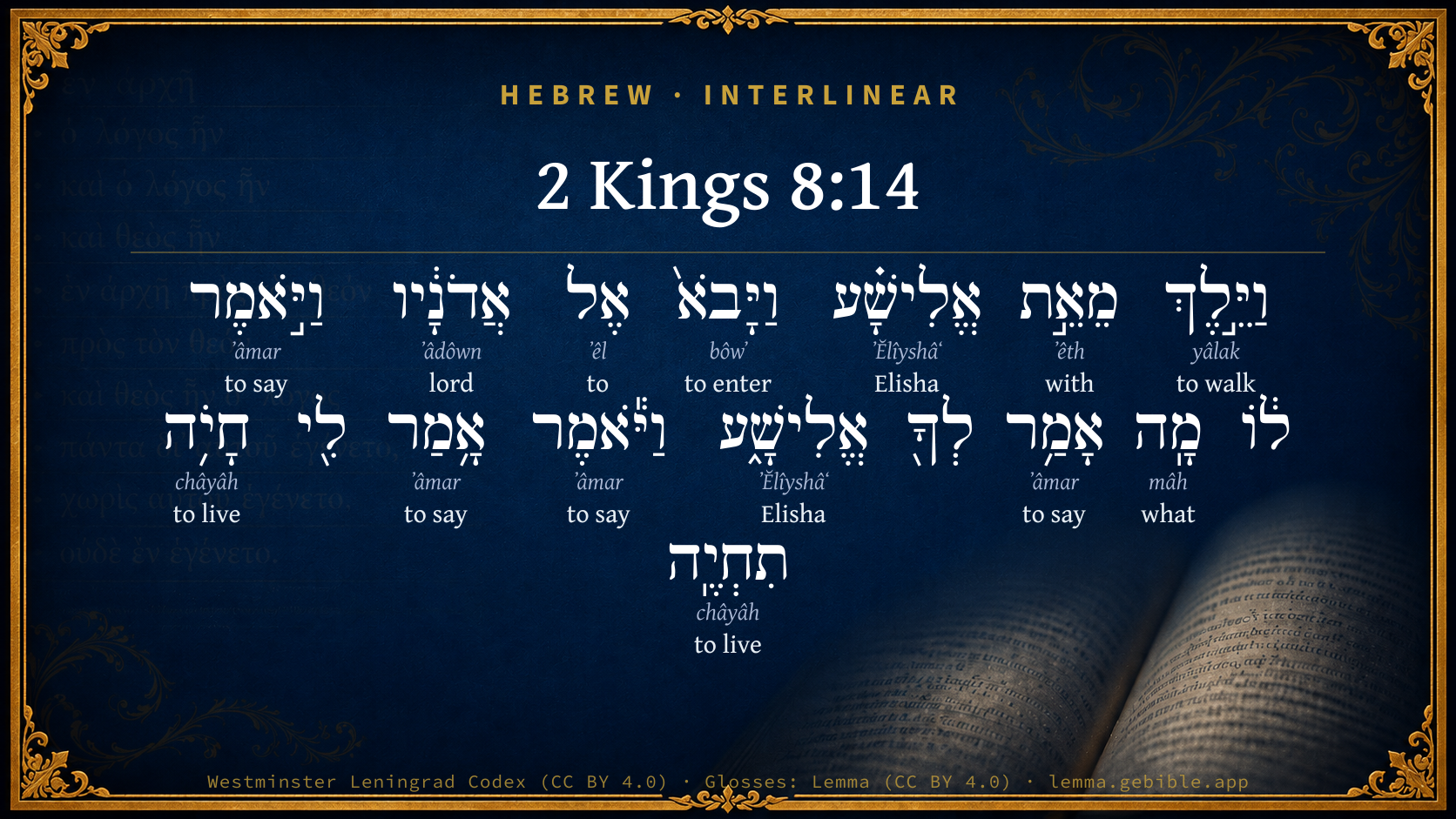
2 Kings 8:14

Hebrew (Westminster Leningrad Codex) 2 Kings 8:14 appears in the Hebrew Old Testament. The text above is from the Westminster Leningrad Codex. Each word links to its Strong’s number, a concise gloss, and parsing drawn from the Open Scriptures Hebrew Bible morphology. Click any word for its full Brown-Driver-Briggs (BDB) entry.
Download image
Cite this verse

2 Kings 8:14 (World English Bible). Public Domain. Lemma interlinear Bible study tool, https://lemma.gebible.app/v/2-kings/8/14.

Show BibTeX & RIS
BibTeX
RIS
English Translation
Then he departed from Elisha, and came to his master; who said to him, What said Elisha to you? He answered, He told me that you would surely recover.
World English Bible · Public Domain
Download a study sheet

One document with this verse’s original text, its word-by-word gloss line, the meaning frame, cross-references with their text, attributed commentary, and full source and license credits — printable, and it pastes into notes with its structure intact.

This verse Autodidact and up

Study sheet (.html) Plain text (.txt)

A passage Seminary Student

Up to 50 verses in one chapter. A passage sheet keeps up to 6 commentary sources and 12 cross-references per verse, in the order this page ranks them, and says so on the sheet whenever that leaves anything out. Ask for a single verse and you get the Autodidact verse sheet above.

Everything on this page stays free to read, with no account — the sheet is a download of what is already on screen, not access to it.

Want to remove ads? Support Godless Engineer
Compare translations 3

The same verse in 3 English versions, stacked beneath the original-language interlinear above. Click any original word for its lexicon entry.

Each is an independent rendering of the whole verse — the interlinear is not word-aligned to these translations.

Highlighted words mark where these versions differ — a whole-verse word diff, not a word-by-word alignment.

  • World English Bible Public Domain
    Then he departed from Elisha, and came to his master; who said to him, What said Elisha to you? He answered, He told me that you would surely recover.
  • King James Version Public Domain
    So he departed from Elisha, and came to his master; who said to him, What said Elisha to thee? And he answered, He told me that thou shouldest surely recover.
  • unfoldingWord Literal Text CC BY-SA 4.0
    And he went from with Elisha, and he came to his master. And he said to him, “What did Elisha say to you?” And he said, “He said to me, ‘Reviving, you will revive.’”

unfoldingWord Literal Text — © unfoldingWord, licensed CC BY-SA 4.0. Word-aligned USFM3 via Door43 (git.door43.org/unfoldingWord/en_ult).

Versions to compare (up to 4)

3 of 4 selected

Show all 18 translations

Every available English version of this verse, each an independent rendering of the whole verse.

  • World English Bible Public Domain
    Then he departed from Elisha, and came to his master; who said to him, What said Elisha to you? He answered, He told me that you would surely recover.
  • Berean Standard Bible Public Domain
    So Hazael left Elisha and went to his master, who asked him, “What did Elisha say to you?” And he replied, “He told me that you would surely recover.”
  • Majority Standard Bible Public Domain
    So Hazael left Elisha and went to his master, who asked him, “What did Elisha say to you?” And he replied, “He told me that you would surely recover.”
  • King James Version Public Domain
    So he departed from Elisha, and came to his master; who said to him, What said Elisha to thee? And he answered, He told me that thou shouldest surely recover.
  • American Standard Version (1901) Public Domain
    Then he departed from Elisha, and came to his master; who said to him, What said Elisha to thee? And he answered, He told me that thou wouldest surely recover.
  • Revised Version (1885) Public Domain
    Then he departed from Elisha, and came to his master; who said to him, What said Elisha to thee? And he answered, He told me that thou shouldest surely recover.
  • Geneva Bible (1599) Public Domain
    So he departed from Elisha, and came to his master, who said to him, What saide Elisha to thee? And he answered, Hee tolde mee that thou shouldest recouer.
  • Douay-Rheims (1899) Public Domain
    And when he was departed from Eliseus, he came to his master, who said to him: What saith Eliseus to thee? And he answered: He told me: Thou shalt recover.
  • Young's Literal Translation Public Domain
    And he goeth from Elisha, and cometh in unto his lord, and he saith unto him, `What said Elisha to thee?' and he saith, `He said to me, Thou dost certainly recover.'
  • Literal Standard Version CC BY-SA 4.0
    And he goes from Elisha, and comes to his lord, and he says to him, “What did Elisha say to you?” And he says, “He said to me, You certainly recover.”
  • Unlocked Literal Bible CC BY-SA 4.0
    Then Hazael left Elisha and came to his master, who said to him, “What did Elisha say to you?” He answered, “He told me that you would certainly recover.”
  • unfoldingWord Literal Text CC BY-SA 4.0
    And he went from with Elisha, and he came to his master. And he said to him, “What did Elisha say to you?” And he said, “He said to me, ‘Reviving, you will revive.’”
  • Darby Bible Public Domain
    And he departed from Elisha, and came to his master, who said to him, What did Elisha say to thee? And he said, He told me [that] thou wouldest certainly recover.
  • World Messianic Bible Public Domain
    Then he departed from Elisha, and came to his master, who said to him, “What did Elisha say to you?” He answered, “He told me that you would surely recover.”
  • Webster's Bible Public Domain
    So he departed from Elisha, and came to his master; who said to him, What said Elisha to thee? And he answered, He told me that thou shouldest surely recover.
  • Free Bible Version CC BY-SA 4.0
    Hazael left Elisha and went to his master, who asked him, “What did Elisha tell you?” Hazael replied, “He told me you would definitely recover.”
  • Bible in Basic English Public Domain
    Then he went away from Elisha and came in to his master, who said to him, What did Elisha say to you? And his answer was, He said that you would certainly get well.
  • JPS Tanakh (1917) Public Domain
    Then he departed from Elisha, and came to his master, who said to him: 'What said Elisha to thee?' And he answered: 'He told me that thou wouldest surely recover.'

Literal Standard Version (2020), Covenant Press — licensed CC BY-SA 4.0. Text via the HelloAO Bible API (eBible.org). Unlocked Literal Bible (unfoldingWord) — licensed CC BY-SA 4.0. Text via the HelloAO Bible API (eBible.org). unfoldingWord Literal Text — © unfoldingWord, licensed CC BY-SA 4.0. Word-aligned USFM3 via Door43 (git.door43.org/unfoldingWord/en_ult). Free Bible Version, Dr. Jonathan Gallagher — licensed CC BY-SA 4.0. Text via the HelloAO Bible API (eBible.org).

Word by word

More ways to search: Search by grammar → Find every occurrence → Compare this word →

Practice this passage: Drill this verse → Learn its vocabulary →

אֱלִישָׁ֗ע
ʼĔlîyshâʻ
H477
“Elisha”
Noun, Proper
Part of Speech
Noun
Type
Proper
Full BDB Definition

Origin: contracted for H474

TWOT: None

Elisha = "God is salvation" - the great prophet who succeeded Elijah
  1. וַיֵּ֣לֶךְ yâlak H3212 “and · to walk” Conjunction + Verb, Qal, Sequential Imperfect, 3rd Person, Masculine, Singular
  2. מֵאֵ֣ת ʼêth H854 “from · with” Preposition + Preposition
  3. וַיָּבֹא֙ bôwʼ H935 “and · to enter” Conjunction + Verb, Qal, Sequential Imperfect, 3rd Person, Masculine, Singular
  4. אֶל ʼêl H413 “to” Preposition
  5. אֲדֹנָ֔יו ʼâdôwn H113 “lords · his” Noun, Common, Masculine, Plural, Construct + Suffix, Personal, 3rd Person, Masculine, Singular
  6. וַיֹּ֣אמֶר ʼâmar H559 “and · to say” Conjunction + Verb, Qal, Sequential Imperfect, 3rd Person, Masculine, Singular
  7. מָֽה mâh H4100 “what” Particle, Interrogative
  8. אָמַ֥ר ʼâmar H559 “to say” Verb, Qal, Perfect, 3rd Person, Masculine, Singular
  9. אֱלִישָׁ֑ע ʼĔlîyshâʻ H477 “Elisha” Noun, Proper
  10. וַיֹּ֕אמֶר ʼâmar H559 “and · to say” Conjunction + Verb, Qal, Sequential Imperfect, 3rd Person, Masculine, Singular
  11. אָ֥מַר ʼâmar H559 “to say” Verb, Qal, Perfect, 3rd Person, Masculine, Singular
  12. חָיֹ֥ה châyâh H2421 “to live” Verb, Qal, Infinitive Absolute
  13. תִחְיֶֽה châyâh H2421 “to live” Verb, Qal, Imperfect, 2nd Person, Masculine, Singular

About this verse

These counts appear in no published source. They are computed here, from the morphology-tagged text and Lemma’s own curated glosses. What Lemma adds →

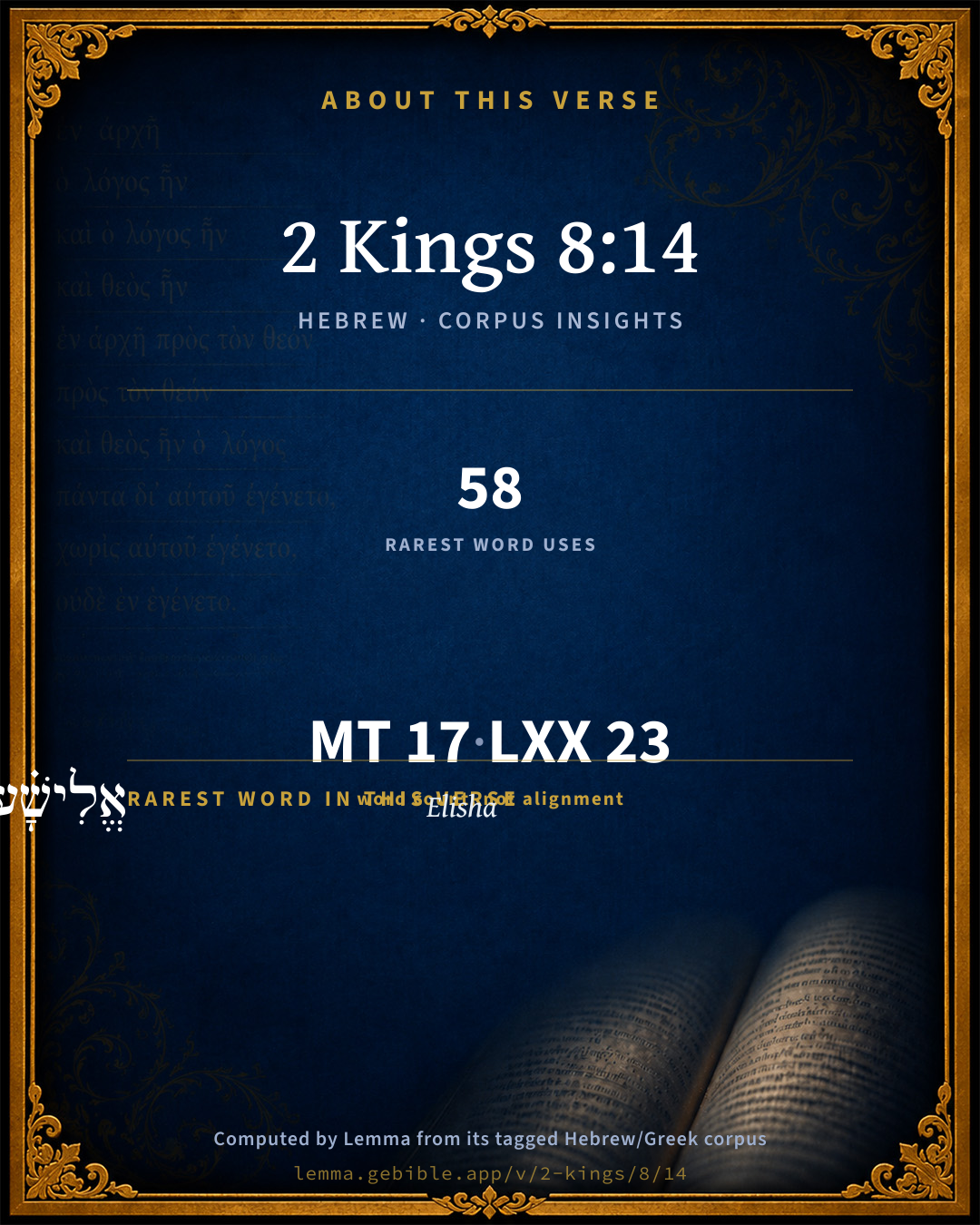
17
words
9
distinct lemmas
Historical
section

Shared distinctive vocabulary

אֱלִישָׁ֗ע Elisha H477 occurs in 52 verses of the Hebrew Bible. Also found in:

Grammatical profile

  • 8 verbs
  • 3 nouns
  • 5 prepositions
  • 1 particle

Verb forms

  • וַיֵּ֣לֶךְ Qal · Sequential Imperfect
  • וַיָּבֹא֙ Qal · Sequential Imperfect
  • וַיֹּ֣אמֶר Qal · Sequential Imperfect
  • אָמַ֥ר Qal · Perfect
  • וַיֹּ֕אמֶר Qal · Sequential Imperfect
  • אָ֥מַר Qal · Perfect
  • חָיֹ֥ה Qal · Infinitive Absolute
  • תִחְיֶֽה Qal · Imperfect

Repetition

Words recur within this verse — often emphatic in Hebrew:

  • וַיֹּ֣אמֶר to say H559 ×4
  • אֱלִישָׁ֗ע Elisha H477 ×2
  • חָיֹ֥ה to live H2421 ×2

Hebrew & Septuagint length

In English translation the verse runs 29 words from the Hebrew and 32 from the Septuagint (LXX English) — closely comparable.

A rough comparison of the two English renderings, which tokenize alike — not a word-level alignment.

Word counts can differ between the Hebrew and the Greek without any difference in meaning — e.g. the Hebrew direct-object marker אֵת has no separate Greek word, and Greek often adds the article ὁ.

In the original languages it is 17 Hebrew tokens and 23 Greek tokens — but the two are counted differently (Hebrew bundles its prefixes and suffixes into one token; the Greek is in lemma form), so that isn’t a like-for-like length.

Cross-references

3

Topical passages linked to 2 Kings 8:14 in the Treasury of Scripture Knowledge — connected by theme and wording, ordered by reader-vote popularity; previews shown in the World English Bible.

  • 2 Kings 8:10 Elisha said to him, Go, tell him, You shall surely recover; however Yahweh has shown me that he shall surely die.
  • 2 Kings 5:25 But he went in, and stood before his master. Elisha said to him, Whence come you, Gehazi? He said, Your servant went no where.
  • Matthew 26:16 From that time he sought opportunity to betray him.

Cross-references courtesy of OpenBible.info (CC BY 4.0).

Hebrew and Greek witnesses Masoretic Hebrew ↔ Greek Septuagint

The same verse in the two great witnesses to the Old Testament, shown verse-for-verse.

These are two independent witnesses, not word-aligned to each other, and the Septuagint is shown in lemma (dictionary) form.

Hebrew 2 Kings 8:14 Masoretic · Westminster Leningrad Codex

וַיֵּ֣לֶךְ מֵאֵ֣ת אֱלִישָׁ֗ע וַיָּבֹא֙ אֶל אֲדֹנָ֔יו וַיֹּ֣אמֶר ל֔וֹ מָֽה אָמַ֥ר לְךָ֖ אֱלִישָׁ֑ע וַיֹּ֕אמֶר אָ֥מַר לִ֖י חָיֹ֥ה תִחְיֶֽה

Then he departed from Elisha, and came to his master; who said to him, What said Elisha to you? He answered, He told me that you would surely recover.

World English Bible · Public Domain

Greek LXX 2 Kings 8:14 Septuagint · lemma form

καί ἀποἔρχομαι ἀπό ελισαιε καί εἰςἔρχομαι πρός ὁ κύριος αὐτός καί εἶπον αὐτός τίς εἶπον σύ ελισαιε καί εἶπον εἶπον ἐγώ ζωή ζάω

And he departed from Elisaie, and went in to his lord; and he said to him, What said Elisaie to you? and he said, He said to me, You shall surely live.

LXX2012 (modern English Septuagint) · Public Domain

Hebrew: Westminster Leningrad Codex (CC BY 4.0). Greek: Septuagint (public domain); English from LXX2012 (modern English Septuagint) (Public Domain). How the Septuagint differs from the Hebrew →

Targum (Aramaic paraphrase)

1

The Targum is the ancient Jewish Aramaic paraphrase of the Hebrew Scriptures — an interpretive translation, not the Hebrew text itself. Onkelos (literal) and Pseudo-Jonathan (expansive) render the Torah, and Jonathan the Prophets. Coverage is partial: where no permissively-licensed English translation exists for a verse, only the Aramaic is shown. This is verse-level text, not a word-by-word alignment to the Hebrew.

  1. Targum Jonathan Prophets (Joshua–Malachi)
    וַאֲזַל מִלְוַת אֱלִישָׁע וַאֲתָא לְוַת רִבּוֹנֵיהּ וַאֲמַר לֵיהּ מָה אֲמַר לָךְ אֱלִישָׁע וַאֲמַר אֲמַר לִי מֵחָא תֵיחֵי:

    (no public-domain English translation for this verse)

    Targum Jonathan — Aramaic: “Mikraot Gedolot” (public domain). English: “Sefaria Community Translation” (CC0 1.0 (public-domain dedication)); “London "Chaldee Paraphrase," 1871” (public domain). Text via Sefaria.

Commentary

Notes on 2 Kings 8:14 from classic Christian and Jewish commentators (each source and its license shown beneath its notes). The classic Christian expositions comment on the surrounding passage and are grouped to its opening verse, so a note may address several verses; the Jewish commentaries on the Tanakh (Rashi and others) are per-verse, so they appear only where the commentator wrote on this verse.

Lemma curates 59 commentaries, every one of them public domain or Creative Commons licensed, each selected and text-cleaned for this edition rather than reprinted as found. About our sources →

Trapp's Complete Commentary

John Trapp

2Ki 8:14 So he departed from Elisha, and came to his master; who said to him, What said Elisha to thee? And he answered, He told me [that] thou shouldest surely recover.

Ver. 14. He told me thou shouldst surely recover.] He relateth the prophet’s words with the same honesty, saith Junius, as he afterwards strangled his master, aud stopped his breath.

John Trapp, A Commentary or Exposition upon All the Books of the Old and New Testament (1647–1656) — public domain. Text from a community e-Sword module.

Joseph Benson's Commentary

2Ki 8:14. He told me that thou shouldest surely recover — This was abominably false. He told him he should die, 2Ki 8:10; but Hazael unfairly and unfaithfully concealed that, either because he was loath to put the king out of humour with bad news, or because he thought he should thereby the more easily put in execution the design which he had already formed against his life, finding he was to be his successor, and which he was eager to see accomplished. Elisha’s prediction might give Satan an occasion of suggesting this villany to his mind; but, as Mr. Scott justly observes, “it was not the cause of his crime, and forms no excuse for it. Had he been of David’s disposition, he would have waited in the path of duty till the Lord had performed his word in that manner which pleased him.” Thus he soon began to manifest the rapaciousness and cruelty of the dog, of which he desired to be thought incapable.

Joseph Benson's Commentary on the Old and New Testaments (1811–1818) — public domain. Text from a community e-Sword module.

Ellicott's Commentary for English Readers

(14) That thou shouldest surely recover.—Rather, Thou wilt certainly live, repeating Elisha’s actual words, but not the tone and gesture which accompanied them.

A Bible Commentary for English Readers, edited by Charles John Ellicott (1878–1897) — public domain. Text from a community e-Sword module.

The Cambridge Bible for Schools and Colleges

gen. ed. J. J. S. Perowne

14. So [R.V. Then] he departed from Elisha] The last words of the prophet had shewn him that his whole aim was clear in Elisha’s sight, and his character thoroughly read. He had been treated as a man who would give a soft answer whatever the real message might be, and now he is sent away with the knowledge that the Lord sees all his policy. But he was a determined spirit, and the words of the prophet did not act as a check, but set him on a bolder course of villainy. He first acts the part that had been imputed to him, and with a lying tongue says ‘He told me thou shouldest surely recover’. After that he cannot wait for time to bring about what God had said would be, but by a short road comes to the throne after smothering his master.

The Cambridge Bible for Schools and Colleges (gen. ed. J. J. S. Perowne; Cambridge University Press, 1878–1918) — public domain. Text from a community e-Sword module.

John Gill's Exposition

So he departed from Elisha, and came to his master,.... Benhadad king of Syria:

who said to him, what said Elisha to thee? concerning his recovery, which was the thing uppermost in his mind, and he was eagerly desirous to know how it would be:

and he answered, he told me that thou shouldest surely recover; which was false; for he only said that he "might", and not that he should; and he concealed what he also declared, that though he might recover of his disease, yet that he should surely die in another way.

John Gill's Exposition of the Whole Bible (1746–1763) — public domain (CC PDM 1.0). Text via the HelloAO Bible API.

Albert Barnes' Notes on the Bible

Hazael omitted the clause by which Elisha had shown how those words were to be understood. He thus deceived his master, while he could flatter himself that he had not uttered a lie.

Albert Barnes' Notes on the Bible (1834–1885) — public domain. Text from a community e-Sword/MySword module.

Matthew Poole's English Annotations

He represents the prophet’s answer by halves, that by his master’s security he might have the fitter opportunity to execute his reasonable design.

Matthew Poole's English Annotations on the Holy Bible (1683–1685) — public domain. Text from a community e-Sword/MySword module.

Whedon's Commentary on the Bible

Daniel D. Whedon

14. He told me… thou shouldest surely recover — This, as we have seen above, is the exact opposite of what Elisha said, made so by the omission of the single word לא, not. Hazael thus deceived Ben-hadad, expecting, probably, to put him off his guard. He who had murder in his heart, and whom Elisha’s words had inspired to a boundless ambition, was none too good to lie.

Daniel D. Whedon (gen. ed.), Commentary on the Old and New Testaments (1874–1909) — public domain. Text from a community e-Sword module.

The Pulpit Commentary

So he departed from Elisha, and came to his master; who said to him, What said Elisha to thee? And he answered, He told me that thou shouldest surely recover. This, as already observed, was giving half Elisha"s answer, and suppressing the other half. The suppressio veri is a suggestio falsi; and the suppression was Hazael"s act, not Elisha"s. Had Hazael repeated the whole of Elisha"s answer, "Say unto him, Thou shalt surely recover; howbeit the Lord hath showed me that he shall surely die; Benhadad might have been puzzled, but he would not have beendeceived.

The Pulpit Commentary (1880–1919), ed. H.D.M. Spence-Jones & Joseph S. Exell — public domain. Text from a community e-Sword module.

Lesson kit

Teaching starters — assembled from the data on this page, not authored interpretation. Every prompt links to the verse data it draws on. Edit before teaching.

2 Kings, in the Historical, opens this verse with 17 words (9 distinct Hebrew lemmas). Its most distinctive word is ʼĔlîyshâʻ (“Elisha”). A historical commentator’s framing appears above. Read the whole chapter for the surrounding context.

Discussion questions

  1. The word ʼĔlîyshâʻ carries the sense “Elisha.” How does it shape the verse?
  2. How does 1 Kings 19:16, which shares the word «Elisha», read alongside this verse?
  3. What does the repetition of “to say” (4× in this one verse) do in this verse?
  4. These translations render this verse differently; the difference is in the English rendering, not the original. What questions does that raise?
  5. «וַיֵּ֣לֶךְ» is a Qal Sequential Imperfect verb. How does that grammatical form shape the action described?
  6. Compare how Trapp's Complete Commentary and Joseph Benson's Commentary read this verse. Where do they agree or differ?

Things to notice

Reading settings

Reading text

Shown beneath each verse's original-language words.

Old Testament
Old Testament edition

Read the OT as the Masoretic Hebrew (MT) or the Greek Septuagint (LXX).

English shown for the Greek Septuagint (in the Hebrew ↔ Greek comparison).

Comparing translations? Open the Compare panel on any verse page to stack up to four side by side.