
Joshua 9:21

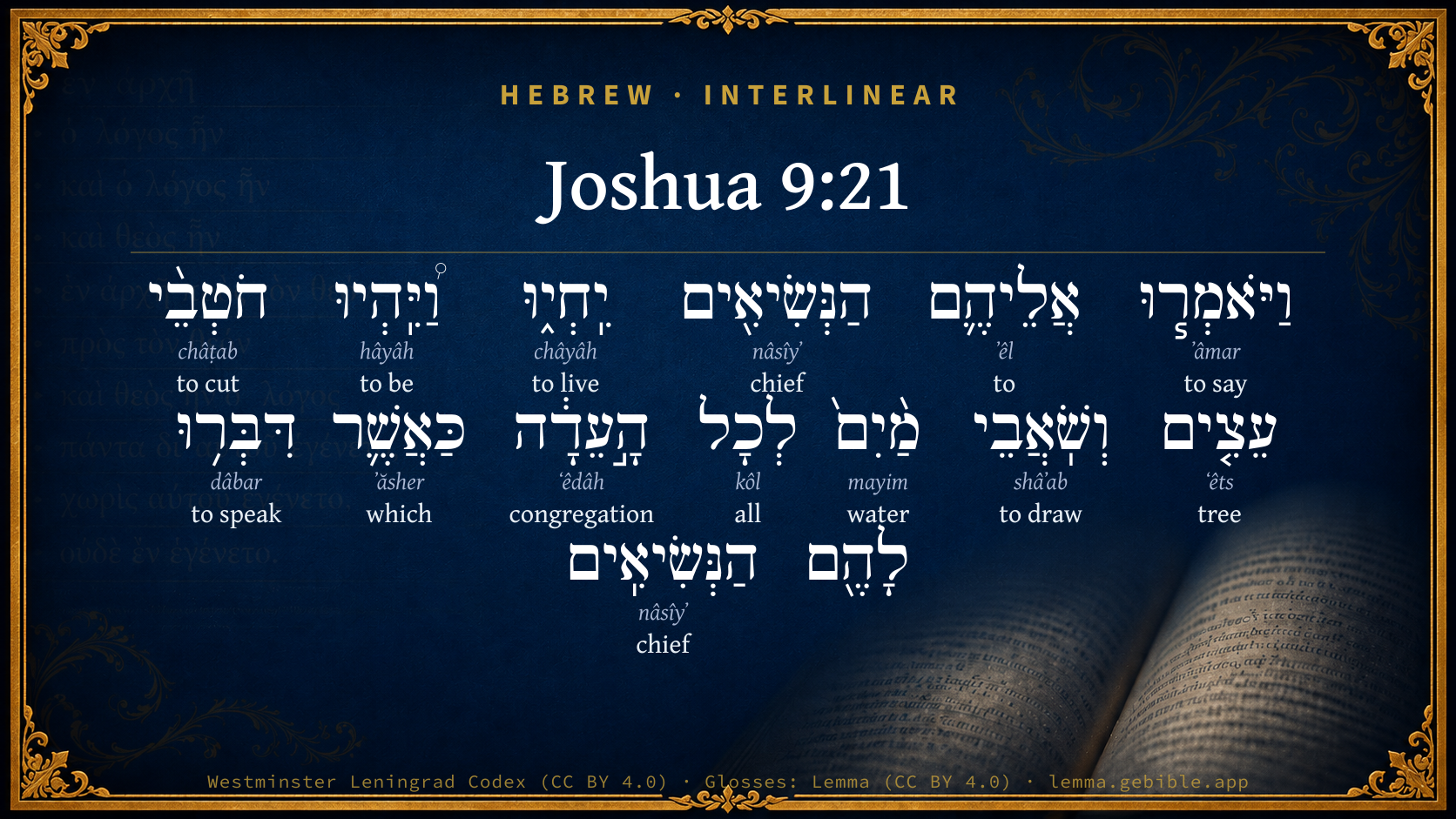
Hebrew (Westminster Leningrad Codex) Joshua 9:21 appears in the Hebrew Old Testament. The text above is from the Westminster Leningrad Codex. Each word links to its Strong’s number, a concise gloss, and parsing drawn from the Open Scriptures Hebrew Bible morphology. Click any word for its full Brown-Driver-Briggs (BDB) entry.
Download image
Cite this verse

Joshua 9:21 (World English Bible). Public Domain. Lemma interlinear Bible study tool, https://lemma.gebible.app/v/joshua/9/21.

Show BibTeX & RIS
BibTeX
RIS
English Translation
The princes said to them, Let them live: so they became wood cutters and drawers of water to all the congregation, as the princes had spoken to them.
World English Bible · Public Domain
Download a study sheet

One document with this verse’s original text, its word-by-word gloss line, the meaning frame, cross-references with their text, attributed commentary, and full source and license credits — printable, and it pastes into notes with its structure intact.

This verse Autodidact and up

Study sheet (.html) Plain text (.txt)

A passage Seminary Student

Up to 50 verses in one chapter. A passage sheet keeps up to 6 commentary sources and 12 cross-references per verse, in the order this page ranks them, and says so on the sheet whenever that leaves anything out. Ask for a single verse and you get the Autodidact verse sheet above.

Everything on this page stays free to read, with no account — the sheet is a download of what is already on screen, not access to it.

Want to remove ads? Support Godless Engineer
Compare translations 3

The same verse in 3 English versions, stacked beneath the original-language interlinear above. Click any original word for its lexicon entry.

Each is an independent rendering of the whole verse — the interlinear is not word-aligned to these translations.

Highlighted words mark where these versions differ — a whole-verse word diff, not a word-by-word alignment.

  • World English Bible Public Domain
    The princes said to them, Let them live: so they became wood cutters and drawers of water to all the congregation, as the princes had spoken to them.
  • King James Version Public Domain
    And the princes said unto them, Let them live; but let them be hewers of wood and drawers of water unto all the congregation; as the princes had promised them.
  • unfoldingWord Literal Text CC BY-SA 4.0
    Then the leaders said to them, “Let them live.” So they became hewers of wood and drawers of water for all of the congregation, just as the leaders had spoken to them.

unfoldingWord Literal Text — © unfoldingWord, licensed CC BY-SA 4.0. Word-aligned USFM3 via Door43 (git.door43.org/unfoldingWord/en_ult).

Versions to compare (up to 4)

3 of 4 selected

Show all 18 translations

Every available English version of this verse, each an independent rendering of the whole verse.

  • World English Bible Public Domain
    The princes said to them, Let them live: so they became wood cutters and drawers of water to all the congregation, as the princes had spoken to them.
  • Berean Standard Bible Public Domain
    They continued, “Let them live, but let them be woodcutters and water carriers for the whole congregation.” So the leaders kept their promise.
  • Majority Standard Bible Public Domain
    They continued, “Let them live, but let them be woodcutters and water carriers for the whole congregation.” So the leaders kept their promise.
  • King James Version Public Domain
    And the princes said unto them, Let them live; but let them be hewers of wood and drawers of water unto all the congregation; as the princes had promised them.
  • American Standard Version (1901) Public Domain
    And the princes said unto them, Let them live: so they became hewers of wood and drawers of water unto all the congregation, as the princes had spoken unto them.
  • Revised Version (1885) Public Domain
    And the princes said unto them, Let them live: so they became hewers of wood and drawers of water unto all the congregation; as the princes had spoken unto them.
  • Geneva Bible (1599) Public Domain
    And the Princes sayd vnto them againe, Let them liue, but they shall hewe wood, and drawe water vnto all the Congregation, as the Princes appoint them.
  • Douay-Rheims (1899) Public Domain
    But so let them live, as to serve the whole multitude in hewing wood, and bringing in water. As they were speaking these things,
  • Young's Literal Translation Public Domain
    And the princes say unto them, `They live, and are hewers of wood and drawers of water for all the company, as the princes spake to them.'
  • Literal Standard Version CC BY-SA 4.0
    And the princes say to them, “They live, and are hewers of wood and drawers of water for all the congregation, as the princes spoke to them.”
  • Unlocked Literal Bible CC BY-SA 4.0
    The leaders said to their people, “Let them live.” So, the Gibeonites became cutters of wood and drawers of water for all the Israelites, just as the leaders said about them.
  • unfoldingWord Literal Text CC BY-SA 4.0
    Then the leaders said to them, “Let them live.” So they became hewers of wood and drawers of water for all of the congregation, just as the leaders had spoken to them.
  • Darby Bible Public Domain
    And the princes said to them, Let them live. And they were hewers of wood and drawers of water for all the assembly; as the princes had said to them.
  • World Messianic Bible Public Domain
    The princes said to them, “Let them live.” So they became wood cutters and drawers of water for all the congregation, as the princes had spoken to them.
  • Webster's Bible Public Domain
    And the princes said to them, Let them live; but let them be hewers of wood, and drawers of water to all the congregation; as the princes had promised them.
  • Free Bible Version CC BY-SA 4.0
    The leaders concluded, “Let them live.” So the Gibeonites became woodcutters and water-carriers in service to the entire assembly, as the Israelite leaders had ordered.
  • Bible in Basic English Public Domain
    Keep them living, and let them be servants, cutting wood and getting water for all the people. And all the people did as the chiefs had said to them.
  • JPS Tanakh (1917) Public Domain
    And the princes said concerning them: 'Let them live'; so they became hewers of wood and drawers of water unto all the congregation, as the princes had spoken concerning them.

Literal Standard Version (2020), Covenant Press — licensed CC BY-SA 4.0. Text via the HelloAO Bible API (eBible.org). Unlocked Literal Bible (unfoldingWord) — licensed CC BY-SA 4.0. Text via the HelloAO Bible API (eBible.org). unfoldingWord Literal Text — © unfoldingWord, licensed CC BY-SA 4.0. Word-aligned USFM3 via Door43 (git.door43.org/unfoldingWord/en_ult). Free Bible Version, Dr. Jonathan Gallagher — licensed CC BY-SA 4.0. Text via the HelloAO Bible API (eBible.org).

Word by word

More ways to search: Search by grammar → Find every occurrence → Compare this word →

Practice this passage: Drill this verse → Learn its vocabulary →

חֹטְבֵ֨י
châṭab
H2404
“cutting”
Verb, Qal, Participle Active, Masculine, Plural, Construct
Part of Speech
Verb
Stem
Qal
Form
Participle Active
Gender
Masculine
Number
Plural
State
Construct
Full BDB Definition

Origin: a primitive root

TWOT: 639

to cut, gather - (Qal) to cut, gather (wood) - (Pual) to cut, carve
  1. וַיֹּאמְר֧וּ ʼâmar H559 “and · to say” Conjunction + Verb, Qal, Sequential Imperfect, 3rd Person, Masculine, Plural
  2. אֲלֵיהֶ֛ם ʼêl H413 “to · them” Preposition + Suffix, Personal, 3rd Person, Masculine, Plural
  3. הַנְּשִׂיאִ֖ים nâsîyʼ H5387 “the · chiefs” Particle, Definite Article + Noun, Common, Masculine, Plural, Absolute
  4. יִֽחְי֑וּ châyâh H2421 “to live” Verb, Qal, Imperfect, 3rd Person, Masculine, Plural
  5. וַ֠יִּֽהְיוּ hâyâh H1961 “and · to be” Conjunction + Verb, Qal, Sequential Imperfect, 3rd Person, Masculine, Plural
  6. עֵצִ֤ים ʻêts H6086 “trees” Noun, Common, Masculine, Plural, Absolute
  7. וְשֹֽׁאֲבֵי shâʼab H7579 “and · drawing” Conjunction + Verb, Qal, Participle Active, Masculine, Plural, Construct
  8. מַ֨יִם֙ mayim H4325 “water(s)” Noun, Common, Masculine, Plural, Absolute
  9. לְכָל kôl H3605 “to/for · all of” Preposition + Noun, Common, Masculine, Singular, Construct
  10. הָ֣עֵדָ֔ה ʻêdâh H5712 “the · congregation” Particle, Definite Article + Noun, Common, Feminine, Singular, Absolute
  11. כַּאֲשֶׁ֛ר ʼăsher H834 “like/as · which” Preposition + Particle, Relative
  12. דִּבְּר֥וּ dâbar H1696 “to speak” Verb, Piel, Perfect, 3rd Person, Common, Plural
  13. הַנְּשִׂיאִֽים nâsîyʼ H5387 “the · chiefs” Particle, Definite Article + Noun, Common, Masculine, Plural, Absolute

About this verse

These counts appear in no published source. They are computed here, from the morphology-tagged text and Lemma’s own curated glosses. What Lemma adds →

15
words
13
distinct lemmas
Historical
section

Notable vocabulary

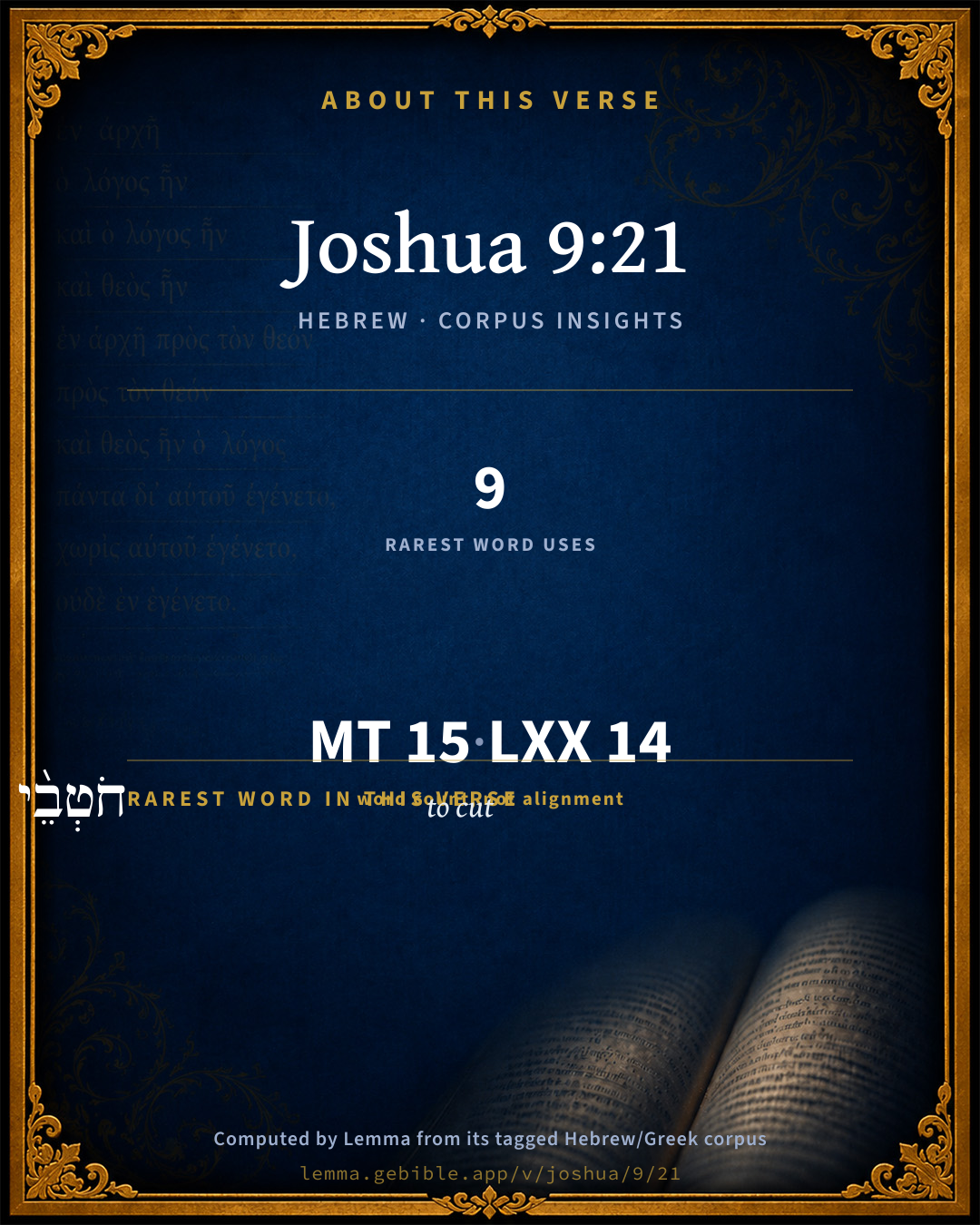
The rarest word here is חֹטְבֵ֨י to cut H2404 — appearing just 9 times in the whole Hebrew Bible.

Shared distinctive vocabulary

חֹטְבֵ֨י to cut H2404 occurs in 9 verses of the Hebrew Bible. Also found in:

Grammatical profile

  • 6 verbs
  • 6 nouns
  • 2 prepositions
  • 1 particle

Verb forms

  • וַיֹּאמְר֧וּ Qal · Sequential Imperfect
  • יִֽחְי֑וּ Qal · Imperfect
  • וַ֠יִּֽהְיוּ Qal · Sequential Imperfect
  • חֹטְבֵ֨י Qal · Participle Active
  • וְשֹֽׁאֲבֵי Qal · Participle Active
  • דִּבְּר֥וּ Piel · Perfect

Repetition

A word recurs within this verse — often emphatic in Hebrew:

  • הַנְּשִׂיאִ֖ים chief H5387 ×2

Hebrew & Septuagint length

In English translation the verse runs 28 words from the Hebrew and 23 from the Septuagint (LXX English) — closely comparable.

A rough comparison of the two English renderings, which tokenize alike — not a word-level alignment.

Word counts can differ between the Hebrew and the Greek without any difference in meaning — e.g. the Hebrew direct-object marker אֵת has no separate Greek word, and Greek often adds the article ὁ.

In the original languages it is 15 Hebrew tokens and 14 Greek tokens — but the two are counted differently (Hebrew bundles its prefixes and suffixes into one token; the Greek is in lemma form), so that isn’t a like-for-like length.

Cross-references

5

Topical passages linked to Joshua 9:21 in the Treasury of Scripture Knowledge — connected by theme and wording, ordered by reader-vote popularity; previews shown in the World English Bible.

  • Deuteronomy 29:11 your little ones, your wives, and your foreigner who is in the midst of your camps, from the one who cuts your wood to the one who draws your water;
  • Joshua 9:23 Now therefore you are cursed, and there shall never fail to be of you bondservants, both wood cutters and drawers of water for the house of my God.
  • Joshua 9:27 That day Joshua made those wood cutters and drawers of water for the congregation, and for the altar of Yahweh, to this day, in the place which he should choose.
  • Joshua 9:15 Joshua made peace with them, and made a covenant with them, to let them live: and the princes of the congregation swore to them.
  • 2 Chronicles 2:17–18 Solomon numbered all the foreigners who were in the land of Israel, after the numbering with which David his father had numbered them; and they were found one hundred fifty-three thousand six hundred.

Cross-references courtesy of OpenBible.info (CC BY 4.0).

Hebrew and Greek witnesses Masoretic Hebrew ↔ Greek Septuagint

The same verse in the two great witnesses to the Old Testament, shown verse-for-verse.

These are two independent witnesses, not word-aligned to each other, and the Septuagint is shown in lemma (dictionary) form.

Hebrew Joshua 9:21 Masoretic · Westminster Leningrad Codex

וַיֹּאמְר֧וּ אֲלֵיהֶ֛ם הַנְּשִׂיאִ֖ים יִֽחְי֑וּ וַ֠יִּֽהְיוּ חֹטְבֵ֨י עֵצִ֤ים וְשֹֽׁאֲבֵי מַ֨יִם֙ לְכָל הָ֣עֵדָ֔ה כַּאֲשֶׁ֛ר דִּבְּר֥וּ לָהֶ֖ם הַנְּשִׂיאִֽים

The princes said to them, Let them live: so they became wood cutters and drawers of water to all the congregation, as the princes had spoken to them.

World English Bible · Public Domain

Greek LXX Joshua 9:21 Septuagint · lemma form

ζάω καί εἰμί ξυλοκόπος καί ὑδροφόρος πᾶς ὁ συναγωγή καθάπερ εἶπον αὐτός ὁ ἄρχων

They shall live, and shall be hewers of wood and drawers of water to all the congregation, as the princes said to them.

LXX2012 (modern English Septuagint) · Public Domain

On this verse, The Pulpit Commentary discusses the Septuagint’s reading. Read the note in Commentary ↓

Hebrew: Westminster Leningrad Codex (CC BY 4.0). Greek: Septuagint (public domain); English from LXX2012 (modern English Septuagint) (Public Domain). How the Septuagint differs from the Hebrew →

Targum (Aramaic paraphrase)

1

The Targum is the ancient Jewish Aramaic paraphrase of the Hebrew Scriptures — an interpretive translation, not the Hebrew text itself. Onkelos (literal) and Pseudo-Jonathan (expansive) render the Torah, and Jonathan the Prophets. Coverage is partial: where no permissively-licensed English translation exists for a verse, only the Aramaic is shown. This is verse-level text, not a word-by-word alignment to the Hebrew.

  1. Targum Jonathan Prophets (Joshua–Malachi)
    וַאֲמַרוּ לְהוֹן רַבְרְבַיָא יֵיחוֹן וַהֲווֹ מְלַקְטֵי אָעִין וּמְלָן מַיָא לְכָל כְּנִשְׁתָּא כְּמָא דְמַלִילוּ לְהוֹן רַבְרְבַיָא:

    (no public-domain English translation for this verse)

    Targum Jonathan — Aramaic: “Mikraot Gedolot” (public domain). English: “Sefaria Community Translation” (CC0 1.0 (public-domain dedication)); “London "Chaldee Paraphrase," 1871” (public domain). Text via Sefaria.

Commentary

Notes on Joshua 9:21 from classic Christian and Jewish commentators (each source and its license shown beneath its notes). The classic Christian expositions comment on the surrounding passage and are grouped to its opening verse, so a note may address several verses; the Jewish commentaries on the Tanakh (Rashi and others) are per-verse, so they appear only where the commentator wrote on this verse.

Lemma curates 59 commentaries, every one of them public domain or Creative Commons licensed, each selected and text-cleaned for this edition rather than reprinted as found. About our sources →

Trapp's Complete Commentary

John Trapp

Jos 9:21 And the princes said unto them, Let them live; but let them be hewers of wood and drawers of water unto all the congregation; as the princes had promised them.

Ver. 21. But let them be hewers of wood and drawers of water.] Lignatores et lixae: so they are freed from a natural death, because of the princes’ oath, but condemned to a civil death (slavery) by the princes’ sentence.

Unto all the congregation.] That they, in the meantime, as a royal nation might be privileged and exempted from such servile drudgery. A great mercy to the one, and, as it proved, no less to the other. See Ezr 2:43, {See Trapp on "Ezr 2:43"} These Gibeonites were afterwards called Nethinims, that is, Dedititii, or rather Deodati, men given to God, and to the public service of the sanctuary and people.

John Trapp, A Commentary or Exposition upon All the Books of the Old and New Testament (1647–1656) — public domain. Text from a community e-Sword module.

Joseph Benson's Commentary

Jos 9:21. Unto all the congregation — That is, let them be public servants, and employed in the meanest offices (one kind being put for all the rest) for the use of the congregation; doing these things partly for the sacrifices and services of the house of God, which otherwise the Israelites themselves must have done; partly for the services of the camp or body of people; and sometimes even for particular Israelites.

Joseph Benson's Commentary on the Old and New Testaments (1811–1818) — public domain. Text from a community e-Sword module.

Keil & Delitzsch

C. F. Keil & F. Delitzsch

The princes declared again most emphatically, "They shall live." Thus the Gibeonites became hewers of wood and drawers of water to the congregation, as the princes had said to them, i.e., had resolved concerning them. This resolution they communicated to the congregation at the time, using the expression יחיוּ (let them live); but the historian has passed this over at Jos 9:21, and instead of mentioning the resolution proceeds at once to describe its execution.

Keil & Delitzsch — Biblical Commentary on the Old Testament (1861–1891) — public domain (CC PDM 1.0). Text via the HelloAO Bible API. (Old Testament only.)

Adam Clarke's Commentary

Verse 21. Hewers of wood and drawers of water] Perhaps this is a sort of proverbial expression, signifying the lowest state of servitude, though it may also be understood literally. See below.

Adam Clarke's Commentary on the Bible (1810–1826) — public domain. Text from a community e-Sword/MySword module.

The Cambridge Bible for Schools and Colleges

gen. ed. J. J. S. Perowne

21. hewers of wood and drawers of water] “trees thei kutten and watris thei beren,” Wyclif. They were devoted to the sanctuary, called at a later period Nethinims = Deo dati, donati, and were bound to discharge menial duties which usually devolved upon the lowest classes. Comp. Deu_29:10-11, “Ye stand this day all of you before the Lord your God; your captains of your tribes, your elders, and your officers, with all the men of Israel, your little ones, your wives, and thy stranger that is in thy camp, from the hewer of thy wood unto the drawer of thy water” Compare also 1Ch_9:2; Ezr_2:43; Ezr_2:70; Neh_7:46; Neh_7:60.

The Cambridge Bible for Schools and Colleges (gen. ed. J. J. S. Perowne; Cambridge University Press, 1878–1918) — public domain. Text from a community e-Sword module.

John Gill's Exposition

And the princes said to them, let them live,.... They were very pressing upon them, and importunate with them, to save their lives, because of the oath they had taken:

(but let them be hewers of wood, and drawers of water, unto all the congregation): which was a very low and mean employment, Deu 29:11; as well as wearisome; and this being a yoke of servitude on the Gibeonites, and a punishment of them for their fraud, and of service, profit, and advantage to the people of Israel, the princess proposed it in hopes of pacifying them, and that they would yield to spare the lives of the Gibeonites; what they proposed was, not that they should hew wood and draw water for all the Israelites for their private use, but what was necessary for the service of the sanctuary, which the congregation was obliged to furnish them with; and now these men should do that work for them, which before was incumbent on them; for Joshua afterwards imposed this upon them, to be hewers of wood and drawers of water for the house of God, Jos 9:23; though Kimchi thinks that while the people of Israel were in camp, and before the land was divided, they were hewers of wood and drawers of water to the congregation; but after the land was divided, and they were settled in their cities and inheritances, then they only hewed wood and drew water for the sanctuary at Gilgal, Shiloh, Nob, Gibeon, and the temple; the Jewish writers say (s), the Nethinim and the Gibeonites were the same, who became proselytes in the times of Joshua, see Ch1 9:2,

as the princes promised them; which is to be connected, not with their being hewers of wood and drawers of water, this the princes had said nothing of before, and which is rightly included in a parenthesis, but with their being let to live; this they had promised and sworn to, even all the princes, not only all that were now at Gibeon, and were persuading the people to let the Gibeonites live, but all the princes, even those that were not present, but in the camp at Gilgal.

(s) Maimon. & Bartenora in Misn. Kiddushin, c. 4. sect. 1.

John Gill's Exposition of the Whole Bible (1746–1763) — public domain (CC PDM 1.0). Text via the HelloAO Bible API.

Albert Barnes' Notes on the Bible

Render “they shall be hewers of wood and drawers of water:” menial duties belonging to the lowest classes only (compare the marginal reference). The curse of Noah Gen 9:25 on the children of Ham was thus fulfilled to the letter in the case of these Hivites.

Albert Barnes' Notes on the Bible (1834–1885) — public domain. Text from a community e-Sword/MySword module.

Haydock's Catholic Bible Commentary

Multitude. The common people, only considering their own private advantage, murmured at the conduct of their leaders, as they supposed that they were thus deprived of the plunder (Calmet) of many cities, and engaged in a dangerous war, with the five confederate kings. But this war was in no degree detrimental to them, as they knew they had to subdue the whole country; and as for the Gabaonites, they eased the people of Israel of a great burden, by doing the drudgery of the tabernacle, which otherwise must have fallen upon them. (Haydock) --- These people were dispersed through the country, particularly in the cities of the priests and Levites, whose servants they were forced to be. Gabaon was allotted to the priests. In latter ages, many of these poor people being slain by Saul, &c., David was obliged to select some others, called Nathineans, or "people given," to supply their place, (Calmet) unless these were all the remnants of the Gabaonites. (Menochius) --- Josephus (Jewish Wars ii. 17,) speaks of the feast of Xylophoria, or "wood carrying," for the uses of the temple; and we read, (2 Esdras x. 34,) that lots were cast among the priests and the Levites, and the people, for the offering of wood, &c., which seems to insinuate that the ancient institution was then altered. Many authors speak of a fountain which furnished the temple with water, after the captivity, so that the service of the Gabaonites was not much wanted. We find no mention of them after that time.

George Leo Haydock (1774–1849), Haydock's Catholic Family Bible and Commentary, 1859 edition — public domain. Excludes Psalms (Douay-Rheims chapter numbering differs from Protestant) and Deuterocanonical books (Catholic canon only).

Matthew Poole's English Annotations

i.e. Let them be public servants, and employed in the meanest offices and drudgeries, (such as this was, this one kind being put for all the rest, as it is Deu 29:11) for the use and benefit of the congregation; to do this partly for the sacrifices and services of the house of God, as it is expressed, Jos 9:23, which otherwise the Israelites themselves must have done, partly for the service of the camp or body of the people, and sometimes upon occasion even to particular Israelites; whence they are made bondmen, which is mentioned as a filing distinct from their service in the house of God, Jos 9:23. And so they are in effect stripped of all their possessions, whereby the main ground of the people’s quarrel was taken away.

As the princes had promised them; or, because or seeing that (as the Hebrew word sometimes signifies) the princes (i.e. we ourselves; they speak of themselves in the third person, which is very frequent in the Hebrew language) had promised it to them, to wit, that they should live, and confirmed their promise by an oath. So the princes speaking here to the people allege the promise or oath of the princes when they met among themselves, and apart from the people. And this change of persons may possibly arise from hence, because some of the princes who were present in the assembly of the princes might now be absent upon some occasion. And this clause relates not to the next words, which are fitly enclosed within a parenthesis, but to the foregoing clause,

let them live, because the princes have promised them their lives.

Matthew Poole's English Annotations on the Holy Bible (1683–1685) — public domain. Text from a community e-Sword/MySword module.

Whedon's Commentary on the Bible

Daniel D. Whedon

21. Hewers of wood and drawers of water — We will keep our oath to the letter: they shall live, but live as slaves. Upon the “great high place” of Gibeon the tabernacle was set up at a later period, (1Ch_16:39,) and there it remained till it was removed to Jerusalem by Solomon. From beneath this eminence water and wood for the service of the tabernacle were constantly carried up, requiring the labour of a large number of people. Stanley says: “They hewed the wood of the adjacent valley and drew the water from the springs and tanks which in its immediate neighbourhood abound, and carried them up to the Sacred Tent, and there attended the altar of the Lord.” Respecting the drudgery of this menial service, Dr. Thomson, while passing through this very region of the Gibeonites, says: “I was forcibly reminded of one item in the sentence of condemnation pronounced upon them for their cunning deception — that they should be hewers of wood — by long files of women and children carrying on their heads heavy bundles of wood. It is the severest drudgery, and my compassion has often been enlisted in behalf of the poor women and children who daily bring loads of wood to Jerusalem from these very mountains of the Gibeonites. To carry water, also, is very laborious. The fountains are far off, in deep wadies with steep banks; and a thousand times have I seen the feeble and the young staggering up long and weary ways, with large jars of water on their heads. It is the work of slaves.”

As the princes had promised them — They had promised life not servitude. This promise was kept by successive generations, till Saul rashly killed some and planned the general massacre of the rest. Seven of Saul’s descendants atoned for this breach of the covenant with their lives. 2Sa_21:1-9. At the time of Saul’s massacre they were so identified with Israel that the historian was obliged to insert a note explaining their origin.

Daniel D. Whedon (gen. ed.), Commentary on the Old and New Testaments (1874–1909) — public domain. Text from a community e-Sword module.

The Pulpit Commentary

Said unto them, i.e., to the Israelites. But let them be. Rather, and they were, with Rosenmuller and Keil. See Keil in loc. for the force of the Vau conversive. The LXX and Vulgate render as our version. Hewers of wood and drawers of water. Some amount of casuistry has been displayed upon this passage. But the fairness of the proceeding seems clear enough. The Gibeonites had escaped death by a fraud. For that fraud they deserved punishment. Their lives were spared by virtue of a solemn oath. But equality of rights had never been promised them. They might think themselves well off if they escaped destruction, even though they might be condemned permanently to occupy a servile condition. They appear to have assisted at the tabernacle worship, since they were condemned to serve, not individual Israelites, but the congregation. Such was the office of the (Nethinhim i.e., the given or devoted) in the later history of Judah. (see 1Ch_9:2 Ezr_2:43-54, Ezr_2:58, 70 8:20. See also Drusius and Masius in loc. ) The latter discusses the question whether the Nethinim were really the Gibeonites, or whether David, as stated in Ezr_8:20, instituted a new order of persons to take their place. If the latter were the case, then we have a proof that the Book of Joshua was written anterior to the time of David. It seems quite possible that Saul (2Sa_21:6) had all but exterminated the Gibeonites, and that David was compelled to institute a new order in their stead. If this suggestion be correct, and it is far from improbable, we have here an undesigned coincidence strongly supporting the credit of the narrative, in the place of Knobel"s insinuation, contained in the words, that "the Elohist in Saul"s time gives no hint of this, although he took the greatest interest in the persons engaged in God"s service." As the princes had promised them. These words as they stand are unintelligible. No such promise had been given. The literal rendering is "as the princes" (see note on ver. 15) "said to them," by the mouth of Joshua, as recorded in ver. 23. The Syriac Version supplies some words here to make up for a supposed deficiency in the text. But this is not necessary. The repetition in vers. 23 and 27 is quite in the manner of the historian. Nor are the words "as the princes said to them" explicable on the supposition that the words after, "let them live," are the words of the princes (see note above).

The Pulpit Commentary (1880–1919), ed. H.D.M. Spence-Jones & Joseph S. Exell — public domain. Text from a community e-Sword module.

John Wesley's Explanatory Notes

Unto all the congregation - That is, Let them be public servants, and employed in the meanest offices, (one kind being put for all the rest) for the use of the congregation; to do this partly for the sacrifices and services of the house of God, which otherwise the Israelites themselves must have done; partly for the service of the camp or body of the people; and sometimes, even to particular Israelites.

John Wesley, Explanatory Notes Upon the Whole Bible (1754–1765) — public domain. Text via the GEBible commentary corpus.

Lesson kit

Teaching starters — assembled from the data on this page, not authored interpretation. Every prompt links to the verse data it draws on. Edit before teaching.

Joshua, in the Historical, opens this verse with 15 words (13 distinct Hebrew lemmas). Its most distinctive word is châṭab (“to cut”). A historical commentator’s framing appears above. Read the whole chapter for the surrounding context.

Discussion questions

  1. The word châṭab carries the sense “to cut.” How does it shape the verse?
  2. Deuteronomy 19:5 shares the word «to cut» with this verse. How do the two illuminate each other?
  3. “chief” occurs 2× in this one verse. What is the effect of the repetition?
  4. The translations on this page render this verse differently — a whole-verse word diff, not a word-by-word alignment. What might account for the different wordings?
  5. The verb «וַיֹּאמְר֧וּ» is Qal Sequential Imperfect. How does its form color the action?
  6. Reading how Trapp's Complete Commentary and Joseph Benson's Commentary read this verse, where do the two commentators agree and where do they part?

Things to notice

Reading settings

Reading text

Shown beneath each verse's original-language words.

Old Testament
Old Testament edition

Read the OT as the Masoretic Hebrew (MT) or the Greek Septuagint (LXX).

English shown for the Greek Septuagint (in the Hebrew ↔ Greek comparison).

Comparing translations? Open the Compare panel on any verse page to stack up to four side by side.