
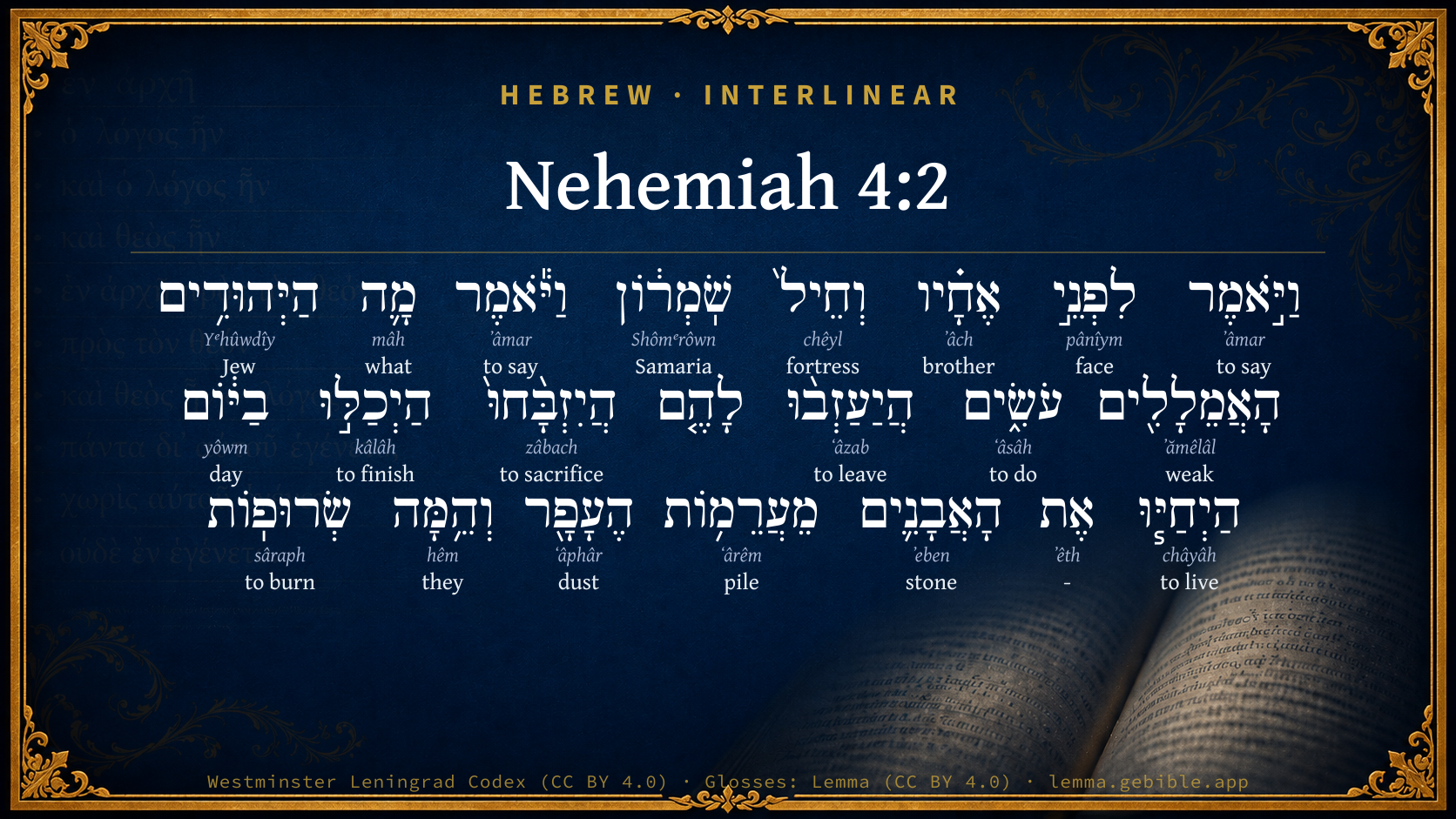
Nehemiah 4:2

Hebrew (Westminster Leningrad Codex) Nehemiah 4:2 appears in the Hebrew Old Testament. The text above is from the Westminster Leningrad Codex. Each word links to its Strong’s number, a concise gloss, and parsing drawn from the Open Scriptures Hebrew Bible morphology. Click any word for its full Brown-Driver-Briggs (BDB) entry.
Download image
Cite this verse

Nehemiah 4:2 (World English Bible). Public Domain. Lemma interlinear Bible study tool, https://lemma.gebible.app/v/nehemiah/4/2.

Show BibTeX & RIS
BibTeX
RIS
English Translation
He spoke before his brothers and the army of Samaria, and said, What are these feeble Jews doing? will they fortify themselves? will they sacrifice? will they make an end in a day? will they revive the stones out of the heaps of rubbish, seeing they are burned?
World English Bible · Public Domain
Highlights
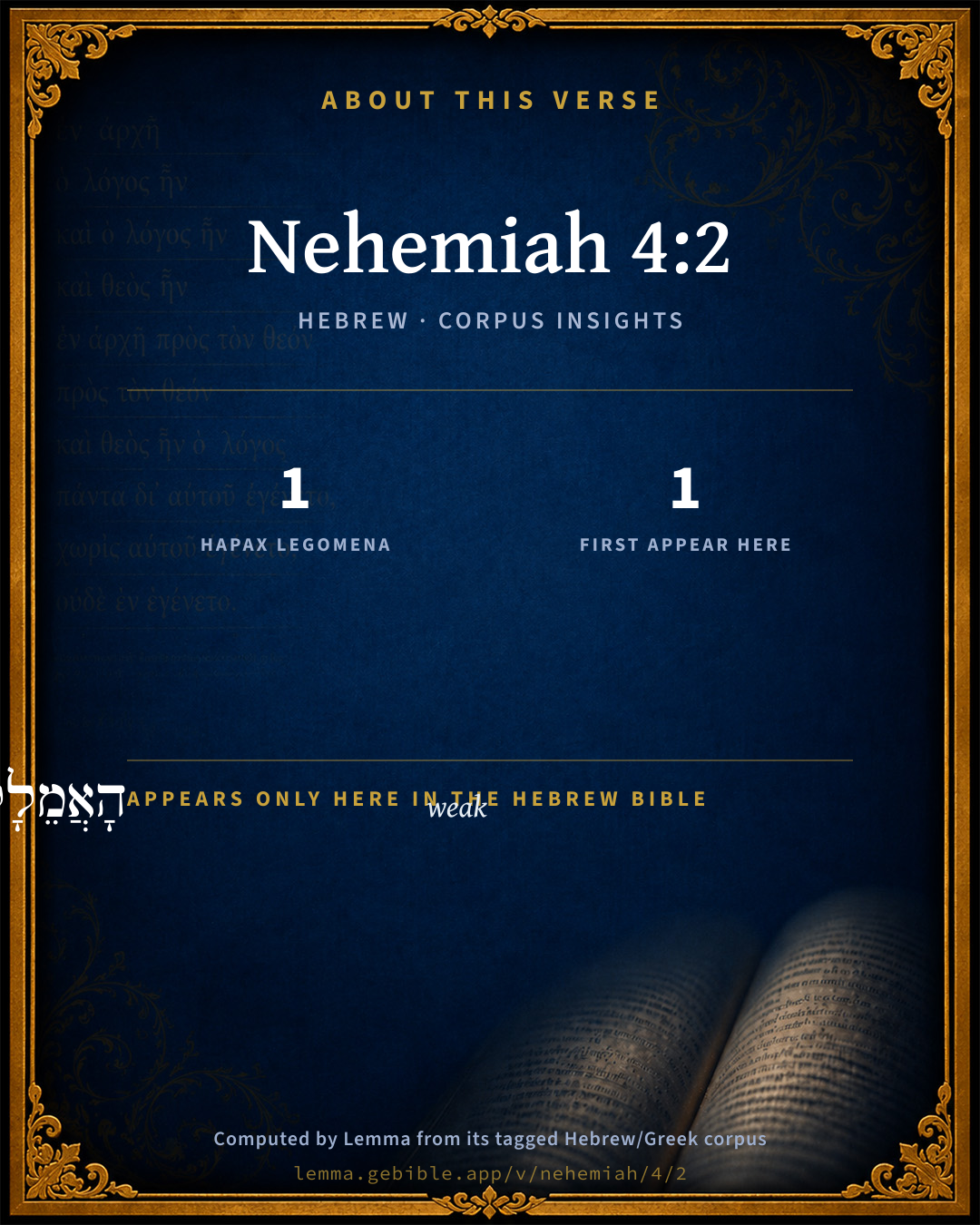
  • 1 hapax legomenon — only here in the Hebrew Bible
  • 1 first appearance in the Hebrew Bible
Full analysis ↓
Download a study sheet

One document with this verse’s original text, its word-by-word gloss line, the meaning frame, cross-references with their text, attributed commentary, and full source and license credits — printable, and it pastes into notes with its structure intact.

This verse Autodidact and up

Study sheet (.html) Plain text (.txt)

A passage Seminary Student

Up to 50 verses in one chapter. A passage sheet keeps up to 6 commentary sources and 12 cross-references per verse, in the order this page ranks them, and says so on the sheet whenever that leaves anything out. Ask for a single verse and you get the Autodidact verse sheet above.

Everything on this page stays free to read, with no account — the sheet is a download of what is already on screen, not access to it.

Want to remove ads? Support Godless Engineer
Compare translations 3

The same verse in 3 English versions, stacked beneath the original-language interlinear above. Click any original word for its lexicon entry.

Each is an independent rendering of the whole verse — the interlinear is not word-aligned to these translations.

Highlighted words mark where these versions differ — a whole-verse word diff, not a word-by-word alignment.

  • World English Bible Public Domain
    He spoke before his brothers and the army of Samaria, and said, What are these feeble Jews doing? will they fortify themselves? will they sacrifice? will they make an end in a day? will they revive the stones out of the heaps of rubbish, seeing they are burned?
  • King James Version Public Domain
    And he spake before his brethren and the army of Samaria, and said, What do these feeble Jews? will they fortify themselves? will they sacrifice? will they make an end in a day? will they revive the stones out of the heaps of the rubbish which are burned?
  • unfoldingWord Literal Text CC BY-SA 4.0
    And he spoke before the face of his brothers and the army of Samaria, and he said, “What are the feeble Jews doing? Will they restore for themselves? Will they sacrifice? Will they finish in a day? Will they bring to life the stones from piles of dust, when they have been burned?”

unfoldingWord Literal Text — © unfoldingWord, licensed CC BY-SA 4.0. Word-aligned USFM3 via Door43 (git.door43.org/unfoldingWord/en_ult).

Versions to compare (up to 4)

3 of 4 selected

Show all 18 translations

Every available English version of this verse, each an independent rendering of the whole verse.

  • World English Bible Public Domain
    He spoke before his brothers and the army of Samaria, and said, What are these feeble Jews doing? will they fortify themselves? will they sacrifice? will they make an end in a day? will they revive the stones out of the heaps of rubbish, seeing they are burned?
  • Berean Standard Bible Public Domain
    before his associates and the army of Samaria, saying, “What are these feeble Jews doing? Can they restore the wall by themselves? Will they offer sacrifices? Will they complete it in a day? Can they bring these burnt stones back to life from the mounds of rubble?”
  • Majority Standard Bible Public Domain
    before his associates and the army of Samaria, saying, “What are these feeble Jews doing? Can they restore the wall by themselves? Will they offer sacrifices? Will they complete it in a day? Can they bring these burnt stones back to life from the mounds of rubble?”
  • King James Version Public Domain
    And he spake before his brethren and the army of Samaria, and said, What do these feeble Jews? will they fortify themselves? will they sacrifice? will they make an end in a day? will they revive the stones out of the heaps of the rubbish which are burned?
  • American Standard Version (1901) Public Domain
    And he spake before his brethren and the army of Samaria, and said, What are these feeble Jews doing? will they fortify themselves? will they sacrifice? will they make an end in a day? will they revive the stones out of the heaps of rubbish, seeing they are burned?
  • Revised Version (1885) Public Domain
    And he spake before his brethren and the army of Samaria, and said, What do these feeble Jews? will they fortify themselves? will they sacrifice? will they make an end in a day? will they revive the stones out of the heaps of rubbish, seeing they are burned?
  • Geneva Bible (1599) Public Domain
    And sayde before his brethren and the armie of Samaria, thus he sayde, What doe these weake Iewes? wil they fortifie them selues? wil they sacrifice? will they finish it in a day? will they make the stones whole againe out of the heapes of dust, seeing they are burnt?
  • Douay-Rheims (1899) Public Domain
    And said before his brethren, and the multitude of the Samaritans: What are the silly Jews doing? Will the Gentiles let them alone? will they sacrifice and make an end in a day? are they able to raise stones out of the heaps of the rubbish, which are burnt?
  • Young's Literal Translation Public Domain
    and saith before his brethren and the force of Samaria, yea, he saith, `What `are' the weak Jews doing? are they left to themselves? do they sacrifice? do they complete in a day? do they revive the stones out of the heaps of the rubbish? -- and they burnt!'
  • Literal Standard Version CC BY-SA 4.0
    and says before his brothers and the force of Samaria, indeed, he says, “What [are] the weak Jews doing? Are they left to themselves? Do they sacrifice? Do they complete in a day? Do they revive the stones out of the heaps of the rubbish—and they are burned?”
  • Unlocked Literal Bible CC BY-SA 4.0
    In the presence of his brothers and the army of Samaria, he said, “What are these feeble Jews doing? Will they restore the city for themselves? Will they offer sacrifices? Will they finish the work in a day? Will they bring to life the stones from the piles of rubble after they were burned?
  • unfoldingWord Literal Text CC BY-SA 4.0
    And he spoke before the face of his brothers and the army of Samaria, and he said, “What are the feeble Jews doing? Will they restore for themselves? Will they sacrifice? Will they finish in a day? Will they bring to life the stones from piles of dust, when they have been burned?”
  • Darby Bible Public Domain
    And he spoke before his brethren and the army of Samaria, and said, What do these feeble Jews? shall they be permitted to go on? Will they offer sacrifices? Will they finish in a day? Will they revive the stones out of the heaps of rubbish, when they are burned?
  • World Messianic Bible Public Domain
    He spoke before his brothers and the army of Samaria, and said, “What are these feeble Jews doing? Will they fortify themselves? Will they sacrifice? Will they finish in a day? Will they revive the stones out of the heaps of rubbish, since they are burned?”
  • Webster's Bible Public Domain
    And he spoke before his brethren, and the army of Samaria, and said, What do these feeble Jews? will they fortify themselves? will they sacrifice? will they make an end in a day? will they revive the stones out of the heaps of the rubbish which are burned?
  • Free Bible Version CC BY-SA 4.0
    in front of his colleagues and the army of Samaria, saying, “What are these useless Jews trying to achieve? Do they think they can rebuild the wall? Are they going to offer sacrifices? Are they going to finish it in a day? Do they think they can re-use stones from piles of rubble and dirt, especially since they've all been burned?”
  • Bible in Basic English Public Domain
    And in the hearing of his countrymen and the army of Samaria he said, What are these feeble Jews doing? will they make themselves strong? will they make offerings? will they get the work done in a day? will they make the stones which have been burned come again out of the dust?
  • JPS Tanakh (1917) Public Domain
    (3-34) And he spoke before his brethren and the army of Samaria, and said: 'What do these feeble Jews? will they restore at will? will they sacrifice? will they make an end this day? will they revive the stones out of the heaps of rubbish, seeing they are burned?'

Literal Standard Version (2020), Covenant Press — licensed CC BY-SA 4.0. Text via the HelloAO Bible API (eBible.org). Unlocked Literal Bible (unfoldingWord) — licensed CC BY-SA 4.0. Text via the HelloAO Bible API (eBible.org). unfoldingWord Literal Text — © unfoldingWord, licensed CC BY-SA 4.0. Word-aligned USFM3 via Door43 (git.door43.org/unfoldingWord/en_ult). Free Bible Version, Dr. Jonathan Gallagher — licensed CC BY-SA 4.0. Text via the HelloAO Bible API (eBible.org).

Word by word

More ways to search: Search by grammar → Find every occurrence → Compare this word →

Practice this passage: Drill this verse → Learn its vocabulary →

הָאֲמֵלָלִ֖ים
ʼămêlâl
H537
“the · weak”
Particle, Definite Article + Adjective, Adjective, Masculine, Plural, Absolute
Part of Speech
Particle + Adjective
Type
Adjective
Gender
Masculine
Number
Plural
State
Absolute
Full BDB Definition

Origin: from H535

TWOT: 114a

weak, feeble
  1. וַיֹּ֣אמֶר ʼâmar H559 “and · to say” Conjunction + Verb, Qal, Sequential Imperfect, 3rd Person, Masculine, Singular
  2. לִפְנֵ֣י pânîym H6440 “to/for · face(s) of” Preposition + Noun, Common, Both, Plural, Construct
  3. אֶחָ֗יו ʼâch H251 “brothers · his” Noun, Common, Masculine, Plural, Construct + Suffix, Personal, 3rd Person, Masculine, Singular
  4. וְחֵיל֙ chêyl H2426 “and · fortress of” Conjunction + Noun, Common, Masculine, Singular, Construct
  5. שֹֽׁמְר֔וֹן Shômᵉrôwn H8111 “Samaria” Noun, Proper
  6. וַיֹּ֕אמֶר ʼâmar H559 “and · to say” Conjunction + Verb, Qal, Sequential Imperfect, 3rd Person, Masculine, Singular
  7. מָ֛ה mâh H4100 “what” Particle, Interrogative
  8. הַיְּהוּדִ֥ים Yᵉhûwdîy H3064 “the · Jews” Particle, Definite Article + Noun, Gentilic, Masculine, Plural, Absolute
  9. עֹשִׂ֑ים ʻâsâh H6213 “doing” Verb, Qal, Participle Active, Masculine, Plural, Absolute
  10. הֲיַעַזְב֨וּ ʻâzab H5800 “to leave” Particle, Interrogative + Verb, Qal, Imperfect, 3rd Person, Masculine, Plural
  11. הֲיִזְבָּ֨חוּ֙ zâbach H2076 “to sacrifice” Particle, Interrogative + Verb, Qal, Imperfect, 3rd Person, Masculine, Plural
  12. הַיְכַלּ֣וּ kâlâh H3615 “to finish” Particle, Interrogative + Verb, Piel, Imperfect, 3rd Person, Masculine, Plural
  13. בַיּ֔וֹם yôwm H3117 “in/at the · day” Preposition, Determined + Noun, Common, Masculine, Singular, Absolute
  14. הַיְחַיּ֧וּ châyâh H2421 “to live” Particle, Interrogative + Verb, Piel, Imperfect, 3rd Person, Masculine, Plural
  15. אֶת ʼêth H853 “-” Particle, Direct Object
  16. הָאֲבָנִ֛ים ʼeben H68 “the · stones” Particle, Definite Article + Noun, Common, Feminine, Plural, Absolute
  17. מֵעֲרֵמ֥וֹת ʻârêm H6194 “from · piles of” Preposition + Noun, Common, Feminine, Plural, Construct
  18. הֶעָפָ֖ר ʻâphâr H6083 “the · dust” Particle, Definite Article + Noun, Common, Masculine, Singular, Absolute
  19. וְהֵ֥מָּה hêm H1992 “and · they” Conjunction + Pronoun, Personal, 3rd Person, Masculine, Plural
  20. שְׂרוּפֽוֹת sâraph H8313 “burnt” Verb, Qal, Participle Passive, Feminine, Plural, Absolute

About this verse

These counts appear in no published source. They are computed here, from the morphology-tagged text and Lemma’s own curated glosses. What Lemma adds →

22
words
20
distinct lemmas
Historical
section

Notable vocabulary

1 hapax legomenon — a word that appears only here in the entire Hebrew Bible:

  • הָאֲמֵלָלִ֖ים weak H537

First appearance in Scripture

This word makes its first canonical appearance in the Hebrew Bible here:

  • הָאֲמֵלָלִ֖ים weak H537

Shared distinctive vocabulary

מֵעֲרֵמ֥וֹת pile H6194 occurs in 10 verses of the Hebrew Bible. Also found in:

Grammatical profile

  • 8 verbs
  • 9 nouns
  • 1 adjective
  • 1 pronoun
  • 1 preposition
  • 2 particles

Verb forms

  • וַיֹּ֣אמֶר Qal · Sequential Imperfect
  • וַיֹּ֕אמֶר Qal · Sequential Imperfect
  • עֹשִׂ֑ים Qal · Participle Active
  • הֲיַעַזְב֨וּ Qal · Imperfect
  • הֲיִזְבָּ֨חוּ֙ Qal · Imperfect
  • הַיְכַלּ֣וּ Piel · Imperfect
  • הַיְחַיּ֧וּ Piel · Imperfect
  • שְׂרוּפֽוֹת Qal · Participle Passive

Repetition

A word recurs within this verse — often emphatic in Hebrew:

  • וַיֹּ֣אמֶר to say H559 ×2

Cross-references

10

Topical passages linked to Nehemiah 4:2 in the Treasury of Scripture Knowledge — connected by theme and wording, ordered by reader-vote popularity; previews shown in the World English Bible.

  • Ezra 4:9–10 then [wrote] Rehum the chancellor, and Shimshai the scribe, and the rest of their companions, the Dinaites, and the Apharsathchites, the Tarpelites, the Apharsites, the Archevites, the Babylonians, the Shushanchites, the Dehaites, the Elamites,
  • 1 Corinthians 1:27 but God chose the foolish things of the world that he might put to shame those who are wise. God chose the weak things of the world, that he might put to shame the things that are strong;
  • 1 Samuel 14:11–12 Both of them disclosed themselves to the garrison of the Philistines: and the Philistines said, Behold, the Hebrews come forth out of the holes where they had hid themselves.
  • 1 Samuel 17:43–44 The Philistine said to David, Am I a dog, that you come to me with sticks? The Philistine cursed David by his gods.
  • Nehemiah 4:10 Judah said, The strength of the bearers of burdens is decayed, and there is much rubbish; so that we are not able to build the wall.
  • Nehemiah 12:43 They offered great sacrifices that day, and rejoiced; for God had made them rejoice with great joy; and the women also and the children rejoiced: so that the joy of Jerusalem was heard even afar off.
  • Ezekiel 37:3–13 He said to me, Son of man, can these bones live? I answered, Lord Yahweh, you know.
  • Habakkuk 3:2 Yahweh, I have heard of your fame. I stand in awe of your deeds, Yahweh. Renew your work in the midst of the years. In the midst of the years make it known. In wrath, you remember mercy.
  • Zechariah 12:8 In that day Yahweh will defend the inhabitants of Jerusalem. He who is feeble among them at that day will be like David, and the house of David will be like God, like the angel of Yahweh before them.
  • Nehemiah 12:27 At the dedication of the wall of Jerusalem they sought the Levites out of all their places, to bring them to Jerusalem, to keep the dedication with gladness, both with giving thanks, and with singing, with cymbals, psalteries, and with harps.

Cross-references courtesy of OpenBible.info (CC BY 4.0).

Hebrew and Greek witnesses Masoretic Hebrew ↔ Greek Septuagint

The same verse in the two great witnesses to the Old Testament, shown verse-for-verse.

These are two independent witnesses, not word-aligned to each other, and the Septuagint is shown in lemma (dictionary) form.

Hebrew Nehemiah 4:2 Masoretic · Westminster Leningrad Codex

וַיֹּ֣אמֶר לִפְנֵ֣י אֶחָ֗יו וְחֵיל֙ שֹֽׁמְר֔וֹן וַיֹּ֕אמֶר מָ֛ה הַיְּהוּדִ֥ים הָאֲמֵלָלִ֖ים עֹשִׂ֑ים הֲיַעַזְב֨וּ לָהֶ֤ם הֲיִזְבָּ֨חוּ֙ הַיְכַלּ֣וּ בַיּ֔וֹם הַיְחַיּ֧וּ אֶת הָאֲבָנִ֛ים מֵעֲרֵמ֥וֹת הֶעָפָ֖ר וְהֵ֥מָּה שְׂרוּפֽוֹת

He spoke before his brothers and the army of Samaria, and said, What are these feeble Jews doing? will they fortify themselves? will they sacrifice? will they make an end in a day? will they revive the stones out of the heaps of rubbish, seeing they are burned?

World English Bible · Public Domain

Greek LXX Structure differs

The Septuagint has no separate book of Nehemiah. Its Greek text is the second half of Esdras B (2 Esdras), chapters 11–23; Ezra is the first half (1–10).

A verse-for-verse comparison isn’t shown here because the chapters and verses don’t line up. Switch to the LXX edition with the MT / LXX toggle above to read the Greek directly.

On this verse, The Cambridge Bible for Schools and Colleges discusses the Septuagint’s reading. Read the note in Commentary ↓

Hebrew: Westminster Leningrad Codex (CC BY 4.0). Greek: Septuagint (public domain); English from a public-domain English Septuagint. How the Septuagint differs from the Hebrew →

Commentary

Notes on Nehemiah 4:2 from classic Christian and Jewish commentators (each source and its license shown beneath its notes). The classic Christian expositions comment on the surrounding passage and are grouped to its opening verse, so a note may address several verses; the Jewish commentaries on the Tanakh (Rashi and others) are per-verse, so they appear only where the commentator wrote on this verse.

Lemma curates 59 commentaries, every one of them public domain or Creative Commons licensed, each selected and text-cleaned for this edition rather than reprinted as found. About our sources →

Trapp's Complete Commentary

John Trapp

Neh 4:2 And he spake before his brethren and the army of Samaria, and said, What do these feeble Jews? will they fortify themselves? will they sacrifice? will they make an end in a day? will they revive the stones out of the heaps of the rubbish which are burned?

Ver. 2. And he spake before his brethren] i.e., before his companions and acomplices, who would second him and say the same, his Aiones and Negones, as one calleth such.

And the army of Samaria] The garrison soldiers; or those that lay there billeted, to observe the people.

What do these feeble Jews?] These beggarly shiftless fellows, these Asinarii (as Molon and Appion of Alexandria disgracefully called the Jews); like as Tertullian tells us that the Pagans painted the God of the Christians with an ass’s head and a book in his hand; to note that they were silly and despicable people. Bishop Jewell, in a sermon of his, citeth this out of Tertullian, and addeth, Do not our adversaries the like at this day against all that profess the gospel?

Will they fortify themselves?] Heb. Will they leave to themselves, sc. anything to trust unto? Junius renders An sinerent eos? should they (sc. the officers and soldiers) suffer them thus to do?

Will they sacrifice?] sc. at the dedication of their new walls? Will they do this all at once? and think they, without more ado, to have the liberty of their sanctuary?

Will they make an end in a day?] It should seem so by their Cito, Cito, quick despatch of their parts and task, &c.

Praecipita tempus; mors atra impendet agenti (Sil. Ital.).

Will they revive the stones, &c.] Stones they lack for their new wall: where will they have them? will they glue together the old stones, and revive them out of the rubbish? will they do this? or, what will they do?

John Trapp, A Commentary or Exposition upon All the Books of the Old and New Testament (1647–1656) — public domain. Text from a community e-Sword module.

Tyndale Open Study Notes

Tyndale Open Resources

4:2 The Persians had stationed Samarian army officers in Jerusalem to keep peace. • poor, feeble Jews: Sanballat’s mockery had an element of truth: The Jews were not rich, powerful, or many in number. However, Sanballat failed to realize the strength of the God whom the Jews served. • Do they think . . . by just offering a few sacrifices? Sanballat might have been mocking a sudden increase in sacrifices at the Temple as the Israelites dedicated their work to the Lord. • rubbish . . . charred: When fire destroyed Jerusalem (586 BC), it heated the stones, causing some to crack and crumble. The people used these stones to restore the walls.

Tyndale Open Study Notes — © Tyndale Open Resources, licensed CC BY-SA 4.0. Text via the HelloAO Bible API.

Geneva Bible (1599)

Geneva Bible translators

Thus the wicked that consider not that God’s power is ever in a readiness for the defense of his, mock them as though they were weak and feeble.

Of his companions that dwelt in Samaria.

Geneva Bible (1599) marginal notes — public domain. Text via Bolls.life.

Adam Clarke's Commentary

Verse 2. The army of Samaria] As he was governor, he had the command of the army, and he wished to excite the soldiers to second his views against Nehemiah and his men.

What do these feeble Jews?] We may remark here, in general, that the enemies of God's work endeavour by all means to discredit and destroy it, and those who are employed in it.

1. They despise the workmen: What do these feeble Jews?

2. They endeavour to turn all into ridicule: Will they fortify themselves?

3. They have recourse to lying: If a fox go up, he shall even break down their stone wall.

4. They sometimes use fair but deceitful speeches; see Ne 6:2, &c.

Adam Clarke's Commentary on the Bible (1810–1826) — public domain. Text from a community e-Sword/MySword module.

Ellicott's Commentary for English Readers

(2) His brethren and the army of Samaria.—The counsellors and body-guard of Sanballat.

Will they fortify themselves?—Rather, will they leave them to themselves? The nations are referred to; but contempt is not scrupulous or precise.

Will they sacrifice?—This is the provocation of God mentioned in Neh_4:5.

A Bible Commentary for English Readers, edited by Charles John Ellicott (1878–1897) — public domain. Text from a community e-Sword module.

The Cambridge Bible for Schools and Colleges

gen. ed. J. J. S. Perowne

2. And he spake before his brethren] Sanballat’s ‘brethren’ would be the chiefs of the Samaritan community.

and the army of Samaria] ‘the army’ (LXX. δύναμις): the word here used is the one generally employed for ‘armed forces,’ see Neh_2:9; Ezr_8:22; Est_1:3. The Samaritans seem to have hastily summoned their forces to consider whether it would be practicable to compel the Jews by a sudden onslaught to desist from an undertaking so menacing to Samaritan independence. ‘The army’ therefore is not equivalent to ‘an assembly (Vulg. frequentia),’ but to the population trained in war and capable of bearing arms, collected in face of a sudden emergency. Some have supposed that a body of regular Persian troops stationed at Samaria under a Governor (Neh_2:7) is intended.

What do these feeble Jews?] The word rendered ‘feeble’ only occurs here in the O.T. It denotes the languor of weakness. It is akin to a word found in 1Sa_2:5, ‘And she that hath many children languisheth’ (A.V. ‘is waxed feeble’).

will they fortify themselves?] so R.V. text. R.V. marg. ‘Or, will they leave to themselves aught? Or, will men let them alone?’

This short interrogative clause has occasioned much difficulty, on account of the word rendered ‘fortify,’ the natural rendering of which (as in Neh_3:8, where see note) would be ‘leave.’ The versions, LXX. ὄτι οἱ Ἰουδαῖοι οὗτοι οἰκοδομοῦσι τὴν ἑαυτῶν πόλιν, Vulg. num dimittent eos gentes, fail to throw any light upon the passage.

(a) The rendering of the English versions gives a clear and intelligible meaning. But (1) the use of the word in the sense of ‘fortify’ belongs to late Hebrew and is very rare: (2) in Biblical Hebrew it can only be supported by the uncertain testimony of Neh_3:8 : (3) there is no mockery in such a question, corresponding to the tone of the other queries.

(b) ‘will they leave to themselves aught?’ This rendering which preserves the usual meaning of the disputed word, is open to the two very strong objections that, (1) the point of the question is conveyed by a word which is not found in the text, i.e. ‘aught,’ (2) the full meaning, obtained from this rendering (i.e. ‘do they expect to survive such an attempt? the Persian Empire will extirpate a people of such presumption; and nothing will be left to them’), is read into the words rather than derived from them.

(c) ‘will men let them alone?’ i.e. will the Persian Government or the neighbouring races permit the Jews to carry out their design? Against this rendering, which gives a very intelligible meaning, it must be urged, that (1) it necessitates an awkward change of subject introducing a new subject between two clauses in which ‘the Jews’ are the subject, (2) it treats the Jewish project with serious indignation instead of with the contempt expressed in the other queries.

(d) ‘will they commit themselves unto them?’ i.e. will the Jews entrust themselves and so great a work to their leaders? But we should expect a greater definiteness of expression in a short scornful question.

(e) ‘will they on their own behalf (lit. for themselves) commit themselves (i.e. unto God)?’ According to this rendering Sanballat is quoting a cant Jewish phrase ‘to commit oneself,’ leaving his hearers to understand its special application. This use of the word may be illustrated from Psa_10:14, ‘the helpless committeth (lit. leaveth) himself unto thee.’ The mockery of such a question is quite in harmony with the general tone of Sanballat’s question.

(f) But it is more probable that the great obscurity of the words arises from an early error in the text, a scribe omitting two syllables very similar to those which followed, and writing ‘lâhem’ = ‘to them’ for ‘lêlôheyhem’ = ‘to their God.’ The sense then would be, ‘Will they commit themselves to their God?’ The same textual error occurs in 1Sa_3:13 (see R.V. marg.). It may then be compared with Rabshakeh’s words in 2Ki_18:30; 2Ki_18:32; 2Ki_18:35.

will they sacrifice?] A mocking question; equivalent to ‘do the Jews imagine that they have only to collect together and propitiate their God with sacrifices, and their work will be done?’

will they make an end in a day?] Is it to be all done so simply and so quickly? ‘In a day’ might be rendered ‘in the day,’ as if they said, ‘will they make a beginning and an end in this day?’ (LXX. σήμερον, Vulg. in una die).

will they revive …?] Are they going to work miracles? The LXX. renders ‘will they heal?’ (ἰάσονται). Cf. ‘the repairing’ (R.V.) in Neh_4:7.

of the heaps of the rubbish which are burnt] R.V. out of the heaps of rubbish, seeing they are burned? The word ‘burned’ refers to ‘the stones.’ Compare on the accumulation of rubbish Sir C. Warren’s statements respecting the excavations at Jerusalem, e.g. in his paper ‘The site of the Temple of the Jews’ (Trans. Bibl. Arch. vol. vii. p. 320), ‘We … found that the old wall exists to the enormous depth of 125 feet below the rubbish, with stones of very great size.’

The Cambridge Bible for Schools and Colleges (gen. ed. J. J. S. Perowne; Cambridge University Press, 1878–1918) — public domain. Text from a community e-Sword module.

John Gill's Exposition

And he spake before his brethren,.... Tobiah the Ammonite, and Geshem the Arabian, and perhaps some other governors of the king of Persia in those parts:

and before the army of Samaria: which, and the inhabitants of it, were implacable enemies of the Jews:

and said, what do these feeble Jews? what do they pretend to do, or what can they do?

will they fortify themselves? by building a wall about their city; can they think they shall ever be able to do this, or that it will be allowed?

will they sacrifice? meaning not their daily sacrifice, as Jarchi, that they had done a long time, but for the dedication of their building, as Aben Ezra:

will they make an end in a day? they seem to be in as great a hurry and haste as if they meant it; and indeed, unless they can do it very quickly, they never will: they will soon be stopped:

will they revive the stones out of the heaps of the rubbish which are burnt? where will they find materials? do they imagine that they can make burnt stones firm and strong again, or harden the dust and rubbish into stones, or make that, which is as if dead, alive? to do this is the same as to revive a dead man, and they may as well think of doing the one as the other; burnt stones being reckoned as dead, as Eben Ezra observes.

John Gill's Exposition of the Whole Bible (1746–1763) — public domain (CC PDM 1.0). Text via the HelloAO Bible API.

Haydock's Catholic Bible Commentary

Multitude. Hebrew and Septuagint, "army." (Calmet) --- Silly. Literally, "feeble." (Haydock) --- Sacrifice, at the dedication. (Tirinus) --- Day, in so short a time, as their present vigorous proceedings seem to promise, notwithstanding their feeble condition, and the paucity of their numbers. (Haydock) --- But no: we shall have time enough to hinder them, (Menochius) if the nature of their materials do it not for us. (Haydock) --- Raise. Hebrew, "revive;" a word used for reparations of walls, &c. (Calmet) (Delrio, adag. 221.) --- Septuagint, "heal." God’s providence did not permit the enemy to rage, till the work was greatly advanced; so infidels laugh at the attempts of your priests to restore religion, which nevertheless flourishes. (Worthington)

George Leo Haydock (1774–1849), Haydock's Catholic Family Bible and Commentary, 1859 edition — public domain. Excludes Psalms (Douay-Rheims chapter numbering differs from Protestant) and Deuterocanonical books (Catholic canon only).

Matthew Poole's English Annotations

Before his brethren; Neh 4:3, and Geshem, Neh 2:19, and others, whom he calls

his brethren, because of their conjunction with him in office and interest.

The army of Samaria; whom he designed hereby to incense against them, or at least to understand their minds herein.

Will they make an end in a day? do they intend to begin and finish the work, and keep the feast of dedication by sacrifice, all in one day? for if they spend any long time about it, they cannot think that we, and the rest of their neighbours, will suffer them to do it. Thus he persuaded himself and his companions that their attempt was ridiculous; and this mistake kept him from giving them any disturbance till it was too late. So God infatuated him to his own grief and shame, and to the advantage of his people.

Will they revive the stones out of the heaps of the rubbish? will they pick up their broken stones out of the ruins, and patch them together? for other materials they want.

Which are burned, i.e. which stones were burned, and broken, or consumed to powder, to wit, by the Chaldeans when they took the city. See Poole "Neh 1:3".

Matthew Poole's English Annotations on the Holy Bible (1683–1685) — public domain. Text from a community e-Sword/MySword module.

Whedon's Commentary on the Bible

Daniel D. Whedon

2. His brethren — His associates in office.

The army of Samaria — Of which he seems to have been the chief commander.

Will they fortify themselves — Literally, Will they leave to them? The meaning is not clear, but seems most naturally brought out if we allow the verb a passive sense: Shall they be left to themselves? This is the thought conveyed both by the Septuagint and Vulgate, although those versions present no literal translation of the Hebrew. The Septuagint has the following: “Is this the power of Samaria, that these Jews build their city?” Vulgate: “Shall the nations let them go?” that is, shall the surrounding nations let them go on with their building their city walls?

Will they sacrifice — Will they presume to renew and perpetuate their ancient cultus?

Make an end in a day — Do they imagine they can so speedily rebuild their city that no one will find it out before it is complete?

Revive the stones — He speaks of the great stones of Jerusalem as having been destroyed by fire, broken, and ruined, so that the attempt of a feeble band of exiles to restore them (Hebrews, make them live) from their heaps of… rubbish was to his mind the height of folly.

Daniel D. Whedon (gen. ed.), Commentary on the Old and New Testaments (1874–1909) — public domain. Text from a community e-Sword module.

The Pulpit Commentary

Before his brethren. By "his brethren" would seem to be meant his chief counsellors probably Tobiah among them. The army of Samaria. Some understand by this a Persian garrison, stationed in Samaria under its own commander, with which Sanballat had influence (Ewald, "History of Israel," vol. 5. p. 153), but there is no real ground for such a supposition. Psalm 83, belongs probably to David"s time; and as Samaria had doubtless its own native force of armed citizens, who were Sanballat"s subjects, it is quite unnecessary to suppose that he addressed himself to any other "army" than this. The Persians would maintain a force in Damascus, but scarcely in Samaria; and Persian soldiers, had there been any in that city, would have been more likely to support a royal cupbearer than a petty governor with no influence at court. We can really only explain the disturbed state of things and approach to open hostility which appears in Nehemiah"s narrative, by the weakness of Persia in these parts, and the consequent power of the native races to act pretty much as they pleased even to the extent of making war one upon another. Will they fortify themselves? No other rendering is tenable. Ewald ("History of Israel," vol. 3. p. 154, note 5) defends it successfully. Will they sacrifice? Will they make an end in a day? The meaning seems to be, "Will they begin and make an end in a day?" It is assumed that they will begin by offering a sacrifice to inaugurate their work. Will they revive the stones out of the heaps of the rubbish which are burned? Rather, "Will they revive the burnt stones (the stones that are burned) out of the heaps of the rubbish?" Will they do what is im-possible-solidify and make into real stone the calcined and crumbling blocks which are all that they will find in the heaps of rubbish? If not, how are they to procure material?

The Pulpit Commentary (1880–1919), ed. H.D.M. Spence-Jones & Joseph S. Exell — public domain. Text from a community e-Sword module.

John Wesley's Explanatory Notes

In a day - Do they intend to begin, and finish the work, all in one day? For if they spend any long time about it, they cannot think that we will suffer them to do it. The stones - Will they pick up their broken stones out of the ruins, and patch them together. Burnt - Which stones were burnt, and broken, by the Chaldeans when they took the city.

John Wesley, Explanatory Notes Upon the Whole Bible (1754–1765) — public domain. Text via the GEBible commentary corpus.

Rashi

Rabbi Shlomo Yitzchaki (Rashi)

and to wreak destruction therein to wreak upon the building of the wall ruin and destruction. It is like (Isa. 32:5): “...and to speak destructively (תּוֹעָה) about the Lord.”

Rashi on the Tanakh — English translations: “The Judaica Press complete Tanach with Rashi, translated by A. J. Rosenberg” (CC BY 4.0); “Pentateuch with Rashi's commentary by M. Rosenbaum and A.M. Silbermann, 1929-1934” (public domain); “The Metsudah Tanach series, Lakewood, N.J” (CC BY 4.0); and “The Book of Joshua, Metsudah Publications, 1997” (CC BY 4.0). Text via Sefaria.

Lesson kit

Teaching starters — assembled from the data on this page, not authored interpretation. Every prompt links to the verse data it draws on. Edit before teaching.

Nehemiah, in the Historical, opens this verse with 22 words (20 distinct Hebrew lemmas). Its most distinctive word is ʼămêlâl (“weak”). A historical commentator’s framing appears above. Read the whole chapter for the surrounding context.

Discussion questions

  1. How does “weak” (ʼămêlâl) shape what this verse is saying?
  2. 1 word here appears nowhere else in the Hebrew Bible. Why might the author reach for such rare wording?
  3. This is the first place “weak” appears in Scripture (first appears here). What does its debut here establish?
  4. How does Ruth 3:7, which shares the word «pile», read alongside this verse?
  5. What does the repetition of “to say” (2× in this one verse) do in this verse?
  6. These translations render this verse differently. What is at stake in choosing one wording over another?
  7. «וַיֹּ֣אמֶר» is a Qal Sequential Imperfect verb. How does that grammatical form shape the action described?
  8. Compare how Trapp's Complete Commentary and Tyndale Open Study Notes read this verse. Where do they agree or differ?

Things to notice

  • 1 word in this verse appears nowhere else in the Hebrew Bible.
  • 1 word makes its first canonical appearance in Scripture here.
  • These translations choose different wording for 25 words in this verse.
  • “to say” occurs 2× in this single verse.
  • 20 distinct Hebrew lemmas span 22 words in this verse.

Reading settings

Reading text

Shown beneath each verse's original-language words.

Old Testament
Old Testament edition

Read the OT as the Masoretic Hebrew (MT) or the Greek Septuagint (LXX).

English shown for the Greek Septuagint (in the Hebrew ↔ Greek comparison).

Comparing translations? Open the Compare panel on any verse page to stack up to four side by side.