
Joshua 2:13

Hebrew (Westminster Leningrad Codex) Joshua 2:13 appears in the Hebrew Old Testament. The text above is from the Westminster Leningrad Codex. Each word links to its Strong’s number, a concise gloss, and parsing drawn from the Open Scriptures Hebrew Bible morphology. Click any word for its full Brown-Driver-Briggs (BDB) entry.
Download image
Cite this verse

Joshua 2:13 (World English Bible). Public Domain. Lemma interlinear Bible study tool, https://lemma.gebible.app/v/joshua/2/13.

Show BibTeX & RIS
BibTeX
RIS
English Translation
and that you will save alive my father, and my mother, and my brothers, and my sisters, and all that they have, and will deliver our lives from death.
World English Bible · Public Domain
Download a study sheet

One document with this verse’s original text, its word-by-word gloss line, the meaning frame, cross-references with their text, attributed commentary, and full source and license credits — printable, and it pastes into notes with its structure intact.

This verse Autodidact and up

Study sheet (.html) Plain text (.txt)

A passage Seminary Student

Up to 50 verses in one chapter. A passage sheet keeps up to 6 commentary sources and 12 cross-references per verse, in the order this page ranks them, and says so on the sheet whenever that leaves anything out. Ask for a single verse and you get the Autodidact verse sheet above.

Everything on this page stays free to read, with no account — the sheet is a download of what is already on screen, not access to it.

Want to remove ads? Support Godless Engineer
Compare translations 3

The same verse in 3 English versions, stacked beneath the original-language interlinear above. Click any original word for its lexicon entry.

Each is an independent rendering of the whole verse — the interlinear is not word-aligned to these translations.

Highlighted words mark where these versions differ — a whole-verse word diff, not a word-by-word alignment.

  • World English Bible Public Domain
    and that you will save alive my father, and my mother, and my brothers, and my sisters, and all that they have, and will deliver our lives from death.
  • King James Version Public Domain
    And that ye will save alive my father, and my mother, and my brethren, and my sisters, and all that they have, and deliver our lives from death.
  • unfoldingWord Literal Text CC BY-SA 4.0
    that you will keep alive my father and my mother and my brothers and my sisters and all who to them and you will deliver our lives from death.”

unfoldingWord Literal Text — © unfoldingWord, licensed CC BY-SA 4.0. Word-aligned USFM3 via Door43 (git.door43.org/unfoldingWord/en_ult).

Versions to compare (up to 4)

3 of 4 selected

Show all 18 translations

Every available English version of this verse, each an independent rendering of the whole verse.

  • World English Bible Public Domain
    and that you will save alive my father, and my mother, and my brothers, and my sisters, and all that they have, and will deliver our lives from death.
  • Berean Standard Bible Public Domain
    that you will spare the lives of my father and mother, my brothers and sisters, and all who belong to them, and that you will deliver us from death.”
  • Majority Standard Bible Public Domain
    that you will spare the lives of my father and mother, my brothers and sisters, and all who belong to them, and that you will deliver us from death.”
  • King James Version Public Domain
    And that ye will save alive my father, and my mother, and my brethren, and my sisters, and all that they have, and deliver our lives from death.
  • American Standard Version (1901) Public Domain
    and that ye will save alive my father, and my mother, and my brethren, and my sisters, and all that they have, and will deliver our lives from death.
  • Revised Version (1885) Public Domain
    and that ye will save alive my father, and my mother, and my brethren, and my sisters, and all that they have, and will deliver our lives from death.
  • Geneva Bible (1599) Public Domain
    And that yee will saue aliue my father and my mother, and my brethren, and my sisters, and all that they haue: and that yee will deliuer our soules from death.
  • Douay-Rheims (1899) Public Domain
    And hearing these things we were affrighted, and our heart fainted away, neither did there remain any spirit in us at your coming in: for the Lord your God he is God in heaven above, and in the earth beneath.
  • Young's Literal Translation Public Domain
    and have kept alive my father, and my mother, and my brothers, and my sisters, and all that they have, and have delivered our souls from death.'
  • Literal Standard Version CC BY-SA 4.0
    and have kept alive my father, and my mother, and my brothers, and my sisters, and all that they have, and have delivered our souls from death.”
  • Unlocked Literal Bible CC BY-SA 4.0
    that you will spare the lives of my father, mother, brothers, sisters and all their families, and that you will save us from death.”
  • unfoldingWord Literal Text CC BY-SA 4.0
    that you will keep alive my father and my mother and my brothers and my sisters and all who to them and you will deliver our lives from death.”
  • Darby Bible Public Domain
    that ye will let my father live, and my mother, and my brethren, and my sisters, and all that belong to them, and deliver our souls from death.
  • World Messianic Bible Public Domain
    and that you will save alive my father, my mother, my brothers, and my sisters, and all that they have, and will deliver our lives from death.”
  • Webster's Bible Public Domain
    And that ye will save alive my father, and my mother, and my brethren, and my sisters, and all that they have, and deliver our lives from death.
  • Free Bible Version CC BY-SA 4.0
    that you will spare my father and mother and brothers and sisters—and all who are part of their families—that you will save them from death.”
  • Bible in Basic English Public Domain
    And that you will keep safe my father and mother and my brothers and sisters and all they have, so that death may not come on us?
  • JPS Tanakh (1917) Public Domain
    and save alive my father, and my mother, and my brethren, and my sisters, and all that they have, and deliver our lives from death.'

Literal Standard Version (2020), Covenant Press — licensed CC BY-SA 4.0. Text via the HelloAO Bible API (eBible.org). Unlocked Literal Bible (unfoldingWord) — licensed CC BY-SA 4.0. Text via the HelloAO Bible API (eBible.org). unfoldingWord Literal Text — © unfoldingWord, licensed CC BY-SA 4.0. Word-aligned USFM3 via Door43 (git.door43.org/unfoldingWord/en_ult). Free Bible Version, Dr. Jonathan Gallagher — licensed CC BY-SA 4.0. Text via the HelloAO Bible API (eBible.org).

Word by word

More ways to search: Search by grammar → Find every occurrence → Compare this word →

Practice this passage: Drill this verse → Learn its vocabulary →

אחותי
ʼâchôwth
H269
“sister · my”
Noun, Common, Feminine, Singular, Construct + Suffix, Personal, 1st Person, Common, Singular
Part of Speech
Noun
Type
Common
Gender
Feminine
Number
Singular
State
Construct
Full BDB Definition

Origin: irregular f of H251

TWOT: 62c

sister - sister (same parents) - half-sister (same father) - relative - (metaphorically) of Israel's and Judah's relationship - beloved - bride - (figuratively) of intimate connection - another
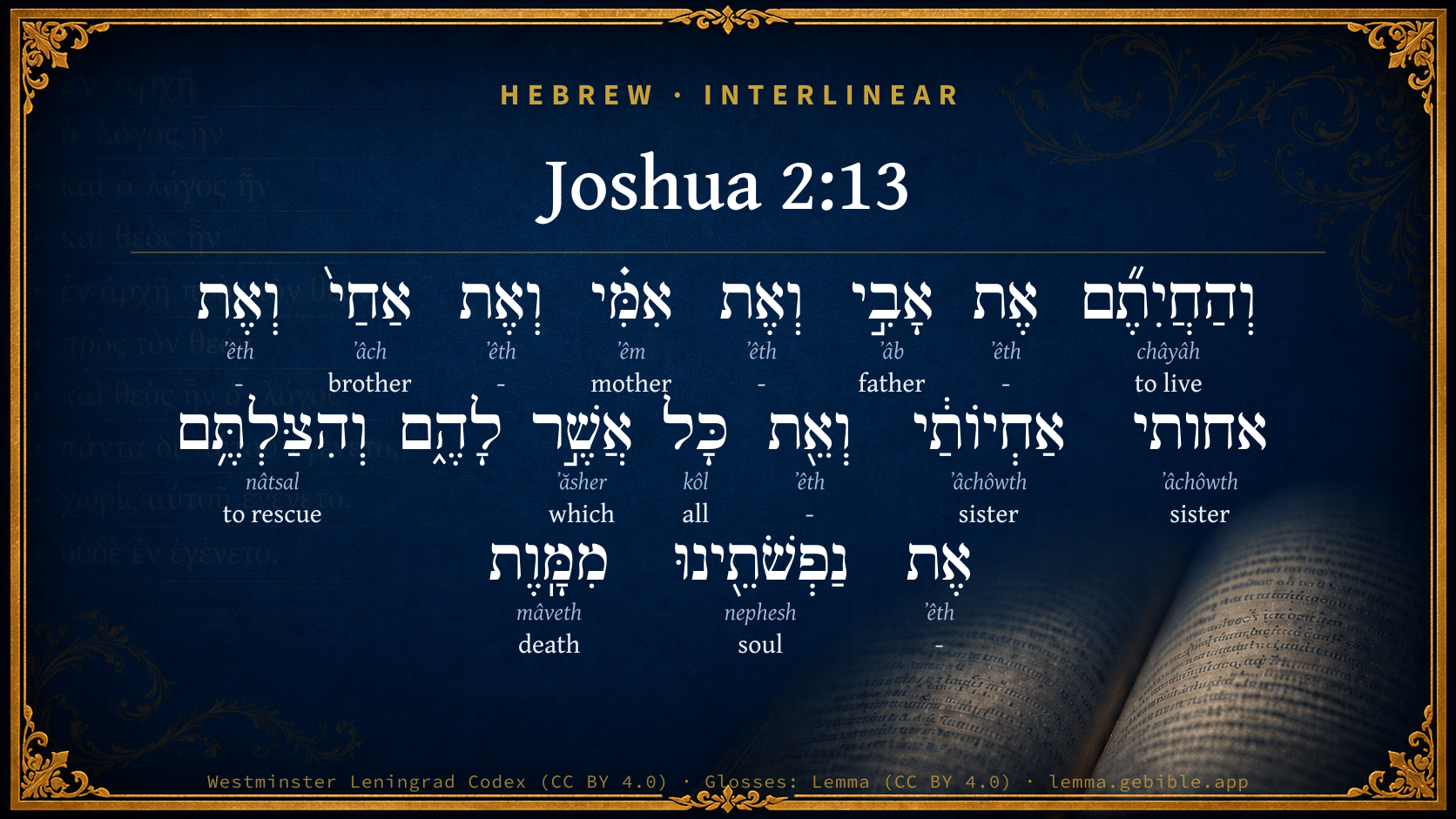
  1. וְהַחֲיִתֶ֞ם châyâh H2421 “and · to live” Conjunction + Verb, Hiphil, Sequential Perfect, 2nd Person, Masculine, Plural
  2. אֶת ʼêth H853 “-” Particle, Direct Object
  3. אָבִ֣י ʼâb H1 “father · my” Noun, Common, Masculine, Singular, Construct + Suffix, Personal, 1st Person, Common, Singular
  4. וְאֶת ʼêth H853 “and · -” Conjunction + Particle, Direct Object
  5. אִמִּ֗י ʼêm H517 “mother · my” Noun, Common, Feminine, Singular, Construct + Suffix, Personal, 1st Person, Common, Singular
  6. וְאֶת ʼêth H853 “and · -” Conjunction + Particle, Direct Object
  7. אַחַי֙ ʼâch H251 “brothers · my” Noun, Common, Masculine, Plural, Construct + Suffix, Personal, 1st Person, Common, Singular
  8. וְאֶת ʼêth H853 “and · -” Conjunction + Particle, Direct Object
  9. אַחְיוֹתַ֔י ʼâchôwth H269 “sisters · my” Noun, Common, Feminine, Plural, Construct + Suffix, Personal, 1st Person, Common, Singular
  10. וְאֵ֖ת ʼêth H853 “and · -” Conjunction + Particle, Direct Object
  11. כָּל kôl H3605 “all of” Noun, Common, Masculine, Singular, Construct
  12. אֲשֶׁ֣ר ʼăsher H834 “which” Particle, Relative
  13. וְהִצַּלְתֶּ֥ם nâtsal H5337 “and · to rescue” Conjunction + Verb, Hiphil, Sequential Perfect, 2nd Person, Masculine, Plural
  14. אֶת ʼêth H853 “-” Particle, Direct Object
  15. נַפְשֹׁתֵ֖ינוּ nephesh H5315 “souls · our” Noun, Common, Both, Plural, Construct + Suffix, Personal, 1st Person, Common, Plural
  16. מִמָּֽוֶת mâveth H4194 “from · death” Preposition + Noun, Common, Masculine, Singular, Absolute

About this verse

These counts appear in no published source. They are computed here, from the morphology-tagged text and Lemma’s own curated glosses. What Lemma adds →

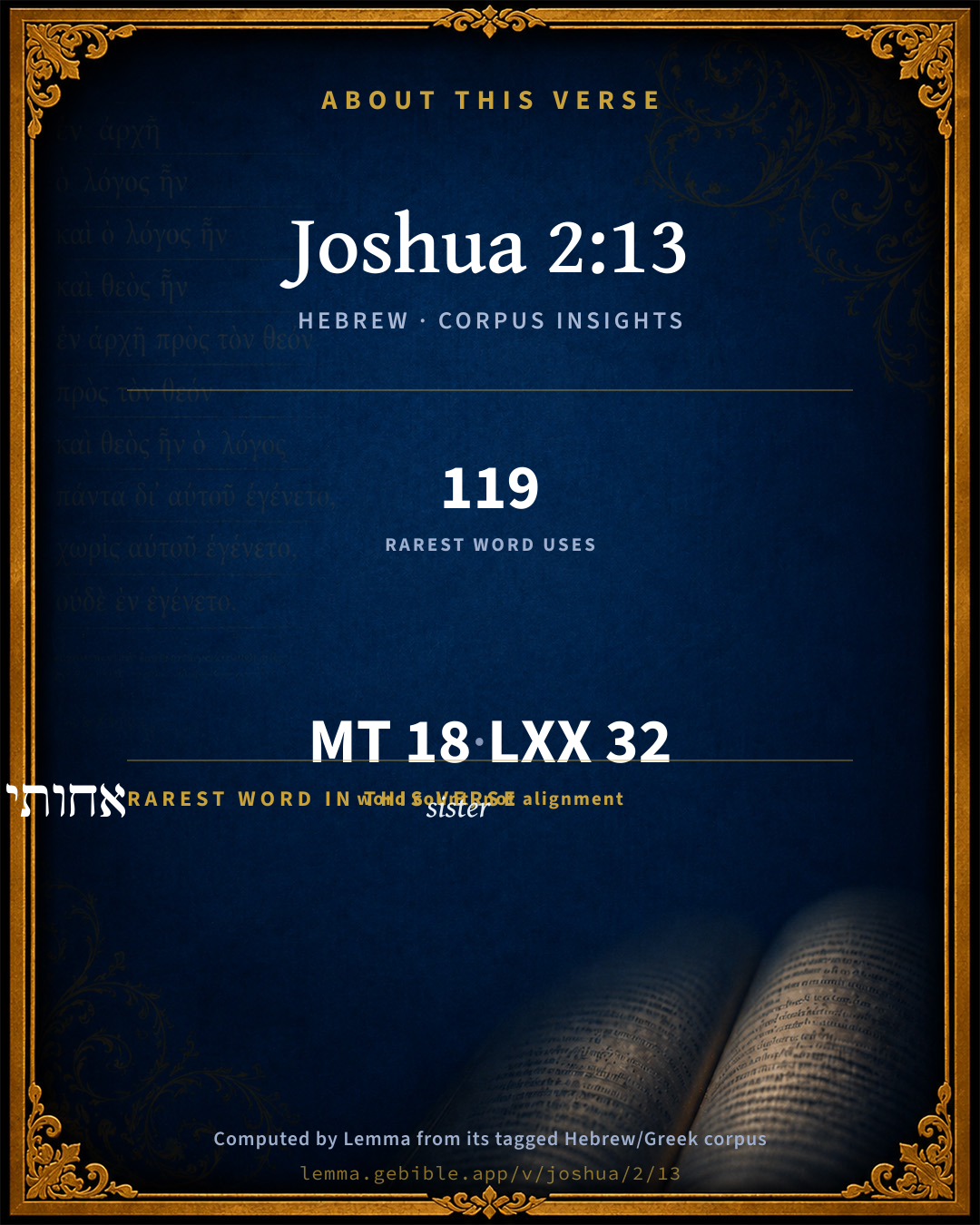
18
words
11
distinct lemmas
Historical
section

Grammatical profile

  • 2 verbs
  • 8 nouns
  • 1 preposition
  • 7 particles

Verb forms

  • וְהַחֲיִתֶ֞ם Hiphil · Sequential Perfect
  • וְהִצַּלְתֶּ֥ם Hiphil · Sequential Perfect

Repetition

A word recurs within this verse — often emphatic in Hebrew:

  • אחותי sister H269 ×2

Hebrew & Septuagint length

In English translation the verse runs 29 words from the Hebrew and 30 from the Septuagint (LXX English) — closely comparable.

A rough comparison of the two English renderings, which tokenize alike — not a word-level alignment.

Word counts can differ between the Hebrew and the Greek without any difference in meaning — e.g. the Hebrew direct-object marker אֵת has no separate Greek word, and Greek often adds the article ὁ.

In the original languages it is 18 Hebrew tokens and 32 Greek tokens — but the two are counted differently (Hebrew bundles its prefixes and suffixes into one token; the Greek is in lemma form), so that isn’t a like-for-like length.

Hebrew and Greek witnesses Masoretic Hebrew ↔ Greek Septuagint

The same verse in the two great witnesses to the Old Testament, shown verse-for-verse.

These are two independent witnesses, not word-aligned to each other, and the Septuagint is shown in lemma (dictionary) form.

Hebrew Joshua 2:13 Masoretic · Westminster Leningrad Codex

וְהַחֲיִתֶ֞ם אֶת אָבִ֣י וְאֶת אִמִּ֗י וְאֶת אַחַי֙ וְאֶת אחותי אַחְיוֹתַ֔י וְאֵ֖ת כָּל אֲשֶׁ֣ר לָהֶ֑ם וְהִצַּלְתֶּ֥ם אֶת נַפְשֹׁתֵ֖ינוּ מִמָּֽוֶת

and that you will save alive my father, and my mother, and my brothers, and my sisters, and all that they have, and will deliver our lives from death.

World English Bible · Public Domain

Greek LXX Joshua 2:13 Septuagint · lemma form

καί ζωγρέω ὁ οἶκος ὁ πατήρ ἐγώ καί ὁ μήτηρ ἐγώ καί ὁ ἀδελφός ἐγώ καί πᾶς ὁ οἶκος ἐγώ καί πᾶς ὅσος εἰμί αὐτός καί ἐκαἱρέω ὁ ψυχή ἐγώ ἐκ θάνατος

and save alive the house of my father, my mother, and my brethren, and all my house, and all that they have, and you⌃ shall rescue my soul from death.

LXX2012 (modern English Septuagint) · Public Domain

Hebrew: Westminster Leningrad Codex (CC BY 4.0). Greek: Septuagint (public domain); English from LXX2012 (modern English Septuagint) (Public Domain). How the Septuagint differs from the Hebrew →

Targum (Aramaic paraphrase)

1

The Targum is the ancient Jewish Aramaic paraphrase of the Hebrew Scriptures — an interpretive translation, not the Hebrew text itself. Onkelos (literal) and Pseudo-Jonathan (expansive) render the Torah, and Jonathan the Prophets. Coverage is partial: where no permissively-licensed English translation exists for a verse, only the Aramaic is shown. This is verse-level text, not a word-by-word alignment to the Hebrew.

  1. Targum Jonathan Prophets (Joshua–Malachi)
    וְתֵיחוּן יַת אַבָּא וְיַת אִמָא וְיַת אֲחַי וְיַת אֲחָתֵי וְיַת כָּל דִילְהוֹן וּתְשֵׁזְבוּן יַת נַפְשָׁתָנָא מִמוֹתָא:

    (no public-domain English translation for this verse)

    Targum Jonathan — Aramaic: “Mikraot Gedolot” (public domain). English: “Sefaria Community Translation” (CC0 1.0 (public-domain dedication)); “London "Chaldee Paraphrase," 1871” (public domain). Text via Sefaria.

Commentary

Notes on Joshua 2:13 from classic Christian and Jewish commentators (each source and its license shown beneath its notes). The classic Christian expositions comment on the surrounding passage and are grouped to its opening verse, so a note may address several verses; the Jewish commentaries on the Tanakh (Rashi and others) are per-verse, so they appear only where the commentator wrote on this verse.

Lemma curates 59 commentaries, every one of them public domain or Creative Commons licensed, each selected and text-cleaned for this edition rather than reprinted as found. About our sources →

Trapp's Complete Commentary

John Trapp

Jos 2:13 And [that] ye will save alive my father, and my mother, and my brethren, and my sisters, and all that they have, and deliver our lives from death.

Ver. 13. And that ye will save alive.] Man is ζωον φιλοζωον, a creature that would fain live, said Aesop. Quis vitam non vult? said Augustine. The Gibeonites were desirous to live upon any terms. {Jos 9:3-14} Rahab’s greatest care was for her kindred, because unconverted. Augustine professeth that he would not for the gain of a million of worlds be an atheist for half an hour: because he knew not but God might in that time call him to account.

John Trapp, A Commentary or Exposition upon All the Books of the Old and New Testament (1647–1656) — public domain. Text from a community e-Sword module.

Geneva Bible (1599)

Geneva Bible translators

Or, lives.

Geneva Bible (1599) marginal notes — public domain. Text via Bolls.life.

Adam Clarke's Commentary

Verse 13. Deliver our lives from death.] She had learned, either from the spies or otherwise, that all the inhabitants of the land were doomed to destruction, and therefore she obliges them to enter into a covenant with her for the preservation of herself and her household.

Adam Clarke's Commentary on the Bible (1810–1826) — public domain. Text from a community e-Sword/MySword module.

Ellicott's Commentary for English Readers

(13) Save alive my father, and my mother, and my brethren, and my sisters.—Whatever Rahab may have been herself, her acknowledgment of all her family is observable. She was in no way separated or degraded from their society. When we remember what Moses describes the Canaanites to have been (in certain passages of the Pentateuch, as Lev_18:24-28; Lev_20:22-23) and compare this chapter, we may reasonably conclude Rahab to have been morally not inferior to her countrymen as they were then, but rather their superior. We are reminded that the “publicans and harlots “were not the worst members of the “evil and adulterous generation” to whom the Word of God came. They believed John the Baptist, and were among the most constant hearers of the true Joshua (Mat_21:32; Luk_15:1).

A Bible Commentary for English Readers, edited by Charles John Ellicott (1878–1897) — public domain. Text from a community e-Sword module.

John Gill's Exposition

And that ye will save alive my father, and my mother, and my brethren, and my sisters,.... She makes no mention of any husband or children she had, as harlots seldom have, and which seems to confirm her character as such; and so Abarbinel observes, that her father's house is only mentioned to tell us that she had no husband, for she was an harlot and had no children, and puts her father and mother in the room of an husband, and her brethren and sisters in the room of children:

and all that they have; not their substance only, but their children more especially, the children of her brethren and sisters:

and deliver our lives from death; here she manifestly includes herself, and requests the saving of her life, and the lives of all her relations, when she knew the inhabitants of the city would be all put to death upon the taking of it: thus she provided for the safety of her family, as Noah in another case and manner did, Heb 11:7; and indeed seemed more concerned for them than for herself; and thus souls sensible of their own estate and condition, by nature and grace, are very solicitous for the salvation of their relations and friends, Rom 9:3.

John Gill's Exposition of the Whole Bible (1746–1763) — public domain (CC PDM 1.0). Text via the HelloAO Bible API.

Whedon's Commentary on the Bible

Daniel D. Whedon

13. And that ye will save alive my father — The English version wrongly supplies that. Read, And ye shall save alive, etc. She was by no means destitute of natural affection. That she does not stipulate for the salvation of the entire state of Jericho is no evidence of her want of patriotism. She was too deeply impressed with the belief of the coming overthrow to ask so much. Our ties of consanguinity should induce us to make extraordinary efforts for the conversion of our kindred to God. This is the highest purpose of the creation of such ties in the human soul.

All that they have — It is not necessary to limit this clause to persons only; it may include portable possessions also. Comp. Jos_6:23, note.

Daniel D. Whedon (gen. ed.), Commentary on the Old and New Testaments (1874–1909) — public domain. Text from a community e-Sword module.

John Wesley's Explanatory Notes

All that they have - That is, their children, as appears from chap. vi, 23.

John Wesley, Explanatory Notes Upon the Whole Bible (1754–1765) — public domain. Text via the GEBible commentary corpus.

Lesson kit

Teaching starters — assembled from the data on this page, not authored interpretation. Every prompt links to the verse data it draws on. Edit before teaching.

Joshua, in the Historical, opens this verse with 18 words (11 distinct Hebrew lemmas). Its most distinctive word is ʼâchôwth (“sister”). A historical commentator’s framing appears above. Read the whole chapter for the surrounding context.

Discussion questions

  1. How does “sister” (ʼâchôwth) shape what this verse is saying?
  2. “sister” occurs 2× in this one verse. What is the effect of the repetition?
  3. These translations render this verse differently. What is at stake in choosing one wording over another?
  4. The verb «וְהַחֲיִתֶ֞ם» is Hiphil Sequential Perfect. How does its form color the action?
  5. Reading how Trapp's Complete Commentary and Geneva Bible (1599) read this verse, where do the two commentators agree and where do they part?

Things to notice

Reading settings

Reading text

Shown beneath each verse's original-language words.

Old Testament
Old Testament edition

Read the OT as the Masoretic Hebrew (MT) or the Greek Septuagint (LXX).

English shown for the Greek Septuagint (in the Hebrew ↔ Greek comparison).

Comparing translations? Open the Compare panel on any verse page to stack up to four side by side.