

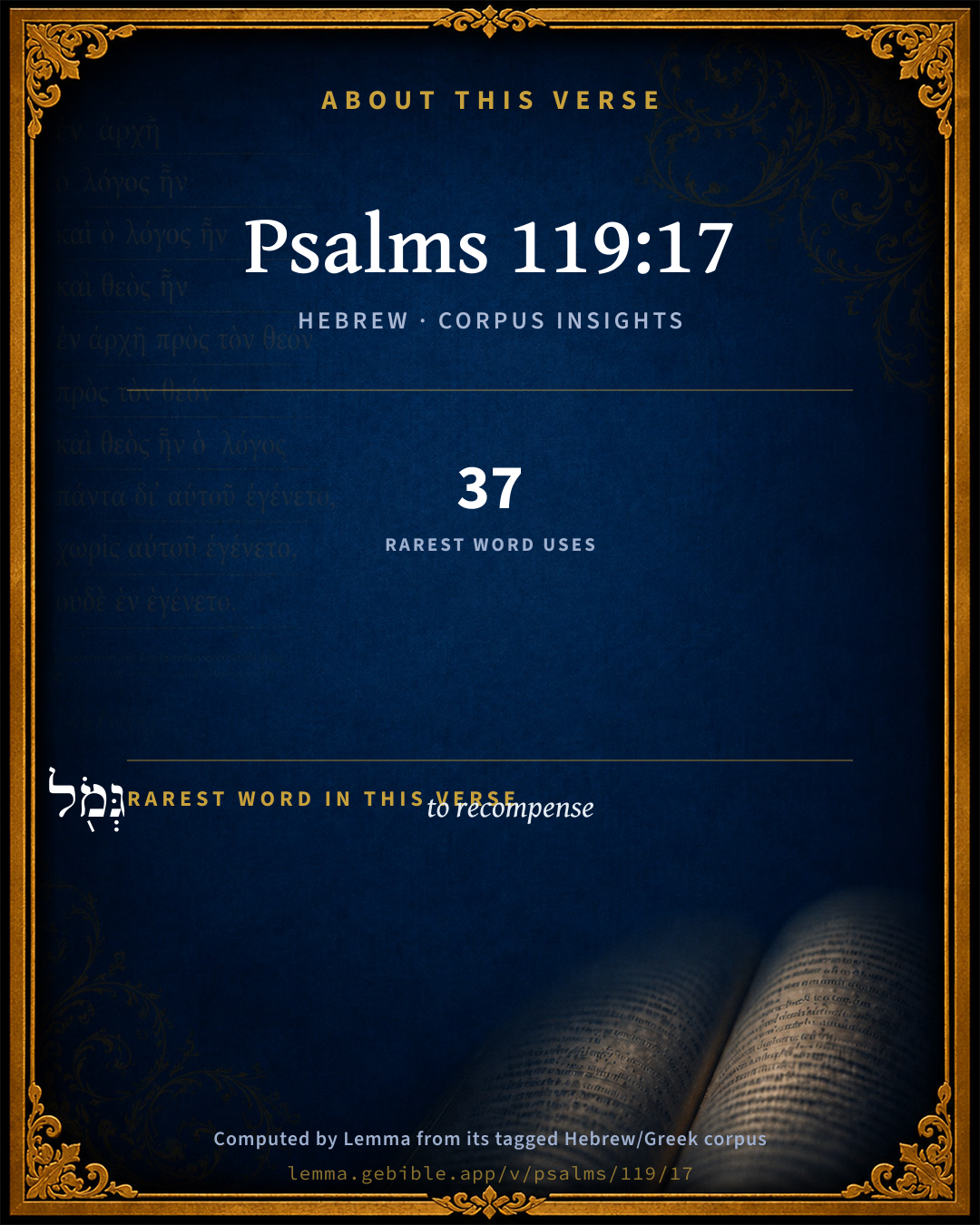
Psalms 119:17

Hebrew (Westminster Leningrad Codex) Psalms 119:17 appears in the Hebrew Old Testament. The text above is from the Westminster Leningrad Codex. Each word links to its Strong’s number, a concise gloss, and parsing drawn from the Open Scriptures Hebrew Bible morphology. Click any word for its full Brown-Driver-Briggs (BDB) entry.
Download image
Cite this verse

Psalms 119:17 (World English Bible). Public Domain. Lemma interlinear Bible study tool, https://lemma.gebible.app/v/psalms/119/17.

Show BibTeX & RIS
BibTeX
RIS
English Translation
Do good to your servant. I will live and I will obey your word.
World English Bible · Public Domain
Download a study sheet

One document with this verse’s original text, its word-by-word gloss line, the meaning frame, cross-references with their text, attributed commentary, and full source and license credits — printable, and it pastes into notes with its structure intact.

This verse Autodidact and up

Study sheet (.html) Plain text (.txt)

A passage Seminary Student

Up to 50 verses in one chapter. A passage sheet keeps up to 6 commentary sources and 12 cross-references per verse, in the order this page ranks them, and says so on the sheet whenever that leaves anything out. Ask for a single verse and you get the Autodidact verse sheet above.

Everything on this page stays free to read, with no account — the sheet is a download of what is already on screen, not access to it.

Want to remove ads? Support Godless Engineer
Compare translations 3

The same verse in 3 English versions, stacked beneath the original-language interlinear above. Click any original word for its lexicon entry.

Each is an independent rendering of the whole verse — the interlinear is not word-aligned to these translations.

Highlighted words mark where these versions differ — a whole-verse word diff, not a word-by-word alignment.

  • World English Bible Public Domain
    Do good to your servant. I will live and I will obey your word.
  • King James Version Public Domain
    Deal bountifully with thy servant, that I may live, and keep thy word.
  • unfoldingWord Literal Text CC BY-SA 4.0
    Deal kindly with your servant so that I may live and keep your word.

unfoldingWord Literal Text — © unfoldingWord, licensed CC BY-SA 4.0. Word-aligned USFM3 via Door43 (git.door43.org/unfoldingWord/en_ult).

Versions to compare (up to 4)

3 of 4 selected

Show all 17 translations

Every available English version of this verse, each an independent rendering of the whole verse.

  • World English Bible Public Domain
    Do good to your servant. I will live and I will obey your word.
  • Berean Standard Bible Public Domain
    Deal bountifully with Your servant, that I may live and keep Your word.
  • Majority Standard Bible Public Domain
    Deal bountifully with Your servant, that I may live and keep Your word.
  • King James Version Public Domain
    Deal bountifully with thy servant, that I may live, and keep thy word.
  • American Standard Version (1901) Public Domain
    GIMEL. Deal bountifully with thy servant, that I may live; So will I observe thy word.
  • Revised Version (1885) Public Domain
    Deal bountifully with thy servant, that I may live; so will I observe thy word.
  • Geneva Bible (1599) Public Domain
    GIMEL. Be beneficiall vnto thy seruant, that I may liue and keepe thy woorde.
  • Young's Literal Translation Public Domain
    `Gimel.' Confer benefits on Thy servant, I live, and I keep Thy word.
  • Literal Standard Version CC BY-SA 4.0
    [GIMEL] Confer benefits on Your servant, || I live, and I keep Your word.
  • Unlocked Literal Bible CC BY-SA 4.0
    Be kind to your servant so that I may live and keep your word.
  • unfoldingWord Literal Text CC BY-SA 4.0
    Deal kindly with your servant so that I may live and keep your word.
  • Darby Bible Public Domain
    GIMEL. Deal bountifully with thy servant [and] I shall live; and I will keep thy word.
  • World Messianic Bible Public Domain
    Do good to your servant. I will live and I will obey your word.
  • Webster's Bible Public Domain
    GIMEL. Deal bountifully with thy servant, that I may live, and keep thy word.
  • Free Bible Version CC BY-SA 4.0
    Be kind to your servant so I can live and follow what you teach.
  • Bible in Basic English Public Domain
    GIMEL Give me, your servant, the reward of life, so that I may keep your word;
  • JPS Tanakh (1917) Public Domain
    GIMEL. Deal bountifully with Thy servant that I may live, and I will observe Thy word.

Literal Standard Version (2020), Covenant Press — licensed CC BY-SA 4.0. Text via the HelloAO Bible API (eBible.org). Unlocked Literal Bible (unfoldingWord) — licensed CC BY-SA 4.0. Text via the HelloAO Bible API (eBible.org). unfoldingWord Literal Text — © unfoldingWord, licensed CC BY-SA 4.0. Word-aligned USFM3 via Door43 (git.door43.org/unfoldingWord/en_ult). Free Bible Version, Dr. Jonathan Gallagher — licensed CC BY-SA 4.0. Text via the HelloAO Bible API (eBible.org).

Word by word

More ways to search: Search by grammar → Find every occurrence → Compare this word →

Practice this passage: Drill this verse → Learn its vocabulary →

About this verse

These counts appear in no published source. They are computed here, from the morphology-tagged text and Lemma’s own curated glosses. What Lemma adds →

6
words
6
distinct lemmas
Wisdom
section

Shared distinctive vocabulary

גְּמֹ֖ל to recompense H1580 occurs in 32 verses of the Hebrew Bible. Also found in:

Grammatical profile

  • 3 verbs
  • 2 nouns
  • 1 preposition

Verb forms

  • גְּמֹ֖ל Qal · Imperative
  • אֶֽחְיֶ֗ה Qal · Cohortative
  • וְאֶשְׁמְרָ֥ה Qal · Cohortative

Hebrew & Septuagint length

In English translation the verse runs 14 words from the Hebrew and 14 from the Septuagint (LXX English) — the same length.

A rough comparison of the two English renderings, which tokenize alike — not a word-level alignment.

Word counts can differ between the Hebrew and the Greek without any difference in meaning — e.g. the Hebrew direct-object marker אֵת has no separate Greek word, and Greek often adds the article ὁ.

Cross-references

14

Topical passages linked to Psalms 119:17 in the Treasury of Scripture Knowledge — connected by theme and wording, ordered by reader-vote popularity; previews shown in the World English Bible.

  • Psalms 13:6 I will sing to Yahweh, Because he has been good to me.
  • Titus 2:11–12 For the grace of God has appeared, bringing salvation to all men,
  • Ephesians 2:4–5 But God, being rich in mercy, for his great love with which he loved us,
  • Psalms 116:7 Return to your rest, my soul, For Yahweh has dealt bountifully with you.
  • Psalms 119:65 Do good to your servant, According to your word, Yahweh.
  • Psalms 119:124 Deal with your servant according to your loving kindness. Teach me your statutes.
  • Psalms 119:132 Turn to me, and have mercy on me, As you always do to those who love your name.
  • John 1:16 From his fullness we all received grace upon grace.
  • 2 Corinthians 9:7–11 Let each man give according as he has determined in his heart; not grudgingly, or under compulsion; for God loves a cheerful giver.
  • Ephesians 2:10 For we are his workmanship, created in Christ Jesus for good works, which God prepared before that we would walk in them.
  • Philippians 4:19 My God will supply every need of yours according to his riches in glory in Christ Jesus.
  • 1 John 2:29 If you know that he is righteous, you know that everyone who practices righteousness is born of him.
  • 1 John 5:3–4 For this is the love of God, that we keep his commandments. His commandments are not grievous.
  • Romans 8:2–4 For the law of the Spirit of life in Christ Jesus made me free from the law of sin and of death.

Cross-references courtesy of OpenBible.info (CC BY 4.0).

Hebrew and Greek witnesses Masoretic Hebrew ↔ Greek Septuagint

The same verse in the two great witnesses to the Old Testament, shown verse-for-verse.

You’re reading Greek Psalm 118 (Hebrew Psalm 119). The Septuagint counts the superscription, so verse numbers can differ from the Hebrew — chapter-level alignment, not verse-by-verse. Numbering follows Rahlfs.

These are two independent witnesses, not word-aligned to each other, and the Septuagint is shown in lemma (dictionary) form.

Hebrew Psalms 119:17 Masoretic · Westminster Leningrad Codex

גְּמֹ֖ל עַֽל עַבְדְּךָ֥ אֶֽחְיֶ֗ה וְאֶשְׁמְרָ֥ה דְבָרֶֽךָ

Do good to your servant. I will live and I will obey your word.

World English Bible · Public Domain

Greek LXX Greek Psalm 118:17 Septuagint · lemma form

γιμαλ ἀντι ἀποδίδωμι ὁ δοῦλος σύ ζάω καί φυλάσσω ὁ λόγος σύ

Render a recompense to your servant: so shall I live, and keep your words.

LXX2012 (modern English Septuagint) · Public Domain

On this verse, Keil & Delitzsch discusses the Septuagint’s reading. Read the note in Commentary ↓

Hebrew: Westminster Leningrad Codex (CC BY 4.0). Greek: Septuagint (public domain); English from LXX2012 (modern English Septuagint) (Public Domain). How the Septuagint differs from the Hebrew →

Commentary

Notes on Psalms 119:17 from classic Christian and Jewish commentators (each source and its license shown beneath its notes). The classic Christian expositions comment on the surrounding passage and are grouped to its opening verse, so a note may address several verses; the Jewish commentaries on the Tanakh (Rashi and others) are per-verse, so they appear only where the commentator wrote on this verse.

Lemma curates 59 commentaries, every one of them public domain or Creative Commons licensed, each selected and text-cleaned for this edition rather than reprinted as found. About our sources →

Trapp's Complete Commentary

John Trapp

Psa 119:17 GIMEL. Deal bountifully with thy servant, [that] I may live, and keep thy word.

Ver. 17. Deal bountifully with thy servant] Per indebitam gratiam retribue. Of thy free grace confer good upon me; and that not scantily, or niggardly, but liberally, and like thyself. The word sometimes signifieth to repay, to recompense; but therehence to infer matter of merit, on man’s part, is too sandy a foundation for such a lofty Babel.

That I may live] Who am in deaths often; and that I may comfortably subsist in the feeling of thy favour, as 1Sa 25:6.

And keep thy word] For which end only I desire life. See the like, Psa 118:17. Non aliter petit vitam, quam ut praestet se fidelem Dei cultorem, saith Arnobius. David doth no otherwise desire life, than for this, that he may faithfully serve God. Non peto vitam propter delicias mundi (Kimchi).

John Trapp, A Commentary or Exposition upon All the Books of the Old and New Testament (1647–1656) — public domain. Text from a community e-Sword module.

Albert Barnes' Notes on the Bible

Deal bountifully ... - This commences the next portion of the psalm, indicated by the letter Gimel (ג g), the third letter of the Hebrew alphabet, answering to our letter “g.” Each verse of this portion Psa 119:17-24 begins with this letter. There is a resemblance between the first word of this verse - גמל gemol - and the letter - “Gimel” - which commences the eight verses of this portion of the psalm. The noun (derived from the verb) - גמל gâmâl - means a camel, and the letter gimel has been supposed to have derived its name from its having originally a resemblance to the camel’s neck. In some of the Phenician inscriptions, and in the Ethiopic alphabet, it has this form (Gesenius, “Lex”). The verb used here means to do, or show, or cause good or evil to anyone; and then to reward, or to recompense, either good or evil. Here it seems to be used in a general sense of doing good, or showing favor, as in Psa 13:6; Psa 116:7; Psa 142:7. Compare Pro 11:17. It does not necessarily imply that the author of the psalm had any claim, or demanded this on the ground of merit. He begged the favor, the friendship, the interposition of God in his behalf.

That I may live - The continuance of life was dependent on the favor of God.

And keep thy word - For grace to do this he was equally dependent on God; and he asked that life might be continued, in order that he might honor the word of God by obeying it.

Albert Barnes' Notes on the Bible (1834–1885) — public domain. Text from a community e-Sword/MySword module.

The Biblical Illustrator

Joseph S. Exell

Psa_119:17

Deal bountifully with Thy servant, that I may live, and keep Thy Word.

Human life

Two facts suggested concerning human life:

I. That its continuance depends upon Divine mercy. No creature has a right to live. All finite life is a gift; especially is this the case with human life, that has outraged its constitution and rebelled against its Creator. We live by mercy.

II. That its value depends upon true obedience. Life apart from obedience is a life without moral peace, without harmony, without spiritual usefulness, without God, without hope. (Homilist.)

The Biblical Illustrator, edited by Joseph S. Exell (c. 1880s–1900s) — public domain. Text from a community e-Sword module.

The Treasury of David

Charles H. Spurgeon

Ver. 17. Deal bountifully with thy servant. He takes pleasure in owning his duty to God, and counts it the joy of his heart to be in the service of his God. Out of his condition he makes a plea, for a servant has some hold upon a master; but in this case the wording of the plea shuts out the idea of legal claim, since he seeks bounty rather than reward. Let my wage be according to thy goodness, and not according to my merit. Reward me according to the largeness of thy liberality, and not according to the scantiness of my service. The hired servants of our Father have all of them bread enough and to spare, and he will not leave one of his household to perish with hunger, .If the Lord will only treat us as he treats the least of his servants we may be well content, for all his true servants are sons, princes of the blood, heirs of life eternal. David felt that his great needs required a bountiful provision, and that his little desert would never earn such a supply; hence he must throw himself upon God's grace, and look for the great things he needed from the great goodness of the Lord. He begs for a liberality of grace, after the fashion of one who prayed, "O Lord, thou must give me great mercy or no mercy, for little mercy will not serve my turn."

That I may live. Without abundant mercy he could not live. It takes great grace to keep a saint alive. Even life is a gift of divine bounty to such undeserving ones as we are. Only the Lord can keep us in being, and it is mighty grace which preserves to us the life which we have forfeited by our sin. It is right to desire to live, it is meet to pray to live, it is just to ascribe prolonged life to the favour of God. Spiritual life, without which this natural life is mere existence, is also to be sought of the Lord's bounty, for it is the noblest work of divine grace, and in it the bounty of God is gloriously displayed. The Lord's servants cannot serve him in their own strength, for they cannot even live unless his grace abounds towards them.

And keep thy word. This should be the rule, the object, and the joy of our life. We may not wish to live and sin; but we may pray to live and keep God's word. Being is a poor thing if it be not well being. Life is only worth keeping while we can keep God's word; indeed, there is no life in the highest sense apart from holiness: life while we break the law is but a name to live.

The prayer of this verse shows that it is only through divine bounty or grace that we can live as faithful servants of God, and manifest obedience to his commands. If we give God service it must be because he gives us grace. We work for him because he works in us. Thus we may make a chain out of the opening verses of the three first octaves of this Psalm: Ps 119:1 blesses the holy man, Ps 119:9 asks how we can attain to such holiness, and Ps 119:17 traces such holiness to its secret source, and shows us how to seek the blessing. The more a man prizes holiness and the more earnestly he strives after it, the more will he be driven towards God for help therein, for he will plainly perceive that his own strength is insufficient, and that he cannot even so much as live without the bounteous assistance of the Lord his God.

Ver. 17. Deal bountifully with thy servant, etc. These words might be Render unto thy servant, or upon thy servant. A deep signification seems to be here involved. The holy man will take the responsibility of being dealt with, not certainly as a mere sinful man, but as a man placing himself in the way appointed for reconciliation. Such we find to be the actual case, as you read in Ps 119:16, in the Part immediately preceding "I will delight myself in thy statutes; I will not forget thy word." Now, the statutes of the Lord referred preeminently to the sacrifices for sin, and the cleansing for purifications that were prescribed in the Law. You have to conceive of the man of God as being in the midst of the Levitical ritual, for which you find him making all preparations: 1 Chronicles 22-24. Placing himself, therefore, upon these, he would pray the Lord to deal with him according to them; or, as we, in New Testament language, would say, placing himself on the great atonement, the believer would pray the Lord to deal with him according to his standing in Christ, which would be in graciousness or bounty. For if the Lord be just to condemn without the atonement, he is also just to pardon through the atonement; yea, he is just, and the justifier of him that believeth in Jesus. John Stephen.

Ver. 17. Deal bountifully, etc. O Lord, I am constantly resolved to obey and adhere to thy known will all the days of my life: O make me those gracious returns which thou hast promised to all such. Henry Hammond.

Ver. 17. Deal bountifully... that I may keep thy word, etc. A faithful servant should count his by past service richly rewarded by being employed yet more in further service, as this prayer teacheth; for David entreats that he may live and keep God's word. David Dickson.

Ver. 17. Bountifully. And indeed, remembering what a poor, weak, empty, and helpless creature the most experienced believer is in himself, it is not to be conceived that anything short of a bountiful supply of grace can answer the emergency. Charles Bridges.

Ver. 17. Thy servant. That he styles himself so frequently the servant of God notes the reverent estimation he had of his God, in that he accounts it more honourable to be called the servant of God who was above him than the king of a mighty, ancient, and most famous people that were under him. And indeed, since the angels are styled his ministers, shall men think it a shame to serve him? and especially since he of his goodness hath made them our servants, "ministering spirits" to us? Should we not joyfully serve him who hath made all his creatures to serve us, and exempted us from the service of all other, and hath only bound us to serve himself? William Cowper.

Ver. 17. That I may live. As a man must "live" in order to work, the first petition is, that God would "deal with his servant, "according to the measure of grace and mercy, enabling him to "live" the life of faith, and strengthening him by the Spirit of might in the inner man. George Horne, 1730-1792.

Ver. 17. That I may live, and keep thy word. David joins here two together, which whosoever disjoins cannot be blessed. He desires to live; but so to live that he may keep God's word. To a reprobate man, who lives a rebel to his Maker, it had been good (as our Saviour said of Judas) that he had never been born. The shorter his life is, the fewer are his sins and the smaller his judgments. But to an elect man, life is a great benefit; for by it he goes from election to glorification, by the way of sanctification. The longer he lives, the more good he doth, to the glory of God, the edification of others, and confirmation of his own salvation; making it sure to himself by wrestling and victory in temptations, and perseverance in well doing. William Cowper.

Outlines Upon Keywords of the Psalm, By Pastor C. A. Davis.

Ver. 17-24. Divine bounties desired. Life, for godly service (Ps 119:17). Illumination (Ps 119:18). Guidance homeward for the stranger ("thy commandments") (Ps 119:19-20), and, glancing at the proud who err from this guidance (Ps 119:21), the Psalmist prays for removal of the "reproach" entailed by fidelity to God (Ps 119:22-24).

Ver. 17.

1. A bountiful master.

2. A needy servant begging for very life.

3. A suitable recompense: "and keep thy word."

Ver. 17. We are here taught,

1. That we owe our lives to God's mercy.

2. That therefore we ought to spend our lives in God's service. Matthew Henry.

Psalms 119:18*

Charles H. Spurgeon's The Treasury of David (1869–1885) — public domain. Psalms only. Text from a community e-Sword/MySword module.

Joseph Benson's Commentary

GIMEL.

Psa 119:17-18. Deal bountifully with thy servant — I plead no merit, but only thy free grace and rich mercy; that I may live — Safely and comfortably; and keep thy word — For I do not desire life that I may satisfy my own lusts, but that I may spend it in thy service. Open thou mine eyes — Enlighten my mind by thy Holy Spirit, and dispel all ignorance and error. That I may behold wondrous things out of thy law — Those great and marvellous depths of divine wisdom and goodness, and those profound mysteries of Christ, and of God’s grace to mankind, and that everlasting state, which are not to be known but by divine illumination.

Joseph Benson's Commentary on the Old and New Testaments (1811–1818) — public domain. Text from a community e-Sword module.

Keil & Delitzsch

C. F. Keil & F. Delitzsch

The eightfold Gimel. This is his life's aim: he will do it under fear of the curse of apostasy; he will do it also though he suffer persecution on account of it. In Psa 119:17 the expression is only אחיה as Psa 118:19, not ואחיה as in Psa 119:77, Psa 119:116, Psa 119:144 : the apodosis imper. only begins with ואשׁמרה, whereas אחיה is the good itself for the bestowment of which the poet prays. גּל in Psa 119:18 is imper. apoc. Piel for גּלּה, like גס in Dan 1:12. נפלאות is the expression for everything supernatural and mysterious which is incomprehensible to the ordinary understanding and is left to the perception of faith. The Tפra beneath the surface of its letter contains an abundance of such "wondrous things," into which only eyes from which God has removed the covering of natural short-sightedness penetrate; hence the prayer in Psa 119:18. Upon earth we have no abiding resting-place, we sojourn here as in a strange land (Psa 119:19, Psa 39:13; Ch1 29:15). Hence the poet prays in Psa 119:19 that God would keep His commandments, these rules of conduct for the journey of life, in living consciousness for him. Towards this, according to Psa 119:20, his longing tends. גּרס (Hiph. in Lam 3:16) signifies to crush in pieces, Arab. jrš, and here, like the Aramaic גּרס, גּרס, to be crushed, broken in pieces. לתאבה (from תּאב, Psa 119:40, Psa 119:174, a secondary form of אבה) states the bias of mind in or at which the soul feels itself thus overpowered even to being crushed: it is crushing form longing after God's judgment, viz., after a more and more thorough knowledge of them. In Psa 119:21 the lxx has probably caught the meaning of the poet better than the pointing has done, inasmuch as it draws ἐπικατάρατοι to Psa 119:21, so that Psa 119:21 consists of two words, just like Psa 119:59, Psa 119:89; and Kamphausen also follows this in his rendering. For ארוּרים as an attribute is unpoetical, and as an accusative of the predicate far-fetched; whereas it comes in naturally as a predicate before השּׁגים ממּצותיך: cursed (ארר = Arab. harra, detestari), viz., by God. Instead of גּל, "roll" (from גּלל, Jos 5:9), it is pointed in Psa 119:22 (מעל) גּל, "uncover" = גּלּה, as in Psa 119:18, reproach being conceived of as a covering or veil (as e.g., in Psa 69:8), cf. Isa 22:8 (perhaps also Lam 2:14; Lam 4:22, if גּלּה על there signifies "to remove the covering upon anything"). גּם in Psa 119:23, as in Jer 36:25, has the sense of גּם־כּי, etiamsi; and גּם in Psa 119:24 the sense of nevertheless, ὅμως, Ew. 354, a. On נדבּר בּ (reciprocal), cf. Eze 33:30. As in a criminal tribunal, princes sit and deliberate how they may be able to render him harmless.

Keil & Delitzsch — Biblical Commentary on the Old Testament (1861–1891) — public domain (CC PDM 1.0). Text via the HelloAO Bible API. (Old Testament only.)

J. A. Alexander on Psalms

Joseph Addison Alexander

17. (Psa 119:17) Grant to thy servant (that) I may live, and I will keep thy word. Grant to, bestow upon, thy servant this favour. See above, on Psa 13:5 ). There may be an allusion to the way in which the law connects life and obedience. See Lev 18:5, Deu 6:24.

Joseph Addison Alexander, The Psalms Translated and Explained (1850) — public domain. Text from a community e-Sword module.

Tyndale Open Study Notes

Tyndale Open Resources

119:17-24 Gimel (ג): Like a foreigner in hostile territory, God’s servant needs God’s guidance.

119:17-18 The psalmist seeks to please the Lord with a full and obedient life of praise (118:17; 119:25, 77, 116, 144, 175). Only the Lord can remove his adversaries and enable him to see the wonderful truths found in God’s instructions.

Tyndale Open Study Notes — © Tyndale Open Resources, licensed CC BY-SA 4.0. Text via the HelloAO Bible API.

Geneva Bible (1599)

Geneva Bible translators

He showeth that we ought not to desire to live but to serve God, and that we cannot serve him aright except he open our eyes and minds.

Geneva Bible (1599) marginal notes — public domain. Text via Bolls.life.

Matthew Henry's Commentary

We are here taught, 1. That we owe our lives to God's mercy. David prays, Deal bountifully with me, that I may live. It was God's bounty that gave us life, that gave us this life; and the same bounty that gave it continues it, and gives all the supports and comforts of it; if these be withheld, we die, or, which is equivalent, our lives are embittered and we become weary of them. If God deals in strict justice with us, we die, we perish, we all perish; if these forfeited lives be preserved and prolonged, it is because God deals bountifully with us, according to his mercy, not according to our deserts. The continuance of the most useful life is owing to God's bounty, and on that we must have a continual dependence. 2. That therefore we ought to spend our lives in God's service. Life is therefore a choice mercy, because it is an opportunity of obeying God in this world, where there are so few that do glorify him; and this David had in his eye: "Not that I may live and grow rich, live and be merry, but that I may live and keep thy word, may observe it myself and transmit it to those that shall come after, which the longer I live the better I shall do."

Matthew Henry's Commentary on the Whole Bible (1708–1710) — public domain (CC PDM 1.0). Text via the HelloAO Bible API.

Adam Clarke's Commentary

LETTER ג GIMEL. - Third Division

Verse 17. Deal bountifully] גמל gemol, reward thy servant. Let him have the return of his faith and prayers, that the Divine life may be preserved in his soul! Then he will keep thy word. From גמל gamal, to reward, &c., comes the name of ג gimel, the third letter in the Hebrew alphabet, which is prefixed to every verse in this part, and commences it with its own name. This is a stroke of the psalmist's art and ingenuity.

Adam Clarke's Commentary on the Bible (1810–1826) — public domain. Text from a community e-Sword/MySword module.

John Calvin's Commentaries

17. Do good to thy servant The term גמל gamal, which some render to requite, does not, among the Hebrews, import mutual recompense, but frequently signifies to confer a benefit, as in Psalm 116:7, and many other passages. Here it must be viewed as expressive of free favor. The words, however, may admit of two senses. They may be read as a separate clause, in this manner: O God! display thy goodness to thy servant, and thus I shall live, or then I shall esteem myself happy. Or the verse may form one connected statement: O God! grant to thy servant the favor that, while I live, I may keep thy commandments. If the former lection is adopted, then, by these words, the prophet declares that, without the favor of God, he is like a dead man; that though he might abound in every thing else, yet he could not subsist without feeling that God was propitious towards him. The latter interpretation is preferable, That the prophet asks as a principal favor, that, while he lives, he may devote himself entirely to God; being fully persuaded that the grand object of his existence consists in his exercising himself in his service, an object which he firmly resolves to pursue. For this reason these two clauses are connected together, that I may live, and keep thy word. “I desire no other mode of living than that of approving myself to be a true and faithful servant of God.” All wish God to grant them a prolongation of their life; a wish after which the whole world ardently aspire, and yet there is scarcely one among a hundred who reflects upon the purpose for which he ought to live. To withdraw us from cherishing such irrational propensities, the prophet here describes the main object of our existence. He declares it to be owing to the peculiar grace of the Holy Spirit, that any person keeps the law of God. Had he imagined that the preparing oneself for the observance of his law depended on his own free will, then this prayer would have been nothing else than downright hypocrisy.

Very similar is the doctrine contained in the next verse. Having acknowledged, that power to keep the law is imparted to men by God, he, at the same time, adds, that every man is blind, until he also enlighten the eyes of his understanding. Admitting that God gives light to us by his word, the prophet here means that we are blind amid the clearest light, until he remove the veil from our eyes. When he confesses that his eyes are veiled and shut, rendering him unable to discern the light of the heavenly doctrine, until God, by the invisible grace of his Spirit, open them, he speaks as if he were deploring his own blindness, and that of the whole human race. But, while God claims this power for himself, he tells us that the remedy is at hand, provided we do not, by trusting to our own wisdom, reject the gracious illumination offered to us. Let us learn, too, that we do not receive the illumination of the Spirit of God to make us contemn the external word, and take pleasure only in secret inspirations, like many fanatics, who do not regard themselves spiritual, except they reject the word of God, and substitute in its place their own wild speculations. Very different is the prophet’s aim, which is to inform us that our illumination is to enable us to discern the light of life, that God manifests by his word. He designates the doctrine of the law, marvelous things, to humble us, to contemplate with admiration its height; and to convince us the more of our need of the grace of God, to comprehend the mysteries, which surpass our limited capacity. From which we infer, that not only the ten commandments are included in the term la but also the covenant of eternal salvation, with all its provisions, which God has made. And knowing, as we do, that Christ, “in whom are hid all the treasures of knowledge and wisdom,” “is the end of the law,” we need not be surprised at the prophet commending it, in consequence of the sublime mysteries which it contains, Colossians 2:3; Romans 10:4

John Calvin's Commentaries (1540-1563) — public domain. Text from the Calvin Translation Society English edition (1840s-50s) via the Christian Classics Ethereal Library (ccel.org). Calvin's coverage is partial (roughly two-thirds of the Bible); uncommented books and verses are honest gaps, never fabricated. The 19th-century editor's footnotes and remarks are omitted so the notes are faithfully Calvin's own voice.

Ellicott's Commentary for English Readers

GIMEL.

(17) Deal bountifully . . . that I may live.—Comp. Psa_13:3; Psa_13:6; Psa_116:7-8, where we see, as here, the same connection between this Hebrew word and preservation from death. Life is connected with obedience to the Divine law throughout the Bible (Lev_18:5; Deu_6:24; Psa_41:1-2; Luk_10:28).

A Bible Commentary for English Readers, edited by Charles John Ellicott (1878–1897) — public domain. Text from a community e-Sword module.

The Cambridge Bible for Schools and Colleges

gen. ed. J. J. S. Perowne

17. Deal bountifully] Cp. Psa_13:6; Psa_116:7; Psa_142:7.

and keep thy word] Better as R.V. So will I observe thy word. “The Psalmist desires continued life mainly because it affords the opportunity of continued obedience” (Maclaren). Cp. Psa_118:17.

17–24. Gimel. The knowledge and observance of God’s law the aim of life, a strength and comfort in time of contempt and persecution.

The Cambridge Bible for Schools and Colleges (gen. ed. J. J. S. Perowne; Cambridge University Press, 1878–1918) — public domain. Text from a community e-Sword module.

John Gill's Exposition

I am a stranger in the earth,.... As all his fathers were, and all the saints are; not to divine and spiritual things; to God, and communion with him; to Christ, and the knowledge of him; to the Spirit, and his operations in their hearts; to their own hearts, and the plague of them; to the Gospel, and its truths; nor to the people of God, and fellowship with them: but to the world, among whom they are, not being known, valued, and respected by them; and they also behaving as strangers to the world, having no fellowship with them in their sinful works; as also not being natives here, but belonging to another city and country, an heavenly one; see Ch1 29:15;

hide not thy commandments from me; the doctrines of the Gospel, the word which God has commanded to a thousand generations; which is pure, and enlightens the eyes, and so needful to strangers in their pilgrimage, Psa 19:8; which God sometimes hides from the wise and prudent, and which the psalmist here deprecates with respect to himself, Mat 11:25. Or the precepts of the world may be meant, which are a light to the feet, and a lamp to the paths, a good direction to travellers and strangers in the way: David, being such an one, prayed that these might not be hid from him, but be showed unto him; that he might know his way, and not go out of it; but walk as a child of light, wisely and circumspectly.

John Gill's Exposition of the Whole Bible (1746–1763) — public domain (CC PDM 1.0). Text via the HelloAO Bible API.

Matthew Poole's English Annotations

GIMEL

Deal bountifully; I plead no merit, but only thy free grace and rich mercy.

That I may live; safely and comfortably, in spite of all the attempts of mine enemies to take away my life.

And keep thy word: I do not desire life that I may satisfy my own lusts, but that I may spend it in thy service.

Matthew Poole's English Annotations on the Holy Bible (1683–1685) — public domain. Text from a community e-Sword/MySword module.

Whedon's Commentary on the Bible

Daniel D. Whedon

ג, Gimel.

17-24. Here is found a phase of experience under persecution. After a prayer for fulness of strength, comes this special petition. He wishes so large and rapturous vision of the law, that his soul may be utterly preoccupied with it. So Stephen, at his death, was entranced with the view of his glorified Lord, and forgot his sufferings.

Thy testimonies… are my… counsellors—In this impressive court scene the prisoner’s soul was sustained by the unseen Word, as if a living advocate were encouraging him.

Daniel D. Whedon (gen. ed.), Commentary on the Old and New Testaments (1874–1909) — public domain. Text from a community e-Sword module.

The Pulpit Commentary

gGIMEL.

Deal bountifully with thy servant, that I may live, and keep thy Word; rather, grant unto thy servant that I may live. Give me the blessing of a long life, that so my keeping of thy Word may be long. The psalmist seems to be praying especially for himself; but the argument of his prayer will extend to all "servants of the Lord.

Vers. 17-24. The soul"s longing unto God"s Word.

Such seems to be the theme of this third section of this psalm. This longing is shown

I IN HIS DESIRE FOR GOD"S CHIEF MERCIES ONLY THAT HE MAY KEEP GOD"S WORD. If most of us were called on to fill up this ver. 17 after the word "and," what should we insert? Most desire to live and have God"s bounty, that they may get rich and become prosperous or achieve some other earthly good. But the psalmist desires God"s bounty and life only that, etc. What an estimate of that Word does such prayer show!

II IN HIS PRAYER FOR OPEN VISION. (Ver. 18) He desires this because he is certain that there are wondrous things in God"s Word which as yet he has never seen, and which he never will see until God cloth open his eyes. And this is true of us all. To how many the Bible is all dark and dull, incomprehensible in many parts, and void of interest in others! It is because the films of sin and prejudice have rendered their eyesight dark and dull. Let their eyes be but opened, and they will behold, not, as now they do, mere words, but wondrous things out of God"s Law.

III IN HIS PITEOUS PLEA THAT GOD"S WORD MAY NOT BE HIDDEN FROM HIM. "I am a stranger in the earth." Hence homeless, friendless, helpless, with none to sympathize or succor, lonely, unused to the ways of those around him, desolate in heart, and often in all else. Therefore thou who hast commanded thy people to show kindness to strangers, will not thou do so for me? Hide not thy commandments from me, for they are to me as home and friends and all needful help. Illust.: Robinson Crusoe"s joy on finding a copy of the Bible when on his desert island. The joy of the persecuted Malagasy in the Scriptures they had managed to preserve.

IV BY HIS DEEP DISTRESS WHEN GOD"S WORD IS WITHHELD FROM HIM. (Ver. 20) He may have had the letter of the Scriptures, but what he wanted was to find God in those Scriptures. Until this longing was satisfied, "all times" were alike sad to him. They who have known the joy of God"s manifestations through his Word will know no joy until they are thus blessed again.

V BY HIS DEPRECATION OF THE DOOM OF THOSE WHO DESPISE GOD"S WORD. (Ver. 21) Misery, shame, and ruin are along the path they tread a path which he would ever shun. It is well for us to look steadily on to the end of the sinner"s path the broad road that we may the more steadily adhere to the ways of the Lord.

VI BY HIS CONVICTION OF THE SURE DELIVERANCE THERE IS FOR HIM IN GOD"S WORD.

1. From reproach and contempt. (See homily on ver. 6) He had kept God"s testimonies, and he knew that therefore reproach and contempt in all their power to distress or harm him would be taken away.

2. From all fear of man. (Ver. 23) Princes may, and probably did, strive to browbeat and terrify him as with Paul, Luther, and many such another; but the memory of God"s Word mused and meditated upon made his soul strong. How true is the verse!"Fear him, ye saints; and you will then Have nothing else to fear: Make you his service your delight, Your wants shall be his care.

VII BY HIS CONFESSION OF THE GOOD HE HAD GOT OUT OF IT. (Ver. 24)

1. God"s testimonies had been his delight. See how our Savior delighted in God"s Word.

2. His counselors. No one finds God"s Word his delight unless he first makes it his counselor. But if we will, then, etc. S.C.

The largeness of Divine dealings.

"Deal bountifully with thy servant;" Prayer-book Version, "Oh do well unto thy servant." The thought is expressed in another psalm, (Psa_116:7) "Return unto thy rest, O my soul; for the Lord hath dealt bountifully with thee." It reappears in the assurance of the New Testament, "He giveth more grace;" "He is able to make all grace abound." The psalmist felt straitened in his own circumstances, but he was quite sure that there was no straitening of the sufficiency of God. His very straitness seemed to make large demands on God; but he felt that he might pray for large and bountiful dealings.

I THE LARGENESS OF THE DIVINE DEALINGS INVOLVES COMPREHENSIVENESS, A large thing covers all. No satisfaction can be felt in God unless we are sure that every feature of our life stands in relation to him. The author of Psalm 139, puts this into poetical figure when he presents the hopelessness of ever getting from the presence of God. In heaven he is. On earth he is. In hell he is. Go where we may, God"s hand is on us. Do what we may, God"s grace and strength are there for our helping. We could not rest in God if we could, even mentally, fix any limit to the sphere of his operation. He would not be God to us if there was a single relation of life with which he was not dealing, or could not deal.

II THE LARGENESS OF THE DIVINE DEALINGS INVOLVES ADAPTATION. The charm of all human relationships lies in adaptation. A thing that fits us helps us much more than a far better thing that does not fit. We have a notion that largeness tends to make us indifferent to adaptation. If it covers, it need not fit. But all the best things we possess are not quantities, but adaptations. And God"s bountifulness is chiefly apprehended in the surprise with which we find he can meet every form of recurring need.

III THE LARGENESS OF THE DIVINE DEALINGS INVOLVES GENEROSITY. The man who barely and exactly does for us what we immediately need gives us no impression of bountifulness. It seems to us that he has not much to give, so must carefully watch his giving. God shows himself in nature, pouring out a wealth of flowers and fruits, and going altogether beyond our need. He giveth spiritual grace and help generously, as if he would convince us of a sufficiency which should inspire us to "trust in him at all times. R.T.

The Pulpit Commentary (1880–1919), ed. H.D.M. Spence-Jones & Joseph S. Exell — public domain. Text from a community e-Sword module.

John Wesley's Explanatory Notes

Live - Safely and comfortably.

John Wesley, Explanatory Notes Upon the Whole Bible (1754–1765) — public domain. Text via the GEBible commentary corpus.

Kretzmann's Popular Commentary

Paul E. Kretzmann

Gimel. Prayer For Enlightenment Unto A Godly Life. —

v. 17. Deal bountifully with Thy servant, giving him a rich measure of favor and of spiritual blessings, that I may live and keep Thy Word, observing the Word of God being the one great object of his life. But he realizes that he cannot, by his own reason and sense, penetrate into the beauties of Holy Writ. Therefore he cries out:

v. 18. Open Thou mine eyes, the eyes of his spirit, of his understanding, that I may behold wondrous things, the inexpressible miracles of God’s mercy and kindness, out of Thy Law, for it is only with eyes enlightened by the Spirit of God that a person may under. stand and realize. the meaning of the Bible truths. All our study of the Bible should be begun with, and accompanied by, this prayer for enlightenment. This is all the more necessary since we are strangers and pilgrims in this world, looking forward to the great revelation of God and to our eternal stay with God in our heavenly home.

v. 19. I am a stranger in the earth, a pilgrim seeking the road which leads to the homeland; hide not Thy commandments from me; for without these heavenly directions of conduct our traveling in this strange world would be like that of a mariner without a compass and with the sky overcast.

v. 20. My soul breaketh for the longing, is crushed and faint with eager desire, that it hath unto Thy judgments at all times, to meet with God’s approval by following the directions of His Word.

v. 21. Thou hast rebuked the proud that are cursed, which do err from Thy commandments, that is, the arrogant, who mocked the believer, have encountered the Lord’s warning threat, since His curse will surely strike those who set aside His Word.

v. 22. Remove from me reproach and contempt, that of the haughty and arrogant scoffers, who delight in heaping scorn upon the Christians for their trust in the Word of God; for I have kept Thy testimonies, observing the revelation of God and His essence for the truth and against sin, and following the guiding principles thus set forth.

v. 23. Princes also did sit and speak against me, for it is a sad fact that the mighty and influential people of the earth are in the majority in taking sides against God’s revelation in the Bible: but Thy servant did meditate in Thy statutes, deliberately ignoring the haughty criticism of the Bible, which will be apt to confuse even the believers if they pay too much attention to it, since every error in spiritual matters is more plausible to natural man than the revealed truth.

v. 24. Thy testimonials also are my delight and my counselors, the constant study of Scriptures being his favorite occupation, and all its truths are like wise men whose advice fortifies the Bible-student against all opposition on the part of the enemies. This fact should encourage and incite every believer to study his Bible day after day and always to seek counsel from the pages of eternal wisdom.

Paul E. Kretzmann, Popular Commentary of the Bible (1921–1924) — public domain. Text from a community e-Sword module.

unfoldingWord translationNotes

Door43 World Missions Community

GIMEL

This is the name of the third letter of the Hebrew alphabet. In the Hebrew language, each line of verses 17-24 begins with this letter.

your servant

The writer called himself "your servant" to show his humility.

Open my eyes so that I may see

The author speaks of gaining understanding, knowledge and wisdom as being able to see. AT: Help me to understand" (See: Metaphor)

marvelous things in your law

The author speaks of insight into the law as objects to marvel at. (See: Metaphor)

in your law

"in your instructions" or "in your commands"

translationWords

servant

life

word of God

amazed

law

unfoldingWord translationNotes — © Distant Shores Media and the Door43 World Missions Community, licensed CC BY-SA 4.0. Source: git.door43.org/Door43/en_tn.

Rashi

Rabbi Shlomo Yitzchaki (Rashi)

Bestow kindness upon Your servant A thing with which I shall be able to live, through the bestowal of your kindness.

Rashi on the Tanakh — English translations: “The Judaica Press complete Tanach with Rashi, translated by A. J. Rosenberg” (CC BY 4.0); “Pentateuch with Rashi's commentary by M. Rosenbaum and A.M. Silbermann, 1929-1934” (public domain); “The Metsudah Tanach series, Lakewood, N.J” (CC BY 4.0); and “The Book of Joshua, Metsudah Publications, 1997” (CC BY 4.0). Text via Sefaria.

Lesson kit

Teaching starters — assembled from the data on this page, not authored interpretation. Every prompt links to the verse data it draws on. Edit before teaching.

Psalms, in the Wisdom, opens this verse with 6 words (6 distinct Hebrew lemmas). Its most distinctive word is gâmal (“to recompense”). A historical commentator’s framing appears above. Read the whole chapter for the surrounding context.

Discussion questions

  1. What does “to recompense” (gâmal) contribute to the verse as a whole?
  2. How does Genesis 21:8, which shares the word «to recompense», read alongside this verse?
  3. The translations on this page render this verse differently — a whole-verse word diff, not a word-by-word alignment. What might account for the different wordings?
  4. «גְּמֹ֖ל» is a Qal Imperative verb. How does that grammatical form shape the action described?
  5. Compare how Trapp's Complete Commentary and Albert Barnes' Notes on the Bible read this verse. Where do they agree or differ?

Things to notice

Reading settings

Reading text

Shown beneath each verse's original-language words.

Old Testament
Old Testament edition

Read the OT as the Masoretic Hebrew (MT) or the Greek Septuagint (LXX).

English shown for the Greek Septuagint (in the Hebrew ↔ Greek comparison).

Comparing translations? Open the Compare panel on any verse page to stack up to four side by side.