
Numbers 24:23

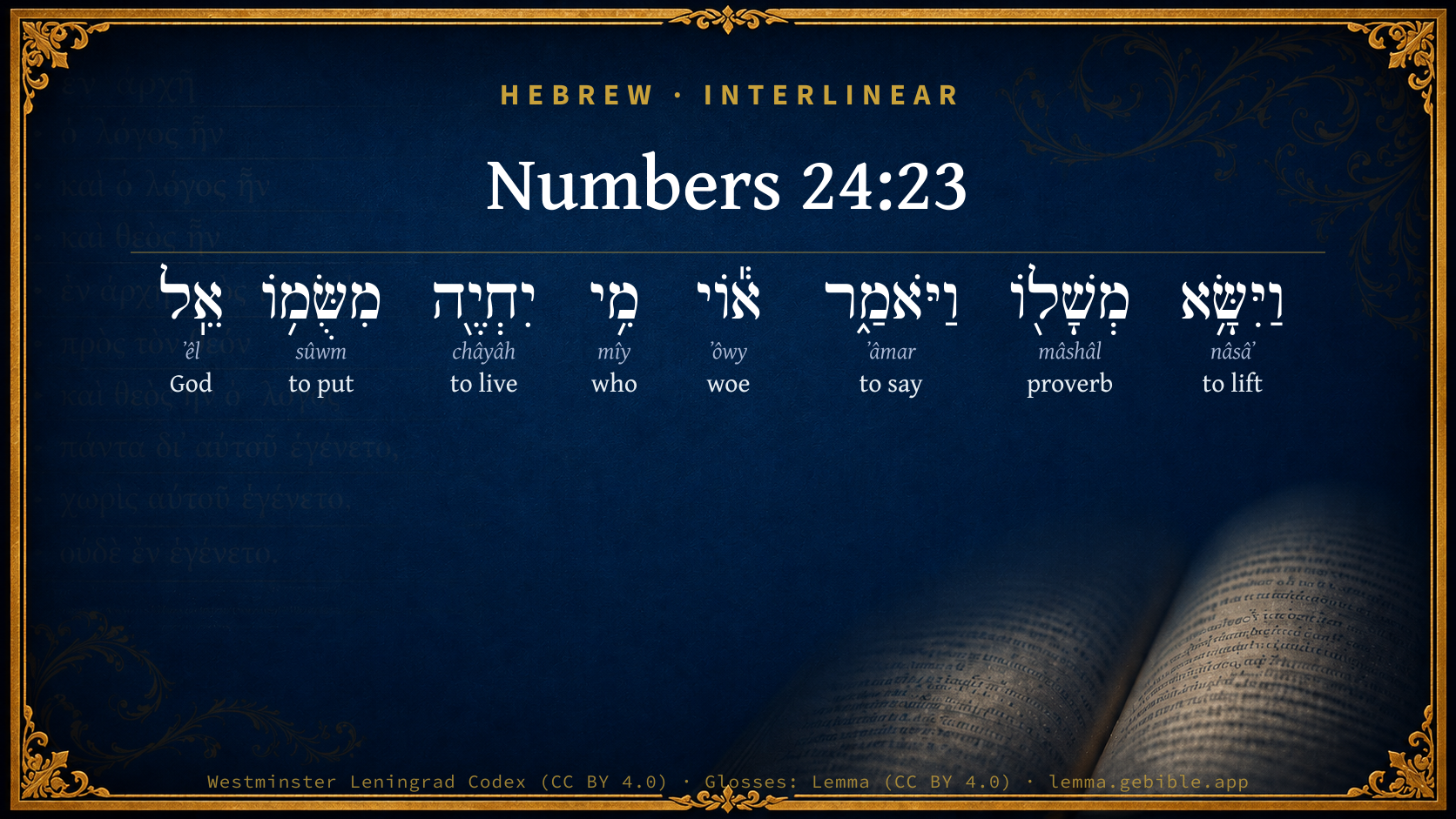
Hebrew (Westminster Leningrad Codex) Numbers 24:23 appears in the Hebrew Old Testament. The text above is from the Westminster Leningrad Codex. Each word links to its Strong’s number, a concise gloss, and parsing drawn from the Open Scriptures Hebrew Bible morphology. Click any word for its full Brown-Driver-Briggs (BDB) entry.
Download image
Cite this verse

Numbers 24:23 (World English Bible). Public Domain. Lemma interlinear Bible study tool, https://lemma.gebible.app/v/numbers/24/23.

Show BibTeX & RIS
BibTeX
RIS
English Translation
He took up his parable, and said, Alas, who shall live when God does this?
World English Bible · Public Domain
Download a study sheet

One document with this verse’s original text, its word-by-word gloss line, the meaning frame, cross-references with their text, attributed commentary, and full source and license credits — printable, and it pastes into notes with its structure intact.

This verse Autodidact and up

Study sheet (.html) Plain text (.txt)

A passage Seminary Student

Up to 50 verses in one chapter. A passage sheet keeps up to 6 commentary sources and 12 cross-references per verse, in the order this page ranks them, and says so on the sheet whenever that leaves anything out. Ask for a single verse and you get the Autodidact verse sheet above.

Everything on this page stays free to read, with no account — the sheet is a download of what is already on screen, not access to it.

Want to remove ads? Support Godless Engineer
Compare translations 3

The same verse in 3 English versions, stacked beneath the original-language interlinear above. Click any original word for its lexicon entry.

Each is an independent rendering of the whole verse — the interlinear is not word-aligned to these translations.

Highlighted words mark where these versions differ — a whole-verse word diff, not a word-by-word alignment.

  • World English Bible Public Domain
    He took up his parable, and said, Alas, who shall live when God does this?
  • King James Version Public Domain
    And he took up his parable, and said, Alas, who shall live when God doeth this!
  • unfoldingWord Literal Text CC BY-SA 4.0
    And he lifted up his discourse and said, “Woe! Who can live apart from God establishing him?

unfoldingWord Literal Text — © unfoldingWord, licensed CC BY-SA 4.0. Word-aligned USFM3 via Door43 (git.door43.org/unfoldingWord/en_ult).

Versions to compare (up to 4)

3 of 4 selected

Show all 18 translations

Every available English version of this verse, each an independent rendering of the whole verse.

  • World English Bible Public Domain
    He took up his parable, and said, Alas, who shall live when God does this?
  • Berean Standard Bible Public Domain
    Once more Balaam lifted up an oracle, saying: “Ah, who can live unless God has ordained it?
  • Majority Standard Bible Public Domain
    Once more Balaam lifted up an oracle, saying: “Ah, who can live unless God has ordained it?
  • King James Version Public Domain
    And he took up his parable, and said, Alas, who shall live when God doeth this!
  • American Standard Version (1901) Public Domain
    And he took up his parable, and said, Alas, who shall live when God doeth this?
  • Revised Version (1885) Public Domain
    And he took up his parable, and said, Alas, who shall live when God doeth this?
  • Geneva Bible (1599) Public Domain
    Againe he vttered his parable, and sayd, Alas, who shall liue when God doeth this?
  • Douay-Rheims (1899) Public Domain
    And taking up his parable, again he said: Alas, who shall live when God shall do these things?
  • Young's Literal Translation Public Domain
    And he taketh up his simile, and saith: `Alas! who doth live when God doth this?
  • Literal Standard Version CC BY-SA 4.0
    And he takes up his allegory and says: “Woe! Who lives when God does this?
  • Unlocked Literal Bible CC BY-SA 4.0
    Then Balaam began his final prophecy. He said, “Woe! Who will survive when God does this?
  • unfoldingWord Literal Text CC BY-SA 4.0
    And he lifted up his discourse and said, “Woe! Who can live apart from God establishing him?
  • Darby Bible Public Domain
    And he took up his parable, and said, Alas! Who shall live when ùGod doeth this?
  • World Messianic Bible Public Domain
    He took up his parable, and said, “Alas, who shall live when God does this?
  • Webster's Bible Public Domain
    And he took up his parable, and said, Alas, who shall live when God doeth this!
  • Free Bible Version CC BY-SA 4.0
    Then Balaam gave another declaration, saying, “It's a tragedy! Who can survive when God does this?
  • Bible in Basic English Public Domain
    Then he went on with his story and said, But who may keep his life when God does this?
  • JPS Tanakh (1917) Public Domain
    And he took up his parable, and said: Alas, who shall live after God hath appointed him?

Literal Standard Version (2020), Covenant Press — licensed CC BY-SA 4.0. Text via the HelloAO Bible API (eBible.org). Unlocked Literal Bible (unfoldingWord) — licensed CC BY-SA 4.0. Text via the HelloAO Bible API (eBible.org). unfoldingWord Literal Text — © unfoldingWord, licensed CC BY-SA 4.0. Word-aligned USFM3 via Door43 (git.door43.org/unfoldingWord/en_ult). Free Bible Version, Dr. Jonathan Gallagher — licensed CC BY-SA 4.0. Text via the HelloAO Bible API (eBible.org).

Word by word

More ways to search: Search by grammar → Find every occurrence → Compare this word →

Practice this passage: Drill this verse → Learn its vocabulary →

About this verse

These counts appear in no published source. They are computed here, from the morphology-tagged text and Lemma’s own curated glosses. What Lemma adds →

8
words
8
distinct lemmas
Pentateuch
section

Notable vocabulary

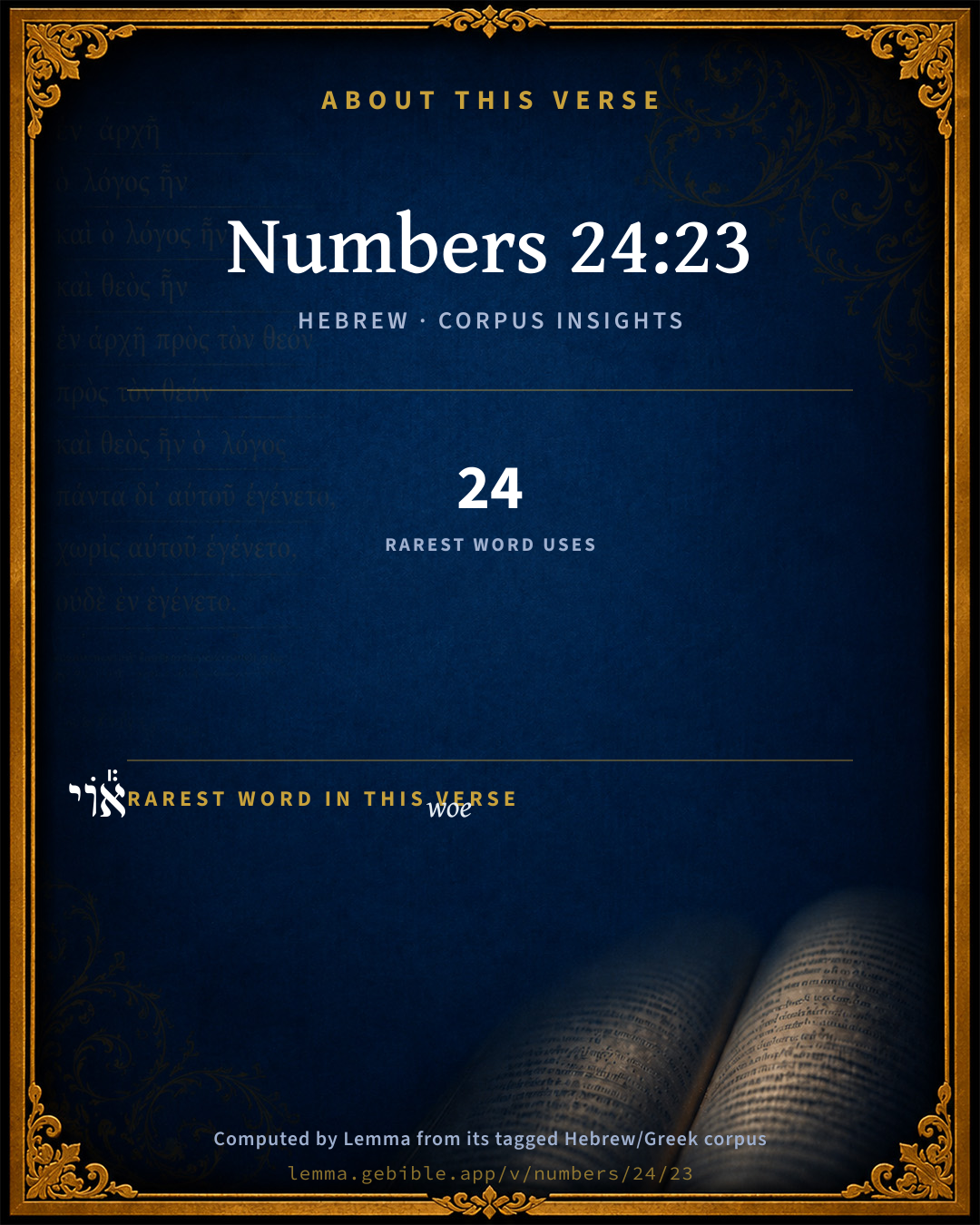
The rarest word here is א֕וֹי woe H188 — appearing just 24 times in the whole Hebrew Bible.

Shared distinctive vocabulary

א֕וֹי woe H188 occurs in 23 verses of the Hebrew Bible. Also found in:

Grammatical profile

  • 4 verbs
  • 2 nouns
  • 2 particles

Verb forms

  • וַיִּשָּׂ֥א Qal · Sequential Imperfect
  • וַיֹּאמַ֑ר Qal · Sequential Imperfect
  • יִחְיֶ֖ה Qal · Imperfect
  • מִשֻּׂמ֥וֹ Qal · Infinitive Construct

Hebrew & Septuagint length

In English translation the verse runs 15 words from the Hebrew and 23 from the Septuagint (LXX English) — the Septuagint runs noticeably longer here. See the side-by-side →

A rough comparison of the two English renderings, which tokenize alike — not a word-level alignment.

Word counts can differ between the Hebrew and the Greek without any difference in meaning — e.g. the Hebrew direct-object marker אֵת has no separate Greek word, and Greek often adds the article ὁ.

Cross-references

3

Topical passages linked to Numbers 24:23 in the Treasury of Scripture Knowledge — connected by theme and wording, ordered by reader-vote popularity; previews shown in the World English Bible.

  • Numbers 23:23 Surely there is no enchantment with Jacob; Neither is there any divination with Israel: Now shall it be said of Jacob and of Israel, What has God done!
  • 2 Kings 5:1 Now Naaman, captain of the host of the king of Syria, was a great man with his master, and honorable, because by him Yahweh had given victory to Syria: he was also a mighty man of valor, [but he was] a leper.
  • Malachi 3:2 "But who can endure the day of his coming? And who will stand when he appears? For he is like a refiner's fire, and like launderer's soap;

Cross-references courtesy of OpenBible.info (CC BY 4.0).

Hebrew and Greek witnesses Masoretic Hebrew ↔ Greek Septuagint

The same verse in the two great witnesses to the Old Testament, shown verse-for-verse.

Here the Septuagint runs noticeably longer than the Hebrew — LXX2012 (modern English Septuagint) 23 words vs World English Bible 15. A rough length comparison of the two English translations, not a word-level alignment — read both below.

These are two independent witnesses, not word-aligned to each other, and the Septuagint is shown in lemma (dictionary) form.

Hebrew Numbers 24:23 Masoretic · Westminster Leningrad Codex

וַיִּשָּׂ֥א מְשָׁל֖וֹ וַיֹּאמַ֑ר א֕וֹי מִ֥י יִחְיֶ֖ה מִשֻּׂמ֥וֹ אֵֽל

He took up his parable, and said, Alas, who shall live when God does this?

World English Bible · Public Domain

Greek LXX Numbers 24:23 Septuagint · lemma form

καί ὁράω ὁ ωγ καί ἀναλαμβάνω ὁ παραβολή αὐτός εἶπον ὦ ὦ τίς ζάω ὅταν τίθημι οὗτος ὁ θεός

And he looked upon Og, and took up his parable and said, Oh, oh, who shall live, when God shall do these things?

LXX2012 (modern English Septuagint) · Public Domain

On this verse, John Gill's Exposition discusses the Septuagint’s reading. Read the note in Commentary ↓

Hebrew: Westminster Leningrad Codex (CC BY 4.0). Greek: Septuagint (public domain); English from LXX2012 (modern English Septuagint) (Public Domain). How the Septuagint differs from the Hebrew →

Targum (Aramaic paraphrase)

2

The Targum is the ancient Jewish Aramaic paraphrase of the Hebrew Scriptures — an interpretive translation, not the Hebrew text itself. Onkelos (literal) and Pseudo-Jonathan (expansive) render the Torah, and Jonathan the Prophets. Coverage is partial: where no permissively-licensed English translation exists for a verse, only the Aramaic is shown. This is verse-level text, not a word-by-word alignment to the Hebrew.

  1. Targum Onkelos Torah (Genesis–Deuteronomy)
    וּנְטַל מַתְלֵיהּ וַאֲמַר וַי לְחַיָיבַיָא דְיֵחוֹן כַּד יַעֲבֵּד אֱלָהָא יָת אִלֵין

    (no public-domain English translation for this verse)

    Targum Onkelos — Aramaic: “Onkelos Genesis” (public domain); “Onkelos Exodus” (public domain); “Onkelos Leviticus” (public domain); “Onkelos Numbers” (public domain); “Onkelos Deuteronomy” (public domain). English: “Sefaria Community Translation” (CC0 1.0 (public-domain dedication)); “J.W. Etheridge. The Targums of Onkelos and Jonathan Ben Uzziel on the Pentateuch. London: Longmans, Green, 1862” (public domain). Text via Sefaria.

  2. Targum Pseudo-Jonathan Torah (Genesis–Deuteronomy)
    וּנְטַל מְתַל נְבוּתֵיהּ וַאֲמַר וַוי מַאן יִתְקְיַים בִּזְמַן דְיִתְגְלֵי מֵימְרָא דַיְיָ לְמִתַּן אֲגַר טַב לְצַדִיקַיָא וּלְמִתְפַּרְעָא מִן רַשִׁיעַיָא וּמְכַתֵּת אוּמַיָא וּמַלְכַיָא וּמְגָרֵי אִלְיֵין בְאִלְיֵין

    And he took up the parable of his prophecy, and said, Woe to them who are alive at the time when the Word of the Lord shall be revealed, to give the good reward to the righteous, and to take vengeance on the wicked, to smite the nations and the kings, and bring these things upon them!

    Targum Pseudo-Jonathan — Aramaic: “Targum Jonathan on Genesis” (public domain); “Targum Jonathan on Exodus” (public domain); “Targum Jonathan on Leviticus” (public domain); “Targum Jonathan on Numbers” (public domain); “Targum Jonathan on Deuteronomy” (public domain). English: “The Targum of Jonathan ben Uzziel, trans. J. W. Etheridge, London, 1862” (public domain). Text via Sefaria.

Commentary

Notes on Numbers 24:23 from classic Christian and Jewish commentators (each source and its license shown beneath its notes). The classic Christian expositions comment on the surrounding passage and are grouped to its opening verse, so a note may address several verses; the Jewish commentaries on the Tanakh (Rashi and others) are per-verse, so they appear only where the commentator wrote on this verse.

Lemma curates 59 commentaries, every one of them public domain or Creative Commons licensed, each selected and text-cleaned for this edition rather than reprinted as found. About our sources →

Trapp's Complete Commentary

John Trapp

Num 24:23 And he took up his parable, and said, Alas, who shall live when God doeth this!

Ver. 23. Who shall live when, &c.] The Assyrian, that rod of God’s wrath, that overflowing scourge, shall take all afore him, shall bereave millions of their lives, as Caesar is said to have done; and of Mohammed, the first Emperor of the Turks, it is storied that he had been in his time the death of eight hundred thousand men {a}

{a} Turk. Hist.

John Trapp, A Commentary or Exposition upon All the Books of the Old and New Testament (1647–1656) — public domain. Text from a community e-Sword module.

Joseph Benson's Commentary

Num 24:23. Alas, who shall live — How calamitous and miserable will the state of the world be, when the Assyrian, and after him the Chaldean, shall overrun and overturn all these parts of the world! Who will be able to keep his heart from fainting under such grievous pressures? Nay, how few will escape the destroying sword!

Joseph Benson's Commentary on the Old and New Testaments (1811–1818) — public domain. Text from a community e-Sword module.

Tyndale Open Study Notes

Tyndale Open Resources

24:23-24 The oracle ends with a word about the rise and fall of invaders from Cyprus (Hebrew Kittim; this term probably referred to a number of Mediterranean people groups; cp. Gen 10:4; Jer 2:10; Dan 11:30).

24:23 This verse, like 22:12, sums up the lesson of the entire incident.

Tyndale Open Study Notes — © Tyndale Open Resources, licensed CC BY-SA 4.0. Text via the HelloAO Bible API.

Geneva Bible (1599)

Geneva Bible translators

Some read, Oh who shall not perish when the enemy that is, Antichrist, shall set himself up as God?

Geneva Bible (1599) marginal notes — public domain. Text via Bolls.life.

Jamieson, Fausset & Brown

Robert Jamieson, A. R. Fausset & David Brown

who shall live when God doeth this!--Few shall escape the desolation that shall send a Nebuchadnezzar to scourge all those regions.

Jamieson, Fausset & Brown — Commentary Critical and Explanatory on the Whole Bible (1871) — public domain (CC PDM 1.0). Text via the HelloAO Bible API.

Adam Clarke's Commentary

Verse 23. Who shall live when God doeth this!] There are two senses in which these words may be taken: -

1. That the event is so distant that none then alive could possibly live to see it.

2. That the times would be so distressing and desolating that scarcely any should be able to escape.

The words are very similar to those of our Lord, and probably are to be taken in the same sense: "Wo to them that are with child, and to them that give suck in those days."

Adam Clarke's Commentary on the Bible (1810–1826) — public domain. Text from a community e-Sword/MySword module.

Ellicott's Commentary for English Readers

(23) When God doeth this.—These words may be rendered, since (or, from the time that) God sets (or, determines) it (or, this)—quando faciet ista Deus (Vulgate); or, because God determines it (or, this).

A Bible Commentary for English Readers, edited by Charles John Ellicott (1878–1897) — public domain. Text from a community e-Sword module.

The Cambridge Bible for Schools and Colleges

gen. ed. J. J. S. Perowne

23. when God doeth this] The only rendering which the words will bear is ‘on account of God appointing him.’ If Num_24:21-24 were all one poem, as some think, ‘him’ might refer to Asshur, appointed by God as an instrument of destruction.

23, 24. Balaam’s last prophetic message. This is the most obscure of all the poems. The translation is uncertain, and no historical event is known to which the words can refer.

Kittim, derived from Kitti a town in Cyprus, was a name used for Greece; cf. Gen_10:4 (where Kittim is reckoned as a son of Javan, i.e. Greece), 1Ma_1:1; 1Ma_8:5; it was also used sometimes for the Western maritime powers generally; cf. Jer_2:10, Eze_27:6. In Dan_11:30 it is even referred to the Romans; cf. Vulg. ‘Italia’ in the present passage.

The Cambridge Bible for Schools and Colleges (gen. ed. J. J. S. Perowne; Cambridge University Press, 1878–1918) — public domain. Text from a community e-Sword module.

John Gill's Exposition

And ships shall come from the coast of Chittim,.... Kittim was the son of Javan, Gen 10:4 and so designs some part of Greece: Josephus (r) says that Kittim possessed the island now called Cyprus, in which was a city now called Citium, after his name; Macedonia, a considerable part of Greece, is called the land of Cittim,"And it happened, after that Alexander son of Philip, the Macedonian, who came out of the land of Chettiim, had smitten Darius king of the Persians and Medes, that he reigned in his stead, the first over Greece,'' (1 Maccabees 1:1)"Beside this, how they had discomfited in battle Philip, and Perseus, king of the Citims, with others that lifted up themselves against them, and had overcome them:'' (1 Maccabees 8:5)but the Targum of Jonathan interprets it, of the country of Italy; the Jerusalem Targum, of the Roman legions; and perhaps both Greeks and Romans are intended, and so ships from Cittim, in Dan 11:30, design Romans in Grecian ships; for in such were the Roman ambassadors carried, who distressed Antiochus, king of Syria; see Gill on Dan 11:30; and both may be intended here: it is affirmed (s) that Noah with his son Japheth, came into the country now called Italy, and built a city, and gave it the name of Cethim, since called Volterra, and was the metropolis of Etruria, and gave name to all Italy; and that in the year two hundred and twenty from the building of that city, Cethim the son of Javan, and grandson of Noah, took two colonies with him, and sailed to an island which he called after his own name Cethim, now Cyprus:

and shall afflict Ashur; which being a part of the Persian empire, was afflicted, conquered, and subdued by Alexander the Macedonian, who is said to come out of the land of Cittim,"And it happened, after that Alexander son of Philip, the Macedonian, who came out of the land of Chettiim, had smitten Darius king of the Persians and Medes, that he reigned in his stead, the first over Greece,'' (1 Maccabees 1:1)

and shall afflict Eber; or the Hebrews, as the Septuagint version; not that the Grecians or Macedonians should do this, for they under Alexander did not afflict the Jews; unless this is to be understood of the Seleucidae, the kings of Syria, the successors of Alexander, who did distress the Jews; but rather this respects the Romans under Pompey, and especially under Titus Vespasian, who destroyed their city, and carried them captive, and who ever since have been dispersed among the nations:

and he also shall perish for ever: not Eber, but those that afflicted him, even the Romans; and indeed both monarchies, Grecian and Roman, are prophesied of as what should be destroyed, and that by a son of Eber, the Messiah; the stone cut out of the mountain without hands, said to break in pieces all these kingdoms, Dan 2:44 and not Rome Pagan only, but Rome Papal also, antichrist and all the antichristian powers, Th2 2:8. and so the Targum of Jonathan says, that the end both of the one and the other, that is, that shall afflict Eber, shall be, to fall by the hand of the King Messiah, and they shall perish for ever.

(r) Antiqu. l. 1. c. 6. sect. 1. (s) Inghiram. Etrusc. Antiqu. apud Dickinson. Delph. Phaenic. Append. p. 153. Vid. p. 77.

John Gill's Exposition of the Whole Bible (1746–1763) — public domain (CC PDM 1.0). Text via the HelloAO Bible API.

Albert Barnes' Notes on the Bible

When God doeth this - The eventual carrying away of the allies of Israel by Assyria presented itself to Balaam as the ruin of all peace and safety upon earth. One prediction was howerer, yet wanting, and is next given, namely, that the conquerors of the Kenites should fare no better than the Kenites themselves.

Albert Barnes' Notes on the Bible (1834–1885) — public domain. Text from a community e-Sword/MySword module.

Haydock's Catholic Bible Commentary

Things, of which he is about to speak. The time is remote, but very dreadful, when the Assyrians shall be chastised, in their turn, as well as the Greeks and Romans, who shall have destroyed Assur, and even the most favourite nation of God. Balaam began by announcing the prosperity of the Hebrews, but he at last gives some comfort to Balac, by letting him know that they shall also be laid waste, as well as his kingdom, and the powerful nations around him. This is the condition of all human things! (Haydock)

George Leo Haydock (1774–1849), Haydock's Catholic Family Bible and Commentary, 1859 edition — public domain. Excludes Psalms (Douay-Rheims chapter numbering differs from Protestant) and Deuterocanonical books (Catholic canon only).

Matthew Poole's English Annotations

How calamitous and miserable will the state of the world be, when the Assyrian, and after him the Chaldean, shall overrun and overturn all these parts of the world! who will be able to live and keep his heart from fainting under such grievous pressures? how few will then escape the destroying sword!

Matthew Poole's English Annotations on the Holy Bible (1683–1685) — public domain. Text from a community e-Sword/MySword module.

Whedon's Commentary on the Bible

Daniel D. Whedon

23, 24. Alas, who shall live — The woe touches the heart of Balaam because his own Mesopotamia is involved in the fearful judgment. See Num_22:5.

Chittim — Signifies (1) the island of Cyprus, (Isa_23:1;) (2) the Chittim islands, denoting the islands and coasts of the West, (Jer_2:10;) and (3) Macedonia and Italy. Dan_11:30. Keil seems to combine all these meanings, since all the Western ships took Cyprus in their way. “The nations that would come across the sea from the side of Cyprus to humble Asshur are not mentioned by name, because this lay beyond the range of Baalam’s vision.”

Eber — The Seventy and Vulgate, Hebrews. Evidently all the posterity of Eber through Abraham.

He also shall perish forever — The conquering power from the West. Dan_7:26. “The judgment of history even upon the imperial powers of the West, and the final victory of the King of the kingdom of God were proclaimed, though in fading outlines, more than a thousand years before the events themselves.” — Tholuck. “So it came to pass when the ships of Cyprus, of Greece, of Europe, then just seen in the horizon of human hopes and fears, did at last, under the Macedonian conqueror, turn the tide of Eastern invasion backward; and Asshur and Babylon and Persia, no less than the wild hordes of the desert, perished forever from the earth.” — Stanley.

Daniel D. Whedon (gen. ed.), Commentary on the Old and New Testaments (1874–1909) — public domain. Text from a community e-Sword module.

The Pulpit Commentary

When God doeth this. Literally, "from the settling of it by God." lae wOmCumi, i.e., when God shall bring these terrible things to pass. Septuagint, otan yh tauta o yeov . This exclamation refers to the woe which he is about to pronounce, which involved his own people also.

The Pulpit Commentary (1880–1919), ed. H.D.M. Spence-Jones & Joseph S. Exell — public domain. Text from a community e-Sword module.

John Wesley's Explanatory Notes

Who shall live - How calamitous and miserable will the state of the world be, when the Assyrian, and after him the Chaldean, shall over-turn all these parts of the world? Who will be able to keep his heart from fainting under such grievous pressures? Nay, how few will escape the destroying sword?

John Wesley, Explanatory Notes Upon the Whole Bible (1754–1765) — public domain. Text via the GEBible commentary corpus.

Keil & Delitzsch

C. F. Keil & F. Delitzsch

The fourth saying applies to Asshur, and is introduced by an exclamation of woe: "Woe! who will live, when God sets this! and ships (come) from the side of Chittim, and press Asshur, and press Eber, and he also perishes." The words "Woe, who will live," point to the fearfulness of the following judgment, which went deep to the heart of the seer, because it would fall upon the sons of his own people (see at Num 22:5). The meaning is, "Who will preserve his life in the universal catastrophe that is coming?" (Hengstenberg). משּׂמו, either "since the setting of it," equivalent to "from the time when God sets (determines) this" (ὅταν θῇ ταῦτα ὁ Θεός, quando faciet ista Deus; lxx, Vulg.), or "on account of the setting of it," i.e., because God determines this. שׂוּם, to set, applied to that which God establishes, ordains, or brings to pass, as in Isa 44:7; Hab 1:12. The suffix in שׂוּמו is not to be referred to Asshur, as Knobel supposes, because the prophecy relates not to Asshur "as the mighty power by which everything was crushed and overthrown," but to a power that would come from the far west and crush Asshur itself. The suffix refers rather to the substance of the prophecy that follows, and is to be understood in a neuter sense. אל is "God," and not an abbreviation of אלּה, which is always written with the article in the Pentateuch (האל, Gen 19:8, Gen 19:25; Gen 26:3-4; Lev 18:27; Deu 4:42; Deu 7:22; Deu 19:11), and only occurs once without the article, viz., in Ch1 20:8. צים, from צי (Isa 33:21), signifies ships, like ציּים in the passage in Dan 11:30, which is founded upon the prophecy before us. מיּד, from the side, as in Exo 2:5; Deu 2:37, etc. כּתּים is Cyprus with the capital Citium (see at Gen 10:4), which is mentioned as intervening between Greece and Phoenicia, and the principal station for the maritime commerce of Phoenicia, so that all the fleets passing from the west to the east necessarily took Cyprus in their way (Isa 23:1). The nations that would come across the sea from the side of Cyprus to humble Asshur, are not mentioned by name, because this lay beyond the range of Balaam's vision. He simply gives utterance to the thought, "A power comes from Chittim over the sea, to which Asshur and Eber, the eastern and the western Shem, will both succumb" (v. Hoffmann). Eber neither refers to the Israelites merely as Hebrews (lxx, Vulg.), nor to the races beyond the Euphrates, as Onkelos and others suppose, but, like "all the sons of Eber" in Gen 10:21, to the posterity of Abraham who descended from Eber through Peleg, and also to the descendants of Eber through Joktan: so that Asshur, as the representative of the Shemites who dwelt in the far east, included Elam within itself; whilst Eber, on the other hand, represented the western Shemites, the peoples that sprang from Arphaxad, Lud, and Aram (Gen 10:21). "And he also shall perish for ever:" these words cannot relate to Asshur and Eber, for their fate is already announced in the word ענּוּ (afflict, press), but only to the new western power that was to come over the sea, and to which the others were to succumb. "Whatever powers might rise up in the world of peoples, the heathen prophet of Jehovah sees them all fall, one through another, and one after another; for at last he loses in the distance the power to discern whence it is that the last which he sees rise up is to receive its fatal blow" (v. Hoffmann, p. 520). The overthrow of this last power of the world, concerning which the prophet Daniel was the fist to receive and proclaim new revelations, belongs to "the end of the days," in which the star out of Jacob is to rise upon Israel as a "bright morning star" (Rev 22:16).

Now if according to this the fact is firmly established, that in this last prophecy of Balaam, "the judgment of history even upon the imperial powers of the West, and the final victory of the King of the kingdom of God were proclaimed, though in fading outlines, more than a thousand years before the events themselves," as Tholuck has expressed it in his Propheten und ihre Weissagung; the announcement of the star out of Jacob, and the sceptre out of Israel, i.e., of the King and Ruler of the kingdom of God, who was to dash Moab to pieces and take possession of Edom, cannot have received its complete fulfilment in the victories of David over these enemies of Israel; but will only be fully accomplished in the future overthrow of all the enemies of the kingdom of God. By the "end of days," both here and everywhere else, we are to understand the Messianic era, and that not merely at its commencement, but in its entire development, until the final completion of the kingdom of God at the return of our Lord to judgment. In the "star out of Jacob," Balaam beholds not David as the one king of Israel, but the Messiah, in whom the royalty of Israel promised to the patriarchs (Gen 17:6, Gen 17:16; Gen 35:11) attains its fullest realization. The star and sceptre are symbols not of "Israel's royalty personified" (Hengstenberg), but of the real King in a concrete form, as He was to arise out of Israel at a future day. It is true that Israel received the promised King in David, who conquered and subjugated the Moabites, Edomites, and other neighbouring nations that were hostile to Israel. But in the person of David and his rule the kingly government of Israel was only realized in its first and imperfect beginnings. Its completion was not attained till the coming of the second David (Hos 3:5; Jer 30:9; Eze 34:24; Eze 37:24-25), the Messiah Himself, who breaks in pieces all the enemies of Israel, and founds an everlasting kingdom, to which all the kingdoms and powers of this world are to be brought into subjection (Sa2 7:12-16; Psa 2:1; 72, and Psa 110:1-7).

(Note: The application of the star out of Jacob to the Messiah is to be found even in Onkelos; and this interpretation was so widely spread among the Jews, that the pseudo-Messiah who arose under Hadrian, and whom even R. Akiba acknowledged, took the name of Bar Cochba (son of a star), on consequence of this prophecy, from which the nickname of Bar Coziba (son of a lie) was afterward formed, when he had submitted to the Romans, with all his followers. In the Christian Church also the Messianic explanation was the prevalent one, from the time of Justin and Irenaeus onwards (see the proofs in Calovii Bibl. ad h. l.), although, according to a remark of Theodoret (qu. 44 ad Num.), there were some who did not adopt it. The exclusive application of the passage to David was so warmly defended, first of all by Grotius, and still more by Verschuir, that even Hengstenberg and Tholuck gave up the Messianic interpretation. But they both of them came back to it afterwards, the former in his "Balaam" and the second edition of his Christology, and the latter in his treatise on "the Prophets." At the present time the Messianic character of the prophecy is denied by none but the supporters of the more vulgar rationalism, such as Knobel and others; whereas G. Baur (in his History of Old Testament Prophecy) has no doubt that the prediction of the star out of Jacob points to the exalted and glorious King, filled with the Holy Spirit, whom Isaiah (Isa 9:5; Isa 11:1.) and Micah (Mic 5:2) expected as the royal founder of the theocracy. Reinke gives a complete history of the interpretation of this passage in his Beitrge, iv. 186ff.)

If, however, the star out of Jacob first rose upon the world in Christ, the star which showed the wise men from the east the way to the new-born "King of the Jews," and went before them, till it stood above the manger at Bethlehem (Mat 2:1-11), is intimately related to our prophecy. Only we must not understand the allusion as being so direct, that Balaam beheld the very star which appeared to the wise men, and made known to them the birth of the Saviour of the world. The star of the wise men was rather an embodiment of the star seen by Balaam, which announced to them the fulfilment of Balaam's prophecy, - a visible sign by which God revealed to them the fact, that the appearance of the star which Balaam beheld in the far distant future had been realized at Bethlehem in the birth of Christ, the King of the Jews. - The "wise men from the east," who had been made acquainted with the revelations of God to Israel by the Jews of the diaspora, might feel themselves specially attracted in their search for the salvation of the world by the predictions of Balaam, from the fact that this seer belonged to their own country, and came "out of the mountains of the east" (Num 23:7); so that they made his sayings the centre of their expectations of salvation, and were also conducted through them to the Saviour of all nations by means of supernatural illumination. "God unfolded to their minds, which were already filled with a longing for the 'star out of Jacob' foretold by Balaam, the meaning of the star which proclaimed the fulfilment of Balaam's prophecy; He revealed to them, that is to say, the fact that it announced the birth of the 'King of the Jews.' And just as Balaam had joyously exclaimed, 'I see Him,' and 'I behold Him,' they also could say, 'We have seen His star' " (Hengstenberg).

If, in conclusion, we compare Balaam's prophecy of the star that would come out of Jacob, and the sceptre that would rise out of Israel, with the prediction of the patriarch Jacob, of the sceptre that should not depart from Judah, till the Shiloh came whom the nations would obey (Gen 49:10), it is easy to observe that Balaam not only foretold more clearly the attitude of Israel to the nations of the world, and the victory of the kingdom of God over every hostile kingdom of the world; but that he also proclaimed the Bringer of Peace expected by Jacob at the end of the days to be a mighty ruler, whose sceptre would break in pieces and destroy all the enemies of the nation of God. The tribes of Israel stood before the mental eye of the patriarch in their full development into the nation in which all the families of the earth were to be blessed. From this point of view, the salvation that was to blossom in the future for the children of Israel culminated in the peaceful kingdom of the Shiloh, in whom the dominion of the victorious lion out of Judah was to attain its fullest perfection. But the eye of Balaam, the seer, which had been opened by the Spirit of God, beheld the nation of Israel encamped, according to its tribes, in the face of its foes, the nations of this world. They were endeavouring to destroy Israel; but according to the counsel of the Almighty God and Lord of the whole world, in their warfare against the nation that was blessed of Jehovah, they were to succumb one after the other, and be destroyed by the king that was to arise out of Israel. This determinate counsel of the living God was to be proclaimed by Balaam, the heathen seer out of Mesopotamia the centre of the national development of the ancient world: and, first of all, to the existing representatives of the nations of the world that were hostile to Israel, that they might see what would at all times tend to their peace - might see, that is to say, that in their hostility to Israel they were rebelling against the Almighty God of heaven and earth, and that they would assuredly perish in the conflict, since life and salvation were only to be found with the people of Israel, whom God had blessed. And even though Balaam had to make known the purpose of the Lord concerning His people primarily, and in fact solely, to the Moabites and their neighbours, who were like-minded with them, his announcement was also intended for Israel itself, and was to be a pledge to the congregation of Israel for all time of the certain fulfilment of the promises of God; and so to fill them with strength and courage, that in all their conflicts with the powers of this world, they should rely upon the Lord their God with the firmest confidence of faith, should strive with unswerving fidelity after the end of their divine calling, and should build up the kingdom of God on earth, which is to outlast all the kingdoms of the world. - In what manner the Israelites became acquainted with the prophecies of Balaam, so that Moses could incorporate them into the Thorah, we are nowhere told, but we can infer it with tolerable certainty from the subsequent fate of Balaam himself.

Keil & Delitzsch — Biblical Commentary on the Old Testament (1861–1891) — public domain (CC PDM 1.0). Text via the HelloAO Bible API. (Old Testament only.)

unfoldingWord translationNotes

Door43 World Missions Community

Who will survive when God does this?

This rhetorical question can be translated as a statement. AT: "No one will survive when God does this!" (See: Rhetorical Question)

Kittim

This is the name of a city on an island in the Mediterranean Sea. (See: How to Translate Names)

they, too, will end in destruction

The abstract noun "destruction" can be stated as an action. AT: "God will destroy them also" (See: Abstract Nouns)

translationWords

woe

unfoldingWord translationNotes — © Distant Shores Media and the Door43 World Missions Community, licensed CC BY-SA 4.0. Source: git.door43.org/Door43/en_tn.

Rashi

Rabbi Shlomo Yitzchaki (Rashi)

וישא משלו וגו׳ AND HE TOOK UP HIS PARABLE etc. — Because he mentioned the captivity into Assyria he exclaimed, אוי מי יחיה משמו אל, who is able to save himself alive, so that He who decrees (God) should not place upon him (משמו) these things (אל, the equivalent of אלה) — for Sannacherib, king of Assyria, shall rise up and bring all the nations into confusion. And further, there will come —

Rashi on the Tanakh — English translations: “The Judaica Press complete Tanach with Rashi, translated by A. J. Rosenberg” (CC BY 4.0); “Pentateuch with Rashi's commentary by M. Rosenbaum and A.M. Silbermann, 1929-1934” (public domain); “The Metsudah Tanach series, Lakewood, N.J” (CC BY 4.0); and “The Book of Joshua, Metsudah Publications, 1997” (CC BY 4.0). Text via Sefaria.

Lesson kit

Teaching starters — assembled from the data on this page, not authored interpretation. Every prompt links to the verse data it draws on. Edit before teaching.

Numbers, in the Pentateuch, opens this verse with 8 words (8 distinct Hebrew lemmas). Its most distinctive word is ʼôwy (“woe”). The Greek Septuagint runs longer here. A historical commentator’s framing appears above. Read the whole chapter for the surrounding context.

Discussion questions

  1. The word ʼôwy carries the sense “woe.” How does it shape the verse?
  2. How does Numbers 21:29, which shares the word «woe», read alongside this verse?
  3. The Septuagint runs longer here than the Hebrew. What might account for the difference?
  4. These translations render this verse differently. What is at stake in choosing one wording over another?
  5. «וַיִּשָּׂ֥א» is a Qal Sequential Imperfect verb. How does that grammatical form shape the action described?
  6. Compare how Trapp's Complete Commentary and Joseph Benson's Commentary read this verse. Where do they agree or differ?

Things to notice

Reading settings

Reading text

Shown beneath each verse's original-language words.

Old Testament
Old Testament edition

Read the OT as the Masoretic Hebrew (MT) or the Greek Septuagint (LXX).

English shown for the Greek Septuagint (in the Hebrew ↔ Greek comparison).

Comparing translations? Open the Compare panel on any verse page to stack up to four side by side.