
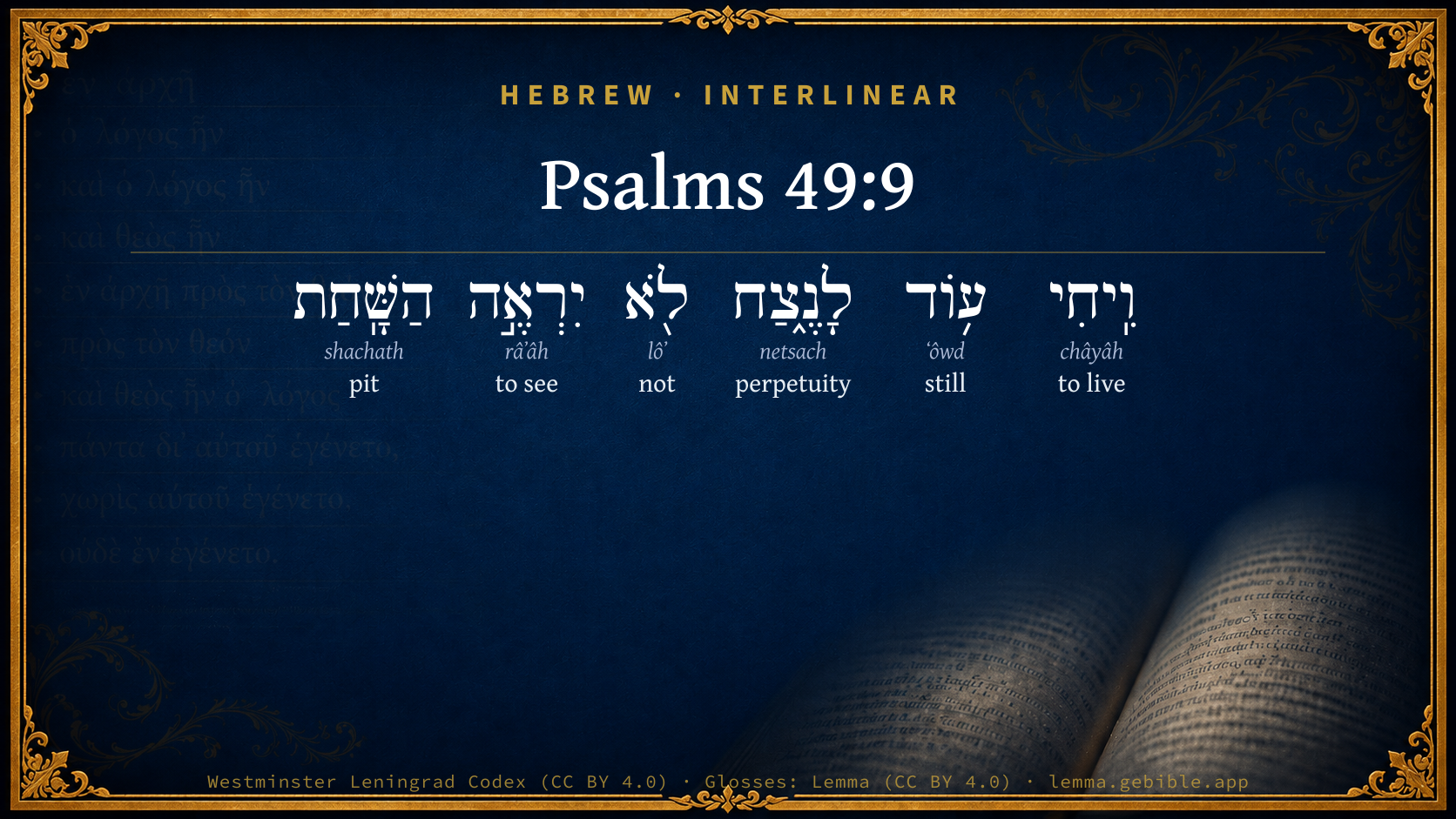
Psalms 49:9

Hebrew (Westminster Leningrad Codex) Psalms 49:9 appears in the Hebrew Old Testament. The text above is from the Westminster Leningrad Codex. Each word links to its Strong’s number, a concise gloss, and parsing drawn from the Open Scriptures Hebrew Bible morphology. Click any word for its full Brown-Driver-Briggs (BDB) entry.
Download image
Cite this verse

Psalms 49:9 (World English Bible). Public Domain. Lemma interlinear Bible study tool, https://lemma.gebible.app/v/psalms/49/9.

Show BibTeX & RIS
BibTeX
RIS
English Translation
That he should live on forever, That he should not see corruption.
World English Bible · Public Domain
Download a study sheet

One document with this verse’s original text, its word-by-word gloss line, the meaning frame, cross-references with their text, attributed commentary, and full source and license credits — printable, and it pastes into notes with its structure intact.

This verse Autodidact and up

Study sheet (.html) Plain text (.txt)

A passage Seminary Student

Up to 50 verses in one chapter. A passage sheet keeps up to 6 commentary sources and 12 cross-references per verse, in the order this page ranks them, and says so on the sheet whenever that leaves anything out. Ask for a single verse and you get the Autodidact verse sheet above.

Everything on this page stays free to read, with no account — the sheet is a download of what is already on screen, not access to it.

Want to remove ads? Support Godless Engineer
Compare translations 3

The same verse in 3 English versions, stacked beneath the original-language interlinear above. Click any original word for its lexicon entry.

Each is an independent rendering of the whole verse — the interlinear is not word-aligned to these translations.

Highlighted words mark where these versions differ — a whole-verse word diff, not a word-by-word alignment.

  • World English Bible Public Domain
    That he should live on forever, That he should not see corruption.
  • King James Version Public Domain
    That he should still live for ever, and not see corruption.
  • unfoldingWord Literal Text CC BY-SA 4.0
    that one should live on forever, one should not see the pit.

unfoldingWord Literal Text — © unfoldingWord, licensed CC BY-SA 4.0. Word-aligned USFM3 via Door43 (git.door43.org/unfoldingWord/en_ult).

Versions to compare (up to 4)

3 of 4 selected

Show all 18 translations

Every available English version of this verse, each an independent rendering of the whole verse.

  • World English Bible Public Domain
    That he should live on forever, That he should not see corruption.
  • Berean Standard Bible Public Domain
    that he should live on forever and not see decay.
  • Majority Standard Bible Public Domain
    that he should live on forever and not see decay.
  • King James Version Public Domain
    That he should still live for ever, and not see corruption.
  • American Standard Version (1901) Public Domain
    That he should still live alway, That he should not see corruption.
  • Revised Version (1885) Public Domain
    That he should still live alway, that he should not see corruption.
  • Geneva Bible (1599) Public Domain
    That he may liue still for euer, and not see the graue.
  • Douay-Rheims (1899) Public Domain
    Nor the price of the redemption of his soul: and shall labour for ever,
  • Young's Literal Translation Public Domain
    And still he liveth for ever, He seeth not the pit.
  • Literal Standard Version CC BY-SA 4.0
    And still he lives forever, || He does not see the pit.
  • Unlocked Literal Bible CC BY-SA 4.0
    No one can live forever so that his body should not decay.
  • unfoldingWord Literal Text CC BY-SA 4.0
    that one should live on forever, one should not see the pit.
  • Darby Bible Public Domain
    That he should still live perpetually, [and] not see corruption.
  • World Messianic Bible Public Domain
    that he should live on forever, that he should not see corruption.
  • Webster's Bible Public Domain
    \\49:8\\(For the redemption of their soul is precious, and it ceaseth for ever:)
  • Free Bible Version CC BY-SA 4.0
    that they could live forever and not face the grave.
  • Bible in Basic English Public Domain
    So that he might have eternal life, and never see the underworld.
  • JPS Tanakh (1917) Public Domain
    (49-10) That he should still live alway, that he should not see the pit.

Literal Standard Version (2020), Covenant Press — licensed CC BY-SA 4.0. Text via the HelloAO Bible API (eBible.org). Unlocked Literal Bible (unfoldingWord) — licensed CC BY-SA 4.0. Text via the HelloAO Bible API (eBible.org). unfoldingWord Literal Text — © unfoldingWord, licensed CC BY-SA 4.0. Word-aligned USFM3 via Door43 (git.door43.org/unfoldingWord/en_ult). Free Bible Version, Dr. Jonathan Gallagher — licensed CC BY-SA 4.0. Text via the HelloAO Bible API (eBible.org).

Word by word

More ways to search: Search by grammar → Find every occurrence → Compare this word →

Practice this passage: Drill this verse → Learn its vocabulary →

About this verse

These counts appear in no published source. They are computed here, from the morphology-tagged text and Lemma’s own curated glosses. What Lemma adds →

6
words
6
distinct lemmas
Wisdom
section

Notable vocabulary

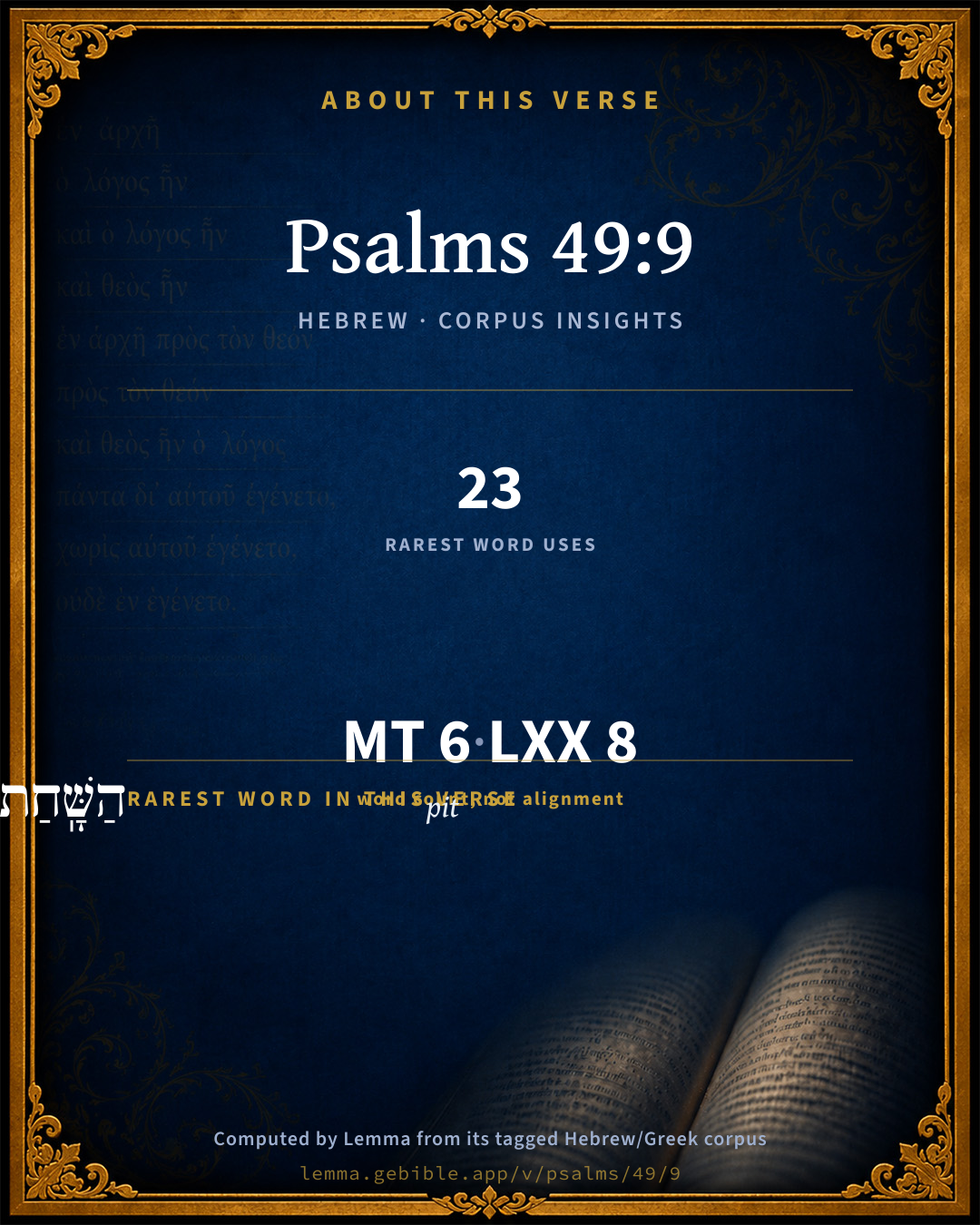
The rarest word here is הַשָּֽׁחַת pit H7845 — appearing just 23 times in the whole Hebrew Bible.

Shared distinctive vocabulary

הַשָּֽׁחַת pit H7845 occurs in 23 verses of the Hebrew Bible. Also found in:

Grammatical profile

  • 2 verbs
  • 2 nouns
  • 1 adverb
  • 1 particle

Verb forms

  • וִֽיחִי Qal · Jussive
  • יִרְאֶ֣ה Qal · Imperfect

Hebrew & Septuagint length

In English translation the verse runs 12 words from the Hebrew and 12 from the Septuagint (LXX English) — the same length.

A rough comparison of the two English renderings, which tokenize alike — not a word-level alignment.

Word counts can differ between the Hebrew and the Greek without any difference in meaning — e.g. the Hebrew direct-object marker אֵת has no separate Greek word, and Greek often adds the article ὁ.

In the original languages it is 6 Hebrew tokens and 8 Greek tokens — but the two are counted differently (Hebrew bundles its prefixes and suffixes into one token; the Greek is in lemma form), so that isn’t a like-for-like length.

Cross-references

13

Topical passages linked to Psalms 49:9 in the Treasury of Scripture Knowledge — connected by theme and wording, ordered by reader-vote popularity; previews shown in the World English Bible.

  • Psalms 89:48 What man is he who shall live and not see death, Who shall deliver his soul from the power of Sheol? Selah.
  • Psalms 16:10 For you will not leave my soul in Sheol, Neither will you allow your holy one to see corruption.
  • Ecclesiastes 8:8 There is no man who has power over the spirit to contain the spirit; neither does he have power over the day of death. There is no discharge in war; neither shall wickedness deliver those who practice it.
  • Proverbs 10:2 Treasures of wickedness profit nothing, But righteousness delivers from death.
  • Proverbs 11:4 Riches don't profit in the day of wrath, But righteousness delivers from death.
  • John 8:51–52 Most assuredly, I tell you, if a person keeps my word, he will never see death."
  • Acts 2:27 Because you will not leave my soul in Hades, Neither will you allow your Holy One to see decay.
  • Psalms 22:29 All the rich ones of the earth shall eat and worship. All those who go down to the dust shall bow before him, Even he who can't keep his soul alive.
  • Zechariah 1:5 Your fathers, where are they? And the prophets, do they live forever?
  • Luke 16:22–23 It happened that the beggar died, and that he was carried away by the angels to Abraham's bosom. The rich man also died, and was buried.
  • Acts 2:31 he foreseeing this spoke about the resurrection of the Christ, that neither was his soul left in Hades, nor did his flesh see decay.
  • Acts 13:33 that God has fulfilled the same to us, their children, in that he raised up Jesus. As it is also written in the second psalm, 'You are my Son. Today I have become your father.'
  • Acts 13:35–37 Therefore he says also in another psalm, 'You will not allow your Holy One to see decay.'

Cross-references courtesy of OpenBible.info (CC BY 4.0).

Hebrew and Greek witnesses Masoretic Hebrew ↔ Greek Septuagint

The same verse in the two great witnesses to the Old Testament, shown verse-for-verse.

You’re reading Greek Psalm 48 (Hebrew Psalm 49). The Septuagint counts the superscription, so verse numbers can differ from the Hebrew — chapter-level alignment, not verse-by-verse. Numbering follows Rahlfs.

These are two independent witnesses, not word-aligned to each other, and the Septuagint is shown in lemma (dictionary) form.

Hebrew Psalms 49:9 Masoretic · Westminster Leningrad Codex

וִֽיחִי ע֥וֹד לָנֶ֑צַח לֹ֖א יִרְאֶ֣ה הַשָּֽׁחַת

That he should live on forever, That he should not see corruption.

World English Bible · Public Domain

Greek LXX Greek Psalm 48:9 Septuagint · lemma form

καί ὁ τιμή ὁ λύτρωσις ὁ ψυχή αὐτός

and live to the end, so that he should not see corruption.

LXX2012 (modern English Septuagint) · Public Domain

Hebrew: Westminster Leningrad Codex (CC BY 4.0). Greek: Septuagint (public domain); English from LXX2012 (modern English Septuagint) (Public Domain). How the Septuagint differs from the Hebrew →

Commentary

Notes on Psalms 49:9 from classic Christian and Jewish commentators (each source and its license shown beneath its notes). The classic Christian expositions comment on the surrounding passage and are grouped to its opening verse, so a note may address several verses; the Jewish commentaries on the Tanakh (Rashi and others) are per-verse, so they appear only where the commentator wrote on this verse.

Lemma curates 59 commentaries, every one of them public domain or Creative Commons licensed, each selected and text-cleaned for this edition rather than reprinted as found. About our sources →

Trapp's Complete Commentary

John Trapp

Psa 49:9 That he should still live for ever, [and] not see corruption.

Ver. 9. That he should still live for ever] As every wicked man would, if it might be had for money; for he knoweth no happiness but to have and to hold; on the other side of the grave he looketh for no good; whereas a godly man holdeth mortality a mercy, as Php 1:23, he hath Mortem in desiderio et vitam in patientia, as Fulgentius saith, he desireth to die, and yet is content to live; accepting of life rather than affecting it, enduring it rather than desiring it.

And not see corruption] Heb. the pit of corruption. The Chaldee understandeth it as hell; to the which the wicked man’s death is as a trap door.

John Trapp, A Commentary or Exposition upon All the Books of the Old and New Testament (1647–1656) — public domain. Text from a community e-Sword module.

J. A. Alexander on Psalms

Joseph Addison Alexander

10. (Psa 49:9). That he should still live for ever, and not see corruption. The form of the first verb in Hebrew shews that this is a dependent sentence, to be immediately connected, as some think, with the ninth verse: "he cannot even redeem a brother, a man cannot pay to God a ransom, so as to live for ever and not see corruption." The tenth verse is then a parenthetical amplification of the ninth. Others connect the ninth and tenth directly, by taking cease to mean that he cannot bring to pass. The redemption of their soul is too costly; he can never so contrive it, that he shall live for ever and not see corruption.

Joseph Addison Alexander, The Psalms Translated and Explained (1850) — public domain. Text from a community e-Sword module.

Jamieson, Fausset & Brown

Robert Jamieson, A. R. Fausset & David Brown

corruption--literally, "pit," or, "grave," thus showing that "soul" is used for "life" [Psa 49:8].

Jamieson, Fausset & Brown — Commentary Critical and Explanatory on the Whole Bible (1871) — public domain (CC PDM 1.0). Text via the HelloAO Bible API.

Ellicott's Commentary for English Readers

(9) That—i.e., in order that; introducing the purpose of the imagined ransom in Psa_49:7. Others connect it consecutively with Psa_49:8, “He must give up for ever the hope of living for ever.”

A Bible Commentary for English Readers, edited by Charles John Ellicott (1878–1897) — public domain. Text from a community e-Sword module.

The Cambridge Bible for Schools and Colleges

gen. ed. J. J. S. Perowne

9. The preceding verse is a parenthesis, and this verse is to be connected with Psa_49:7 and rendered,

That he should live on perpetually,

(And) should not see the pit.

‘To see the pit’ = to experience death. The word shachath, rendered corruption in the A.V., must mean ‘pit’ in some passages where it occurs (e.g. Psa_7:15; Psa_30:9), and may have this meaning always. Cp. note on Psa_16:10.

The Cambridge Bible for Schools and Colleges (gen. ed. J. J. S. Perowne; Cambridge University Press, 1878–1918) — public domain. Text from a community e-Sword module.

John Gill's Exposition

That he should still live for ever,.... Or "though he should live", &c. (w). Though the rich man should live ever so long, a thousand years twice told, as in Ecc 6:6; yet he could not in all this time, with all his riches, redeem his brother; and at last must die himself, and so must his brother too, as his own experience and observation may assure him, Psa 49:10. Or the meaning is, he cannot so redeem his brother, or give to God a ransom for him, that he should live a corporeal life for ever, and never die; since all men die, wise men and fools, rich and poor; and much less that he should live and enjoy an "eternal life", as the Targum; a life of happiness and bliss hereafter, which is not to be obtained by gold and silver, but is the pure gift of God;

and not see corruption; the grave, the pit of corruption, the house appointed for all living: or "the judgment of hell", according to the Chaldee paraphrase.

(w) "etiamsi vivat", Gejerus.

John Gill's Exposition of the Whole Bible (1746–1763) — public domain (CC PDM 1.0). Text via the HelloAO Bible API.

Albert Barnes' Notes on the Bible

That he should still live for ever - That his brother whom he could not redeem - or that he himself - should not die, Psa 49:8. The idea is, that the price of life is so great that no wealth can rescue it so that a man shall not die.

And not see corruption - Should not return to dust, or moulder away in the grave. See the notes at Psa 16:10.

Albert Barnes' Notes on the Bible (1834–1885) — public domain. Text from a community e-Sword/MySword module.

Matthew Poole's English Annotations

Or, the pit, or the grave, i.e. not die, as that phrase is oft used, as has been noted before.

Matthew Poole's English Annotations on the Holy Bible (1683–1685) — public domain. Text from a community e-Sword/MySword module.

The Treasury of David

Charles H. Spurgeon

Ver. 9. No price could secure for any man that he should still live for ever, and not see corruption. Mad are men now after gold, what would they be if it could buy the elixir of immortality? Gold is lavished out of the bag to cheat the worm of the poor body by embalming it, or enshrining it in a coffin of lead, but it is a miserable business, a very burlesque and comedy. As for the soul, it is too subtle a thing to be detained when it hears the divine command to soar through tracks unknown. Never, therefore, will we fear those base nibblers at our heels, whose boasted treasure proves to be so powerless to save.

Charles H. Spurgeon's The Treasury of David (1869–1885) — public domain. Psalms only. Text from a community e-Sword/MySword module.

The Pulpit Commentary

That he should still live for ever, and not see corruption. This verse is to be closely connected with ver. 7, ver. 8 being parenthetical It describes the effect which the payment of a ransom by the rich, were it possible, might be expected to have.

The Pulpit Commentary (1880–1919), ed. H.D.M. Spence-Jones & Joseph S. Exell — public domain. Text from a community e-Sword module.

unfoldingWord translationNotes

Door43 World Missions Community

so that his body should not decay

This refers to the body decomposing in the grave.

he will see decay

The writer speaks of experiencing something as if it were seeing that thing. AT: "he will die and his body will decay" (See: Metaphor)

Wise men die; the fool and the brute alike perish

The author refers to all people by referring to those who have the most and least wisdom. (See: Merism)

brute

This means a person who is stupid or unintelligent.

translationWords

life

eternity

wise

die

fool

perish

unfoldingWord translationNotes — © Distant Shores Media and the Door43 World Missions Community, licensed CC BY-SA 4.0. Source: git.door43.org/Door43/en_tn.

Rashi

Rabbi Shlomo Yitzchaki (Rashi)

will be too dear that he will live forever and not see the Pit. Menachem (p. 158) associated it as an expression of withholding, as (Isa. 13:12): “I will make mortal man dearer (אוקיר) than fine gold”; (Lev. 26:21), “I will go with them with wrath of withdrawal (קיר)” i.e., the ransom of their soul will be withheld.

Rashi on the Tanakh — English translations: “The Judaica Press complete Tanach with Rashi, translated by A. J. Rosenberg” (CC BY 4.0); “Pentateuch with Rashi's commentary by M. Rosenbaum and A.M. Silbermann, 1929-1934” (public domain); “The Metsudah Tanach series, Lakewood, N.J” (CC BY 4.0); and “The Book of Joshua, Metsudah Publications, 1997” (CC BY 4.0). Text via Sefaria.

Lesson kit

Teaching starters — assembled from the data on this page, not authored interpretation. Every prompt links to the verse data it draws on. Edit before teaching.

Psalms, in the Wisdom, opens this verse with 6 words (6 distinct Hebrew lemmas). Its most distinctive word is shachath (“pit”). A historical commentator’s framing appears above. Read the whole chapter for the surrounding context.

Discussion questions

  1. The word shachath carries the sense “pit.” How does it shape the verse?
  2. Job 9:31 shares the word «pit» with this verse. How do the two illuminate each other?
  3. These translations render this verse differently. What is at stake in choosing one wording over another?
  4. The verb «וִֽיחִי» is Qal Jussive. How does its form color the action?
  5. Reading how Trapp's Complete Commentary and J. A. Alexander on Psalms read this verse, where do the two commentators agree and where do they part?

Things to notice

Reading settings

Reading text

Shown beneath each verse's original-language words.

Old Testament
Old Testament edition

Read the OT as the Masoretic Hebrew (MT) or the Greek Septuagint (LXX).

English shown for the Greek Septuagint (in the Hebrew ↔ Greek comparison).

Comparing translations? Open the Compare panel on any verse page to stack up to four side by side.