
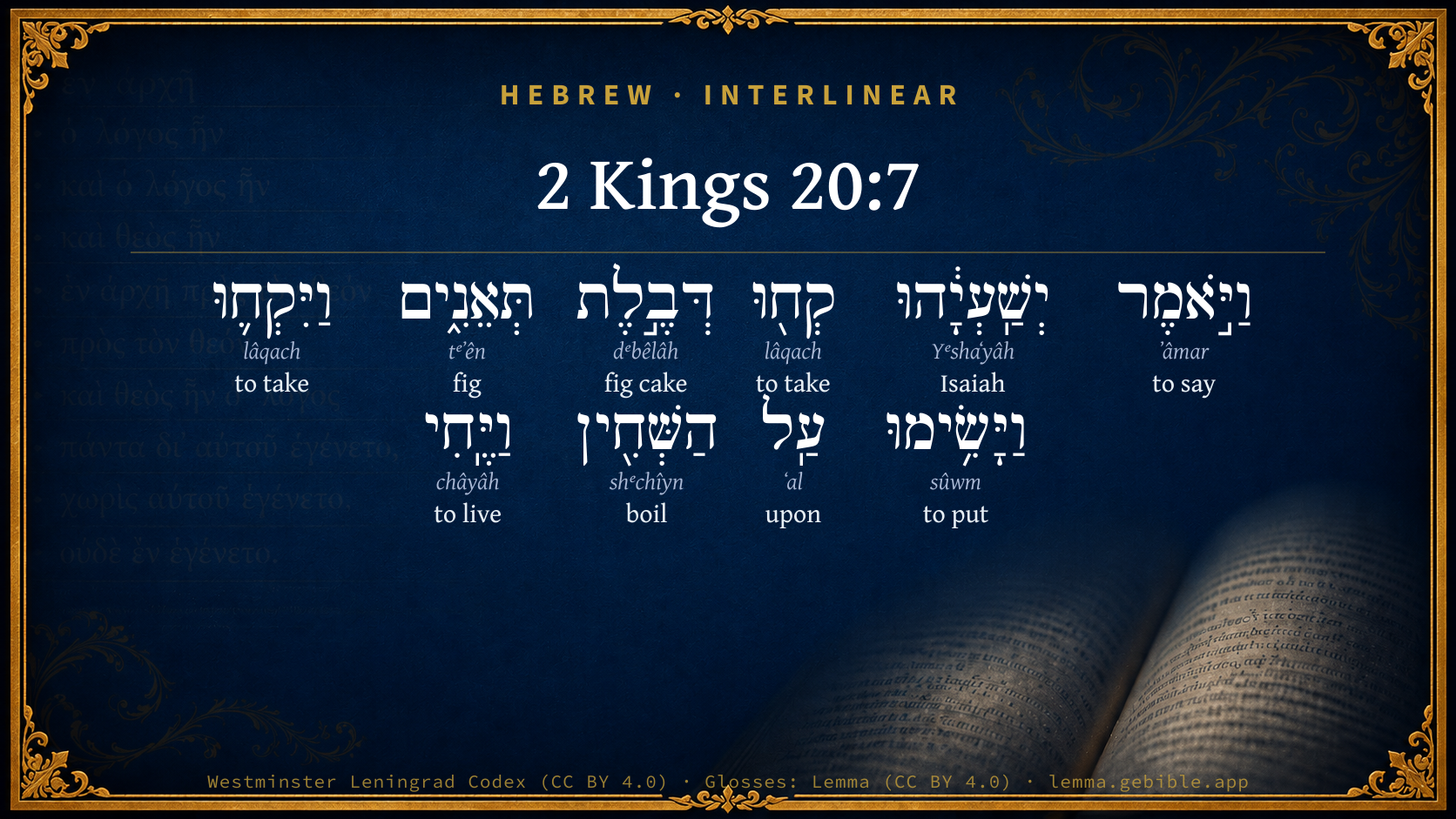
2 Kings 20:7

Hebrew (Westminster Leningrad Codex) 2 Kings 20:7 appears in the Hebrew Old Testament. The text above is from the Westminster Leningrad Codex. Each word links to its Strong’s number, a concise gloss, and parsing drawn from the Open Scriptures Hebrew Bible morphology. Click any word for its full Brown-Driver-Briggs (BDB) entry.
Download image
Cite this verse

2 Kings 20:7 (World English Bible). Public Domain. Lemma interlinear Bible study tool, https://lemma.gebible.app/v/2-kings/20/7.

Show BibTeX & RIS
BibTeX
RIS
English Translation
Isaiah said, Take a cake of figs. They took and laid it on the boil, and he recovered.
World English Bible · Public Domain
Download a study sheet

One document with this verse’s original text, its word-by-word gloss line, the meaning frame, cross-references with their text, attributed commentary, and full source and license credits — printable, and it pastes into notes with its structure intact.

This verse Autodidact and up

Study sheet (.html) Plain text (.txt)

A passage Seminary Student

Up to 50 verses in one chapter. A passage sheet keeps up to 6 commentary sources and 12 cross-references per verse, in the order this page ranks them, and says so on the sheet whenever that leaves anything out. Ask for a single verse and you get the Autodidact verse sheet above.

Everything on this page stays free to read, with no account — the sheet is a download of what is already on screen, not access to it.

Want to remove ads? Support Godless Engineer
Compare translations 3

The same verse in 3 English versions, stacked beneath the original-language interlinear above. Click any original word for its lexicon entry.

Each is an independent rendering of the whole verse — the interlinear is not word-aligned to these translations.

Highlighted words mark where these versions differ — a whole-verse word diff, not a word-by-word alignment.

  • World English Bible Public Domain
    Isaiah said, Take a cake of figs. They took and laid it on the boil, and he recovered.
  • King James Version Public Domain
    And Isaiah said, Take a lump of figs. And they took and laid it on the boil, and he recovered.
  • unfoldingWord Literal Text CC BY-SA 4.0
    And Isaiah said, “Bring a cake of figs.” And they brought, and they put on the sore, and he lived.

unfoldingWord Literal Text — © unfoldingWord, licensed CC BY-SA 4.0. Word-aligned USFM3 via Door43 (git.door43.org/unfoldingWord/en_ult).

Versions to compare (up to 4)

3 of 4 selected

Show all 18 translations

Every available English version of this verse, each an independent rendering of the whole verse.

  • World English Bible Public Domain
    Isaiah said, Take a cake of figs. They took and laid it on the boil, and he recovered.
  • Berean Standard Bible Public Domain
    Then Isaiah said, “Prepare a poultice of figs.” So they brought it and applied it to the boil, and Hezekiah recovered.
  • Majority Standard Bible Public Domain
    Then Isaiah said, “Prepare a poultice of figs.” So they brought it and applied it to the boil, and Hezekiah recovered.
  • King James Version Public Domain
    And Isaiah said, Take a lump of figs. And they took and laid it on the boil, and he recovered.
  • American Standard Version (1901) Public Domain
    And Isaiah said, Take a cake of figs. And they took and laid it on the boil, and he recovered.
  • Revised Version (1885) Public Domain
    And Isaiah said, Take a cake of figs. And they took and laid it on the boil, and he recovered.
  • Geneva Bible (1599) Public Domain
    Then Isaiah sayde, Take a lumpe of dry figges. And they tooke it, and layed it on the boyle, and he recouered.
  • Douay-Rheims (1899) Public Domain
    And Isaias said: Bring me a lump of figs. And when they had brought it, and laid it upon his boil. he was healed.
  • Young's Literal Translation Public Domain
    And Isaiah saith, `Take ye a cake of figs;' and they take and lay `it' on the boil, and he reviveth.
  • Literal Standard Version CC BY-SA 4.0
    And Isaiah says, “Take a cake of figs”; and they take and lay [it] on the boil, and he revives.
  • Unlocked Literal Bible CC BY-SA 4.0
    So Isaiah said, “Take a lump of figs.” They did so and put it on his boil, and he recovered.
  • unfoldingWord Literal Text CC BY-SA 4.0
    And Isaiah said, “Bring a cake of figs.” And they brought, and they put on the sore, and he lived.
  • Darby Bible Public Domain
    And Isaiah said, Take a cake of figs. And they took and laid it on the boil, and he recovered.
  • World Messianic Bible Public Domain
    Isaiah said, “Take a cake of figs.” They took and laid it on the boil, and he recovered.
  • Webster's Bible Public Domain
    And Isaiah said, Take a lump of figs. And they took and laid it on the boil, and he recovered.
  • Free Bible Version CC BY-SA 4.0
    Then Isaiah said, “Prepare a dressing from figs.” Hezekiah's servants did so and put it on the skin sores, and Hezekiah got better.
  • Bible in Basic English Public Domain
    Then Isaiah said, Take a cake of figs. So they took it and put it on his wound, and he got better.
  • JPS Tanakh (1917) Public Domain
    And Isaiah said: 'Take a cake of figs.' And they took and laid it on the boil, and he recovered.

Literal Standard Version (2020), Covenant Press — licensed CC BY-SA 4.0. Text via the HelloAO Bible API (eBible.org). Unlocked Literal Bible (unfoldingWord) — licensed CC BY-SA 4.0. Text via the HelloAO Bible API (eBible.org). unfoldingWord Literal Text — © unfoldingWord, licensed CC BY-SA 4.0. Word-aligned USFM3 via Door43 (git.door43.org/unfoldingWord/en_ult). Free Bible Version, Dr. Jonathan Gallagher — licensed CC BY-SA 4.0. Text via the HelloAO Bible API (eBible.org).

Word by word

More ways to search: Search by grammar → Find every occurrence → Compare this word →

Practice this passage: Drill this verse → Learn its vocabulary →

דְּבֶ֣לֶת
dᵉbêlâh
H1690
“fig cake of”
Noun, Common, Feminine, Singular, Construct
Part of Speech
Noun
Type
Common
Gender
Feminine
Number
Singular
State
Construct
Full BDB Definition

Origin: from an unused root (akin to H2082 )

TWOT: 397a

fig cake, lump of pressed figs
  1. וַיֹּ֣אמֶר ʼâmar H559 “and · to say” Conjunction + Verb, Qal, Sequential Imperfect, 3rd Person, Masculine, Singular
  2. יְשַֽׁעְיָ֔הוּ Yᵉshaʻyâh H3470 “Isaiah” Noun, Proper
  3. קְח֖וּ lâqach H3947 “take” Verb, Qal, Imperative, 2nd Person, Masculine, Plural
  4. תְּאֵנִ֑ים tᵉʼên H8384 “figs” Noun, Common, Feminine, Plural, Absolute
  5. וַיִּקְח֛וּ lâqach H3947 “and · to take” Conjunction + Verb, Qal, Sequential Imperfect, 3rd Person, Masculine, Plural
  6. וַיָּשִׂ֥ימוּ sûwm H7760 “and · to put” Conjunction + Verb, Qal, Sequential Imperfect, 3rd Person, Masculine, Plural
  7. עַֽל ʻal H5921 “upon” Preposition
  8. הַשְּׁחִ֖ין shᵉchîyn H7822 “the · boil” Particle, Definite Article + Noun, Common, Masculine, Singular, Absolute
  9. וַיֶּֽחִי châyâh H2421 “and · to live” Conjunction + Verb, Qal, Sequential Imperfect, 3rd Person, Masculine, Singular

About this verse

These counts appear in no published source. They are computed here, from the morphology-tagged text and Lemma’s own curated glosses. What Lemma adds →

10
words
9
distinct lemmas
Historical
section

Notable vocabulary

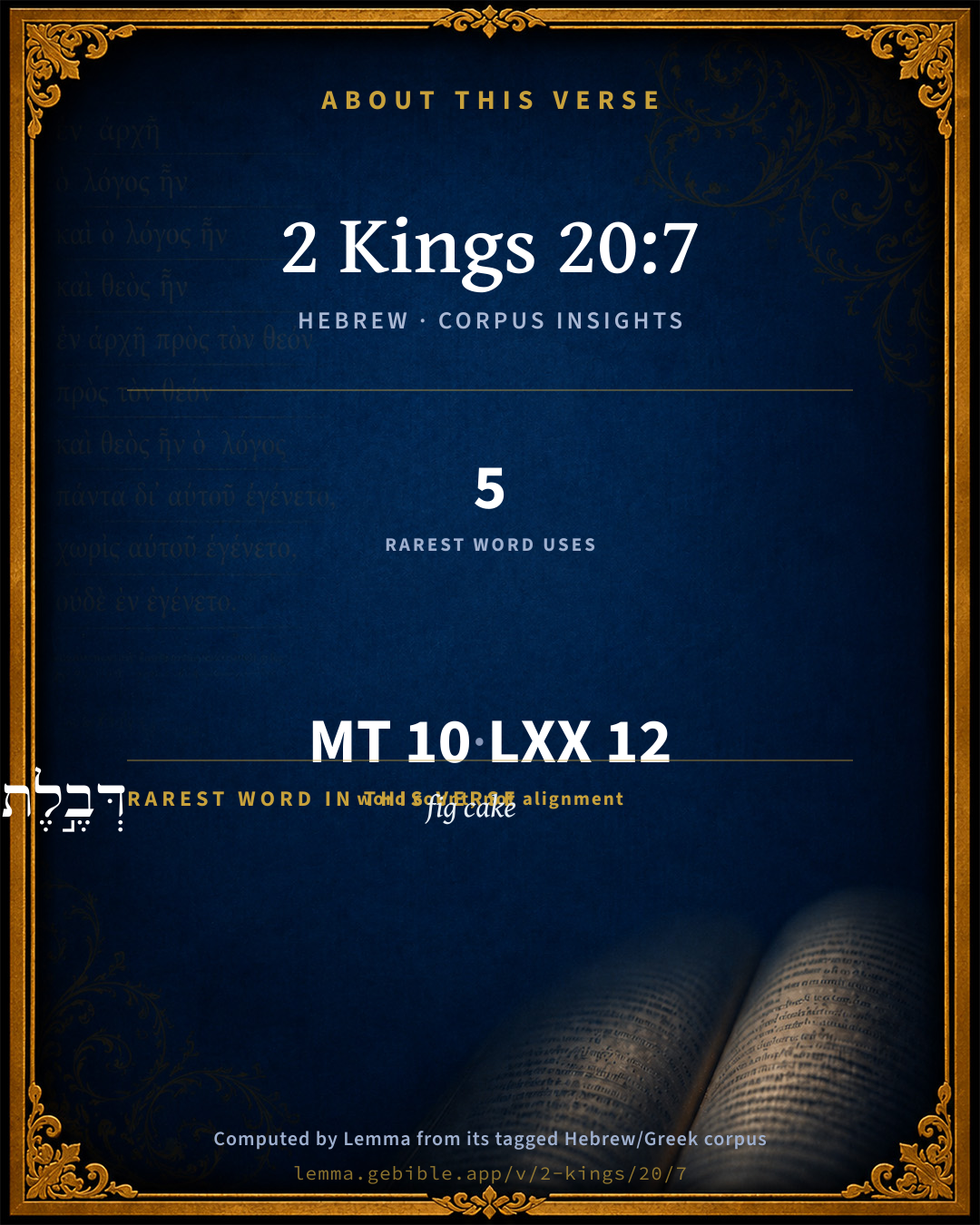
The rarest word here is דְּבֶ֣לֶת fig cake H1690 — appearing just 5 times in the whole Hebrew Bible.

Shared distinctive vocabulary

דְּבֶ֣לֶת fig cake H1690 occurs in 5 verses of the Hebrew Bible. Also found in:

Grammatical profile

  • 5 verbs
  • 4 nouns
  • 1 preposition

Verb forms

  • וַיֹּ֣אמֶר Qal · Sequential Imperfect
  • קְח֖וּ Qal · Imperative
  • וַיִּקְח֛וּ Qal · Sequential Imperfect
  • וַיָּשִׂ֥ימוּ Qal · Sequential Imperfect
  • וַיֶּֽחִי Qal · Sequential Imperfect

Repetition

A word recurs within this verse — often emphatic in Hebrew:

  • קְח֖וּ to take H3947 ×2

Hebrew & Septuagint length

In English translation the verse runs 18 words from the Hebrew and 21 from the Septuagint (LXX English) — closely comparable.

A rough comparison of the two English renderings, which tokenize alike — not a word-level alignment.

Word counts can differ between the Hebrew and the Greek without any difference in meaning — e.g. the Hebrew direct-object marker אֵת has no separate Greek word, and Greek often adds the article ὁ.

In the original languages it is 10 Hebrew tokens and 12 Greek tokens — but the two are counted differently (Hebrew bundles its prefixes and suffixes into one token; the Greek is in lemma form), so that isn’t a like-for-like length.

Cross-references

3

Topical passages linked to 2 Kings 20:7 in the Treasury of Scripture Knowledge — connected by theme and wording, ordered by reader-vote popularity; previews shown in the World English Bible.

  • Isaiah 38:21 Now Isaiah had said, Let them take a cake of figs, and lay it for a plaster on the boil, and he shall recover.
  • 2 Kings 2:20–22 He said, Bring me a new jar, and put salt therein. They brought it to him.
  • 2 Kings 4:41 But he said, Then bring meal. He cast it into the pot; and he said, Pour out for the people, that they may eat. There was no harm in the pot.

Cross-references courtesy of OpenBible.info (CC BY 4.0).

Hebrew and Greek witnesses Masoretic Hebrew ↔ Greek Septuagint

The same verse in the two great witnesses to the Old Testament, shown verse-for-verse.

These are two independent witnesses, not word-aligned to each other, and the Septuagint is shown in lemma (dictionary) form.

Hebrew 2 Kings 20:7 Masoretic · Westminster Leningrad Codex

וַיֹּ֣אמֶר יְשַֽׁעְיָ֔הוּ קְח֖וּ דְּבֶ֣לֶת תְּאֵנִ֑ים וַיִּקְח֛וּ וַיָּשִׂ֥ימוּ עַֽל הַשְּׁחִ֖ין וַיֶּֽחִי

Isaiah said, Take a cake of figs. They took and laid it on the boil, and he recovered.

World English Bible · Public Domain

Greek LXX 2 Kings 20:7 Septuagint · lemma form

καί εἶπον λαμβάνω παλάθης συκῆ καί ἐπιτίθημι ἐπί ὁ ἕλκος καί ὑγιάζω

And he said, Let them take a cake of figs, and lay it upon the ulcer, and he shall be well.

LXX2012 (modern English Septuagint) · Public Domain

Hebrew: Westminster Leningrad Codex (CC BY 4.0). Greek: Septuagint (public domain); English from LXX2012 (modern English Septuagint) (Public Domain). How the Septuagint differs from the Hebrew →

Targum (Aramaic paraphrase)

1

The Targum is the ancient Jewish Aramaic paraphrase of the Hebrew Scriptures — an interpretive translation, not the Hebrew text itself. Onkelos (literal) and Pseudo-Jonathan (expansive) render the Torah, and Jonathan the Prophets. Coverage is partial: where no permissively-licensed English translation exists for a verse, only the Aramaic is shown. This is verse-level text, not a word-by-word alignment to the Hebrew.

  1. Targum Jonathan Prophets (Joshua–Malachi)
    וַאֲמַר יְשַׁעְיָהוּ יִסְבוּן דְבֶלֶת תֵּינִין וּנְסִיבוּ וְשַׁוִיאוּ עַל שִׁיחֲנָא וְאִתַּסִי:

    (no public-domain English translation for this verse)

    Targum Jonathan — Aramaic: “Mikraot Gedolot” (public domain). English: “Sefaria Community Translation” (CC0 1.0 (public-domain dedication)); “London "Chaldee Paraphrase," 1871” (public domain). Text via Sefaria.

Commentary

Notes on 2 Kings 20:7 from classic Christian and Jewish commentators (each source and its license shown beneath its notes). The classic Christian expositions comment on the surrounding passage and are grouped to its opening verse, so a note may address several verses; the Jewish commentaries on the Tanakh (Rashi and others) are per-verse, so they appear only where the commentator wrote on this verse.

Lemma curates 59 commentaries, every one of them public domain or Creative Commons licensed, each selected and text-cleaned for this edition rather than reprinted as found. About our sources →

Trapp's Complete Commentary

John Trapp

2Ki 20:7 And Isaiah said, Take a lump of figs. And they took and laid [it] on the boil, and he recovered.

Ver. 7. Take a lump of figs.] This poultice was fit enough for the carbuncle, but yet could never have cured him so soon without a miracle. See on 2Ki 20:1.

And he recovered.] Non ex facultate ficuum, sed ex Dei verbo, saith Junius: By a supernatural virtue added to the figs, which else could not have wrought the cure.

John Trapp, A Commentary or Exposition upon All the Books of the Old and New Testament (1647–1656) — public domain. Text from a community e-Sword module.

Joseph Benson's Commentary

2Ki 20:7. Take a lump of figs — Though the deliverance was certainly promised, yet means must be used, and those suitable. The figs would help to ripen the bile, and bring it to a head, that the matter of the disease might be discharged that way. This means, however, would have been altogether insufficient of itself to effect so sudden and complete a cure, without the co-operation of the divine power, to which the king’s restoration to health is chiefly to be ascribed.

Joseph Benson's Commentary on the Old and New Testaments (1811–1818) — public domain. Text from a community e-Sword module.

Geneva Bible (1599)

Geneva Bible translators

He declareth that albeit God can heal without other medicines, yet he showeth that he will not have these inferior means contemned.

Geneva Bible (1599) marginal notes — public domain. Text via Bolls.life.

Adam Clarke's Commentary

Verse 7. Take a lump of figs - and laid it on the boil] We cannot exactly say in what Hezekiah's malady consisted. שחין shechin signifies any inflammatory tumour, boil, abscess, c. The versions translate it sore, wound, and such like. Some think it was a pleurisy others, that it was the plague; others, the elephantiasis; and others, that it was a quinsey. A poultice of figs might be very proper to maturate a boil, or to discuss any obstinate inflammatory swelling. This Pliny remarks, Omnibus quae maturanda ant discutienda sunt imponuntur. But we cannot pronounce on the propriety of the application, unless we were certain of the nature of the malady. This, however was the natural means which God chose to bless to the recovery of Hezekiah's health; and without this interposition he must have died.

Adam Clarke's Commentary on the Bible (1810–1826) — public domain. Text from a community e-Sword/MySword module.

Ellicott's Commentary for English Readers

(7, 8) In Isaiah these two verses are given at the end of the narrative; a position in which they are obviously out of place. Probably some copyist, after accidentally omitting them where they properly belonged, added them there, “with marks for insertion in their proper places, which marks were afterwards neglected by transcribers” (Lowth, cited by Cheyne), perhaps because they had become obliterated.

Take a lump of figs.—Figs pressed into a cake (1Sa_25:18). “Many commentators suppose the figs to be mentioned as a remedy current at the time. But surely so simple and unscientific a medicine would have been thought of, without applying to the prophet by those about Hezekiah. The plaster of figs is rather a sign or symbol of the cure, like the water of the Jordan in the narrative of Naaman (2Ki_5:10)” (Cheyne). That in antiquity figs were a usual remedy for boils of various kinds appears from the testimony of Dioscorides and Pliny.

Laid it on the boil.—It is not to be supposed that Hezekiah was suffering from the plague and, in fact, the very plague which destroyed the army of Sennacherib. (See Note on 2Ki_20:1). The word “boil” (shĕhîn) denotes leprous and other similar ulcers (Exo_9:9; Job_2:7), but not plague, which moreover, would not have attacked Hezekiah alone, and would have produced not one swelling, but many.

And he recovered.—Heb., lived. The result is mentioned here by natural anticipation.

A Bible Commentary for English Readers, edited by Charles John Ellicott (1878–1897) — public domain. Text from a community e-Sword module.

The Cambridge Bible for Schools and Colleges

gen. ed. J. J. S. Perowne

7. Take a lump [R.V. cake] of figs] Except here and in Isaiah 38. ‘cake’ is the constant rendering of A.V. for this word. See 1Sa_25:18; 1Sa_30:12; 1Ch_12:40. The figs were closely pressed together for better keeping when they were dried, just as we find is done at the present time.

The virtue of figs made into a plaster has long been celebrated. Gerarde in his Herball (p. 1328) says, ‘Figs stamped and made into the form of a plaister … soften and ripen impostumes … all hot and angry swellings, and tumours behind the eares’. The boil from which Hezekiah was suffering was clearly something of this character, and confined to one spot, so that it could be treated by a poultice. It was therefore most likely some sort of carbuncle, which in certain parts of the body, as the back of the neck, can prove fatal. The conjectures some of which make the disease to be pleurisy, others the plague, contracted from the Assyrians, others, elephantiasis or leprosy, are not so probable, as none of them appear likely to have been treated by a plaster.

The Cambridge Bible for Schools and Colleges (gen. ed. J. J. S. Perowne; Cambridge University Press, 1878–1918) — public domain. Text from a community e-Sword module.

John Gill's Exposition

And Hezekiah said unto Isaiah,.... Or "had said", (w) before the plaster of figs was directed to, or, however, laid on, and as soon as he was told he should be healed:

what shall be the sign that the Lord will heal me, and that I shall go up into the house of the Lord the third day? not that he disbelieved the promise of God, or doubted of a cure, but this he requested for the confirmation of his faith; which good men sometimes asked, when they doubted not, as Gideon; and Ahaz, Hezekiah's father, was bid to ask a sign for the like purpose, and it was resented in him that he did not, see Jdg 6:17.

(w) "dixerat autem", V. L. Vatablus.

John Gill's Exposition of the Whole Bible (1746–1763) — public domain (CC PDM 1.0). Text via the HelloAO Bible API.

Albert Barnes' Notes on the Bible

A lump of figs - The usual remedy in the East, even at the present day, for ordinary boils. But such a remedy would not naturally cure the dangerous tumor or carbuncle from which Hezekiah suffered. Thus the means used in this miracle were means having a tendency toward the result performed by them, but insufficient of themselves to produce that result (compare 2Ki 4:34 note).

Albert Barnes' Notes on the Bible (1834–1885) — public domain. Text from a community e-Sword/MySword module.

Haydock's Catholic Bible Commentary

Figs; dried. They are very serviceable in various disorders of the throat, to mullify, &c. (Pliny, [Natural History?] xxiii. 3.) (Aldrov. ii.) --- St. Jerome (in Isaias xxxviii.) acknowledges that they might help to removed the disorder. Grotius is of a contrary opinion; (Calmet) and this would enhance the miracle. See Vales. xxxix. (Menochius) --- At any rate, the discovery of this remedy to the prophet, and its sudden efficacy, were miraculous. (Calmet)

George Leo Haydock (1774–1849), Haydock's Catholic Family Bible and Commentary, 1859 edition — public domain. Excludes Psalms (Douay-Rheims chapter numbering differs from Protestant) and Deuterocanonical books (Catholic canon only).

Matthew Poole's English Annotations

Take a lump of figs: though the deliverance was certainly promised, yet means must be used, and those suitable; for this hath naturally a power of ripening and softening boils or sores, though that power was altogether insufficient to produce so sudden and so complete a cure. The boil seems to have been a plague-sore.

Matthew Poole's English Annotations on the Holy Bible (1683–1685) — public domain. Text from a community e-Sword/MySword module.

Whedon's Commentary on the Bible

Daniel D. Whedon

7. A lump of figs — Figs pressed together into a mass or poultice. The use of figs in the cure of boils or ulcers is attested by several ancient writers. Dioscorides says, they “disperse tumors,” and Pliny, they “open ulcers.”

The boil — שׁחין, a burning sore, an in flamed ulcer. In Hezekiah’s case, it was very probably a carbuncle.

He recovered — That is, at the end of three days; but previous to his recovery he asked and received a marvellous sign of Divine interposition. See 2Ki_20:8-11. In Isa_38:9-20, we have a psalm of thanksgiving which Hezekiah sang to the Lord at his recovery.

Daniel D. Whedon (gen. ed.), Commentary on the Old and New Testaments (1874–1909) — public domain. Text from a community e-Sword module.

The Pulpit Commentary

And Isaiah said, Take a lump of figs. Figs were the usual remedy for boils. Dioscorides says of the fig, diaforei sklhriav; Pliny, "Ulcera aperit;" while Jerome, in his-commentary on Isaiah, has the following: "Juxta artem medicorum omnis sanies siccioribus ficis atque contusis in cutis superficiem provocatur." The remedy is said to be still in use among Easterns. It can scarcely be supposed to have cured a malignant bell by its intrinsic force; hut under the Divine blessing it was made effectual, and the cure followed. And they took and laid it on the boil. The royal attendants obtained a lump of figs, and applied it to the inflamed boil or carbuncle, as Isaiah had suggested. It is impossible to say what exactly was the nature of the "boil," since diseases change their characters, and every age has its own special disorders; but modem medical science knows of more than one kind of pustular swelling, which, as soon as it is detected, is regarded as fatal. And he recovered. Not suddenly, but by degrees; after the manner of natural remedies. It was three days before he was well enough to quit the palace, and offer thanks in the temple for his miraculous cure (see ver. 5).

The Pulpit Commentary (1880–1919), ed. H.D.M. Spence-Jones & Joseph S. Exell — public domain. Text from a community e-Sword module.

Rashi

Rabbi Shlomo Yitzchaki (Rashi)

A cake of pressed figs. When they are fresh, they are called תאנים [=figs], and when they are pressed into a round cake, they are called דבלה.

And placed it on the boil, and it was healed. This was a miracle within a miracle, for even healthy flesh, when you place a cake of pressed figs upon it, decays, yet the Holy One, Blessed Is He, [instructs to] put something that is injurious upon something that is vulnerable, and it becomes healed.

Rashi on the Tanakh — English translations: “The Judaica Press complete Tanach with Rashi, translated by A. J. Rosenberg” (CC BY 4.0); “Pentateuch with Rashi's commentary by M. Rosenbaum and A.M. Silbermann, 1929-1934” (public domain); “The Metsudah Tanach series, Lakewood, N.J” (CC BY 4.0); and “The Book of Joshua, Metsudah Publications, 1997” (CC BY 4.0). Text via Sefaria.

Lesson kit

Teaching starters — assembled from the data on this page, not authored interpretation. Every prompt links to the verse data it draws on. Edit before teaching.

2 Kings, in the Historical, opens this verse with 10 words (9 distinct Hebrew lemmas). Its most distinctive word is dᵉbêlâh (“fig cake”). A historical commentator’s framing appears above. Read the whole chapter for the surrounding context.

Discussion questions

  1. How does “fig cake” (dᵉbêlâh) shape what this verse is saying?
  2. How does 1 Samuel 25:18, which shares the word «fig cake», read alongside this verse?
  3. What does the repetition of “to take” (2× in this one verse) do in this verse?
  4. The translations on this page render this verse differently — a whole-verse word diff, not a word-by-word alignment. What might account for the different wordings?
  5. «וַיֹּ֣אמֶר» is a Qal Sequential Imperfect verb. How does that grammatical form shape the action described?
  6. Compare how Trapp's Complete Commentary and Joseph Benson's Commentary read this verse. Where do they agree or differ?

Things to notice

Reading settings

Reading text

Shown beneath each verse's original-language words.

Old Testament
Old Testament edition

Read the OT as the Masoretic Hebrew (MT) or the Greek Septuagint (LXX).

English shown for the Greek Septuagint (in the Hebrew ↔ Greek comparison).

Comparing translations? Open the Compare panel on any verse page to stack up to four side by side.