
Psalms 119:77

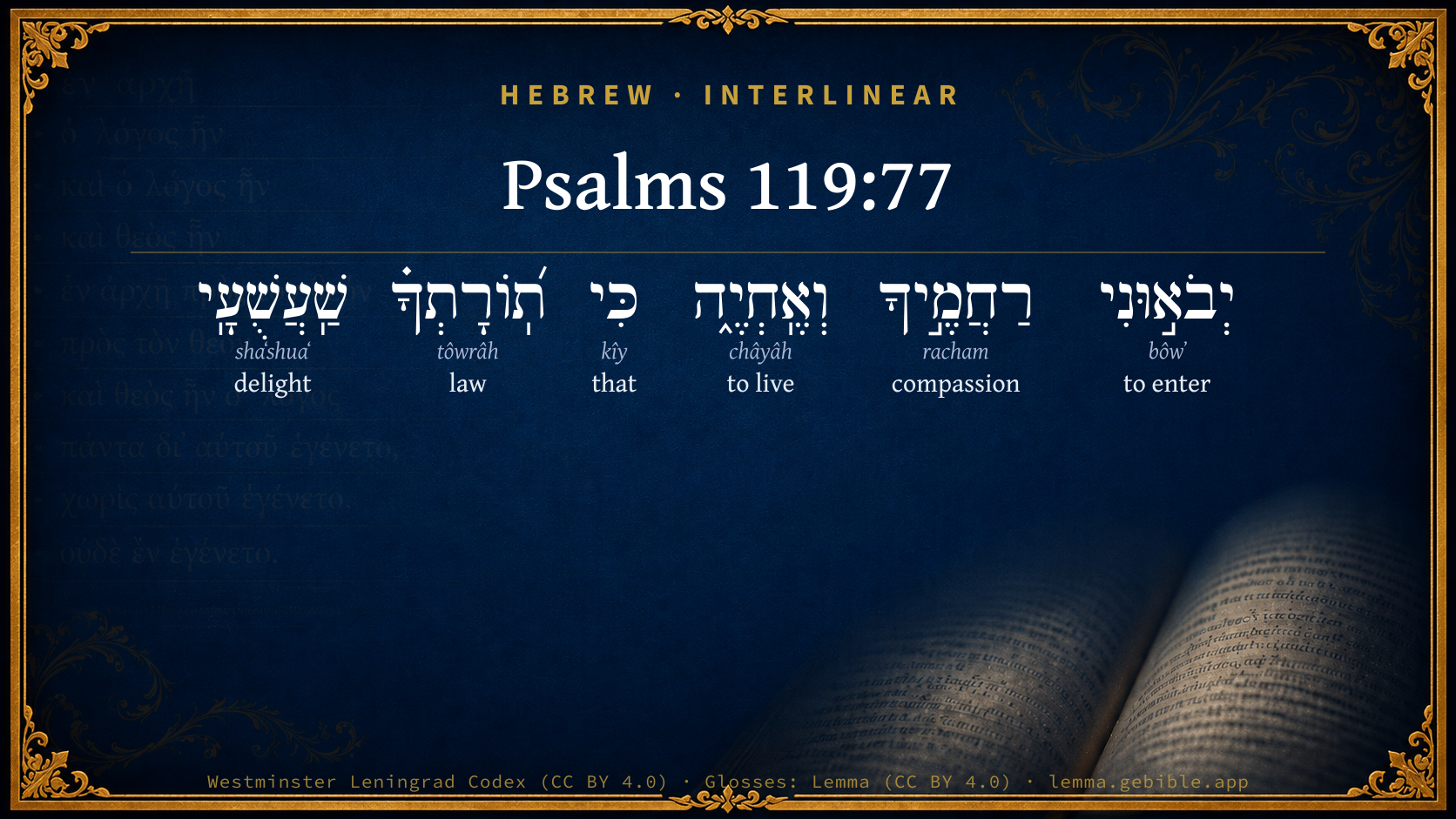
Hebrew (Westminster Leningrad Codex) Psalms 119:77 appears in the Hebrew Old Testament. The text above is from the Westminster Leningrad Codex. Each word links to its Strong’s number, a concise gloss, and parsing drawn from the Open Scriptures Hebrew Bible morphology. Click any word for its full Brown-Driver-Briggs (BDB) entry.
Download image
Cite this verse

Psalms 119:77 (World English Bible). Public Domain. Lemma interlinear Bible study tool, https://lemma.gebible.app/v/psalms/119/77.

Show BibTeX & RIS
BibTeX
RIS
English Translation
Let your tender mercies come to me, that I may live; For your law is my delight.
World English Bible · Public Domain
Download a study sheet

One document with this verse’s original text, its word-by-word gloss line, the meaning frame, cross-references with their text, attributed commentary, and full source and license credits — printable, and it pastes into notes with its structure intact.

This verse Autodidact and up

Study sheet (.html) Plain text (.txt)

A passage Seminary Student

Up to 50 verses in one chapter. A passage sheet keeps up to 6 commentary sources and 12 cross-references per verse, in the order this page ranks them, and says so on the sheet whenever that leaves anything out. Ask for a single verse and you get the Autodidact verse sheet above.

Everything on this page stays free to read, with no account — the sheet is a download of what is already on screen, not access to it.

Want to remove ads? Support Godless Engineer
Compare translations 3

The same verse in 3 English versions, stacked beneath the original-language interlinear above. Click any original word for its lexicon entry.

Each is an independent rendering of the whole verse — the interlinear is not word-aligned to these translations.

Highlighted words mark where these versions differ — a whole-verse word diff, not a word-by-word alignment.

  • World English Bible Public Domain
    Let your tender mercies come to me, that I may live; For your law is my delight.
  • King James Version Public Domain
    Let thy tender mercies come unto me, that I may live: for thy law is my delight.
  • unfoldingWord Literal Text CC BY-SA 4.0
    May your compassion come to me so that I may live, for your teaching my delight.

unfoldingWord Literal Text — © unfoldingWord, licensed CC BY-SA 4.0. Word-aligned USFM3 via Door43 (git.door43.org/unfoldingWord/en_ult).

Versions to compare (up to 4)

3 of 4 selected

Show all 17 translations

Every available English version of this verse, each an independent rendering of the whole verse.

  • World English Bible Public Domain
    Let your tender mercies come to me, that I may live; For your law is my delight.
  • Berean Standard Bible Public Domain
    May Your compassion come to me, that I may live, for Your law is my delight.
  • Majority Standard Bible Public Domain
    May Your compassion come to me, that I may live, for Your law is my delight.
  • King James Version Public Domain
    Let thy tender mercies come unto me, that I may live: for thy law is my delight.
  • American Standard Version (1901) Public Domain
    Let thy tender mercies come unto me, that I may live; For thy law is my delight.
  • Revised Version (1885) Public Domain
    Let thy tender mercies come unto me, that I may live: for thy law is my delight.
  • Geneva Bible (1599) Public Domain
    Let thy tender mercies come vnto me, that I may liue: for thy Lawe is my delite.
  • Young's Literal Translation Public Domain
    Meet me do Thy mercies, and I live, For Thy law `is' my delight.
  • Literal Standard Version CC BY-SA 4.0
    Your mercies meet me, and I live, || For Your law [is] my delight.
  • Unlocked Literal Bible CC BY-SA 4.0
    Show me compassion so that I may live, for your law is my delight.
  • unfoldingWord Literal Text CC BY-SA 4.0
    May your compassion come to me so that I may live, for your teaching my delight.
  • Darby Bible Public Domain
    Let thy tender mercies come unto me, that I may live; for thy law is my delight.
  • World Messianic Bible Public Domain
    Let your tender mercies come to me, that I may live; for your Torah is my delight.
  • Webster's Bible Public Domain
    Let thy tender mercies come to me, that I may live: for thy law is my delight.
  • Free Bible Version CC BY-SA 4.0
    Be compassionate to me so I may live, for I love your teachings.
  • Bible in Basic English Public Domain
    Let your gentle mercies come to me, so that I may have life; for your law is my delight.
  • JPS Tanakh (1917) Public Domain
    Let Thy tender mercies come unto me, that I may live; for Thy law is my delight.

Literal Standard Version (2020), Covenant Press — licensed CC BY-SA 4.0. Text via the HelloAO Bible API (eBible.org). Unlocked Literal Bible (unfoldingWord) — licensed CC BY-SA 4.0. Text via the HelloAO Bible API (eBible.org). unfoldingWord Literal Text — © unfoldingWord, licensed CC BY-SA 4.0. Word-aligned USFM3 via Door43 (git.door43.org/unfoldingWord/en_ult). Free Bible Version, Dr. Jonathan Gallagher — licensed CC BY-SA 4.0. Text via the HelloAO Bible API (eBible.org).

Word by word

More ways to search: Search by grammar → Find every occurrence → Compare this word →

Practice this passage: Drill this verse → Learn its vocabulary →

About this verse

These counts appear in no published source. They are computed here, from the morphology-tagged text and Lemma’s own curated glosses. What Lemma adds →

6
words
6
distinct lemmas
Wisdom
section

Notable vocabulary

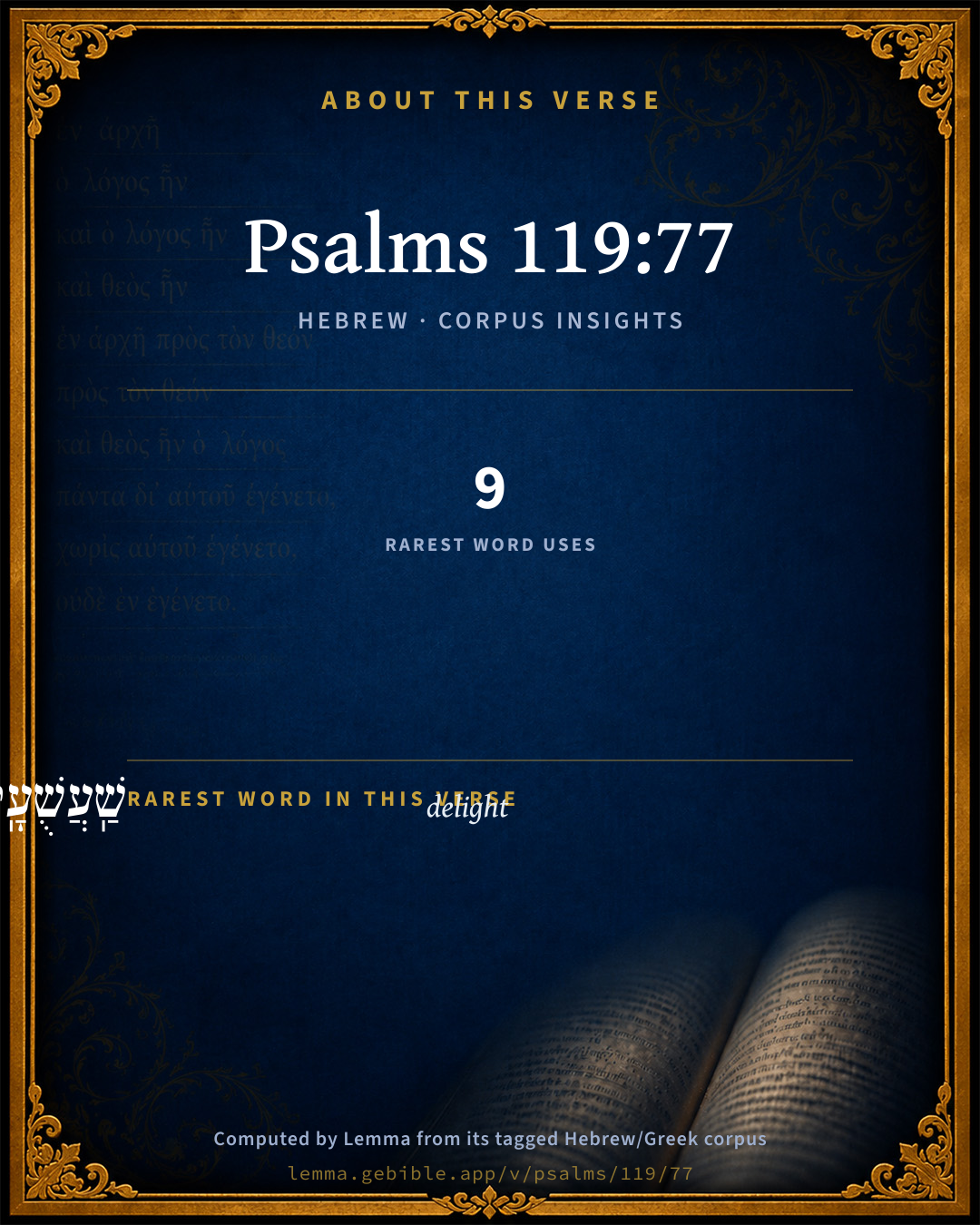
The rarest word here is שַֽׁעֲשֻׁעָֽי delight H8191 — appearing just 9 times in the whole Hebrew Bible.

Shared distinctive vocabulary

שַֽׁעֲשֻׁעָֽי delight H8191 occurs in 9 verses of the Hebrew Bible. Also found in:

Grammatical profile

  • 2 verbs
  • 3 nouns
  • 1 conjunction

Verb forms

  • יְבֹא֣וּנִי Qal · Imperfect
  • וְאֶֽחְיֶ֑ה Qal · Imperfect

Hebrew & Septuagint length

In English translation the verse runs 17 words from the Hebrew and 16 from the Septuagint (LXX English) — closely comparable.

A rough comparison of the two English renderings, which tokenize alike — not a word-level alignment.

Word counts can differ between the Hebrew and the Greek without any difference in meaning — e.g. the Hebrew direct-object marker אֵת has no separate Greek word, and Greek often adds the article ὁ.

Cross-references

9

Topical passages linked to Psalms 119:77 in the Treasury of Scripture Knowledge — connected by theme and wording, ordered by reader-vote popularity; previews shown in the World English Bible.

  • Psalms 1:2 But his delight is in Yahweh's law; On his law he meditates day and night.
  • Psalms 119:41 Let your loving kindness also come to me, Yahweh, Your salvation, according to your word.
  • Psalms 119:174 I have longed for your salvation, Yahweh. Your law is my delight.
  • Lamentations 3:22–23 [It is of] Yahweh's loving kindnesses that we are not consumed, because his compassion doesn't fail.
  • Psalms 119:24 Indeed your statutes are my delight, And my counselors.
  • Psalms 119:47 I will delight myself in your commandments, Because I love them.
  • Daniel 9:18 My God, turn your ear, and hear; open your eyes, and see our desolations, and the city which is called by your name: for we do not present our petitions before you for our righteousness, but for your great mercies' sake.
  • Hebrews 8:10–12 "For this is the covenant that I will make with the house of Israel. After those days," says the Lord; "I will put my laws into their mind, I will also write them on their heart. I will be to them a God, And they will be to me a people.
  • Psalms 51:1–3 Have mercy on me, God, according to your loving kindness. According to the multitude of your tender mercies, blot out my transgressions.

Cross-references courtesy of OpenBible.info (CC BY 4.0).

Hebrew and Greek witnesses Masoretic Hebrew ↔ Greek Septuagint

The same verse in the two great witnesses to the Old Testament, shown verse-for-verse.

You’re reading Greek Psalm 118 (Hebrew Psalm 119). The Septuagint counts the superscription, so verse numbers can differ from the Hebrew — chapter-level alignment, not verse-by-verse. Numbering follows Rahlfs.

These are two independent witnesses, not word-aligned to each other, and the Septuagint is shown in lemma (dictionary) form.

Hebrew Psalms 119:77 Masoretic · Westminster Leningrad Codex

יְבֹא֣וּנִי רַחֲמֶ֣יךָ וְאֶֽחְיֶ֑ה כִּי תֽ֝וֹרָתְךָ֗ שַֽׁעֲשֻׁעָֽי

Let your tender mercies come to me, that I may live; For your law is my delight.

World English Bible · Public Domain

Greek LXX Greek Psalm 118:77 Septuagint · lemma form

ἔρχομαι ἐγώ ὁ οἰκτιρμός σύ καί ζάω ὅτι ὁ νόμος σύ μελέτη ἐγώ εἰμί

Let your compassions come to me, that I may live: for your law is my meditation.

LXX2012 (modern English Septuagint) · Public Domain

Hebrew: Westminster Leningrad Codex (CC BY 4.0). Greek: Septuagint (public domain); English from LXX2012 (modern English Septuagint) (Public Domain). How the Septuagint differs from the Hebrew →

Commentary

Notes on Psalms 119:77 from classic Christian and Jewish commentators (each source and its license shown beneath its notes). The classic Christian expositions comment on the surrounding passage and are grouped to its opening verse, so a note may address several verses; the Jewish commentaries on the Tanakh (Rashi and others) are per-verse, so they appear only where the commentator wrote on this verse.

Lemma curates 59 commentaries, every one of them public domain or Creative Commons licensed, each selected and text-cleaned for this edition rather than reprinted as found. About our sources →

Trapp's Complete Commentary

John Trapp

Psa 119:77 Let thy tender mercies come unto me, that I may live: for thy law [is] my delight.

Ver. 77. Let thy tender mercies come unto me, &c.] He repeateth the same thing in other words, and re-enforceth his request; showing that he could not live without divine comforts.

For thy law is my delight] Thou hast my heart and goodwill; which showeth that I am thy workmanship in a spiritual sense also, Eph 2:10. Oh look upon the wounds of thine hands, and forget not the work of thine hands, as Queen Elizabeth prayed.

John Trapp, A Commentary or Exposition upon All the Books of the Old and New Testament (1647–1656) — public domain. Text from a community e-Sword module.

The Biblical Illustrator

Joseph S. Exell

Psa_119:77

Let Thy tender mercies come unto me, that I may live.

Mercy to live well

He prayed before for mercy; now again he prayeth for mercy. The children of God have such an earnest desire of mercy, that whatever sense thereof they get, they still cry for more; and sure it is in this life they can never be satisfied. Nevertheless, happy are they who hunger and thirst, for hereafter they shall be satisfied. But if we mark more narrowly, we shall find that David here seeks another sort of mercy than he sought before. For first, he sought mercy to forgive his sins: then he sought mercy to comfort him in his troubles; now he seeks mercy to live and sin no more. Alas, many seek the first mercy of remission, and the second mercy of consolation in trouble, who are altogether careless of the third mercy, to live well. It is a great mercy of God to amend thy life; where this is not, let no man think he hath received either of the former. It is a great mercy of God which not only pardons evil that is done, but strengthens us also to further good that we have not done; and this is the mercy which here David seeks. (Bp. Cowper.)

The Biblical Illustrator, edited by Joseph S. Exell (c. 1880s–1900s) — public domain. Text from a community e-Sword module.

J. A. Alexander on Psalms

Joseph Addison Alexander

77. (Psa 119:77) Let thy compassion come unto me (or upon me), and I shall live, for thy law (is) my delights. The construction in the first clause is like that in Psa 119:41. And I shall live, or as we might express it, that I may live. See above, on Psa 119:17. He pleads what he has received already as a ground for asking more. The plural (delights) expresses fulness and completeness, or perhaps implies that this joy is equal or superior to all others, or includes them all. The Hebrew noun is derived from the verb in Psa 119:16; Psa 119:47; Psa 119:70.

Joseph Addison Alexander, The Psalms Translated and Explained (1850) — public domain. Text from a community e-Sword module.

Geneva Bible (1599)

Geneva Bible translators

He declareth, that when he felt not God’s mercies, he was as dead.

Geneva Bible (1599) marginal notes — public domain. Text via Bolls.life.

Adam Clarke's Commentary

Verse 77. Let thy tender mercies] רחמיך rachameycha, thy fatherly and affectionate feelings.

Adam Clarke's Commentary on the Bible (1810–1826) — public domain. Text from a community e-Sword/MySword module.

John Calvin's Commentaries

77. Let thy companions come unto me. In this verse, the Psalmist repeats and confirms almost the same request as in the preceding verse, although in phraseology somewhat different. As he had just now said, that his sorrow could not be removed, nor his joy restored, in any other way than by God’s mercy being exercised towards him; so now he affirms that he cannot have without being reconciled to God. He thus distinguishes himself from worldly men, who are very little affected with a concern about having God reconciled to them; or, rather, who do not cease securely to enjoy themselves, although God is angry with them. He distinctly affirms, that, until he know that God is reconciled to him, he is a dead man even while living; but that, on the other hand, whenever God shall cause his mercy to shine upon him, he will be restored from death to life. By the way, he intimates that he was deprived for a time of the tokens of God’s fatherly favor; for it would have been needless for him to have wished that it might come to him, had it not been removed from him. As an argument for obtaining what he supplicates, he asserts that the law of God was his delight; nor could he otherwise hope that God would be merciful to him. Besides, no man truly feels what virtue is in the Divine favor, but he who, placing his chief happiness in that alone, is convinced that all who dissever themselves from God are miserable and accursed; a truth which the prophet had learned from the law.

John Calvin's Commentaries (1540-1563) — public domain. Text from the Calvin Translation Society English edition (1840s-50s) via the Christian Classics Ethereal Library (ccel.org). Calvin's coverage is partial (roughly two-thirds of the Bible); uncommented books and verses are honest gaps, never fabricated. The 19th-century editor's footnotes and remarks are omitted so the notes are faithfully Calvin's own voice.

The Cambridge Bible for Schools and Colleges

gen. ed. J. J. S. Perowne

77. thy tender mercies] Thy compassions (Psa_119:156). Cp. Deu_13:17-18; Isa_49:13; Isa_54:7; Zec_1:16.

The Cambridge Bible for Schools and Colleges (gen. ed. J. J. S. Perowne; Cambridge University Press, 1878–1918) — public domain. Text from a community e-Sword module.

John Gill's Exposition

CAPH.--The Eleventh Part.

CAPH. My soul fainteth for thy salvation, Either for temporal salvation and deliverance from enemies; which, being promised, was expected by him from the Lord; but not coming so soon as looked for, his spirits began to sink and faint: or for spiritual and eternal salvation, for a view of interest in it, for the joys and comforts of it, and for the full possession of is in heaven; and, particularly, for the promised Messiah, the author of it, often called the Salvation of God, because prepared and appointed by him to be the author of it: of him there was a promise, which gave the Old Testament saints reason to expect him, and for him they waited; his coming they earnestly wished for, but being long deferred, were sometimes out of heart, and ready to faint, which was here David's case;

but I hope in thy word; the word of promise concerning deliverance and salvation, especially by the Messiah, which supported him, and kept him from fainting; that being firm and sure, for ever settled in heaven, and has the oath of God annexed to it, for the confirmation of it; and God is faithful that has promised, and is also able to perform; so that his word lays a solid foundation for faith and hope.

John Gill's Exposition of the Whole Bible (1746–1763) — public domain (CC PDM 1.0). Text via the HelloAO Bible API.

Albert Barnes' Notes on the Bible

Let thy tender mercies come unto me - See the notes at Psa 119:41.

That I may live - It is evident that this was uttered in view of some great calamity by which his life was threatened. He was dependent for life - for recovery from sickness, or for deliverance from danger - wholly on the compassion of God.

For thy law is my delight - See the notes at Psa 119:16; compare Psa 119:24, Psa 119:47. This is urged here as a reason for the divine interposition. The meaning is, that he was a friend of God; that he had pleasure in his service and in his commandments; and that he might, therefore, with propriety, appeal to God to interpose in his behalf. This is a proper ground of appeal to God in our prayers, not on the ground of merit or claim, but because we may reasonably suppose that God will be disposed to protect his friends, and to deliver them in the day of trouble.

Albert Barnes' Notes on the Bible (1834–1885) — public domain. Text from a community e-Sword/MySword module.

Matthew Poole's English Annotations

That I may live; that I may be preserved from that violent and untimely death which mine enemies design to bring upon me.

For thy law is my delight; I humbly beg and expect thy protection, because I am thy faithful servant.

Matthew Poole's English Annotations on the Holy Bible (1683–1685) — public domain. Text from a community e-Sword/MySword module.

The Treasury of David

Charles H. Spurgeon

Ver. 77. Let thy tender mercies come unto me, that I may live. He was so hard pressed that he was at death's door if God did not succour him. He needed not only mercy, but "mercies, "and these must be of a very gracious and considerate kind, even "tender mercies, "for he was sore with his wounds. These gentle favours must be of the Lord's giving, for nothing less would suffice; and they must "come" all the way to the sufferer's heart, for he was not able to journey after them; all he could do was to sigh out, "Oh that they would come." If deliverance did not soon come, he felt ready to expire, and yet he told us but a verse or so ago that he hoped in God's word: how true it is that hope lives on when death seems written on all besides. A heathen said, "dum spiro spero, "while I breathe I hope; but the Christian can say, "dum expiro spero, "even when I expire I still expect the blessing. Yet no true child of God can live without the tender mercy of the Lord; it; is death to him to be under God's displeasure. Notice, again, the happy combination of the words of our English version. Was there ever a sweeter sound than this "tender mercies"? He who has been grievously afflicted, and yet tenderly succoured is the only man who knows the meaning of such choice language.

How truly we live when tender mercy comes to us. Then we do not merely exist, but live; we are lively, full of life, vivacious, and vigorous. We know not what life is till we know God. Some are said to die by the visitation of God, but we live by it.

For thy law is my delight. O blessed faith! He is no mean believer who rejoices in the law even when its broken precepts cause him to suffer. To delight in the word when it rebukes us, is proof that we are profiting under it. Surely this is a plea which will prevail with God, however bitter our griefs may be; if we still delight in the law of the Lord he cannot let us die, he must and will cast a tender look upon us and comfort our hearts.

Ver. 77. Let thy tender mercies come unto me, that I may live. If we mark narrowly we shall find that David here seeks another sort of mercy than he sought before. For first he sought mercy to forgive his sins; then he sought mercy to comfort him in his troubles; now he seeks mercy to live, and sin no more. Alas, many seek the first mercy, of remission; and the second mercy, of consolation in trouble, who are altogether careless of the third mercy, to live well. It is a great mercy of God to amend thy life: where this is not, let no man think he hath received either of the former. It is a great mercy of God, which not only pardons evil that is done, but strengthens us also to further good that we have not done; and this is the mercy which here David seeks. William Cowper.

Ver. 77. Let thy tender mercies come unto me, etc. The mercies of God are "tender mercies, "they are the mercies of a father to his children, nay, tender as the compassion of a mother over the son of her womb. They "come unto" us, when we are not able to go to them. By them alone we "live" the life of faith, of love, of joy and gladness. And to such as "delight" in his law, God will grant these mercies, and this life; he will give them pardon, and, by so doing, he will give them life from the dead. George Horne.

Ver. 77. Let thy tender mercies, etc. Taking the more literal rendering, the words express high confidence "Thy tender mercies shall come unto me, and I shall live; for thy law is my delight." Had the believer nothing but his own deserts to support his plea at the throne of grace, he could never rise into this high confidence. He goes upon the foundation of the divine goodness, manifested through the anointed One, and he goes surely. John Stephen.

Ver. 77. Come. Coming to him notes a personal and effectual application. First. A personal application, as in Ps 119:41; "Let thy mercies come also unto me, O Lord, even thy salvation, according to thy word." David would not be forgotten, or left out or lost in the throng of mankind, when mercy was distributing the blessing to them. Secondly. Effectual application: which signifieth, 1. The removal of obstacles and hindrances; 2. The obtaining the fruits and effects of this mercy.

First. The removing of obstacles. Till there be a way made, the mercy of God cannot come at us; for the way is barricaded and shut up by our sins: as the Lord maketh a way for his anger (Ps 78:50), by removing the hindrances, so the Lord maketh way for his mercy, or mercy maketh way for itself, when it removeth the obstruction. Sin is the great hindrance of mercy. We ourselves raise the mists and the clouds which intercept the light of God's countenance; we build up the partition wall which separates between God and us; yet mercy finds the way.

Secondly. The obtaining the fruits of mercy...It is not enough to hear somewhat of God's saving mercies; but we should beg that they may come unto us, be effectually and sensibly communicated unto us, that we may have experience of them in our own souls. A man that hath read of honey, or heard of honey, may know the sweetness of it by guess and imagination; but a man that hath tasted of honey knoweth the sweetness of it in truth: so, by reading and hearing of the grace and mercy of God in Christ, we may guess that it is a sweet thing; but he that hath had an experimental proof of the sweet effects and fruits of it in his own heart perceives that all which is spoken of God's pardoning and comforting of sinners is verified in himself. Thomas Manton.

Ver. 77. Thy law is my delight. A child of God, though he cannot serve the Lord perfectly, yet he serves him willingly; his will is in the law of the Lord; he is not a pressed soldier, but a volunteer. By the beating of this pulse we may judge whether there be spiritual life in us or no. David professes that God's law was his delight; he had his crown to delight in, he had his music to delight in; but the love he had to God's law did drown all other delights; as the joy of harvest and vintage exceeds the joy of gleaning. Thomas Watson.

Ver. 77.

1. Visitors invited.

2. Boon expected.

3. Welcome guaranteed: "for thy law, "etc.

Ver. 77. Divine life it is born, sustained, increased, by God's tender mercies. W.W

Psalms 119:78*

Charles H. Spurgeon's The Treasury of David (1869–1885) — public domain. Psalms only. Text from a community e-Sword/MySword module.

The Pulpit Commentary

Let thy tender mercies come unto me, that I may live. The psalmist"s afflictions have brought him near to the gates of death. God must visit him with his "tender mercies" for him once more to "live." For thy Law is my delight. His renewed life will be an exercising of himself in God"s Law, since that Law is his "delight" (comp. vers. 16, 24, 47, 111, 174).

The Pulpit Commentary (1880–1919), ed. H.D.M. Spence-Jones & Joseph S. Exell — public domain. Text from a community e-Sword module.

unfoldingWord translationNotes

Door43 World Missions Community

Let the proud be put to shame

This can be stated in active form. AT: "Put the proud to shame" or "Cause those who are proud to be ashamed" (See: Active or Passive)

the proud

This nominal adjective can be stated as an adjective. AT: "proud people" or "those who are proud" (See: Nominal Adjectives)

translationWords

compassion

life

law

delight

proud

shame

slander

meditate

unfoldingWord translationNotes — © Distant Shores Media and the Door43 World Missions Community, licensed CC BY-SA 4.0. Source: git.door43.org/Door43/en_tn.

Lesson kit

Teaching starters — assembled from the data on this page, not authored interpretation. Every prompt links to the verse data it draws on. Edit before teaching.

Psalms, in the Wisdom, opens this verse with 6 words (6 distinct Hebrew lemmas). Its most distinctive word is shaʻshuaʻ (“delight”). A historical commentator’s framing appears above. Read the whole chapter for the surrounding context.

Discussion questions

  1. How does “delight” (shaʻshuaʻ) shape what this verse is saying?
  2. How does Psalms 119:24, which shares the word «delight», read alongside this verse?
  3. These translations render this verse differently. What is at stake in choosing one wording over another?
  4. «יְבֹא֣וּנִי» is a Qal Imperfect verb. How does that grammatical form shape the action described?
  5. Compare how Trapp's Complete Commentary and The Biblical Illustrator read this verse. Where do they agree or differ?

Things to notice

Reading settings

Reading text

Shown beneath each verse's original-language words.

Old Testament
Old Testament edition

Read the OT as the Masoretic Hebrew (MT) or the Greek Septuagint (LXX).

English shown for the Greek Septuagint (in the Hebrew ↔ Greek comparison).

Comparing translations? Open the Compare panel on any verse page to stack up to four side by side.