
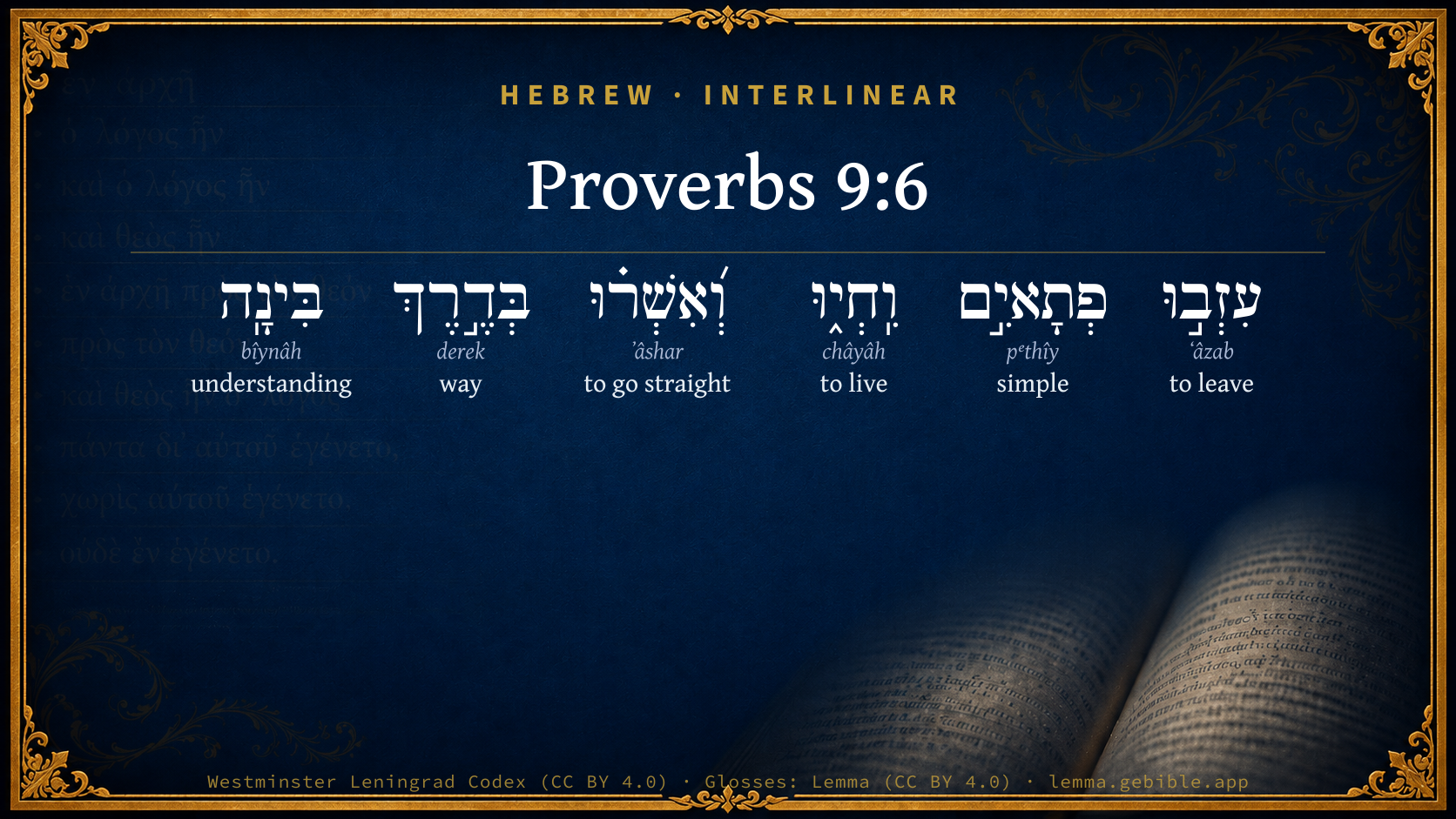
Proverbs 9:6

Hebrew (Westminster Leningrad Codex) Proverbs 9:6 appears in the Hebrew Old Testament. The text above is from the Westminster Leningrad Codex. Each word links to its Strong’s number, a concise gloss, and parsing drawn from the Open Scriptures Hebrew Bible morphology. Click any word for its full Brown-Driver-Briggs (BDB) entry.
Download image
Cite this verse

Proverbs 9:6 (World English Bible). Public Domain. Lemma interlinear Bible study tool, https://lemma.gebible.app/v/proverbs/9/6.

Show BibTeX & RIS
BibTeX
RIS
English Translation
Leave your simple ways, and live. Walk in the way of understanding."
World English Bible · Public Domain
Download a study sheet

One document with this verse’s original text, its word-by-word gloss line, the meaning frame, cross-references with their text, attributed commentary, and full source and license credits — printable, and it pastes into notes with its structure intact.

This verse Autodidact and up

Study sheet (.html) Plain text (.txt)

A passage Seminary Student

Up to 50 verses in one chapter. A passage sheet keeps up to 6 commentary sources and 12 cross-references per verse, in the order this page ranks them, and says so on the sheet whenever that leaves anything out. Ask for a single verse and you get the Autodidact verse sheet above.

Everything on this page stays free to read, with no account — the sheet is a download of what is already on screen, not access to it.

Want to remove ads? Support Godless Engineer
Compare translations 3

The same verse in 3 English versions, stacked beneath the original-language interlinear above. Click any original word for its lexicon entry.

Each is an independent rendering of the whole verse — the interlinear is not word-aligned to these translations.

Highlighted words mark where these versions differ — a whole-verse word diff, not a word-by-word alignment.

  • World English Bible Public Domain
    Leave your simple ways, and live. Walk in the way of understanding."
  • King James Version Public Domain
    Forsake the foolish, and live; and go in the way of understanding.
  • unfoldingWord Literal Text CC BY-SA 4.0
    Forsake naive things and live; and stride on the way of understanding.

unfoldingWord Literal Text — © unfoldingWord, licensed CC BY-SA 4.0. Word-aligned USFM3 via Door43 (git.door43.org/unfoldingWord/en_ult).

Versions to compare (up to 4)

3 of 4 selected

Show all 18 translations

Every available English version of this verse, each an independent rendering of the whole verse.

  • World English Bible Public Domain
    Leave your simple ways, and live. Walk in the way of understanding."
  • Berean Standard Bible Public Domain
    Leave your folly behind, and you will live; walk in the way of understanding.”
  • Majority Standard Bible Public Domain
    Leave your folly behind, and you will live; walk in the way of understanding.”
  • King James Version Public Domain
    Forsake the foolish, and live; and go in the way of understanding.
  • American Standard Version (1901) Public Domain
    Leave off, ye simple ones, and live; And walk in the way of understanding.
  • Revised Version (1885) Public Domain
    Leave off, ye simple ones, and live; and walk in the way of understanding.
  • Geneva Bible (1599) Public Domain
    Forsake your way, ye foolish, and ye shall liue: and walke in the way of vnderstanding.
  • Douay-Rheims (1899) Public Domain
    Forsake childishness, and live, and walk by the ways of prudence.
  • Young's Literal Translation Public Domain
    Forsake ye, the simple, and live, And be happy in the way of understanding.
  • Literal Standard Version CC BY-SA 4.0
    Forsake the simple and live, || And be blessed in the way of understanding.”
  • Unlocked Literal Bible CC BY-SA 4.0
    Leave your naive actions and live; walk in the path of understanding.
  • unfoldingWord Literal Text CC BY-SA 4.0
    Forsake naive things and live; and stride on the way of understanding.
  • Darby Bible Public Domain
    Forsake follies and live, and go in the way of intelligence.
  • World Messianic Bible Public Domain
    Leave your simple ways, and live. Walk in the way of understanding.”
  • Webster's Bible Public Domain
    Forsake the foolish, and live; and go in the way of understanding.
  • Free Bible Version CC BY-SA 4.0
    Leave your foolish ways and you will live; follow the path that makes sense.”
  • Bible in Basic English Public Domain
    Give up the simple ones and have life, and go in the way of knowledge.
  • JPS Tanakh (1917) Public Domain
    Forsake all thoughtlessness, and live; and walk in the way of understanding.

Literal Standard Version (2020), Covenant Press — licensed CC BY-SA 4.0. Text via the HelloAO Bible API (eBible.org). Unlocked Literal Bible (unfoldingWord) — licensed CC BY-SA 4.0. Text via the HelloAO Bible API (eBible.org). unfoldingWord Literal Text — © unfoldingWord, licensed CC BY-SA 4.0. Word-aligned USFM3 via Door43 (git.door43.org/unfoldingWord/en_ult). Free Bible Version, Dr. Jonathan Gallagher — licensed CC BY-SA 4.0. Text via the HelloAO Bible API (eBible.org).

Word by word

More ways to search: Search by grammar → Find every occurrence → Compare this word →

Practice this passage: Drill this verse → Learn its vocabulary →

וְ֝אִשְׁר֗וּ
ʼâshar
H833
“and · go straight”
Conjunction + Verb, Qal, Imperative, 2nd Person, Masculine, Plural
Part of Speech
Conjunction + Verb
Stem
Qal
Form
Imperative
Person
2nd Person
Gender
Masculine
Number
Plural
Full BDB Definition

Origin: a primitive root

TWOT: 183

to go straight, walk, go on, advance, make progress - (Qal) to go straight on, make progress - (Piel) - to go straight on, advance - to lead on (causative) - to set right, righten - to pronounce happy, call blessed - (Pual) - to be advanced, be led on - to be made happy, be blessed
  1. עִזְב֣וּ ʻâzab H5800 “leave” Verb, Qal, Imperative, 2nd Person, Masculine, Plural
  2. פְתָאיִ֣ם pᵉthîy H6612 “simple ones” Noun, Common, Masculine, Plural, Absolute
  3. וִֽחְי֑וּ châyâh H2421 “and · live” Conjunction + Verb, Qal, Imperative, 2nd Person, Masculine, Plural
  4. בְּדֶ֣רֶךְ derek H1870 “in/at · way of” Preposition + Noun, Common, Both, Singular, Construct
  5. בִּינָֽה bîynâh H998 “understanding” Noun, Common, Feminine, Singular, Absolute

About this verse

These counts appear in no published source. They are computed here, from the morphology-tagged text and Lemma’s own curated glosses. What Lemma adds →

6
words
6
distinct lemmas
Wisdom
section

Notable vocabulary

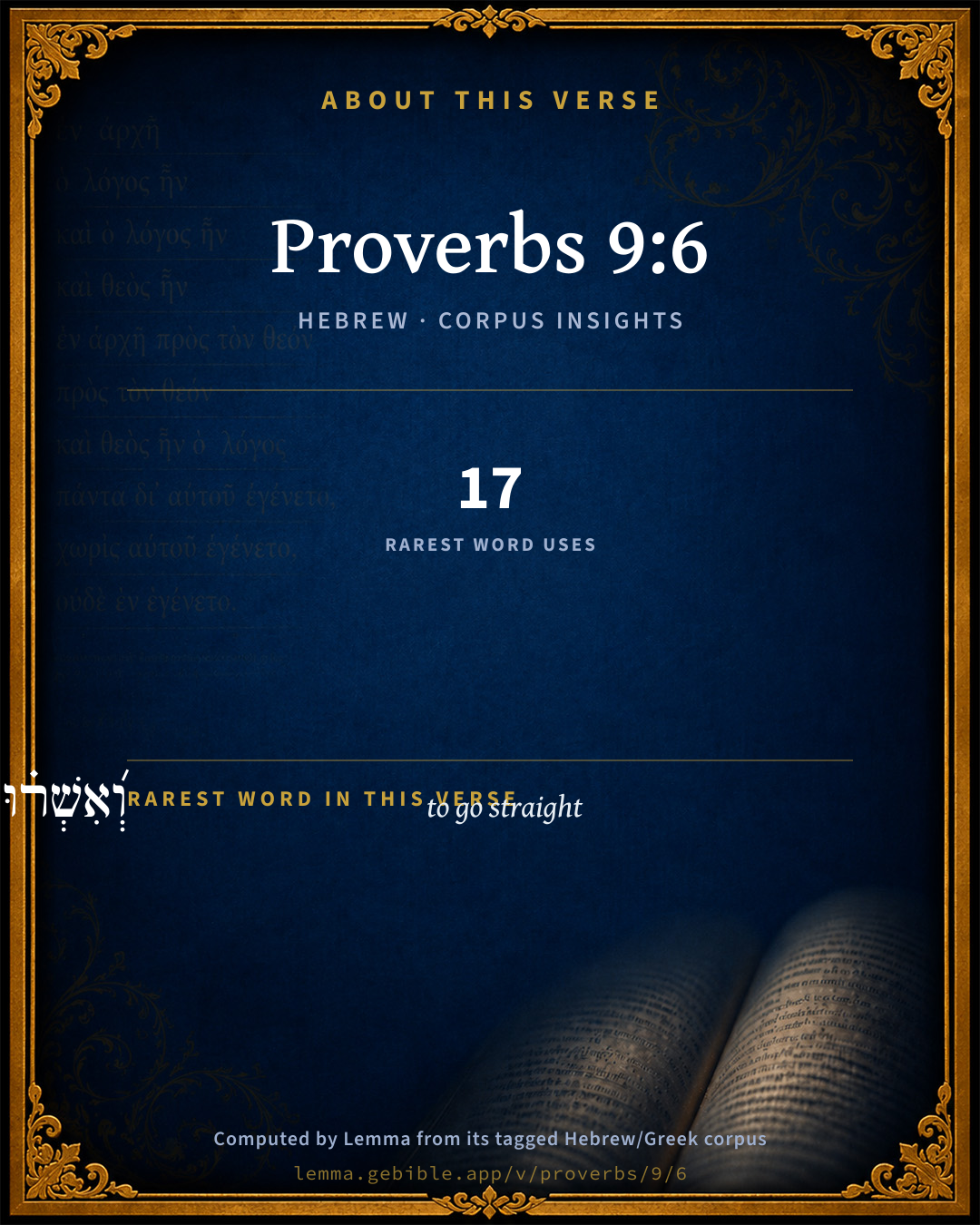
The rarest word here is וְ֝אִשְׁר֗וּ to go straight H833 — appearing just 17 times in the whole Hebrew Bible.

Shared distinctive vocabulary

וְ֝אִשְׁר֗וּ to go straight H833 occurs in 15 verses of the Hebrew Bible. Also found in:

Grammatical profile

  • 3 verbs
  • 3 nouns

Verb forms

  • עִזְב֣וּ Qal · Imperative
  • וִֽחְי֑וּ Qal · Imperative
  • וְ֝אִשְׁר֗וּ Qal · Imperative

Hebrew & Septuagint length

In English translation the verse runs 12 words from the Hebrew and 16 from the Septuagint (LXX English) — closely comparable.

A rough comparison of the two English renderings, which tokenize alike — not a word-level alignment.

Word counts can differ between the Hebrew and the Greek without any difference in meaning — e.g. the Hebrew direct-object marker אֵת has no separate Greek word, and Greek often adds the article ὁ.

Cross-references

13

Topical passages linked to Proverbs 9:6 in the Treasury of Scripture Knowledge — connected by theme and wording, ordered by reader-vote popularity; previews shown in the World English Bible.

  • Proverbs 13:20 One who walks with wise men grows wise, But a companion of fools suffers harm.
  • Proverbs 4:11 I have taught you in the way of wisdom. I have led you in straight paths.
  • Luke 13:24 "Strive to enter in by the narrow door, for many, I tell you, will seek to enter in, and will not be able.
  • 2 Corinthians 6:17 Therefore, "'Come out from among them, And be separate,' says the Lord, 'Touch no unclean thing. I will receive you.
  • Psalms 26:4–6 I have not sat with deceitful men, Neither will I go in with hypocrites.
  • Psalms 45:10 Listen, daughter, consider, and turn your ear. Forget your own people, and also your father's house.
  • Psalms 119:115 Depart from me, you evildoers, That I may keep the commandments of my God.
  • Proverbs 4:14–15 Don't enter into the path of the wicked. Don't walk in the way of evil men.
  • Proverbs 8:35 For whoever finds me, finds life, And will obtain favor from Yahweh.
  • Proverbs 9:11 For by me your days will be multiplied. The years of your life will be increased.
  • Matthew 7:13–14 "Enter in by the narrow gate; for wide is the gate and broad is the way that leads to destruction, and many are those who enter in by it.
  • Acts 2:40 With many other words he testified, and exhorted them, saying, "Save yourselves from this crooked generation!"
  • Revelation 18:4 I heard another voice from heaven, saying, "Come out of her, my people, that you have no participation in her sins, and that you don't receive of her plagues,

Cross-references courtesy of OpenBible.info (CC BY 4.0).

Hebrew and Greek witnesses Masoretic Hebrew ↔ Greek Septuagint

The same verse in the two great witnesses to the Old Testament, shown verse-for-verse.

These are two independent witnesses, not word-aligned to each other, and the Septuagint is shown in lemma (dictionary) form.

Hebrew Proverbs 9:6 Masoretic · Westminster Leningrad Codex

עִזְב֣וּ פְתָאיִ֣ם וִֽחְי֑וּ וְ֝אִשְׁר֗וּ בְּדֶ֣רֶךְ בִּינָֽה

Leave your simple ways, and live. Walk in the way of understanding."

World English Bible · Public Domain

Greek LXX Proverbs 9:6 Septuagint · lemma form

ἀπολείπω ἀφροσύνη καί ζάω καί ζητέω φρόνησις ἵνα βιόω καί ὀρθόω ἐν γνῶσις σύνεσις

Leave folly, that you⌃ may reign for ever; and seek wisdom, and improve understanding by knowledge.

LXX2012 (modern English Septuagint) · Public Domain

On this verse, The Cambridge Bible for Schools and Colleges discusses the Septuagint’s reading. Read the note in Commentary ↓

Hebrew: Westminster Leningrad Codex (CC BY 4.0). Greek: Septuagint (public domain); English from LXX2012 (modern English Septuagint) (Public Domain). How the Septuagint differs from the Hebrew →

Commentary

Notes on Proverbs 9:6 from classic Christian and Jewish commentators (each source and its license shown beneath its notes). The classic Christian expositions comment on the surrounding passage and are grouped to its opening verse, so a note may address several verses; the Jewish commentaries on the Tanakh (Rashi and others) are per-verse, so they appear only where the commentator wrote on this verse.

Lemma curates 59 commentaries, every one of them public domain or Creative Commons licensed, each selected and text-cleaned for this edition rather than reprinted as found. About our sources →

Trapp's Complete Commentary

John Trapp

Pro 9:6 Forsake the foolish, and live; and go in the way of understanding.

Ver. 6. Forsake the foolish.] No coming to this feast in the tattered rags of the old Adam; you must relinquish your former evil courses and companies. There are those who read the words thus, "Forsake, O foolish ones - viz., your own ways - and live."

And go in the way of understanding.] Renounce your vices, and practise the contrary graces. True repentance stands in an entire change of the whole man, from all that is evil to all that is good.

John Trapp, A Commentary or Exposition upon All the Books of the Old and New Testament (1647–1656) — public domain. Text from a community e-Sword module.

The Biblical Illustrator

Joseph S. Exell

Pro_9:6

Forsake the foolish, and live; and go in the way of understanding.

The foolish way forsaken

True religion includes two particulars, called in Scripture ceasing to do evil, and learning to do well.

I. What are the two ways mentioned in our text--namely, the way of the foolish and the way of understanding?

1. And with regard to the character of the foolish--whom and whose ways we are to forsake--how different is the estimate of the Word of God from the current opinions of mankind! The world usually account that man foolish who does not make the things of this life, in one or other of its aspects, the great object of his desires. The covetous man thinks him foolish who neglects the pursuit of riches, or is not skilful in obtaining them; the man of pleasure, him who does not endeavour to secure ease and amusement; the ambitious man, him who does not attain worldly honours. But, in the estimate of Scripture, though we had the worldly wisdom of each or all these classes of persons, and had not something infinitely above it, we should be numbered among the foolish. The rich man spoken of by our Lord, whose ground brought forth plentifully, was accounted a fool And why? Because he was laying up treasures for himself upon earth, and was not rich towards God; because he disregarded the great end and object of his being; because he made no preparation for death. In short, sin of every kind--irreligion, disobedience to God, and carelessness respecting our immortal interests--is called in Scripture foolishness. And can any folly be greater than sporting, as it were, upon the brink of eternity; calling down upon us the anger of our Almighty Creator; rejecting the means which He has provided for our pardon and reconciliation, or perverting the gospel of His mercy to our own destruction?

2. Such being the way of the foolish, we may easily infer what is the way of understanding. Behold, said Job, the fear of the Lord, that is wisdom; and to depart from evil is understanding. The knowledge of the Holy, says Solomon, in the chapter from which our text is taken, is understanding; and a good understanding, says the psalmist, have all they who do His commandments.

II. The importance of forsaking the one and going in the other. Forsake the foolish, and live; and go in the way of understanding.

1. And let us inquire why we must forsake the foolish, ungodly companions, ungodly practices, ungodly thoughts, ungodly books, everything that is ungodly. It might be sufficient to satisfy our reason to answer, that our Creator has commanded us to forsake them. But, in addition, He is pleased to appeal to our hopes and fears, by promises and threatenings. Forsake the foolish, and live; implying that the ways of the foolish are ways of death. Shall we not, then, forsake so dangerous a path, a path beset with thorns and snares.

2. But, in addition to the command to forsake the foolish, our text adds, And go in the way of understanding. These two duties are indeed inseparable; for the first step out of the path of destruction is a step in the path of life; yet it is important that each should be particularly noticed, because we are too apt to content ourselves with a few feeble advances, a few superficial attainments in religion, as if the victory were complete when we are but girding on our armour for the warfare. It is not enough that we have learned that the ways of sin are ways of bitterness and folly; we must, in addition, learn what is the way of understanding: we must walk in the paths of righteousness. And infinitely important is it that we should go in this way of understanding; for by no other path can we arrive at the kingdom of heaven. The language of the text shows us that religion involves active and zealous exertion. There is one path to be forsaken, and another to be discovered and pursued. To forsake means more than careless indifference, or partial reformation, or a temporary suspension of our evil habits. It is a fixed and determined resolution. (The Christian Observer.)

The Biblical Illustrator, edited by Joseph S. Exell (c. 1880s–1900s) — public domain. Text from a community e-Sword module.

Tyndale Open Study Notes

Tyndale Open Resources

9:6 Wisdom gives people the ability to navigate life successfully.

Tyndale Open Study Notes — © Tyndale Open Resources, licensed CC BY-SA 4.0. Text via the HelloAO Bible API.

Adam Clarke's Commentary

Verse 6. Forsake the foolish] For the companion of fools must be a fool.

And live] Answer the end for which thou wert born.

Adam Clarke's Commentary on the Bible (1810–1826) — public domain. Text from a community e-Sword/MySword module.

Ellicott's Commentary for English Readers

(6) Forsake the foolish.—Rather, the simple; be no longer counted among the weak, who can be “carried about with every wind of doctrine” (Eph_4:14), but “stand fast in the faith, quit you like men, be strong” (1Co_16:13).

A Bible Commentary for English Readers, edited by Charles John Ellicott (1878–1897) — public domain. Text from a community e-Sword module.

The Cambridge Bible for Schools and Colleges

gen. ed. J. J. S. Perowne

6. Forsake the foolish] Rather, forsake, ye simple (sc. your simplicity): come to a decision; your present neutral position (see note on Pro_1:4, “the simple”) is untenable. Your choice lies between Wisdom and “the scorner,” Pro_9:7. Therefore break altogether with the scorner and the wicked man, and become the guests of Wisdom. See next note. Comp. 2Co_6:17-18; 2Co_7:1.

“The old versions” (e.g. LXX. ἀπολείπετε ἀφροσύνην) and most modern commentators regard the noun as abstract, equivalent to the sing. פְחִי in Pro_1:22, or the abstract derivative פְחַיוּח in Pro_9:13 below, and therefore translate, ‘Forsake simplicity, let your simplicity go’.” Lange ad loc., who however rejects this view.

The Cambridge Bible for Schools and Colleges (gen. ed. J. J. S. Perowne; Cambridge University Press, 1878–1918) — public domain. Text from a community e-Sword module.

John Gill's Exposition

Forsake the foolish,.... Foolish men and their company; not men of weak abilities in things natural and civil, or who are reckoned foolish by the world; for so the saints are, whose company is not to be neglected and forsaken; but such who are wickedly foolish, who are ignorant of divine things, and make a mock at sin and at religion; such company is very unsuitable for Wisdom's guests; such as turn in to her house ought to forsake these; it is quite out of character for Wisdom's followers to be the companions of fools; it is very unprofitable to keep company with such vain men, yea, very pernicious and hurtful, and of very bad consequence; it corrupts good manners, and causes grief, and breaks peace, sooner or later; it is quite unbecoming them to converse with them; they are called out from among them by Christ, and should obey: and, besides, they have better company to attend unto: and they should also forsake "foolish" (m) things; the Septuagint version renders it, "foolishness"; and the Arabic version, "imprudence"; the Targum and Syriac version, "want of understanding", or "judgment"; foolish lusts, which are hurtful, and war against the soul, and which should be denied and abstained from; and all foolish ways, their own or others', which are dangerous and lead to ruin; and all foolish doctrines, such as are contrary to the Scriptures, to the doctrine of Christ and his apostles; that tend to degrade any of the Persons of the Trinity, to obscure or lessen the grace of God in man's salvation, or to exalt the creature; all such are to be forsaken, shunned, and avoided, and by no means countenanced and encouraged;

and live; which may be considered either as an exhortation, as the foregoing; live on the provisions of Wisdom's house, on her bread and her wine; live on Christ himself by faith; live not as the foolish do, but as the wise; live not to yourselves, nor to the lusts of men, but to the will and glory of God; live not in sin, but unto righteousness; live not to the flesh, nor after it, but to and after the spirit: or as a promise by way of encouragement, and as enforcing the preceding exhortation, "and ye shall live" (n); honourably, and not scandalously, as they do that keep company with the foolish; comfortably and delightfully, as they do that turn into Wisdom's house, and are her guests; such live in communion with Christ, and with his people; they live a spiritual life now, and shall live an eternal one hereafter;

and go in the way of understanding; as such do that quit the conversation of foolish men, and become the guests of Wisdom; such are in, and go in the way of understanding, who frequently attend the throne of grace, and ask wisdom of the Father of lights; the Spirit of wisdom and revelation in the knowledge of divine things, which they that ask have; Solomon got all his wisdom and understanding this way: such are in the way of it, and go in the way of it, who constantly and carefully read the Scriptures, which are able to make a man wise unto salvation; who go up to the house of the Lord as often as they have opportunity, that they may be taught by trim; who sit under the ministry of Gospel preachers, that feed men with knowledge and understanding; who submit to Gospel ordinances, and keep the commandments of Christ; for such are said to have a good understanding; they show that they have, and by these means get and increase it; see Psa 111:10; and who also converse with knowing and experienced Christians; for "he that walketh with wise men shall be wise", Pro 13:20.

(m) "imperitiam", Tigurine version; "stultitias", Vatablus; "fatuitates", Piscator, Schultens; "stoliditates", Gejerus, Gussetius, p. 703. (n) "et vivetis", Pagninus, Vatablus, Piscator, Mercerus, Michaelis.

John Gill's Exposition of the Whole Bible (1746–1763) — public domain (CC PDM 1.0). Text via the HelloAO Bible API.

Matthew Poole's English Annotations

The foolish, i.e. the wicked, and their courses and society: you must either forsake them or me, for we are irreconcilable enemies.

In the way of understanding; which leads to it, and is prescribed by it.

Matthew Poole's English Annotations on the Holy Bible (1683–1685) — public domain. Text from a community e-Sword/MySword module.

Whedon's Commentary on the Bible

Daniel D. Whedon

6. The foolish — Same word as in Pro_9:4, rendered “simple,” but here in the plural abstract, follies.

And go — אשׁרו, (ishrou,) go straight forward.

Daniel D. Whedon (gen. ed.), Commentary on the Old and New Testaments (1874–1909) — public domain. Text from a community e-Sword module.

The Pulpit Commentary

Forsake the foolish, and live; Vulgate, relinquite infantiam; Septuagint, apoleipete afrosunhn , "leave folly." These versions take the plural (petaim) as equivalent to an abstract noun, which gives a good sense; but the plural is not so used in our book, so we must admit the rendering of the Authorized Version, "Quit the class, give up being of the category of fools," or else we must take the word as vocative, "Leave off, ye simple ones" (Revised Version), i.e. quit your simplicity, your folly. And live. (see on Pro_4:4) It is not a mere prosperous life on earth that is here promised, but something far higher and better. (Joh_6:51, "If any man eat of this bread, he shall live forever The LXX saw something of this when they paraphrased the clause, "Leave ye folly, that ye may reign forever." Go in the way of understanding. Leaving folly, stay not, but make real progress in the direction of wisdom. Septuagint, "Seek ye prudence, and direct understanding by knowledge."

The Pulpit Commentary (1880–1919), ed. H.D.M. Spence-Jones & Joseph S. Exell — public domain. Text from a community e-Sword module.

Rashi

Rabbi Shlomo Yitzchaki (Rashi)

Leave, you simpletons the way of simplicity and live.

and step Heb. מסכתי, an expression of stepping, as in (Job 23:11): “To his steps (באשרו) my foot was held fast.”

Rashi on the Tanakh — English translations: “The Judaica Press complete Tanach with Rashi, translated by A. J. Rosenberg” (CC BY 4.0); “Pentateuch with Rashi's commentary by M. Rosenbaum and A.M. Silbermann, 1929-1934” (public domain); “The Metsudah Tanach series, Lakewood, N.J” (CC BY 4.0); and “The Book of Joshua, Metsudah Publications, 1997” (CC BY 4.0). Text via Sefaria.

Lesson kit

Teaching starters — assembled from the data on this page, not authored interpretation. Every prompt links to the verse data it draws on. Edit before teaching.

Proverbs, in the Wisdom, opens this verse with 6 words (6 distinct Hebrew lemmas). Its most distinctive word is ʼâshar (“to go straight”). A historical commentator’s framing appears above. Read the whole chapter for the surrounding context.

Discussion questions

  1. What does “to go straight” (ʼâshar) contribute to the verse as a whole?
  2. Genesis 30:13 shares the word «to go straight» with this verse. How do the two illuminate each other?
  3. The translations on this page render this verse differently — a whole-verse word diff, not a word-by-word alignment. What might account for the different wordings?
  4. The verb «עִזְב֣וּ» is Qal Imperative. How does its form color the action?
  5. Reading how Trapp's Complete Commentary and The Biblical Illustrator read this verse, where do the two commentators agree and where do they part?

Things to notice

Reading settings

Reading text

Shown beneath each verse's original-language words.

Old Testament
Old Testament edition

Read the OT as the Masoretic Hebrew (MT) or the Greek Septuagint (LXX).

English shown for the Greek Septuagint (in the Hebrew ↔ Greek comparison).

Comparing translations? Open the Compare panel on any verse page to stack up to four side by side.