
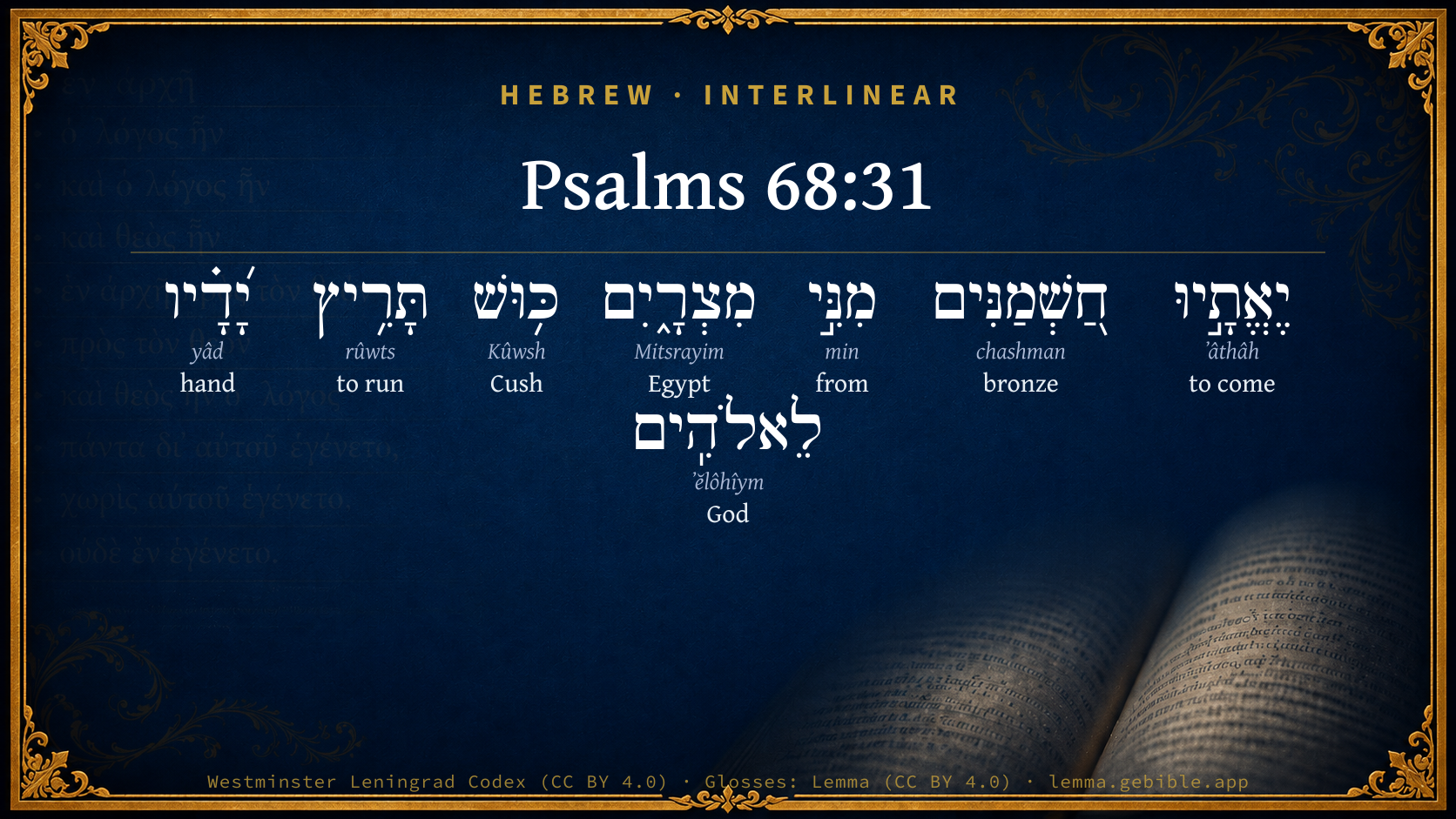
Psalms 68:31

Hebrew (Westminster Leningrad Codex) Psalms 68:31 appears in the Hebrew Old Testament. The text above is from the Westminster Leningrad Codex. Each word links to its Strong’s number, a concise gloss, and parsing drawn from the Open Scriptures Hebrew Bible morphology. Click any word for its full Brown-Driver-Briggs (BDB) entry.
Download image
Cite this verse

Psalms 68:31 (World English Bible). Public Domain. Lemma interlinear Bible study tool, https://lemma.gebible.app/v/psalms/68/31.

Show BibTeX & RIS
BibTeX
RIS
English Translation
Princes shall come out of Egypt. Ethiopia shall hurry to stretch out her hands to God.
World English Bible · Public Domain
Highlights
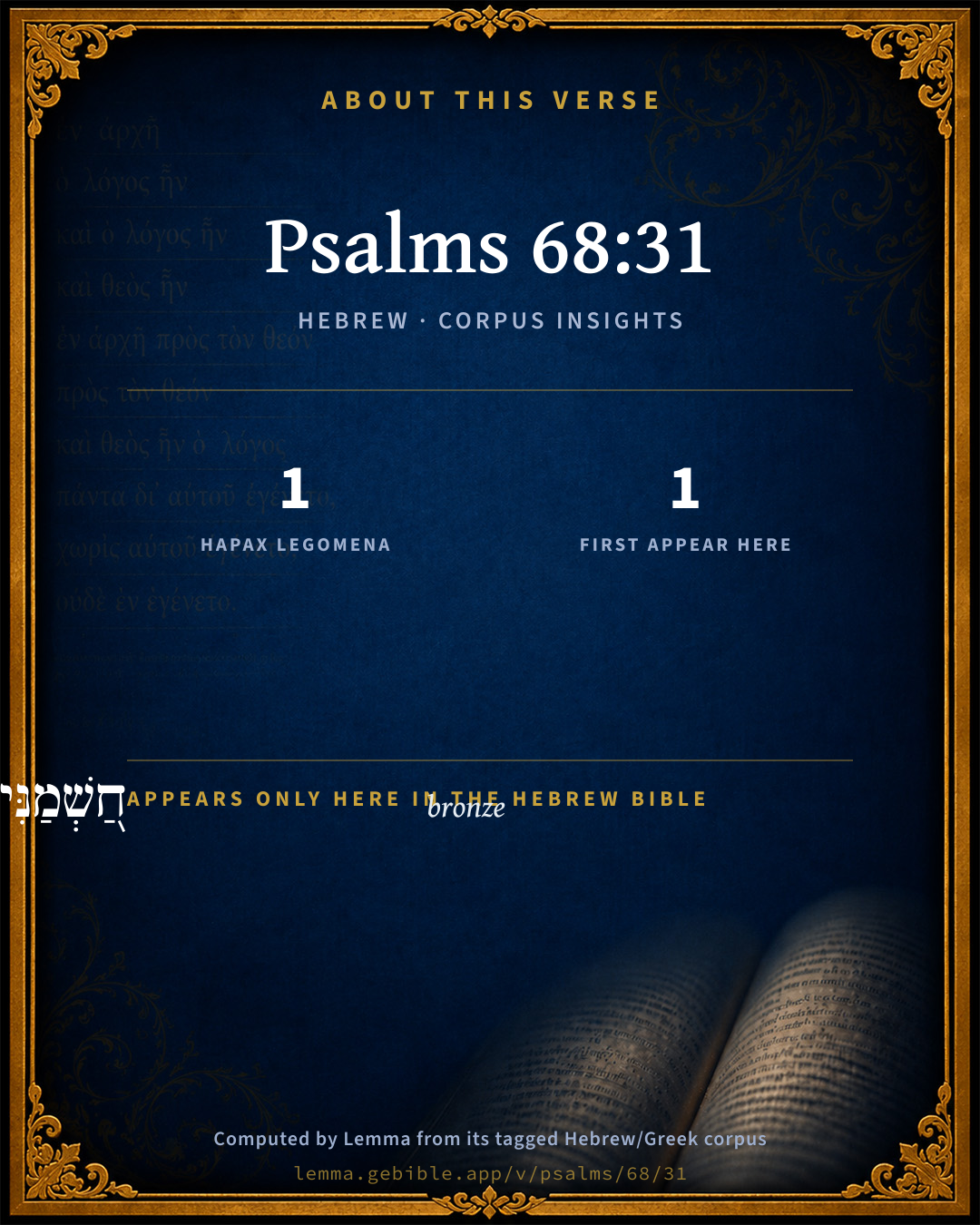
  • 1 hapax legomenon — only here in the Hebrew Bible
  • 1 first appearance in the Hebrew Bible
Full analysis ↓
Download a study sheet

One document with this verse’s original text, its word-by-word gloss line, the meaning frame, cross-references with their text, attributed commentary, and full source and license credits — printable, and it pastes into notes with its structure intact.

This verse Autodidact and up

Study sheet (.html) Plain text (.txt)

A passage Seminary Student

Up to 50 verses in one chapter. A passage sheet keeps up to 6 commentary sources and 12 cross-references per verse, in the order this page ranks them, and says so on the sheet whenever that leaves anything out. Ask for a single verse and you get the Autodidact verse sheet above.

Everything on this page stays free to read, with no account — the sheet is a download of what is already on screen, not access to it.

Want to remove ads? Support Godless Engineer
Compare translations 3

The same verse in 3 English versions, stacked beneath the original-language interlinear above. Click any original word for its lexicon entry.

Each is an independent rendering of the whole verse — the interlinear is not word-aligned to these translations.

Highlighted words mark where these versions differ — a whole-verse word diff, not a word-by-word alignment.

  • World English Bible Public Domain
    Princes shall come out of Egypt. Ethiopia shall hurry to stretch out her hands to God.
  • King James Version Public Domain
    Princes shall come out of Egypt; Ethiopia shall soon stretch out her hands unto God.
  • unfoldingWord Literal Text CC BY-SA 4.0
    Nobles will come from Egypt; Cush will make its hands run to God.

unfoldingWord Literal Text — © unfoldingWord, licensed CC BY-SA 4.0. Word-aligned USFM3 via Door43 (git.door43.org/unfoldingWord/en_ult).

Versions to compare (up to 4)

3 of 4 selected

Show all 18 translations

Every available English version of this verse, each an independent rendering of the whole verse.

  • World English Bible Public Domain
    Princes shall come out of Egypt. Ethiopia shall hurry to stretch out her hands to God.
  • Berean Standard Bible Public Domain
    Envoys will arrive from Egypt; Cush will stretch out her hands to God.
  • Majority Standard Bible Public Domain
    Envoys will arrive from Egypt; Cush will stretch out her hands to God.
  • King James Version Public Domain
    Princes shall come out of Egypt; Ethiopia shall soon stretch out her hands unto God.
  • American Standard Version (1901) Public Domain
    Princes shall come out of Egypt; Ethiopia shall haste to stretch out her hands unto God.
  • Revised Version (1885) Public Domain
    Princes shall come out of Egypt; Ethiopia shall haste to stretch out her hands unto God.
  • Geneva Bible (1599) Public Domain
    Then shall the princes come out of Egypt: Ethiopia shall hast to stretche her hands vnto God.
  • Douay-Rheims (1899) Public Domain
    Rebuke the wild beasts of the reeds, the congregation of bulls with the kine of the people; who seek to exclude them who are tried with silver. Scatter thou the nations that delight in wars:
  • Young's Literal Translation Public Domain
    Come do fat ones out of Egypt, Cush causeth her hands to run to God.
  • Literal Standard Version CC BY-SA 4.0
    Fat ones come out of Egypt, || Cush causes her hands to run to God.
  • Unlocked Literal Bible CC BY-SA 4.0
    Princes will come out of Egypt; Cush will hurry to reach out with her hands to God.
  • unfoldingWord Literal Text CC BY-SA 4.0
    Nobles will come from Egypt; Cush will make its hands run to God.
  • Darby Bible Public Domain
    Great ones shall come out of Egypt; Ethiopia shall quickly stretch out her hands unto God.
  • World Messianic Bible Public Domain
    Princes shall come out of Egypt. Ethiopia shall hurry to stretch out her hands to God.
  • Webster's Bible Public Domain
    \\68:30\\Rebuke the company of spearmen, the multitude of the bulls, with the calves of the people, till every one shall submit himself with pieces of silver: scatter thou the people that delight in war.
  • Free Bible Version CC BY-SA 4.0
    Let Egypt come with bronze gifts; let Ethiopia come quickly and hand over their tributes to God!
  • Bible in Basic English Public Domain
    Kings will give you offerings, they will come out of Egypt; from Pathros will come offerings of silver; Ethiopia will be stretching out her hands to God.
  • JPS Tanakh (1917) Public Domain
    (68-32) Nobles shall come out of Egypt; Ethiopia shall hasten to stretch out her hands unto God.

Literal Standard Version (2020), Covenant Press — licensed CC BY-SA 4.0. Text via the HelloAO Bible API (eBible.org). Unlocked Literal Bible (unfoldingWord) — licensed CC BY-SA 4.0. Text via the HelloAO Bible API (eBible.org). unfoldingWord Literal Text — © unfoldingWord, licensed CC BY-SA 4.0. Word-aligned USFM3 via Door43 (git.door43.org/unfoldingWord/en_ult). Free Bible Version, Dr. Jonathan Gallagher — licensed CC BY-SA 4.0. Text via the HelloAO Bible API (eBible.org).

Word by word

More ways to search: Search by grammar → Find every occurrence → Compare this word →

Practice this passage: Drill this verse → Learn its vocabulary →

About this verse

These counts appear in no published source. They are computed here, from the morphology-tagged text and Lemma’s own curated glosses. What Lemma adds →

8
words
8
distinct lemmas
Wisdom
section

Notable vocabulary

1 hapax legomenon — a word that appears only here in the entire Hebrew Bible:

  • חַ֭שְׁמַנִּים bronze H2831

First appearance in Scripture

This word makes its first canonical appearance in the Hebrew Bible here:

  • חַ֭שְׁמַנִּים bronze H2831

Shared distinctive vocabulary

יֶאֱתָ֣יוּ to come H857 occurs in 20 verses of the Hebrew Bible. Also found in:

Grammatical profile

  • 2 verbs
  • 5 nouns
  • 1 preposition

Verb forms

  • יֶאֱתָ֣יוּ Qal · Imperfect
  • תָּרִ֥יץ Hiphil · Imperfect

Hebrew & Septuagint length

In English translation the verse runs 16 words from the Hebrew and 17 from the Septuagint (LXX English) — closely comparable.

A rough comparison of the two English renderings, which tokenize alike — not a word-level alignment.

Word counts can differ between the Hebrew and the Greek without any difference in meaning — e.g. the Hebrew direct-object marker אֵת has no separate Greek word, and Greek often adds the article ὁ.

Cross-references

11

Topical passages linked to Psalms 68:31 in the Treasury of Scripture Knowledge — connected by theme and wording, ordered by reader-vote popularity; previews shown in the World English Bible.

  • Isaiah 45:14 Thus says Yahweh: "The labor of Egypt, and the merchandise of Ethiopia, and the Sabeans, men of stature, shall come over to you, and they shall be yours. They shall go after you. In chains they shall come over; and they shall fall down to you. They shall make supplication to you: 'Surely God is in you; and there is none else, there is no other god.
  • Zephaniah 3:10 From beyond the rivers of Cush, my worshipers, even the daughter of my dispersed people, will bring my offering.
  • Psalms 44:20 If we have forgotten the name of our God, Or spread forth our hands to a strange god;
  • Isaiah 19:18–25 In that day there shall be five cities in the land of Egypt that speak the language of Canaan, and swear to Yahweh of hosts; one shall be called The city of destruction.
  • Acts 8:27–40 He arose and went; and behold, there was a man of Ethiopia, a eunuch of great authority under Candace, queen of the Ethiopians, who was over all her treasure, who had come to Jerusalem to worship.
  • Psalms 72:8–11 He shall have dominion also from sea to sea, From the River to the ends of the earth.
  • Psalms 143:6 I spread forth my hands to you. My soul thirsts for you, like a parched land. Selah.
  • Isaiah 60:6–7 The multitude of camels shall cover you, the dromedaries of Midian and Ephah; all they from Sheba shall come; they shall bring gold and frankincense, and shall proclaim the praises of Yahweh.
  • 1 Kings 8:22 Solomon stood before the altar of Yahweh in the presence of all the assembly of Israel, and spread forth his hands toward heaven;
  • Psalms 88:9 My eyes are dim from grief. I have called on you daily, Yahweh. I have spread out my hands to you.
  • Isaiah 66:19 I will set a sign among them, and I will send such as escape of them to the nations, to Tarshish, Pul, and Lud, who draw the bow, to Tubal and Javan, to the isles afar off, who have not heard my fame, neither have seen my glory; and they shall declare my glory among the nations.

Cross-references courtesy of OpenBible.info (CC BY 4.0).

Hebrew and Greek witnesses Masoretic Hebrew ↔ Greek Septuagint

The same verse in the two great witnesses to the Old Testament, shown verse-for-verse.

You’re reading Greek Psalm 67 (Hebrew Psalm 68). The Septuagint counts the superscription, so verse numbers can differ from the Hebrew — chapter-level alignment, not verse-by-verse. Numbering follows Rahlfs.

These are two independent witnesses, not word-aligned to each other, and the Septuagint is shown in lemma (dictionary) form.

Hebrew Psalms 68:31 Masoretic · Westminster Leningrad Codex

יֶאֱתָ֣יוּ חַ֭שְׁמַנִּים מִנִּ֣י מִצְרָ֑יִם כּ֥וּשׁ תָּרִ֥יץ יָ֝דָ֗יו לֵאלֹהִֽים

Princes shall come out of Egypt. Ethiopia shall hurry to stretch out her hands to God.

World English Bible · Public Domain

Greek LXX Greek Psalm 67:31 Septuagint · lemma form

ἐπιτιμάω ὁ θηρίον ὁ κάλαμος ὁ συναγωγή ὁ ταῦρος ἐν ὁ δάμαλις ὁ λαός ὁ μή ἀποκλείω ὁ δοκιμάζω ὁ ἀργύριον διασκορπίζω ἔθνος ὁ ὁ πόλεμος θέλω

Ambassadors shall arrive out of Egypt; Ethiopia shall hasten to stretch out her hand readily to God.

LXX2012 (modern English Septuagint) · Public Domain

On this verse, The Cambridge Bible for Schools and Colleges discusses the Septuagint’s reading. Read the note in Commentary ↓

Hebrew: Westminster Leningrad Codex (CC BY 4.0). Greek: Septuagint (public domain); English from LXX2012 (modern English Septuagint) (Public Domain). How the Septuagint differs from the Hebrew →

Commentary

Notes on Psalms 68:31 from classic Christian and Jewish commentators (each source and its license shown beneath its notes). The classic Christian expositions comment on the surrounding passage and are grouped to its opening verse, so a note may address several verses; the Jewish commentaries on the Tanakh (Rashi and others) are per-verse, so they appear only where the commentator wrote on this verse.

Lemma curates 59 commentaries, every one of them public domain or Creative Commons licensed, each selected and text-cleaned for this edition rather than reprinted as found. About our sources →

Trapp's Complete Commentary

John Trapp

Psa 68:31 Princes shall come out of Egypt; Ethiopia shall soon stretch out her hands unto God.

Ver. 31. Princes shall come out of Egypt] The Gentiles shall one day be called, and caused Deum verum cognoscere et colere; even Egypt, that archenemy of the Church; and Ethiopia, the offspring of cursed Ham.

Ethiopia shall soon stretch out her hands to God] Heb. shall make her hands to run; whereby is noted her speediness in giving or in receiving the gospel, Manibus pedibusque obnixe omnia faciet (Terent.). It is likely that that good eunuch, Act 8:26-39, preached the Christian verity which himself had embraced, for goodness is diffusive; and birds, when they come to a full heap of corn, will chirp and call in for their fellows. The Habassines are still a kind of Christians, the Nubians have forsaken the faith once delivered, and embraced instead of it partly Mahometanism, and partly idolatry, through lack of ministers, as Alvarez reports (Hist. Aethi. cap. 137).

John Trapp, A Commentary or Exposition upon All the Books of the Old and New Testament (1647–1656) — public domain. Text from a community e-Sword module.

The Biblical Illustrator

Joseph S. Exell

Psa_68:31

Ethiopia shall soon stretch out her hands unto God.

Ethiopias appeal

Ethiopia is a woman who, after the manner of the poets, represents the whole race of the Ethiopians, just as Britannia, in our songs, represents all the Britons. By Ethiopia the Jews usually meant the country next to Egypt, Ethiopia proper, the cradle of the African race. Even to this day the Africans bury their dead with their faces towards the north-east, their first home. Fix now your pitying eye upon Ethiopia. She is--

I. Helpless. Hands outstretched are signals of distress, which the weak always use. The other year hundreds were burnt or suffocated in a church at Santiago, and all the dead were found standing with hands outstretched. The veil has just been lifted from the Dark Continent, and lo! there stands before us a woman with the slave-stick around her neck. And like a child in fear, like a weakling imploring help, her hands are heavenwards. Let Livingstone and other African travellers tell the horrors of the slave trade. Africa is dark indeed, and as such is full of the habitations of cruelty. It has been for two thousand years the slave-hunting ground of the world. And white men have had a great share in it. Bleeding Ethiopia, helpless before the cruelty of man, feels equally helpless in presence of the unseen. Through fear they are all their lifetime subject to bondage. To their fear of wild beasts and wilder men is added their great fear of evil spirits. For the Africans are religious in their own poor way; but their whole religion is a weary effort to ward off the spirits of the departed, who, as they think, are full of vengeance, and able to haunt and destroy them. They believe the air to be filled with millions of spirits, all cruel and bent on mischief. Hence they give themselves up to devil-worship. Then their idols are fearful to look upon, and their religion is only a religion of fear. How touching to read of their longings, their lonely helplessness, their dread of the strange land beyond the dark mountains. The boldest hunter when dying will cry for his mother, though she has been dead for many years. He knows no one else who would be minded to help him in the dark valley. One who knew them well says, There is nothing more heartrending than their death-wails. When they turn their eyes to the future world, they have a view cheerless enough of their own utter helplessness and hopelessness. Their thoughts often wander through the future. Do people die with you? two young cannibals asked Livingstone. Have you no charm against death? He spoke to them of the Great Father who hears the cry of His children: and they thought this to be natural. But--

II. Ethiopia is seeking help. The salt mines in Austria lately illustrated this subject to me. The abundance of salt God has stored there is beyond belief. The miners dig a narrow drain into the rock and let in fresh water. The water sucks the salt out of the rock, which then falls in, and soon the whole rock is melted down. Commerce and exploration are digging their channels through the rocky barriers of heathendom, and letting in civilized ideas, which are quietly penetrating and melting down every heathen system, and creating a vacancy which we should fill with the blessed Gospel. We talk of an open door among the heathen; in many places it is all door together. Even heathens are advertising for a better religion than their own. Hardly one educated young Indian has now any heart-faith in Hinduism. Mrs. Brassey advises all who wish to see Japan to go at once, else they will never see it, ms European customs are spreading everywhere.

III. Ethiopia is hopeful. Our text prophesies that she shall soon stretch out her hands unto God, soon after the Gospel is brought to her, in the morning of the day of her opportunity. No spiritual sluggard, she shall early and eagerly make her hands run unto God, as the word means. Her hands, turned from idols, shall be opened to receive Gods gifts, or, as some believe, shall be filled with offerings of homage and service. When he came here there were no Christians; when he went away there were no heathen--these words describe the life-work of a missionary who was only twenty-four years on the island of Ancityum. Some say our text means that Ethiopias hands will be filled with splendid offerings of gratitude to God. We may expect this. Robert Moffat, famishing and wearied, was once ordered not to enter a heathen village. Under shadow of night a woman brought him a bundle of wood, a bowl of milk, and a leg of mutton, kindled a fire and cooked the meat in silence. As he pressed her to tell the reason of her kindness, the tears stole down her sable cheek as she said, I love Him whose servant you are, and surely it is my duty to give you a cup of cold water in His name. My heart is full, and therefore I cannot speak the joy I feel to see you in this out-of-the-way place. All was explained by a New Testament which she drew from her bosom, and showed to the delighted missionary. Let your heart go out to Ethiopia, and let your helping hands meet her outstretched hands. Cherish a generous grief over Ethiopias woes, and believe that God calls you to help the weak He has taught you to pity. Have a full faith in the promise, apparently never so near fulfilment as now, Ethiopia shall soon stretch out her hands unto God. (James Wells, M. A.)

The heathen brought to the saving knowledge of God

I. The present mournful condition of the heathen world without God.

1. Enveloped in gross darkness.

2. Groping in vain and painfully to find happiness.

3. In a state of rebellion against God.

4. Hopeless and helpless in their state of darkness.

II. The glorious prospect which these words hold out of their conversion to God.

1. The Word of God shall yet be sent, and the Gospel shall be preached unto them.

2. The power of the Holy Spirit accompanying the Word will render it effectual for their salvation.

3. The ultimate success of the Gospel among the heathen is most certain.

4. The present time affords great encouragement to earnest, energetic and prayerful efforts for the salvation of the heathen. (John Ritchie.)

The missionary call

1. We appeal to you to scorn any man who is fattening upon the vices of weaker nations. Scorn any man who is amassing wealth, by importing guns and ammunition, or fire-water, into these poor, degraded nations of the world.

2. We ask you to consecrate the great wealth of this great city--which comes from all quarters of the earth--we ask you to consecrate some of this wealth in giving back to these various quarters of the world the Gospel which we rejoice in here.

3. We ask you to give some of your sons and some of your daughters to carry this Gospel of the Lord Jesus Christ. If there is a grand opening in a mercantile house at Zanzibar, you immediately find numbers taking advantage of it. If there is an opening for a young man on the river Niger, many are willing to go. We ask that there shall be the same readiness to take hold of opportunities in the mission field that there is now to take hold of openings in mercantile enterprise. And so we shall joy to see the kingdom of our blessed Lord and Master extended throughout the world. The last of the triumphs shall be this, when these heathen nations have bowed the knee to Jesus. (E. A. Stuart, M. A.)

.

Psa_69:1-36

The Biblical Illustrator, edited by Joseph S. Exell (c. 1880s–1900s) — public domain. Text from a community e-Sword module.

Joseph Benson's Commentary

Psa 68:31. Princes shall come out of Egypt — The word חשׁמנים, chashmannim, here rendered princes, is not found elsewhere in the Scriptures, and therefore its precise meaning is not certainly known. Elias, a Jewish rabbi, observes that the Jews call cardinals by this name in Italy: and the term is thought to signify a princely person accompanied by a numerous attendance. The Seventy render it πρεσβεις, elders, senators, or ambassadors. It does not appear from Scripture, whether any of the great men of Egypt came up to worship the true God at Jerusalem, while the temple was standing, or not. But it is certain that, in after ages, a great number of the inhabitants of Egypt were Jews, whether it was that they were of Jewish original, and whose ancestors had betaken themselves thither, or whether they were originally Egyptians who had embraced the Jewish religion. The Prophet Isaiah foretold, that it should come to pass that five cities in the land of Egypt should speak the language of Canaan, and swear to the Lord of hosts, that is, worship him. Ethiopia shall soon stretch out her hands unto God — Either in the way of humble supplication and submission, begging mercy of him, or to offer up the presents expressed Psa 68:29. He only mentions Egypt and Ethiopia, as having been the great and ancient enemies of God and of his church, and as a most wicked and idolatrous people; but by them he understands all other nations of a like character. And he here expresses his hope, that the victories which he and the Israelites should gain over the neighbouring nations would induce even those which were more remote, and most addicted to idolatry, to come to Jerusalem, and join themselves to the worshippers of the true God. And his hopes were so far realized, that when, through the instrumentality of David, the surrounding “hostile powers were overthrown, and the church of Israel was fully established, the more distant nations, even those which had been most given to idolatry, sued for her friendship, and came to Jerusalem with gifts and oblations.” — Horne. But this prophecy, as also that contained in the next verse, evidently belongs to the times of the Messiah, when the Gentiles were to be brought to the knowledge and worship of the true God; with the thoughts and hopes whereof David often comforted himself in that confined and afflicted state of the church in his time.

Joseph Benson's Commentary on the Old and New Testaments (1811–1818) — public domain. Text from a community e-Sword module.

J. A. Alexander on Psalms

Joseph Addison Alexander

32. (Psa 68:31). Princes shall come out of Egypt; Ethiopia shall soon stretch out her hands unto God. Egypt is again named as the representative of the Gentile world, but in conjunction with the neighbouring state of Cush or Ethiopia, often referred to by the prophets as a powerful and splendid empire. See Isa 18:7; Isa 45:14, Zep 3:10. The word translated princes means originally fat ones, elsewhere put for prosperous and potent men. See above, on Psa 22:29. From this word is supposed to be derived the name Hasmonean, which was given to the Maccabees or Jewishprinces in the interval between the Old and New Testaments. Soon stretch out is not a version but a paraphrase of the original expression, which means strictly, make its hands to run, and may perhaps denote the eagerness with which the action is performed.

Joseph Addison Alexander, The Psalms Translated and Explained (1850) — public domain. Text from a community e-Sword module.

Geneva Bible (1599)

Geneva Bible translators

He prophecieth that the Gentiles shall come to the true knowledge and worship of God.

Geneva Bible (1599) marginal notes — public domain. Text via Bolls.life.

Jamieson, Fausset & Brown

Robert Jamieson, A. R. Fausset & David Brown

Princes--or, literally, "fat ones," the most eminent from the most wealthy, and the most distant nation, represent the universal subjection.

stretch out her hands--or, "make to run her hands," denoting haste.

Jamieson, Fausset & Brown — Commentary Critical and Explanatory on the Whole Bible (1871) — public domain (CC PDM 1.0). Text via the HelloAO Bible API.

Adam Clarke's Commentary

Verse 31. Ethiopia shall soon stretch out her hands unto God.] This verse had its literal fulfilment under Solomon, when Egypt formed an alliance with that king by his marriage with Pharaoh's daughter; and when the queen of Sheba came to Jerusalem to hear the wisdom of Solomon. But as this may be a prophetic declaration of the spread of Christianity, it was literally fulfilled after the resurrection of our Lord. There were Egyptians at Jerusalem on the day of Pentecost, who, St. Hilary tells us, on their return to their own country proclaimed what they had seen, and became in that country the ambassadors of Christ. The Ethiopian eunuch was one of the first among the Gentiles who received the Gospel. Thus princes or chief men came out of Egypt, and Ethiopia stretched out her hands to God. The words themselves refer to the sending ambassadors, and making alliances. The Hebrew is very emphatic: כוש תריץ ידיו לאלהים cush tarits yadiav lelohim; Cush will cause her hands to run out to God. She will, with great alacrity and delight, surrender her power and influence unto God. The Chaldee paraphrases well: "The sons of Cush will run, that they may spread out their hands in prayer before God."

Adam Clarke's Commentary on the Bible (1810–1826) — public domain. Text from a community e-Sword/MySword module.

John Calvin's Commentaries

31. Princes shall come out of Egypt. He resumes the strain of thanksgiving, and confirms what he had previously asserted, that kings would come and pay tribute unto God. The examples which he brings forward are those of the Egyptians and Ethiopians. This sufficiently proves that the prediction must be extended to Christ, by whom the Egyptians and Ethiopians were brought under the sway of God. The word תריף, tarits, translated, shall soon stretch out, might have been rendered, shall cause to run. But it seemed necessary to soften the harshness of the figure. It is doubtful whether the allusion be to the promptness with which they should yield subjection, or whether he means that they would stretch out their hands to entreat pardon, this being an attitude common to suppliants. According to either interpretation, it is their submission which is intended, and it is enough to know that David asserts that Ethiopia and Egypt would come under the power of God, and not they only, but the most distant parts of the world.

John Calvin's Commentaries (1540-1563) — public domain. Text from the Calvin Translation Society English edition (1840s-50s) via the Christian Classics Ethereal Library (ccel.org). Calvin's coverage is partial (roughly two-thirds of the Bible); uncommented books and verses are honest gaps, never fabricated. The 19th-century editor's footnotes and remarks are omitted so the notes are faithfully Calvin's own voice.

Ellicott's Commentary for English Readers

(31) Princes.—Or, magnates.

Ethiopia.—Literally, Cush shall make to run his hands to God, an idiom easily intelligible, expressing hasty submission.

(32–35) A noble doxology, worthy of the close of one of the finest Hebrew hymns.

A Bible Commentary for English Readers, edited by Charles John Ellicott (1878–1897) — public domain. Text from a community e-Sword module.

The Cambridge Bible for Schools and Colleges

gen. ed. J. J. S. Perowne

31. Princes] Or, magnates. LXX πρέσβεις, ambassadors. The word occurs here only, and is of doubtful meaning.

shall soon stretch out &c.] R.V., shall haste to stretch out her hands unto God, either in token of submission (cp. Lat. dare manus); or in supplication (cp. Isa_45:14); or with gifts of homage (Psa_72:10; Isa_18:7). Egypt and Ethiopia are often coupled together, and they are mentioned here as examples of the nations which come to pay homage, the one as the typical ancient enemy of Israel (cp. Isa_19:19 ff.), the other as a remote nation of noble appearance and formidable reputation (Isa_18:1; Isa_18:7). Cp. Isa_45:14. Their submission signifies that the most inveterate foes of God and His people, and the most remote and the noblest of the peoples of the world, acknowledge His supremacy. Morians in P.B.V. means ‘Moors,’ ‘blackamoors,’ the Heb. Cush being taken as a general term for ‘Africans.’

The Cambridge Bible for Schools and Colleges (gen. ed. J. J. S. Perowne; Cambridge University Press, 1878–1918) — public domain. Text from a community e-Sword module.

John Gill's Exposition

Princes shall come out of Egypt,.... The Vulgate Latin and all the Oriental versions render it "ambassadors". This verse is a prophecy of the conversion of the Gentiles, under the names of Egypt and Ethiopia; which will be at the same time that the kings of the earth will become Christians, and antichrist will be destroyed. The Gospel is said to be preached in Egypt by Mark the Evangelist; and no doubt but there were conversions there in the first times of the Gospel; but there will be more in the latter day; see Psa 87:3. Unless we understand this of kings and princes, that shall leave the communion of the church of Rome, which is spiritually and mystically Egypt, and join themselves with the true churches of see Rev 11:8. The conversion of every sinner is a coming out of Egypt; it is a call of them out of darkness and bondage, worse than that of Egypt, into light and liberty, when they are set among princes, even the princes of Christ's people;

Ethiopia shall soon stretch out her hands unto God; the Gospel is said to be preached in Ethiopia by the Evangelist Matthew, and also by Matthias, who succeeded Judas in the apostleship; by means of whose ministry there is reason to conclude some were converted: and we have an instance of a famous Ethiopian, that was converted and baptized by Philip, Act 8:27; and who very likely carried the Gospel into this country, and spread it: so that this prophecy began to have its fulfilment then, but will have a greater hereafter; see, Psa 87:4. All men are like Ethiopians, even God's elect, in a state of nature and unregeneracy: they are black with original sin and actual transgressions; and can no more remove this blackness than the Ethiopian can change his skin, Jer 13:23. They are, like them, idolaters, serving divers lusts and pleasures, the idols of their own hearts; are in a state of distance, afar off from God and Christ, and from his people, word, and ordinances; and are enemies in their minds by wicked works, yea, enmity itself, and stretch out their hands against God; but when they are called and converted, and made sensible of their state, then they stretch out their hands unto God, as a gesture of sorrow, Jer 4:31; expressing their sorrow for sin, as committed against God, and because of the evil that is in it; and look to Christ, and stretch out their hands to him, whom they have pierced, and mourn; and as a prayer gesture, Job 11:13. For, as soon as a man is converted, he prays and cries to God for pardoning grace and mercy, and to be cleansed from his sin, and to be openly received into his favour, and to enjoy communion with him; and as the gesture of a man in the utmost danger, who stretches out, his hand to lay hold on anything to save him; and so a sinner, sensible of its danger, and seeing Christ and salvation in him, it stretches out its hand, lays hold on him, and will have him and no other to be its Saviour, and receives his righteousness, and grace out of his fulness; and as the gesture of one that is conquered, resigning up himself into the victor's hands, as a token of submission, peace, and reconciliation (m); so sinners, in the day of Christ's power upon them, are made willing to submit and give up themselves to him. In the Hebrew text it is, "shall make her hands to run unto God" (n); that is, with an offering, gold or some treasure, to bring it unto God, as Aben Ezra, Kimchi, and Ben Melech, interpret it, which may very well be understood of the offering of themselves, as well as of the spiritual sacrifices of prayer and praise. The Targum is,

"the sons of Ham shall come, the great men out of Egypt, to be made proselytes; the children of Cush (or Ethiopia) shall run to stretch out their hands in prayer to God.''

Jarchi's note is,

"and then when thou shalt destroy Esau (his posterity), and the King Messiah shall arise, they shall bring to thee gifts out of Ethiopia.''

And so he owns this to be a prophecy of the Messiah; and so it is applied to the times of the Messiahs and to the nations bringing gifts to him, in the Talmud (o), and other Jewish writings (p).

(m) Vid. Caesar. Comment. de Bello Gallic. l. 7. c. 48. "Oremus pacem et dextras tendamus inermes". Virgil. Aeneid. 11. (n) "faciet currere", Pagninus, Montanus, Gejerus, Michaelis. (o) T. Bab. Pesachim, fol. 118. 2. (p) Shemot Rabba, s. 35. fol. 136. 4.

John Gill's Exposition of the Whole Bible (1746–1763) — public domain (CC PDM 1.0). Text via the HelloAO Bible API.

Albert Barnes' Notes on the Bible

Princes shall come out of Egypt - That is, Shall come and acknowledge the true God. Egypt is referred to here as one of the most prominent of the foreign nations then known; and the idea is, that the distinguished men of foreign nations - the rulers and princes of the world - would come and submit themselves to God, and be united to his people. The word rendered “princes” here - חשׁמנים chashmaniym - occurs nowhere else in the Scriptures. It means, according to Gesenius (Lexicon), the fat; then, the rich; the opulent; nobles. It is the word from which the name “Hasmonean” (or Asmonean), which was given by the Jews to the Maccabees, or Jewish princes in the time of the Jewish history between the Old and New Testaments, is supposed to have been derived. The Septuagint, the Vulgate, and the Syriac, render it “legates” or “ambassadors.” Luther renders it “princes.” The reference is undoubtedly to men of station or rank.

Ethiopia - Hebrew, “Cush.” On the meaning of this word in the Scriptures, see the notes at Isa 11:11.

Shall soon stretch out her hands - literally, “Shall make its hands to run.” The expression denotes the eagerness or haste with which it would be done. The act is an act of supplication, and the reference is to prayer.

Unto God - To the true God. The nation will supplicate the mercy of God, or will worship him. The idea, in accordance with that in the previous verses, is, that the country here referred to would become subject to the true God. It is a view of the future; of the time when the nations would be converted to the true faith, or would acknowledge the true God. Whether this refers to the Cush in Arabia, or to the Cush in Africa (Ethiopia as commonly understood), it is a description of what will yet occur, for all these lands, and all other lands, will be converted to the true religion, and will stretch out their hands in supplication and prayer, and will find acceptance with God. Even Africa - wronged, degraded, oppressed, injured Africa - will do it; and the worship of her children will be as acceptable to the Universal Father as that of any other of the races of mankind that dwell on the earth.

Albert Barnes' Notes on the Bible (1834–1885) — public domain. Text from a community e-Sword/MySword module.

Matthew Poole's English Annotations

Egypt, Ethiopia: he names only these, as the great and ancient enemies of God, and of his people, and as a most wicked, and idolatrous, and incorrigible sort of men; see Jer 13:23; Amo 9:7; but by them he synecdochically understands all other nations and people of the like character.

Stretch out her hands unto God; either in way of humble supplication and submission, begging mercy of him; or to offer up the presents expressed, Psa 68:29. But this prophecy, as also the next verse, evidently belongs to the times of the Messiah, when the Gentiles were tel be brought in to the knowledge and worship of the true God; with the thoughts and hopes whereof David oft comforteth himself in that confined and afflicted state of the church in his time.

Matthew Poole's English Annotations on the Holy Bible (1683–1685) — public domain. Text from a community e-Sword/MySword module.

The Treasury of David

Charles H. Spurgeon

Ver. 31. Princes shall come out of Egypt. Old foes shall be new friends. Solomon shall find a spouse in Pharaoh's house. Christ shall gather a people from the realm of sin. Great sinners shall yield themselves to the sceptre of grace, and great men shall become good men, by coming to God.

Ethiopia shall soon stretch out her hands unto God. Cush shall hasten to present peace offerings. Sheba's queen shall come from the far south. Candace's chamberlain shall ask of Him who was led as a lamb to the slaughter. Abyssinia shall yet be converted, and Africa become the willing seeker after grace, eagerly desiring and embracing the Christ of God. Poor Ethiopia, thy hands have been long manacled and hardened by cruel toil, but millions of thy sons have in their bondage found the liberty with which Christ made men free; and so thy cross, like the cross of Simon of Cyrene, has been Christ's cross, and God has been thy salvation. Hasten, O Lord, this day, when both the civilization and the barbarism of the earth shall adore thee, Egypt and Ethiopia blending with glad accord in thy worship! Here is the confidence of thy saints, even thy promise; hasten it in thine own time, good Lord.

Ver. 31. Ethiopia. It is a matter of fact, familiar to the learned reader, that the names Ethiopia, and "Ethiopians, " are frequently substituted in our English version of the Old Testament, where the Hebrew preserves the proper name, "Cush." And the name, "Cush, "when so applied in Scripture, belongs uniformly not to the African, but to the Asiatic, Ethiopia, or Arabia. Charles Forster, in "The Historical Geography of Arabia."

Charles H. Spurgeon's The Treasury of David (1869–1885) — public domain. Psalms only. Text from a community e-Sword/MySword module.

Whedon's Commentary on the Bible

Daniel D. Whedon

31. The language is henceforward only prophetic of the victories of Messiah, his majesty and glory, and the submission of the nations.

Egypt— The first of the nations who oppressed Israel, shall adopt her faith and submit to Jehovah. Comp. Isa_19:18-22.

Ethiopia—Hebrew, Cush, the dark skinned, which more commonly applies to Arabia, but in later times sometimes to Ethiopia proper.

Stretch out her hands unto God— That is, pray to God, (for this was the form of prayer, Psa_44:20,) in evidence that she had cast off her idolatry. Psa_28:2

Daniel D. Whedon (gen. ed.), Commentary on the Old and New Testaments (1874–1909) — public domain. Text from a community e-Sword module.

The Pulpit Commentary

Princes shall come out of Egypt. Then shall princely ambassadors come to Zion out of Egypt, and make submission. (comp. Isa_43:3 Isa_45:14) Ethiopia shall soon stretch out her hands unto God. The Ptolemies, in their wars with Syria, often sought the favour of the Jews. Christian Churches at an early date were established both in Egypt and in Abyssinia, and some of the most promising mission fields today are in Africa.

The Pulpit Commentary (1880–1919), ed. H.D.M. Spence-Jones & Joseph S. Exell — public domain. Text from a community e-Sword module.

John Wesley's Explanatory Notes

Ethiopia - He names these, as the ancient enemies of God, and of his people; but by them he understands all other nations of the like character. Unto God - Begging mercy of him. This prophecy, as also the next verse, evidently belongs to the times of the Messiah.

John Wesley, Explanatory Notes Upon the Whole Bible (1754–1765) — public domain. Text via the GEBible commentary corpus.

Rashi

Rabbi Shlomo Yitzchaki (Rashi)

Rebuke the people of the forest This is Ishmael [Esau], who is compared to the “boar from the forest,” which dwells among the reeds (below 80:14).

the congregation of mighty bulls, among peoples like calves A people that has become fat and thick like mighty bulls among the other nations, which are merely like calves as compared to them.

submitting himself for pieces of silver They do not submit themselves to any person unless he persuades them with money.

he scatters peoples They scattered the tribes, as it is said: (Deut. 33:3): “Also He loves the peoples,” and they always desire battles. They want to fight with us.

Rashi on the Tanakh — English translations: “The Judaica Press complete Tanach with Rashi, translated by A. J. Rosenberg” (CC BY 4.0); “Pentateuch with Rashi's commentary by M. Rosenbaum and A.M. Silbermann, 1929-1934” (public domain); “The Metsudah Tanach series, Lakewood, N.J” (CC BY 4.0); and “The Book of Joshua, Metsudah Publications, 1997” (CC BY 4.0). Text via Sefaria.

Lesson kit

Teaching starters — assembled from the data on this page, not authored interpretation. Every prompt links to the verse data it draws on. Edit before teaching.

Psalms, in the Wisdom, opens this verse with 8 words (8 distinct Hebrew lemmas). Its most distinctive word is chashman (“bronze”). A historical commentator’s framing appears above. Read the whole chapter for the surrounding context.

Discussion questions

  1. What does “bronze” (chashman) contribute to the verse as a whole?
  2. This verse holds 1 word here found nowhere else in the Hebrew Bible. What might the rare word draw attention to?
  3. The word “bronze” first appears here in Scripture. What is being introduced at this debut?
  4. Deuteronomy 33:2 shares the word «to come» with this verse. How do the two illuminate each other?
  5. These translations render this verse differently; the difference is in the English rendering, not the original. What questions does that raise?
  6. The verb «יֶאֱתָ֣יוּ» is Qal Imperfect. How does its form color the action?
  7. Reading how Trapp's Complete Commentary and The Biblical Illustrator read this verse, where do the two commentators agree and where do they part?

Things to notice

  • 1 word in this verse appears nowhere else in the Hebrew Bible.
  • 1 word makes its first canonical appearance in Scripture here.
  • These translations choose different wording for 12 words in this verse.
  • 8 distinct Hebrew lemmas span 8 words in this verse.

Reading settings

Reading text

Shown beneath each verse's original-language words.

Old Testament
Old Testament edition

Read the OT as the Masoretic Hebrew (MT) or the Greek Septuagint (LXX).

English shown for the Greek Septuagint (in the Hebrew ↔ Greek comparison).

Comparing translations? Open the Compare panel on any verse page to stack up to four side by side.