
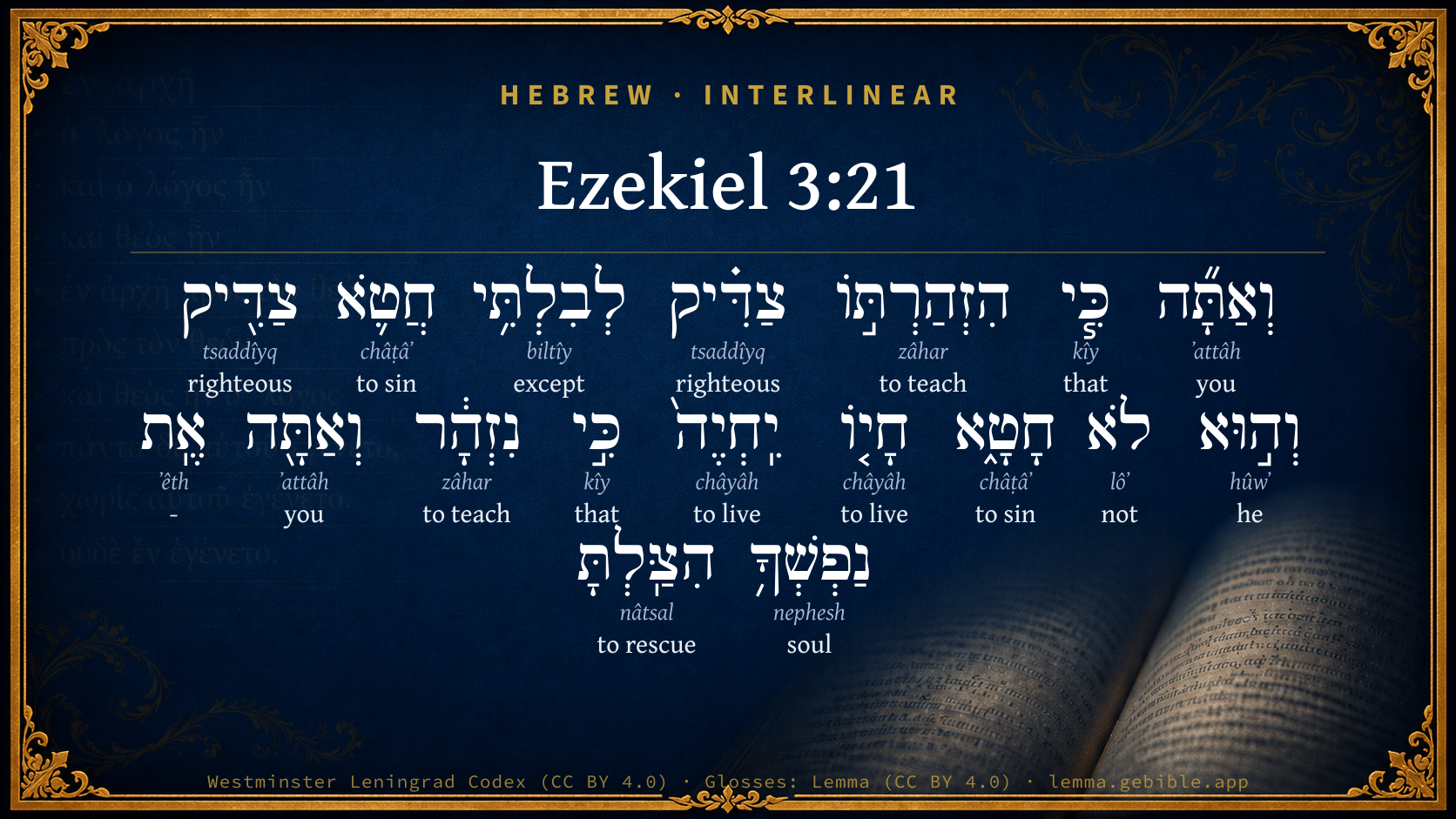
Ezekiel 3:21

Hebrew (Westminster Leningrad Codex) Ezekiel 3:21 appears in the Hebrew Old Testament. The text above is from the Westminster Leningrad Codex. Each word links to its Strong’s number, a concise gloss, and parsing drawn from the Open Scriptures Hebrew Bible morphology. Click any word for its full Brown-Driver-Briggs (BDB) entry.
Download image
Cite this verse

Ezekiel 3:21 (World English Bible). Public Domain. Lemma interlinear Bible study tool, https://lemma.gebible.app/v/ezekiel/3/21.

Show BibTeX & RIS
BibTeX
RIS
English Translation
Nevertheless if you warn the righteous man, that the righteous not sin, and he does not sin, he shall surely live, because he took warning; and you have delivered your soul.
World English Bible · Public Domain
Download a study sheet

One document with this verse’s original text, its word-by-word gloss line, the meaning frame, cross-references with their text, attributed commentary, and full source and license credits — printable, and it pastes into notes with its structure intact.

This verse Autodidact and up

Study sheet (.html) Plain text (.txt)

A passage Seminary Student

Up to 50 verses in one chapter. A passage sheet keeps up to 6 commentary sources and 12 cross-references per verse, in the order this page ranks them, and says so on the sheet whenever that leaves anything out. Ask for a single verse and you get the Autodidact verse sheet above.

Everything on this page stays free to read, with no account — the sheet is a download of what is already on screen, not access to it.

Want to remove ads? Support Godless Engineer
Compare translations 3

The same verse in 3 English versions, stacked beneath the original-language interlinear above. Click any original word for its lexicon entry.

Each is an independent rendering of the whole verse — the interlinear is not word-aligned to these translations.

Highlighted words mark where these versions differ — a whole-verse word diff, not a word-by-word alignment.

  • World English Bible Public Domain
    Nevertheless if you warn the righteous man, that the righteous not sin, and he does not sin, he shall surely live, because he took warning; and you have delivered your soul.
  • King James Version Public Domain
    Nevertheless if thou warn the righteous man, that the righteous sin not, and he doth not sin, he shall surely live, because he is warned; also thou hast delivered thy soul.
  • unfoldingWord Literal Text CC BY-SA 4.0
    But if you warn the righteous man to stop sinning so that he no longer sins, he will surely live since he was warned; and you will have rescued your own life.”

unfoldingWord Literal Text — © unfoldingWord, licensed CC BY-SA 4.0. Word-aligned USFM3 via Door43 (git.door43.org/unfoldingWord/en_ult).

Versions to compare (up to 4)

3 of 4 selected

Show all 18 translations

Every available English version of this verse, each an independent rendering of the whole verse.

  • World English Bible Public Domain
    Nevertheless if you warn the righteous man, that the righteous not sin, and he does not sin, he shall surely live, because he took warning; and you have delivered your soul.
  • Berean Standard Bible Public Domain
    But if you warn the righteous man not to sin, and he does not sin, he will indeed live because he heeded your warning, and you will have saved yourself.”
  • Majority Standard Bible Public Domain
    But if you warn the righteous man not to sin, and he does not sin, he will indeed live because he heeded your warning, and you will have saved yourself.”
  • King James Version Public Domain
    Nevertheless if thou warn the righteous man, that the righteous sin not, and he doth not sin, he shall surely live, because he is warned; also thou hast delivered thy soul.
  • American Standard Version (1901) Public Domain
    Nevertheless if thou warn the righteous man, that the righteous sin not, and he doth not sin, he shall surely live, because he took warning; and thou hast delivered thy soul.
  • Revised Version (1885) Public Domain
    Nevertheless if thou warn the righteous man, that the righteous sin not, and he doth not sin, he shall surely live, because he took warning; and thou hast delivered thy soul.
  • Geneva Bible (1599) Public Domain
    Neuerthelesse, if thou admonish that righteous man, that the righteous sinne not, and that he doeth not sinne, he shall liue because he is admonished: also thou hast deliuered thy soule.
  • Douay-Rheims (1899) Public Domain
    But if thou warn the just man, that the just may not sin, and he doth not sin: living he shall live, because thou hast warned him, and thou hast delivered thy soul.
  • Young's Literal Translation Public Domain
    And thou, because thou hast warned him -- the righteous -- that the righteous sin not, and he hath not sinned, he surely liveth, because he hath been warned; and thou thy soul hast delivered.'
  • Literal Standard Version CC BY-SA 4.0
    And you, because you have warned him—the righteous—that the righteous does not sin, and he has not sinned, he surely lives, because he has been warned; and you have delivered your soul.”
  • Unlocked Literal Bible CC BY-SA 4.0
    But if you warn the righteous man to stop sinning so that he no longer sins, he will surely live since he was warned; and you will have rescued your own life.”
  • unfoldingWord Literal Text CC BY-SA 4.0
    But if you warn the righteous man to stop sinning so that he no longer sins, he will surely live since he was warned; and you will have rescued your own life.”
  • Darby Bible Public Domain
    And if thou warn the righteous [man], that the righteous sin not, and he doth not sin, he shall certainly live, for he hath taken warning; and thou hast delivered thy soul.
  • World Messianic Bible Public Domain
    Nevertheless if you warn the righteous man, that the righteous not sin, and he does not sin, he will surely live, because he took warning; and you have delivered your soul.”
  • Webster's Bible Public Domain
    Nevertheless if thou shalt warn the righteous man, that the righteous sin not, and he doth not sin, he shall surely live, because he is warned; also thou hast delivered thy soul.
  • Free Bible Version CC BY-SA 4.0
    However, if you warn those who are living right not to sin, and they don't sin, they will live for sure, because they paid attention to your warning, and you will have saved yourself—you won't die.”
  • Bible in Basic English Public Domain
    But if you say to the upright man that he is not to do evil, he will certainly keep his life because he took note of your word; and your life will be safe.
  • JPS Tanakh (1917) Public Domain
    Nevertheless if thou warn the righteous man, that the righteous sin not, and he doth not sin, he shall surely live, because he took warning; and thou hast delivered thy soul.'

Literal Standard Version (2020), Covenant Press — licensed CC BY-SA 4.0. Text via the HelloAO Bible API (eBible.org). Unlocked Literal Bible (unfoldingWord) — licensed CC BY-SA 4.0. Text via the HelloAO Bible API (eBible.org). unfoldingWord Literal Text — © unfoldingWord, licensed CC BY-SA 4.0. Word-aligned USFM3 via Door43 (git.door43.org/unfoldingWord/en_ult). Free Bible Version, Dr. Jonathan Gallagher — licensed CC BY-SA 4.0. Text via the HelloAO Bible API (eBible.org).

Word by word

More ways to search: Search by grammar → Find every occurrence → Compare this word →

Practice this passage: Drill this verse → Learn its vocabulary →

הִזְהַרְתּ֣וֹ
zâhar
H2094
“to teach · him”
Verb, Hiphil, Perfect, 2nd Person, Masculine, Singular + Suffix, Personal, 3rd Person, Masculine, Singular
Part of Speech
Verb
Stem
Hiphil
Form
Perfect
Person
2nd Person
Gender
Masculine
Number
Singular
Full BDB Definition

Origin: a primitive root

TWOT: 531 , 532

to admonish, warn, teach, shine, send out light, be light, be shining - (Niphal) to be taught, be admonished - (Hiphil) - to teach, warn - to shine, send out light (figuratively)
  1. וְאַתָּ֞ה ʼattâh H859 “and · you” Conjunction + Pronoun, Personal, 2nd Person, Masculine, Singular
  2. כִּ֧י kîy H3588 “that” Conjunction
  3. צַדִּ֗יק tsaddîyq H6662 “righteous” Adjective, Adjective, Masculine, Singular, Absolute
  4. לְבִלְתִּ֥י biltîy H1115 “to/for · except” Preposition + Conjunction
  5. חֲטֹ֛א châṭâʼ H2398 “to sin” Verb, Qal, Infinitive Construct
  6. צַדִּ֖יק tsaddîyq H6662 “righteous” Adjective, Adjective, Masculine, Singular, Absolute
  7. וְה֣וּא hûwʼ H1931 “and · he” Conjunction + Pronoun, Personal, 3rd Person, Masculine, Singular
  8. לֹא lôʼ H3808 “not” Particle, Negative
  9. חָטָ֑א châṭâʼ H2398 “to sin” Verb, Qal, Perfect, 3rd Person, Masculine, Singular
  10. חָי֤וֹ châyâh H2421 “to live” Verb, Qal, Infinitive Absolute
  11. יִֽחְיֶה֙ châyâh H2421 “to live” Verb, Qal, Imperfect, 3rd Person, Masculine, Singular
  12. כִּ֣י kîy H3588 “that” Conjunction
  13. נִזְהָ֔ר zâhar H2094 “teaching” Verb, Niphal, Participle Active, Masculine, Singular, Absolute
  14. וְאַתָּ֖ה ʼattâh H859 “and · you” Conjunction + Pronoun, Personal, 2nd Person, Masculine, Singular
  15. אֶֽת ʼêth H853 “-” Particle, Direct Object
  16. נַפְשְׁךָ֥ nephesh H5315 “soul · your” Noun, Common, Both, Singular, Construct + Suffix, Personal, 2nd Person, Masculine, Singular
  17. הִצַּֽלְתָּ nâtsal H5337 “to rescue” Verb, Hiphil, Perfect, 2nd Person, Masculine, Singular

About this verse

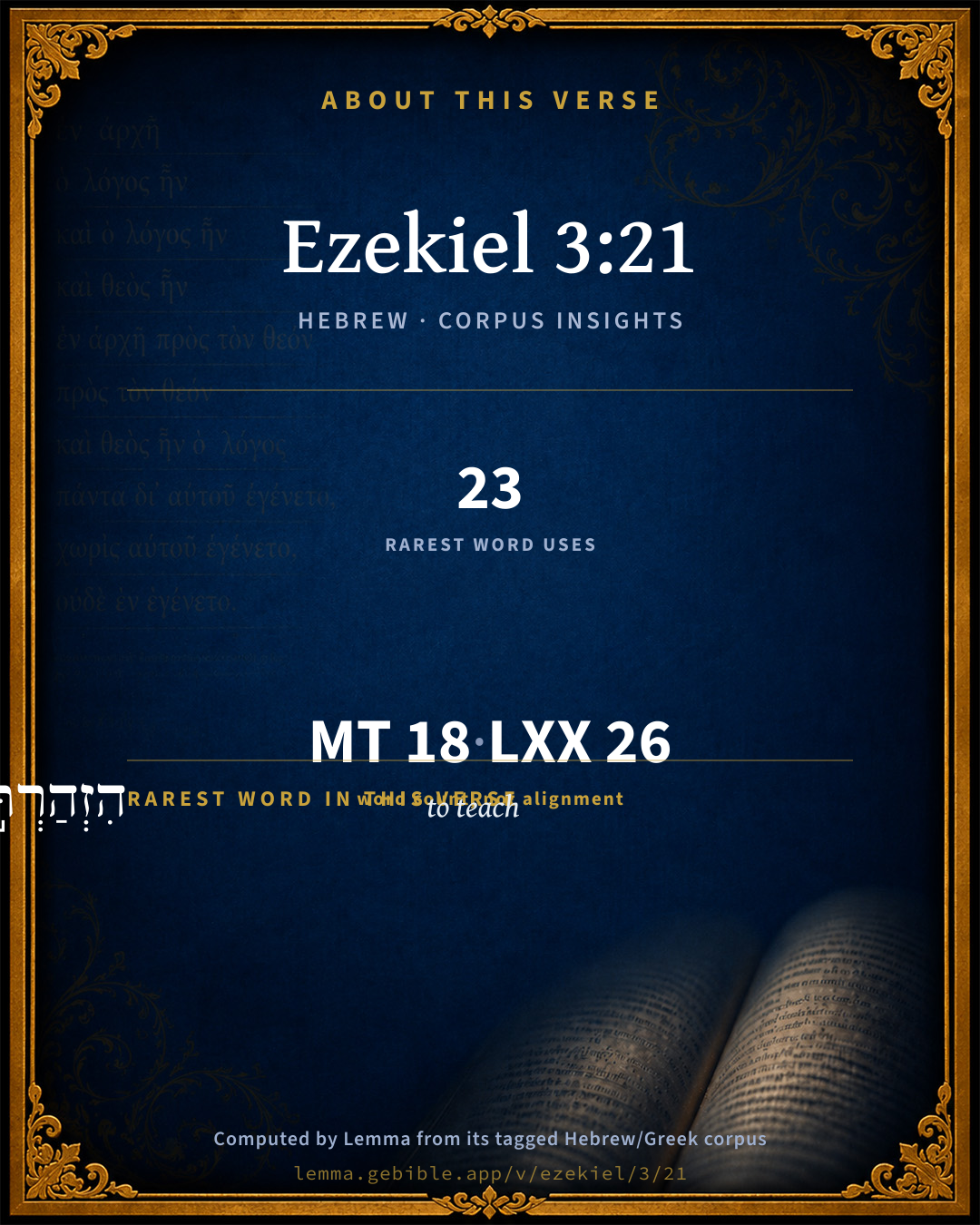
These counts appear in no published source. They are computed here, from the morphology-tagged text and Lemma’s own curated glosses. What Lemma adds →

18
words
12
distinct lemmas
Prophets
section

Notable vocabulary

The rarest word here is הִזְהַרְתּ֣וֹ to teach H2094 — appearing just 23 times in the whole Hebrew Bible.

Shared distinctive vocabulary

הִזְהַרְתּ֣וֹ to teach H2094 occurs in 19 verses of the Hebrew Bible. Also found in:

Grammatical profile

  • 7 verbs
  • 1 noun
  • 2 adjectives
  • 3 pronouns
  • 3 conjunctions
  • 2 particles

Verb forms

  • הִזְהַרְתּ֣וֹ Hiphil · Perfect
  • חֲטֹ֛א Qal · Infinitive Construct
  • חָטָ֑א Qal · Perfect
  • חָי֤וֹ Qal · Infinitive Absolute
  • יִֽחְיֶה֙ Qal · Imperfect
  • נִזְהָ֔ר Niphal · Participle Active
  • הִצַּֽלְתָּ Hiphil · Perfect

Repetition

Words recur within this verse — often emphatic in Hebrew:

  • הִזְהַרְתּ֣וֹ to teach H2094 ×2
  • צַדִּ֗יק righteous H6662 ×2
  • חֲטֹ֛א to sin H2398 ×2
  • חָי֤וֹ to live H2421 ×2
  • וְאַתָּ֞ה you H859 ×2
  • כִּ֧י that H3588 ×2

Hebrew & Septuagint length

In English translation the verse runs 31 words from the Hebrew and 30 from the Septuagint (LXX English) — closely comparable.

A rough comparison of the two English renderings, which tokenize alike — not a word-level alignment.

Word counts can differ between the Hebrew and the Greek without any difference in meaning — e.g. the Hebrew direct-object marker אֵת has no separate Greek word, and Greek often adds the article ὁ.

In the original languages it is 18 Hebrew tokens and 26 Greek tokens — but the two are counted differently (Hebrew bundles its prefixes and suffixes into one token; the Greek is in lemma form), so that isn’t a like-for-like length.

Cross-references

22

Topical passages linked to Ezekiel 3:21 in the Treasury of Scripture Knowledge — connected by theme and wording, ordered by reader-vote popularity; previews shown in the World English Bible.

  • 1 Timothy 4:16 Pay attention to yourself, and to your teaching. Continue in these things, for in doing this you will save both yourself and those who hear you.
  • Proverbs 9:9 Instruct a wise man, and he will be still wiser. Teach a righteous man, and he will increase in learning.
  • 1 Corinthians 4:14 I don't write these things to shame you, but to admonish you as my beloved children.
  • Titus 2:15 Say these things and exhort and reprove with all authority. Let no man despise you.
  • James 5:20 let him know that he who turns a sinner from the error of his way will save a soul from death, and will cover a multitude of sins.
  • Psalms 19:11 Moreover by them is your servant warned. In keeping them there is great reward.
  • Ezekiel 3:19–20 Yet if you warn the wicked, and he doesn't turn from his wickedness, nor from his wicked way, he shall die in his iniquity; but you have delivered your soul.
  • Acts 20:31 Therefore watch, remembering that for a period of three years I didn't cease to admonish everyone night and day with tears.
  • Galatians 1:6–10 I marvel that you are so quickly deserting him who called you in the grace of Christ to a different gospel;
  • 1 John 3:6–9 Whoever remains in him doesn't sin. Whoever sins hasn't seen him, neither knows him.
  • Proverbs 17:10 A rebuke enters deeper into one who has understanding Than a hundred lashes into a fool.
  • Galatians 5:2–7 Behold, I, Paul, tell you that if you receive circumcision, Christ will profit you nothing.
  • Colossians 3:5–8 Put to death therefore your members which are on the earth: sexual immorality, uncleanness, depraved passion, evil desire, and covetousness, which is idolatry;
  • 1 Thessalonians 4:6–8 that no one should take advantage of and wrong a brother or sister in this matter; because the Lord is an avenger in all these things, as also we forewarned you and testified.
  • 1 Thessalonians 5:14 We exhort you, brothers, admonish the disorderly, encourage the fainthearted, support the weak, be patient toward all.
  • Revelation 3:19 As many as I love, I reprove and chasten. Be zealous therefore, and repent.
  • Matthew 24:24–25 For there will arise false christs, and false prophets, and they will show great signs and wonders, so as to lead astray, if possible, even the chosen ones.
  • 1 Corinthians 10:12 Therefore let him who thinks he stands be careful that he doesn't fall.
  • Galatians 2:11–13 But when Peter came to Antioch, I resisted him to the face, because he stood condemned.
  • Ephesians 4:17–21 This I say therefore, and testify in the Lord, that you no longer walk as the rest of the Gentiles also walk, in the futility of their mind,
  • Ephesians 5:5–6 Know this for sure, that no sexually immoral person, nor unclean person, nor covetous man, who is an idolater, has any inheritance in the Kingdom of Christ and God.
  • Colossians 1:28 whom we proclaim, admonishing every man and teaching every man in all wisdom, that we may present every man perfect in Christ Jesus;

Cross-references courtesy of OpenBible.info (CC BY 4.0).

Hebrew and Greek witnesses Masoretic Hebrew ↔ Greek Septuagint

The same verse in the two great witnesses to the Old Testament, shown verse-for-verse.

These are two independent witnesses, not word-aligned to each other, and the Septuagint is shown in lemma (dictionary) form.

Hebrew Ezekiel 3:21 Masoretic · Westminster Leningrad Codex

וְאַתָּ֞ה כִּ֧י הִזְהַרְתּ֣וֹ צַדִּ֗יק לְבִלְתִּ֥י חֲטֹ֛א צַדִּ֖יק וְה֣וּא לֹא חָטָ֑א חָי֤וֹ יִֽחְיֶה֙ כִּ֣י נִזְהָ֔ר וְאַתָּ֖ה אֶֽת נַפְשְׁךָ֥ הִצַּֽלְתָּ

Nevertheless if you warn the righteous man, that the righteous not sin, and he does not sin, he shall surely live, because he took warning; and you have delivered your soul.

World English Bible · Public Domain

Greek LXX Ezekiel 3:21 Septuagint · lemma form

σύ δέ ἐάν διαστέλλω ὁ δίκαιος ὁ μή ἁμαρτάνω καί αὐτός μή ἁμαρτάνω ὁ δίκαιος ζωή ζάω ὅτι διαστέλλω αὐτός καί σύ ὁ σεαυτοῦ ψυχή ῥύομαι

But if you warn the righteous not to sin, and he sin not, the righteous shall surely live, because you have warned him; and you shall deliver your own soul.

LXX2012 (modern English Septuagint) · Public Domain

Hebrew: Westminster Leningrad Codex (CC BY 4.0). Greek: Septuagint (public domain); English from LXX2012 (modern English Septuagint) (Public Domain). How the Septuagint differs from the Hebrew →

Targum (Aramaic paraphrase)

1

The Targum is the ancient Jewish Aramaic paraphrase of the Hebrew Scriptures — an interpretive translation, not the Hebrew text itself. Onkelos (literal) and Pseudo-Jonathan (expansive) render the Torah, and Jonathan the Prophets. Coverage is partial: where no permissively-licensed English translation exists for a verse, only the Aramaic is shown. This is verse-level text, not a word-by-word alignment to the Hebrew.

  1. Targum Jonathan Prophets (Joshua–Malachi)
    וְאַתְּ אֲרֵי אַזְהַרְתְּ לְצַדִיקָא בְּדִיל דְלָא לְמֶחֱטֵי צַדִיקָא וְהוּא לָא חָטֵי מַחֵי יְחֵי אֲרֵי אִזְדָהֵר וְאַתְּ יַת נַפְשָׁךְ שֵׁיזַבְתָּא:

    (no public-domain English translation for this verse)

    Targum Jonathan — Aramaic: “Mikraot Gedolot” (public domain). English: “Sefaria Community Translation” (CC0 1.0 (public-domain dedication)); “London "Chaldee Paraphrase," 1871” (public domain). Text via Sefaria.

Commentary

Notes on Ezekiel 3:21 from classic Christian and Jewish commentators (each source and its license shown beneath its notes). The classic Christian expositions comment on the surrounding passage and are grouped to its opening verse, so a note may address several verses; the Jewish commentaries on the Tanakh (Rashi and others) are per-verse, so they appear only where the commentator wrote on this verse.

Lemma curates 59 commentaries, every one of them public domain or Creative Commons licensed, each selected and text-cleaned for this edition rather than reprinted as found. About our sources →

The Cambridge Bible for Schools and Colleges

gen. ed. J. J. S. Perowne

21. The case of the righteous is even more complex and perilous for the watchman than that of the wicked, though it might not be thought so. The wicked has to be warned to turn from his evil, and so has the righteous if he sins. But the righteous has also to be warned, in ways that are suitable, lest he fall into evil. Only when the righteous is seen maintaining his righteousness unto the end can the watchman feel that he has delivered his own soul in regard to him. Like a ship laden with a precious freight he has to be anxiously piloted into the haven.

This passage, ch. Eze_1:1 to Eze_3:21, is not quite easy to estimate. There are two questions suggested by it, viz., first, how does the prophet represent the occurrences? and secondly, how is his representation to be interpreted? In answer to the first question, it is evident that all narrated from ch. Eze_1:1 to Eze_3:12 or Eze_3:15 belongs to the prophet’s trance. The vision of God in ch. 1 and his inspiration under the symbol of eating a book, as also his commission generally, all belong to the sphere of ecstatic experience. This is manifest so far as the great Theophany of ch. 1 is concerned; but all that follows, ch. Eze_2:1 to Eze_3:12, was transacted in the presence of this Theophany, and like it must be regarded as part of the trance or ecstasy. In Eze_3:12, however, it is said that the vision of God went up from him, and if this were to be interpreted as ch. Eze_11:24-25, where the same vision of God departed from him and he reported all he had seen during it to them of the captivity, we might suppose that the ecstasy was over. In ch. Eze_3:15, it is said that he came to them of the captivity. It is added, however, that the spirit took him up and carried him there, that he sat among the captives dumb seven days, and that the hand of the Lord was strong upon him. All these expressions are usual to describe prophetic ecstasy, e.g. Eze_8:3, Eze_37:1, Eze_40:2. In the passage ch. Eze_33:22, “the hand of the Lord” might describe something less than the full ecstasy, though this is not certain. After the prophet’s statement that he came to them of the captivity to Tel-abib, we might have expected some account of his ministry among them, but nothing of this is given; what follows is a more precise definition of his office, which is to be that of a watchman. The representation appears to be that the place by the river Chebar where the vision of God was seen by him was at some distance from Tel-abib, and that when the vision went up from him he “came” to the captives at that place. This “coming,” however, is described as being taken up and carried by the spirit, terms usual to describe prophetic ecstasy, and it almost seems that the prophet does not strictly distinguish between what he did in the spirit, in vision, and what he did bodily and in reality.

If the last remark be true, it may suggest how the prophet’s representation is to be interpreted. On the one hand the extent and variety of the incidents represented as occurring in the trance, the things seen and heard, the prophet’s emotions and the like, hardly form any argument against the literal reality of the account. The rapidity of the mind’s operation in such conditions is well known. Naturally the thoughts of God and of the people and of himself and all the general ideas described as presenting themselves in the vision are not to be regarded as absolutely new to the prophet’s mind. They had many times before occurred to him, at least separately and in fragments. But now in a more exalted frame of mind than usual they are reproduced in connexion with one another and with a power to influence the mind to action which they had not before possessed. This is how the inaugural vision of all the prophets, Isaiah (6) and Jeremiah (1) as well as Ezekiel are to be understood. It is probable that the prophet was subject to trances, for the vision is but a higher form of the mental condition which clothes its thoughts in symbols, and this symbolism is characteristic of the whole Book.

On the other hand the presumption is that the various incidents described did not occur precisely as represented. It is probable that these three chapters cover the earliest part of the prophet’s ministry, extending over a considerable period. But in the first place he has condensed the events and experiences of this period, the thoughts and feelings which he had in his intercourse with the exiles and the reception he met with at their hands, into the present brief statement. And secondly, he has thrown the experiences of this period into a symbolical form; the thought of God, of the divine majesty and greatness, which filled his mind at first and constantly, is presented under the form of the Theophany (ch. 1) always present with him. The feeling that he was a true prophet of God, commissioned to declare his will, and that the divine presence was always with him is symbolised in the other actions which follow (2, 3). At a later time looking back over this early period, recalling his vivid sense of God, of his presence with him directing all he did and inspiring all his words, he has presented the religious meaning of the period under the symbol of a trance in which he was in the immediate presence of God (cf. 8–11).

The Cambridge Bible for Schools and Colleges (gen. ed. J. J. S. Perowne; Cambridge University Press, 1878–1918) — public domain. Text from a community e-Sword module.

Trapp's Complete Commentary

John Trapp

Eze 3:21 Nevertheless if thou warn the righteous [man], that the righteous sin not, and he doth not sin, he shall surely live, because he is warned; also thou hast delivered thy soul.

Ver. 21. Nevertheless if thou warn the righteous.] As the best may need to be warned, and must take it for a mercy.

“ Acer et ad palmae per se cursurus honores,

Si tamen horteris, fortius ibit equus. ” - Ovid.

John Trapp, A Commentary or Exposition upon All the Books of the Old and New Testament (1647–1656) — public domain. Text from a community e-Sword module.

John Calvin's Commentaries

We saw in our last lecture that the office of pastors is twofold, that they collect the dispersed sheep, and retain within the fold those whom they had gathered together. For as man’s nature is inclined to many failures, it often happens that those who have been gathered into God’s sheepfold are dispersed hither and thither, through their own infirmity, unless they are strengthened. For this reason constant admonitions are necessary; and hence God asserts that those pastors will be guilty, if though their negligence the righteous fall away. He now pursues the same sentiment, but adds another clause — but if the righteous is admonished the shepherd is guiltless The whole meaning is this, because Ezekiel had been called to the office of teaching, he ought to be intent in recalling into the way those who have erred, and also in retaining others. In the meanwhile we must observe, that those who seem to have entered on the right way are daily subject to error, unless God retains them by his servants, and urges them to go forward. Now it follows —

John Calvin's Commentaries (1540-1563) — public domain. Text from the Calvin Translation Society English edition (1840s-50s) via the Christian Classics Ethereal Library (ccel.org). Calvin's coverage is partial (roughly two-thirds of the Bible); uncommented books and verses are honest gaps, never fabricated. The 19th-century editor's footnotes and remarks are omitted so the notes are faithfully Calvin's own voice.

John Gill's Exposition

Nevertheless, if thou warn the righteous man,.... Every righteous man, that is so in a judgment of charity, whether truly righteous or not, which the event shows; who should be warned not to trust in their own righteousness, but to depend on the righteousness of Christ; that they be careful to maintain good works, to avoid sin, and live holy lives and conversations, as follows:

that the righteous sin not; not that there is any just man that does good, and sins not; the best of men are often sinning in thought, word, or deed; but he is to be warned that he does not continue in sin, and lead a sinful coups of life; which is contrary to his character, and to his faith in Christ for righteousness, which is attended with good works:

and he doth not sin; the warning and exhortation given him having so good an effect, through the power of divine grace, as to be a means of preserving him from a vain conversation:

he shall surely live; spiritually and comfortably now, and eternally hereafter:

because he is warned; that being a means, and with the divine blessing taking effect:

also thou hast delivered thy soul; See Gill on Eze 3:19.

John Gill's Exposition of the Whole Bible (1746–1763) — public domain (CC PDM 1.0). Text via the HelloAO Bible API.

Haydock's Catholic Bible Commentary

Warn. It is the duty of a pastor to warn the just as well as sinners. (Worthington) --- It will not suffice to do this publicly: sometimes we must go from house to house, like St. Paul, and compel those who are in the hedges to enter the marriage feast, by the most persuasive arguments. (Haydock)

George Leo Haydock (1774–1849), Haydock's Catholic Family Bible and Commentary, 1859 edition — public domain. Excludes Psalms (Douay-Rheims chapter numbering differs from Protestant) and Deuterocanonical books (Catholic canon only).

Matthew Poole's English Annotations

If thou warn; as often as need. The righteous man; the truly and really pious, the regenerate man.

Sin not; deliberately, customarily, habitually.

And he doth not sin; takes warning, and departs further from sin, and keeps better to the ways of God.

Live; be accepted with God and happy; and both warner and warned have delivered their souls.

Matthew Poole's English Annotations on the Holy Bible (1683–1685) — public domain. Text from a community e-Sword/MySword module.

Whedon's Commentary on the Bible

Daniel D. Whedon

21. Warn the righteous man — The word of the prophet is not for out-breaking sinners only. The good man needs to be warned against falling into temptation. Ezekiel need not go to his people at Tel-abib speaking to them as if they were incorrigibles. The best Israelite needs the word of exhortation and warning.

Daniel D. Whedon (gen. ed.), Commentary on the Old and New Testaments (1874–1909) — public domain. Text from a community e-Sword module.

Lesson kit

Teaching starters — assembled from the data on this page, not authored interpretation. Every prompt links to the verse data it draws on. Edit before teaching.

Ezekiel, in the Prophets, opens this verse with 18 words (12 distinct Hebrew lemmas). Its most distinctive word is zâhar (“to teach”). A historical commentator’s framing appears above. Read the whole chapter for the surrounding context.

Discussion questions

  1. What does “to teach” (zâhar) contribute to the verse as a whole?
  2. How does Exodus 18:20, which shares the word «to teach», read alongside this verse?
  3. What does the repetition of “to teach” (2× in this one verse) do in this verse?
  4. The translations on this page render this verse differently — a whole-verse word diff, not a word-by-word alignment. What might account for the different wordings?
  5. «הִזְהַרְתּ֣וֹ» is a Hiphil Perfect verb. How does that grammatical form shape the action described?
  6. Compare how The Cambridge Bible for Schools and Colleges and Trapp's Complete Commentary read this verse. Where do they agree or differ?

Things to notice

Reading settings

Reading text

Shown beneath each verse's original-language words.

Old Testament
Old Testament edition

Read the OT as the Masoretic Hebrew (MT) or the Greek Septuagint (LXX).

English shown for the Greek Septuagint (in the Hebrew ↔ Greek comparison).

Comparing translations? Open the Compare panel on any verse page to stack up to four side by side.