Psalms 22:26

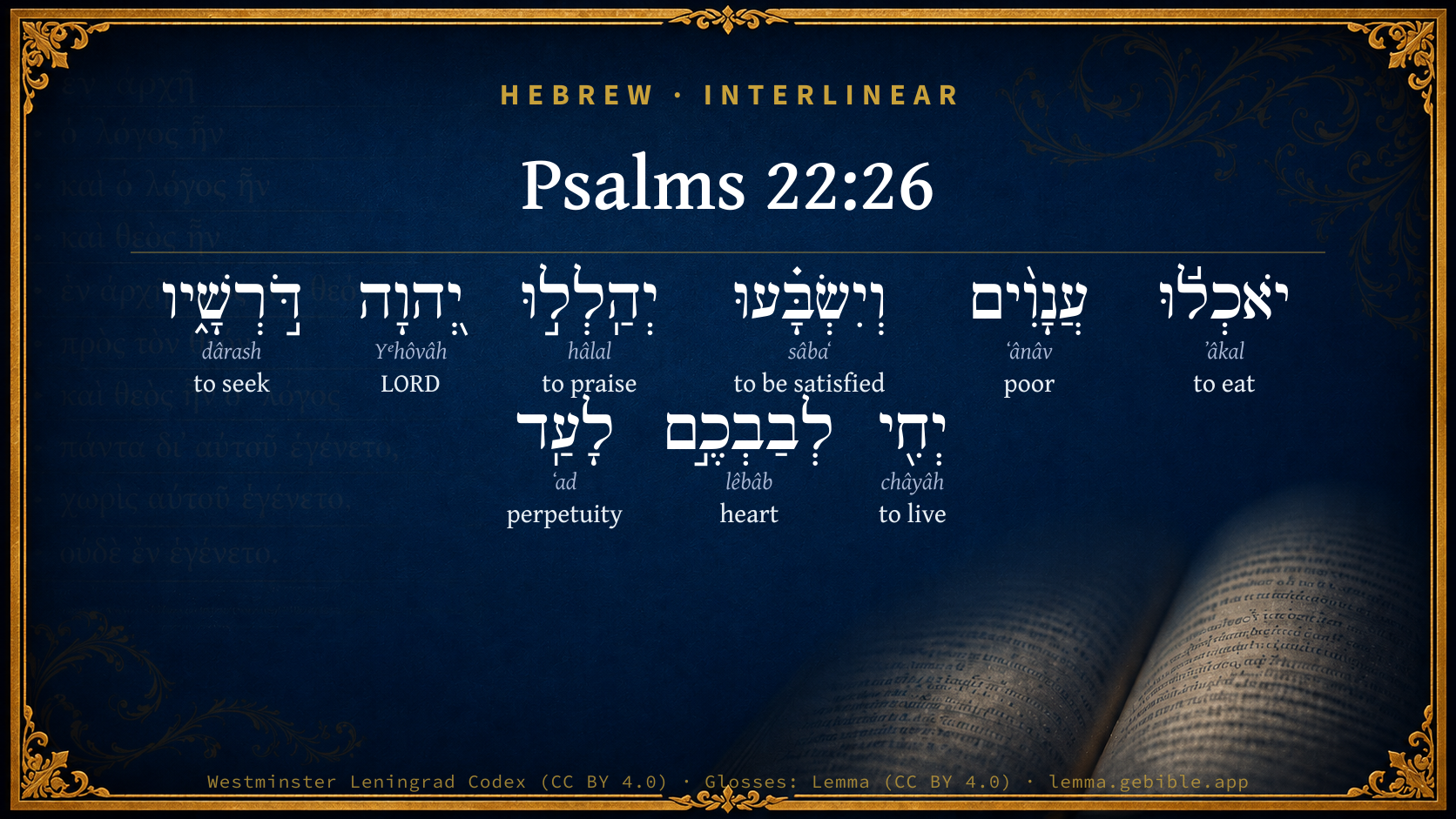
Hebrew (Westminster Leningrad Codex) Psalms 22:26 appears in the Hebrew Old Testament. The text above is from the Westminster Leningrad Codex. Each word links to its Strong’s number, a concise gloss, and parsing drawn from the Open Scriptures Hebrew Bible morphology. Click any word for its full Brown-Driver-Briggs (BDB) entry.
Download image
Cite this verse

Psalms 22:26 (World English Bible). Public Domain. Lemma interlinear Bible study tool, https://lemma.gebible.app/v/psalms/22/26.

Show BibTeX & RIS
BibTeX
RIS
English Translation
The humble shall eat and be satisfied. They shall praise Yahweh who seek after him. Let your hearts live forever.
World English Bible · Public Domain
Download a study sheet

One document with this verse’s original text, its word-by-word gloss line, the meaning frame, cross-references with their text, attributed commentary, and full source and license credits — printable, and it pastes into notes with its structure intact.

This verse Autodidact and up

Study sheet (.html) Plain text (.txt)

A passage Seminary Student

Up to 50 verses in one chapter. A passage sheet keeps up to 6 commentary sources and 12 cross-references per verse, in the order this page ranks them, and says so on the sheet whenever that leaves anything out. Ask for a single verse and you get the Autodidact verse sheet above.

Everything on this page stays free to read, with no account — the sheet is a download of what is already on screen, not access to it.

Want to remove ads? Support Godless Engineer
Compare translations 3

The same verse in 3 English versions, stacked beneath the original-language interlinear above. Click any original word for its lexicon entry.

Each is an independent rendering of the whole verse — the interlinear is not word-aligned to these translations.

Highlighted words mark where these versions differ — a whole-verse word diff, not a word-by-word alignment.

  • World English Bible Public Domain
    The humble shall eat and be satisfied. They shall praise Yahweh who seek after him. Let your hearts live forever.
  • King James Version Public Domain
    The meek shall eat and be satisfied: they shall praise the LORD that seek him: your heart shall live for ever.
  • unfoldingWord Literal Text CC BY-SA 4.0
    The poor will eat and be satisfied. The ones seeking Yahweh will praise. May your heart live forever.

unfoldingWord Literal Text — © unfoldingWord, licensed CC BY-SA 4.0. Word-aligned USFM3 via Door43 (git.door43.org/unfoldingWord/en_ult).

Versions to compare (up to 4)

3 of 4 selected

Show all 18 translations

Every available English version of this verse, each an independent rendering of the whole verse.

  • World English Bible Public Domain
    The humble shall eat and be satisfied. They shall praise Yahweh who seek after him. Let your hearts live forever.
  • Berean Standard Bible Public Domain
    The poor will eat and be satisfied; those who seek the LORD will praise Him. May your hearts live forever!
  • Majority Standard Bible Public Domain
    The poor will eat and be satisfied; those who seek the LORD will praise Him. May your hearts live forever!
  • King James Version Public Domain
    The meek shall eat and be satisfied: they shall praise the LORD that seek him: your heart shall live for ever.
  • American Standard Version (1901) Public Domain
    The meek shall eat and be satisfied; They shall praise Jehovah that seek after him: Let your heart live for ever.
  • Revised Version (1885) Public Domain
    The meek shall eat and be satisfied: they shall praise the LORD that seek after him: let your heart live for ever.
  • Geneva Bible (1599) Public Domain
    The poore shall eate and be satisfied: they that seeke after the Lord, shall prayse him: your heart shall liue for euer.
  • Douay-Rheims (1899) Public Domain
    With thee is my praise in a great church: I will pay my vows in the sight of them that fear him.
  • Young's Literal Translation Public Domain
    The humble do eat and are satisfied, Praise Jehovah do those seeking Him, Your heart doth live for ever.
  • Literal Standard Version CC BY-SA 4.0
    The humble eat and are satisfied, || Those seeking Him praise YHWH, || Your heart lives forever.
  • Unlocked Literal Bible CC BY-SA 4.0
    The oppressed will eat and be satisfied; those who seek Yahweh will praise him. May your hearts live forever.
  • unfoldingWord Literal Text CC BY-SA 4.0
    The poor will eat and be satisfied. The ones seeking Yahweh will praise. May your heart live forever.
  • Darby Bible Public Domain
    The meek shall eat and be satisfied; they shall praise Jehovah that seek him: your heart shall live for ever.
  • World Messianic Bible Public Domain
    The humble shall eat and be satisfied. They shall praise the LORD who seek after him. Let your hearts live forever.
  • Webster's Bible Public Domain
    \\22:25\\My praise shall be of thee in the great congregation: I will pay my vows before them that fear him.
  • Free Bible Version CC BY-SA 4.0
    The poor shall eat, and they shall be satisfied. All who come to the Lord will praise him—may you all live forever!
  • Bible in Basic English Public Domain
    The poor will have a feast of good things: those who make search for the Lord will give him praise: your heart will have life for ever.
  • JPS Tanakh (1917) Public Domain
    (22-27) Let the humble eat and be satisfied; let them praise the LORD that seek after Him; may your heart be quickened for ever!

Literal Standard Version (2020), Covenant Press — licensed CC BY-SA 4.0. Text via the HelloAO Bible API (eBible.org). Unlocked Literal Bible (unfoldingWord) — licensed CC BY-SA 4.0. Text via the HelloAO Bible API (eBible.org). unfoldingWord Literal Text — © unfoldingWord, licensed CC BY-SA 4.0. Word-aligned USFM3 via Door43 (git.door43.org/unfoldingWord/en_ult). Free Bible Version, Dr. Jonathan Gallagher — licensed CC BY-SA 4.0. Text via the HelloAO Bible API (eBible.org).

Word by word

More ways to search: Search by grammar → Find every occurrence → Compare this word →

Practice this passage: Drill this verse → Learn its vocabulary →

עֲנָוִ֨ים
ʻânâv
H6035
“poor”
Adjective, Adjective, Masculine, Plural, Absolute
Part of Speech
Adjective
Type
Adjective
Gender
Masculine
Number
Plural
State
Absolute
Full BDB Definition

Origin: from H6031

TWOT: 1652a

poor, humble, afflicted, meek - poor, needy - poor and weak - poor, weak and afflicted - humble, lowly, meek
  1. יֹאכְל֬וּ ʼâkal H398 “to eat” Verb, Qal, Imperfect, 3rd Person, Masculine, Plural
  2. וְיִשְׂבָּ֗עוּ sâbaʻ H7646 “and · to be satisfied” Conjunction + Verb, Qal, Imperfect, 3rd Person, Masculine, Plural
  3. יְהַֽלְל֣וּ hâlal H1984 “to praise” Verb, Piel, Imperfect, 3rd Person, Masculine, Plural
  4. יְ֭הוָה Yᵉhôvâh H3068 “LORD” Noun, Proper
  5. דֹּ֣רְשָׁ֑יו dârash H1875 “seeking · him” Verb, Qal, Participle Active, Masculine, Plural, Construct + Suffix, Personal, 3rd Person, Masculine, Singular
  6. יְחִ֖י châyâh H2421 “to live” Verb, Qal, Imperfect, 3rd Person, Masculine, Singular
  7. לְבַבְכֶ֣ם lêbâb H3824 “heart · your” Noun, Common, Masculine, Singular, Construct + Suffix, Personal, 2nd Person, Masculine, Plural
  8. לָעַֽד ʻad H5703 “to/for · perpetuity” Preposition + Noun, Common, Masculine, Singular, Absolute

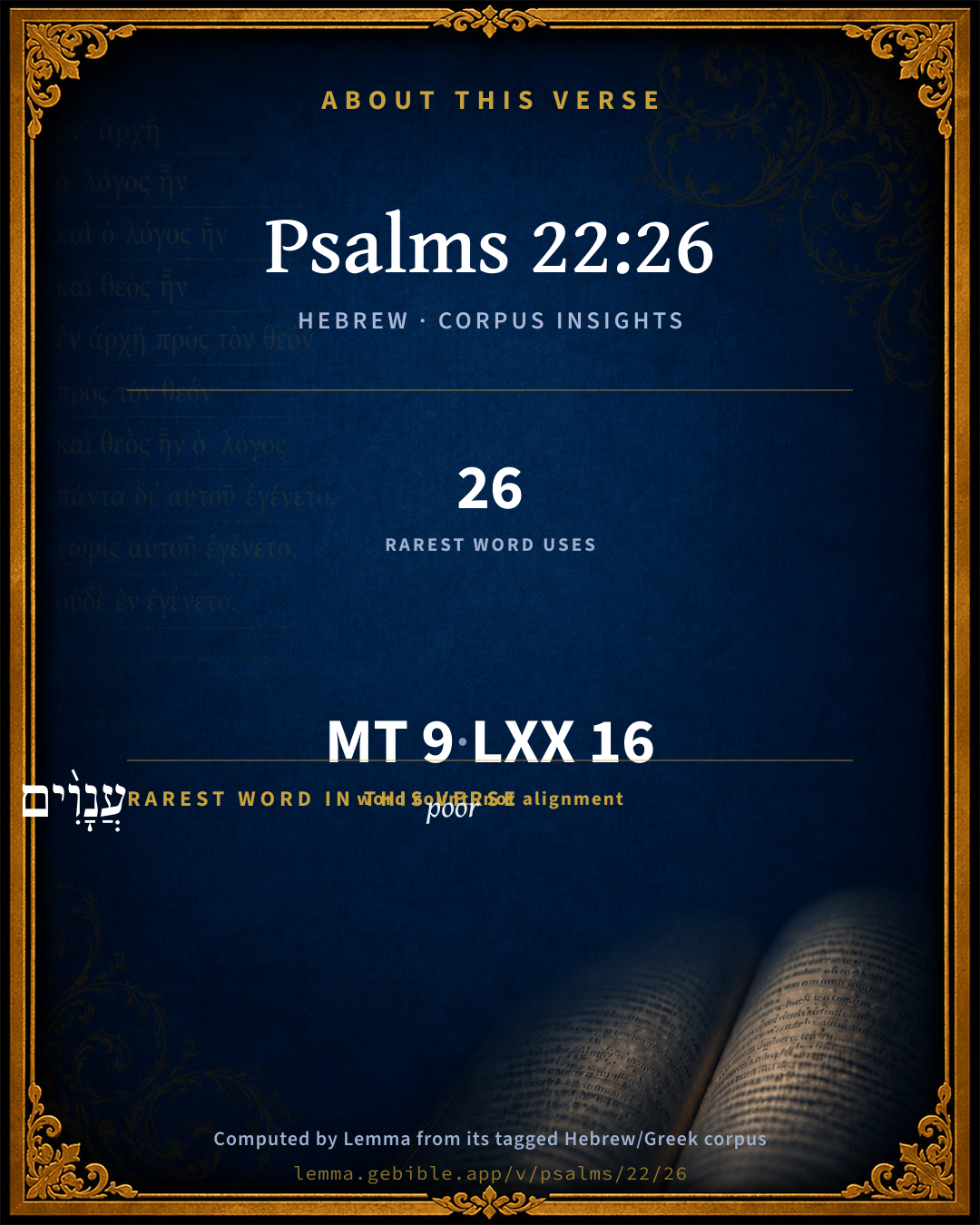
About this verse

These counts appear in no published source. They are computed here, from the morphology-tagged text and Lemma’s own curated glosses. What Lemma adds →

9
words
9
distinct lemmas
Wisdom
section

Shared distinctive vocabulary

עֲנָוִ֨ים poor H6035 occurs in 24 verses of the Hebrew Bible. Also found in:

Grammatical profile

  • 5 verbs
  • 3 nouns
  • 1 adjective

Verb forms

  • יֹאכְל֬וּ Qal · Imperfect
  • וְיִשְׂבָּ֗עוּ Qal · Imperfect
  • יְהַֽלְל֣וּ Piel · Imperfect
  • דֹּ֣רְשָׁ֑יו Qal · Participle Active
  • יְחִ֖י Qal · Imperfect

Hebrew & Septuagint length

In English translation the verse runs 20 words from the Hebrew and 22 from the Septuagint (LXX English) — closely comparable.

A rough comparison of the two English renderings, which tokenize alike — not a word-level alignment.

Word counts can differ between the Hebrew and the Greek without any difference in meaning — e.g. the Hebrew direct-object marker אֵת has no separate Greek word, and Greek often adds the article ὁ.

In the original languages it is 9 Hebrew tokens and 16 Greek tokens — but the two are counted differently (Hebrew bundles its prefixes and suffixes into one token; the Greek is in lemma form), so that isn’t a like-for-like length.

Cross-references

9

Topical passages linked to Psalms 22:26 in the Treasury of Scripture Knowledge — connected by theme and wording, ordered by reader-vote popularity; previews shown in the World English Bible.

  • Psalms 69:32 The humble have seen it, and are glad. You who seek after God, let your heart live.
  • Psalms 40:16 Let all those who seek you rejoice and be glad in you. Let such as love your salvation say continually, "Let Yahweh be exalted!"
  • Isaiah 65:13 Therefore thus says the Lord Yahweh, Behold, my servants shall eat, but you shall be hungry; behold, my servants shall drink, but you shall be thirsty; behold, my servants shall rejoice, but you shall be disappointed;
  • Psalms 105:3–4 Glory in his holy name. Let the heart of those who seek Yahweh rejoice.
  • Psalms 107:9 For he satisfies the longing soul. He fills the hungry soul with good.
  • Isaiah 25:6 In this mountain will Yahweh of Hosts make to all peoples a feast of fat things, a feast of wines on the lees, of fat things full of marrow, of wines on the lees well refined.
  • John 6:48–58 I am the bread of life.
  • John 4:14 but whoever drinks of the water that I will give him will never thirst again; but the water that I will give him will become in him a well of water springing up to eternal life."
  • Leviticus 7:11–17 "'This is the law of the sacrifice of peace offerings, which one shall offer to Yahweh.

Cross-references courtesy of OpenBible.info (CC BY 4.0).

Hebrew and Greek witnesses Masoretic Hebrew ↔ Greek Septuagint

The same verse in the two great witnesses to the Old Testament, shown verse-for-verse.

You’re reading Greek Psalm 21 (Hebrew Psalm 22). The Septuagint counts the superscription, so verse numbers can differ from the Hebrew — chapter-level alignment, not verse-by-verse. Numbering follows Rahlfs.

These are two independent witnesses, not word-aligned to each other, and the Septuagint is shown in lemma (dictionary) form.

Hebrew Psalms 22:26 Masoretic · Westminster Leningrad Codex

יֹאכְל֬וּ עֲנָוִ֨ים וְיִשְׂבָּ֗עוּ יְהַֽלְל֣וּ יְ֭הוָה דֹּ֣רְשָׁ֑יו יְחִ֖י לְבַבְכֶ֣ם לָעַֽד

The humble shall eat and be satisfied. They shall praise Yahweh who seek after him. Let your hearts live forever.

World English Bible · Public Domain

Greek LXX Greek Psalm 21:26 Septuagint · lemma form

παρά σύ ὁ ἔπαινος ἐγώ ἐν ἐκκλησία μέγας ὁ εὐχή ἐγώ ἀποδίδωμι ἐνώπιον ὁ φοβέω αὐτός

The poor shall eat and be satisfied; and they shall praise the Lord that seek him: their heart shall live for ever.

LXX2012 (modern English Septuagint) · Public Domain

On this verse, Ellicott's Commentary for English Readers discusses the Septuagint’s reading. Read the note in Commentary ↓

Hebrew: Westminster Leningrad Codex (CC BY 4.0). Greek: Septuagint (public domain); English from LXX2012 (modern English Septuagint) (Public Domain). How the Septuagint differs from the Hebrew →

Commentary

Notes on Psalms 22:26 from classic Christian and Jewish commentators (each source and its license shown beneath its notes). The classic Christian expositions comment on the surrounding passage and are grouped to its opening verse, so a note may address several verses; the Jewish commentaries on the Tanakh (Rashi and others) are per-verse, so they appear only where the commentator wrote on this verse.

Lemma curates 59 commentaries, every one of them public domain or Creative Commons licensed, each selected and text-cleaned for this edition rather than reprinted as found. About our sources →

Trapp's Complete Commentary

John Trapp

Psa 22:26 The meek shall eat and be satisfied: they shall praise the LORD that seek him: your heart shall live for ever.

Ver. 26. The meek shall eat and be satisfied] They shall be well filled at my peace offering feast, saith David; at my holy supper, saith Christ; and in me shall have the full fruition of all good things; as at a feast of fat things full of marrow, of wines refined on the lees, Isa 25:6 Nec copiam huius saeculi concupiscent nec timebunt inopiam, saith Austin; Here they shall neither covet the wealth of this world nor fear the want of it.

They shall praise the Lord] viz. At the eucharist, and after.

Your heart shall live for ever] Apostrophe ad mansuetos emphatica. You meek of the earth and seekers of the Lord, who have eaten of Christ’s flesh that was given for the life of the world, Joh 6:51, your heart shall live for ever; and if so, then in death itself. As Aristotle giveth the reason of the swan’s singing a little before his death, because generous blood goeth then to the heart, making it cheerful, and that thence cometh the melody.

John Trapp, A Commentary or Exposition upon All the Books of the Old and New Testament (1647–1656) — public domain. Text from a community e-Sword module.

The Biblical Illustrator

Joseph S. Exell

Psa_22:26

The meek shall eat and be satisfied.

Feasting on the sacrifice

The custom of sacrificial feasts was common to many lands.

I. The worlds sacrificial feast. The Jewish ritual, and that of many other nations, provided for a festal meal following on, and consisting of the material of the sacrifice. That which, in one aspect, is a peace offering reconciling to God, in another aspect is the nourishment and joy of the hearts that accept it. And so the work of Jesus Christ has two distinct phases of application, according as we think of it as being offered to God or appropriated by man. In the one case it is our peace; in the other it is our food and our life. The Christ that feeds the world is the Christ that died for the world. The peace offering for the world is the food of the world. We see hence the connection between these great spiritual ideas and the central act of Christian worship. The Lords Supper simply says by act what the text says in words. The translation of the eating into spiritual reality is simply that we partake of the food of our spirits by the act of faith in Jesus Christ. Personal appropriation and making the worlds food mine, by an individual act, is the condition on which alone I get any good from it.

II. The rich fruition of this feast. Satisfied. Jesus Christ, in the facts of His death and resurrection, being to us all that our circumstances, relationships, and inward condition can require.

III. The guests. It is the meek who eat. Meek usually refers to mens demeanour to one another. The expression here goes deeper. It means both afflicted and lowly,--the right use of affliction being to bow men, and they that bow themselves are those who are fit to come to Christs feast. Men are shut out only because they shut themselves out. (A. Maclaren, D. D.)

The recompense of piety

In genuine religion there is great reward. Nothing is so conducive to the happiness of man, nothing so effectually secures it.

I. The temper to be cherished. Meekness, lowliness of mind, which so becomes us as sinners.

II. The conduct to be pursued. We should seek the Lord. This supposes--

1. That we have suffered loss. We do not seek what we have. We have lost the knowledge, favour, image, and the enjoyment of God.

2. That this loss may be regained. The Gospel shows us how.

3. The use of proper means is also implied.

III. The blessings which shall be secured. We shall eat and he satisfied; shall praise the Lord, and live forever. (T. Kidd.)

They shall praise the Lord that seek Him.--

Good news for seekers

These are the words of Jesus on the Cross. He died to further the Fathers glory. This was the object He sought, and He solaces Himself with the thought of all the kindreds of the nations turning to God, and that they who seek the Lord shall praise Him. The assurance of text very encouraging. Note--

I. The persons--the seekers of the Lord. These are they--

1. Who really desire to commune with God. Not mere repeaters of a prayer, but those who really seek the Lord.

2. Who know that they are at a distance from Him.

3. But are anxious that that distance should be taken away.

4. And would feel themselves to be the friends of God.

5. And desire all this now. All this prepares the man to praise when he finds the Lord.

II. The promise. They shall, etc.

1. It is fulfilled unconsciously while the man is seeking.

2. The praise abounds when the desire is granted. You who seek, you shall surely find salvation, and that ere long. God may try yon, let you wait a while before He gives you the joy of realised pardon; but seek on still.

3. You shall go on seeking and go on praising.

III. The praise. It will be--

1. Because we found Him as we did.

2. That we found such a Saviour.

3. Because of our security.

4. Because we ever sought the Lord at all.

Conclusion: Let us who have sought the Lord praise Him. Let us show our poor friends the seekers the way. We sought and we found; let us magnify the Lord at once. (C. H. Spurgeon.)

Arduous seeking becomes joyous in finding

All his seeking, I say, helps him to prize Divine mercy when he receives it, and trains him to praise God according to the promise of our text, They shall praise the Lord that seek Him. Never is a babe so dear to its mother as when it has just been restored from a sickness which threatened his life; never does a father rejoice over his little child so much as when he has been long lost in the woods, and after a weary search is at last brought home. No gold is so precious to a man as that which he has earned by hard labour and self-denial: the harder he has toiled to gain it, the more rejoiced is he when at length he has enough to permit him to rest. No freedom is so precious as the new found liberty of a slave, no enlargement so joyous as that of one who has long been sitting in the valley of the shadow of death bound in affliction and iron. No return to a country is so full of delight as that of sorrowful exiles who come back from cruel Babylon, by whose waters they sat and wept, yea, wept when they remembered Zion. (C. H. Spurgeon.)

Seekers become singers

As a bird lies hidden among the heather, but is seen when at last it is startled and made to take to the wing, so doth praise take to the wing and display itself when at last those who seek the Lord are permitted to find Him. What thunderclaps of praise come from poor sinners when they have just found their all in all in God in the person, of Christ Jesus. Then their joy becomes almost too much for them to hold, vastly too much for them to express. Oh, the praises, the day and night praises, the continuous praises, which rise from the returning, repenting soul which has at last felt the Fathers arms around its neck and the Father swarm kisses on its cheek, and is sitting down at the table where the happy household eat and drink and are merry. Praising time has come indeed when finding time has arrived. Happy day! Happy day! when we meet with God in Jesus Christ. (C. H. Spurgeon.)

Your heart shall live forever.--

The immortality of the affections

The heart has been employed by the inspired writers as the symbol of human affections. So the heart of man is said to be tried by God--to be opened, established, enlightened, strengthened, searched by God. The text asserts the absolute indestructibility of our religious affections. Work up to this through the intervening lessons.

1. There is one thing in this fleeting world which is immortal. Man wears on his forehead the crown of his regnant majesty; for his nature is undying. No soul has ever yet passed out of existence.

2. The text draws a distinction between life and mere existence. Into this word live we must suffer a new increment of meaning to enter. These hearts of ours may have one of two moral states. Whichever of these is possessed as a permanent character decides destiny. The heart that seeks God enters immediately into the nearness of Gods presence, where there is fulness of joy. The heart that wilfully refuses to seek God is forced into the darkness of utter banishment from God for the unending future. The first of these conditions is life, the second is death.

3. The text evidences its authority by language peremptory and plain. The word shall is of itself sovereign and conclusive But the form of speech employed is not that of prediction so much as that of promise. There are also three fixed laws of human nature which, fairly working together, render it absolutely certain that our affections will survive the shock of death, and reassert themselves hereafter.

(1) One is the law of habit. The pressure of such a law holds more surely in our mental and moral nature than in our physical. Loves are stronger and hates are more inveterate than simple habits of body and mind.

(2) Another law is that of exercise. Practice makes perfect. Under this law the memory is often so wonderfully strengthened that it disdains data of aid. The most curious working of this law will appear in the fact that when our affections are wrought upon their increase is supreme. Ones prejudices become his master.

(3) Then there is the law of association. Most of all, this is subtle and forceful. When its action reaches a mans moral and mental natures working together it seems almost irresistible. These three laws actually intertwine themselves together, and accelerate the action of each other.

4. The text teaches that human immortality is quite independent of all accidents and surroundings. Augustine says, Our life is so brief and insecure that I know not whether to call it a dying life or a living death. It is not in the body that our immortality resides. Your heart is yourself. There is one thing in man, only one, that is immortal--the soul. Human affections will live forever in the line of their seeking. The heart therefore is independent of all surroundings.

5. The text fixes all its force by an immediate application of its doctrine to such as are meek enough to receive it. If your heart is to live forever, then much consideration ought to be given to your aims in life, for they are fashioning the heart that is to be immortal. And our companionships ought to be chosen with a view to the far future which is coming. If our hearts are to live forever, then some care should be had concerning our processes of education by which our affections are trained. And if our hearts are to live forever, then surely it is now time some hearts were changed powerfully by the Spirit of Divine grace. (C. S. Robinson, D. D.)

Immortality of the affections

Transient and occasional bursts of inspiration in the Old Testament anticipate what Christianity was afterwards to teach. They seem like lightning flashes, illuminating the deep obscurity for a moment. How much is implied in these words, Your heart shall live forever. They mean that the body shall not,--in its present elements it shall not; it has nothing to do with the life immortal. The happiness of the future existence shall not come from the body, from the gratification of its passions nor the exercise of its powers; and just so far as a man depends for his enjoyment on these earthly indulgences he is unfit for that spiritual state to which death will soon translate us, and for which it is our wisdom now to prepare. These words of the text also imply that the mind, though it shall endure, will not be the source of happiness in another existence. We know too little of its nature to say whether death will change it; but certainly it will change our estimation of it; for now, in this world, talent, force of mind, genius are set highest among the gifts of God. The affections (or the heart) are as much above the understanding as the mind is above the body. It is in the affections that the elements of heavenly happiness are to be found. These words teach us what should be our constant object, and lead us also to consider how abundantly God has provided for it on every side. Consider--

1. How all the arrangements of this life favour the growth of those affections which are the elements of life immortal. The home, requiring of each within it to suppress those selfish passions which darken over everything which they touch, and making it manifest that all the sunshine and comfort of the dwelling depend, not on its magnificence, not on the luxuries within it, but simply and entirely on the spirit of love within. And the circle of friendship carries out those same affections into wider range. That these are Divine arrangements may be seen from the moral and spiritual laws which run through theme--which ordain that these affections shall move in paths of duty. But these arrangements of life for a certain purpose are not meant to effect that purpose of themselves; it rests with us to trace out, to follow, and improve them. The first business of the Christian life is to deny ourselves, which means not to deny ourselves a blessing here and there, but to resist the strong selfish tendency of our nature, to train our affections in the right Way, to regard them as the beginnings and indications of our future destiny, and to keep our heart with all diligence, since out of it are the fountains of immortal life. Once attach this thought of immortality to the affections, and how mighty and solemn those interests become!

2. All the arrangements of death, all of which have a purpose and meaning, are even more fitted to form for immortality the heart which is to live forever. The world is changed by the presence of death; wherever it comes we feel that a new influence is there, a power is there which was not there before. Each one who feels at all feels that something is meant by it, that it is a communication addressed to him. Never do the affections come forth in purer or more disinterested action than in the presence of death.

3. The arrangements of the future existence are also of a kind to favour the growth of the affections. The foresight of the future state, the vision of it which lies before us in the light of the Gospel, must necessarily have a great effect on the efforts we make to reach it. Awake, then, to a sense of the importance of the heart. See how all your welfare for this world and the other depends on the right unfolding and care of its affections. (W. B. O. Peabody, D. D.)

The Biblical Illustrator, edited by Joseph S. Exell (c. 1880s–1900s) — public domain. Text from a community e-Sword module.

Joseph Benson's Commentary

Psa 22:26. The meek — That is, the poor or humble, gentle and teachable, namely, believing and godly persons whose hearts the grace of God hath softened and sweetened, subduing their pride and passion, and their rebellion against God, and fierceness toward men; shall eat and be satisfied — Shall partake of those spiritual blessings which God hath provided for them in his gospel, that grace, and peace, and comfort, which all believing souls enjoy, in a sense of God’s love, in the pardon of their sins, and in the influences of God’s Spirit. Of these and not of any temporal blessings, this clause is doubtless to be understood. They shall praise the Lord that seek him — That seek his favour, and the true spiritual knowledge of, and communion with, him. Your heart shall live — He speaks of the same persons still, though there be a change from the third to the second person, as is usual in these poetical books. For ever — Your comfort shall not be short and transitory, as worldly comforts are, but everlasting.

Joseph Benson's Commentary on the Old and New Testaments (1811–1818) — public domain. Text from a community e-Sword module.

J. A. Alexander on Psalms

Joseph Addison Alexander

27. (Psa 22:26). (Then) shall eat (thereof) the humble, and be satisfied; (then) shall praise Jehovah those who seek him. May your heart live for ever! The adverb then is here supplied in the translation, in order to retain the Hebrew order of the sentence. The word thereof is introduced to remove all ambiguity of syntax, and to connect the act of eating with the sacrificial feast of the foregoing verse. —To seek God, in the dialect of Scripture, is to seek to know him, and also to seek his favour, not only by specific acts of prayer, but by the whole course of the life. See above, on Psa 14:2.— The concluding wish, your heart live for ever, comprehends an assurance that it shall live. The heart is said to die, in cases of extreme grief and distress. See 1Sa 25:37, and compare Psa 109:22. The objects of address are those who seek and praise God. The sudden change of person is analogous to that in Psa 22:26 (25), which begins from thee, and ends with fearing him. That this is not an inadvertent irregularity, appears from its recurrence in the next verse. —The humble and the seekers of Jehovah are parallel descriptions of the same class, namely, true believers, those who are elsewhere called the righteous.

Joseph Addison Alexander, The Psalms Translated and Explained (1850) — public domain. Text from a community e-Sword module.

MacLaren's Expositions of Holy Scripture

Alexander MacLaren

Psalms

FEASTING ON THE SACRIFICE

Psa 22:26.

‘The flesh of the sacrifice of his peace-offering for thanksgiving shall be offered in the day of his oblation.’ Such was the law for Israel. And the custom of sacrificial feasts, which it embodies, was common to many lands. To such a custom my text alludes; for the Psalmist has just been speaking of ‘paying his vows’ {that is, sacrifices which he had vowed in the time of his trouble}, and to partake of these he invites the meek. The sacrificial dress is only a covering for high and spiritual thoughts. In some way or other the singer of this psalm anticipates that his experiences shall be the nourishment and gladness of a wide circle; and if we observe that in the context that circle is supposed to include the whole world, and that one of the results of partaking of this sacrificial feast is ‘your heart shall live for ever,’ we may well say with the Ethiopian eunuch, ‘Of whom speaketh the Psalmist thus?’ The early part of the psalm answers the question. Jesus Christ laid His hand on this wonderful psalm of desolation, despair, and deliverance when on the Cross He took its first words as expressing His emotion then: ‘My God! My God! Why hast Thou forsaken Me?’ Whatever may be our views as to its authorship, and as to the connection between the Psalmist’s utterances and his own personal experiences, none to whom that voice that rang through the darkness on Calvary is the voice of the Son of God, can hesitate as to who it is whose very griefs and sorrows are thus the spiritual food that gives life to the whole world.

From this, the true point of view, then, from which to look at the whole of this wonderful psalm, I desire to deal with the words of my text now.

I. We have, first, then, the world’s sacrificial feast.

The Jewish ritual, and that of many other nations, as I have remarked, provided for a festal meal following on, and consisting of the material of, the sacrifice. A generation which studies comparative mythology, and spares no pains to get at the meaning underlying the barbarous worship of the rudest nations, ought to be interested in the question of the ideas that formed and were expressed by that elaborate Jewish ritual. In the present case, the signification is plain enough. That which, in one aspect, is a peace-offering reconciling to God, in another aspect is the nourishment and the joy of the hearts that accept it. And so the work of Jesus Christ has two distinct phases of application, according as we think of it as being offered to God or appropriated by men. In the one case it is our peace; in the other it is our food and our life. If we glance for a moment at the marvellous picture of suffering and desolation in the previous portion of this psalm, which sounds the very depths of both, we shall understand more touchingly what it is on which Christian hearts are to feed. The desolation that spoke in ‘Why hast Thou forsaken Me?’ the consciousness of rejection and reproach, of mockery and contempt, which wailed, ‘All that see Me laugh Me to scorn; they shoot out the lip; they shake the head, saying, “He trusted on the Lord that He would deliver Him; let Him deliver Him, seeing He delighteth in Him”‘; the physical sufferings which are the very picture of crucifixion, so as that the whole reads liker history than prophecy, in ‘All My bones are out of joint; My strength is dried up like a potsherd; and My tongue cleaveth to My jaws’; the actual passing into the darkness of the grave, which is expressed in ‘Thou hast brought Me into the dust of death’; and even the minute correspondence, so inexplicable upon any hypothesis except that it is direct prophecy, which is found in ‘They part My garments among them, and cast lots upon My vesture’-these be the viands, not without bitter herbs, that are laid on the table which Christ spreads for us. They are parts of the sacrifice that reconciles to God. Offered to Him they make our peace. They are parts and elements of the food of our spirits. Appropriated and partaken of by us they make our strength and our life.

Brethren! there is little food, there is little impulse, little strength for obedience, little gladness or peace of heart to be got from a Christ who is not a Sacrifice. If we would know how much He may be to us, as the nourishment of our best life, and as the source of our purest and permanent gladness, we must, first of all, look upon Him as the Offering for the world’s sin, and then as the very Life and Bread of our souls. The Christ that feeds the world is the Christ that died for the world.

Hence our Lord Himself, most eminently in one great and profound discourse, has set forth, not only that He is the Bread of God which ‘came down from heaven,’ but that His flesh and His blood are such, and the separation between the two in the discourse, as in the memorial rite, indicates that there has come the violent separation of death, and that thereby He becomes the life of humanity.

So my text, and the whole series of Old Testament representations in which the blessings of the Kingdom are set forth as a feast, and the parables of the New Testament in which a similar representation is contained, do all converge upon, and receive their deepest meaning from, that one central thought that the peace-offering for the world is the food of the world.

We see, hence, the connection between these great spiritual ideas and the central act of Christian worship. The Lord’s Supper simply says by act what my text says in words. I know no difference between the rite and the parable, except that the one is addressed to the eye and the other to the ear. The rite is an acted parable; the parable is a spoken rite. And when Jesus Christ, in the great discourse to which I have referred, dilates at length upon the ‘eating of His flesh and the drinking of His blood’ as being the condition of spiritual life, He is not referring to the Lord’s Supper, but the discourse and the rite refer both to the same spiritual truth. One is a symbol; the other is a saying; and symbol and saying mean just the same thing. The saying does not refer to the symbol, but to that to which the symbol refers. It seems to me that one of the greatest dangers which now threaten Evangelical Christianity is the strange and almost inexplicable recrudescence of Sacramentarianism in this generation to which those Christian communities are contributing, however reluctantly and unconsciously, who say there is something more than commemorative symbols in the bread and wine of the Lord’s table. If once you admit that, it seems, in my humble judgment, that you open the door to the whole flood of evils which the history of the Church declares have come with the Sacramentarian hypothesis. And we must take our stand, as I believe, upon the plain, intelligible thoughts-Baptism is a declaratory symbol, and nothing more; the Lord’s Supper is a commemorative symbol, and nothing more; except that both are acts of obedience to the enjoining Lord. When we stand there we can face all priestly superstitions, and say, ‘Jesus I know; and Paul I know; but who are ye?’ ‘The meek shall eat and be satisfied,’ and the food of the world is the suffering Messiah.

But what have we to say about the act expressed in the text? ‘The meek shall eat.’ I do not desire to dwell at any length upon the thought of the process by which this food of the world becomes ours, in this sermon. But there are two points which perhaps may be regarded as various aspects of one, on which I would like to say just a sentence or two. Of course, the translation of the ‘eating’ of my text into spiritual reality is simply that we partake of the food of our spirits by the act of faith in Jesus Christ. But whilst that is so, let me put emphasis, in a sentence, upon the thought that personal appropriation, and making the world’s food mine, by my own individual act, is the condition on which alone I get any good from it. It is possible to die of starvation at the door of a granary. It is possible to have a table spread with all that is needful, and yet to set one’s teeth, and lock one’s lips, and receive no strength and no gladness from the rich provision. ‘Eat’ means, at any rate, incorporate with myself, take into my very own lips, masticate with my very own teeth, swallow down by my very own act, and so make part of my physical frame. And that is what we have to do with Jesus Christ, or He is nothing to us. ‘Eat’; claim your part in the universal blessing; see that it becomes yours by your own taking of it into the very depths of your heart. And then, and then only, will it become your food.

And how are we to do that if, day in and day out, and week in and week out, and year in and year out, with some of us, there be scarce a thought turned to Him; scarce a desire winging its way to Him; scarce one moment of quiet contemplation of these great truths. We have to ruminate, we have to meditate; we have to make conscious and frequent efforts to bring before the mind, in the first place, and then before the heart and all the sensitive, emotional, and voluntary nature, the great truths on which our salvation rests. In so far as we do that we get good out of them; in so far as we fail to do it, we may call ourselves Christians, and attend to religious observances, and be members of churches, and diligent in good works, and all the rest of it, but nothing passes from Him to us, and we starve even whilst we call ourselves guests at His table.

Oh! the average Christian life of this day is a strange thing; very, very little of it has the depth that comes from quiet communion with Jesus Christ; and very little of it has the joyful consciousness of strength that comes from habitual reception into the heart of the grace that He brings. What is the good of all your profession unless it brings you to that? If a coroner’s jury were to sit upon many of us-and we are dead enough to deserve it-the verdict would be, ‘Died of starvation.’ ‘The meek shall eat,’ but what about the professing Christians that feed their souls upon anything, everything rather than upon the Christ whom they say they trust and serve?

II. And now let me say a word, in the second place, about the rich fruition of this feast.

‘The meek shall be satisfied.’ ‘Satisfied!’ Who in the world is? And if we are not, why are we not? Jesus Christ, in the facts of His death and resurrection-for His resurrection as well as His death are included in the psalm-brings to us all that our circumstances, relationships, and inward condition can require.

Think of what that death, as the sacrifice for the world’s sin, does. It sets all right in regard to our relation to God. It reveals to us a God of infinite love. It provides a motive, an impulse, and a Pattern for all life. It abolishes death, and it gives ample scope for the loftiest and most exuberant hopes that a man can cherish. And surely these are enough to satisfy the seeking spirit.

But go to the other end, and think, not of what Christ’s work does for us, but of what we need to have done for us. What do you and I want to be satisfied? It would take a long time to go over the catalogue; let me briefly run through some of the salient points of it. We want, for the intellect, which is the regal part of man, though it be not the highest, truth which is certain, comprehensive, and inexhaustible; the first, to provide anchorage; the second, to meet and regulate and unify all thought and life; and the last, to allow room for endless research and ceaseless progress. And in that fact that the Eternal Son of the Eternal Father took upon Himself human nature, lived, died, rose, and reigns at God’s right hand, I believe there lie the seeds of all truth, except the purely physical and material, which men need. Everything is there; every truth about God, about man, about duty, about a future, about society; everything that the world needs is laid up in germ in that great gospel of our salvation. If a man will take it for the foundation of his beliefs and the guide of his thinkings, he will find his understanding is satisfied, because it grasps the personal Truth who liveth, and is with us for ever.

Our hearts crave, however imperfect their love may be, a perfect love; and a perfect love means one untinged by any dash of selfishness, incapable of any variation or eclipse, all-knowing, all-pitying, all-powerful. We have made experience of precious loves that die. We know of loves that change, that grow cold, that misconstrue, that may have tears but have no hands. We know of ‘loves’ that are only a fine name for animal passions, and are twice cursed, cursing them that give and them that take. The happiest will admit, and the lonely will achingly feel, how we all want for satisfaction a love that cannot fail, that can help, that beareth all things, and that can do all things. We have it in Jesus Christ, and the Cross is the pledge thereof.

Conscience wants pacifying, cleansing, enlightening, directing, and we get all these in the good news of One that has died for us, and that lives to be our Lord. The will needs authority which is not force. And where is there an authority so constraining in its sweetness and so sweet in its constraint as in those silken bonds which are stronger than iron fetters? Hope, imagination, and all other of our powers or weaknesses, our gifts or needs, are satisfied when they feed on Christ. If we feed upon anything else it turns to ashes that break our teeth and make our palates gritty, and have no nourishment in them. We shall be ‘for ever roaming with a hungry heart’ unless we take our places at the feast on the one sacrifice for the world’s peace.

III. I can say but a word as to the guests.

It is ‘the meek’ who eat. The word translated ‘meek’ has a wider and deeper meaning than that. ‘Meek’ refers, in our common language, mainly to men’s demeanour to one another; but the expression here goes deeper. It means both ‘afflicted’ and ‘lowly’-the right use of affliction being to bow men, and they that bow themselves are those who are fit to come to Christ’s feast. There is a very remarkable contrast between the words of my text and those that follow a verse or two afterwards. ‘The meek shall eat and be satisfied,’ says the text. And then close upon its heels comes, ‘All those that be fat upon earth shall eat.’ That is to say, the lofty and proud have to come down to the level of the lowly, and take indiscriminate places at the table with the poor and the starving, which, being turned into plain English is just this-the one thing that hinders a man from partaking of the fulness of Christ’s feeding grace is self-sufficiency, and the absence of a sense of need. They that ‘hunger and thirst after righteousness shall be filled’; and they that come, knowing themselves to be poor and needy, and humbly consenting to accept a gratuitous feast of charity-they, and only they, do get the rich provisions.

You are shut out because you shut yourselves out. They that do not know themselves to be hungry have no ears for the dinner-bell. They that feel the pangs of starvation and know that their own cupboards are empty, they are those who will turn to the table that is spread in the wilderness, and there find a ‘feast of fat things.’

And so, dear friends! when He calls, do not let us make excuses, but rather listen to that voice that says to us, ‘Why do you spend your money for that which is not bread, and your labour for that which satisfieth not. . . . Incline your ear unto Me; hear, and your soul shall live.’

Alexander MacLaren, Expositions of Holy Scripture (1904–1910) — public domain. Text from a community e-Sword module.

Tyndale Open Study Notes

Tyndale Open Resources

22:26 God knows his people’s needs and addresses them (63:5; 81:16; 103:5; 107:9; 132:15; 145:16; 147:14).

Tyndale Open Study Notes — © Tyndale Open Resources, licensed CC BY-SA 4.0. Text via the HelloAO Bible API.

Geneva Bible (1599)

Geneva Bible translators

He doth allude still to the sacrifice.

Geneva Bible (1599) marginal notes — public domain. Text via Bolls.life.

Adam Clarke's Commentary

Verse 26. The meek shall eat] ענוים anavim. the POOR, shall eat. In the true only Sacrifice there shall be such a provision for all believers, that they shall have a fulness of joy. Those who offered the sacrifice, fed on what they offered. Jesus, the true Sacrifice, is the bread that came down from heaven; they who eat of this bread shall never die.

Adam Clarke's Commentary on the Bible (1810–1826) — public domain. Text from a community e-Sword/MySword module.

John Calvin's Commentaries

26. The poor shall eat. The Psalmist has a reference to the custom which was at that time prevalent among the Jews, of feasting on their sacrifices, as is very well known. He here promises this feast, in order to exercise and prove his charity. And surely that is a pleasant and an acceptable oblation to God to which compassion and mercy are joined. Without these, the ceremonies by which men profess to worship God, with all their pomp and magnificence, vanish into smoke. David does not, however, simply promise to bestow upon the poor and the hungry something for the mere nourishment of the body. He declares that they shall be partakers of this feast for another purpose, namely, that matter of comfort being ministered to them, joy might be restored to their hearts and flourish afresh. For they saw in that feast, as in a mirror, the goodness of God set forth to all who are in affliction, which might assuage with wonderful consolation the grief arising from all their calamities. The Psalmist therefore adds, They shall praise Jehovah that seek him. The abundant repast of which they had partaken ought, no doubt, to have incited them to give thanks to God; but what is particularly meant is, praising God for that deliverance in grateful commemoration of which the sacrifice was offered. This appears still more clearly from the last clause of the verse: Your heart shall live for ever One meal could not have sufficed to make their hearts live for ever. It was rather the hope which they entertained of having ready succor from God which did this; for all the faithful justly reckoned the deliverance of this one man as a deliverance wrought for themselves in particular. Whence it follows, that, in the peace-offerings, the praises of God were so celebrated, as that genuine worshippers also exercised their hope in them. Farther, as hypocrites content themselves with merely going through the bare and lifeless ceremony, the Psalmist restricts the right performance of this exercise to true and holy Israelites; They shall praise Jehovah that seek him; and to seek God is the certain mark of genuine godliness. Now, if the fathers under the law had their spiritual life renewed and invigorated by their holy feasts, this virtue will show itself much more abundantly at this day in the holy supper of Christ, provided those who come to partake of it seek the Lord truly, and with their whole heart.

John Calvin's Commentaries (1540-1563) — public domain. Text from the Calvin Translation Society English edition (1840s-50s) via the Christian Classics Ethereal Library (ccel.org). Calvin's coverage is partial (roughly two-thirds of the Bible); uncommented books and verses are honest gaps, never fabricated. The 19th-century editor's footnotes and remarks are omitted so the notes are faithfully Calvin's own voice.

Ellicott's Commentary for English Readers

(26) The meek.—Better, The afflicted. This term, combined here with so many expressions for the worship of Jehovah, points to the Levites.

Your heart.—LXX. and Vulg., “their,” which carries on the construction better. But such sudden changes of person are common in Hebrew; see even next verse. The feast that was made after a great sacrifice, such as 2Ch_7:5, not improbably suggested the figure of the banquet at which all the restored of Israel should meet; afterwards elaborated in the prophets (comp. Isa_25:6), and adopted in its refined spiritual sense by our Lord (Luk_14:16).

The prophetic glance reaches further than the immediate occasion, and in the sufferer’s triumphant sense of vindication and restoration he embraces the whole world. (Comp. Jer_16:19.) The interposition of Divine judgment in favour of Israel will warn the nations into sudden recollection of Him, and bring them submissive to His throne.

A Bible Commentary for English Readers, edited by Charles John Ellicott (1878–1897) — public domain. Text from a community e-Sword module.

The Cambridge Bible for Schools and Colleges

gen. ed. J. J. S. Perowne

26. The meek shall eat and be satisfied] The flesh of a sacrifice offered in performance of a vow was to be eaten on the same day on which it was offered, or on the morrow (Lev_7:16; Num_15:3). The Psalmist will invite the meek to join him in this eucharistic meal. Such an invitation is not indeed prescribed in the Law, but it is in full accordance with the command to invite the poor and needy to share in the tithes (Deu_14:29; Deu_26:12; where the phrase ‘eat and be satisfied’ occurs), and in the harvest festivals (Deu_16:11; Deu_16:14). There seems to be no good reason for supposing that the words are to be understood wholly in a figurative and spiritual sense, though on the other hand their meaning is not to be limited to the external performance of a ritual ceremony. At any rate the language of this and the preceding verse is based upon the idea of a sacrifice of thanksgiving of which the worshippers partook (Psa_23:5). ‘Eat and be satisfied’ is not merely a current formula for the refreshment which flows from Divine blessing, the Psalmist anticipating that his own deliverance will lead to the prosperity of all the godly.

that seek him] R.V., that seek after him. All Jehovah’s devoted followers (see on Psa_24:6) will swell the anthem.

your heart shall live &c.] R.V., let your heart live for ever. The entertainer invokes a blessing on his guests. May those who were ready to perish be revived and quickened with an undying energy! With the whole verse cp. Psa_69:32.

If the primary and immediate reference is to a sacrificial feast, it is clear that the words reach far beyond the outward rite to the spiritual communion of which it was the symbol; while the Christian reader cannot but see the counterpart and fulfilment of the words in the Holy Eucharist.

The Cambridge Bible for Schools and Colleges (gen. ed. J. J. S. Perowne; Cambridge University Press, 1878–1918) — public domain. Text from a community e-Sword module.

John Gill's Exposition

The meek shall eat and be satisfied,.... Such who, being made thoroughly sensible of sin, look upon themselves the chief of sinners, and the least of saints; and being truly convicted of the insufficiency of their own righteousness, wholly trust to and rely on the righteousness of Christ; and, being acquainted with their impotency and inability to do any good thing of themselves, ascribe all to the grace of God, and have no dependence on anything done by them; who are willing to be instructed and reproved by the meanest saint; are not easily provoked to wrath; patiently bear indignities and affronts, and are gentle unto all men: these shall "eat" the fat and drink the sweet of Christ the bread of lift; they shall eat of his flesh by faith, which is meat indeed; they shall find the word, and eat it; feed on the wholesome words of Christ, the words of faith and good doctrine, and shall be "satisfied", or "filled": other food is not satisfying; it proves gravel, ashes, and wind; it is not bread, and satisfies not; but such as hunger and thirst after Christ and his righteousness, and are poor in their own eyes, meek and humble; these are filled with good things to satisfaction, Mat 5:6; Jarchi interprets these words of the time of the redemption and the days of the Messiah;

they shall praise the Lord that seek him; in Christ, with their whole heart; who being filled by him and satisfied, bless the Lord for their spiritual food and comfortable repast, as it becomes men to do for their corporeal food, Deu 8:10;

your heart shall live for ever; this is an address of Christ to them that fear the Lord, the seed of Jacob and Israel; the meek ones, and that seek the Lord, his face and favour, and who eat and are satisfied; signifying, that they should be revived and refreshed, should be cheerful and comfortable; should live by faith on Christ now, and have eternal life in them; and should live with him for ever hereafter, and never die the second death.

John Gill's Exposition of the Whole Bible (1746–1763) — public domain (CC PDM 1.0). Text via the HelloAO Bible API.

Albert Barnes' Notes on the Bible

The meek shall eat and be satisfied - The word “meek” - ענוים ‛ănâviym - means here rather “afflicted, distressed, miserable.” This is its usual meaning. It is employed sometimes in the sense of mild or meek (compare Num 12:3); but it here manifestly denotes the afflicted; the poor; the distressed. When it is said that they would “eat and be satisfied,” the idea is that of prosperity or abundance; and the statement is, that, as the result of the Redeemer’s work, blessings in abundance would be imparted to the poor and the distressed - those who had been destitute, forsaken, and friendless.

They shall praise the Lord that seek him - Those that worship God, or the pious, shall see abundant cause to praise God. They will not merely call upon him by earnest prayer, but they will render him thanks for his mercies.

Your heart shall live for ever - The hearts of those that worship God. Their hearts would not faint or be discouraged. They would exult and rejoice continually. In other words, their joy and their praise would never die away.

Albert Barnes' Notes on the Bible (1834–1885) — public domain. Text from a community e-Sword/MySword module.

Matthew Poole's English Annotations

The meek, i.e. faithful or godly persons, who are frequently called meek ones, as Psa 25:9; 76:9; 149:4; Isa 11:4; 61:1; Zep 2:3, because the grace of God doth soften and sweeten the hearts of sinners, and subdues their pride, and passion, and rebellion against God, and their fierceness towards men. Or, the poor, as this word is oft rendered; which seems well to suit this place, partly, because these are opposed to the fat ones upon earth, Psa 22:29; partly, because the following eating and satisfaction may seem most proper and acceptable to such as were in want; partly, because here is an allusion to the legal feasts, made of the remainders of the sacrifices, in which the poor had a share; and partly, because this well agrees to the time of Christ’s coming, when the body of the Jewish nation were a poor and afflicted people, and the poor especially did receive the gospel, Mat 11:5.

Eat and be satisfied; which is mentioned as a great blessing, Joe 2:26, as it is threatened as a grievous curse that men should eat and not be satisfied, Lev 26:26; Mic 6:14. But because it was comparatively a poor and mean thing to have one’s belly filled and satisfied with that food which perisheth and passeth away presently after it is received, this magnificent promise is doubtless to be understood spiritually, of those spiritual blessings, that grace, and peace, and comfort, and full satisfaction, which all believing and pious souls have in the sense of God’s love, and the pardon of their sins, and in the influences of God’s Spirit into their souls. That seek him; that seek his favour; or that inquire after him, and labour to know and discern him; wherein possibly the Spirit of God may intimate to us the necessity of seeking, and the difficulty of finding or discovering God, when he shall appear in the flesh, and in the form of a servant; which was likely to hide him from the eyes of the carnal and careless Jews, and not to be discerned but by those that were studious and inquisitive concerning the mind of God revealed in the Scriptures concerning that matter.

Your heart, i.e. their; for he speaks of the same persons still, though there be a change from the third to the second person, as is usual in these poetical and prophetical books of Scripture.

Shall live, i.e. shall be greafiy refreshed and comforted; life being oft put for a happy and comfortable life, as 1Ki 1:25; Psa 34:12; in which respect Jacob’s heart or spirit is said to have revived, Gen 45:27; as, on the contrary, Nabal’s heart was said to have died within him, 1Sa 25:37, when it was oppressed with great sadness.

For ever; your comfort shall not be short and transitory, as worldly comforts are, but everlasting.

Matthew Poole's English Annotations on the Holy Bible (1683–1685) — public domain. Text from a community e-Sword/MySword module.

The Treasury of David

Charles H. Spurgeon

Ver. 26. The meek shall eat and be satisfied: they shall praise the Lord that seek him; your heart shall live for ever. A spiritual banquet is prepared in the church for the "meek" and lowly in heart. The death of Christ was the sacrifice for sin; his flesh is meat indeed, and his blood is drink indeed. The poor in spirit feed on this provision, in their hearts by faith, and are satisfied; and thus, whilst they "seek" the Lord, they "praise" him also, and their "hearts" (or souls), are preserved unto eternal life. Practical Illustrations of the "Book of Psalms", 1826.

Ver. 26. The meek. Bonaventure engraved this sweet saying of our Lord, "Learn of me, for I am meek and lowly in heart", in his study. O that this saying was engraved upon all your foreheads, and upon all your hearts! Charles Bradbury.

Ver. 26. They shall praise the Lord that seek him; your heart shall live for ever. Now, I would fain know the man that ever went about to form such laws as should bind the hearts of men, or prepare such rewards as should reach the souls and consciences of men! Truly, if any mortal man should make a law that his subjects should love him with all their hearts and souls, and not dare, upon peril of his greatest indignation, to entertain a traitorous thought against his royal person, but presently confess it to him, or else he would be avenged on him, he would deserve to be more laughed at for his pride and folly, than Xerxes for casting his fetters into the Hellespont, to chain the waves into his obedience; or Caligula, that threatened the air, if it durst rain when he was at his pastimes, who durst not himself so much as look into the air when it thundered. Certainly a madhouse would be more fit for such a person than a throne, who should so far forfeit his reason, as to think that the thoughts and hearts of men were within his jurisdiction. William Gurnall.

Ver. 26. Your heart, that is, not your outward man, but the hidden man of the heart (Eze 36:26); the new man which is created after the image of God in righteousness and true holiness, shall live for ever. The life which animates it is the life of the Spirit of God. John Stevenson.

Ver. 26. Spiritual feasting. The guests, the food, the host, and the satisfaction.

Ver. 26. (second clause). Seekers who shall be singers. Who they are? What they shall do? When? and what is the reason for expecting that they shall?

Psalms 22:27*

Charles H. Spurgeon's The Treasury of David (1869–1885) — public domain. Psalms only. Text from a community e-Sword/MySword module.

Whedon's Commentary on the Bible

Daniel D. Whedon

26. The meek shall eat—The poor and humble shall eat the sacrificial meal (Psa_22:25) with him in accordance with Deu_16:11

Daniel D. Whedon (gen. ed.), Commentary on the Old and New Testaments (1874–1909) — public domain. Text from a community e-Sword module.

The Pulpit Commentary

The meek shall eat and be satisfied. In the Eucharistic feasts of Christ"s kingdom it is "the meek" especially who shall eat, and be satisfied, feeling that they have all their souls long for a full banquet, of the very crumbs of which they are not worthy. They shall praise the Lord that seek him. The service shall be emphatically one of praise. Your heart shall live for ever. The result shall be life for evermore; for the body and blood of the Lord Jesus Christ, worthily received, preserve men"s bodies and souls to everlasting life.

The Pulpit Commentary (1880–1919), ed. H.D.M. Spence-Jones & Joseph S. Exell — public domain. Text from a community e-Sword module.

John Wesley's Explanatory Notes

Satisfied - This is doubtless to be understood, of those spiritual blessings, that grace and peace, and comfort, which all believing souls have in the sense of God's love, the pardon of their sins, and the influences of God's spirit. Seek him - That seek his favour. Your heart - He speaks of the same persons still, though there be a change from the third to the second person, as is usual in these poetical books. For ever - Your comfort shall not be short and transitory, as worldly comforts are, but everlasting.

John Wesley, Explanatory Notes Upon the Whole Bible (1754–1765) — public domain. Text via the GEBible commentary corpus.

unfoldingWord translationNotes

Door43 World Missions Community

The oppressed will eat and be satisfied

This refers to the fellowship meal which occurs after the writer offers to God the sacrifices that he promised. He will invite those who were suffering to eat a part of the animal he sacrificed. (See: Assumed Knowledge and Implicit Information)

those who seek Yahweh

Those who want to know Yahweh and please him are spoken of as if they are literally seeking to find Yahweh. (See: Metaphor)

May your hearts live forever

Here "hearts" represent the whole person. AT: "May you live forever" (See: Synecdoche)

May your hearts

Here "your" is plural and refers to the oppressed people. (See: Forms of You)

will remember and turn to Yahweh

Starting to obey Yahweh is spoken of as if the people physically turn toward Yahweh. AT: "will remember Yahweh and obey him" (See: Metaphor)

all the families of the nations will bow down before you

This means the same thing as the first part of the sentence. The writer is emphasizing that everyone from every place will worship and obey Yahweh. (See: Parallelism)

will bow down before you

This is a sign of giving honor and respect to someone. (See: Symbolic Action)

before you

Here "you" refers to Yahweh. It can be translated in the third person to match the first part of the sentence. AT: "before him" (See: Forms of You and First, Second, or Third Person)

translationWords

oppress

seek

heart

life

eternity

people group

earth

turn

family

nation

bow

unfoldingWord translationNotes — © Distant Shores Media and the Door43 World Missions Community, licensed CC BY-SA 4.0. Source: git.door43.org/Door43/en_tn.

Radak

Rabbi David Kimhi (Radak)

Of Thee is my praise: – The speaker is every individual Israelite, or else all Israel as one, inasmuch as they are the subject of the Psalm: my praise, i.e. with which I praise Thee:

in the great congregation – of the nations; it (my praise) is of Thee, for Thou hast been to me the occasion of praise because Thou didst deliver me.

My vows – which I vowed –

will I pay before them that fear Him: – for all the nations will fear Him then, as he says (infra): All the ends of the earth shall remember and turn unto the Lord.

Radak on the Tanakh — English translations: “Sefaria Community Translation” (CC0 1.0 (public-domain dedication)); “Eliyahu Munk, HaChut Hameshulash” (CC BY 4.0); “Rabbi Mike Feuer, Jerusalem Anthology” (CC BY 4.0); and “R. David Kimhi on the first book of Psalms, Translated by R.G. Finch, London, 1919” (public domain). Text via Sefaria.

Lesson kit

Teaching starters — assembled from the data on this page, not authored interpretation. Every prompt links to the verse data it draws on. Edit before teaching.

Psalms, in the Wisdom, opens this verse with 9 words (9 distinct Hebrew lemmas). Its most distinctive word is ʻânâv (“poor”). A historical commentator’s framing appears above. Read the whole chapter for the surrounding context.

Discussion questions

  1. The word ʻânâv carries the sense “poor.” How does it shape the verse?
  2. Numbers 12:3 shares the word «poor» with this verse. How do the two illuminate each other?
  3. These translations render this verse differently; the difference is in the English rendering, not the original. What questions does that raise?
  4. The verb «יֹאכְל֬וּ» is Qal Imperfect. How does its form color the action?
  5. Reading how Trapp's Complete Commentary and The Biblical Illustrator read this verse, where do the two commentators agree and where do they part?

Things to notice

Reading settings

Reading text

Shown beneath each verse's original-language words.

Old Testament
Old Testament edition

Read the OT as the Masoretic Hebrew (MT) or the Greek Septuagint (LXX).

English shown for the Greek Septuagint (in the Hebrew ↔ Greek comparison).

Comparing translations? Open the Compare panel on any verse page to stack up to four side by side.