
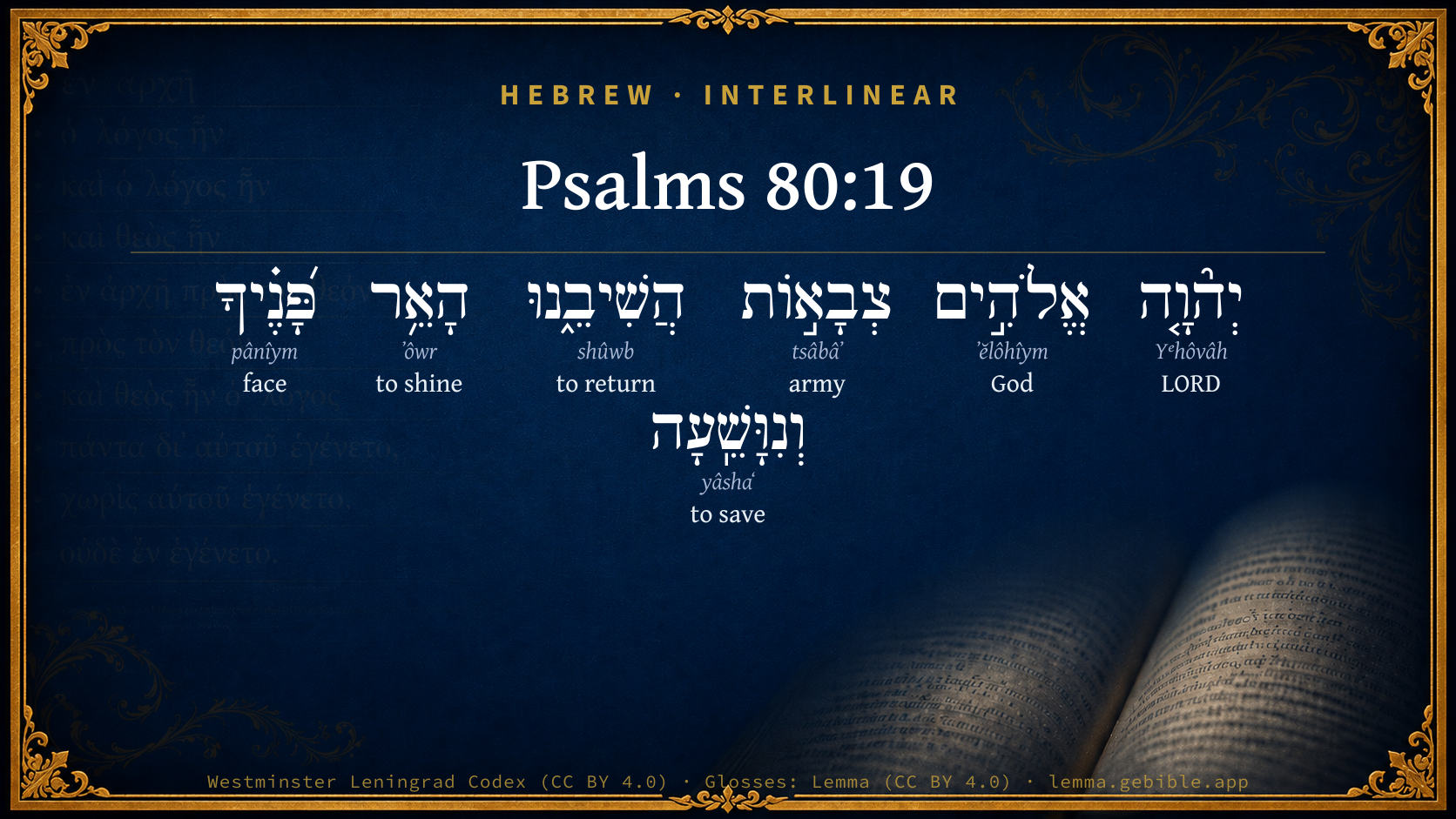
Psalms 80:19

Hebrew (Westminster Leningrad Codex) Psalms 80:19 appears in the Hebrew Old Testament. The text above is from the Westminster Leningrad Codex. Each word links to its Strong’s number, a concise gloss, and parsing drawn from the Open Scriptures Hebrew Bible morphology. Click any word for its full Brown-Driver-Briggs (BDB) entry.
Download image
Cite this verse

Psalms 80:19 (World English Bible). Public Domain. Lemma interlinear Bible study tool, https://lemma.gebible.app/v/psalms/80/19.

Show BibTeX & RIS
BibTeX
RIS
English Translation
Turn us again, Yahweh God of hosts. Cause your face to shine, and we will be saved.
World English Bible · Public Domain
Download a study sheet

One document with this verse’s original text, its word-by-word gloss line, the meaning frame, cross-references with their text, attributed commentary, and full source and license credits — printable, and it pastes into notes with its structure intact.

This verse Autodidact and up

Study sheet (.html) Plain text (.txt)

A passage Seminary Student

Up to 50 verses in one chapter. A passage sheet keeps up to 6 commentary sources and 12 cross-references per verse, in the order this page ranks them, and says so on the sheet whenever that leaves anything out. Ask for a single verse and you get the Autodidact verse sheet above.

Everything on this page stays free to read, with no account — the sheet is a download of what is already on screen, not access to it.

Want to remove ads? Support Godless Engineer
Compare translations 3

The same verse in 3 English versions, stacked beneath the original-language interlinear above. Click any original word for its lexicon entry.

Each is an independent rendering of the whole verse — the interlinear is not word-aligned to these translations.

Highlighted words mark where these versions differ — a whole-verse word diff, not a word-by-word alignment.

  • World English Bible Public Domain
    Turn us again, Yahweh God of hosts. Cause your face to shine, and we will be saved.
  • King James Version Public Domain
    Turn us again, O LORD God of hosts, cause thy face to shine; and we shall be saved.
  • unfoldingWord Literal Text CC BY-SA 4.0
    Yahweh, God of armies, restore us. Make your face shine, and let us be saved.

unfoldingWord Literal Text — © unfoldingWord, licensed CC BY-SA 4.0. Word-aligned USFM3 via Door43 (git.door43.org/unfoldingWord/en_ult).

Versions to compare (up to 4)

3 of 4 selected

Show all 18 translations

Every available English version of this verse, each an independent rendering of the whole verse.

  • World English Bible Public Domain
    Turn us again, Yahweh God of hosts. Cause your face to shine, and we will be saved.
  • Berean Standard Bible Public Domain
    Restore us, O LORD God of Hosts; cause Your face to shine upon us, that we may be saved.
  • Majority Standard Bible Public Domain
    Restore us, O LORD God of Hosts; cause Your face to shine upon us, that we may be saved.
  • King James Version Public Domain
    Turn us again, O LORD God of hosts, cause thy face to shine; and we shall be saved.
  • American Standard Version (1901) Public Domain
    Turn us again, O Jehovah God of hosts; Cause thy face to shine, and we shall be saved. Psalm 81 For the Chief Musician; set to the Gittith. `A Psalm' of Asaph.
  • Revised Version (1885) Public Domain
    Turn us again, O LORD God of hosts; cause thy face to shine, and we shall be saved.
  • Geneva Bible (1599) Public Domain
    Turne vs againe, O Lord God of hostes: cause thy face to shine and we shalbe saued.
  • Douay-Rheims (1899) Public Domain
    And we depart not from thee, thou shalt quicken us: and we will call upon thy name.
  • Young's Literal Translation Public Domain
    O Jehovah, God of Hosts, turn us back, Cause Thy face to shine, and we are saved!
  • Literal Standard Version CC BY-SA 4.0
    O YHWH, God of Hosts, turn us back, || Cause Your face to shine, and we are saved!
  • Unlocked Literal Bible CC BY-SA 4.0
    Yahweh God of hosts, restore us; make your face shine on us, and we will be saved.
  • unfoldingWord Literal Text CC BY-SA 4.0
    Yahweh, God of armies, restore us. Make your face shine, and let us be saved.
  • Darby Bible Public Domain
    Restore us, O Jehovah, God of hosts; cause thy face to shine, and we shall be saved.
  • World Messianic Bible Public Domain
    Turn us again, LORD God of Hosts. Cause your face to shine, and we will be saved.
  • Webster's Bible Public Domain
    \\80:18\\So will we not go back from thee: revive us, and we will call upon thy name.
  • Free Bible Version CC BY-SA 4.0
    Lord God Almighty, please restore us! Let your face shine on us so we can be saved.
  • Bible in Basic English Public Domain
    Take us back, O Lord God of armies; let us see the shining of your face, and let us be safe.
  • JPS Tanakh (1917) Public Domain
    (80-20) O LORD God of hosts, restore us; cause Thy face to shine, and we shall be saved.

Literal Standard Version (2020), Covenant Press — licensed CC BY-SA 4.0. Text via the HelloAO Bible API (eBible.org). Unlocked Literal Bible (unfoldingWord) — licensed CC BY-SA 4.0. Text via the HelloAO Bible API (eBible.org). unfoldingWord Literal Text — © unfoldingWord, licensed CC BY-SA 4.0. Word-aligned USFM3 via Door43 (git.door43.org/unfoldingWord/en_ult). Free Bible Version, Dr. Jonathan Gallagher — licensed CC BY-SA 4.0. Text via the HelloAO Bible API (eBible.org).

Word by word

More ways to search: Search by grammar → Find every occurrence → Compare this word →

Practice this passage: Drill this verse → Learn its vocabulary →

הָאֵ֥ר
ʼôwr
H215
“shine”
Verb, Hiphil, Imperative, 2nd Person, Masculine, Singular
Part of Speech
Verb
Stem
Hiphil
Form
Imperative
Person
2nd Person
Gender
Masculine
Number
Singular
Full BDB Definition

Origin: a primitive root

TWOT: 52

to be or become light, shine - (Qal) - to become light (day) - to shine (of the sun) - to become bright - (Niphal) - to be illuminated - to become lighted up - (Hiphil) - to give light, shine (of sun, moon, and stars) - to illumine, light up, cause to shine, shine - to kindle, light (candle, wood) - lighten (of the eyes, his law, etc) - to make shine (of the face)
  1. יְה֘וָ֤ה Yᵉhôvâh H3068 “LORD” Noun, Proper
  2. אֱלֹהִ֣ים ʼĕlôhîym H430 “God(s)” Noun, Common, Masculine, Plural, Absolute
  3. צְבָא֣וֹת tsâbâʼ H6635 “armies” Noun, Common, Both, Plural, Absolute
  4. הֲשִׁיבֵ֑נוּ shûwb H7725 “return · us” Verb, Hiphil, Imperative, 2nd Person, Masculine, Singular + Suffix, Personal, 1st Person, Common, Plural
  5. פָּ֝נֶ֗יךָ pânîym H6440 “face(s) · your” Noun, Common, Both, Plural, Construct + Suffix, Personal, 2nd Person, Masculine, Singular
  6. וְנִוָּשֵֽׁעָה yâshaʻ H3467 “and · to save” Conjunction + Verb, Niphal, Cohortative, 1st Person, Common, Plural

About this verse

These counts appear in no published source. They are computed here, from the morphology-tagged text and Lemma’s own curated glosses. What Lemma adds →

7
words
7
distinct lemmas
Wisdom
section

Shared distinctive vocabulary

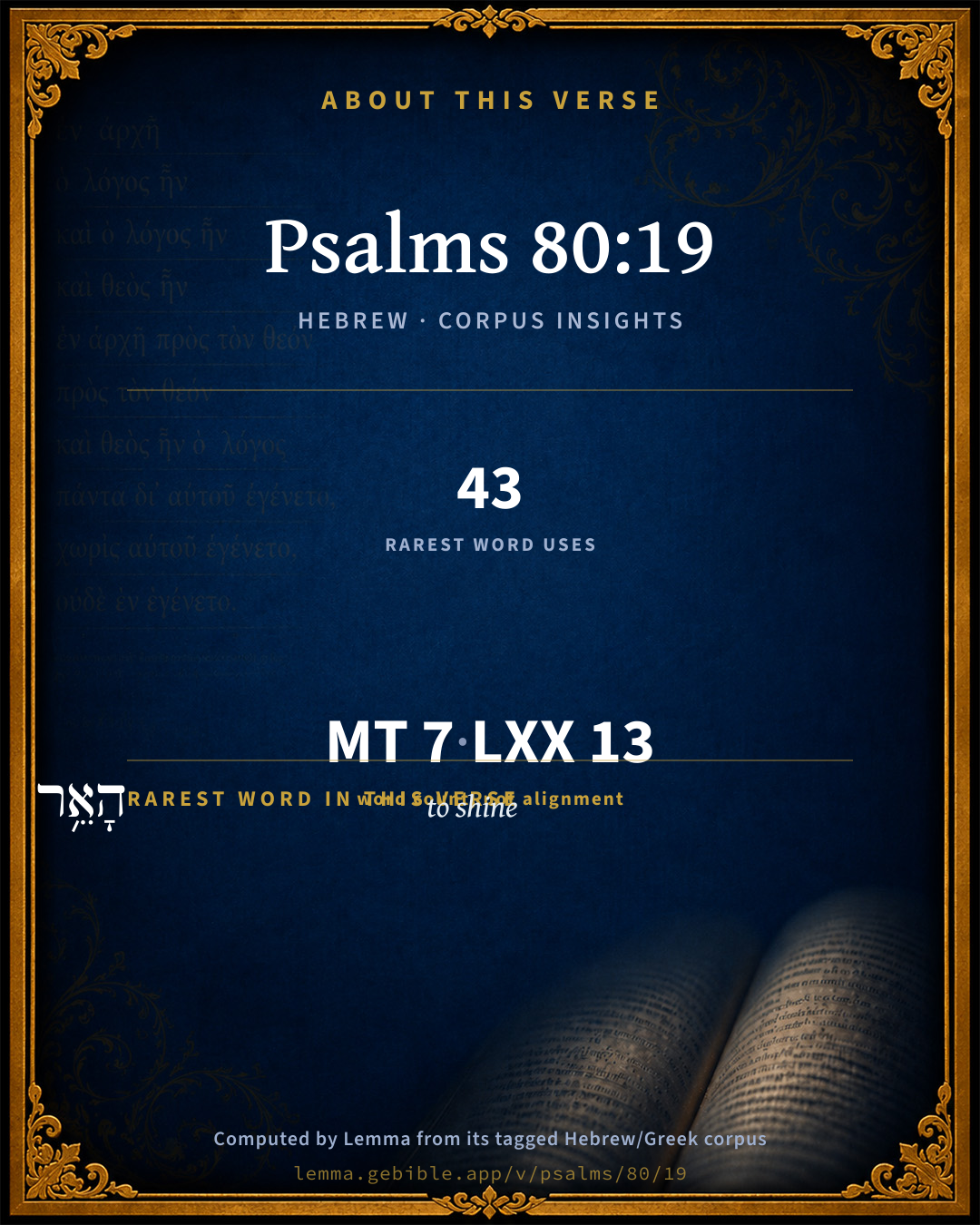
הָאֵ֥ר to shine H215 occurs in 43 verses of the Hebrew Bible. Also found in:

Grammatical profile

  • 3 verbs
  • 4 nouns

Verb forms

  • הֲשִׁיבֵ֑נוּ Hiphil · Imperative
  • הָאֵ֥ר Hiphil · Imperative
  • וְנִוָּשֵֽׁעָה Niphal · Cohortative

Hebrew & Septuagint length

In English translation the verse runs 17 words from the Hebrew and 18 from the Septuagint (LXX English) — closely comparable.

A rough comparison of the two English renderings, which tokenize alike — not a word-level alignment.

Word counts can differ between the Hebrew and the Greek without any difference in meaning — e.g. the Hebrew direct-object marker אֵת has no separate Greek word, and Greek often adds the article ὁ.

In the original languages it is 7 Hebrew tokens and 13 Greek tokens — but the two are counted differently (Hebrew bundles its prefixes and suffixes into one token; the Greek is in lemma form), so that isn’t a like-for-like length.

Cross-references

8

Topical passages linked to Psalms 80:19 in the Treasury of Scripture Knowledge — connected by theme and wording, ordered by reader-vote popularity; previews shown in the World English Bible.

  • Jeremiah 3:22–23 Return, you backsliding children, I will heal your backsliding. Behold, we are come to you; for you are Yahweh our God.
  • Psalms 27:4 One thing I have asked of Yahweh, that I will seek after, That I may dwell in the house of Yahweh all the days of my life, To see Yahweh's beauty, And to inquire in his temple.
  • Psalms 80:3 Turn us again, God. Cause your face to shine, And we will be saved.
  • Psalms 44:3 For they didn't get the land in possession by their own sword, Neither did their own arm save them; But your right hand, and your arm, and the light of your face, Because you were favorable to them.
  • Psalms 80:1 Hear us, Shepherd of Israel, You who lead Joseph like a flock, You who sit above the cherubim, shine forth.
  • Psalms 27:9 Don't hide your face from me. Don't put your servant away in anger. You have been my help. Don't abandon me, Neither forsake me, God of my salvation.
  • Psalms 31:16 Make your face to shine on your servant. Save me in your loving kindness.
  • Psalms 80:7 Turn us again, God of hosts. Cause your face to shine, And we will be saved.

Cross-references courtesy of OpenBible.info (CC BY 4.0).

Hebrew and Greek witnesses Masoretic Hebrew ↔ Greek Septuagint

The same verse in the two great witnesses to the Old Testament, shown verse-for-verse.

You’re reading Greek Psalm 79 (Hebrew Psalm 80). The Septuagint counts the superscription, so verse numbers can differ from the Hebrew — chapter-level alignment, not verse-by-verse. Numbering follows Rahlfs.

These are two independent witnesses, not word-aligned to each other, and the Septuagint is shown in lemma (dictionary) form.

Hebrew Psalms 80:19 Masoretic · Westminster Leningrad Codex

יְה֘וָ֤ה אֱלֹהִ֣ים צְבָא֣וֹת הֲשִׁיבֵ֑נוּ הָאֵ֥ר פָּ֝נֶ֗יךָ וְנִוָּשֵֽׁעָה

Turn us again, Yahweh God of hosts. Cause your face to shine, and we will be saved.

World English Bible · Public Domain

Greek LXX Greek Psalm 79:19 Septuagint · lemma form

καί οὐ μή ἀποἵστημι ἀπό σύ ζωόω ἐγώ καί ὁ ὄνομα σύ ἐπικαλέω

Turn us, O Lord God of hosts, and make your face to shine; and we shall be saved.

LXX2012 (modern English Septuagint) · Public Domain

Hebrew: Westminster Leningrad Codex (CC BY 4.0). Greek: Septuagint (public domain); English from LXX2012 (modern English Septuagint) (Public Domain). How the Septuagint differs from the Hebrew →

Commentary

Notes on Psalms 80:19 from classic Christian and Jewish commentators (each source and its license shown beneath its notes). The classic Christian expositions comment on the surrounding passage and are grouped to its opening verse, so a note may address several verses; the Jewish commentaries on the Tanakh (Rashi and others) are per-verse, so they appear only where the commentator wrote on this verse.

Lemma curates 59 commentaries, every one of them public domain or Creative Commons licensed, each selected and text-cleaned for this edition rather than reprinted as found. About our sources →

Adam Clarke's Commentary

Verse 19. Turn as again] Redeem us from this captivity.

O Lord God of hosts] Thou who hast all power in heaven and earth, the innumerable hosts of both worlds being at thy command.

Cause thy face to shine] Let us know that thou art reconciled to us. Let us once more enjoy thy approbation. Smile upon thy poor rebels, weary of their sins, and prostrate at thy feet, imploring mercy.

And we shall be saved.] From the power and oppression of the Chaldeans, from the guilt and condemnation of our sins, and from thy wrath and everlasting displeasure. Thus, O God, save US!

ANALYSIS OF THE EIGHTIETH PSALM

The parts of this Psalm are the following: -

I. A prayer, Ps 80:1-3.

II. A complaint by way of expostulation, Ps 80:4-7.

III. In the twelve last verses, to move God's mercy, he, 1. Shows God's love to Israel under the allegory of a vine, Ps 80:8-12. 2. Deplores the waste made upon it, Ps 80:12-13. 3. Prays for its restoration, Ps 80:13-18.

IV. He makes a vow of perpetual service, Ps 80:19.

I. The first part, his petition, Ps 80:1. 1. For audience, Ps 80:2. 2. For assistance, Ps 80:3. 3. For grace to amend, Ps 80:3.

The arguments he uses to induce the Lord to hear. 1. He was formerly their Shepherd. 2. He sat between the cherubim, on the mercy - seat. 3. He has only to shine forth, and show himself; and they shall be saved.

II. The second part, his complaint. He complains, 1. That God was angry with them. 2. That the people were in the most distressed circumstances, Ps 80:5. 3. Of what they suffered from their neighbours, Ps 80:6.

On which he redoubles his prayer. 1. Turn us. 2. Cause thy face to shine. And, 3. Then we shall be saved, Ps 80:7.

III. The third part: what God had done for his people. 1. He brought the vine out of Egypt, Ps 80:8. 2. He cast out the heathen, Ps 80:8. 3. He planted it. 4. He prepared the soil for it. 5. He caused it to take deep root. 6. And it filled the land, from the river Euphrates to the Mediterranean Sea, Ps 80:9-11.

He deplores the waste made upon it. 1. The fence was broken down. 2. It was spoiled by those who passed by, and by the wild beasts.

Then he prays, 1. Look down from heaven. 2. Visit this vine. 3. It is cut down. 4. It is burnt with fire. 5. Let thy power in its behalf be shown by the Man of thy right hand. See the notes.

Some think Zerubbabel is meant; others think the Jewish nation is thus called the son of man, and the man of God's right hand.

IV. The last part of the Psalm: gratitude and obedience are promised. 1. We will backslide no more, Ps 80:18. 2. We are nearly dead; quicken us, and we will live to thee. 3. We will invoke thy name. We will serve thee alone, and never more bow down to any strange god, Ps 80:18.

All these things considered, he thinks he has good ground for his prayer; and therefore confidently repeats what he had twice before said: "Turn us again, O Lord God of hosts, cause thy face to shine," &c.

Adam Clarke's Commentary on the Bible (1810–1826) — public domain. Text from a community e-Sword/MySword module.

Trapp's Complete Commentary

John Trapp

Psa 80:19 Turn us again, O LORD God of hosts, cause thy face to shine; and we shall be saved.

Ver. 19. Turn us again] See Psa 80:7. Prayers are like arrows of deliverance, which would be multiplied and enlarged, 2Ki 13:17.

John Trapp, A Commentary or Exposition upon All the Books of the Old and New Testament (1647–1656) — public domain. Text from a community e-Sword module.

The Biblical Illustrator

Joseph S. Exell

Psa_80:19

Turn us again, O Lord God of hosts, cause Thy face to shine; and we shall be saved.

Divine greatness and Divine graciousness

I. Divine greatness, Lord God of hosts. What hosts are under Him? All the tribes of irrational life on this earth, all classes of men, all the stars of heaven, all the myriad systems of globes in space, all the innumerable armies of intelligent existences, both the happy and the miserable, He is Lord of all. How great is God! To whom will ye liken Me? saith the Lord, etc.

II. Divine graciousness. Cause Thy face to shine.

1. The enjoyment of Gods graciousness requires a Divine change on mans part. Turn us.

(1) Some do not see God at all. God is not in all their thoughts.

(2) Some see His frown. Their guilty conscience invests Him with terrible attributes and covers His face with the frowns of indignant justice.

(3) Some see His shining face. Thy face--beaming face; Such are they whom He has turned to Him, by repentance towards Him and faith in our Lord Jesus Christ.

2. The enjoyment of Gods graciousness involves the realization of mans highest hopes, And we shall be saved. What is that? We know what it meant to the author of this poem; but it means infinitely more to all human souls. (Homilist.)

One antidote for many ills

This seems to be the only prayer the psalmist puts up in this psalm, as being of itself sufficient for the removal of all the ills over which he mourned. The reason is obvious. He had traced all the calamities to one source--O Lord God, how long wilt Thou be angry? and now he seeks refreshing from one fountain.

I. The benefits of revival to any Church in the world will be a lasting blessing. I do not mean that spurious kind of revival. I do not mean all that excitement attendant upon religion, which has brought men into a kind of spasmodic godliness, and translated them from sensible beings into such as could only rave about a religion they did not understand. I do not think that is a real and true revival. Gods revivals, whilst they are attended with a great heat and warmth of piety, yet have with them knowledge as well as life, understanding as well as power. Among the blessings of the revival of Christians are--

1. The salvation of sinners. For this we must, and will, cry, O Lord our God, visit Thy plantation, and pour out again upon us Thy mighty Spirit.

2. The promotion of true love and unanimity in its midst. Oh, if God gives us revival, we shall have perfect unanimity.

3. The mouths of the enemies of the truth are stopped.

4. The promotion of the glory of God. If we would honour God by the Church, we must have a warm Church, a burning Church, loving the truths it holds, and carrying them out in the life.

II. What are the means of revival? They are twofold. One is, Turn us again, O Lord God of hosts; and the other is, Cause Thy face to shine. There can be no revival without both of these.

1. Turn us again, O Lord God of hosts.

(1) Your minister feels that he needs to be turned more thoroughly to the Lord his God.

(2) But there are some of you who are workers in the Church. Large numbers are actively engaged for Christ. Now, what I exhort you to is this: cry unto God--Turn us again, O God. You want more of the Spirit of God in all your labours.

(3) Turn us again must be the prayer of all of you, not only in your religious labours, but in your daily lives.

2. The other means of revival is a precious one--Cause Thy face to shine. Ah! we might ask of God, that we might all be devoted, all His servants, all prayerful, and all what we want to be; but it would never come without this second prayer being answered; and even if it did come without this, where would be the blessing? It is the causing of His face to shine on His Church that makes a Church flourish. A black cloud has swept over us, all we want is that the sun should come, and it shall sweep that cloud away. There have been direful things; but what of them, if God, our God, shall appear?

III. Come, now, let me stir you all up, all of you who love the Saviour, to seek after this revival. (C. H. Spurgeon.)

.

Psa_81:1-16

The Biblical Illustrator, edited by Joseph S. Exell (c. 1880s–1900s) — public domain. Text from a community e-Sword module.

J. A. Alexander on Psalms

Joseph Addison Alexander

20. (Psa 80:19) Jehovah, God, (God of) Hosts, restore us, let thy face shine, and let us be saved! While the prayer in this verse is identical with that in Psa 80:3 and Psa 80:7, there is a kind of climax in the form of the address. In the first of the three places it is simply God, in the second God of Hosts, in the third and last Jehovah God of Hosts, as if to add to the general ideas of divinity and sovereignty those of self-existence, eternity, and covenant relation to his chosen people, as additional warrants for the hope and prayer, that he would turn them, smile upon them, save them.

Joseph Addison Alexander, The Psalms Translated and Explained (1850) — public domain. Text from a community e-Sword module.

Ellicott's Commentary for English Readers

(19) Turn us.—By a fine gradation in the style of the address to God, the refrain has at last reached its full tone, expressive of the completest trust—

“God’s ways seem dark, but soon or late

They touch the shining hills of day.

The evil cannot brook delay;

The good can well afford to wait.”

WHITTIER.

A Bible Commentary for English Readers, edited by Charles John Ellicott (1878–1897) — public domain. Text from a community e-Sword module.

The Cambridge Bible for Schools and Colleges

gen. ed. J. J. S. Perowne

19. O Lord God of hosts] There is a climax in the use of divine names in the refrains (3, 7, 19). The Psalmist clenches his appeal by the use of the covenant name Jehovah, along with the title expressive of universal sovereignty, God of hosts.

The Cambridge Bible for Schools and Colleges (gen. ed. J. J. S. Perowne; Cambridge University Press, 1878–1918) — public domain. Text from a community e-Sword module.

Albert Barnes' Notes on the Bible

Turn us again, O Lord God of hosts ... - See Psa 80:3, note; Psa 80:7, note; Psa 80:14, note. This is the sum and the burden of the psalm. The repetition of the prayer shows the earnestness of the people, and their conviction that their only hope in their troubles was that God would interpose and bring them back again; that he would be favorable to them, and lift upon them the light of his countenance. So with all. In our backslidings, our afflictions, and our troubles, our only hope is that God will bring us back to himself; our proper place is at the throne of mercy; our pleadings should be urgent, earnest, and constant, that he will interpose and have mercy on us; our solemn purpose - our expressed and recorded pledge - should be that if we are restored to God, we will wander no more. But, alas! how much easier it is to say this than to do it; how much easier to promise than to perform; how much easier to pledge ourselves when we are in affliction that if the troubles are removed we will be faithful, than it is to carry out such a purpose when the days of prosperity return, and we are again surrounded by the blessings of health and of peace. If all people - even good people - kept the vows which they make, the world would be comparatively a pure and happy world; if the church itself would only carry out its own solemn pledges, it would indeed arise and shine, and the world would soon be filled with light and salvation.

Albert Barnes' Notes on the Bible (1834–1885) — public domain. Text from a community e-Sword/MySword module.

The Treasury of David

Charles H. Spurgeon

Ver. 19. Turn us again, O Lord God of Hosts. Here we have another advance in the title and the incommunicable name of Jehovah, the I AM is introduced. Faith's day grows brighter as the hours roll on; and her prayers grow more full and mighty.

Cause thy face to shine; and we shall be saved. Even we who were so destroyed. No extremity is too great for the power of God. He is able to save at the last point, and that too by simply turning his smiling face upon his afflicted. Men can do little with their arm, but God can do all things with a glance. Oh, to live for ever in the light of Jehovah's countenance.

Ver. 19. Turn us again. How well that we can look to God when our face is set wrong, that he may turn us, and so his face shine on us, as to bring blessing and present deliverance to his people. J. N. Darby.

Ver. 19. During distress God comes; and when he comes it is no more distress. Gaelic Proverb.

None.

Charles H. Spurgeon's The Treasury of David (1869–1885) — public domain. Psalms only. Text from a community e-Sword/MySword module.

Whedon's Commentary on the Bible

Daniel D. Whedon

19. Turn us again, O Lord God of hosts—The closing refrain. See Psa_80:7. In this wonderful prayer a noticeable rising in the titles of deity appears: “Shepherd of Israel,” “God,” “God of hosts,” “Jehovah, God of hosts;” and with the endearing and awful names of deity, urged in the agony of desire and the imminence of ruin, rises the psalmist’s earnest, tender, and appealing pathos. With the good King Hezekiah and the prophets Isaiah, (now in his vigour,) Micah, and Hosea, to cooperate in the movements of the reformation, as in the spirit of this psalm, how could they fail of success? Yet most of the people of the northern tribes mocked at the preachers and heralds, though many were brought back to God. 2Ch_30:10-11. After this by Hezekiah, no great effort was made to reclaim the wasted “ten tribes,” or kingdom of Israel. At the restoration of Judah from the Babylonian captivity, all of Israel, of whatsoever tribe, who could prove their genealogical descent, were welcomed back to the fellowship of the Hebrew family; but beyond this no restoration of the lost “ten tribes” has ever been made, nor has history preserved any record of their distinct existence. We know that in later times the Galileans, Samaritans, and those east of Jordan were largely of mixed heathen and Hebrew blood.

Daniel D. Whedon (gen. ed.), Commentary on the Old and New Testaments (1874–1909) — public domain. Text from a community e-Sword module.

The Pulpit Commentary

Turn us again, O Lord God of hosts, cause thy face to shine; and we shall he saved. The psalm is closed by the refrain in its third and most perfect form. First we had, "Turn us again, O God" (ver. 3); then, "Turn us again, O God of hosts" (ver. 7); now, "Turn us again, O Lord God of hosts the appeal to God continually increasing in intensity. Having made his third appeal by the covenant Name, the psalmist seems to feel that he has done all that he can, and desists.

The Pulpit Commentary (1880–1919), ed. H.D.M. Spence-Jones & Joseph S. Exell — public domain. Text from a community e-Sword module.

unfoldingWord translationNotes

Door43 World Missions Community

shine on us

The writer speaks of Yahweh acting favorably towards them as if Yahweh's face shone a light on them. See how you translated this in Psalms 80:3. AT: "act favorably towards us" (See: Metaphor)

we will be saved

This can be stated in active form. AT: "you will save us" (See: Active or Passive)

translationWords

restore

Yahweh

Yahweh of hosts

save

unfoldingWord translationNotes — © Distant Shores Media and the Door43 World Missions Community, licensed CC BY-SA 4.0. Source: git.door43.org/Door43/en_tn.

Rashi

Rabbi Shlomo Yitzchaki (Rashi)

And let us not withdraw from You Do not cause us to withdraw from You.

grant us life from the exile, and we shall mention Your goodness and Your might, and then we shall call out in Your name.

Rashi on the Tanakh — English translations: “The Judaica Press complete Tanach with Rashi, translated by A. J. Rosenberg” (CC BY 4.0); “Pentateuch with Rashi's commentary by M. Rosenbaum and A.M. Silbermann, 1929-1934” (public domain); “The Metsudah Tanach series, Lakewood, N.J” (CC BY 4.0); and “The Book of Joshua, Metsudah Publications, 1997” (CC BY 4.0). Text via Sefaria.

Lesson kit

Teaching starters — assembled from the data on this page, not authored interpretation. Every prompt links to the verse data it draws on. Edit before teaching.

Psalms, in the Wisdom, opens this verse with 7 words (7 distinct Hebrew lemmas). Its most distinctive word is ʼôwr (“to shine”). A historical commentator’s framing appears above. Read the whole chapter for the surrounding context.

Discussion questions

  1. How does “to shine” (ʼôwr) shape what this verse is saying?
  2. Genesis 1:15 shares the word «to shine» with this verse. How do the two illuminate each other?
  3. These translations render this verse differently; the difference is in the English rendering, not the original. What questions does that raise?
  4. The verb «הֲשִׁיבֵ֑נוּ» is Hiphil Imperative. How does its form color the action?
  5. Reading how Adam Clarke's Commentary and Trapp's Complete Commentary read this verse, where do the two commentators agree and where do they part?

Things to notice

Reading settings

Reading text

Shown beneath each verse's original-language words.

Old Testament
Old Testament edition

Read the OT as the Masoretic Hebrew (MT) or the Greek Septuagint (LXX).

English shown for the Greek Septuagint (in the Hebrew ↔ Greek comparison).

Comparing translations? Open the Compare panel on any verse page to stack up to four side by side.