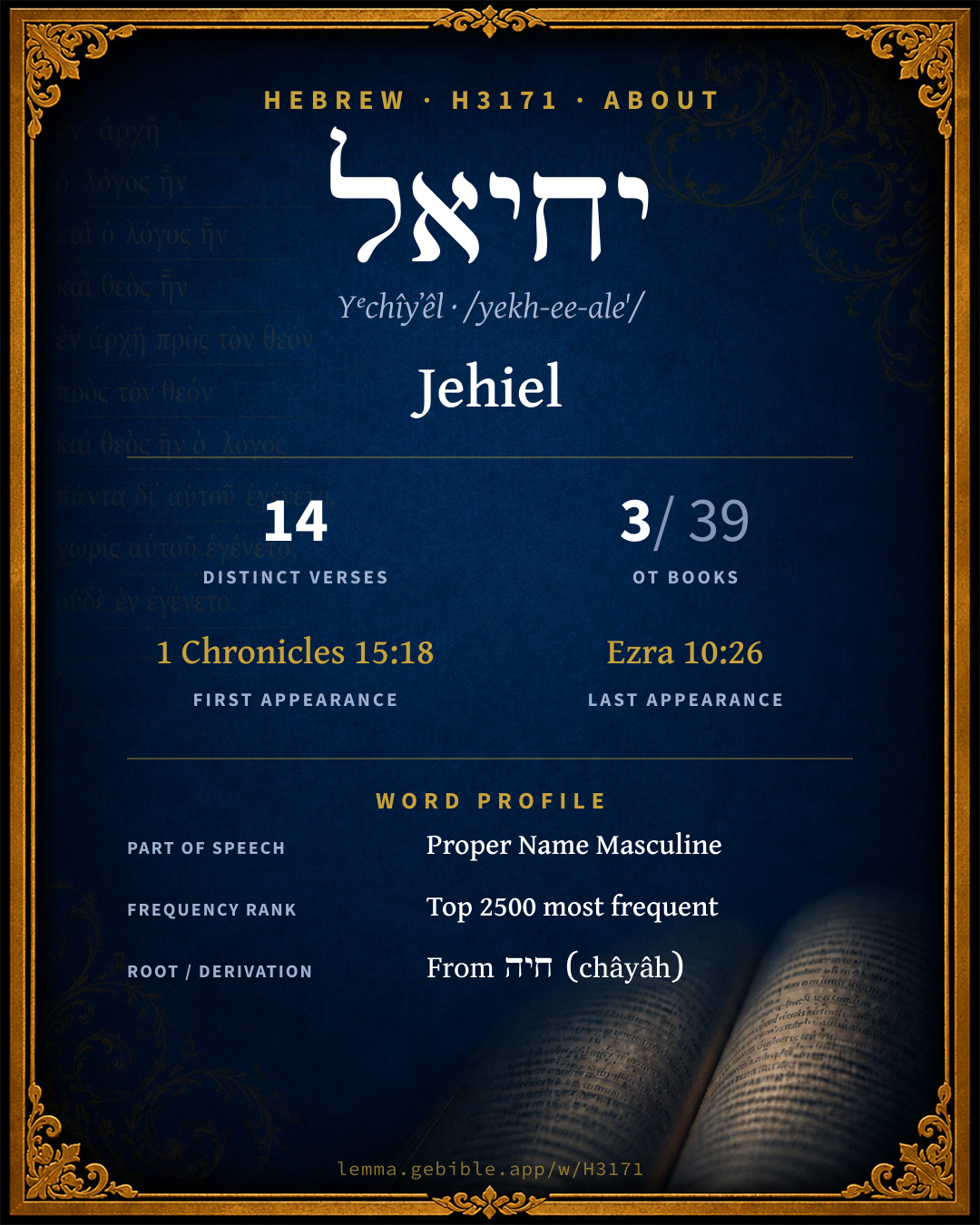
יְחִיאֵל
Jehiel
BDB lists 10 entries for ‘Jehiel’ fuller range ↓
Full lexicon entry — Brown-Driver-Briggs (BDB)
From Brown-Driver-Briggs (BDB)
Where this word appears
Grammar key — what these labels mean
Part of speech
- Noun
- A naming word — a person, place, thing, or idea.
Noun type
- Proper
- A name of a specific person, place, or people (e.g. Abraham, Zion, Israel).
Every verse where H3171 appears — 14 distinct verses across 3 books. Click any verse to open its interlinear word-by-word view. Verse text shown in the World English Bible for context — . Each verse’s Hebrew form is shown with its reference; the English is not keyword-highlighted, since the data carries no word-level English alignment. Use “Compare translations” on any verse to read it across multiple English versions. This concordance covers the Hebrew Bible; Septuagint (Greek Old Testament) occurrences are not indexed here.
1 Chronicles 6 verses
- 1 Chronicles 15:18 וִ/יחִיאֵ֣ל conj + n Proper and with them their brothers of the second degree, Zechariah, Ben, and Jaaziel, and Shemiramoth, and Jehiel, and Unni, Eliab, and Benaiah, and Maaseiah, and Mattithiah, and Eliphelehu, and Mikneiah, and Obed-edom, and Jeiel, the doorkeepers.
- 1 Chronicles 15:20 וִֽ/יחִיאֵל֙ conj + n Proper and Zechariah, and Aziel, and Shemiramoth, and Jehiel, and Unni, and Eliab, and Maaseiah, and Benaiah, with psalteries set to Alamoth;
- 1 Chronicles 16:5 וִֽ/יחִיאֵ֡ל conj + n Proper Asaph the chief, and second to him Zechariah, Jeiel, and Shemiramoth, and Jehiel, and Mattithiah, and Eliab, and Benaiah, and Obed-edom, and Jeiel, with psalteries and with harps; and Asaph with cymbals, sounding aloud;
- 1 Chronicles 23:8 יְחִיאֵ֛ל n Proper The sons of Ladan: Jehiel the chief, and Zetham, and Joel, three.
- 1 Chronicles 27:32 וִֽ/יחִיאֵ֥ל conj + n Proper Also Jonathan, David's uncle, was a counselor, a man of understanding, and a scribe: and Jehiel the son of Hachmoni was with the king's sons:
- 1 Chronicles 29:8 יְחִיאֵ֖ל n Proper They with whom [precious] stones were found gave them to the treasure of the house of Yahweh, under the hand of Jehiel the Gershonite.
2 Chronicles 4 verses
- 2 Chronicles 21:2 וִֽ/יחִיאֵל֙ conj + n Proper He had brothers, the sons of Jehoshaphat: Azariah, and Jehiel, and Zechariah, and Azariah, and Michael, and Shephatiah; all these were the sons of Jehoshaphat king of Israel.
- 2 Chronicles 29:14 יחואל יְחִיאֵ֣ל n Proper n Proper and of the sons of Heman, Jehuel and Shimei; and of the sons of Jeduthun, Shemaiah and Uzziel.
- 2 Chronicles 31:13 וִֽ/יחִיאֵ֡ל conj + n Proper Jehiel, and Azaziah, and Nahath, and Asahel, and Jerimoth, and Jozabad, and Eliel, and Ismachiah, and Mahath, and Benaiah, were overseers under the hand of Conaniah and Shimei his brother, by the appointment of Hezekiah the king, and Azariah the ruler of the house of God.
- 2 Chronicles 35:8 וִֽ/יחִיאֵ֗ל conj + n Proper His princes gave for a freewill-offering to the people, to the priests, and to the Levites. Hilkiah and Zechariah and Jehiel, the rulers of the house of God, gave to the priests for the Passover offerings two thousand and six hundred [small cattle], and three hundred oxen.
Ezra 4 verses
- Ezra 8:9 יְחִיאֵ֑ל n Proper Of the sons of Joab, Obadiah the son of Jehiel; and with him two hundred and eighteen males.
- Ezra 10:2 יְחִיאֵ֜ל n Proper Shecaniah the son of Jehiel, one of the sons of Elam, answered Ezra, We have trespassed against our God, and have married foreign women of the peoples of the land: yet now there is hope for Israel concerning this thing.
- Ezra 10:21 וִ/יחִיאֵ֖ל conj + n Proper Of the sons of Harim: Maaseiah, and Elijah, and Shemaiah, and Jehiel, and Uzziah.
- Ezra 10:26 וִ/יחִיאֵ֣ל conj + n Proper Of the sons of Elam: Mattaniah, Zechariah, and Jehiel, and Abdi, and Jeremoth, and Elijah.
About this entry
At a glance — auto-summarized from this page’s data, not written by a person. Every figure links to its source below. This summary describes the numbers; it doesn’t interpret them.
“Jehiel” is the headline sense of the Hebrew name יחיאל (Yᵉchîyʼêl). First canonically at 1 Chronicles 15:18, it enters the text early. It appears 14 verses across 3 books of the Hebrew Bible, among its uncommon vocabulary. More than a third of its appearances fall in 1 Chronicles. The sections below give every occurrence and version rendering.
Gloss history
Strong's 1890 vs modern scholarship
About this word
Strong's H3171 catalogs a Hebrew word from the Hebrew Old Testament.
These counts are not copied from any lexicon or concordance. They are computed here, from the morphology-tagged Hebrew Old Testament. What Lemma adds →
- 14
- distinct verses
- The word appears in 14 distinct verses.
- 3 / 39
- OT books
- The word appears in 3 of 39 Old Testament books.
- #1,836
- by frequency
- Top 2500 most frequent Hebrew words (rank 1,836 of 8,640 Hebrew words by occurrence).
View all 14 occurrences in the concordance →
Most concentrated in
- 1 Chronicles 6 verses 43%
- 2 Chronicles 4 verses 29%
- Ezra 4 verses 29%
By section of the Old Testament
By traditional corpus
Conventional, traditional groupings — biblical authorship is debated, so this is a traditional corpus grouping, not an authorship claim. Each share is this word’s portion of its verses in that division of the Hebrew canon. Each figure is a share of the word’s 14 distinct verses.
- Writings (Ketuvim) 14 verses · 100%
How translations render this word
Counts come from each version’s own published word-to-Strong’s tagging or interlinear alignment — an approximate guide to how each version renders this word, not a word-level alignment the data otherwise carries. Because each total is that version’s own tagged count, the per-version totals vary from one another and need not match the appearance or distinct-verse counts above. These counts may also differ from a printed concordance because Lemma counts each distinctly tagged rendering and does not collapse phrase taggings into a single head-word total. This is a fixed set of word-tagged versions (KJV, ASV, BSB, ULT) and does not change with the reading translation you choose elsewhere. Each version’s license is shown beside its name below (and on Sources).
BDB lists this Strong’s number as 2 distinct words (homographs). Each count above pools all of them and is not split by sense — see the Senses section below. A low-frequency rendering may belong to a different one of those words, not the primary meaning.
- King James Version†: Jehiel 13×
- American Standard Version†: Jehiel 13×
- Berean Standard Bible†: Jehiel 14×
- unfoldingWord Literal Text†: Jehiel 13×
King James Version Public Domain
Renders H3171 across 14† tagged occurrences — most commonly:
Plus 1 rendering that appears only once — usually multi-word phrases or single function words the recovered tagging swept in, not distinct renderings.
American Standard Version Public Domain
Renders H3171 across 14† tagged occurrences — most commonly:
Plus 1 rendering that appears only once — usually multi-word phrases or single function words the recovered tagging swept in, not distinct renderings.
Berean Standard Bible Public Domain
Renders H3171 across 14† tagged occurrences — most commonly:
unfoldingWord Literal Text CC BY-SA 4.0
Renders H3171 across 14† tagged occurrences — most commonly:
Plus 1 rendering that appears only once — usually multi-word phrases or single function words the recovered tagging swept in, not distinct renderings.
8 senses and sub-senses in the full BDB
What do BDB’s symbols mean?
BDB uses these scholarly abbreviations:
| Symbol | Meaning |
|---|---|
| 𝔊 | the Septuagint (the ancient Greek translation, LXX) |
| 𝔙 | the Vulgate (the Latin translation) |
| 𝔖 | the Syriac version (the Peshitta) |
| 𝔗 | the Targum (the Aramaic translation) |
| ψ | the Psalms |
| √ | root (the underlying root or stem) |
| ‖ | parallel passage (a synonymous or contrasted parallel) |
| † | the dagger: every passage where the word occurs is cited |
The 8 senses and sub-senses the full Brown-Driver-Briggs lexicon distinguishes for this word, in lexicon order (not ranked by frequency), with BDB’s own verbatim wording and sub-sense lettering. Shown in Hebrew script with BDB’s own scholarly abbreviations. The condensed entry is in the Lexicon Entry tab. See also the Forms in the corpus table below.
- 1. one of David’s chief musicians 1 Ch 15:18 (𝔊 Ιειηλ, 𝔊L Ιαιηλ), v 20 (𝔊 Ειθηλ, 𝔊L Ιειηλ), 16:5 (𝔊 Ειειηλ, 𝔊L Ιαιηλ). e.g. 1 Chronicles 15:18
- 2. one of David’s chiefs of the Levites 1 Ch 23:8 (𝔊 Ι(ει)ηλ), 29:8 (𝔊 Βεσιηλ, A 𝔊L Ιειηλ). e.g. 1 Chronicles 23:8
- 3. tutor of David’s sons 1 Ch 27:32 (𝔊 Ιε(ρι)ηλ, 𝔊L Ιωηλ). e.g. 1 Chronicles 27:32
- 4. son of Jehoshaphat 2 Ch 21:2. e.g. 2 Chronicles 21:2
- 5. יְחִו֯אֵל Hemanite of Hezekiah’s reign 2 Ch 29:14. e.g. 2 Chronicles 29:14
- 6. overseer in Hezekiah’s reign 2 Ch 31:13. e.g. 2 Chronicles 31:13
- 7. ruler of the temple in Josiah’s reign 2 Ch 35:8. e.g. 2 Chronicles 35:8
- 8. contemporaries of Ezra, Ezr 8:9 (𝔊 Ιεμα, A Ιεειηλ, 𝔊L Ιειηλ), 10:2, 21, 6. e.g. Ezra 8:9
Senses from the full Brown-Driver-Briggs lexicon (Brown, Driver, Briggs; Oxford 1906 — public domain), digitized via Sefaria, supplemented by the OpenScriptures HebrewLexicon (CC BY 4.0). Full attribution on Sources.
Word origin
n.pr.m. (may Ēl live; Ph. יחואלן, יחומלך v. Eut ZMG 1876, 136)—𝔊 usually Ιειηλ, Ιαιηλ;—
— Brown-Driver-Briggs (Oxford 1906, public domain), digitized via Sefaria, supplemented by the OpenScriptures HebrewLexicon (CC BY 4.0). See Sources.
Derived from חיה (châyâh) (H2421) — to live.
Forms in the corpus
The 12 distinct written forms H3171 takes in the Hebrew Bible, most frequent first — each parse links to that state’s occurrences in the concordance. Hebrew forms include their vowel points and cantillation, so a single lemma takes many written forms.
| Form | Parsing | Example | Uses |
|---|---|---|---|
| וִ/יחִיאֵ֣ל | Noun, Proper | Ezra 10:26 | 2 |
| וִֽ/יחִיאֵ֡ל | Noun, Proper | 1 Chronicles 16:5 | 2 |
| וִֽ/יחִיאֵל֙ | Noun, Proper | 1 Chronicles 15:20 | 2 |
| וִ/יחִיאֵ֖ל | Noun, Proper | Ezra 10:21 | 1 |
| וִֽ/יחִיאֵ֗ל | Noun, Proper | 2 Chronicles 35:8 | 1 |
| וִֽ/יחִיאֵ֥ל | Noun, Proper | 1 Chronicles 27:32 | 1 |
| יְחִיאֵ֑ל | Noun, Proper | Ezra 8:9 | 1 |
| יְחִיאֵ֖ל | Noun, Proper | 1 Chronicles 29:8 | 1 |
| יְחִיאֵ֛ל | Noun, Proper | 1 Chronicles 23:8 | 1 |
| יְחִיאֵ֜ל | Noun, Proper | Ezra 10:2 | 1 |
| יְחִיאֵ֣ל | Noun, Proper | 2 Chronicles 29:14 | 1 |
| יחואל | Noun, Proper | 2 Chronicles 29:14 | 1 |
Same root — word family
Other BDB entries built from the same root as H3171, grouped by Strong’s listed origin. These share a root / origin per the lexicon — not necessarily a shared meaning. Each links to that word’s own entry.
Derives from
Shares the same root
- חי chay H2416 living
- חיא chăyâʼ H2418 to live
- חיה châyeh H2422 lively
- חיות chayûwth H2424 living
- חיי châyay H2425 to live
- מחיה michyâh H4241 sustenance
Proper names from this root
People and places named from this root — a name, not an additional meaning of the word.
Compare all same-root words → Showing 4 of 10 — not the complete family. 2 of the same-root words are proper names (people or places). They share a root, not necessarily a meaning.
Bible dictionary
Public-domain dictionary articles matched to this entry by name (Jehiel). A biblical name can be shared by more than one person or place, so an article may treat several.
Easton's Bible Dictionary · M. G. Easton, 1897
God's living one. (1.) The father of Gibeon (1 Chr. 9:35).
(2.) One of David's guard (1 Chr. 11:44).
(3.) One of the Levites "of the second degree," appointed to conduct the music on the occasion of the ark's being removed to Jerusalem (1 Chr. 15:18, 20).
(4.) A Hachmonite, a tutor in the family of David toward the close of his reign (1 Chr. 27:32).
(5.) The second of Jehoshaphat's six sons (2 Chr. 21:2).
(6.) One of the Levites of the family of Heman who assisted Hezekiah in his work of reformation (2 Chr. 29:14).
(7.) A "prince" and "ruler of the house of God" who contributed liberally to the renewal of the temple sacrifices under Josiah (2 Chr. 35:8).
(8.) The father of Obadiah (Ezra 8:9).
(9.) One of the "sons" of Elam (Ezra 10:26).
(10.) Ezra 10:21.
Smith's Bible Dictionary · William Smith, 1863
(treasured of God), a perfectly distinct name from the last.
+ A man described as father of Gibeon; a fore-father of King Saul. (1 Chronicles 9:35) + One of the sons of Hotham the Aroerite; a member of David's guard. (1 Chronicles 11:44) (B.C. 1046.)
(God lives).
+ One of the Levites appointed by David to assist in the service of the house of God. (1 Chronicles 15:18,20; 16:5) + One of the sons of Jehoshaphat king of Judah, put to death by his brother Jehoram. (2 Chronicles 21:2,4) (B.C. 887.) + One of the rulers of the house of God at the time of the reforms of Josiah. (2 Chronicles 35:8) (B.C. 623.) + A Gershonite Levite, (1 Chronicles 23:8) who had charge of the treasures. ch. (1 Chronicles 28:8) + A son of Hachmoni named in the list of David's officers, (1 Chronicles 27:32) as "with the king's sons," whatever that may mean. + A Levite who took part in the restorations of King Hezekiah. (2 Chronicles 29:14) (B.C. 726.) + Another Levite at the same period. (2 Chronicles 31:13) + Father of Obadiah, of the Bene-Joab. (Ezra 8:9) (B.C. before 459.) + One of the Bene-Elam, father of Shechaniah. (Ezra 10:2) + A member of the same family, who himself had to part with his wife. (Ezra 10:26) + A priest, one of the Bene-Harim, who also had to put away his foreign wife. (Ezra 10:21) (B.C. 459.)
Classic public-domain reference works; full attribution on Sources.
Septuagint verse parallels
This word appears in 14 verses that also exist in the Greek Old Testament (Septuagint), out of the 14 Hebrew verses it occurs in. You can read those verses in Greek by switching the Old Testament edition to the Septuagint.
Read these verses in the Septuagint
This is a verse-level parallel only — the same verses exist in both the Hebrew and Greek Old Testaments. No word-level Hebrew↔Greek correspondence is claimed: the data carries no such alignment, so no Greek word is shown as this Hebrew word’s translation. Coverage is not total — the Septuagint omits the deuterocanon and renumbers the Psalms, so some Hebrew verses have no direct Greek parallel.