
2 Kings 13:21

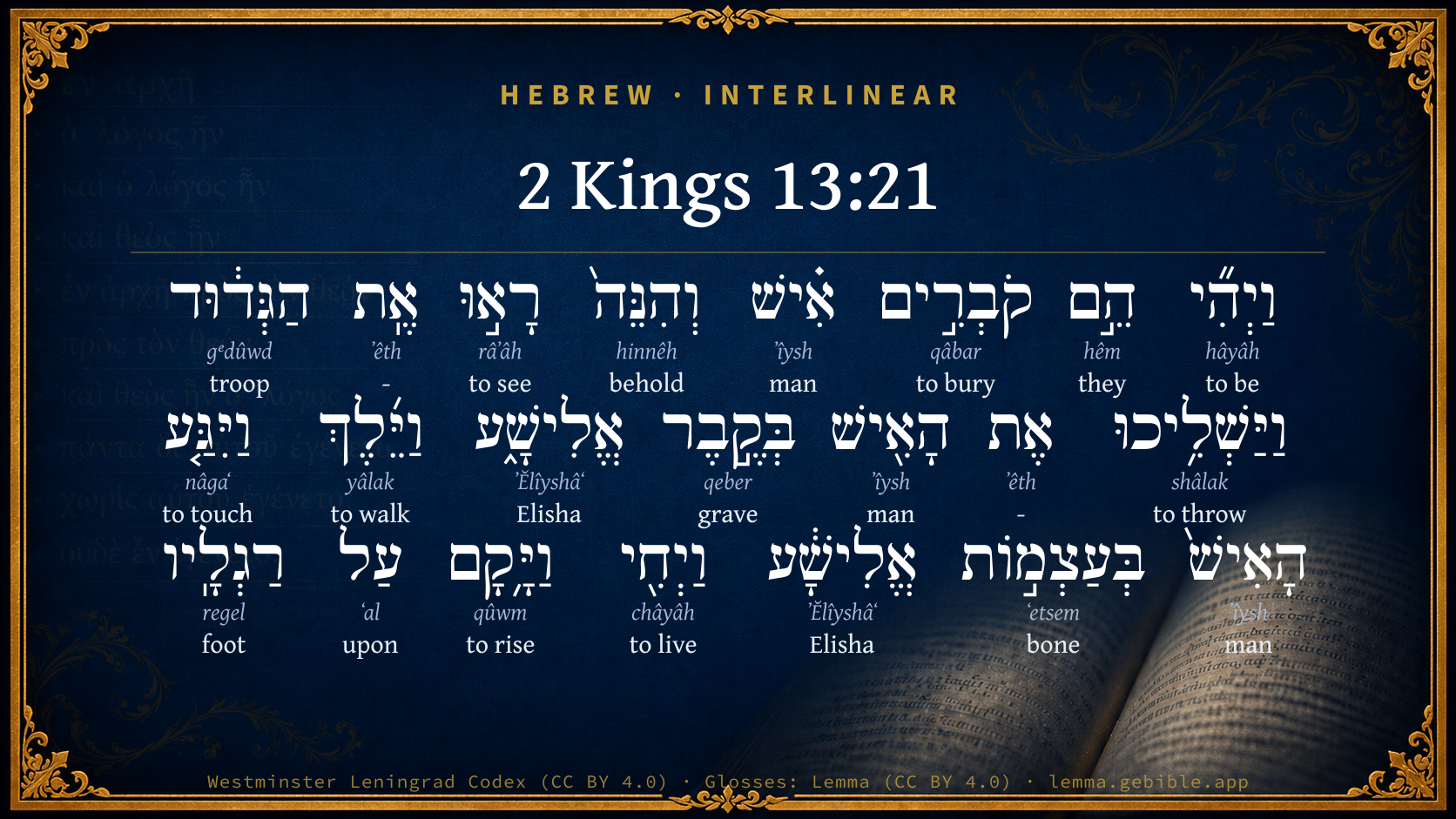
Hebrew (Westminster Leningrad Codex) 2 Kings 13:21 appears in the Hebrew Old Testament. The text above is from the Westminster Leningrad Codex. Each word links to its Strong’s number, a concise gloss, and parsing drawn from the Open Scriptures Hebrew Bible morphology. Click any word for its full Brown-Driver-Briggs (BDB) entry.
Download image
Cite this verse

2 Kings 13:21 (World English Bible). Public Domain. Lemma interlinear Bible study tool, https://lemma.gebible.app/v/2-kings/13/21.

Show BibTeX & RIS
BibTeX
RIS
English Translation
It happened, as they were burying a man, that behold, they spied a band; and they cast the man into the tomb of Elisha: and as soon as the man touched the bones of Elisha, he revived, and stood up on his feet.
World English Bible · Public Domain
Download a study sheet

One document with this verse’s original text, its word-by-word gloss line, the meaning frame, cross-references with their text, attributed commentary, and full source and license credits — printable, and it pastes into notes with its structure intact.

This verse Autodidact and up

Study sheet (.html) Plain text (.txt)

A passage Seminary Student

Up to 50 verses in one chapter. A passage sheet keeps up to 6 commentary sources and 12 cross-references per verse, in the order this page ranks them, and says so on the sheet whenever that leaves anything out. Ask for a single verse and you get the Autodidact verse sheet above.

Everything on this page stays free to read, with no account — the sheet is a download of what is already on screen, not access to it.

Want to remove ads? Support Godless Engineer
Compare translations 3

The same verse in 3 English versions, stacked beneath the original-language interlinear above. Click any original word for its lexicon entry.

Each is an independent rendering of the whole verse — the interlinear is not word-aligned to these translations.

Highlighted words mark where these versions differ — a whole-verse word diff, not a word-by-word alignment.

  • World English Bible Public Domain
    It happened, as they were burying a man, that behold, they spied a band; and they cast the man into the tomb of Elisha: and as soon as the man touched the bones of Elisha, he revived, and stood up on his feet.
  • King James Version Public Domain
    And it came to pass, as they were burying a man, that, behold, they spied a band of men; and they cast the man into the sepulchre of Elisha: and when the man was let down, and touched the bones of Elisha, he revived, and stood up on his feet.
  • unfoldingWord Literal Text CC BY-SA 4.0
    And it happened, they were burying a man, and behold, they saw a raiding band, and they threw the man into the grave of Elisha. And the man went and touched the bones of Elisha, and it happened that he arose onto his feet.

unfoldingWord Literal Text — © unfoldingWord, licensed CC BY-SA 4.0. Word-aligned USFM3 via Door43 (git.door43.org/unfoldingWord/en_ult).

Versions to compare (up to 4)

3 of 4 selected

Show all 18 translations

Every available English version of this verse, each an independent rendering of the whole verse.

  • World English Bible Public Domain
    It happened, as they were burying a man, that behold, they spied a band; and they cast the man into the tomb of Elisha: and as soon as the man touched the bones of Elisha, he revived, and stood up on his feet.
  • Berean Standard Bible Public Domain
    Once, as the Israelites were burying a man, suddenly they saw a band of raiders, so they threw the man’s body into Elisha’s tomb. And as soon as his body touched the bones of Elisha, the man was revived and stood up on his feet.
  • Majority Standard Bible Public Domain
    Once, as the Israelites were burying a man, suddenly they saw a band of raiders, so they threw the man’s body into Elisha’s tomb. And as soon as his body touched the bones of Elisha, the man was revived and stood up on his feet.
  • King James Version Public Domain
    And it came to pass, as they were burying a man, that, behold, they spied a band of men; and they cast the man into the sepulchre of Elisha: and when the man was let down, and touched the bones of Elisha, he revived, and stood up on his feet.
  • American Standard Version (1901) Public Domain
    And it came to pass, as they were burying a man, that, behold, they spied a band; and they cast the man into the sepulchre of Elisha: and as soon as the man touched the bones of Elisha, he revived, and stood up on his feet.
  • Revised Version (1885) Public Domain
    And it came to pass, as they were burying a man, that, behold, they spied a band; and they cast the man into the sepulchre of Elisha: and as soon as the man touched the bones of Elisha, he revived, and stood up on his feet.
  • Geneva Bible (1599) Public Domain
    And as they were burying a man, behold, they saw the souldiers: therfore they cast the man into the sepulchre of Elisha. And when the man was downe, and touched the bones of Elisha, he reuiued and stoode vpon his feete.
  • Douay-Rheims (1899) Public Domain
    And some that were burying a man, saw the rovers, and cast the body into the sepulchre of Eliseus. And when it had touched the bones of Eliseus, the man came to life, and stood upon his feet.
  • Young's Literal Translation Public Domain
    and it cometh to pass, they are burying a man, and lo, they have seen the troop, and cast the man into the grave of Elisha, and the man goeth and cometh against the bones of Elisha, and liveth, and riseth on his feet.
  • Literal Standard Version CC BY-SA 4.0
    and it comes to pass, they are burying a man, and behold, they have seen the troop, and cast the man into the grave of Elisha, and the man goes and comes against the bones of Elisha, and lives, and rises on his feet.
  • Unlocked Literal Bible CC BY-SA 4.0
    As they were burying a certain man, they saw a group of Moabites, so they threw the body into Elisha's grave. As soon as the man touched Elisha's bones, he revived and stood up on his feet.
  • unfoldingWord Literal Text CC BY-SA 4.0
    And it happened, they were burying a man, and behold, they saw a raiding band, and they threw the man into the grave of Elisha. And the man went and touched the bones of Elisha, and it happened that he arose onto his feet.
  • Darby Bible Public Domain
    And it came to pass as they were burying a man, that behold, they saw the band, and they cast the man into the sepulchre of Elisha; and the man went [down], and touched the bones of Elisha, and he revived, and stood upon his feet.
  • World Messianic Bible Public Domain
    As they were burying a man, behold, they saw a band of raiders; and they threw the man into Elisha’s tomb. As soon as the man touched Elisha’s bones, he revived, and stood up on his feet.
  • Webster's Bible Public Domain
    And it came to pass, as they were burying a man, that behold, they spied a band of men; and they cast the man into the sepulcher of Elisha: and when the man was let down, and touched the bones of Elisha, he revived, and stood on his feet.
  • Free Bible Version CC BY-SA 4.0
    One time some Israelites were burying a man when suddenly they saw some raiders coming, so they quickly threw the man into Elisha's tomb. As soon as he touched Elisha's bones, the man came back to life and stood up.
  • Bible in Basic English Public Domain
    And while they were putting a dead man into the earth, they saw a band coming; and they put the man quickly into the place where Elisha's body was; and the dead man, on touching Elisha's bones, came to life again, and got up on his feet.
  • JPS Tanakh (1917) Public Domain
    And it came to pass, as they were burying a man, that, behold, they spied a band; and they cast the man into the sepulchre of Elisha; and as soon as the man touched the bones of Elisha, he revived, and stood up on his feet.

Literal Standard Version (2020), Covenant Press — licensed CC BY-SA 4.0. Text via the HelloAO Bible API (eBible.org). Unlocked Literal Bible (unfoldingWord) — licensed CC BY-SA 4.0. Text via the HelloAO Bible API (eBible.org). unfoldingWord Literal Text — © unfoldingWord, licensed CC BY-SA 4.0. Word-aligned USFM3 via Door43 (git.door43.org/unfoldingWord/en_ult). Free Bible Version, Dr. Jonathan Gallagher — licensed CC BY-SA 4.0. Text via the HelloAO Bible API (eBible.org).

Word by word

More ways to search: Search by grammar → Find every occurrence → Compare this word →

Practice this passage: Drill this verse → Learn its vocabulary →

הַגְּד֔וּד
gᵉdûwd
H1416
“the · troop”
Particle, Definite Article + Noun, Common, Masculine, Singular, Absolute
Part of Speech
Particle + Noun
Type
Common
Gender
Masculine
Number
Singular
State
Absolute
Full BDB Definition

Origin: from H1413

TWOT: 313a

a band, troop, marauding band - marauding band, raiding band - troop, band (of divisions of army) - foray, raid
  1. וַיְהִ֞י hâyâh H1961 “and · to be” Conjunction + Verb, Qal, Sequential Imperfect, 3rd Person, Masculine, Singular
  2. הֵ֣ם hêm H1992 “they” Pronoun, Personal, 3rd Person, Masculine, Plural
  3. קֹבְרִ֣ים qâbar H6912 “burying” Verb, Qal, Participle Active, Masculine, Plural, Absolute
  4. אִ֗ישׁ ʼîysh H376 “man” Noun, Common, Masculine, Singular, Absolute
  5. וְהִנֵּה֙ hinnêh H2009 “and · behold” Conjunction + Particle, Demonstrative
  6. רָא֣וּ râʼâh H7200 “to see” Verb, Qal, Perfect, 3rd Person, Common, Plural
  7. אֶֽת ʼêth H853 “-” Particle, Direct Object
  8. וַיַּשְׁלִ֥יכוּ shâlak H7993 “and · to throw” Conjunction + Verb, Hiphil, Sequential Imperfect, 3rd Person, Masculine, Plural
  9. אֶת ʼêth H853 “-” Particle, Direct Object
  10. הָאִ֖ישׁ ʼîysh H376 “the · man” Particle, Definite Article + Noun, Common, Masculine, Singular, Absolute
  11. בְּקֶ֣בֶר qeber H6913 “in/at · grave of” Preposition + Noun, Common, Masculine, Singular, Construct
  12. אֱלִישָׁ֑ע ʼĔlîyshâʻ H477 “Elisha” Noun, Proper
  13. וַיֵּ֜לֶךְ yâlak H3212 “and · to walk” Conjunction + Verb, Qal, Sequential Imperfect, 3rd Person, Masculine, Singular
  14. וַיִּגַּ֤ע nâgaʻ H5060 “and · to touch” Conjunction + Verb, Qal, Sequential Imperfect, 3rd Person, Masculine, Singular
  15. הָאִישׁ֙ ʼîysh H376 “the · man” Particle, Definite Article + Noun, Common, Masculine, Singular, Absolute
  16. בְּעַצְמ֣וֹת ʻetsem H6106 “in/at · bones of” Preposition + Noun, Common, Feminine, Plural, Construct
  17. אֱלִישָׁ֔ע ʼĔlîyshâʻ H477 “Elisha” Noun, Proper
  18. וַיְחִ֖י châyâh H2421 “and · to live” Conjunction + Verb, Qal, Sequential Imperfect, 3rd Person, Masculine, Singular
  19. וַיָּ֥קָם qûwm H6965 “and · to rise” Conjunction + Verb, Qal, Sequential Imperfect, 3rd Person, Masculine, Singular
  20. עַל ʻal H5921 “upon” Preposition
  21. רַגְלָֽיו regel H7272 “feet · his” Noun, Common, Feminine, Dual, Construct + Suffix, Personal, 3rd Person, Masculine, Singular

About this verse

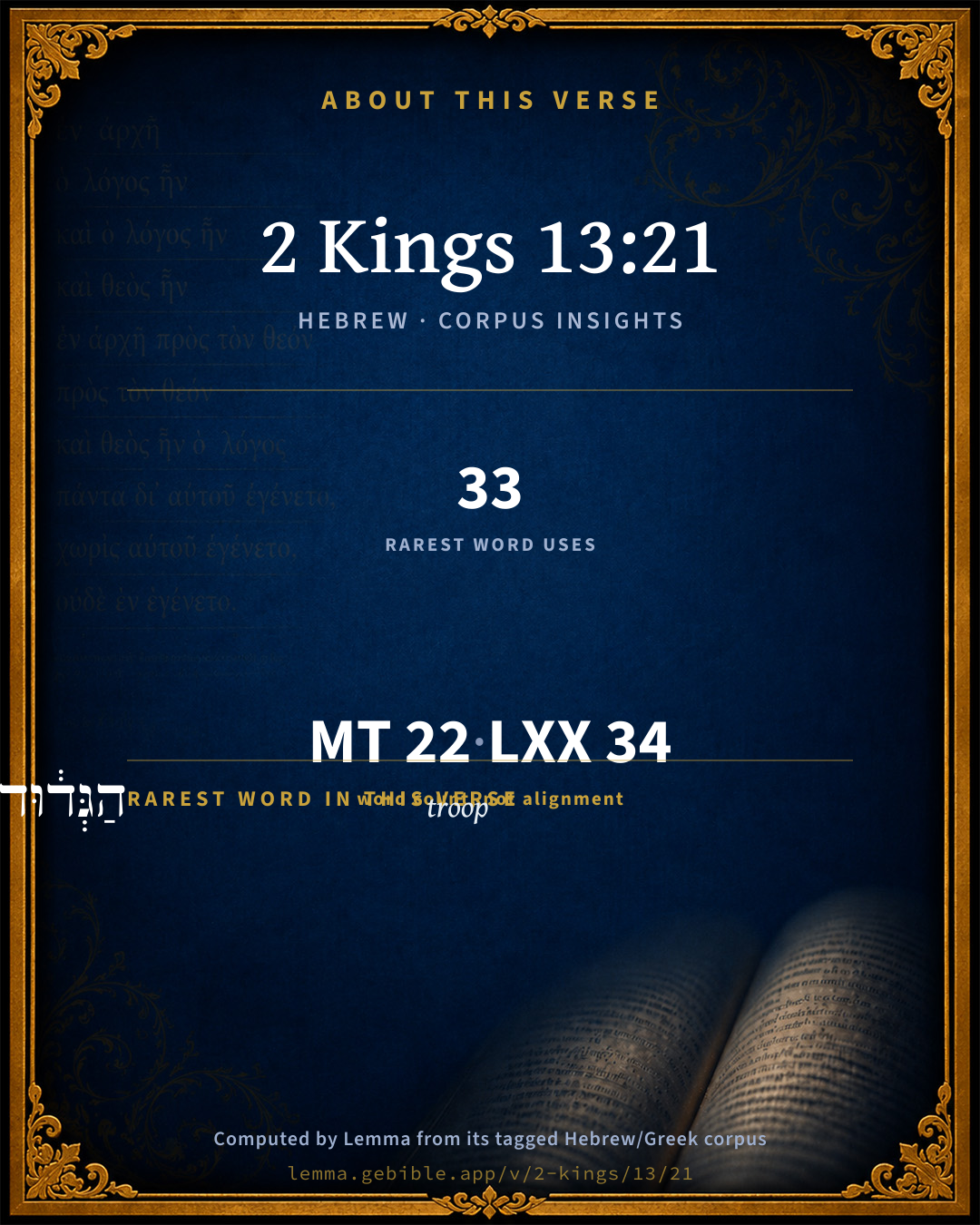
These counts appear in no published source. They are computed here, from the morphology-tagged text and Lemma’s own curated glosses. What Lemma adds →

22
words
18
distinct lemmas
Historical
section

Shared distinctive vocabulary

הַגְּד֔וּד troop H1416 occurs in 29 verses of the Hebrew Bible. Also found in:

Grammatical profile

  • 8 verbs
  • 9 nouns
  • 1 pronoun
  • 1 preposition
  • 3 particles

Verb forms

  • וַיְהִ֞י Qal · Sequential Imperfect
  • קֹבְרִ֣ים Qal · Participle Active
  • רָא֣וּ Qal · Perfect
  • וַיַּשְׁלִ֥יכוּ Hiphil · Sequential Imperfect
  • וַיֵּ֜לֶךְ Qal · Sequential Imperfect
  • וַיִּגַּ֤ע Qal · Sequential Imperfect
  • וַיְחִ֖י Qal · Sequential Imperfect
  • וַיָּ֥קָם Qal · Sequential Imperfect

Repetition

Words recur within this verse — often emphatic in Hebrew:

  • אִ֗ישׁ man H376 ×3
  • אֱלִישָׁ֑ע Elisha H477 ×2

Hebrew & Septuagint length

In English translation the verse runs 43 words from the Hebrew and 47 from the Septuagint (LXX English) — closely comparable.

A rough comparison of the two English renderings, which tokenize alike — not a word-level alignment.

Word counts can differ between the Hebrew and the Greek without any difference in meaning — e.g. the Hebrew direct-object marker אֵת has no separate Greek word, and Greek often adds the article ὁ.

In the original languages it is 22 Hebrew tokens and 34 Greek tokens — but the two are counted differently (Hebrew bundles its prefixes and suffixes into one token; the Greek is in lemma form), so that isn’t a like-for-like length.

Cross-references

10

Topical passages linked to 2 Kings 13:21 in the Treasury of Scripture Knowledge — connected by theme and wording, ordered by reader-vote popularity; previews shown in the World English Bible.

  • Ezekiel 37:1–10 The hand of Yahweh was on me, and he brought me out in the Spirit of Yahweh, and set me down in the midst of the valley; and it was full of bones.
  • John 5:28–29 Don't marvel at this, for the hour comes, in which all that are in the tombs will hear his voice,
  • Acts 19:12 so that even handkerchiefs or aprons were carried away from his body to the sick, and the evil spirits went out.
  • 2 Kings 4:35 Then he returned, and walked in the house once back and forth; and went up, and stretched himself on him: and the child sneezed seven times, and the child opened his eyes.
  • John 5:25 Most assuredly, I tell you, the hour comes, and now is, when the dead will hear the Son of God's voice; and those who hear will live.
  • Acts 5:15 They even carried out the sick into the streets, and laid them on cots and mattresses, so that as Peter came by, at the least his shadow might overshadow some of them.
  • Isaiah 26:19 Your dead shall live; my dead bodies shall arise. Awake and sing, you who dwell in the dust; for your dew is [as] the dew of herbs, and the earth shall cast forth the dead.
  • Matthew 27:52–53 The tombs were opened, and many bodies of the saints who had fallen asleep were raised;
  • John 11:44 He who was dead came out, bound hand and foot with wrappings, and his face was wrapped around with a cloth. Jesus said to them, "Free him, and let him go."
  • Revelation 11:11 After the three and a half days, the breath of life from God entered into them, and they stood on their feet. Great fear fell on those who saw them.

Cross-references courtesy of OpenBible.info (CC BY 4.0).

Hebrew and Greek witnesses Masoretic Hebrew ↔ Greek Septuagint

The same verse in the two great witnesses to the Old Testament, shown verse-for-verse.

These are two independent witnesses, not word-aligned to each other, and the Septuagint is shown in lemma (dictionary) form.

Hebrew 2 Kings 13:21 Masoretic · Westminster Leningrad Codex

וַיְהִ֞י הֵ֣ם קֹבְרִ֣ים אִ֗ישׁ וְהִנֵּה֙ רָא֣וּ אֶֽת הַגְּד֔וּד וַיַּשְׁלִ֥יכוּ אֶת הָאִ֖ישׁ בְּקֶ֣בֶר אֱלִישָׁ֑ע וַיֵּ֜לֶךְ וַיִּגַּ֤ע הָאִישׁ֙ בְּעַצְמ֣וֹת אֱלִישָׁ֔ע וַיְחִ֖י וַיָּ֥קָם עַל רַגְלָֽיו

It happened, as they were burying a man, that behold, they spied a band; and they cast the man into the tomb of Elisha: and as soon as the man touched the bones of Elisha, he revived, and stood up on his feet.

World English Bible · Public Domain

Greek LXX 2 Kings 13:21 Septuagint · lemma form

καί γίγνομαι αὐτός θάπτω ὁ ἀνήρ καί ἰδού ὁράω ὁ μονόζωνος καί ῥίπτω ὁ ἀνήρ ἐν ὁ τάφος ελισαιε καί πορεύομαι καί ἅπτομαι ὁ ὀστέον ελισαιε καί ζάω καί ἀναἵστημι ἐπί ὁ πούς αὐτός

And it came to pass as they were burying a man, that behold, they saw a band of men, and they cast the man into the grave of Elisaie: and as soon as he touched the bones of Elisaie, he revived and stood up on his feet.

LXX2012 (modern English Septuagint) · Public Domain

Hebrew: Westminster Leningrad Codex (CC BY 4.0). Greek: Septuagint (public domain); English from LXX2012 (modern English Septuagint) (Public Domain). How the Septuagint differs from the Hebrew →

Targum (Aramaic paraphrase)

1

The Targum is the ancient Jewish Aramaic paraphrase of the Hebrew Scriptures — an interpretive translation, not the Hebrew text itself. Onkelos (literal) and Pseudo-Jonathan (expansive) render the Torah, and Jonathan the Prophets. Coverage is partial: where no permissively-licensed English translation exists for a verse, only the Aramaic is shown. This is verse-level text, not a word-by-word alignment to the Hebrew.

  1. Targum Jonathan Prophets (Joshua–Malachi)
    וַהֲוָה עַד דְאִינוּן קָבְרִין גַבְרָא וְהָא חֲזוֹ יַת מַשְׁרִיתָא וּרְמוֹ יַת גַבְרָא בְּקִבְרָא דֶאֱלִישָׁע וַאֲזַל וּקְרֵיב גַבְרָא בְּגַרְמֵי דֶאֱלִישָׁע וַחֲיָא וְקָם עַל רִגְלוֹהִי:

    (no public-domain English translation for this verse)

    Targum Jonathan — Aramaic: “Mikraot Gedolot” (public domain). English: “Sefaria Community Translation” (CC0 1.0 (public-domain dedication)); “London "Chaldee Paraphrase," 1871” (public domain). Text via Sefaria.

Commentary

Notes on 2 Kings 13:21 from classic Christian and Jewish commentators (each source and its license shown beneath its notes). The classic Christian expositions comment on the surrounding passage and are grouped to its opening verse, so a note may address several verses; the Jewish commentaries on the Tanakh (Rashi and others) are per-verse, so they appear only where the commentator wrote on this verse.

Lemma curates 59 commentaries, every one of them public domain or Creative Commons licensed, each selected and text-cleaned for this edition rather than reprinted as found. About our sources →

Trapp's Complete Commentary

John Trapp

2Ki 13:21 And it came to pass, as they were burying a man, that, behold, they spied a band [of men]; and they cast the man into the sepulchre of Elisha: and when the man was let down, and touched the bones of Elisha, he revived, and stood up on his feet.

Ver. 21. He revived, and stood upon his feet.] By as true - though spiritual - a miracle it is that new life is put into a dead soul, "dead in trespasses and sins," by the touch of God’s prophets, applying thereunto the death and resurrection of the Son of God, who restored life to his own dead body, and thereby not only declared himself with power to be God blessed for ever, {Rom 1:4} but also that he quickeneth all true believers, who are united unto him by the ligament of a lively faith, as it were by a corporeal contract.

John Trapp, A Commentary or Exposition upon All the Books of the Old and New Testament (1647–1656) — public domain. Text from a community e-Sword module.

Joseph Benson's Commentary

2Ki 13:21. As they were burying a man — Carrying him to his grave; they spied a band of men — A party of Moabites coming toward them, but at some distance; and they cast the man into the sepulchre of Elisha — This sepulchre being near the place where they then were, they removed some stone, or opened some door, and hastily flung down the dead corpse into it; fearing lest, if they proceeded to the place where a grave was prepared, they should fall into the hands of the Moabites. And when the man was let down — His body, or the coffin in which it was put; and touched the bones of Elisha, he revived, and stood upon his feet — Which great miracle, wrought, not by the bones of Elisha, in which there could be no innate power to produce any such effect, but by the almighty power of God, was doubtless intended for divers important purposes; as, 1st, To do honour to that great and holy prophet; and a singular honour it was, not much inferior to that conferred on Elijah when he was translated. Elijah was honoured in his departure; Elisha after his departure. Thus God dispenses honours as he pleases. 2d, To seal and confirm his doctrine and prophecies, and thereby confute the false doctrine and worship of the Israelites. 3d, To strengthen the faith of Joash and the Israelites in the promises which he had given them of success against the Syrians. And, 4th, In the midst of all their calamities to comfort such Israelites as were Elisha’s followers, with the hopes of that eternal life, whereof the reviving of this dead man was a manifest pledge, and to awaken the people to a due care about, and preparation for it. According to Calmet, this was further a symbol and prophecy of the resurrection of Jesus Christ, with this difference, and a mighty one it is, that Elisha raised a dead body without raising himself, while the Lord Jesus not only raised himself, but gives life to all those that believe in him.

Joseph Benson's Commentary on the Old and New Testaments (1811–1818) — public domain. Text from a community e-Sword module.

Geneva Bible (1599)

Geneva Bible translators

By this miracle God confirmed the authority of Elisha, whose doctrine in his life they contemned, that at this sight they might return and embrace the same doctrine.

Geneva Bible (1599) marginal notes — public domain. Text via Bolls.life.

Adam Clarke's Commentary

Verse 21. They spied a band] They saw one of these marauding parties; and through fear could not wait to bury their dead, but threw the body into the grave of Elisha, which chanced then to be open; and as soon as it touched the bones of the prophet, the man was restored to life. This shows that the prophet did not perform his miracles by any powers of his own, but by the power of God; and he chose to honour his servant, by making even his bones the instrument of another miracle after his death. This is the first, and I believe the last, account of a true miracle performed by the bones of a dead man; and yet on it and such like the whole system of miraculous working relics has been founded by the popish Church.

Adam Clarke's Commentary on the Bible (1810–1826) — public domain. Text from a community e-Sword/MySword module.

Ellicott's Commentary for English Readers

(21) As they were burying.—They—i.e., a party of Israelites. The story is told with vivid definiteness.

A band.—Rather, the troop. The particular troop of Moabites which happened to be making an inroad at the time.

They cast the man into the sepulchre of Elisha.—Comp. Mar_16:3-4. In this case, we must suppose that the tomb was more easily opened, as the action was obviously done in haste.

And when the man was let down, and touched the bones.—Rather, and they departed. And the man touched the bones. The order of words in the original, as well as the sense, supports old Houbigans conjecture. If the meaning were, “and the man went and touched,” the subject in the Hebrew would have followed the first verb, not the second. Moreover, the verb would hardly have been hâlak.

He revived.—Literally, and he lived. Thenius thinks that the sacred writer regarded this miracle as a pledge of the fulfilment of Elisha’s promise to Joash Bähr says: “Elisha died and was buried, like all other men, but even in death and in the grave he is avouched to be the prophet and servant of God.” Dante’s warning may not be out of place here:—

“O voi che avete gintelletti sani,

Mirate la dottrina, che s asconde

Sotto il velame degli versi strani.”

Inf. 9:61, sqq.

A Bible Commentary for English Readers, edited by Charles John Ellicott (1878–1897) — public domain. Text from a community e-Sword module.

The Cambridge Bible for Schools and Colleges

gen. ed. J. J. S. Perowne

21. as they were burying a man] i.e. Some Israelites had brought a dead body to the burial-place. The body was carried on a bier, and was not enclosed in a coffin (cf. Luk_7:12-14), so that when cast into the grave it would touch any other body which had been deposited there before. In the East the graves are usually excavated in the rock, and closed by a stone at the mouth. The bodies were laid there, but there was no covering them with earth as in burials among western nations.

behold they spied a band of men] The R.V. omits the italics. The band was a band of the marauding Moabites, at whose approach the Israelites were terrified, and so made all haste to dispose of the corpse they were carrying.

unto the sepulchre of Elisha] This must have been nearer at hand than the grave which they intended to use. The distance from which the Moabites were visible allowed the bearers to open the first grave they came to, and there to lay down their burden, but gave time for nothing more. Josephus says that it was the robbers who had killed a man and that they cast him into Elisha’s grave (Ant. IX. 8. 6).

and when the man was let down and touched] R.V. and as soon as the man touched. It will be seen from the margin of R.V. that the Hebrew means ‘and when the man went and touched’; a very unusual kind of expression, but which does not warrant the idea conveyed by the A.V. that the body was lowered into the tomb.

the bones of Elisha] We need not press the literal sense of ‘bones’, as though a long time had elapsed since Elisha died. The lying prophet of Bethel (1Ki_13:31), speaking of his own death and burial, says ‘Lay my bones beside his bones’.

he revived and stood up on his feet] The record of this miracle seems intended to set forth that it was nothing in the prophet himself which had given him the great powers he manifested in his lifetime. Through his dead body God could work a miracle also. ‘Israel shall well see that He lives, by whose virtue Elisha was, both in life and death, miraculous. While the prophet was alive, the impetration might seem to be his, though the power were God’s; now that he is dead, the bones can challenge nothing, but send the wandering Israelites to that Almighty agent to whom it is all one to work by the quick or dead.’ (Bp. Hall.)

The Cambridge Bible for Schools and Colleges (gen. ed. J. J. S. Perowne; Cambridge University Press, 1878–1918) — public domain. Text from a community e-Sword module.

John Gill's Exposition

So Hazael the king of Syria died, and Benhadad his son reigned in his stead. This was Benhadad the third; the first of this name was of the Damascene kings; but though the kingdom was now in another family, yet this name, being respectable with the Syrians, was retained in it.

2 Kings 13:25

John Gill's Exposition of the Whole Bible (1746–1763) — public domain (CC PDM 1.0). Text via the HelloAO Bible API.

Albert Barnes' Notes on the Bible

They cast the man - Rather, “they thrust the man.” The graves of the Jews were not pits dug in the ground, like ours, but caves or cells excavated in the side of a rock, the mouth of the cave being ordinarily shut by a heavy stone.

Stood up on his feet - Coffins were not used by the Jews. The body was simply wrapped or swathed in grave-clothes (compare Luk 7:15; Joh 11:44).

This miracle of Elisha’s after his death is more surprising than any of those which he performed during his lifetime. The Jews regarded it as his highest glory (compare Ecclesiaticus 48:13, 14). It may be said to belong to a class of Scriptural miracles, cases, i. e. where the miracle was not performed through the agency of a living miracle-worker, but by a material object in which, by God’s will, “virtue” for the time resided (compare Act 19:12). The primary effect of the miracle was, no doubt, greatly to increase the reverence of the Israelites for the memory of Elisha, to lend force to his teaching, and especially to add weight to his unfulfilled prophecies, as to that concerning the coming triumphs of Israel over Syria. In the extreme state of depression to which the Israelites were now reduced, a very signal miracle may have been needed to encourage and reassure them.

Albert Barnes' Notes on the Bible (1834–1885) — public domain. Text from a community e-Sword/MySword module.

Haydock's Catholic Bible Commentary

CHAPTER XIII.

Eliseus. His tomb was not in the city, but in a spacious cave, the entrance of which was secured with a stone, according to custom. This was removed in the hurry, and the corpse thrown into the same recess, which had been prepared for the remains of the prophet. Josephus ([Antiquities?] ix. 8.) relates the history in a different manner, and pretends that robbers having slain a person, threw his corpse accidentally into the tomb of Eliseus. The Rabbins tell us his name was Sellum, and that he died again immediately, because he was a wicked man, which would render the miracle, in a manner, useless. (Calmet) --- By it God honoured his servant, and convinced the Israelites that what he had so lately foretold, respecting the Syrians, would undoubtedly take place. (Menochius)

George Leo Haydock (1774–1849), Haydock's Catholic Family Bible and Commentary, 1859 edition — public domain. Excludes Psalms (Douay-Rheims chapter numbering differs from Protestant) and Deuterocanonical books (Catholic canon only).

Matthew Poole's English Annotations

As they were burying, or, were about to bury, as that particle is oft used in the Hebrew tongue.

They spied a band of men coming towards them, but at some distance.

They cast the man into the sepulchre of Elisha; not daring to carry the dead corpse further to the place appointed for his burial, they made use of the next burying-place, where Elisha was buried, and there they removed some stone, or opened some door, and hastily flung down their dead corpse there.

The man, i.e. the man’s dead body, or the coffin in which he was put.

Touched the bones of Elisha; which might easily be, the coffin and linen in which Elisha’s body was put, and the flesh of his body, being now consumed; for this was some considerable time after his death.

He revived, and stood up on his feet; which miracle God wrought there, partly, to do honour to that great prophet, and that by this seal he might confirm his doctrine, and thereby confute the false doctrine and worship of the Israelites; partly, to strengthen the faith of Joash, and of the Israelites, in his promise of their success against the Syrians; and partly, in the midst of all their calamities, to comfort such Israelites as were Elisha’s followers with the hopes of that eternal life whereof this was a manifest pledge, and to awaken the rest of that people to a due care and preparation for it.

Matthew Poole's English Annotations on the Holy Bible (1683–1685) — public domain. Text from a community e-Sword/MySword module.

Whedon's Commentary on the Bible

Daniel D. Whedon

21. They spied a band of men — That is, a band of those marauding Moabites just mentioned. The sight of the invaders caused the haste with which they cast the dead man into the wrong sepulchre.

When the man was let down — Literally, The man went and touched against the bones of Elisha. That is, his body was thrust into the tomb, so that it came in contact with the bones of Elisha. “Among the Israelites the dead were neither enclosed in coffins nor covered with earth, but only wrapped in linen cloth and laid in tombs, so that one body might touch another, and, on returning to life, would not be hindered from moving. It was not the dead body of Elisha, but the living God, that gave life again to the dead; and Omnipotence worked by contact with the dead Elisha to show that the Divine efficiency that was in the prophet had not disappeared from Israel with his death. The special object of the miracle was to convince most effectually people and king that the promise of victory over the Syrians was sure, and would come to pass just as the dying Elisha had announced to king Joash by the laying of his hands upon the hands of the king. The historian intimates this object when, immediately after the account of this miracle, he records the historical fulfillment of that promise. 2Ki_13:22-25.” — Keil.

On the contrast between Elijah and Elisha, see note at the beginning of chap. 4. “It was Elijah,” says the son of Sirach, “who was covered with a whirlwind; and Elisha was filled with his spirit; whilst he lived he was not moved by any prince, neither could any bring him into subjection. No word could overcome him, and after his death his body prophesied. He did wonders in his life, and at his death were his works marvellous.”

The miracle of Elisha’s bones has been the subject both of criticism and of allegory. The rationalist, of course, admits no miracle. In his view the deceased was a person only apparently dead, fallen into a trance, perhaps, but suddenly brought to his senses again by the shock of being roughly cast into Elisha’s tomb. Others admit a real miracle, but seem to look upon it with suspicion. “This,” says Clarke, “is the first, and, I believe, the last, account of a true miracle performed by the bones of a dead man. And yet on it, and such like, the whole system of miracle-working relics has been founded by the popish Church.” “Elisha’s works,” says Stanley, “stand alone in the Bible in their likeness to the acts of mediaeval saints. There alone, in the sacred history, the gulf between biblical and ecclesiastical miracles almost disappears. In this, as in so much besides, his life and miracles are not Jewish but Christian.” By others the miracle is made a type of Jesus’s power to raise to life by his own death and burial those who are dead in trespasses and sins. “So, too,” says Wordsworth, “the apostles and evangelists being dead yet speak to all the world in the Gospels and Epistles, and by the word of God in them they raise souls to life eternal.”

Daniel D. Whedon (gen. ed.), Commentary on the Old and New Testaments (1874–1909) — public domain. Text from a community e-Sword module.

The Pulpit Commentary

And it came to pass, as they were burying a man, that. "They" is used indefinitely of some unnamed Israelites, like the French on. Certain persons, it does not matter who, were burying a man, i.e. about to bury him, and were carrying the corpse to the grave, when an interruption occurred. Behold, they spied a band of men rather, the band, i.e. the band of that yearand they cast the man into the sepulcher of Elisha. There was no time for ceremony. Hastily, and somewhat roughly, it may be, the bearers of the body thrust it into Elisha"s tomb, which happened to be at hand, and from the mouth of which they were able to remove the closing stone. They did not "throw" the body in, but pushed it in. And when the man was let down. The man was not "let down." Our translators seem to have been unacquainted with the Jewish mode of burial. They imagine that Elisha"s tomb is a pit dug in the ground from the surface downwards, like a modern grave, and the man has therefore to be "let down," or to "go down" (marginal translation) into it. The Revised Version avoids the mistranslation, but weakens the force of the original. Translate, and when the man came, etc. And touched the bones of Elisha, he revived. The violent push given to the corpse imparted to it a movement which brought it in contact with the bones, i.e. the body (1Ki_13:31) of Elisha, as it lay, wound in its grave-clothes, but uncoffined, on the floor of the sepulchral chamber. At the moment of contact the dead man came to life And stood up on his feet. In many Jewish tombs the sepulchral chamber would allow of this.

The Pulpit Commentary (1880–1919), ed. H.D.M. Spence-Jones & Joseph S. Exell — public domain. Text from a community e-Sword module.

John Wesley's Explanatory Notes

He revived - Which miracle God wrought, to do honour to that great prophet, and that by this seal he might confirm his doctrine, to strengthen the faith of Joash, and of the Israelites, in this promise of their success against the Syrians; and in the midst of all their calamities to comfort such Israelites as were Elisha's followers, with the hopes of eternal life, whereof this was a manifest pledge, and to awaken the rest of that people to a due care and preparation for it.

John Wesley, Explanatory Notes Upon the Whole Bible (1754–1765) — public domain. Text via the GEBible commentary corpus.

Lesson kit

Teaching starters — assembled from the data on this page, not authored interpretation. Every prompt links to the verse data it draws on. Edit before teaching.

2 Kings, in the Historical, opens this verse with 22 words (18 distinct Hebrew lemmas). Its most distinctive word is gᵉdûwd (“troop”). A historical commentator’s framing appears above. Read the whole chapter for the surrounding context.

Discussion questions

  1. What does “troop” (gᵉdûwd) contribute to the verse as a whole?
  2. How does Genesis 49:19, which shares the word «troop», read alongside this verse?
  3. What does the repetition of “man” (3× in this one verse) do in this verse?
  4. These translations render this verse differently. What is at stake in choosing one wording over another?
  5. «וַיְהִ֞י» is a Qal Sequential Imperfect verb. How does that grammatical form shape the action described?
  6. Compare how Trapp's Complete Commentary and Joseph Benson's Commentary read this verse. Where do they agree or differ?

Things to notice

Reading settings

Reading text

Shown beneath each verse's original-language words.

Old Testament
Old Testament edition

Read the OT as the Masoretic Hebrew (MT) or the Greek Septuagint (LXX).

English shown for the Greek Septuagint (in the Hebrew ↔ Greek comparison).

Comparing translations? Open the Compare panel on any verse page to stack up to four side by side.