
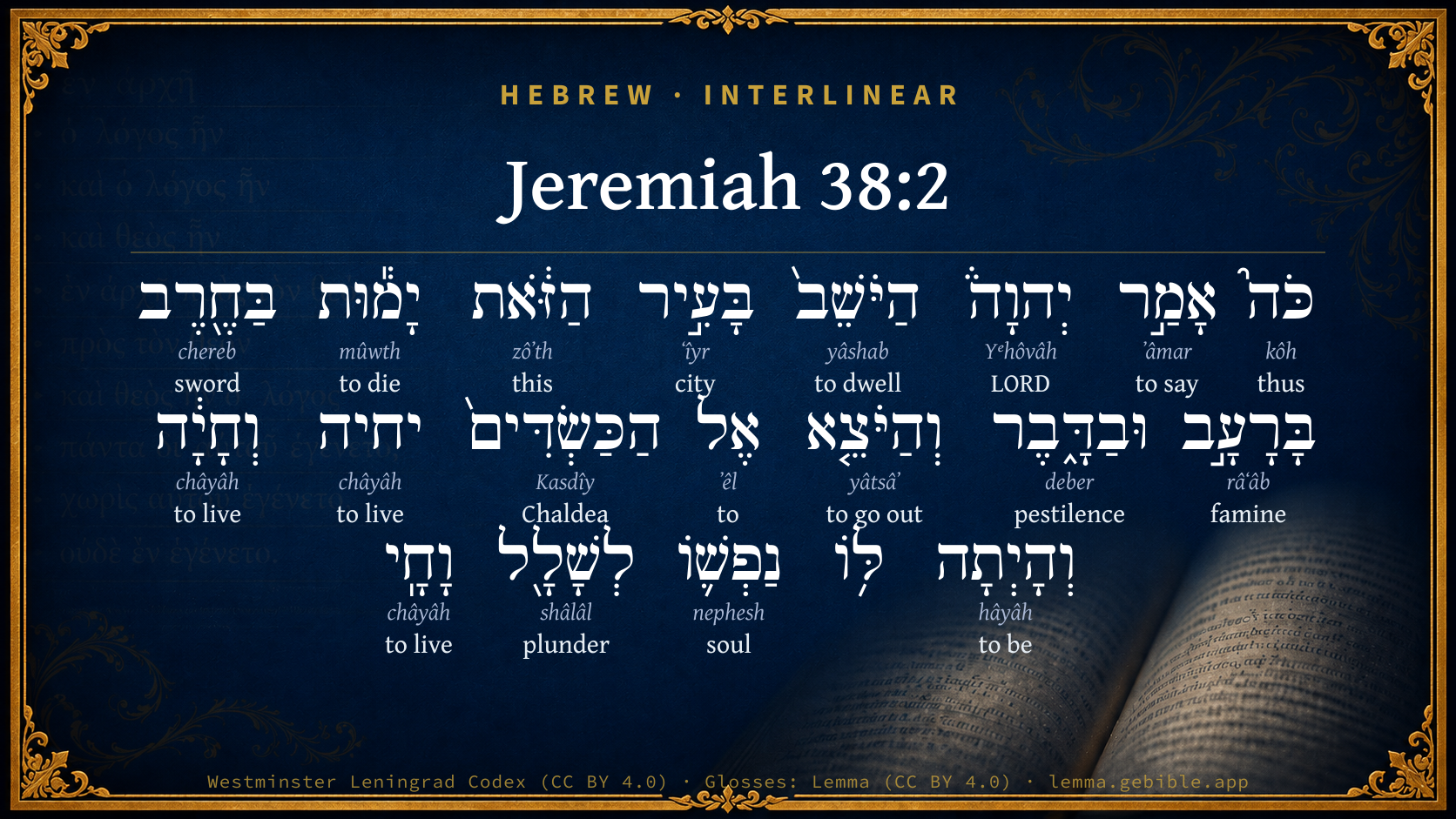
Jeremiah 38:2

Hebrew (Westminster Leningrad Codex) Jeremiah 38:2 appears in the Hebrew Old Testament. The text above is from the Westminster Leningrad Codex. Each word links to its Strong’s number, a concise gloss, and parsing drawn from the Open Scriptures Hebrew Bible morphology. Click any word for its full Brown-Driver-Briggs (BDB) entry.
Download image
Cite this verse

Jeremiah 38:2 (World English Bible). Public Domain. Lemma interlinear Bible study tool, https://lemma.gebible.app/v/jeremiah/38/2.

Show BibTeX & RIS
BibTeX
RIS
English Translation
Thus says Yahweh, He who remains in this city shall die by the sword, by the famine, and by the pestilence; but he who goes forth to the Chaldeans shall live, and his life shall be to him for a prey, and he shall live.
World English Bible · Public Domain
Download a study sheet

One document with this verse’s original text, its word-by-word gloss line, the meaning frame, cross-references with their text, attributed commentary, and full source and license credits — printable, and it pastes into notes with its structure intact.

This verse Autodidact and up

Study sheet (.html) Plain text (.txt)

A passage Seminary Student

Up to 50 verses in one chapter. A passage sheet keeps up to 6 commentary sources and 12 cross-references per verse, in the order this page ranks them, and says so on the sheet whenever that leaves anything out. Ask for a single verse and you get the Autodidact verse sheet above.

Everything on this page stays free to read, with no account — the sheet is a download of what is already on screen, not access to it.

Want to remove ads? Support Godless Engineer
Compare translations 3

The same verse in 3 English versions, stacked beneath the original-language interlinear above. Click any original word for its lexicon entry.

Each is an independent rendering of the whole verse — the interlinear is not word-aligned to these translations.

Highlighted words mark where these versions differ — a whole-verse word diff, not a word-by-word alignment.

  • World English Bible Public Domain
    Thus says Yahweh, He who remains in this city shall die by the sword, by the famine, and by the pestilence; but he who goes forth to the Chaldeans shall live, and his life shall be to him for a prey, and he shall live.
  • King James Version Public Domain
    Thus saith the LORD, He that remaineth in this city shall die by the sword, by the famine, and by the pestilence: but he that goeth forth to the Chaldeans shall live; for he shall have his life for a prey, and shall live.
  • unfoldingWord Literal Text CC BY-SA 4.0
    “Yahweh says this: Anyone staying in this city will be killed by sword, famine, and plague. But anyone who goes out to the Chaldeans will survive. He will escape with his own life, and live.

unfoldingWord Literal Text — © unfoldingWord, licensed CC BY-SA 4.0. Word-aligned USFM3 via Door43 (git.door43.org/unfoldingWord/en_ult).

Versions to compare (up to 4)

3 of 4 selected

Show all 18 translations

Every available English version of this verse, each an independent rendering of the whole verse.

  • World English Bible Public Domain
    Thus says Yahweh, He who remains in this city shall die by the sword, by the famine, and by the pestilence; but he who goes forth to the Chaldeans shall live, and his life shall be to him for a prey, and he shall live.
  • Berean Standard Bible Public Domain
    “This is what the LORD says: Whoever stays in this city will die by sword and famine and plague, but whoever surrenders to the Chaldeans will live; he will retain his life like a spoil of war, and he will live.
  • Majority Standard Bible Public Domain
    “This is what the LORD says: Whoever stays in this city will die by sword and famine and plague, but whoever surrenders to the Chaldeans will live; he will retain his life like a spoil of war, and he will live.
  • King James Version Public Domain
    Thus saith the LORD, He that remaineth in this city shall die by the sword, by the famine, and by the pestilence: but he that goeth forth to the Chaldeans shall live; for he shall have his life for a prey, and shall live.
  • American Standard Version (1901) Public Domain
    Thus saith Jehovah, He that abideth in this city shall die by the sword, by the famine, and by the pestilence; but he that goeth forth to the Chaldeans shall live, and his life shall be unto him for a prey, and he shall live.
  • Revised Version (1885) Public Domain
    Thus saith the LORD, He that abideth in this city shall die by the sword, by the famine, and by the pestilence: but he that goeth forth to the Chaldeans shall live, and his life shall be unto him for a prey, and he shall live.
  • Geneva Bible (1599) Public Domain
    Thus sayth the Lord, He that remaineth in this citie, shall dye by the sworde, by the famine and by the pestilence: but hee that goeth foorth to the Caldeans, shall liue: for he shall haue his life for a praye, and shall liue.
  • Douay-Rheims (1899) Public Domain
    Thus saith the Lord: Whosoever shell remain in this city, shall die by the sword, and by famine, and by pestilence: but he that shall go forth to the Chaldeans, shall live, and his life shall be safe, and he shall live.
  • Young's Literal Translation Public Domain
    `Thus said Jehovah: He who is remaining in this city dieth, by sword, by famine, and by pestilence, and he who is going forth unto the Chaldeans liveth, and his soul hath been to him for a prey, and he liveth.
  • Literal Standard Version CC BY-SA 4.0
    “Thus said YHWH: He who is remaining in this city dies, by sword, by famine, and by pestilence, and he who is going forth to the Chaldeans lives, and his soul has been to him for a prey, and he lives.
  • Unlocked Literal Bible CC BY-SA 4.0
    “Yahweh says this: Anyone staying in this city will be killed by sword, famine, and plague. But anyone who goes out to the Chaldeans will survive. He will escape with his own life, and live.
  • unfoldingWord Literal Text CC BY-SA 4.0
    “Yahweh says this: Anyone staying in this city will be killed by sword, famine, and plague. But anyone who goes out to the Chaldeans will survive. He will escape with his own life, and live.
  • Darby Bible Public Domain
    Thus saith Jehovah: He that remaineth in this city shall die by the sword, by the famine, and by the pestilence; but he that goeth forth to the Chaldeans shall live; and he shall have his life for a prey, and shall live.
  • World Messianic Bible Public Domain
    “The LORD says, ‘He who remains in this city will die by the sword, by the famine, and by the pestilence, but he who goes out to the Kasdim will live. He will escape with his life and he will live.’
  • Webster's Bible Public Domain
    Thus saith the LORD, He that remaineth in this city shall die by the sword, by the famine, and by the pestilence: but he that goeth forth to the Chaldeans shall live; for he shall have his life for a prey, and shall live.
  • Free Bible Version CC BY-SA 4.0
    This is what the Lord says: Anyone who remains in this city will die from war and famine and disease, but anyone who goes over to the Babylonians will live. Their reward will be to save their lives.
  • Bible in Basic English Public Domain
    These are the words of the Lord: Whoever goes on living in this town will come to his death by the sword or through need of food or by disease: but whoever goes out to the Chaldaeans will keep his life out of the power of the attackers and be safe.
  • JPS Tanakh (1917) Public Domain
    'Thus saith the LORD: He that remaineth in this city shall die by the sword, by the famine, and by the pestilence; but he that goeth forth to the Chaldeans shall live, and his life shall be unto him for a prey, and he shall live.

Literal Standard Version (2020), Covenant Press — licensed CC BY-SA 4.0. Text via the HelloAO Bible API (eBible.org). Unlocked Literal Bible (unfoldingWord) — licensed CC BY-SA 4.0. Text via the HelloAO Bible API (eBible.org). unfoldingWord Literal Text — © unfoldingWord, licensed CC BY-SA 4.0. Word-aligned USFM3 via Door43 (git.door43.org/unfoldingWord/en_ult). Free Bible Version, Dr. Jonathan Gallagher — licensed CC BY-SA 4.0. Text via the HelloAO Bible API (eBible.org).

Word by word

More ways to search: Search by grammar → Find every occurrence → Compare this word →

Practice this passage: Drill this verse → Learn its vocabulary →

וּבַדָּ֑בֶר
deber
H1698
“and · in/at the · pestilence”
Conjunction + Preposition, Determined + Noun, Common, Masculine, Singular, Absolute
Part of Speech
Conjunction + Preposition + Noun
Type
Common
Gender
Masculine
Number
Singular
State
Absolute
Full BDB Definition

Origin: from H1696 (in the sense of destroying)

TWOT: 399b

pestilence, plague - murrain, cattle disease, cattle-plague
  1. כֹּה֮ kôh H3541 “thus” Adverb
  2. אָמַ֣ר ʼâmar H559 “to say” Verb, Qal, Perfect, 3rd Person, Masculine, Singular
  3. יְהוָה֒ Yᵉhôvâh H3068 “LORD” Noun, Proper
  4. הַיֹּשֵׁב֙ yâshab H3427 “the · dwelling” Particle, Definite Article + Verb, Qal, Participle Active, Masculine, Singular, Absolute
  5. בָּעִ֣יר ʻîyr H5892 “in/at the · city” Preposition, Determined + Noun, Common, Feminine, Singular, Absolute
  6. הַזֹּ֔את zôʼth H2063 “the · this” Particle, Definite Article + Pronoun, Demonstrative, Feminine, Singular
  7. יָמ֕וּת mûwth H4191 “to die” Verb, Qal, Imperfect, 3rd Person, Masculine, Singular
  8. בַּחֶ֖רֶב chereb H2719 “in/at the · sword” Preposition, Determined + Noun, Common, Feminine, Singular, Absolute
  9. בָּרָעָ֣ב râʻâb H7458 “in/at the · famine” Preposition, Determined + Noun, Common, Masculine, Singular, Absolute
  10. וְהַיֹּצֵ֤א yâtsâʼ H3318 “and · the · going out” Conjunction + Particle, Definite Article + Verb, Qal, Participle Active, Masculine, Singular, Absolute
  11. אֶל ʼêl H413 “to” Preposition
  12. הַכַּשְׂדִּים֙ Kasdîy H3778 “the · Chaldea” Particle, Definite Article + Noun, Proper
  13. יחיה châyâh H2421 “to live” Verb, Qal, Imperfect, 3rd Person, Masculine, Singular
  14. וְחָיָ֔ה châyâh H2421 “and · to live” Conjunction + Verb, Qal, Sequential Perfect, 3rd Person, Masculine, Singular
  15. וְהָיְתָה hâyâh H1961 “and · to be” Conjunction + Verb, Qal, Sequential Perfect, 3rd Person, Feminine, Singular
  16. נַפְשׁ֛וֹ nephesh H5315 “soul · his” Noun, Common, Both, Singular, Construct + Suffix, Personal, 3rd Person, Masculine, Singular
  17. לְשָׁלָ֖ל shâlâl H7998 “to/for · plunder” Preposition + Noun, Common, Masculine, Singular, Absolute
  18. וָחָֽי châyâh H2421 “and · to live” Conjunction + Verb, Qal, Sequential Perfect, 3rd Person, Masculine, Singular

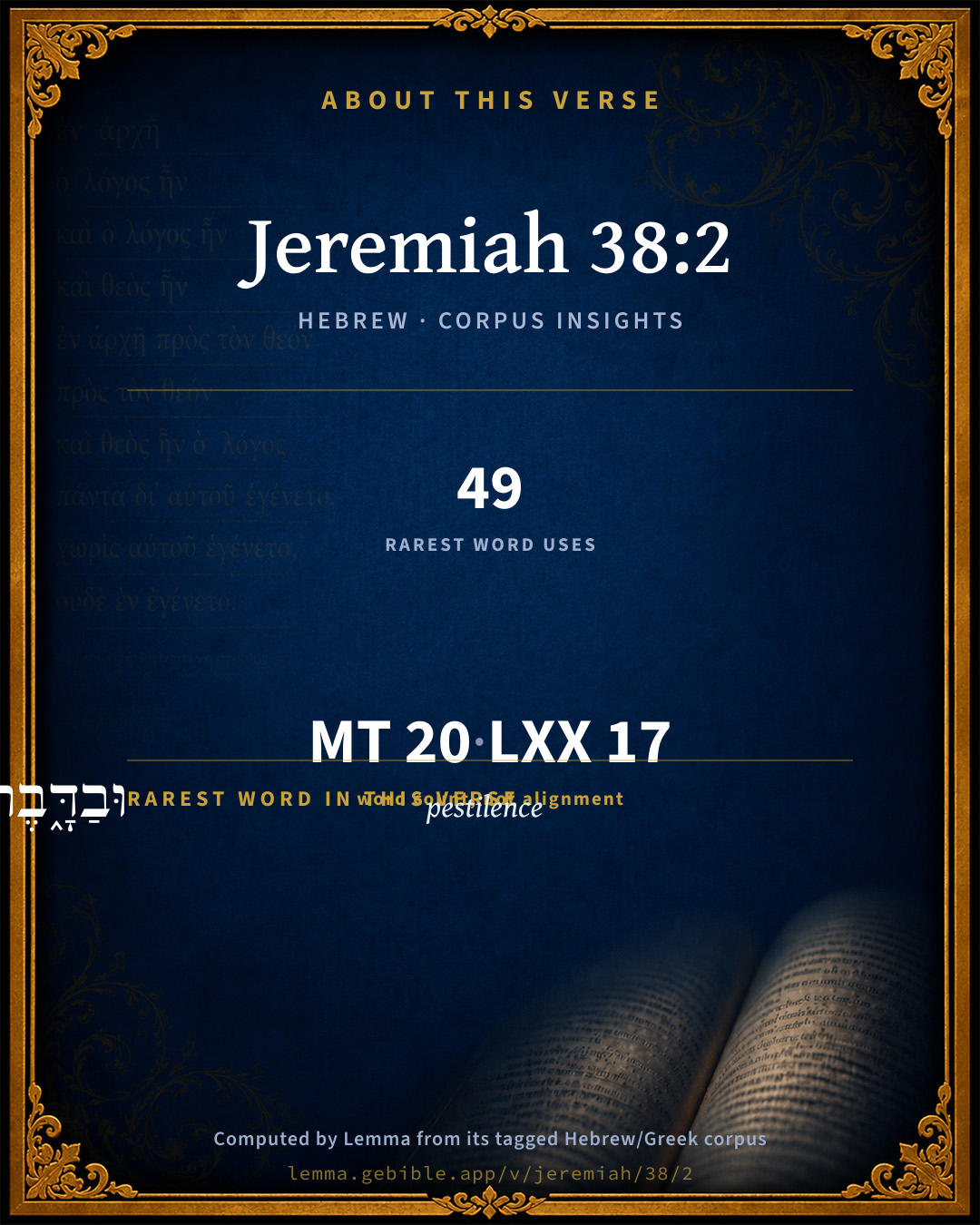
About this verse

These counts appear in no published source. They are computed here, from the morphology-tagged text and Lemma’s own curated glosses. What Lemma adds →

20
words
17
distinct lemmas
Prophets
section

Shared distinctive vocabulary

וּבַדָּ֑בֶר pestilence H1698 occurs in 48 verses of the Hebrew Bible. Also found in:

Grammatical profile

  • 8 verbs
  • 8 nouns
  • 1 pronoun
  • 2 prepositions
  • 1 adverb

Verb forms

  • אָמַ֣ר Qal · Perfect
  • הַיֹּשֵׁב֙ Qal · Participle Active
  • יָמ֕וּת Qal · Imperfect
  • וְהַיֹּצֵ֤א Qal · Participle Active
  • יחיה Qal · Imperfect
  • וְחָיָ֔ה Qal · Sequential Perfect
  • וְהָיְתָה Qal · Sequential Perfect
  • וָחָֽי Qal · Sequential Perfect

Repetition

A word recurs within this verse — often emphatic in Hebrew:

  • יחיה to live H2421 ×3

Hebrew & Septuagint length

In the original languages it is 20 Hebrew tokens and 17 Greek tokens — but the two are counted differently (Hebrew bundles its prefixes and suffixes into one token; the Greek is in lemma form), so that isn’t a like-for-like length.

Cross-references

17

Topical passages linked to Jeremiah 38:2 in the Treasury of Scripture Knowledge — connected by theme and wording, ordered by reader-vote popularity; previews shown in the World English Bible.

  • Jeremiah 39:18 For I will surely save you, and you shall not fall by the sword, but your life shall be for a prey to you; because you have put your trust in me, says Yahweh.
  • Jeremiah 34:17 Therefore thus says Yahweh: you have not listened to me, to proclaim liberty, every man to his brother, and every man to his neighbor: behold, I proclaim to you a liberty, says Yahweh, to the sword, to the pestilence, and to the famine; and I will make you to be tossed back and forth among all the kingdoms of the earth.
  • Jeremiah 45:5 Seek you great things for yourself? Don't seek them; for, behold, I will bring evil on all flesh, says Yahweh; but your life will I give to you for a prey in all places where you go.
  • Jeremiah 42:17 So shall it be with all the men who set their faces to go into Egypt to sojourn there: they shall die by the sword, by the famine, and by the pestilence; and none of them shall remain or escape from the evil that I will bring on them.
  • Ezekiel 14:21 For thus says the Lord Yahweh: How much more when I send my four sore judgments on Jerusalem, the sword, and the famine, and the evil animals, and the pestilence, to cut off from it man and animal!
  • Jeremiah 21:8–9 To this people you shall say, Thus says Yahweh: Behold, I set before you the way of life and the way of death.
  • Jeremiah 24:8 As the bad figs, which can't be eaten, they are so bad, surely thus says Yahweh, So will I give up Zedekiah the king of Judah, and his princes, and the residue of Jerusalem, who remain in this land, and those who dwell in the land of Egypt,
  • Jeremiah 27:13 Why will you die, you and your people, by the sword, by the famine, and by the pestilence, as Yahweh has spoken concerning the nation that will not serve the king of Babylon?
  • Jeremiah 29:18 I will pursue after them with the sword, with the famine, and with the pestilence, and will deliver them to be tossed back and forth among all the kingdoms of the earth, to be an object of horror, and an astonishment, and a hissing, and a reproach, among all the nations where I have driven them;
  • Jeremiah 38:17–23 Then said Jeremiah to Zedekiah, Thus says Yahweh, the God of hosts, the God of Israel: If you will go forth to the king of Babylon's princes, then your soul shall live, and this city shall not be burned with fire; and you shall live, and your house.
  • Jeremiah 42:22 Now therefore know certainly that you shall die by the sword, by the famine, and by the pestilence, in the place where you desire to go to sojourn there.
  • Jeremiah 44:13 For I will punish those who dwell in the land of Egypt, as I have punished Jerusalem, by the sword, by the famine, and by the pestilence;
  • Ezekiel 5:12–17 A third part of you shall die with the pestilence, and with famine shall they be consumed in the midst of you; and a third part shall fall by the sword round about you; and a third part I will scatter to all the winds, and will draw out a sword after them.
  • Ezekiel 6:11 Thus says the Lord Yahweh: Smite with your hand, and stamp with your foot, and say, Alas! because of all the evil abominations of the house of Israel; for they shall fall by the sword, by the famine, and by the pestilence.
  • Ezekiel 7:15 The sword is outside, and the pestilence and the famine within: he who is in the field shall die with the sword: and he who is in the city, famine and pestilence shall devour him.
  • Matthew 24:7–8 For nation will rise against nation, and kingdom against kingdom; and there will be famines, plagues, and earthquakes in various places.
  • Revelation 6:4–8 Another came forth, a red horse. To him who sat on it was given power to take peace from the earth, and that they should kill one another. There was given to him a great sword.

Cross-references courtesy of OpenBible.info (CC BY 4.0).

Hebrew and Greek witnesses Masoretic Hebrew ↔ Greek Septuagint

The same verse in the two great witnesses to the Old Testament, shown verse-for-verse.

These are two independent witnesses, not word-aligned to each other, and the Septuagint is shown in lemma (dictionary) form.

Hebrew Jeremiah 38:2 Masoretic · Westminster Leningrad Codex

כֹּה֮ אָמַ֣ר יְהוָה֒ הַיֹּשֵׁב֙ בָּעִ֣יר הַזֹּ֔את יָמ֕וּת בַּחֶ֖רֶב בָּרָעָ֣ב וּבַדָּ֑בֶר וְהַיֹּצֵ֤א אֶל הַכַּשְׂדִּים֙ יחיה וְחָיָ֔ה וְהָיְתָה לּ֥וֹ נַפְשׁ֛וֹ לְשָׁלָ֖ל וָחָֽי

Thus says Yahweh, He who remains in this city shall die by the sword, by the famine, and by the pestilence; but he who goes forth to the Chaldeans shall live, and his life shall be to him for a prey, and he shall live.

World English Bible · Public Domain

Greek LXX Structure differs

In the Septuagint, Jeremiah is about an eighth shorter than the Hebrew and arranges its material differently — the Oracles Against the Nations (Hebrew chapters 46–51) appear in the middle of the Greek book, after 25:13. Because the chapter and verse boundaries do not line up, a verse-for-verse comparison with the Hebrew is not shown.

A verse-for-verse comparison isn’t shown here because the chapters and verses don’t line up. Switch to the LXX edition with the MT / LXX toggle above to read the Greek directly.

On this verse, Haydock's Catholic Bible Commentary discusses the Septuagint’s reading. Read the note in Commentary ↓

Hebrew: Westminster Leningrad Codex (CC BY 4.0). Greek: Septuagint (public domain); English from a public-domain English Septuagint. How the Septuagint differs from the Hebrew →

Targum (Aramaic paraphrase)

1

The Targum is the ancient Jewish Aramaic paraphrase of the Hebrew Scriptures — an interpretive translation, not the Hebrew text itself. Onkelos (literal) and Pseudo-Jonathan (expansive) render the Torah, and Jonathan the Prophets. Coverage is partial: where no permissively-licensed English translation exists for a verse, only the Aramaic is shown. This is verse-level text, not a word-by-word alignment to the Hebrew.

  1. Targum Jonathan Prophets (Joshua–Malachi)
    כִּדְנַן אֲמַר יְיָ דְיָתֵיב בְּקַרְתָּא הָדָא יִתְקְטֵיל בְּחַרְבָּא בְּכַפְנָא וּבְמוֹתָא וּדְיִפּוֹק וְיִשְׁתְּמַע לְכַסְדָאֵי וִיחֵי וּתְהֵי לֵיהּ נַפְשֵׁיהּ לְשֵׁיזָבָא וְיִתְקַיֵם:

    (no public-domain English translation for this verse)

    Targum Jonathan — Aramaic: “Mikraot Gedolot” (public domain). English: “Sefaria Community Translation” (CC0 1.0 (public-domain dedication)); “London "Chaldee Paraphrase," 1871” (public domain). Text via Sefaria.

Commentary

Notes on Jeremiah 38:2 from classic Christian and Jewish commentators (each source and its license shown beneath its notes). The classic Christian expositions comment on the surrounding passage and are grouped to its opening verse, so a note may address several verses; the Jewish commentaries on the Tanakh (Rashi and others) are per-verse, so they appear only where the commentator wrote on this verse.

Lemma curates 59 commentaries, every one of them public domain or Creative Commons licensed, each selected and text-cleaned for this edition rather than reprinted as found. About our sources →

Trapp's Complete Commentary

John Trapp

Jer 38:2 Thus saith the LORD, He that remaineth in this city shall die by the sword, by the famine, and by the pestilence: but he that goeth forth to the Chaldeans shall live; for he shall have his life for a prey, and shall live.

Ver. 2. Thus saith the Lord, He that remaineth in the city.] This is the self-same truth which he had preached before, and for the which he suffered. See Jer 21:9. He is constant to his principles, and although it be commonly said and seen that he who receives a courtesy sells his liberty; yet it was not so with this holy prophet. He had received some enlargement, and care was taken by the king that a piece, or a roll of bread should be brought him daily to the prison out of the baker’s street: but that stoppeth not his mouth.

John Trapp, A Commentary or Exposition upon All the Books of the Old and New Testament (1647–1656) — public domain. Text from a community e-Sword module.

Joseph Benson's Commentary

Jer 38:2-5. Thus saith the Lord, He that goeth forth to the Chaldeans shall live — This had been the constant tenor of this prophet’s prophecies. The crime of which he was now accused, seems to lie in this, that in such a time of danger he should repeat this prophecy, and also advise the people to leave the city, and go out to the Chaldeans, telling them that if they did so, though the city would be lost, yet they should save their lives, which might induce some to desert their posts. This they interpret to be not seeking the welfare of the people, but their hurt; though, indeed, their welfare was that alone which he sought, knowing that there was no other way for them to save their lives, but by submitting to the Chaldeans. The great men, however, would not believe it; for they would not form their judgments on the revelations which God had been pleased to make of his will, but were determined to judge of their safety from what they wished. Hence, for any one not to be of their opinion was to be an enemy to the state. Therefore the princes said unto the king — See Jer 36:12; Jer 36:21; We beseech thee, let this man be put to death — His crime deserves no less a punishment; for he weakeneth the hands of the men of war — By making them despair of success. Then the king said, Behold he is in your hand — At your disposal; I give him up into your power. Though Zedekiah was convinced that Jeremiah was a prophet sent of God, yet he had not courage to own this conviction, but weakly yielded to the violence of his persecutors. For the king is not he that can do any thing against you — He speaks as one who did not dare, in such difficult times, to contradict the great men about him. Blaney renders the clause, “For the king can carry no point in competition with you;” observing, “The king evidently speaks this in disgust with the princes for endeavouring to frustrate his clemency. He had once rescued Jeremiah out of their hands, and taken him under his royal protection. But his prerogative, he tells them, was likely to avail but little when opposed by their obstinate and repeated importunities. The power was in reality theirs and not his.”

Joseph Benson's Commentary on the Old and New Testaments (1811–1818) — public domain. Text from a community e-Sword module.

Geneva Bible (1599)

Geneva Bible translators

Read Jer. 21:9 and 45:5.

Geneva Bible (1599) marginal notes — public domain. Text via Bolls.life.

Jamieson, Fausset & Brown

Robert Jamieson, A. R. Fausset & David Brown

life . . . a prey--He shall escape with his life; though losing all else in a shipwreck, he shall carry off his life as his gain, saved by his going over to the Chaldeans. (See on Jer 21:9).

Jamieson, Fausset & Brown — Commentary Critical and Explanatory on the Whole Bible (1871) — public domain (CC PDM 1.0). Text via the HelloAO Bible API.

John Calvin's Commentaries

We have seen elsewhere that the Prophet had before said the same; it was not, then, a new thing, for he had thirty years before that time dearly pronounced the same in the Temple, and it was then written as a prophecy and fixed to the doors of the Temple. It was, therefore, nothing new to hear all this from the mouth of Jeremiah. But as I have already said, the king and his couriers thought that he was so subdued by evils that he could hardly open his mouth. In short, they thought that the holy man had, in a manner, lost his tongue since he had been in prison. This, then, was the reason why they now accused him so gravely to the king, and declared him worthy of death. He had deserved death many years before, if he had now committed a capital offense. But as I have already stated, they regarded the Prophet as having designedly despised the king’s authority, and they were indignant because he could not be subdued, when yet he was a prisoner and might see danger at hand every hour. This, then, was the reason why they regarded as a new thing what Jeremiah said, Whosoever abides in the city shall perish, etc.

As to these threatenings, we have elsewhere said, that all those who expected help from the Egyptians were willful despisers of God; for the Prophet had often exhorted them all, quietly and submissively to bear that temporary punishment which God had resolved to inflict on them. They wished in their perverseness to drive to a distance God’s judgment, and then when they saw that God was their enemy, they deemed it enough to have the Egyptians as their friends. It was then no wonder that the Prophet allotted to them the sword, and famine, and pestilence.

He then adds, Whosoever passeth over to the Chaldeans shall live The condition, however, was very hard; his soul, he says, shall be for a prey, as though he had said, “He who flees to the Chaldeans shall only save his life, but must suffer the loss of all his property,” as when a shipwreck is dreaded, there is no one who is not ready to save his life at the loss of all his goods; and, therefore, in extreme danger the merchants are wont to cast into the sea all that they have, for they prefer to escape to the harbor empty and destitute of everything, than to perish together with their riches. It was, then, a hard condition; but the Prophet shews that they could not otherwise escape; they were to give up their own country, and all other things, and could only preserve their life. For this reason he says, that their life would be for a prey to them, as when anything is snatched from the fire, or as when one is exposed to plunder, he were content to take something away by stealth, for otherwise, if he sought to take away many things, he would have to contend with many enemies. The Prophet then intimates that the Jews could not save themselves from death in any other way than by casting away all they had, and by being solicitous only to save life. He again repeats, he shall live. By this repetition he more pressingly urged them, and with more earnestness exhorted them to save their life.

John Calvin's Commentaries (1540-1563) — public domain. Text from the Calvin Translation Society English edition (1840s-50s) via the Christian Classics Ethereal Library (ccel.org). Calvin's coverage is partial (roughly two-thirds of the Bible); uncommented books and verses are honest gaps, never fabricated. The 19th-century editor's footnotes and remarks are omitted so the notes are faithfully Calvin's own voice.

Ellicott's Commentary for English Readers

(2) Thus saith the Lord.—The words carry us back to Jer_21:9, and in any chronological arrangement of the book the one chapter would follow the other. It is obvious that to all who did not recognise the divine mission of the prophet, words like those which he had then spoken would seem to come from the lips of a traitor. Desertion to the enemy was represented as the only way of safety, and this was the counsel given to those who were defending the city of their fathers against an alien invader. What made it appear worse was that the prophet himself had been caught in an act which, though he denied the charge, might not unnaturally seem like an act of treacherous desertion.

A Bible Commentary for English Readers, edited by Charles John Ellicott (1878–1897) — public domain. Text from a community e-Sword module.

The Cambridge Bible for Schools and Colleges

gen. ed. J. J. S. Perowne

2. He that abideth, etc.] The v. is substantially identical with Jer_21:9, and Co. following Du. considers that it is a later insertion in this place, on the ground that while such advice under the earlier circumstances was permissible, now in the actual presence of the enemy it would have been treasonable.

The Cambridge Bible for Schools and Colleges (gen. ed. J. J. S. Perowne; Cambridge University Press, 1878–1918) — public domain. Text from a community e-Sword module.

John Gill's Exposition

Thus saith the Lord, he that remaineth in this city,.... Of Jerusalem; that does not go out of it, and surrender himself to the Chaldeans; but continues in it fighting against them:

shall die by the sword, by the famine, and by the pestilence; that is, by one or other of these:

but he that goeth forth to the Chaldeans shall live: that goes out of the city, throws down his arms, delivers up himself to the Chaldean army, and submits to their mercy, shall have quarters given him, and his life shall be spared:

for he shall have his life for a prey, and shall live; or, "his soul, and it shall live" (n); comfortably and in safety; he shall escape with his life, and that shall be preserved from the sword, famine, and pestilence; and whereas it was, as it were, lost, it shall be recovered out of the jaws of death, out of the above calamities it was exposed to; and so be like a prey taken out of the hands of the mighty, and be quite safe.

(n) "et erit illi anima ejus in praedam et vivet", Junius & Tremellius, Piscator, Cocceius, Schmidt.

John Gill's Exposition of the Whole Bible (1746–1763) — public domain (CC PDM 1.0). Text via the HelloAO Bible API.

Haydock's Catholic Bible Commentary

Safe. Hebrew, "a booty," chap. xxi. 9. --- Septuagint, "like a thing found." (Calmet) --- The Hebrew idiom implies that he shall most surely live. Voluntary offerings prevent eternal misery. (Worthington)

George Leo Haydock (1774–1849), Haydock's Catholic Family Bible and Commentary, 1859 edition — public domain. Excludes Psalms (Douay-Rheims chapter numbering differs from Protestant) and Deuterocanonical books (Catholic canon only).

Matthew Poole's English Annotations

As to what is Jer 38:3, it is no more than had for some time been the constant tenor of this prophet’s prophecies. The crime seemeth to lie in this, that in such a time of extreme danger he should repeat this prophecy, and also advise the people to leave the city, and shift for themselves, by going out to the Chaldeans, telling them that if they did so, though the city would be lost, and their estates in it lost, yet they should save their lives, which words might encourage many of low and cowardly spirits to desert their posts; which indeed had been crime sufficient in an ordinary time, and under ordinary circumstances, but was no crime now that God had revealed his will to the king, princes, and people that the city should be lost; there lay now no further duty upon any to contribute to its defence, but they were obliged to make as good provisions for themselves as they could; but these wicked princes believed no such thing, therefore they make this a great charge.

Matthew Poole's English Annotations on the Holy Bible (1683–1685) — public domain. Text from a community e-Sword/MySword module.

The Pulpit Commentary

Vers. 2, 3. He that remaineth, etc. Jeremiah repeats what he had said to Zedekiah"s embassy in Jer_21:9, Jer_21:10.

The Pulpit Commentary (1880–1919), ed. H.D.M. Spence-Jones & Joseph S. Exell — public domain. Text from a community e-Sword module.

Rashi

Rabbi Shlomo Yitzchaki (Rashi)

and he shall have his life as prey His life shall be saved, as if had “plundered” his soul; just as a man profits from plundering booty, so this person will profit [by saving] his life.

Rashi on the Tanakh — English translations: “The Judaica Press complete Tanach with Rashi, translated by A. J. Rosenberg” (CC BY 4.0); “Pentateuch with Rashi's commentary by M. Rosenbaum and A.M. Silbermann, 1929-1934” (public domain); “The Metsudah Tanach series, Lakewood, N.J” (CC BY 4.0); and “The Book of Joshua, Metsudah Publications, 1997” (CC BY 4.0). Text via Sefaria.

Lesson kit

Teaching starters — assembled from the data on this page, not authored interpretation. Every prompt links to the verse data it draws on. Edit before teaching.

Jeremiah, in the Prophets, opens this verse with 20 words (17 distinct Hebrew lemmas). Its most distinctive word is deber (“pestilence”). A historical commentator’s framing appears above. Read the whole chapter for the surrounding context.

Discussion questions

  1. How does “pestilence” (deber) shape what this verse is saying?
  2. Exodus 5:3 shares the word «pestilence» with this verse. How do the two illuminate each other?
  3. “to live” occurs 3× in this one verse. What is the effect of the repetition?
  4. These translations render this verse differently. What is at stake in choosing one wording over another?
  5. The verb «אָמַ֣ר» is Qal Perfect. How does its form color the action?
  6. Reading how Trapp's Complete Commentary and Joseph Benson's Commentary read this verse, where do the two commentators agree and where do they part?

Things to notice

Reading settings

Reading text

Shown beneath each verse's original-language words.

Old Testament
Old Testament edition

Read the OT as the Masoretic Hebrew (MT) or the Greek Septuagint (LXX).

English shown for the Greek Septuagint (in the Hebrew ↔ Greek comparison).

Comparing translations? Open the Compare panel on any verse page to stack up to four side by side.