
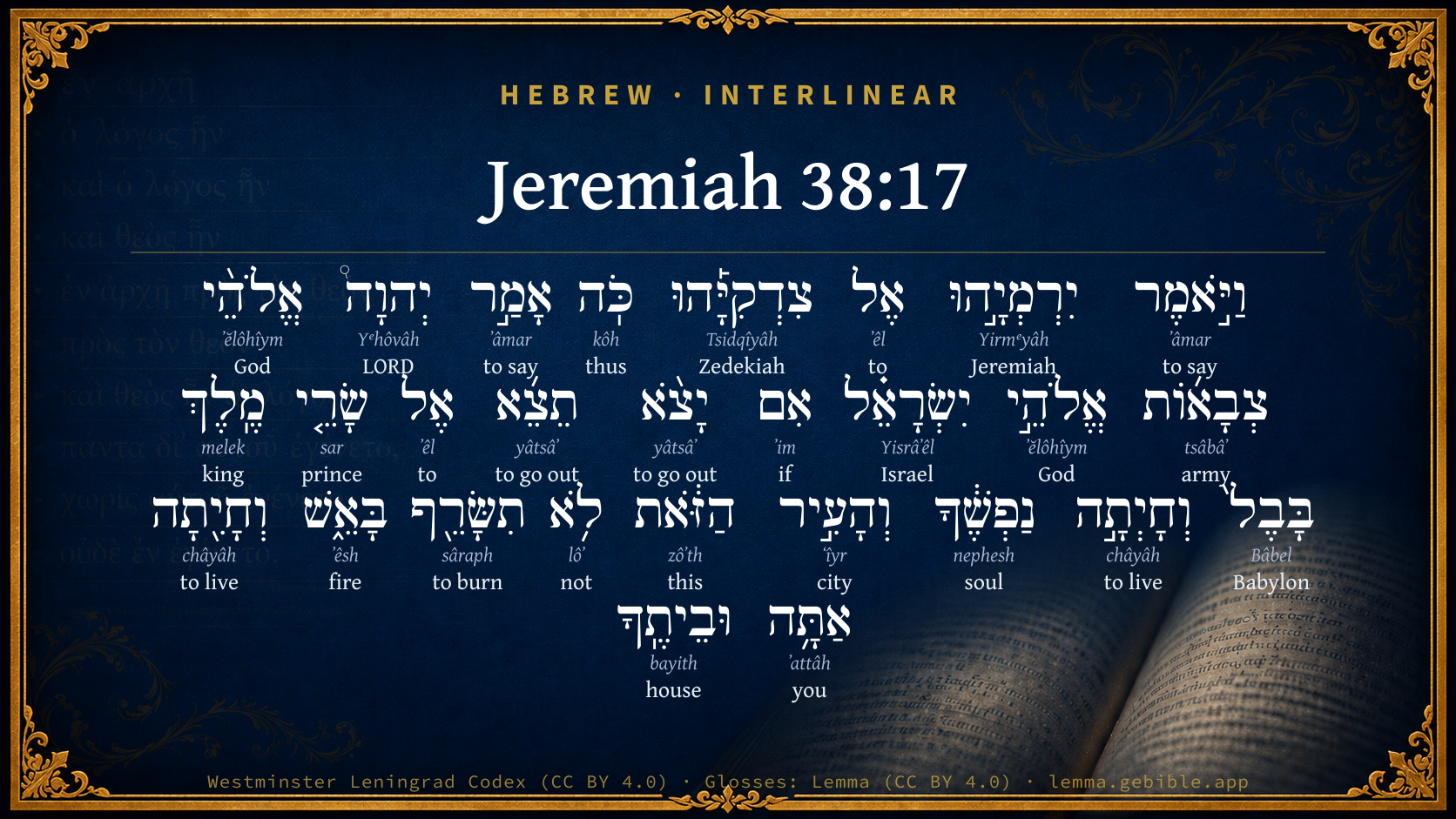
Jeremiah 38:17

Hebrew (Westminster Leningrad Codex) Jeremiah 38:17 appears in the Hebrew Old Testament. The text above is from the Westminster Leningrad Codex. Each word links to its Strong’s number, a concise gloss, and parsing drawn from the Open Scriptures Hebrew Bible morphology. Click any word for its full Brown-Driver-Briggs (BDB) entry.
Download image
Cite this verse

Jeremiah 38:17 (World English Bible). Public Domain. Lemma interlinear Bible study tool, https://lemma.gebible.app/v/jeremiah/38/17.

Show BibTeX & RIS
BibTeX
RIS
English Translation
Then said Jeremiah to Zedekiah, Thus says Yahweh, the God of hosts, the God of Israel: If you will go forth to the king of Babylon's princes, then your soul shall live, and this city shall not be burned with fire; and you shall live, and your house.
World English Bible · Public Domain
Download a study sheet

One document with this verse’s original text, its word-by-word gloss line, the meaning frame, cross-references with their text, attributed commentary, and full source and license credits — printable, and it pastes into notes with its structure intact.

This verse Autodidact and up

Study sheet (.html) Plain text (.txt)

A passage Seminary Student

Up to 50 verses in one chapter. A passage sheet keeps up to 6 commentary sources and 12 cross-references per verse, in the order this page ranks them, and says so on the sheet whenever that leaves anything out. Ask for a single verse and you get the Autodidact verse sheet above.

Everything on this page stays free to read, with no account — the sheet is a download of what is already on screen, not access to it.

Want to remove ads? Support Godless Engineer
Compare translations 3

The same verse in 3 English versions, stacked beneath the original-language interlinear above. Click any original word for its lexicon entry.

Each is an independent rendering of the whole verse — the interlinear is not word-aligned to these translations.

Highlighted words mark where these versions differ — a whole-verse word diff, not a word-by-word alignment.

  • World English Bible Public Domain
    Then said Jeremiah to Zedekiah, Thus says Yahweh, the God of hosts, the God of Israel: If you will go forth to the king of Babylon's princes, then your soul shall live, and this city shall not be burned with fire; and you shall live, and your house.
  • King James Version Public Domain
    Then said Jeremiah unto Zedekiah, Thus saith the LORD, the God of hosts, the God of Israel; If thou wilt assuredly go forth unto the king of Babylon's princes, then thy soul shall live, and this city shall not be burned with fire; and thou shalt live, and thine house:
  • unfoldingWord Literal Text CC BY-SA 4.0
    So Jeremiah said to Zedekiah, “Yahweh, God of hosts, God of Israel, says this: If you indeed go out to the officials of the king of Babylon then you will live, and this city will not be burned. You and your family will live.

unfoldingWord Literal Text — © unfoldingWord, licensed CC BY-SA 4.0. Word-aligned USFM3 via Door43 (git.door43.org/unfoldingWord/en_ult).

Versions to compare (up to 4)

3 of 4 selected

Show all 18 translations

Every available English version of this verse, each an independent rendering of the whole verse.

  • World English Bible Public Domain
    Then said Jeremiah to Zedekiah, Thus says Yahweh, the God of hosts, the God of Israel: If you will go forth to the king of Babylon's princes, then your soul shall live, and this city shall not be burned with fire; and you shall live, and your house.
  • Berean Standard Bible Public Domain
    Then Jeremiah said to Zedekiah, “This is what the LORD God of Hosts, the God of Israel, says: ‘If you indeed surrender to the officers of the king of Babylon, then you will live, this city will not be burned down, and you and your household will survive.
  • Majority Standard Bible Public Domain
    Then Jeremiah said to Zedekiah, “This is what the LORD God of Hosts, the God of Israel, says: ‘If you indeed surrender to the officers of the king of Babylon, then you will live, this city will not be burned down, and you and your household will survive.
  • King James Version Public Domain
    Then said Jeremiah unto Zedekiah, Thus saith the LORD, the God of hosts, the God of Israel; If thou wilt assuredly go forth unto the king of Babylon's princes, then thy soul shall live, and this city shall not be burned with fire; and thou shalt live, and thine house:
  • American Standard Version (1901) Public Domain
    Then said Jeremiah unto Zedekiah, Thus saith Jehovah, the God of hosts, the God of Israel: If thou wilt go forth unto the king of Babylon's princes, then thy soul shall live, and this city shall not be burned with fire; and thou shalt live, and thy house.
  • Revised Version (1885) Public Domain
    Then said Jeremiah unto Zedekiah, Thus saith the LORD, the God of hosts, the God of Israel: If thou wilt go forth unto the king of Babylon’s princes, then thy soul shall live, and this city shall not be burned with fire; and thou shalt live, and thine house:
  • Geneva Bible (1599) Public Domain
    Then sayd Ieremiah vnto Zedekiah, Thus sayth the Lord God of hostes, the God of Israel, If thou wilt goe foorth vnto the King of Babels princes, then thy soule shall liue, and this citie shall not be burnt vp with fire, and thou shalt liue, and thine house.
  • Douay-Rheims (1899) Public Domain
    And Jeremias said to Sedecias: Thus saith the Lord of hosts the God of Israel: If thou wilt take a resolution and go out to the princes of the king of Babylon, thy soul shall live, and this city shall not be burnt with fire: and thou shalt be safe, and thy house.
  • Young's Literal Translation Public Domain
    And Jeremiah saith unto Zedekiah, `Thus said Jehovah, God of Hosts, God of Israel: If thou dost certainly go forth unto the heads of the king of Babylon, then hath thy soul lived, and this city is not burned with fire, yea, thou hast lived, thou and thy house.
  • Literal Standard Version CC BY-SA 4.0
    And Jeremiah says to Zedekiah, “Thus said YHWH, God of Hosts, God of Israel: If you certainly go forth to the heads of the king of Babylon, then your soul has lived, and this city is not burned with fire, indeed, you have lived, you and your house.
  • Unlocked Literal Bible CC BY-SA 4.0
    So Jeremiah said to Zedekiah, “Yahweh, God of hosts, God of Israel, says this: If you indeed go out to the officials of the king of Babylon then you will live, and this city will not be burned. You and your family will live.
  • unfoldingWord Literal Text CC BY-SA 4.0
    So Jeremiah said to Zedekiah, “Yahweh, God of hosts, God of Israel, says this: If you indeed go out to the officials of the king of Babylon then you will live, and this city will not be burned. You and your family will live.
  • Darby Bible Public Domain
    And Jeremiah said unto Zedekiah, Thus saith Jehovah the God of hosts, the God of Israel: If thou wilt freely go forth to the king of Babylon's princes, then thy soul shall live, and this city shall not be burned with fire; and thou shalt live, and thy house.
  • World Messianic Bible Public Domain
    Then Jeremiah said to Zedekiah, “The LORD, the God of Hosts, the God of Israel, says: ‘If you will go out to the king of Babylon’s princes, then your soul will live, and this city will not be burned with fire. You will live, along with your house.
  • Webster's Bible Public Domain
    Then said Jeremiah to Zedekiah, Thus saith the LORD, the God of hosts, the God of Israel; If thou wilt assuredly go forth to the king of Babylon's princes, then thy soul shall live, and this city shall not be burned with fire; and thou shalt live, and thy house:
  • Free Bible Version CC BY-SA 4.0
    Then Jeremiah told Zedekiah, “This is what the Lord God Almighty, the God of Israel, says: ‘If you hand yourself over to the officers of the king of Babylon, then you'll live. Jerusalem won't be burned down, and you and your family will survive.
  • Bible in Basic English Public Domain
    Then Jeremiah said to Zedekiah, These are the words of the Lord, the God of armies, the God of Israel: If you go out to the king of Babylon's captains, then you will have life, and the town will not be burned with fire, and you and your family will be kept from death:
  • JPS Tanakh (1917) Public Domain
    Then said Jeremiah unto Zedekiah: 'Thus saith the LORD, the God of hosts, the God of Israel: If thou wilt go forth unto the king of Babylon's princes, then thy soul shall live, and this city shall not be burned with fire; and thou shalt live, thou, and thy house;

Literal Standard Version (2020), Covenant Press — licensed CC BY-SA 4.0. Text via the HelloAO Bible API (eBible.org). Unlocked Literal Bible (unfoldingWord) — licensed CC BY-SA 4.0. Text via the HelloAO Bible API (eBible.org). unfoldingWord Literal Text — © unfoldingWord, licensed CC BY-SA 4.0. Word-aligned USFM3 via Door43 (git.door43.org/unfoldingWord/en_ult). Free Bible Version, Dr. Jonathan Gallagher — licensed CC BY-SA 4.0. Text via the HelloAO Bible API (eBible.org).

Word by word

More ways to search: Search by grammar → Find every occurrence → Compare this word →

Practice this passage: Drill this verse → Learn its vocabulary →

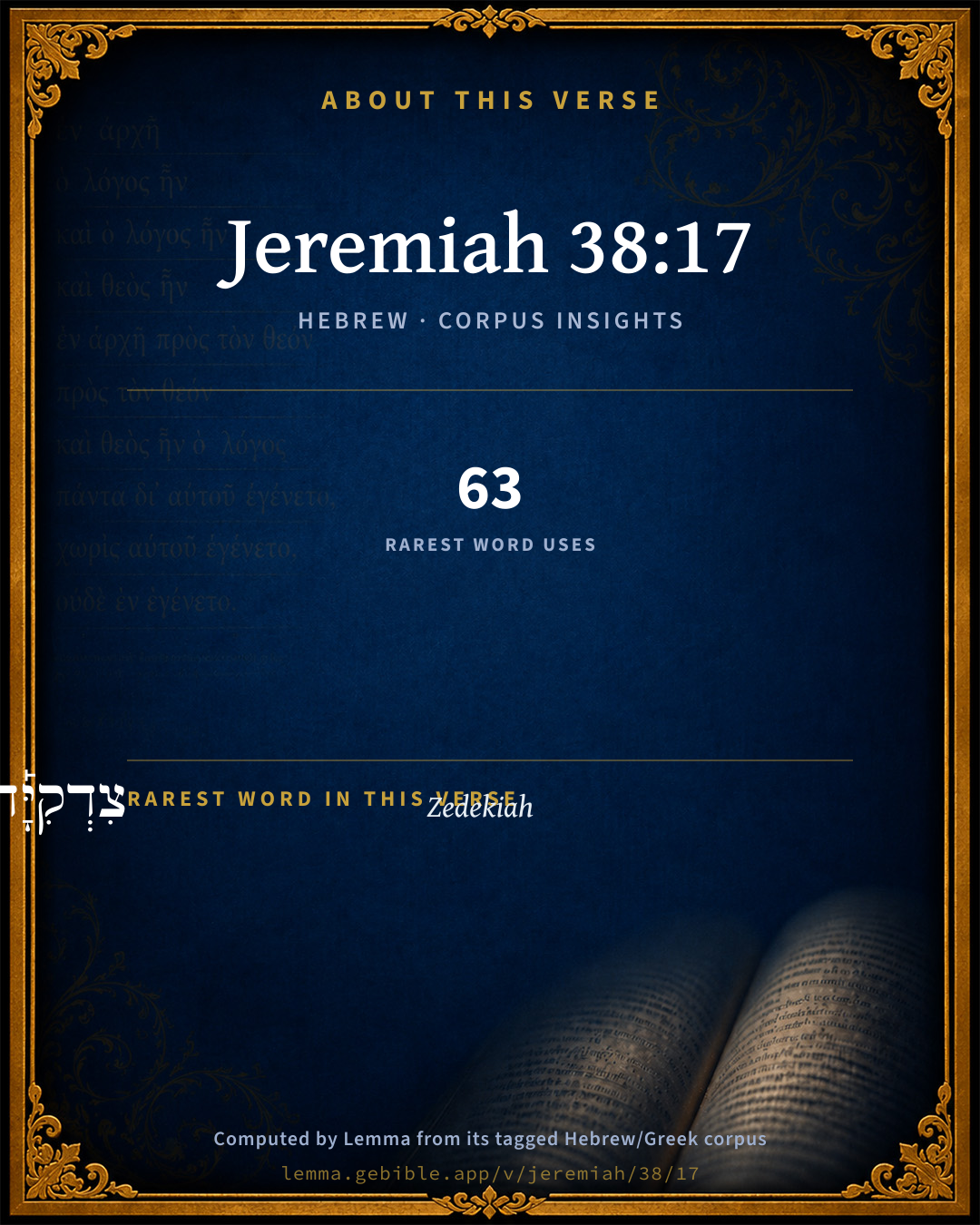
צִדְקִיָּ֡הוּ
Tsidqîyâh
H6667
“Zedekiah”
Noun, Proper
Part of Speech
Noun
Type
Proper
Full BDB Definition

Origin: from H6664 and H3050

TWOT: None

Zedekiah = "Jehovah is righteous" - the last king of Judah renamed from 'Mattaniah' by Nebuchadnezzar; son of Josiah by wife Hamutal; placed on the throne by Nebuchadnezzar when he carried his nephew Jehoiakim in captivity - false prophet at the court of king Ahab of the northern kingdom of Israel - son of Maaseiah, a false prophet in Babylon - son of Hananiah, one of the princes of Judah in the time of Jeremiah - a priest who sealed the covenant with Nehemiah - son of king Jehoiakim of Judah
  1. וַיֹּ֣אמֶר ʼâmar H559 “and · to say” Conjunction + Verb, Qal, Sequential Imperfect, 3rd Person, Masculine, Singular
  2. יִרְמְיָ֣הוּ Yirmᵉyâh H3414 “Jeremiah” Noun, Proper
  3. אֶל ʼêl H413 “to” Preposition
  4. כֹּֽה kôh H3541 “thus” Adverb
  5. אָמַ֣ר ʼâmar H559 “to say” Verb, Qal, Perfect, 3rd Person, Masculine, Singular
  6. יְהוָה֩ Yᵉhôvâh H3068 “LORD” Noun, Proper
  7. אֱלֹהֵ֨י ʼĕlôhîym H430 “God(s) of” Noun, Common, Masculine, Plural, Construct
  8. צְבָא֜וֹת tsâbâʼ H6635 “armies” Noun, Common, Both, Plural, Absolute
  9. אֱלֹהֵ֣י ʼĕlôhîym H430 “God(s) of” Noun, Common, Masculine, Plural, Construct
  10. יִשְׂרָאֵ֗ל Yisrâʼêl H3478 “Israel” Noun, Proper
  11. אִם ʼim H518 “if” Conjunction
  12. יָצֹ֨א yâtsâʼ H3318 “to go out” Verb, Qal, Infinitive Absolute
  13. תֵצֵ֜א yâtsâʼ H3318 “to go out” Verb, Qal, Imperfect, 2nd Person, Masculine, Singular
  14. אֶל ʼêl H413 “to” Preposition
  15. שָׂרֵ֤י sar H8269 “princes of” Noun, Common, Masculine, Plural, Construct
  16. מֶֽלֶךְ melek H4428 “king of” Noun, Common, Masculine, Singular, Construct
  17. בָּבֶל֙ Bâbel H894 “Babylon” Noun, Proper
  18. וְחָיְתָ֣ה châyâh H2421 “and · to live” Conjunction + Verb, Qal, Sequential Perfect, 3rd Person, Feminine, Singular
  19. נַפְשֶׁ֔ךָ nephesh H5315 “soul · your” Noun, Common, Both, Singular, Construct + Suffix, Personal, 2nd Person, Masculine, Singular
  20. וְהָעִ֣יר ʻîyr H5892 “and · the · city” Conjunction + Particle, Definite Article + Noun, Common, Feminine, Singular, Absolute
  21. הַזֹּ֔את zôʼth H2063 “the · this” Particle, Definite Article + Pronoun, Demonstrative, Feminine, Singular
  22. לֹ֥א lôʼ H3808 “not” Particle, Negative
  23. תִשָּׂרֵ֖ף sâraph H8313 “to burn” Verb, Niphal, Imperfect, 3rd Person, Feminine, Singular
  24. בָּאֵ֑שׁ ʼêsh H784 “in/at the · fire” Preposition, Determined + Noun, Common, Both, Singular, Absolute
  25. וְחָיִ֖תָה châyâh H2421 “and · to live” Conjunction + Verb, Qal, Sequential Perfect, 2nd Person, Masculine, Singular
  26. אַתָּ֥ה ʼattâh H859 “you” Pronoun, Personal, 2nd Person, Masculine, Singular
  27. וּבֵיתֶֽךָ bayith H1004 “and · house · your” Conjunction + Noun, Common, Masculine, Singular, Construct + Suffix, Personal, 2nd Person, Masculine, Singular

About this verse

These counts appear in no published source. They are computed here, from the morphology-tagged text and Lemma’s own curated glosses. What Lemma adds →

28
words
23
distinct lemmas
Prophets
section

Grammatical profile

  • 7 verbs
  • 14 nouns
  • 2 pronouns
  • 2 prepositions
  • 1 conjunction
  • 1 adverb
  • 1 particle

Verb forms

  • וַיֹּ֣אמֶר Qal · Sequential Imperfect
  • אָמַ֣ר Qal · Perfect
  • יָצֹ֨א Qal · Infinitive Absolute
  • תֵצֵ֜א Qal · Imperfect
  • וְחָיְתָ֣ה Qal · Sequential Perfect
  • תִשָּׂרֵ֖ף Niphal · Imperfect
  • וְחָיִ֖תָה Qal · Sequential Perfect

Repetition

Words recur within this verse — often emphatic in Hebrew:

  • וַיֹּ֣אמֶר to say H559 ×2
  • אֱלֹהֵ֨י God H430 ×2
  • יָצֹ֨א to go out H3318 ×2
  • וְחָיְתָ֣ה to live H2421 ×2
  • אֶל to H413 ×2

Cross-references

13

Topical passages linked to Jeremiah 38:17 in the Treasury of Scripture Knowledge — connected by theme and wording, ordered by reader-vote popularity; previews shown in the World English Bible.

  • Jeremiah 27:12 I spoke to Zedekiah king of Judah according to all these words, saying, Bring your necks under the yoke of the king of Babylon, and serve him and his people, and live.
  • Jeremiah 27:17 Don't listen to them; serve the king of Babylon, and live: why should this city become a desolation?
  • Jeremiah 38:2 Thus says Yahweh, He who remains in this city shall die by the sword, by the famine, and by the pestilence; but he who goes forth to the Chaldeans shall live, and his life shall be to him for a prey, and he shall live.
  • Jeremiah 21:8–10 To this people you shall say, Thus says Yahweh: Behold, I set before you the way of life and the way of death.
  • Jeremiah 39:3 that all the princes of the king of Babylon came in, and sat in the middle gate, [to wit], Nergal Sharezer, Samgar-nebo, Sarsechim, Rabsaris, Nergal Sharezer, Rabmag, with all the rest of the princes of the king of Babylon.
  • 2 Kings 24:12 and Jehoiachin the king of Judah went out to the king of Babylon, he, and his mother, and his servants, and his princes, and his officers: and the king of Babylon took him in the eighth year of his reign.
  • Jeremiah 7:6–7 if you don't oppress the foreigner, the fatherless, and the widow, and don't shed innocent blood in this place, neither walk after other gods to your own hurt:
  • 1 Chronicles 17:24 Let your name be established and magnified forever, saying, Yahweh of Hosts is the God of Israel, even a God to Israel: and the house of David your servant is established before you.
  • Psalms 80:7 Turn us again, God of hosts. Cause your face to shine, And we will be saved.
  • Psalms 80:14 Turn again, we beg you, God of hosts. Look down from heaven, and see, and visit this vine,
  • Amos 5:27 Therefore will I cause you to go into captivity beyond Damascus," says Yahweh, whose name is the God of hosts.
  • Ezra 9:4 Then were assembled to me everyone who trembled at the words of the God of Israel, because of the trespass of them of the captivity; and I sat confounded until the evening offering.
  • Job 23:13 But he stands alone, and who can oppose him? What his soul desires, even that he does.

Cross-references courtesy of OpenBible.info (CC BY 4.0).

Hebrew and Greek witnesses Masoretic Hebrew ↔ Greek Septuagint

The same verse in the two great witnesses to the Old Testament, shown verse-for-verse.

These are two independent witnesses, not word-aligned to each other, and the Septuagint is shown in lemma (dictionary) form.

Hebrew Jeremiah 38:17 Masoretic · Westminster Leningrad Codex

וַיֹּ֣אמֶר יִרְמְיָ֣הוּ אֶל צִדְקִיָּ֡הוּ כֹּֽה אָמַ֣ר יְהוָה֩ אֱלֹהֵ֨י צְבָא֜וֹת אֱלֹהֵ֣י יִשְׂרָאֵ֗ל אִם יָצֹ֨א תֵצֵ֜א אֶל שָׂרֵ֤י מֶֽלֶךְ בָּבֶל֙ וְחָיְתָ֣ה נַפְשֶׁ֔ךָ וְהָעִ֣יר הַזֹּ֔את לֹ֥א תִשָּׂרֵ֖ף בָּאֵ֑שׁ וְחָיִ֖תָה אַתָּ֥ה וּבֵיתֶֽךָ

Then said Jeremiah to Zedekiah, Thus says Yahweh, the God of hosts, the God of Israel: If you will go forth to the king of Babylon's princes, then your soul shall live, and this city shall not be burned with fire; and you shall live, and your house.

World English Bible · Public Domain

Greek LXX Structure differs

In the Septuagint, Jeremiah is about an eighth shorter than the Hebrew and arranges its material differently — the Oracles Against the Nations (Hebrew chapters 46–51) appear in the middle of the Greek book, after 25:13. Because the chapter and verse boundaries do not line up, a verse-for-verse comparison with the Hebrew is not shown.

A verse-for-verse comparison isn’t shown here because the chapters and verses don’t line up. Switch to the LXX edition with the MT / LXX toggle above to read the Greek directly.

Hebrew: Westminster Leningrad Codex (CC BY 4.0). Greek: Septuagint (public domain); English from a public-domain English Septuagint. How the Septuagint differs from the Hebrew →

Targum (Aramaic paraphrase)

1

The Targum is the ancient Jewish Aramaic paraphrase of the Hebrew Scriptures — an interpretive translation, not the Hebrew text itself. Onkelos (literal) and Pseudo-Jonathan (expansive) render the Torah, and Jonathan the Prophets. Coverage is partial: where no permissively-licensed English translation exists for a verse, only the Aramaic is shown. This is verse-level text, not a word-by-word alignment to the Hebrew.

  1. Targum Jonathan Prophets (Joshua–Malachi)
    וַאֲמַר יִרְמְיָה לְצִדְקִיָה כִּדְנַן אֲמַר יְיָ צְבָאוֹת אֱלָהָא דְיִשְׂרָאֵל אִם מִפַּק תִּפּוֹק לְוַת רַבְרְבֵי מַלְכָּא דְבָבֶל וְתִתְקַיֵם נַפְשָׁךְ וְקַרְתָּא הָדָא לָא תִתּוֹקַד בְּנוּרָא וּתְחֵי אַתְּ וֶאֱנַשׁ בֵּיתָךְ:

    (no public-domain English translation for this verse)

    Targum Jonathan — Aramaic: “Mikraot Gedolot” (public domain). English: “Sefaria Community Translation” (CC0 1.0 (public-domain dedication)); “London "Chaldee Paraphrase," 1871” (public domain). Text via Sefaria.

Commentary

Notes on Jeremiah 38:17 from classic Christian and Jewish commentators (each source and its license shown beneath its notes). The classic Christian expositions comment on the surrounding passage and are grouped to its opening verse, so a note may address several verses; the Jewish commentaries on the Tanakh (Rashi and others) are per-verse, so they appear only where the commentator wrote on this verse.

Lemma curates 59 commentaries, every one of them public domain or Creative Commons licensed, each selected and text-cleaned for this edition rather than reprinted as found. About our sources →

Trapp's Complete Commentary

John Trapp

Jer 38:17 Then said Jeremiah unto Zedekiah, Thus saith the LORD, the God of hosts, the God of Israel; If thou wilt assuredly go forth unto the king of Babylon’s princes, then thy soul shall live, and this city shall not be burned with fire; and thou shalt live, and thine house:

Ver. 17. If thou wilt assuredly go forth.] Jeremiah was semper idem, one and the same still; no changeling at all, but a faithful and constant preacher of God’s Word.

John Trapp, A Commentary or Exposition upon All the Books of the Old and New Testament (1647–1656) — public domain. Text from a community e-Sword module.

Joseph Benson's Commentary

Jer 38:17-18. Then said Jeremiah, Thus saith the Lord — Here we have the good advice which Jeremiah gave him, with the reasons why the king ought to take it; reasons drawn, not from any prudence or politics of his own, but in the name of the Lord, the God of hosts, and God of Israel. If thou wilt assuredly go forth unto the king of Babylon’s princes — Those mentioned Jer 39:3, and submit thyself to them; then thy soul shall live — That is, thou shalt live; and this city shall not be burned, &c. — Thou shalt save the city from destruction by fire, and thy wives and children from suffering a violent death. It must be observed that Nebuchadnezzar was not now in person at the siege of Jerusalem, but at Riblah in Syria, Jer 39:5; Jer 39:9. His army was commanded by his generals; and it is to them, here termed princes, that Jeremiah counsels Zedekiah to go forth, and through them to submit himself to the king, by whom he had been established on the throne. But if thou wilt not go forth, &c. — As he had before used exhortations and promises, so here he uses warnings and threatenings to prevail with the king to take that course by which alone he could preserve Jerusalem, and himself, and family from ruin.

Joseph Benson's Commentary on the Old and New Testaments (1811–1818) — public domain. Text from a community e-Sword module.

Tyndale Open Study Notes

Tyndale Open Resources

38:17-18 Jeremiah laid out the Lord’s decree. Zedekiah could save the city by surrendering or he could watch as it was destroyed by the invaders.

Tyndale Open Study Notes — © Tyndale Open Resources, licensed CC BY-SA 4.0. Text via the HelloAO Bible API.

Geneva Bible (1599)

Geneva Bible translators

And yield thyself unto them.

Geneva Bible (1599) marginal notes — public domain. Text via Bolls.life.

Jamieson, Fausset & Brown

Robert Jamieson, A. R. Fausset & David Brown

princes-- (Jer 39:3). He does not say "to the king himself," for he was at Riblah, in Hamath (Jer 39:5; Kg2 25:6). "If thou go forth" (namely, to surrender; Kg2 24:12; Isa 36:16), God foreknows future conditional contingencies, and ordains not only the end, but also the means to the end.

Jamieson, Fausset & Brown — Commentary Critical and Explanatory on the Whole Bible (1871) — public domain (CC PDM 1.0). Text via the HelloAO Bible API.

Adam Clarke's Commentary

Verse 17. Wilt assuredly go] On the king's obedience to the advice of the prophet the safety of the city depended.

Unto the king of Babylon's princes] The generals of the army then returning to the siege from the defeat of the Egyptians; for Nebuchadnezzar himself was then at Riblah, in Syria, Jer 39:5; Jer 39:6.

Adam Clarke's Commentary on the Bible (1810–1826) — public domain. Text from a community e-Sword/MySword module.

John Calvin's Commentaries

A question may be raised here, Whether God had again bidden his Prophet to repeat what he had so often spoken in vain? To this we cannot say anything certain, except that the probability is, that the Prophet did not open his mouth without being guided by the Holy Spirit. For though he had not received any new command, yet the Spirit of God influenced him, and ruled his tongue as well as his heart. We shall indeed presently find, that what was nigh at hand had been revealed to him; not what he had before, but it was added as a new confirmation of former doctrine. But this is only a probable conjecture; let then every one take his own view of the question.

That he might now gain credit to his answer, he prefaced it by saying, that he did not speak except from God’s mouth. He had often declared this, having testified that what he said was made known to him by God. But it is not now known whether he had been bidden to repeat the same things; though it is certain that he did not make a wrong use of God’s name, nor did he, without authority, assert that it was God’s word. The Spirit, therefore, as I have said, was his guide and ruler, though we may grant that he did not receive any divine command.

He calls God, the God of hosts, and the God of Israel. By the first title he denotes the omnipotence of God; and by the second, the covenant which he had made with the Jews. He then did set forth the immeasurable power of God, that he might make Zedekiah to fear; for hypocrites, though they are constrained to dread God’s name, yet afterwards do, in a manner, become hardened: it is therefore necessary to rouse them, as the Prophet did here. He then touched on the impiety of Zedekiah; for he not only professed himself to be one of God’s elect people, but he was also the king and head; he ruled over the heritage of the Lord. And yet he did not believe any of the prophecies. There is therefore implied a reprobation, when the Prophet says, the God of Israel

A mitigation of punishment is added, provided Zedekiah willingly put his neck under the yoke. And it was no common mercy from God, that he could yet escape extreme punishment; for he was unworthy to be regarded by God, since for some years he had not attended to what he had heard from the mouth of Jeremiah, that he was to surrender himself, his people, and the city to the Chaldeans. he had refused, nay, he had been refractory and obstinate against God. We hence see, that he was unworthy of any alleviation; and yet God was still ready to forgive him, as to his life, provided he passed over, of his own accord, to the Chal-deans. And thus he was made more inexcusable, inasmuch as when he heard that God would be propitious if he submitted to due punishment, he was still unwilling to obey, as afterwards we shall see. And thus we see that Jeremiah had not said without reason, “If I give thee counsel, thou wilt not hear nor obey me;” for the event proved this. This is one thing. Then he said, Thou shalt live; and in the first place, he said, Thy soul shall live; and then, This city shall not be burned, and thou shalt live; and he repeated the words, Thou shalt live, thou and thy house Now follows the threatening —

John Calvin's Commentaries (1540-1563) — public domain. Text from the Calvin Translation Society English edition (1840s-50s) via the Christian Classics Ethereal Library (ccel.org). Calvin's coverage is partial (roughly two-thirds of the Bible); uncommented books and verses are honest gaps, never fabricated. The 19th-century editor's footnotes and remarks are omitted so the notes are faithfully Calvin's own voice.

Ellicott's Commentary for English Readers

(17) If thou wilt assuredly go forth.—Literally, If going thou wilt go, the Hebrew idiom of emphasis. The prophet places before the king the alternative of surrender and safety, resistance and destruction, and leaves him to make his choice. The princes of the king of Babylon were those in command of the army by which Jerusalem was invested. The king himself was at Riblah, on the Orontes, in Northern Syria (Jer_39:5).

A Bible Commentary for English Readers, edited by Charles John Ellicott (1878–1897) — public domain. Text from a community e-Sword module.

The Cambridge Bible for Schools and Colleges

gen. ed. J. J. S. Perowne

17. go forth] surrender thyself.

the king of Babylon’s princes] an intimation that Nebuchadnezzar was not himself at this time in command of the besieging forces. See Jer_39:3; Jer_39:5.

19–28 a. See introd. summary to the section.

The Cambridge Bible for Schools and Colleges (gen. ed. J. J. S. Perowne; Cambridge University Press, 1878–1918) — public domain. Text from a community e-Sword module.

John Gill's Exposition

Then said Jeremiah unto Zedekiah,.... Being thus indemnified and secured by the king's word and oath, he proceeds freely to lay before the king the whole matter as from the Lord:

thus saith the Lord, the God of hosts, the God of Israel; the prophet does not give the following advice in his own name, but in the name of the eternal Jehovah, the Lord of armies above and below, and who had a special regard to the people of Israel, and their welfare; and therefore it became the king to show the more regard unto it:

if thou wilt assuredly go forth unto the king of Babylon's princes; the generals of his army, whose names are mentioned, Jer 39:3; the king not being with his army at this time, but at Riblah, Jer 39:5; the meaning is, if he would open the gates of Jerusalem, and go forth from thence to the Chaldean army, and surrender himself and the city into the hands of the princes in it, and general officers of it:

then thy soul shall live; in thy body, and not be separated from it; or live comfortably, in peace and safety, though not in so much splendour and glory as he had done:

and this city shall not be burned with fire; as had been threatened; and as the Chaldeans would be provoked to do, should it hold out to the last extremity; but should preserve it upon a surrender:

and thou shall live, and thine house; not only himself, but his wives and children, and servants.

John Gill's Exposition of the Whole Bible (1746–1763) — public domain (CC PDM 1.0). Text via the HelloAO Bible API.

Haydock's Catholic Bible Commentary

King. He was at Reblatha. Though an usurper, he had claims upon Sedecias, whom he had appointed ruler, on his swearing to be faithful and to pay tribute. The prophet’s advice was just. (Calmet) --- Even conditional prophecies are certain, and the king would have been treated differently if he had complied. But on his refusal, great misery ensued. (Worthington)

George Leo Haydock (1774–1849), Haydock's Catholic Family Bible and Commentary, 1859 edition — public domain. Excludes Psalms (Douay-Rheims chapter numbering differs from Protestant) and Deuterocanonical books (Catholic canon only).

Matthew Poole's English Annotations

Thy soul shall live; that is, thou shalt live.

And this city shall not be burned with fire; and thou shalt live, and thine house; and thou shalt save the city from being burned with fire, and thy wives and children from death. God did certainly know that Zedekiah would not do this, though it was in his power to do it, yet he doth not judge it vain for him, to exhort him to it, and to annex such a promise; for thereby he was left inexcusable, in his not saving the city and his relations’ lives.

Matthew Poole's English Annotations on the Holy Bible (1683–1685) — public domain. Text from a community e-Sword/MySword module.

Whedon's Commentary on the Bible

Daniel D. Whedon

17. King of Babylon’s princes — This language suggests that the king may not himself have been present with the army at this time. As intimated in Jer_39:5, and 2Ki_25:6, he was probably at this time at Riblah, and hence we have here a minute and apparently altogether undesigned coincidence, but one which stamps on the whole the image of verisimilitude.

Daniel D. Whedon (gen. ed.), Commentary on the Old and New Testaments (1874–1909) — public domain. Text from a community e-Sword module.

The Pulpit Commentary

The king of Babylon"s princes. Nebuchadnezzar himself was in Riblah. (Jer_39:5)

Vers. 17-23. God"s terms of salvation hard.

I IN WHAT THEY ARE HARD.

1. They attack our pride. Zedekiah was afraid of the mockery of "the Jews that are fallen to the Chaldeans." He did not like to acknowledge himself in error. There was no glory in surrender. Pride is one of the first hindrances to salvation. We want to be our own saviours.

2. They crush self-will. "Not as I will, but as thou wilt the first and last prayer of the true child of God. It was not Zedekiah"s plan, and contradicted all the policy of his rebellion. It should be sufficient to the sinner to know that God has appointed the way of escape. He has no right to choose.

3. They require faith. How was the king to be certain that yielding himself into the hands of the princes of the Chaldeans would secure the ends desired? He hardly realized that it could be so. And similarly it is asked, "How can Jesus save?" He is to the Jews a stumbling block and to the Gentiles foolishness, but to them that believe the Power of God and the Wisdom of God. Only believe," that is the hardest thing the unregenerate soul can do. Yet it is necessary.

II THEY DO NOT ADMIT OF COMPROMISE.

1. See how relentless the alternative. There is no middle way, no royal road to salvation. It was a step simple enough in itself, but it involved everything, and could not, therefore, be qualified. Christ and his salvation are our only hope: "And in none other is there salvation: for neither is there any other Name under heaven, that is given among men, wherein we must be saved" (Act_4:12; cf. Gal_1:8).

2. Nor is the messenger of God at liberty to alter them. These are the terms for all, and they represent the infinite wisdom and love of God. It is not for man to attempt to improve upon them. To do so would be equivalent to creating a human gospel. Jeremiah, although he had reasons for ingratiating himself with the wicked king, yet presents an example of faithfulness to every minister of the truth. He might not suffer himself to corrupt the Word of God even for such considerations.

III YET IS THEIR HARDNESS MORE APPARENT THAN REAL.

1. Belief and obedience will remove every difficulty. The troubles of Zedekiah were almost wholly imaginary. Had he not been assured that everything would be made sure by adopting the advice given? One act of faith on the part of the sinner will save him. Henceforth is will be infinitely easier to do the things that remain, and to pass from faith to faith.

2. How mild are they compared with the consequences of disobedience! M.

Vers. 17, 18. The path of obedience the path of safety.

The circumstances here recorded show that

I IT MAY BE MUCH ELSE. It may be

(1) a difficult path;

(2) humiliating;

(3) repellant to our whole disposition and will;

(4) seemingly unlikely, arguing after the manner of men.

II BUT IT WELL BE SAFE.

1. It would have been so in this case. For the king, his misery, exile, and degradation would have been escaped. The city of Jerusalem would not have been destroyed; nor the temple. All that would have been needful was submission to the rule of Babylon, which would have been neither intolerably harsh nor of long duration. For the prophet knew the rapidly approaching doom of both Babylon and her king. Hence he gave the counsel here told of. Whilst, on the other hand, he knew that if the wrath of the King of Babylon was aroused, all that now might be saved would then be utterly lost. Nebuchadnezzar was now like a sated lion, not desiring to destroy or devour. But let him be angered, and then woe to the weakling that had dared his rage! Submission was, therefore, the prophet"s perpetual and earnest counsel. It was a case in which arguments were not merely to be counted, but weighed.

2. And it is so always. The path of obedience to God may have much urged against it, and truly urged, but it will ever be found to be the right and best way after all.

III AND THE REASON IS: the path God commands is the path which pleases him who knows and who controls all events. All other paths are the self-chosen ways of men, who know but little and can control less.

IV THIS ESPECIALLY TRUE IN REGARD TO THE SINNER"S RECONCILIATION WITH GOD. That path is protested against by voices not a few from within and without. But it is the right way, cannot but be so. We, therefore, as ambassadors for God, beseech you "in Christ"s stead, be ye reconciled to God. C.

The Pulpit Commentary (1880–1919), ed. H.D.M. Spence-Jones & Joseph S. Exell — public domain. Text from a community e-Sword module.

Keil & Delitzsch

C. F. Keil & F. Delitzsch

After this solemn asseveration of the king, Jeremiah said to him, "Thus saith Jahveh, the God of hosts, the God of Israel: If thou wilt assuredly go out to the princes of the king of Babylon [i.e., wilt surrender thyself to them, cf. Kg2 18:31; Kg2 24:12], then thy soul shall live, and this city shall not be burned with fire, and thou and thy house shall live. But if thou dost not go out to the princes of the king of Babylon, then this city will be given into the hand of the Chaldeans, and they shall burn it with fire, and thou shalt not escape out of their hand." The word of God is the same that Jeremiah had already repeatedly announced to the king, cf. Jer 34:2-5; Jer 32:4; Jer 21:4-10. The princes (chiefs, generals) of the king of Babylon are named, because they commanded the besieging army (Jer 39:3, Jer 39:13); Nebuchadnezzar himself had his headquarters at Riblah, Jer 39:5.

Keil & Delitzsch — Biblical Commentary on the Old Testament (1861–1891) — public domain (CC PDM 1.0). Text via the HelloAO Bible API. (Old Testament only.)

unfoldingWord translationNotes

Door43 World Missions Community

God of Israel

The name of the people group is metonym for the people of that group. AT: "God of the people of Israel" (See: Metonymy)

this city will not be burned

This can be translated in active form. AT: "the Babylonian army will not burn this city" (See: Active or Passive)

this city will be given into the hand of the Chaldeans

The word "hand" is a metonym for the power or control that the hand exercises. This can be translated in active form. See how similar words are translated in Jeremiah 38:2. AT: "I will allow the Chaldeans to conquer this city" or "I will allow the Chaldeans to do whatever they want with this city" (See: Active or Passive)

you will not escape from their hand

The word "hand" is a metonym for the power or control that the hand exercises. AT: "you will not escape from their power" (See: Metonymy)

translationWords

Yahweh of hosts

Israel

Babylon

family

Chaldea

unfoldingWord translationNotes — © Distant Shores Media and the Door43 World Missions Community, licensed CC BY-SA 4.0. Source: git.door43.org/Door43/en_tn.

Lesson kit

Teaching starters — assembled from the data on this page, not authored interpretation. Every prompt links to the verse data it draws on. Edit before teaching.

Jeremiah, in the Prophets, opens this verse with 28 words (23 distinct Hebrew lemmas). Its most distinctive word is Tsidqîyâh (“Zedekiah”). A historical commentator’s framing appears above. Read the whole chapter for the surrounding context.

Discussion questions

  1. The word Tsidqîyâh carries the sense “Zedekiah.” How does it shape the verse?
  2. Jeremiah 27:12 shares this passage’s theme. How do the two illuminate each other?
  3. “to say” occurs 2× in this one verse. What is the effect of the repetition?
  4. These translations render this verse differently; the difference is in the English rendering, not the original. What questions does that raise?
  5. The verb «וַיֹּ֣אמֶר» is Qal Sequential Imperfect. How does its form color the action?
  6. Reading how Trapp's Complete Commentary and Joseph Benson's Commentary read this verse, where do the two commentators agree and where do they part?

Things to notice

Reading settings

Reading text

Shown beneath each verse's original-language words.

Old Testament
Old Testament edition

Read the OT as the Masoretic Hebrew (MT) or the Greek Septuagint (LXX).

English shown for the Greek Septuagint (in the Hebrew ↔ Greek comparison).

Comparing translations? Open the Compare panel on any verse page to stack up to four side by side.