
2 Kings 5:7

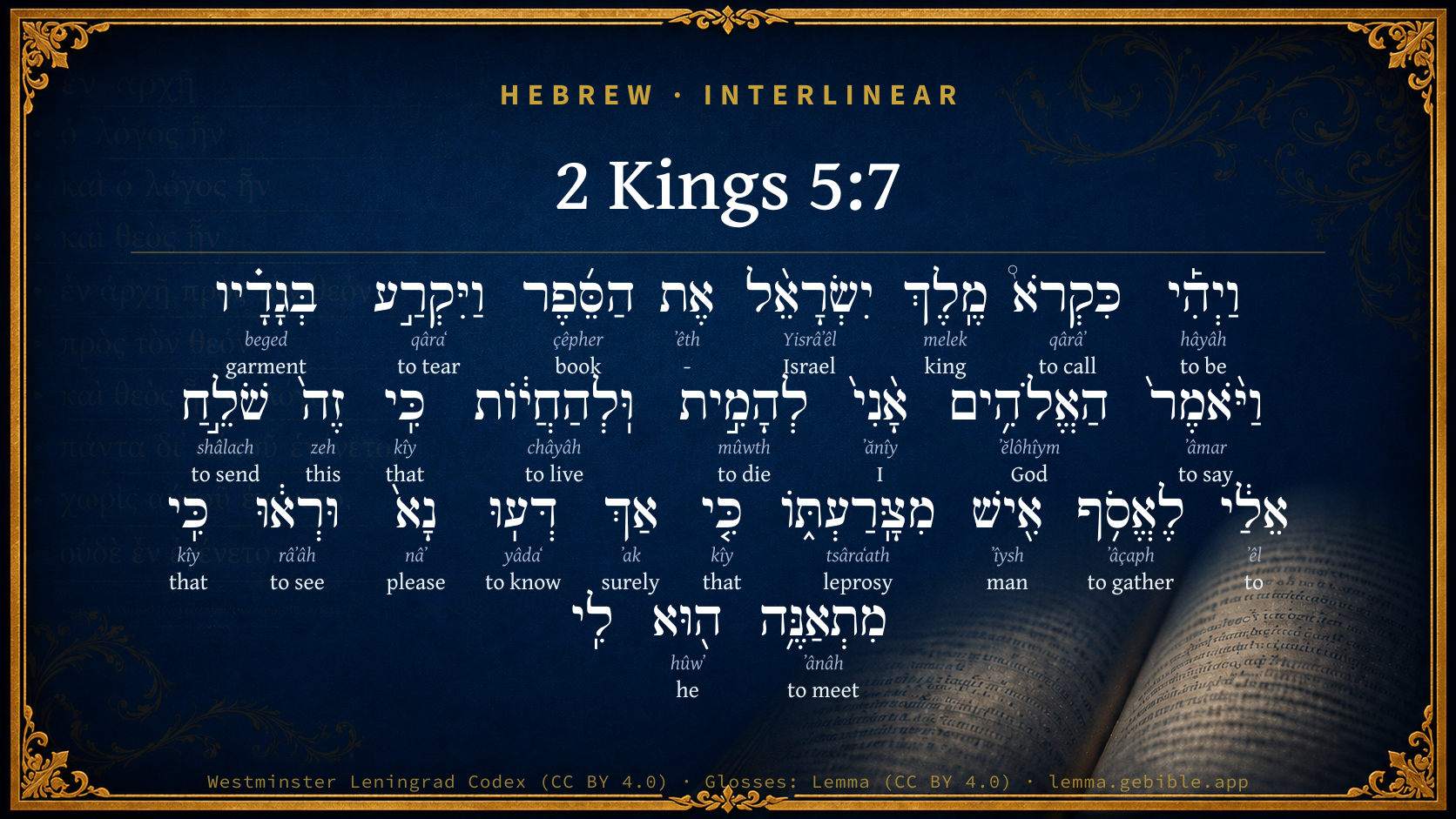
Hebrew (Westminster Leningrad Codex) 2 Kings 5:7 appears in the Hebrew Old Testament. The text above is from the Westminster Leningrad Codex. Each word links to its Strong’s number, a concise gloss, and parsing drawn from the Open Scriptures Hebrew Bible morphology. Click any word for its full Brown-Driver-Briggs (BDB) entry.
Download image
Cite this verse

2 Kings 5:7 (World English Bible). Public Domain. Lemma interlinear Bible study tool, https://lemma.gebible.app/v/2-kings/5/7.

Show BibTeX & RIS
BibTeX
RIS
English Translation
It happened, when the king of Israel had read the letter, that he tore his clothes, and said, Am I God, to kill and to make alive, that this man does send to me to recover a man of his leprosy? but consider, I pray you, and see how he seeks a quarrel against me.
World English Bible · Public Domain
Download a study sheet

One document with this verse’s original text, its word-by-word gloss line, the meaning frame, cross-references with their text, attributed commentary, and full source and license credits — printable, and it pastes into notes with its structure intact.

This verse Autodidact and up

Study sheet (.html) Plain text (.txt)

A passage Seminary Student

Up to 50 verses in one chapter. A passage sheet keeps up to 6 commentary sources and 12 cross-references per verse, in the order this page ranks them, and says so on the sheet whenever that leaves anything out. Ask for a single verse and you get the Autodidact verse sheet above.

Everything on this page stays free to read, with no account — the sheet is a download of what is already on screen, not access to it.

Want to remove ads? Support Godless Engineer
Compare translations 3

The same verse in 3 English versions, stacked beneath the original-language interlinear above. Click any original word for its lexicon entry.

Each is an independent rendering of the whole verse — the interlinear is not word-aligned to these translations.

Highlighted words mark where these versions differ — a whole-verse word diff, not a word-by-word alignment.

  • World English Bible Public Domain
    It happened, when the king of Israel had read the letter, that he tore his clothes, and said, Am I God, to kill and to make alive, that this man does send to me to recover a man of his leprosy? but consider, I pray you, and see how he seeks a quarrel against me.
  • King James Version Public Domain
    And it came to pass, when the king of Israel had read the letter, that he rent his clothes, and said, Am I God, to kill and to make alive, that this man doth send unto me to recover a man of his leprosy? wherefore consider, I pray you, and see how he seeketh a quarrel against me.
  • unfoldingWord Literal Text CC BY-SA 4.0
    And it happened when the king of Israel read the letter that he tore his clothes, and he said, “ I God, killing and making alive, that this is sending to me to remove a man from his leprosy? For surely, please know and see that he is seeking a quarrel with me.”

unfoldingWord Literal Text — © unfoldingWord, licensed CC BY-SA 4.0. Word-aligned USFM3 via Door43 (git.door43.org/unfoldingWord/en_ult).

Versions to compare (up to 4)

3 of 4 selected

Show all 18 translations

Every available English version of this verse, each an independent rendering of the whole verse.

  • World English Bible Public Domain
    It happened, when the king of Israel had read the letter, that he tore his clothes, and said, Am I God, to kill and to make alive, that this man does send to me to recover a man of his leprosy? but consider, I pray you, and see how he seeks a quarrel against me.
  • Berean Standard Bible Public Domain
    When the king of Israel read the letter, he tore his clothes and asked, “Am I God, killing and giving life, that this man expects me to cure a leper? Surely you can see that he is seeking a quarrel with me!”
  • Majority Standard Bible Public Domain
    When the king of Israel read the letter, he tore his clothes and asked, “Am I God, killing and giving life, that this man expects me to cure a leper? Surely you can see that he is seeking a quarrel with me!”
  • King James Version Public Domain
    And it came to pass, when the king of Israel had read the letter, that he rent his clothes, and said, Am I God, to kill and to make alive, that this man doth send unto me to recover a man of his leprosy? wherefore consider, I pray you, and see how he seeketh a quarrel against me.
  • American Standard Version (1901) Public Domain
    And it came to pass, when the king of Israel had read the letter, that he rent his clothes, and said, Am I God, to kill and to make alive, that this man doth send unto me to recover a man of his leprosy? but consider, I pray you, and see how he seeketh a quarrel against me.
  • Revised Version (1885) Public Domain
    And it came to pass, when the king of Israel had read the letter, that he rent his clothes, and said, Am I God, to kill and to make alive, that this man doth send unto me to recover a man of his leprosy? but consider, I pray you, and see how he seeketh a quarrel against me.
  • Geneva Bible (1599) Public Domain
    And when the King of Israel had read the letter, he rent his clothes, and sayde, Am I God, to kill and to giue life, that hee doth send to mee, that I should heale a man from his leprosie? wherfore consider, I pray you, and see howe he seeketh a quarel against me.
  • Douay-Rheims (1899) Public Domain
    And when the king of Israel had read the letter, he rent his garments, and said: Am I God, to be able to kill and give life, that this man hath sent to me, to heal a man of his leprosy? mark, and see how he seeketh occasions against me.
  • Young's Literal Translation Public Domain
    And it cometh to pass, at the king of Israel's reading the letter, that he rendeth his garments, and saith, `Am I God, to put to death and to keep alive, that this `one' is sending unto me to recover a man from his leprosy? for surely know, I pray you, and see, for he is presenting himself to me.'
  • Literal Standard Version CC BY-SA 4.0
    And it comes to pass, at the king of Israel’s reading the letter, that he tears his garments and says, “Am I God, to put to death and to keep alive, that this [one] is sending to me to recover a man from his leprosy? For surely know now, and see, for he is presenting himself to me.”
  • Unlocked Literal Bible CC BY-SA 4.0
    When the king of Israel had read the letter, he tore his clothes and said, “Am I God, to kill and to make alive, that this man wants me to cure a man of his leprosy? It seems he is seeking to start an argument with me.”
  • unfoldingWord Literal Text CC BY-SA 4.0
    And it happened when the king of Israel read the letter that he tore his clothes, and he said, “ I God, killing and making alive, that this is sending to me to remove a man from his leprosy? For surely, please know and see that he is seeking a quarrel with me.”
  • Darby Bible Public Domain
    And it came to pass when the king of Israel had read the letter, that he rent his garments, and said, Am I God, to kill and to make alive, that this man sends to me to cure a man of his leprosy? Wherefore consider, I pray you, and see how he seeks an occasion against me.
  • World Messianic Bible Public Domain
    When the king of Israel had read the letter, he tore his clothes and said, “Am I God, to kill and to make alive, that this man sends to me to heal a man of his leprosy? But please consider and see how he seeks a quarrel against me.”
  • Webster's Bible Public Domain
    And it came to pass, when the king of Israel had read the letter, that he rent his clothes, and said, Am I God, to kill and to make alive, that this man doth send to me to recover a man of his leprosy? wherefore consider, I pray you, and see how he seeketh a quarrel against me.
  • Free Bible Version CC BY-SA 4.0
    When the king of Israel read the letter, he ripped his clothes in panic and said, “Does this man think I'm God, having power over life and death, sending me a leper to heal? Obviously he's just trying to invent an excuse to attack me, as anyone can see!”
  • Bible in Basic English Public Domain
    But the king of Israel, after reading the letter, was greatly troubled and said, Am I God, to give death and life? why does this man send a leper to me to be made well? is it not clear that he is looking for a cause of war?
  • JPS Tanakh (1917) Public Domain
    And it came to pass, when the king of Israel had read the letter, that he rent his clothes, and said: 'Am I God, to kill and to make alive, that this man doth send unto me to recover a man of his leprosy? but consider, I pray you, and see how he seeketh an occasion against me.'

Literal Standard Version (2020), Covenant Press — licensed CC BY-SA 4.0. Text via the HelloAO Bible API (eBible.org). Unlocked Literal Bible (unfoldingWord) — licensed CC BY-SA 4.0. Text via the HelloAO Bible API (eBible.org). unfoldingWord Literal Text — © unfoldingWord, licensed CC BY-SA 4.0. Word-aligned USFM3 via Door43 (git.door43.org/unfoldingWord/en_ult). Free Bible Version, Dr. Jonathan Gallagher — licensed CC BY-SA 4.0. Text via the HelloAO Bible API (eBible.org).

Word by word

More ways to search: Search by grammar → Find every occurrence → Compare this word →

Practice this passage: Drill this verse → Learn its vocabulary →

מִתְאַנֶּ֥ה
ʼânâh
H579
“meeting”
Verb, Hithpael, Participle Active, Masculine, Singular, Absolute
Part of Speech
Verb
Stem
Hithpael
Form
Participle Active
Gender
Masculine
Number
Singular
State
Absolute
Full BDB Definition

Origin: a primitive root [perhaps rather identical with H578 through the idea of contraction in anguish]

TWOT: 126

to meet, encounter, approach, be opportune - (Piel) to allow to meet, cause to meet - (Pual) to be sent, be allowed to meet - (Hithpael) to seek occasion (quarrel), cause oneself to meet
  1. וַיְהִ֡י hâyâh H1961 “and · to be” Conjunction + Verb, Qal, Sequential Imperfect, 3rd Person, Masculine, Singular
  2. כִּקְרֹא֩ qârâʼ H7121 “like/as · to call” Preposition + Verb, Qal, Infinitive Construct
  3. מֶֽלֶךְ melek H4428 “king of” Noun, Common, Masculine, Singular, Construct
  4. יִשְׂרָאֵ֨ל Yisrâʼêl H3478 “Israel” Noun, Proper
  5. אֶת ʼêth H853 “-” Particle, Direct Object
  6. הַסֵּ֜פֶר çêpher H5612 “the · book” Particle, Definite Article + Noun, Common, Masculine, Singular, Absolute
  7. וַיִּקְרַ֣ע qâraʻ H7167 “and · to tear” Conjunction + Verb, Qal, Sequential Imperfect, 3rd Person, Masculine, Singular
  8. בְּגָדָ֗יו beged H899 “garments · his” Noun, Common, Masculine, Plural, Construct + Suffix, Personal, 3rd Person, Masculine, Singular
  9. וַיֹּ֨אמֶר֙ ʼâmar H559 “and · to say” Conjunction + Verb, Qal, Sequential Imperfect, 3rd Person, Masculine, Singular
  10. הַאֱלֹהִ֥ים ʼĕlôhîym H430 “God(s)” Particle, Interrogative + Noun, Common, Masculine, Plural, Absolute
  11. אָ֨נִי֙ ʼănîy H589 “I” Pronoun, Personal, 1st Person, Common, Singular
  12. לְהָמִ֣ית mûwth H4191 “to die” Preposition + Verb, Hiphil, Infinitive Construct
  13. וּֽלְהַחֲי֔וֹת châyâh H2421 “and · to live” Conjunction + Preposition + Verb, Hiphil, Infinitive Construct
  14. כִּֽי kîy H3588 “that” Conjunction
  15. זֶה֙ zeh H2088 “this” Pronoun, Demonstrative, Masculine, Singular
  16. שֹׁלֵ֣חַ shâlach H7971 “sending” Verb, Qal, Participle Active, Masculine, Singular, Absolute
  17. אֵלַ֔י ʼêl H413 “to · me” Preposition + Suffix, Personal, 1st Person, Common, Singular
  18. לֶאֱסֹ֥ף ʼâçaph H622 “to gather” Preposition + Verb, Qal, Infinitive Construct
  19. אִ֖ישׁ ʼîysh H376 “man” Noun, Common, Masculine, Singular, Absolute
  20. מִצָּֽרַעְתּ֑וֹ tsâraʻath H6883 “from · leprosy · his” Preposition + Noun, Common, Feminine, Singular, Construct + Suffix, Personal, 3rd Person, Masculine, Singular
  21. כִּ֤י kîy H3588 “that” Conjunction
  22. אַךְ ʼak H389 “surely” Particle, Accusative
  23. דְּעֽוּ yâdaʻ H3045 “know” Verb, Qal, Imperative, 2nd Person, Masculine, Plural
  24. נָא֙ nâʼ H4994 “please” Particle, Exhortation
  25. וּרְא֔וּ râʼâh H7200 “and · see” Conjunction + Verb, Qal, Imperative, 2nd Person, Masculine, Plural
  26. כִּֽי kîy H3588 “that” Conjunction
  27. ה֖וּא hûwʼ H1931 “he” Pronoun, Personal, 3rd Person, Masculine, Singular

About this verse

These counts appear in no published source. They are computed here, from the morphology-tagged text and Lemma’s own curated glosses. What Lemma adds →

29
words
26
distinct lemmas
Historical
section

Notable vocabulary

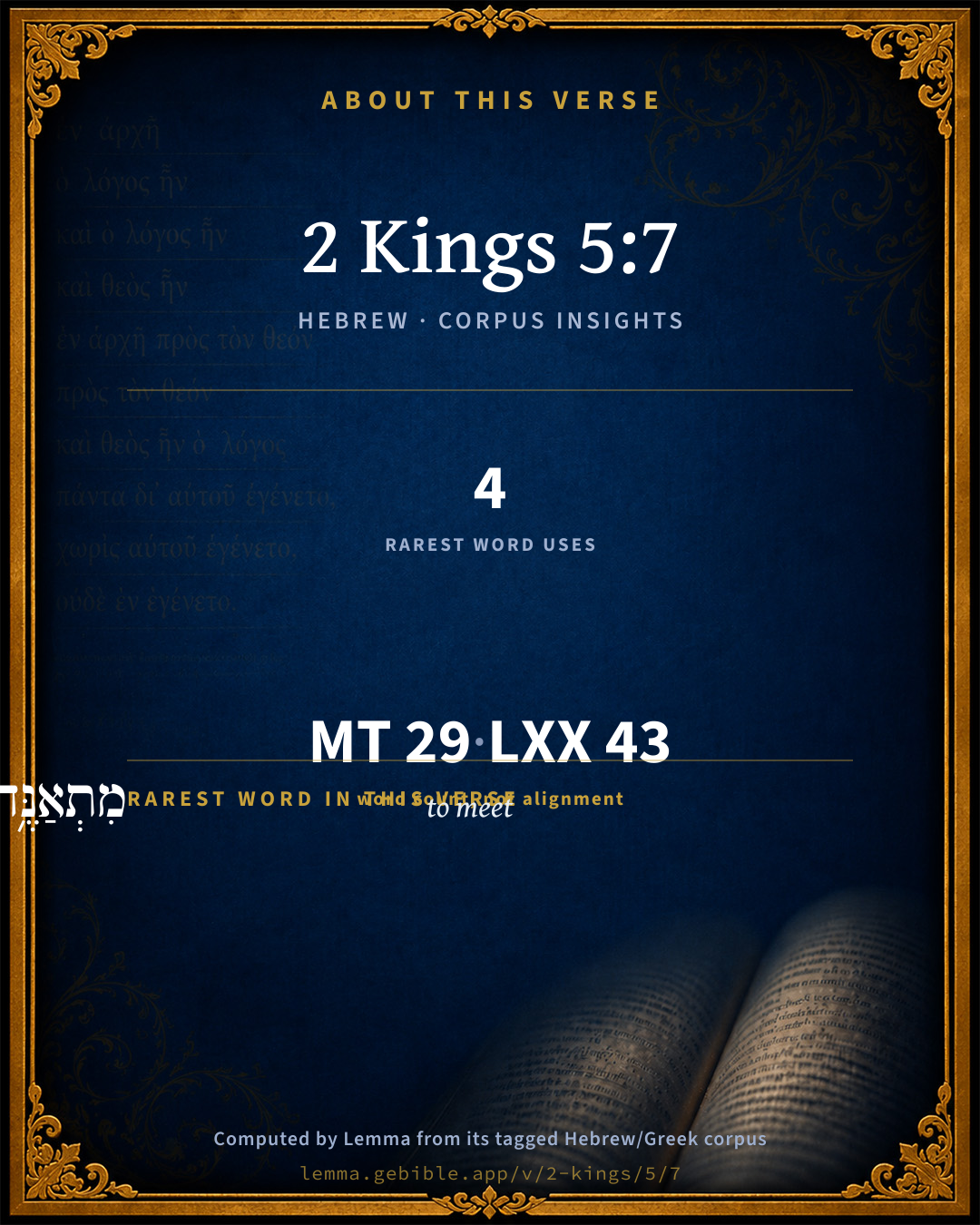
The rarest word here is מִתְאַנֶּ֥ה to meet H579 — appearing just 4 times in the whole Hebrew Bible.

Shared distinctive vocabulary

מִתְאַנֶּ֥ה to meet H579 occurs in 4 verses of the Hebrew Bible. Also found in:

Grammatical profile

  • 11 verbs
  • 7 nouns
  • 3 pronouns
  • 2 prepositions
  • 3 conjunctions
  • 3 particles

Verb forms

  • וַיְהִ֡י Qal · Sequential Imperfect
  • כִּקְרֹא֩ Qal · Infinitive Construct
  • וַיִּקְרַ֣ע Qal · Sequential Imperfect
  • וַיֹּ֨אמֶר֙ Qal · Sequential Imperfect
  • לְהָמִ֣ית Hiphil · Infinitive Construct
  • וּֽלְהַחֲי֔וֹת Hiphil · Infinitive Construct
  • שֹׁלֵ֣חַ Qal · Participle Active
  • לֶאֱסֹ֥ף Qal · Infinitive Construct
  • דְּעֽוּ Qal · Imperative
  • וּרְא֔וּ Qal · Imperative
  • מִתְאַנֶּ֥ה Hithpael · Participle Active

Repetition

A word recurs within this verse — often emphatic in Hebrew:

  • כִּֽי that H3588 ×3

Hebrew & Septuagint length

In English translation the verse runs 55 words from the Hebrew and 57 from the Septuagint (LXX English) — closely comparable.

A rough comparison of the two English renderings, which tokenize alike — not a word-level alignment.

Word counts can differ between the Hebrew and the Greek without any difference in meaning — e.g. the Hebrew direct-object marker אֵת has no separate Greek word, and Greek often adds the article ὁ.

In the original languages it is 29 Hebrew tokens and 43 Greek tokens — but the two are counted differently (Hebrew bundles its prefixes and suffixes into one token; the Greek is in lemma form), so that isn’t a like-for-like length.

Cross-references

14

Topical passages linked to 2 Kings 5:7 in the Treasury of Scripture Knowledge — connected by theme and wording, ordered by reader-vote popularity; previews shown in the World English Bible.

  • 1 Samuel 2:6 Yahweh kills, and makes alive: He brings down to Sheol, and brings up.
  • Genesis 30:2 Jacob's anger was kindled against Rachel, and he said, "Am I in God's place, who has withheld from you the fruit of the womb?"
  • 1 Kings 20:7 Then the king of Israel called all the elders of the land, and said, Please notice how this man seeks mischief: for he sent to me for my wives, and for my children, and for my silver, and for my gold; and I didn't deny him.
  • Deuteronomy 32:39 See now that I, even I, am he, There is no god with me: I kill, and I make alive; I wound, and I heal; There is none who can deliver out of my hand.
  • Daniel 2:11 It is a rare thing that the king requires, and there is no other who can show it before the king, except the gods, whose dwelling is not with flesh.
  • Hosea 6:1 "Come, and let us return to Yahweh; For he has torn us to pieces, And he will heal us; He has injured us, And he will bind up our wounds.
  • Luke 11:54 lying in wait for him, and seeking to catch him in something he might say, that they might accuse him.
  • Numbers 14:6 Joshua the son of Nun and Caleb the son of Jephunneh, who were of those who spied out the land, tore their clothes:
  • Deuteronomy 32:29 Oh that they were wise, that they understood this, That they would consider their latter end!
  • 2 Kings 11:14 and she looked, and, behold, the king stood by the pillar, as the manner was, and the captains and the trumpets by the king; and all the people of the land rejoiced, and blew trumpets. Then Athaliah tore her clothes, and cried, Treason! treason!
  • 2 Kings 18:37–19:1 Then came Eliakim the son of Hilkiah, who was over the household, and Shebna the scribe, and Joah the son of Asaph the recorder, to Hezekiah with their clothes torn, and told him the words of Rabshakeh.
  • Jeremiah 36:24 They were not afraid, nor tore their garments, neither the king, nor any of his servants who heard all these words.
  • Matthew 26:65 Then the high priest tore his clothing, saying, "He has spoken blasphemy! Why do we need any more witnesses? Behold, now you have heard his blasphemy.
  • Acts 14:14 But when the apostles, Barnabas and Paul, heard of it, they tore their clothes, and sprang into the multitude, crying out,

Cross-references courtesy of OpenBible.info (CC BY 4.0).

Hebrew and Greek witnesses Masoretic Hebrew ↔ Greek Septuagint

The same verse in the two great witnesses to the Old Testament, shown verse-for-verse.

These are two independent witnesses, not word-aligned to each other, and the Septuagint is shown in lemma (dictionary) form.

Hebrew 2 Kings 5:7 Masoretic · Westminster Leningrad Codex

וַיְהִ֡י כִּקְרֹא֩ מֶֽלֶךְ יִשְׂרָאֵ֨ל אֶת הַסֵּ֜פֶר וַיִּקְרַ֣ע בְּגָדָ֗יו וַיֹּ֨אמֶר֙ הַאֱלֹהִ֥ים אָ֨נִי֙ לְהָמִ֣ית וּֽלְהַחֲי֔וֹת כִּֽי זֶה֙ שֹׁלֵ֣חַ אֵלַ֔י לֶאֱסֹ֥ף אִ֖ישׁ מִצָּֽרַעְתּ֑וֹ כִּ֤י אַךְ דְּעֽוּ נָא֙ וּרְא֔וּ כִּֽי מִתְאַנֶּ֥ה ה֖וּא לִֽי

It happened, when the king of Israel had read the letter, that he tore his clothes, and said, Am I God, to kill and to make alive, that this man does send to me to recover a man of his leprosy? but consider, I pray you, and see how he seeks a quarrel against me.

World English Bible · Public Domain

Greek LXX 2 Kings 5:7 Septuagint · lemma form

καί γίγνομαι ὡς ἀναγιγνώσκω βασιλεύς ἰσραήλ ὁ βιβλίον διαῥήγνυμι ὁ ἱμάτιον αὐτός καί εἶπον μή θεός ἐγώ ὁ θανατόω καί ζωοποιέω ὅτι οὗτος ἀποστέλλω πρός ἐγώ ἀπο συνἄγω ἀνήρ ἀπό ὁ λέπρα αὐτός ὅτι πλήν γιγνώσκω δή καί ὁράω ὅτι προφασίζω οὗτος ἐγώ

And it came to pass, when the king of Israel read the letter, that he tore his garments, and said, Am I God, to kill and to make alive, that this man sends to me to recover a man of his leprosy? consider, however, I pray you, and see that this man seeks an occasion against me.

LXX2012 (modern English Septuagint) · Public Domain

Hebrew: Westminster Leningrad Codex (CC BY 4.0). Greek: Septuagint (public domain); English from LXX2012 (modern English Septuagint) (Public Domain). How the Septuagint differs from the Hebrew →

Targum (Aramaic paraphrase)

1

The Targum is the ancient Jewish Aramaic paraphrase of the Hebrew Scriptures — an interpretive translation, not the Hebrew text itself. Onkelos (literal) and Pseudo-Jonathan (expansive) render the Torah, and Jonathan the Prophets. Coverage is partial: where no permissively-licensed English translation exists for a verse, only the Aramaic is shown. This is verse-level text, not a word-by-word alignment to the Hebrew.

  1. Targum Jonathan Prophets (Joshua–Malachi)
    וַהֲוָה כַּד קְרָא מַלְכָּא דְיִשְׂרָאֵל יַת אִגַרְתָּא וּבְזַע יַת לְבוּשׁוֹהִי וַאֲמַר הַצְרוֹךְ אִית בִּי מִן קֳדָם יְיָ לְמִקְטַל וּלְאַחָאָה אֲרֵי דֵין שְׁלַח לִי לְאַסָאָה גַבְרָא מִסְגִירוּתֵיהּ אֲרֵי בְרַם דְעוּ כְעַן וַחֲזוֹ אֲרֵי תוּסְקְפָא דֵין בָּעֵי לְאִתְגְרָאָה בִּי:

    (no public-domain English translation for this verse)

    Targum Jonathan — Aramaic: “Mikraot Gedolot” (public domain). English: “Sefaria Community Translation” (CC0 1.0 (public-domain dedication)); “London "Chaldee Paraphrase," 1871” (public domain). Text via Sefaria.

Commentary

Notes on 2 Kings 5:7 from classic Christian and Jewish commentators (each source and its license shown beneath its notes). The classic Christian expositions comment on the surrounding passage and are grouped to its opening verse, so a note may address several verses; the Jewish commentaries on the Tanakh (Rashi and others) are per-verse, so they appear only where the commentator wrote on this verse.

Lemma curates 59 commentaries, every one of them public domain or Creative Commons licensed, each selected and text-cleaned for this edition rather than reprinted as found. About our sources →

Trapp's Complete Commentary

John Trapp

2Ki 5:7 And it came to pass, when the king of Israel had read the letter, that he rent his clothes, and said, [Am] I God, to kill and to make alive, that this man doth send unto me to recover a man of his leprosy? wherefore consider, I pray you, and see how he seeketh a quarrel against me.

Ver. 7. He rent his clothes.] As apprehending it to be blasphemy, and deeply detesting such an impiety. Meanwhile he never thought of Elisha, who was better known and more regarded abroad than at home.

See how he seeketh a quarrel.] This troubled Jehoram more than the blasphemy, whatever he pretended. This Benhadad who wrote the letter, was he who slew Ahab at Ramothgilead, {1Ki 22:35; 1Ki 22:37} who besieging Samaria, brought it to that extreme famine, {2Ki 6:24-25} and afterwards at Ramothgilead wounded this Jehoram. {2Ki 8:28-29}

John Trapp, A Commentary or Exposition upon All the Books of the Old and New Testament (1647–1656) — public domain. Text from a community e-Sword module.

Joseph Benson's Commentary

2Ki 5:7. The king of Israel rent his clothes — Either as one in great affliction and trouble, or because he looked upon it as blasphemy, to ascribe that power to him which belonged to God alone. Am I God, to kill and make alive? — He expresses himself thus, because the leprosy is a kind or degree of death, Num 12:12; and he thought it as impossible to cure it as to raise the dead. Every body can kill; but when a person is killed, to make him alive again is the work only of the Almighty. See how he seeketh a quarrel against me — For not doing what he requires, which he knows to be impossible for me to do. Though he had seen what miracles Elisha had done, yet he either had forgot them, or thought this to be beyond his power. Or, it may be, he was loath to see still further demonstration of his power with God, and therefore did not send to him on this occasion.

Joseph Benson's Commentary on the Old and New Testaments (1811–1818) — public domain. Text from a community e-Sword module.

Tyndale Open Study Notes

Tyndale Open Resources

5:7 tore his clothes: This action was often a sign of intense agitation (11:4), grief (Gen 37:34; 2 Sam 13:31), or sorrow (2 Kgs 6:30; Job 1:20; 2:12). Due to the perennial distrust and hostilities between the Arameans and the Israelites, Joram assumed that the Aramean king was trying to pick a fight, as had occurred in the days of his father Ahab (1 Kgs 20:1-12).

Tyndale Open Study Notes — © Tyndale Open Resources, licensed CC BY-SA 4.0. Text via the HelloAO Bible API.

Jamieson, Fausset & Brown

Robert Jamieson, A. R. Fausset & David Brown

when the king of Israel had read the letter, that he rent his clothes--According to an ancient practice among the Eastern people, the main object only was stated in the letter that was carried by the party concerned, while other circumstances were left to be explained at the interview. This explains Jehoram's burst of emotion--not horror at supposed blasphemy, but alarm and suspicion that this was merely made an occasion for a quarrel. Such a prince as he was would not readily think of Elisha, or, perhaps, have heard of his miraculous deeds.

Jamieson, Fausset & Brown — Commentary Critical and Explanatory on the Whole Bible (1871) — public domain (CC PDM 1.0). Text via the HelloAO Bible API.

Adam Clarke's Commentary

Verse 7. Am I God, to kill and to make alive] He spoke thus under the conviction that God alone could cure the leprosy; which, indeed, was universally acknowledged: and must have been as much a maxim among the Syrians as among the Israelites, for the disorder was equally prevalent in both countries; and in both equally incurable. See the notes on Leviticus 13 and 14. And it was this that led the king of Israel to infer that the Syrian king sought a quarrel with him, in desiring him to do a work which God only could do; and then declaring war upon him because he did not do it.

Adam Clarke's Commentary on the Bible (1810–1826) — public domain. Text from a community e-Sword/MySword module.

Ellicott's Commentary for English Readers

(7) He rent his clothes.—As if he had heard blasphemy. (Comp. Mat_26:65.)

Am I God, to kill and to make alive?—Deu_32:39, “I kill, and I make alive;” 1Sa_2:6, “The Lord killeth, and maketh alive.” Leprosy was a kind of living death. (Comp. Num_12:12, Heb., “Let her not become as the dead, who, when he cometh forth of his mother’s womb, hath half his flesh consumed.”)

Wherefore.—Heb., For only know (i.e., notice), and see. Plural verbs are used, because the king is addressing his grandees, in whose presence the letter would be delivered and read.

He seeketh a quarrel.—This form of the verb (hithpael) occurs here only. (Comp. the noun, Jdg_14:4.) Jehoram was hardly in a position to renew the war, after the severe defeat of his father (1Ki_22:30, seq.).

A Bible Commentary for English Readers, edited by Charles John Ellicott (1878–1897) — public domain. Text from a community e-Sword module.

The Cambridge Bible for Schools and Colleges

gen. ed. J. J. S. Perowne

7. that he rent his clothes] Sometimes the act was a sign of grief as in 2Ki_2:12 above and Gen_37:29; sometimes as here, of horror and alarm. Cf. also 2Ki_18:36; Ezr_9:3; Jer_36:24.

to kill and to make alive] The disease of leprosy was incurable, and so the request that it should be cured was such as the author of life alone could grant. Cf. for the language Deu_32:39, ‘I, even I, am he, and there is no god with me, I kill and I make alive’. So also in Hannah’s song (1Sa_2:6). This is a power that belongs to God only.

doth send unto me] The knowledge of Elisha’s mighty acts must have been less before the mind of the king than of his subjects, or he would not have failed to see that the request might be granted by God through his prophet. ‘Himself with the two other kings had been eyewitnesses of what Elisha could do, yet now the calves of Dan and Bethel have so often taken up his heart that there is no room for the memory of Elisha. Whom he sued to in his extremity, now his prosperity hath forgotten. Carnal hearts when need drives them can think of God and his prophet: when their turn is served, can as utterly forget them as if they were not’ (Bp Hall).

he seeketh a quarrel against me] The verb, in this form and sense, only occurs here, but the cognate noun in the sense of ‘an occasion of quarrel’ is found Jdg_14:4. Hence the R.V. has put ‘occasion’ on the margin. It is only the one who feels his superiority that ventures on seeking a quarrel, and from the timid words of Jehoram we may conclude that he thought the Syrians more than a match for him; as was only natural, since they had defeated his father at Ramoth-Gilead not long before. He dreaded a renewal of such a conflict.

The Cambridge Bible for Schools and Colleges (gen. ed. J. J. S. Perowne; Cambridge University Press, 1878–1918) — public domain. Text from a community e-Sword module.

John Gill's Exposition

And it came to pass, when the king of Israel had read the letter, that he rent his clothes,.... As one in great distress, being thrown into perplexity of mind by it, not knowing what to do; or, as some think, at the blasphemy he supposed to be in it, requiring that of him which only God could do:

and said, am I God, to kill and to make alive; or have the power of life and death, which only belongs to the Supreme Being:

that this man doth send unto me to recover a man of his leprosy; for a leper was reckoned as one dead, his disease incurable, his flesh upon him being mortified by it, see Num 12:12 and therefore not supposed to be in the power of man, only of God, to cure; and therefore, in Israel, none had anything to do with the leper but the priest, in the name of God:

wherefore consider, I pray you, and see how he seeketh a quarrel against me; to pick a quarrel with him, in order to go to war with him as he supposed. This seems to have been spoken to his lords and courtiers about him.

John Gill's Exposition of the Whole Bible (1746–1763) — public domain (CC PDM 1.0). Text via the HelloAO Bible API.

Albert Barnes' Notes on the Bible

He rent his clothes - The action indicated alarm and terror quite as much as sorrow 2Sa 13:19; Ezr 9:3; 2Ch 34:27; Jer 36:22.

Consider, I pray you - Jehoram speaks to his chief officers, and bids them mark the animus of the Syrian monarch. Compare the conduct of Ahab 1Ki 20:7.

Albert Barnes' Notes on the Bible (1834–1885) — public domain. Text from a community e-Sword/MySword module.

Haydock's Catholic Bible Commentary

Leprosy. The cure was deemed very difficult; as it generally kept gaining ground, and destroyed the constitution. See Numbers xii. 12., and Isaias liii 4. (Calmet) --- Me. The letter was, in effect, written in a haughty style, (Menochius) and the king might naturally infer that war would be the consequence. (Haydock)

George Leo Haydock (1774–1849), Haydock's Catholic Family Bible and Commentary, 1859 edition — public domain. Excludes Psalms (Douay-Rheims chapter numbering differs from Protestant) and Deuterocanonical books (Catholic canon only).

Matthew Poole's English Annotations

He rent his clothes; either in detestation of his blasphemy, in giving God’s perfections to him; or rather, for grief arising from a suspicion and fear that the Syrian made this only a pretence for the war which he designed against him.

I God, to kill and to make alive? he expresseth it thus, because leprosy is a kind or degree of death, Num 12:12, and he thought it as impossible to cure it as to raise the dead.

See how he seeketh a quarrel against me, for not doing what he requires, which he knows impossible for me to do.

Matthew Poole's English Annotations on the Holy Bible (1683–1685) — public domain. Text from a community e-Sword/MySword module.

Whedon's Commentary on the Bible

Daniel D. Whedon

7. Am I God — As much as to say: Who but God can cure the leprosy? Who but He who has all power over human life? In his unbelief and carelessness Jehoram had forgotten that there was a man in his kingdom through whom God worked miracles.

Seeketh a quarrel — Jehoram fails to see the hand of God in all this; his worldly spirit discerns only a stratagem to break the peace between the two nations. He imagines Ben-hadad will ask an impossible thing of him, and then, because he cannot work a miracle for him, will war against him. His obtuseness is equal to Ben-hadad’s ignorance.

Daniel D. Whedon (gen. ed.), Commentary on the Old and New Testaments (1874–1909) — public domain. Text from a community e-Sword module.

The Pulpit Commentary

And it came to pass, when the King of Israel had read the letter, that he rent his clothes. In horror and alarm. (comp. 2Ch_34:27; Ezr_9:3; Jer_36:24) He concluded that once more (see 1Ki_20:7) the Syrian monarch was determined to find a ground of quarrel, and had therefore sent to him an impossible request. And said, Am I God, to kill and to make alive? To "kill" and to "make alive" were familiar expressions in the mouth of the Israelites to designate omnipotence (see Deu_32:39; 1Sa_2:6) Recovering from leprosy was equivalent to making alive, for a leprous person was "as one dead" (Num_12:12) according to Hebrew notions. That this man doth send unto me to recover a man of his leprosy. The king evidently does not bethink himself of Elisha, of whose great miracle of raising the dead to life (2Ki_4:35-36) he may not up to this time have heard. Elisha"s early miracles were mostly wrought with a certain amount of secrecy. Wherefore consider, I pray you, and see how he seeketh a quarrel against me. The king misjudged Benhadad, but not without some grounds of reason, if he was ignorant of Elisha"s miraculous gifts. Benhadad, when seeking a ground of quarrel with Ahab, had made extravagant requests. (see 1Ki_20:3-6)

The Pulpit Commentary (1880–1919), ed. H.D.M. Spence-Jones & Joseph S. Exell — public domain. Text from a community e-Sword module.

Kretzmann's Popular Commentary

Paul E. Kretzmann

The Healing of Naaman

v. 8. And it was so, when Elisha, the man of God, had heard that the king of Israel had rent his clothes, being in despair on account of the apparently impossible feat which was expected of him, that he sent to the king, saying, Wherefore hast thou rent thy clothes? in his opinion an act of foolish fear. Let him come now to me, and he shall know that there is a prophet in Israel, a servant of the true and almighty God.

v. 9. So Naaman came with his horses and with his chariot, with his entire retinue, and stood at the door of the house of Elisha, too proud, as it seems, to enter the poor hut, but expecting the prophet to deal with him in a manner befitting his rank.

v. 10. And Elisha, utterly unimpressed by the show of wealth and power, sent a messenger unto him, saying, Go and wash in Jordan seven times, and thy flesh shall come again to thee, return to the former state of firmness and health, and thou shalt be clean. From this Naaman was to learn that his healing would not be a matter of magic nor dependent upon the person of Elisha, but that it was a free gift of the God of Israel.

v. 11. But Naaman was wroth, which shows in what state of mind he had come to Samaria, as the proud general demanding aid, not as a suppliant pleading for help, and went away, and said, Behold, I thought, He will surely come out to me, and stand, and call on the name of the Lord, his God, and strike his hand over the place, moving it back and forth over the infected spot with a gesture of conjuring, and recover the leper. He thought such religious ceremonies, together with some application of magic, were essential, especially in his case.

v. 12. Are not Abana (or Amana) and Pharpar, mountain streams with clear, fresh water, rivers of Damascus, better than all the waters of Israel? May I not wash in them and be clean? He thought the cure consisted in the removal of the filth in the flesh by the outward application of water. So he turned and went away in a rage.

v. 13. And his servants came near, and spake unto him, and said, My father, an address at the same time intimate and respectful, if the prophet had bid thee do some great thing, something particularly difficult to perform, wouldest thou not have done it? How much rather, then, when he saith to thee, Wash and be clean?

v. 14. Then went he down, from the hill on which Samaria was situated, and dipped himself seven times in Jordan, according to the saying of the man of God, the number seven being the signature of the works of God; and his flesh came again, it was restored to its full healthy condition,like unto the flesh of a little child, and he was clean.

v. 15. And he returned to the man of God, to Samaria, he and all his company, and came and stood before him. And he said, in the conviction which had been forced upon him by his recent experiences, Behold, now I know that there is no God in all the earth but in Israel, faith in the true God had been wrought in his heart. Now, therefore, I pray thee, take a blessing of thy servant, in the form of a rich present.

v. 16. But he said, As the Lord liveth, before whom I stand, as His humble and devoted servant, I will receive none. And he urged him to take it; but he refused, not wishing to have even the suspicion of selfishness and of seeking personal gain resting upon him.

v. 17. And Naaman said, in a humble tone, which contrasted strangely with his former overbearing behavior, Shall there not, then, I pray thee, be given to thy servant two mules’ burden of earth? For thy servant will henceforth offer neither burnt offering nor sacrifice unto other gods, but unto the Lord. He did not ascribe magical powers to the soil of Israel, but wanted his act of building an altar from this earth to he a confession of his faith in Jehovah.

v. 18. In this thing the Lord pardon thy servant, that when my master goeth into the house of Rimmon, the chief idol of Syria, to worship there, and he leaneth on my hand, and I bow myself in the house of Rimmon, namely, while assisting the king in his act of worship: when I bow down myself in the house of Rimmon, not in personal worship, but in serving his master, the Lord pardon thy servant in this thing. He freely confessed this scruple of a tender conscience, in order not to have it appear that he was denying the Lord whom he now had so openly accepted.

v. 19. a. And he, Elisha, said unto him, Go in peace. We see from this entire story, first, that the Lord demands simple and absolute obedience to His Word; secondly, that He had mercy. also upon the poor heathen; and finally, that He expects us to watch very carefully lest we become partakers of other men’s sins.

Paul E. Kretzmann, Popular Commentary of the Bible (1921–1924) — public domain. Text from a community e-Sword module.

unfoldingWord translationNotes

Door43 World Missions Community

he tore his clothes

Often people would rip their clothes if they were in great distress. AT: "he ripped his clothes to show his distress" (See: Symbolic Action)

Am I God, to kill and to make alive, that this man wants me to cure a man of his leprosy?

The king uses this rhetorical question to emphasize that the request of the king of Aram is outrageous and something he cannot do. This can be written as a statement. AT: "The king of Aram must think I am some sort of God, with the power over death and life! He wants me to cure this man of his leprosy, but I cannot do that." (See: Rhetorical Question)

It seems he is seeking to start an argument with me

The king of Israel did not believe the request to heal Naamam was the real reason for the letter. He thought the real reason was to start a fight. AT: "It seems he is looking for an excuse to start a fight with me" (See: Assumed Knowledge and Implicit Information)

translationWords

God

life

leper

unfoldingWord translationNotes — © Distant Shores Media and the Door43 World Missions Community, licensed CC BY-SA 4.0. Source: git.door43.org/Door43/en_tn.

Rashi

Rabbi Shlomo Yitzchaki (Rashi)

“Am I God?” The [first] ‘ה’ is voweled with a ‘פתח’ to indicate that it is a question.

He is looking for an excuse. He is looking for a pretext to attack me. He is looking for an excuse.

[מִתְאַנֶּה is] an expression of “false accusation [=עֲלִילוֹת דְּבָרִים].”

Rashi on the Tanakh — English translations: “The Judaica Press complete Tanach with Rashi, translated by A. J. Rosenberg” (CC BY 4.0); “Pentateuch with Rashi's commentary by M. Rosenbaum and A.M. Silbermann, 1929-1934” (public domain); “The Metsudah Tanach series, Lakewood, N.J” (CC BY 4.0); and “The Book of Joshua, Metsudah Publications, 1997” (CC BY 4.0). Text via Sefaria.

Lesson kit

Teaching starters — assembled from the data on this page, not authored interpretation. Every prompt links to the verse data it draws on. Edit before teaching.

2 Kings, in the Historical, opens this verse with 29 words (26 distinct Hebrew lemmas). Its most distinctive word is ʼânâh (“to meet”). A historical commentator’s framing appears above. Read the whole chapter for the surrounding context.

Discussion questions

  1. How does “to meet” (ʼânâh) shape what this verse is saying?
  2. Exodus 21:13 shares the word «to meet» with this verse. How do the two illuminate each other?
  3. “that” occurs 3× in this one verse. What is the effect of the repetition?
  4. The translations on this page render this verse differently — a whole-verse word diff, not a word-by-word alignment. What might account for the different wordings?
  5. The verb «וַיְהִ֡י» is Qal Sequential Imperfect. How does its form color the action?
  6. Reading how Trapp's Complete Commentary and Joseph Benson's Commentary read this verse, where do the two commentators agree and where do they part?

Things to notice

Reading settings

Reading text

Shown beneath each verse's original-language words.

Old Testament
Old Testament edition

Read the OT as the Masoretic Hebrew (MT) or the Greek Septuagint (LXX).

English shown for the Greek Septuagint (in the Hebrew ↔ Greek comparison).

Comparing translations? Open the Compare panel on any verse page to stack up to four side by side.