
Psalms 119:107

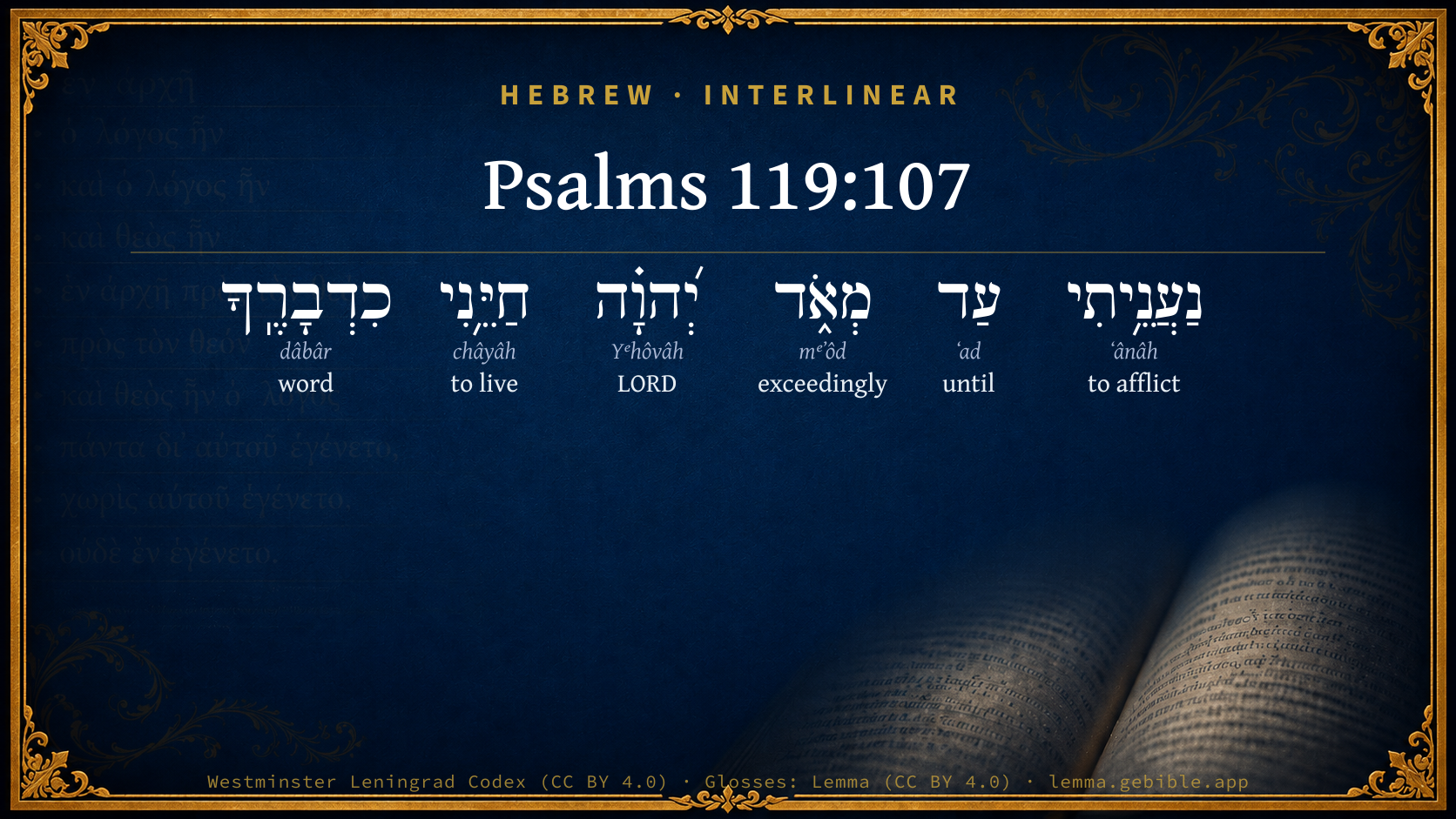
Hebrew (Westminster Leningrad Codex) Psalms 119:107 appears in the Hebrew Old Testament. The text above is from the Westminster Leningrad Codex. Each word links to its Strong’s number, a concise gloss, and parsing drawn from the Open Scriptures Hebrew Bible morphology. Click any word for its full Brown-Driver-Briggs (BDB) entry.
Download image
Cite this verse

Psalms 119:107 (World English Bible). Public Domain. Lemma interlinear Bible study tool, https://lemma.gebible.app/v/psalms/119/107.

Show BibTeX & RIS
BibTeX
RIS
English Translation
I am afflicted very much. Revive me, Yahweh, according to your word.
World English Bible · Public Domain
Download a study sheet

One document with this verse’s original text, its word-by-word gloss line, the meaning frame, cross-references with their text, attributed commentary, and full source and license credits — printable, and it pastes into notes with its structure intact.

This verse Autodidact and up

Study sheet (.html) Plain text (.txt)

A passage Seminary Student

Up to 50 verses in one chapter. A passage sheet keeps up to 6 commentary sources and 12 cross-references per verse, in the order this page ranks them, and says so on the sheet whenever that leaves anything out. Ask for a single verse and you get the Autodidact verse sheet above.

Everything on this page stays free to read, with no account — the sheet is a download of what is already on screen, not access to it.

Want to remove ads? Support Godless Engineer
Compare translations 3

The same verse in 3 English versions, stacked beneath the original-language interlinear above. Click any original word for its lexicon entry.

Each is an independent rendering of the whole verse — the interlinear is not word-aligned to these translations.

Highlighted words mark where these versions differ — a whole-verse word diff, not a word-by-word alignment.

  • World English Bible Public Domain
    I am afflicted very much. Revive me, Yahweh, according to your word.
  • King James Version Public Domain
    I am afflicted very much: quicken me, O LORD, according unto thy word.
  • unfoldingWord Literal Text CC BY-SA 4.0
    I have been afflicted exceedingly; Yahweh, revive me according to your word.

unfoldingWord Literal Text — © unfoldingWord, licensed CC BY-SA 4.0. Word-aligned USFM3 via Door43 (git.door43.org/unfoldingWord/en_ult).

Versions to compare (up to 4)

3 of 4 selected

Show all 17 translations

Every available English version of this verse, each an independent rendering of the whole verse.

  • World English Bible Public Domain
    I am afflicted very much. Revive me, Yahweh, according to your word.
  • Berean Standard Bible Public Domain
    I am severely afflicted, O LORD; revive me through Your word.
  • Majority Standard Bible Public Domain
    I am severely afflicted, O LORD; revive me through Your word.
  • King James Version Public Domain
    I am afflicted very much: quicken me, O LORD, according unto thy word.
  • American Standard Version (1901) Public Domain
    I am afflicted very much: Quicken me, O Jehovah, according unto thy word.
  • Revised Version (1885) Public Domain
    I am afflicted very much: quicken me, O LORD, according unto thy word.
  • Geneva Bible (1599) Public Domain
    I am very sore afflicted: O Lord, quicken me according to thy word.
  • Young's Literal Translation Public Domain
    I have been afflicted very much, O Jehovah, quicken me, according to Thy word.
  • Literal Standard Version CC BY-SA 4.0
    I have been afflicted very much, || O YHWH, quicken me, according to Your word.
  • Unlocked Literal Bible CC BY-SA 4.0
    I am very afflicted; keep me alive, Yahweh, as you have promised in your word.
  • unfoldingWord Literal Text CC BY-SA 4.0
    I have been afflicted exceedingly; Yahweh, revive me according to your word.
  • Darby Bible Public Domain
    I am afflicted very much; O Jehovah, quicken me according to thy word.
  • World Messianic Bible Public Domain
    I am afflicted very much. Revive me, LORD, according to your word.
  • Webster's Bible Public Domain
    I am afflicted very much: revive me, O LORD, according to thy word.
  • Free Bible Version CC BY-SA 4.0
    Lord, I'm really suffering! Please let me live, as you have promised.
  • Bible in Basic English Public Domain
    I am greatly troubled, O Lord, give me life in keeping with your word.
  • JPS Tanakh (1917) Public Domain
    I am afflicted very much; quicken me, O LORD, according unto Thy word.

Literal Standard Version (2020), Covenant Press — licensed CC BY-SA 4.0. Text via the HelloAO Bible API (eBible.org). Unlocked Literal Bible (unfoldingWord) — licensed CC BY-SA 4.0. Text via the HelloAO Bible API (eBible.org). unfoldingWord Literal Text — © unfoldingWord, licensed CC BY-SA 4.0. Word-aligned USFM3 via Door43 (git.door43.org/unfoldingWord/en_ult). Free Bible Version, Dr. Jonathan Gallagher — licensed CC BY-SA 4.0. Text via the HelloAO Bible API (eBible.org).

Word by word

More ways to search: Search by grammar → Find every occurrence → Compare this word →

Practice this passage: Drill this verse → Learn its vocabulary →

נַעֲנֵ֥יתִי
ʻânâh
H6031
“to afflict”
Verb, Niphal, Perfect, 1st Person, Common, Singular
Part of Speech
Verb
Stem
Niphal
Form
Perfect
Person
1st Person
Gender
Common
Number
Singular
Full BDB Definition

Origin: a primitive root [possibly rather ident. with H6030 through the idea of looking down or browbeating]

TWOT: 1651 , 1652

(Qal) to be occupied, be busied with - to afflict, oppress, humble, be afflicted, be bowed down - (Qal) - to be put down, become low - to be depressed, be downcast - to be afflicted - to stoop - (Niphal) - to humble oneself, bow down - to be afflicted, be humbled - (Piel) - to humble, mishandle, afflict - to humble, be humiliated - to afflict - to humble, weaken oneself - (Pual) - to be afflicted - to be humbled - (Hiphil) to afflict - (Hithpael) - to humble oneself - to be afflicted
  1. עַד ʻad H5704 “until” Preposition
  2. מְאֹ֑ד mᵉʼôd H3966 “exceedingly” Adverb
  3. יְ֝הוָ֗ה Yᵉhôvâh H3068 “LORD” Noun, Proper
  4. חַיֵּ֥נִי châyâh H2421 “live · me” Verb, Piel, Imperative, 2nd Person, Masculine, Singular + Suffix, Personal, 1st Person, Common, Singular
  5. כִדְבָרֶֽךָ dâbâr H1697 “like/as · word · your” Preposition + Noun, Common, Masculine, Singular, Construct + Suffix, Personal, 2nd Person, Masculine, Singular

About this verse

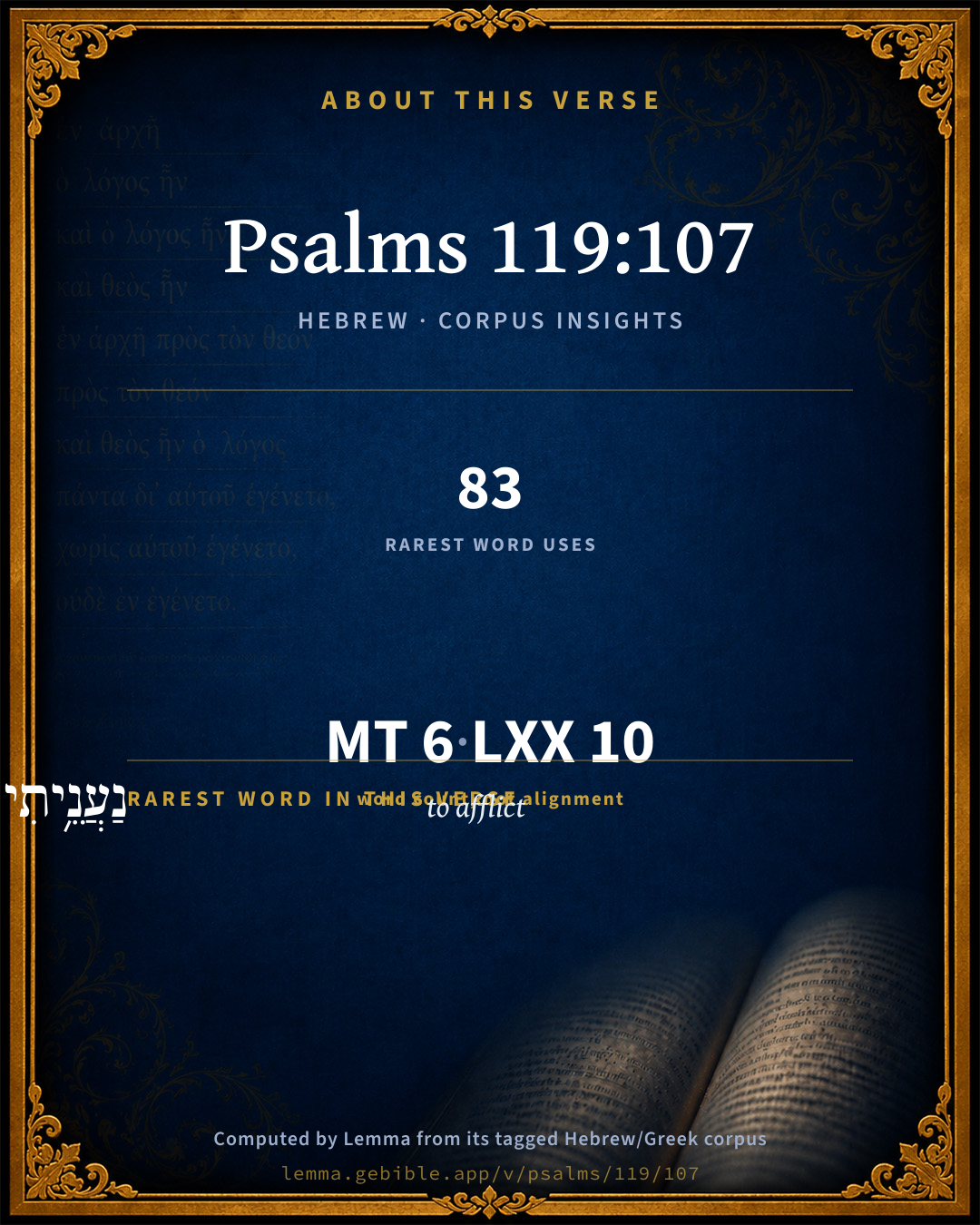
These counts appear in no published source. They are computed here, from the morphology-tagged text and Lemma’s own curated glosses. What Lemma adds →

6
words
6
distinct lemmas
Wisdom
section

Grammatical profile

  • 2 verbs
  • 2 nouns
  • 1 preposition
  • 1 adverb

Verb forms

  • נַעֲנֵ֥יתִי Niphal · Perfect
  • חַיֵּ֥נִי Piel · Imperative

Hebrew & Septuagint length

In English translation the verse runs 12 words from the Hebrew and 14 from the Septuagint (LXX English) — closely comparable.

A rough comparison of the two English renderings, which tokenize alike — not a word-level alignment.

Word counts can differ between the Hebrew and the Greek without any difference in meaning — e.g. the Hebrew direct-object marker אֵת has no separate Greek word, and Greek often adds the article ὁ.

In the original languages it is 6 Hebrew tokens and 10 Greek tokens — but the two are counted differently (Hebrew bundles its prefixes and suffixes into one token; the Greek is in lemma form), so that isn’t a like-for-like length.

Cross-references

6

Topical passages linked to Psalms 119:107 in the Treasury of Scripture Knowledge — connected by theme and wording, ordered by reader-vote popularity; previews shown in the World English Bible.

  • Psalms 34:19 Many are the afflictions of the righteous, But Yahweh delivers him out of them all.
  • Psalms 143:11 Revive me, Yahweh, for your name's sake. In your righteousness, bring my soul out of trouble.
  • Psalms 119:25 My soul is laid low in the dust. Revive me according to your word!
  • Psalms 22:14–18 I am poured out like water. All my bones are out of joint. My heart is like wax; It is melted within me.
  • Psalms 119:88 Preserve my life according to your loving kindness, So I will obey the statutes of your mouth.
  • Psalms 6:1 Yahweh, don't rebuke me in your anger, Neither discipline me in your wrath.

Cross-references courtesy of OpenBible.info (CC BY 4.0).

Hebrew and Greek witnesses Masoretic Hebrew ↔ Greek Septuagint

The same verse in the two great witnesses to the Old Testament, shown verse-for-verse.

You’re reading Greek Psalm 118 (Hebrew Psalm 119). The Septuagint counts the superscription, so verse numbers can differ from the Hebrew — chapter-level alignment, not verse-by-verse. Numbering follows Rahlfs.

These are two independent witnesses, not word-aligned to each other, and the Septuagint is shown in lemma (dictionary) form.

Hebrew Psalms 119:107 Masoretic · Westminster Leningrad Codex

נַעֲנֵ֥יתִי עַד מְאֹ֑ד יְ֝הוָ֗ה חַיֵּ֥נִי כִדְבָרֶֽךָ

I am afflicted very much. Revive me, Yahweh, according to your word.

World English Bible · Public Domain

Greek LXX Greek Psalm 118:107 Septuagint · lemma form

ταπεινόω ἕως σφόδρα κύριος ζάω ἐγώ κατά ὁ λόγος σύ

I have been very greatly afflicted, O Lord: quicken me, according to your word.

LXX2012 (modern English Septuagint) · Public Domain

Hebrew: Westminster Leningrad Codex (CC BY 4.0). Greek: Septuagint (public domain); English from LXX2012 (modern English Septuagint) (Public Domain). How the Septuagint differs from the Hebrew →

Commentary

Notes on Psalms 119:107 from classic Christian and Jewish commentators (each source and its license shown beneath its notes). The classic Christian expositions comment on the surrounding passage and are grouped to its opening verse, so a note may address several verses; the Jewish commentaries on the Tanakh (Rashi and others) are per-verse, so they appear only where the commentator wrote on this verse.

Lemma curates 59 commentaries, every one of them public domain or Creative Commons licensed, each selected and text-cleaned for this edition rather than reprinted as found. About our sources →

Trapp's Complete Commentary

John Trapp

Psa 119:107 I am afflicted very much: quicken me, O LORD, according unto thy word.

Ver. 107. I am adflicted very much] Usque valde, extremely. If David be so fully bent to obey God, he shall have troubles great store; 1Ti 3:12, All that will live godly, and are set upon it, shall suffer persecution. Zeal for Christ draweth troubles to itself, as the wind Caecias doth clouds.

Quicken me, O Lord, according unto thy word] Help me to keep my promise, to perform mine oath, notwithstanding these troubles growing upon me. A vow made without prayer is never kept.

John Trapp, A Commentary or Exposition upon All the Books of the Old and New Testament (1647–1656) — public domain. Text from a community e-Sword module.

The Biblical Illustrator

Joseph S. Exell

Psa_119:107

I am afflicted very much: quicken me, O Lord, according unto Thy Word.

A common condition and an indispensable blessing

I. A condition that is common to man. How varied the afflictions of men, personal and social, physical and mental--disease, poverty, bereavement, oppression, etc. Our human afflictions may be divided into two classes.

1. The penal. All the sufferings of wicked men come on them as righteous punishment.

2. Disciplinary. To the genuine disciples of Christ afflictions are the chastisements of the Father.

II. A blessing that is indispensable to man. The quickening of the spiritual nature, the soul.

1. In faith. Faith in God.

2. In love. Supreme love to the supremely good.

3. In hope. Hope for a complete transformation into the image of his God. (Homilist.)

The Biblical Illustrator, edited by Joseph S. Exell (c. 1880s–1900s) — public domain. Text from a community e-Sword module.

J. A. Alexander on Psalms

Joseph Addison Alexander

107. (Psa 119:107) I am afflicted even to extremity; Jehovah, quicken me according to its thy word. That the first clause does not relate merely to past sufferings (I was afflicted), seems to follow from the prayer in the last clause, which may, however, be understood as a petition for deliverance from the deadening effects of a calamity already past, such as the Babylonish exile, the enfeebling influence of which, notwithstanding incidental benefits, continued to be felt for ages. The first verb in Hebrew, with the idea of suffering, always suggests that of humiliation. Even to extremity, the same words that occur above, in Psa 119:8; Psa 119:43; Psa 119:51. The meaning of the last clause is, bestow upon me that life which is promised in the Law to those who keep it. See Lev 18:5, Deu 6:24.

Joseph Addison Alexander, The Psalms Translated and Explained (1850) — public domain. Text from a community e-Sword module.

Matthew Henry's Commentary

Here is, 1. The representation David makes of the sorrowful condition he was in: I am afflicted very much, afflicted in spirit; he seems to mean that especially. He laboured under many discouragements; without were fightings, within were fears. This is often the lot of the best saints; therefore think it not strange if sometimes it be ours. 2. The recourse he has to God in this condition; he prays for his grace: "Quicken me, O Lord! make me lively, make me cheerful; quicken me by afflictions to greater diligence in my work. Quicken me, that is, deliver me out of my afflictions, which will be as life from the dead." He pleads the promise of God, guides his desires by it, and grounds his hopes upon it: Quicken me according to thy word. David resolved to perform his promises to God (Psa 119:106) and therefore could, with humble boldness, beg of God to make good his word to him.

Matthew Henry's Commentary on the Whole Bible (1708–1710) — public domain (CC PDM 1.0). Text via the HelloAO Bible API.

Adam Clarke's Commentary

Verse 107. I am afflicted very much] עד מאד ad meod, "to extremity, excessively." We are in the most oppressive captivity.

Quicken me] Deliver us from our bondage.

Adam Clarke's Commentary on the Bible (1810–1826) — public domain. Text from a community e-Sword/MySword module.

John Calvin's Commentaries

107. I am greatly afflicted, O Jehovah! This verse teaches, that God did not cherish the fathers under the law in his bosom so delicately as not to exercise them with grievous temptations; for the Psalmist declares that he was not afflicted lightly, or in an ordinary degree, but above measure. His prayer to be quickened implies that he was at the point of death. He, however, at the same time, shows, that though he was besieged by death, he yet fainted not, because he leaned upon God — a point worthy of special notice; for though, at the beginning, we may call upon God with much alacrity, yet when the trial increases in severity, our hearts quail, and, in the extremity of fear, our confidence is extinguished. Yet the prophet implores God for grace, not in order to his life being preserved in safety, but in order to his recovering the life he had lost, which indicates both the low condition to which he was reduced, and his continued confidence in God. We must also observe attentively the last part of the clause, according to thy word We will pray coldly, or rather we will not pray at all, if God’s promise does not inspire us with courage in our sorrow and distress. In short, as we have said elsewhere, it is indispensably necessary that we should have this key at hand, in order to our having free access to the throne of grace.

John Calvin's Commentaries (1540-1563) — public domain. Text from the Calvin Translation Society English edition (1840s-50s) via the Christian Classics Ethereal Library (ccel.org). Calvin's coverage is partial (roughly two-thirds of the Bible); uncommented books and verses are honest gaps, never fabricated. The 19th-century editor's footnotes and remarks are omitted so the notes are faithfully Calvin's own voice.

The Cambridge Bible for Schools and Colleges

gen. ed. J. J. S. Perowne

107. Resolute observance of the law however has exposed him to persecution; therefore he prays God to preserve his life according to His promise. Cp. Psa_119:25.

The Cambridge Bible for Schools and Colleges (gen. ed. J. J. S. Perowne; Cambridge University Press, 1878–1918) — public domain. Text from a community e-Sword module.

John Gill's Exposition

Thy testimonies have I taken as an heritage for ever,.... The Scriptures, which testify of Christ and of his grace, and of the mind and will of God, are a portion of themselves; and a goodly heritage they are, better than thousands of gold and silver, preferable to all worldly inheritances; as they have been to many, who have forsaken all for Christ and his Gospel. These, like an inheritance, have been transmitted from father to son, from one age of the church to another, in successive generations; nor shall they depart from her, nor from her seed and seed's seed, from henceforth and for ever; they are an inheritance which will continue for ever, Deu 33:4. These David chose and took, as for his counsellors, so for his portion and inheritance; and a wise and good choice he made; he chose the good part that should never be taken away; his reason for it follows:

for they are the rejoicing of my heart; the doctrines in them, the promises of them, when read or heard explained, gave him a sensible pleasure; revived his heart, and cheered his spirits, supported him under all his troubles, and caused him to go on his way rejoicing; see Jer 15:16.

John Gill's Exposition of the Whole Bible (1746–1763) — public domain (CC PDM 1.0). Text via the HelloAO Bible API.

Albert Barnes' Notes on the Bible

I am afflicted very much - The form of the affliction is not mentioned. There are frequent allusions in the psalm to the fact that the author was and had been afflicted - as, in fact, must be the case in the life of every good man. Compare Psa 119:71, Psa 119:75. If David was the author of the psalm, we know that there were numerous occasions in his life when this language would be appropriate. As designed for the people of God at all times, it was important that there should be these allusions to affliction.

Quicken me ... - Make me live; give me life and vigor, that I may bear up under my trials. See the notes at Psa 119:25.

Albert Barnes' Notes on the Bible (1834–1885) — public domain. Text from a community e-Sword/MySword module.

The Treasury of David

Charles H. Spurgeon

Ver. 107. I am afflicted very much. According to the last verse he had been sworn in as a soldier of the Lord, and in this next verse he is called to suffer hardness in that capacity. Our service of the Lord does not screen us from trial, but rather secures it for us. The Psalmist was a consecrated man, and yet a chastened man; nor were his chastisements light; for it seemed as if the more he was obedient the more he was afflicted. He evidently felt the rod to be cutting deep, and this he pleads before the Lord. He speaks not by way of murmuring, but by way of pleading; from the very much affliction he argues for very much quickening.

Quicken me, O Lord, according unto thy word. This is the best remedy for tribulation; the soul is raised above the thought of present distress, and is filled with that holy joy which attends all vigorous spiritual life, and so the affliction grows light. Jehovah alone can quicken: he has life in himself, and therefore can communicate it readily; he can give us life at any moment, yea, at this present instant; for it is of the nature of quickening to be quick in its operation. The Lord has promised, prepared, and provided this blessing of renewed life for all his waiting servants: it is a covenant blessing, and it is as obtainable as it is needful. Frequently the affliction is made the means of the quickening, even as the stirring of a fire promotes the heat of the flame. In their affliction some desire death, let us pray for life. Our foreboding under trial are often very gloomy, let us entreat the Lord to deal with us, not according to our fears, but according to his own word. David had but few promises to quote, and probably these were in his own psalms, yet he pleads the word of the Lord; how much more should we do so, since to us so many holy men have spoken by the Spirit of the Lord in that wonderful library which is now our Bible. Seeing we have more promises, let us offer more prayers.

Ver. 107. I am afflicted very much, etc. Whence learn,

1. It is no strange thing for the most holy men to be acquainted with the saddest sort of affliction, bodily and spiritual: "I am afflicted very much."

2. From whence soever affliction doth come, faith goeth to God only for comfort, as here: "Quicken me, O Lord."

3. When God is pleased to make the word of promise lively, or to perform what the promise alloweth us to expect, such a consolation is a sufficient antidote to the heaviest affliction: "Quicken me, O Lord, according unto thy word." David Dickson.

Ver. 107. I am a afflicted very much. We can recommend so persuasively the cheerful drinking of the cup of sorrow when in the hand of others, but what wry faces we make when it is put into our own. Alfred John Morris, 1814-1869.

Ver. 107. I am afflicted... quicken me. The Christian lives in the midst of crosses, as the fish lives in the sea. Jean Baptiste Marie Vianney, 1786-1859.

Ver. 107. Quicken me, O Lord. How doth God quicken us? By reviving our suffering graces, such as our hope, patience, and faith. Thus he puts life into us again, that we may go on cheerfully in our service, by infusion of new comforts. He revives the heart of his contrite ones, so the prophet saith (Isa 57:15). This is very necessary, for the Psalmist saith elsewhere, "Quicken us, and we will call upon thy name" (Ps 80:18). Discomfort and discouragement weaken our hands in calling upon God. Until the Lord cheers us again we have no life in prayer. By two things especially doth God quicken us in affliction, by reviving our sense of his love, and by reviving our hope of glory. Thomas Manton.

Ver. 107. According unto thy word. David goes often over with that phrase, which imports that David lay under the sense of some promise which God had made for the quickening of his heart when it was out of frame, and accordingly he recounts the gracious influences of God's Spirit, and professes that he will never forget his precepts, because by them he had quickened him: Ps 119:93.

Thus, lay your dead hearts at Christ's feet, and plead in this manner: Lord, my heart is exceedingly dull and distracted; I feel not those enlarging, melting influences which thy saints have felt; but are they not chief material mercies of the covenant? dost thou not promise a spirit of illumination, conviction, and humiliation? is not holiness of heart and life a main branch of it? dost thou not promise therein to write thy law in my heart? to give me oneness of heart, to put thy fear within me, to subdue my corruptions, to help my infirmities in prayer? Now, Lord, these are the mercies my soul wants and waits for, fill my soul with these animating influences, revive thy work of grace in my soul, draw out my heart towards thee, increase my affection for thee, repair thine image, call forth grace into lively exercise. Doth not that gracious word intend such a mercy when thou sayest thou wilt not only give a new heart, but "put a new spirit within me" (Eze 36:26), to make my soul lively, active, and spiritual in duties and exercises? Dear Lord, am not I in covenant with thee? and are not these covenant mercies? why, then, my God, is my heart thus hardened from thy fear? why dost thou leave me in all this deadness and distraction? Remember thy word unto thy servant in which thou hast caused me to hope, and which thou hast helped me to plead; O quicken my dull heart according to thy word. Oliver Heywood.

Ver. 107. According unto thy word. David, when he begs for quickening, he is encouraged so to do by a promise. The question is, where this promise should be? Some think it was that general promise of the law, if thou do these things, thou shalt live in them (Le 18:5), and that from thence David drew this particular conclusion, that God would give life to his people. But rather, it was some other promise, some word of God he had, to bear him out in this request. The Lord has made many promises to us of sanctifying our affliction. The fruit of all shall be the taking away of sin (Isa 27:9); of bettering and improving us by it (Heb 4:10), of moderating our affliction, that he will stay his rough wind in the day of the east wind (Isa 27:8); that he will lay no more upon us than he will enable us to bear (1Co 10:13). He hath promised he will moderate our affliction, so that we shall not be tempted above our strength. He hath promised he will deliver us from it, that the rod of the wicked shall not always rest on the lot of the righteous (Ps 125:3); that he will be with us in it, and never fail us (Heb 13:5). Now, I argue thus: if the people of God could stay their hearts upon God's word, when they had but such obscure hints to work upon that we do not know where the promise lies, ah! how should our hearts be stayed upon God, when we have so many promises! When the Scriptures are enlarged for the comfort and enlarging of our faith, surely we should say now as Paul, when he got a word, "I believed God" (Ac 27:25); I may expect God will do thus for me, when his word speaks it everywhere. Thomas Manton.

Ver. 107.

1. A good man greatly afflicted.

2. A sure cute for the ills of affliction: "Quicken me."

3. A safe rule to pray by when afflicted: "according unto thy word."

Ver. 107.

1. The "very much" afflicted.

(a) The world has such widows, orphans, etc., etc.

(b) Most take their turn.

2. But there is "very much" grace.

(a) God's word promises the needed quickening.

(b) Himself very much greater than all our needs.

(c) Christ died "in all points" has all help.

3. Therefore bring "very much" faith, as the Psalmist here.

(a) Keen eyed for promises.

(b) Fervent in pleading them.

(c) Strong in expectation. W.B.H.

Psalms 119:108*

Charles H. Spurgeon's The Treasury of David (1869–1885) — public domain. Psalms only. Text from a community e-Sword/MySword module.

The Pulpit Commentary

I am afflicted very much (comp. vers. 23, 28, 50, 51, 61, 71, 78, etc.). Spoken against by princes, reproached by the proud, persecuted without a cause, the psalmist felt his "affliction" to be grievous, almost intolerable. Being brought near to death, he prays for a "little reviving." Quicken me, O Lord, according unto thy Word (comp. vers. 25, 37, 40, 88, etc.).

Soul-life for suffering bodies.

"I am troubled above measure; quicken me, O Lord, according to thy Word" (Prayer-book Version). The point here can best be seen in a contrast. The Apostle Paul had some severe bodily infirmity, which he calls a "thorn in the flesh." He prayed to God about it, and asked that he might lose his trouble; have his circumstances changed; have the "thorn in the flesh removed." The apostle in this was on a lower level than the psalmist. He too had some serious form of bodily trial, or temporal trouble, that almost overwhelmed him; and he too took the matter to God in prayer. But he did not ask for any change of his circumstances; he asked to be quickened, soul-quickened; to be so filled with Divine life, and made so soul-strong, that he could rise above his circumstances, however distressful they might be. And the apostle had to be taught by God the lesson which the psalmist had learned ages before. God"s answer to his prayer was, "My grace is sufficient for thee. My strength is made perfect in weakness." Power to bear is a better Divine blessing than any mere removal of suffering from our bodies. The wonder of our Lord"s bearing in the judgment-halls and Calvary is the soul-strength that triumphed over circumstances.

I SOUL-LIFE IS BETTER THAN RELIEVED SUFFERING. But we find this very hard to believe. We only do believe it as we realize that God"s idea for a man"s life is not the providing of a pleasant time, but the providing of a scene which shall become a moral discipline, out of which spiritual character may be evolved. The suffering has in view the character; and to remove the suffering may be the worst thing that could happen to the man. The sigh of the Divine using of the suffering for the highest ends is found in the imparting of soul-strength. It shows the suffering to be a blessing to us.

II SOUL-LIFE REALLY MATES AND MASTERS THE SUFFERING. For the real measure of the suffering is the measure of power to bear which the sufferer has. Some can bear nothing; some can bear anything. At one time we can bear what at another overwhelms. Then strength to bear the soul-life of full trust in God does actually lift us above our sufferings, and make them feel, as Christ"s yoke is, easy and light. R.T.

The Pulpit Commentary (1880–1919), ed. H.D.M. Spence-Jones & Joseph S. Exell — public domain. Text from a community e-Sword module.

unfoldingWord translationNotes

Door43 World Missions Community

as you have promised in your word

"as you have promised to do"

freewill offerings of my mouth

The writer speaks of his prayer as if it were a sacrifice that he is offering to God. AT: "my prayer as a sacrifice to you" (See: Metaphor)

of my mouth

Here "mouth" represents the whole person. (See: Synecdoche)

translationWords

afflicted

life

Yahweh

promise

freewill offering

righteous

decree

unfoldingWord translationNotes — © Distant Shores Media and the Door43 World Missions Community, licensed CC BY-SA 4.0. Source: git.door43.org/Door43/en_tn.

Rashi

Rabbi Shlomo Yitzchaki (Rashi)

I have been... humbled Heb. נעניתי, I have been made poor and humble, like (Exod. 10): “to humble Yourself from before Me”; (Hos. 5:5), “And the pride of Israel shall be humbled before them,” which Jonathan renders: וימאךְ. And a poor man is accounted as dead. Therefore, revive me according to Your words.

I have been...humbled Heb. נעניתי. This is a sickness that deranges the mind, and it is called עֲוִית convulsion, in the language of the Mishnah (Chul. 60b).

Rashi on the Tanakh — English translations: “The Judaica Press complete Tanach with Rashi, translated by A. J. Rosenberg” (CC BY 4.0); “Pentateuch with Rashi's commentary by M. Rosenbaum and A.M. Silbermann, 1929-1934” (public domain); “The Metsudah Tanach series, Lakewood, N.J” (CC BY 4.0); and “The Book of Joshua, Metsudah Publications, 1997” (CC BY 4.0). Text via Sefaria.

Lesson kit

Teaching starters — assembled from the data on this page, not authored interpretation. Every prompt links to the verse data it draws on. Edit before teaching.

Psalms, in the Wisdom, opens this verse with 6 words (6 distinct Hebrew lemmas). Its most distinctive word is ʻânâh (“to afflict”). A historical commentator’s framing appears above. Read the whole chapter for the surrounding context.

Discussion questions

  1. What does “to afflict” (ʻânâh) contribute to the verse as a whole?
  2. How does Psalms 34:19, which shares this passage’s theme, read alongside this verse?
  3. The translations on this page render this verse differently — a whole-verse word diff, not a word-by-word alignment. What might account for the different wordings?
  4. «נַעֲנֵ֥יתִי» is a Niphal Perfect verb. How does that grammatical form shape the action described?
  5. Compare how Trapp's Complete Commentary and The Biblical Illustrator read this verse. Where do they agree or differ?

Things to notice

Reading settings

Reading text

Shown beneath each verse's original-language words.

Old Testament
Old Testament edition

Read the OT as the Masoretic Hebrew (MT) or the Greek Septuagint (LXX).

English shown for the Greek Septuagint (in the Hebrew ↔ Greek comparison).

Comparing translations? Open the Compare panel on any verse page to stack up to four side by side.