
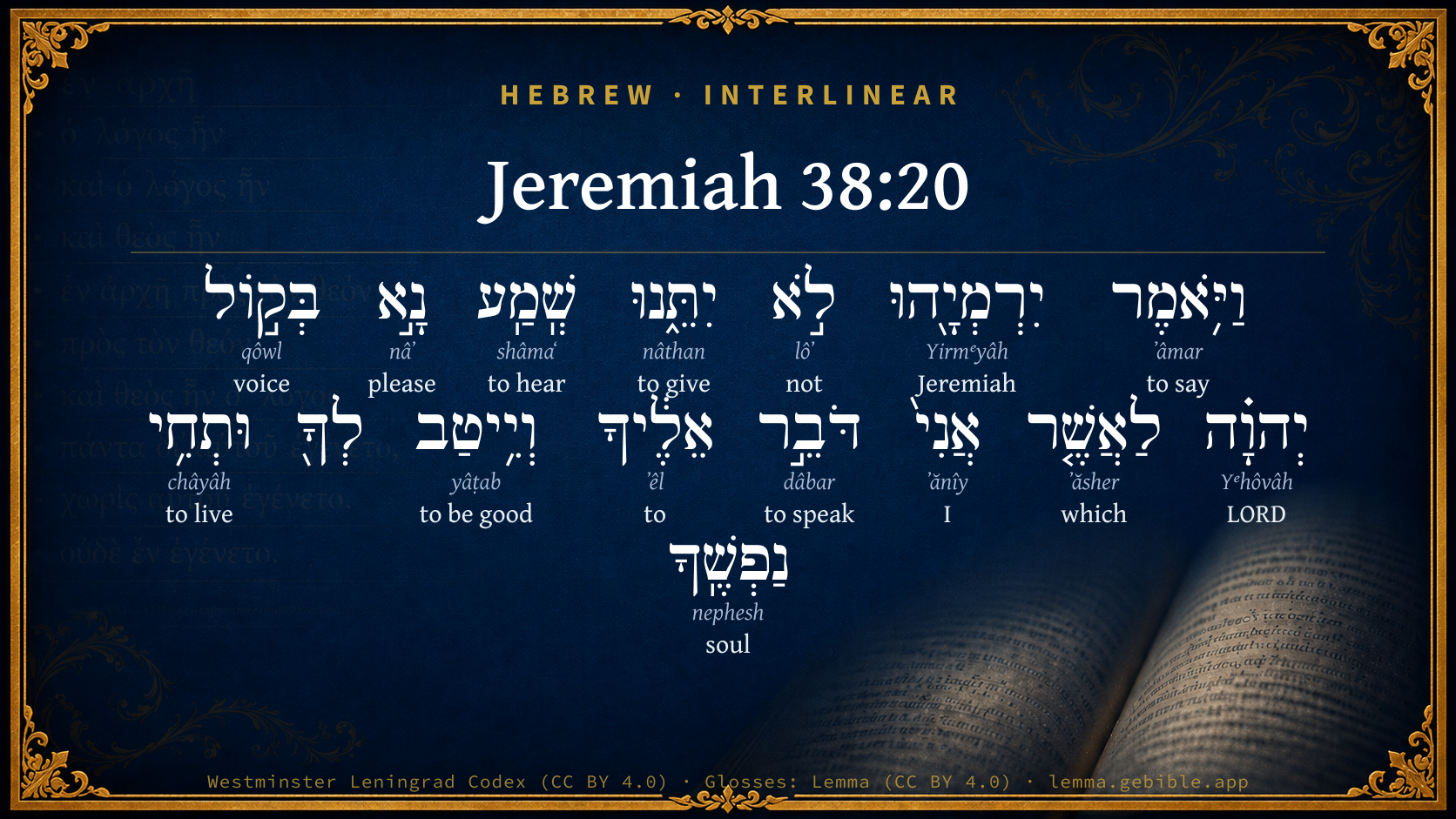
Jeremiah 38:20

Hebrew (Westminster Leningrad Codex) Jeremiah 38:20 appears in the Hebrew Old Testament. The text above is from the Westminster Leningrad Codex. Each word links to its Strong’s number, a concise gloss, and parsing drawn from the Open Scriptures Hebrew Bible morphology. Click any word for its full Brown-Driver-Briggs (BDB) entry.
Download image
Cite this verse

Jeremiah 38:20 (World English Bible). Public Domain. Lemma interlinear Bible study tool, https://lemma.gebible.app/v/jeremiah/38/20.

Show BibTeX & RIS
BibTeX
RIS
English Translation
But Jeremiah said, They shall not deliver you. Obey, I beg you, the voice of Yahweh, in that which I speak to you: so it shall be well with you, and your soul shall live.
World English Bible · Public Domain
Download a study sheet

One document with this verse’s original text, its word-by-word gloss line, the meaning frame, cross-references with their text, attributed commentary, and full source and license credits — printable, and it pastes into notes with its structure intact.

This verse Autodidact and up

Study sheet (.html) Plain text (.txt)

A passage Seminary Student

Up to 50 verses in one chapter. A passage sheet keeps up to 6 commentary sources and 12 cross-references per verse, in the order this page ranks them, and says so on the sheet whenever that leaves anything out. Ask for a single verse and you get the Autodidact verse sheet above.

Everything on this page stays free to read, with no account — the sheet is a download of what is already on screen, not access to it.

Want to remove ads? Support Godless Engineer
Compare translations 3

The same verse in 3 English versions, stacked beneath the original-language interlinear above. Click any original word for its lexicon entry.

Each is an independent rendering of the whole verse — the interlinear is not word-aligned to these translations.

Highlighted words mark where these versions differ — a whole-verse word diff, not a word-by-word alignment.

  • World English Bible Public Domain
    But Jeremiah said, They shall not deliver you. Obey, I beg you, the voice of Yahweh, in that which I speak to you: so it shall be well with you, and your soul shall live.
  • King James Version Public Domain
    But Jeremiah said, They shall not deliver thee. Obey, I beseech thee, the voice of the LORD, which I speak unto thee: so it shall be well unto thee, and thy soul shall live.
  • unfoldingWord Literal Text CC BY-SA 4.0
    Jeremiah said, “They will not give you over to them. Obey the message from Yahweh that I am telling you, so that things will go well for you, and so that you will live.

unfoldingWord Literal Text — © unfoldingWord, licensed CC BY-SA 4.0. Word-aligned USFM3 via Door43 (git.door43.org/unfoldingWord/en_ult).

Versions to compare (up to 4)

3 of 4 selected

Show all 18 translations

Every available English version of this verse, each an independent rendering of the whole verse.

  • World English Bible Public Domain
    But Jeremiah said, They shall not deliver you. Obey, I beg you, the voice of Yahweh, in that which I speak to you: so it shall be well with you, and your soul shall live.
  • Berean Standard Bible Public Domain
    “They will not hand you over,” Jeremiah replied. “Obey the voice of the LORD in what I am telling you, that it may go well with you and you may live.
  • Majority Standard Bible Public Domain
    “They will not hand you over,” Jeremiah replied. “Obey the voice of the LORD in what I am telling you, that it may go well with you and you may live.
  • King James Version Public Domain
    But Jeremiah said, They shall not deliver thee. Obey, I beseech thee, the voice of the LORD, which I speak unto thee: so it shall be well unto thee, and thy soul shall live.
  • American Standard Version (1901) Public Domain
    But Jeremiah said, They shall not deliver thee. Obey, I beseech thee, the voice of Jehovah, in that which I speak unto thee: so it shall be well with thee, and thy soul shall live.
  • Revised Version (1885) Public Domain
    But Jeremiah said, They shall not deliver thee. Obey, I beseech thee, the voice of the LORD, in that which I speak unto thee: so it shall be well with thee, and thy soul shall live.
  • Geneva Bible (1599) Public Domain
    But Ieremiah sayd, They shall not deliuer thee: hearken vnto the voyce of the Lord, I beseech thee, which I speake vnto thee: so shall it be well vnto thee, and thy soule shall liue.
  • Douay-Rheims (1899) Public Domain
    But Jeremias answered: They shall not deliver thee: hearken, I beseech thee, to the word of the Lord, which I speak to thee, and it shall be well with thee, and thy soul shall live.
  • Young's Literal Translation Public Domain
    And Jeremiah saith, `They do not give thee up; hearken, I pray thee, to the voice of Jehovah, to that which I am speaking unto thee, and it is well for thee, and thy soul doth live.
  • Literal Standard Version CC BY-SA 4.0
    And Jeremiah says, “They do not give you up; please listen to the voice of YHWH, to that which I am speaking to you, and it is well for you, and your soul lives.
  • Unlocked Literal Bible CC BY-SA 4.0
    Jeremiah said, “They will not give you over to them. Obey the message from Yahweh that I am telling you, so that things will go well for you, and so that you will live.
  • unfoldingWord Literal Text CC BY-SA 4.0
    Jeremiah said, “They will not give you over to them. Obey the message from Yahweh that I am telling you, so that things will go well for you, and so that you will live.
  • Darby Bible Public Domain
    And Jeremiah said, They shall not give [thee] over. Hearken, I beseech thee, unto the voice of Jehovah, in that which I speak unto thee; so shall it be well unto thee, and thy soul shall live.
  • World Messianic Bible Public Domain
    But Jeremiah said, “They won’t deliver you. Obey, I beg you, the LORD’s voice, in that which I speak to you; so it will be well with you, and your soul will live.
  • Webster's Bible Public Domain
    But Jeremiah said, They shall not deliver thee. Obey, I beseech thee, the voice of the LORD, which I speak to thee: so it shall be well to thee, and thy soul shall live.
  • Free Bible Version CC BY-SA 4.0
    “They won't hand you over,” Jeremiah replied. “If you obey what the Lord says by doing what I tell you, then things will go well for you and you'll live.
  • Bible in Basic English Public Domain
    But Jeremiah said, They will not give you up: be guided now by the word of the Lord as I have given it to you, and it will be well for you, and you will keep your life.
  • JPS Tanakh (1917) Public Domain
    But Jeremiah said: 'They shall not deliver thee. Hearken, I beseech thee, to the voice of the LORD, in that which I speak unto thee; so it shall be well with thee, and thy soul shall live.

Literal Standard Version (2020), Covenant Press — licensed CC BY-SA 4.0. Text via the HelloAO Bible API (eBible.org). Unlocked Literal Bible (unfoldingWord) — licensed CC BY-SA 4.0. Text via the HelloAO Bible API (eBible.org). unfoldingWord Literal Text — © unfoldingWord, licensed CC BY-SA 4.0. Word-aligned USFM3 via Door43 (git.door43.org/unfoldingWord/en_ult). Free Bible Version, Dr. Jonathan Gallagher — licensed CC BY-SA 4.0. Text via the HelloAO Bible API (eBible.org).

Word by word

More ways to search: Search by grammar → Find every occurrence → Compare this word →

Practice this passage: Drill this verse → Learn its vocabulary →

וְיִ֥יטַב
yâṭab
H3190
“and · to be good”
Conjunction + Verb, Qal, Imperfect, 3rd Person, Masculine, Singular
Part of Speech
Conjunction + Verb
Stem
Qal
Form
Imperfect
Person
3rd Person
Gender
Masculine
Number
Singular
Full BDB Definition

Origin: a primitive root

TWOT: 863

to be good, be pleasing, be well, be glad - (Qal) - to be glad, be joyful - to be well placed - to be well for, be well with, go well with - to be pleasing, be pleasing to - (Hiphil) - to make glad, rejoice - to do good to, deal well with - to do well, do thoroughly - to make a thing good or right or beautiful - to do well, do right
  1. וַיֹּ֥אמֶר ʼâmar H559 “and · to say” Conjunction + Verb, Qal, Sequential Imperfect, 3rd Person, Masculine, Singular
  2. יִרְמְיָ֖הוּ Yirmᵉyâh H3414 “Jeremiah” Noun, Proper
  3. לֹ֣א lôʼ H3808 “not” Particle, Negative
  4. יִתֵּ֑נוּ nâthan H5414 “to give” Verb, Qal, Imperfect, 3rd Person, Masculine, Plural
  5. שְֽׁמַֽע shâmaʻ H8085 “hear” Verb, Qal, Imperative, 2nd Person, Masculine, Singular
  6. נָ֣א nâʼ H4994 “please” Particle, Exhortation
  7. בְּק֣וֹל qôwl H6963 “in/at · voice of” Preposition + Noun, Common, Masculine, Singular, Construct
  8. יְהוָ֗ה Yᵉhôvâh H3068 “LORD” Noun, Proper
  9. לַאֲשֶׁ֤ר ʼăsher H834 “to/for · which” Preposition + Particle, Relative
  10. אֲנִי֙ ʼănîy H589 “I” Pronoun, Personal, 1st Person, Common, Singular
  11. דֹּבֵ֣ר dâbar H1696 “speaking” Verb, Qal, Participle Active, Masculine, Singular, Absolute
  12. אֵלֶ֔יךָ ʼêl H413 “to · you” Preposition + Suffix, Personal, 2nd Person, Masculine, Singular
  13. וּתְחִ֥י châyâh H2421 “and · to live” Conjunction + Verb, Qal, Jussive, 3rd Person, Feminine, Singular
  14. נַפְשֶֽׁךָ nephesh H5315 “soul · your” Noun, Common, Both, Singular, Construct + Suffix, Personal, 2nd Person, Masculine, Singular

About this verse

These counts appear in no published source. They are computed here, from the morphology-tagged text and Lemma’s own curated glosses. What Lemma adds →

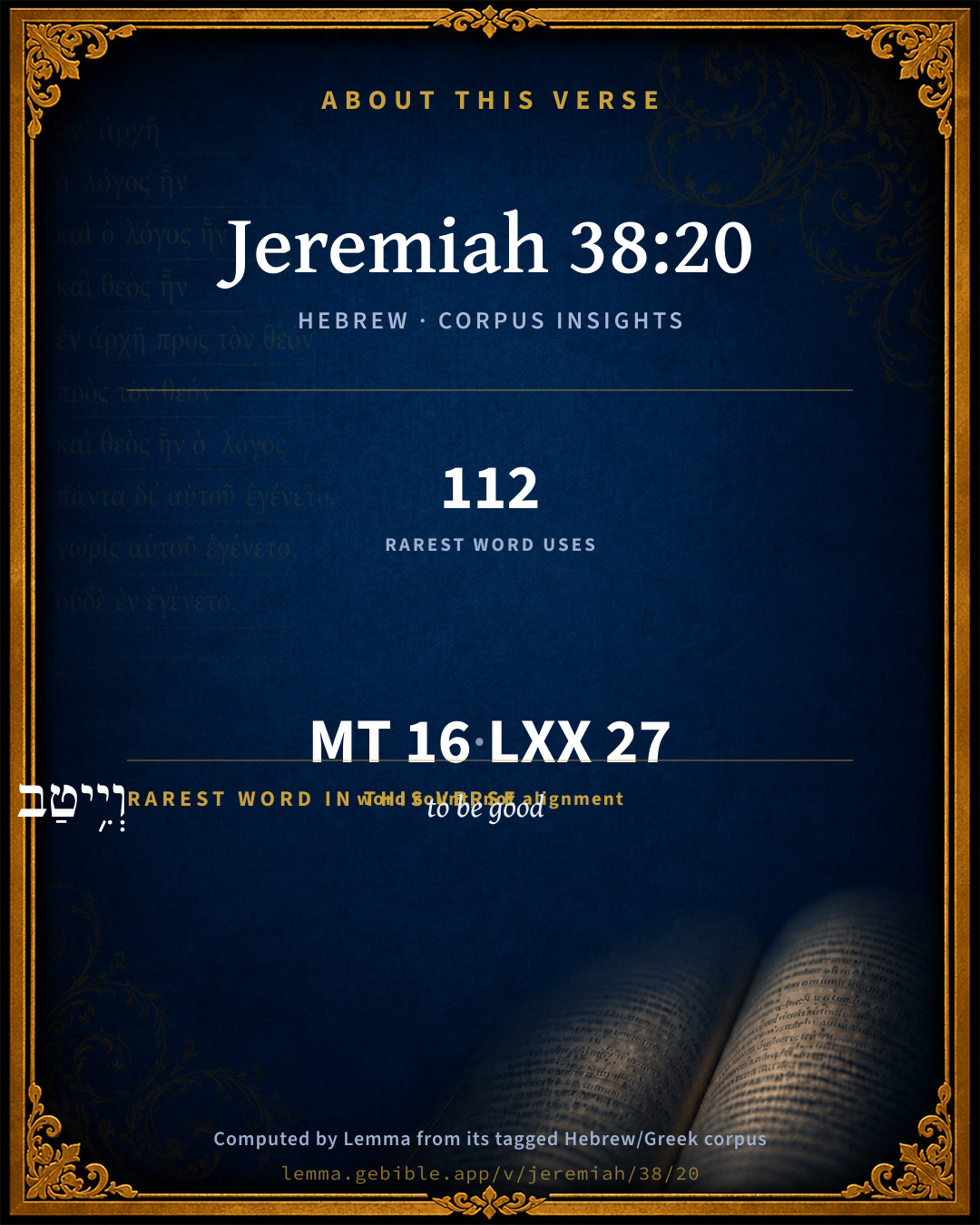
16
words
15
distinct lemmas
Prophets
section

Grammatical profile

  • 6 verbs
  • 4 nouns
  • 1 pronoun
  • 2 prepositions
  • 3 particles

Verb forms

  • וַיֹּ֥אמֶר Qal · Sequential Imperfect
  • יִתֵּ֑נוּ Qal · Imperfect
  • שְֽׁמַֽע Qal · Imperative
  • דֹּבֵ֣ר Qal · Participle Active
  • וְיִ֥יטַב Qal · Imperfect
  • וּתְחִ֥י Qal · Jussive

Hebrew & Septuagint length

In the original languages it is 16 Hebrew tokens and 27 Greek tokens — but the two are counted differently (Hebrew bundles its prefixes and suffixes into one token; the Greek is in lemma form), so that isn’t a like-for-like length.

Cross-references

11

Topical passages linked to Jeremiah 38:20 in the Treasury of Scripture Knowledge — connected by theme and wording, ordered by reader-vote popularity; previews shown in the World English Bible.

  • Isaiah 55:3 Turn your ear, and come to me; hear, and your soul shall live: and I will make an everlasting covenant with you, even the sure mercies of David.
  • Jeremiah 26:13 Now therefore amend your ways and your doings, and obey the voice of Yahweh your God; and Yahweh will repent him of the evil that he has pronounced against you.
  • Daniel 4:27 Therefore, O king, let my counsel be acceptable to you, and break off your sins by righteousness, and your iniquities by showing mercy to the poor; if there may be a lengthening of your tranquillity.
  • 2 Chronicles 20:20 They rose early in the morning, and went forth into the wilderness of Tekoa: and as they went forth, Jehoshaphat stood and said, Hear me, Judah, and you inhabitants of Jerusalem: believe in Yahweh your God, so shall you be established; believe his prophets, so shall you prosper.
  • Acts 26:29 Paul said, "I pray to God, that whether with little or with much, not only you, but also all that hear me this day, might become such as I am, except for these bonds."
  • Jeremiah 11:4 which I commanded your fathers in the day that I brought them forth out of the land of Egypt, out of the iron furnace, saying, Obey my voice, and do them, according to all which I command you: so shall you be my people, and I will be your God;
  • 2 Corinthians 5:11 Knowing therefore the fear of the Lord, we persuade men, but we are revealed to God; and I hope that we are revealed also in your consciences.
  • 2 Corinthians 5:20 We are therefore ambassadors on behalf of Christ, as though God were entreating by us. We beg you on behalf of Christ, be reconciled to God.
  • 2 Corinthians 6:1 Working together, we entreat also that you not receive the grace of God in vain,
  • Philemon 1:8–10 Therefore, though I have all boldness in Christ to command you that which is appropriate,
  • James 1:22 But be doers of the word, and not only hearers, deluding your own selves.

Cross-references courtesy of OpenBible.info (CC BY 4.0).

Hebrew and Greek witnesses Masoretic Hebrew ↔ Greek Septuagint

The same verse in the two great witnesses to the Old Testament, shown verse-for-verse.

These are two independent witnesses, not word-aligned to each other, and the Septuagint is shown in lemma (dictionary) form.

Hebrew Jeremiah 38:20 Masoretic · Westminster Leningrad Codex

וַיֹּ֥אמֶר יִרְמְיָ֖הוּ לֹ֣א יִתֵּ֑נוּ שְֽׁמַֽע נָ֣א בְּק֣וֹל יְהוָ֗ה לַאֲשֶׁ֤ר אֲנִי֙ דֹּבֵ֣ר אֵלֶ֔יךָ וְיִ֥יטַב לְךָ֖ וּתְחִ֥י נַפְשֶֽׁךָ

But Jeremiah said, They shall not deliver you. Obey, I beg you, the voice of Yahweh, in that which I speak to you: so it shall be well with you, and your soul shall live.

World English Bible · Public Domain

Greek LXX Structure differs

In the Septuagint, Jeremiah is about an eighth shorter than the Hebrew and arranges its material differently — the Oracles Against the Nations (Hebrew chapters 46–51) appear in the middle of the Greek book, after 25:13. Because the chapter and verse boundaries do not line up, a verse-for-verse comparison with the Hebrew is not shown.

A verse-for-verse comparison isn’t shown here because the chapters and verses don’t line up. Switch to the LXX edition with the MT / LXX toggle above to read the Greek directly.

Hebrew: Westminster Leningrad Codex (CC BY 4.0). Greek: Septuagint (public domain); English from a public-domain English Septuagint. How the Septuagint differs from the Hebrew →

Targum (Aramaic paraphrase)

1

The Targum is the ancient Jewish Aramaic paraphrase of the Hebrew Scriptures — an interpretive translation, not the Hebrew text itself. Onkelos (literal) and Pseudo-Jonathan (expansive) render the Torah, and Jonathan the Prophets. Coverage is partial: where no permissively-licensed English translation exists for a verse, only the Aramaic is shown. This is verse-level text, not a word-by-word alignment to the Hebrew.

  1. Targum Jonathan Prophets (Joshua–Malachi)
    וַאֲמַר יִרְמְיָה לָא יִמְסְרוּן קַבֵּיל כְּעַן לְמֵימְרָא דַייָ לְדַאֲנָא מְמַלֵיל עִמָךְ וְיֵיטַב לָךְ וְתִתְקַיֵם נַפְשָׁךְ:

    (no public-domain English translation for this verse)

    Targum Jonathan — Aramaic: “Mikraot Gedolot” (public domain). English: “Sefaria Community Translation” (CC0 1.0 (public-domain dedication)); “London "Chaldee Paraphrase," 1871” (public domain). Text via Sefaria.

Commentary

Notes on Jeremiah 38:20 from classic Christian and Jewish commentators (each source and its license shown beneath its notes). The classic Christian expositions comment on the surrounding passage and are grouped to its opening verse, so a note may address several verses; the Jewish commentaries on the Tanakh (Rashi and others) are per-verse, so they appear only where the commentator wrote on this verse.

Lemma curates 59 commentaries, every one of them public domain or Creative Commons licensed, each selected and text-cleaned for this edition rather than reprinted as found. About our sources →

Trapp's Complete Commentary

John Trapp

Jer 38:20 But Jeremiah said, They shall not deliver [thee]. Obey, I beseech thee, the voice of the LORD, which I speak unto thee: so it shall be well unto thee, and thy soul shall live.

Ver. 20. They shall not deliver thee.] This the good prophet speaketh from the mouth of the Lord, to cure him of that causeless fear, and to bring him to a better obedience; but it was past time of day with him to be wrought upon by anything that could be spoken, though never so well.

So it shall be well unto thee, and thy soul shall live.] This is also the voice of the gospel, and the result of all the promises.

John Trapp, A Commentary or Exposition upon All the Books of the Old and New Testament (1647–1656) — public domain. Text from a community e-Sword module.

Tyndale Open Study Notes

Tyndale Open Resources

38:20-22 Jeremiah reassured Zedekiah that everything would go well if Zedekiah chose to obey the Lord. If he refused, even his friends would abandon him.

Tyndale Open Study Notes — © Tyndale Open Resources, licensed CC BY-SA 4.0. Text via the HelloAO Bible API.

John Calvin's Commentaries

Here again Jeremiah strengthens Zedekiah, that he might not hesitate to make the trial, since God would yet give him pardon, so that at least his chastisement would be paternal and light He then promised to Zedekiah that he would be safe from all the insults about which he was anxious. They will not deliver thee, he says; as though he had said, “Leave this to God’s providence, resign thyself to God, and doubt not but that he will keep thee safe.” God, in his kindness, as I have said, allows the faithful to cast their cares into his bosom: but at the same time, if any disobey, when he confirms them, it is a sign of deliberate wickedness, and such perverseness extinguishes all the light of grace. Such was the stupidity of Zedekiah, that he did not accept of this second promise. He might indeed have confessed his fear, but he ought also to have received the remedy. The Prophet assured him that his life would be safe in God’s hand; what more could he have wished? But this was said to no purpose, because fear fully occupied his mind, so that there was no entrance for the promise. Now this ought to be carefully noticed; for there are none of us whom many cares do not disturb, and many fears do not perplex; but a place ought to be given to a remedy. God succors us when he sees us distressed by anxious thoughts; but if fear so prevails, that all the promises by which God raises us up avail nothing, it is a sign of hopeless unbelief.

It afterwards follows, Hear the voice of Jehovah, which I utter to you, that it may be well with thee, and that thy soul, may live The promise is again added, to lead Zedekiah to submit more willingly to God. For though we know that we cannot escape his power, it will yet be dreaded by us, except he favors us with the promises of grace. In this way, then, the Prophet endeavored to lead Zedekiah to render obedience to God: Hear, he says, the voice of Jehovah, that it may be well with thee He shewed that it was yet in the power of Zedekiah to provide for his own safety, if only he obeyed the word of God. And this passage teaches us, that the Prophet had not spoken thoughtlessly and in vain, but under the guidance and teaching of God’s Spirit For though it may not have been, that he had received a new command, he yet knew that it was God’s will, that he should confirm and reassert the previous oracles; for he did not falsely assume God’s name, when he bade Zedekiah to hear God’s voice which he had made known.

Now, though this discourse was especially directed to Zedekiah, we may yet conclude, that it is always for our good to embrace whatever God declares to us, though it may apparently be hard and unpleasant, as it was to Zedekiah; for it was by no means an agreeable thing to him to deliver up himself to his enemies, to be deprived of his regal power, to be drawn into exile, and from a king to become a slave; and yet nothing was better for him, in order to save his life, than to obey God. Though, then, the words of God contain what is contrary and grievous to our flesh, yet let us feel persuaded that God always speaks what is good for our salvation. It would then have been well for Zedekiah, had he obeyed the counsel of the Prophet; for he would have found in captivity that God would be propitious to him, and this would have been an invaluable comfort; and then he might have been brought back from exile, at least he would have preserved the city and the Temple: but by his obstinacy he betrayed the city to his enemies, and hence it was also that the Temple was burnt.

John Calvin's Commentaries (1540-1563) — public domain. Text from the Calvin Translation Society English edition (1840s-50s) via the Christian Classics Ethereal Library (ccel.org). Calvin's coverage is partial (roughly two-thirds of the Bible); uncommented books and verses are honest gaps, never fabricated. The 19th-century editor's footnotes and remarks are omitted so the notes are faithfully Calvin's own voice.

John Gill's Exposition

But Jeremiah said, they shall not deliver thee,.... To take off the above excuse, or remove that objection, the prophet assures the king that the Chaldeans would never deliver him into the hands of the Jews; he might depend upon it, it would never be done:

obey, I beseech thee, the voice of the Lord, which I speak unto thee; the counsel he had given him, to surrender to the Chaldeans, was not from himself, but from the Lord: and though he had no express order to give it at that time, yet it was what was agreeable to the will of God, and what he had exhorted the people to in the beginning of this chapter; and therefore, since it came from the Lord, as it ought to be attended to, so he might be assured of the divine protection, should he act according to it:

so it shall be well with thee, and thy soul shall live; that is, it would not only be much better with him than he feared, but than it would be with him should he obstinately stand out to the last; he should have more respect and honour from the king of Babylon; and not only have his life spared, but enjoy more of the comforts of life; particularly the sight of his eyes, which he lost when taken.

John Gill's Exposition of the Whole Bible (1746–1763) — public domain (CC PDM 1.0). Text via the HelloAO Bible API.

Haydock's Catholic Bible Commentary

CHAPTER XXXVIII.

George Leo Haydock (1774–1849), Haydock's Catholic Family Bible and Commentary, 1859 edition — public domain. Excludes Psalms (Douay-Rheims chapter numbering differs from Protestant) and Deuterocanonical books (Catholic canon only).

Matthew Poole's English Annotations

The Chaldeans shall not do so base an act, but deal with thee as with a prince. Let not this therefore be a temptation to thee to disobey the command of God, which if thou doest, thou shalt live, though not in that splendour in which thou now livest, yet in a much more comfortable state than thou wilt do if they take the city by storming.

Matthew Poole's English Annotations on the Holy Bible (1683–1685) — public domain. Text from a community e-Sword/MySword module.

The Pulpit Commentary

The blessedness of. obedience.

Jeremiah entreats Zedekiah to obey the voice of God urging him with promises of deliverance. Note here

I THE ENTREATY. Jeremiah says, "I beseech thee." This is characteristic of the kindliness and earnestness of the prophet. It is also indicative of the character of God who inspired him. With St. Paul he might have said, "We are ambassadors therefore on behalf of Christ, as though God were entreating you by us; we beseech you on behalf of Christ,... be ye reconciled to God". (2Co_5:20) This Divine entreaty signifies

(1) earnestness God truly desires our good;

(2) kindliness and sympathy;

(3) condescension; and

(4) the greatness of the issues at stake.

II THE DUTY.

1. This is obedience, the cardinal duty of the Old Testament. The importance of this duty in the New Testament has been underrated. There, too, it takes a first place in the teaching of Christ (Joh_15:14) and of his apostles St. Paul, (Rom_2:8) St, Peter, (1Pe_3:1) St. John, (1Jn_3:24) and St. James. (Jam_1:22) Indeed, all religion consists in submission (passive faith) and obedience (active faith).

2. Such obedience must be implicit. Zedekiah did not understand the reason of the Divine command. To carry it out was unpalatable to him and his people. But once we know God"s will, questions of mystery and of inclination should not affect us. In the gospel dispensation obedience is more intelligent. We have spiritual principles in place of formal precepts, Yet here also there is often mystery and fear as to the results of obedience, and then our duty is the soldier"s duty of unquestioning obedience. Theirs not to reason why; Theirs but to do and die.

III THE CLAIM.

1. It rests on the will of God. The king is to obey the voice of God. The monkish duty of obedience stayed with the ecclesiastical superior. But the spiritual Christian must feel that he owes his supreme allegiance directly to God. Our King and Father commands. We must obey his will.

2. It is determined by the revelation of the will of God. The obedience is to be given to the voice as it is made known by the prophet. "Which I speak unto thee." We are only responsible for obedience to God"s will as far as he has revealed it to us. But we cannot plead total ignorance of his will. That has been declared by prophets and apostles, manifested in Christ, confirmed by the Spirit of God in our conscience.

IV THE PROMISE.

1. Whatever happens. "It shall be well a vague promise, but sufficient. We cannot tell what is well for us. The thing God sends may not seem good as it approaches. But in the result it shall be well. That is enough for faith.

2. Life is secured. "And thy soul shall live." What is the use of the preservation of our possessions if our life is taken? Men toil for earthly gain and forget that the one condition of enjoying it may go at any moment. Life in the highest sense, eternal life, is the full reward for obedience.

Obeying the voice of the Lord.

I GOD HAS A VOICE FOR THOSE IN DOUBT. Poor Zedekiah, king though he be, is in a state of great vacillation. Counsellors speak one thing, and a prophet speaks another. Counsellors proclaim continued and resolute resistance, though it is by no means plain that they believe in what they say, and from ver. 19 it is clear that there were very considerable divisions in the city. Jeremiah, on the other hand, speaks like a man who is perfectly sure of his ground. He was oftentimes wretched and depressed in his own heart, but never did he speak the message of Jehovah with a doubt as to whether it was a real message at all. The world abounds in doubters, coming continually to a place where two ways meet, and standing long in uncertainty and fear which way to take. And yet they are uncertain only because they do not see the direction which God has given. For even as at crossroads finger posts are put up to direct strangers, so God has his finger posts forevery doubtful traveller in the ways of terrestrial life. Zedekiah seems to have had a feeling that he was seeking in the right direction when he sent again to Jeremiah. He seems to have made himself ready to listen, without hinting that he expected some particular answer. So to speak, it was Zedekiah"s last chance, and he gave the prophet the opportunity of speaking with corresponding plainness. And as God"s Word is here, so it is everywhere, spoken with the utmost assurance and from the whole nature of the messenger.

II THE VOICE CALLS TO IMMEDIATE OBEDIENCE. There is always some duty that lies nearest us. Part of the mischief of doubt is that, while we are doubting, some good thing is left undone, the opportunity for it passing away unused. There was just one thing for Zedekiah to do at this moment go forth and surrender himself to the generals of the King of Babylon. Repentance and amendment of life these were no longer available to avert the capture of Jerusalem. That was a thing settled on. But carnage and destruction might be averted by a timely surrender. Every day there is something made plain for us to do that day. It may be difficult, painful, in all ways hard to the flesh; but if it is neglected, then we shall only meet something still more painful tomorrow. "Obey the voice of the Lord, and it shall be well with thee," is a word to us all The voice of self or the voice of others may hint at procrastination or at some qualified obedience. Our only safety is in attending to the clear and urgent voice from heaven. Paradox as it seems, the most difficult way is really the easiest, and the easiest the most difficult. Zedekiah did not attend to the prophet"s imperative utterance, and the next chapter tells the dreadful things which happened. The king really made things worse by going out of his way to seek for direction, and then, when he had got it, paying no attention to it. Y.

The Pulpit Commentary (1880–1919), ed. H.D.M. Spence-Jones & Joseph S. Exell — public domain. Text from a community e-Sword module.

unfoldingWord translationNotes

Door43 World Missions Community

They will not give you over to them

"The Chaldeans will not give you over to the Judeans." Here "you" refers to Zedekiah. (See: Forms of You)

this is what Yahweh has shown me

Here the word "this" refers to what Jeremiah will say next.

translationWords

obey

unfoldingWord translationNotes — © Distant Shores Media and the Door43 World Missions Community, licensed CC BY-SA 4.0. Source: git.door43.org/Door43/en_tn.

Lesson kit

Teaching starters — assembled from the data on this page, not authored interpretation. Every prompt links to the verse data it draws on. Edit before teaching.

Jeremiah, in the Prophets, opens this verse with 16 words (15 distinct Hebrew lemmas). Its most distinctive word is yâṭab (“to be good”). A historical commentator’s framing appears above. Read the whole chapter for the surrounding context.

Discussion questions

  1. What does “to be good” (yâṭab) contribute to the verse as a whole?
  2. Isaiah 55:3 shares this passage’s theme. How do the two illuminate each other?
  3. The translations on this page render this verse differently — a whole-verse word diff, not a word-by-word alignment. What might account for the different wordings?
  4. The verb «וַיֹּ֥אמֶר» is Qal Sequential Imperfect. How does its form color the action?
  5. Reading how Trapp's Complete Commentary and Tyndale Open Study Notes read this verse, where do the two commentators agree and where do they part?

Things to notice

Reading settings

Reading text

Shown beneath each verse's original-language words.

Old Testament
Old Testament edition

Read the OT as the Masoretic Hebrew (MT) or the Greek Septuagint (LXX).

English shown for the Greek Septuagint (in the Hebrew ↔ Greek comparison).

Comparing translations? Open the Compare panel on any verse page to stack up to four side by side.