
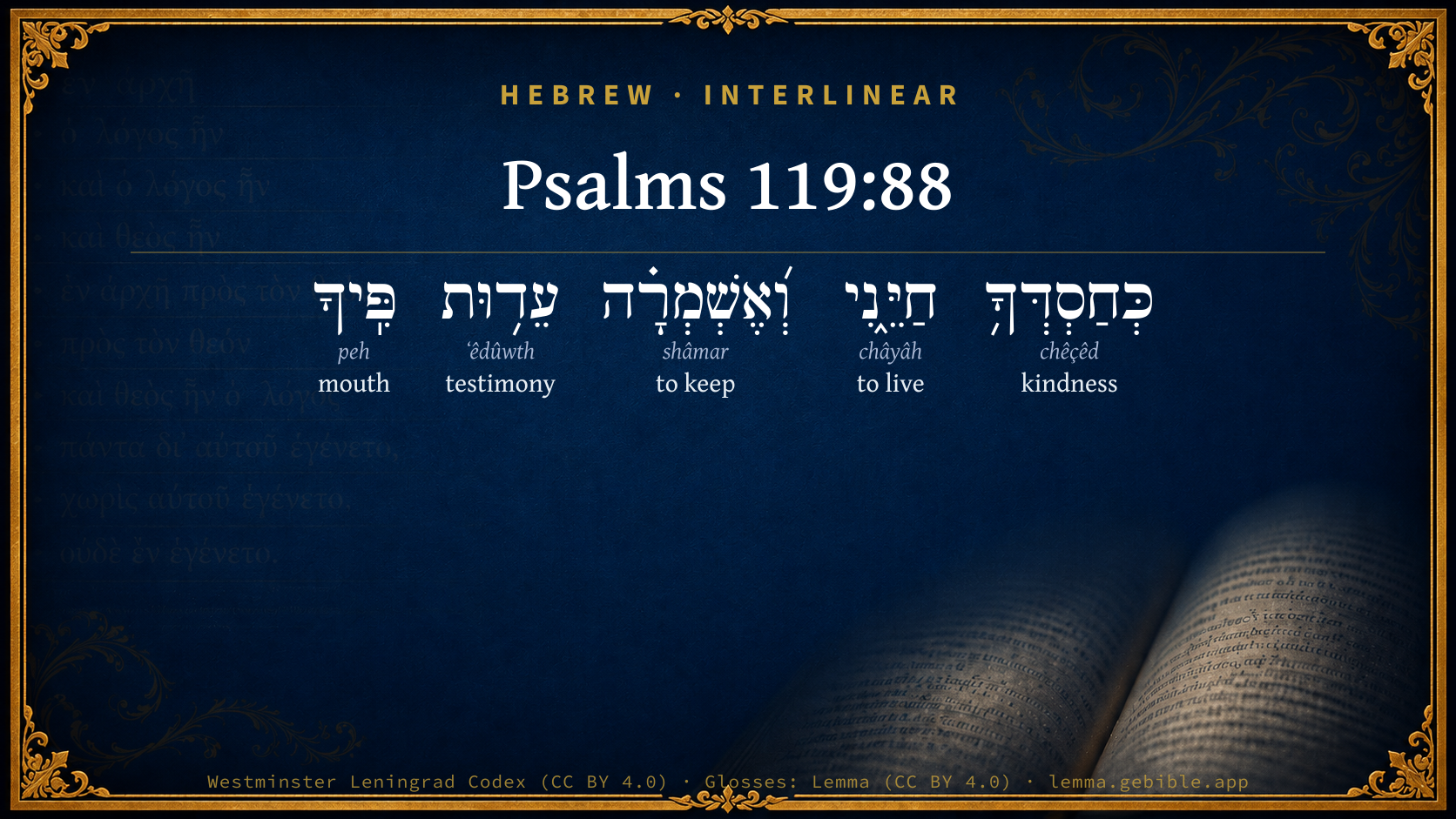
Psalms 119:88

Hebrew (Westminster Leningrad Codex) Psalms 119:88 appears in the Hebrew Old Testament. The text above is from the Westminster Leningrad Codex. Each word links to its Strong’s number, a concise gloss, and parsing drawn from the Open Scriptures Hebrew Bible morphology. Click any word for its full Brown-Driver-Briggs (BDB) entry.
Download image
Cite this verse

Psalms 119:88 (World English Bible). Public Domain. Lemma interlinear Bible study tool, https://lemma.gebible.app/v/psalms/119/88.

Show BibTeX & RIS
BibTeX
RIS
English Translation
Preserve my life according to your loving kindness, So I will obey the statutes of your mouth.
World English Bible · Public Domain
Download a study sheet

One document with this verse’s original text, its word-by-word gloss line, the meaning frame, cross-references with their text, attributed commentary, and full source and license credits — printable, and it pastes into notes with its structure intact.

This verse Autodidact and up

Study sheet (.html) Plain text (.txt)

A passage Seminary Student

Up to 50 verses in one chapter. A passage sheet keeps up to 6 commentary sources and 12 cross-references per verse, in the order this page ranks them, and says so on the sheet whenever that leaves anything out. Ask for a single verse and you get the Autodidact verse sheet above.

Everything on this page stays free to read, with no account — the sheet is a download of what is already on screen, not access to it.

Want to remove ads? Support Godless Engineer
Compare translations 3

The same verse in 3 English versions, stacked beneath the original-language interlinear above. Click any original word for its lexicon entry.

Each is an independent rendering of the whole verse — the interlinear is not word-aligned to these translations.

Highlighted words mark where these versions differ — a whole-verse word diff, not a word-by-word alignment.

  • World English Bible Public Domain
    Preserve my life according to your loving kindness, So I will obey the statutes of your mouth.
  • King James Version Public Domain
    Quicken me after thy lovingkindness; so shall I keep the testimony of thy mouth.
  • unfoldingWord Literal Text CC BY-SA 4.0
    According to your covenant faithfulness, keep me alive, so that I may observe the testimony of your mouth. LAMEDH

unfoldingWord Literal Text — © unfoldingWord, licensed CC BY-SA 4.0. Word-aligned USFM3 via Door43 (git.door43.org/unfoldingWord/en_ult).

Versions to compare (up to 4)

3 of 4 selected

Show all 17 translations

Every available English version of this verse, each an independent rendering of the whole verse.

  • World English Bible Public Domain
    Preserve my life according to your loving kindness, So I will obey the statutes of your mouth.
  • Berean Standard Bible Public Domain
    Revive me according to Your loving devotion, that I may obey the testimony of Your mouth.
  • Majority Standard Bible Public Domain
    Revive me according to Your loving devotion, that I may obey the testimony of Your mouth.
  • King James Version Public Domain
    Quicken me after thy lovingkindness; so shall I keep the testimony of thy mouth.
  • American Standard Version (1901) Public Domain
    LAMEDH. Quicken me after thy lovingkindness; So shall I observe the testimony of thy mouth.
  • Revised Version (1885) Public Domain
    Quicken me after thy lovingkindness; so shall I observe the testimony of thy mouth.
  • Geneva Bible (1599) Public Domain
    Quicken me according to thy louing kindnes: so shall I keepe the testimony of thy mouth.
  • Young's Literal Translation Public Domain
    According to Thy kindness quicken Thou me, And I keep the testimony of Thy mouth!
  • Literal Standard Version CC BY-SA 4.0
    Quicken me according to Your kindness, || And I keep the Testimony of Your mouth!
  • Unlocked Literal Bible CC BY-SA 4.0
    By your steadfast love, keep me alive, so that I may obey your commands.
  • unfoldingWord Literal Text CC BY-SA 4.0
    According to your covenant faithfulness, keep me alive, so that I may observe the testimony of your mouth. LAMEDH
  • Darby Bible Public Domain
    Quicken me according to thy loving-kindness, and I will keep the testimony of thy mouth.
  • World Messianic Bible Public Domain
    Preserve my life according to your loving kindness, so I will obey the statutes of your mouth. LAMEDH
  • Webster's Bible Public Domain
    Revive me after thy loving-kindness; so shall I keep the testimony of thy mouth.
  • Free Bible Version CC BY-SA 4.0
    Since you love me with your trustworthy love, don't let me die, so I can go on following the instructions you have given. Lamedh
  • Bible in Basic English Public Domain
    Give me life in your mercy; so that I may be ruled by the unchanging word of your mouth.
  • JPS Tanakh (1917) Public Domain
    Quicken me after Thy lovingkindness, and I will observe the testimony of Thy mouth.

Literal Standard Version (2020), Covenant Press — licensed CC BY-SA 4.0. Text via the HelloAO Bible API (eBible.org). Unlocked Literal Bible (unfoldingWord) — licensed CC BY-SA 4.0. Text via the HelloAO Bible API (eBible.org). unfoldingWord Literal Text — © unfoldingWord, licensed CC BY-SA 4.0. Word-aligned USFM3 via Door43 (git.door43.org/unfoldingWord/en_ult). Free Bible Version, Dr. Jonathan Gallagher — licensed CC BY-SA 4.0. Text via the HelloAO Bible API (eBible.org).

Word by word

More ways to search: Search by grammar → Find every occurrence → Compare this word →

Practice this passage: Drill this verse → Learn its vocabulary →

About this verse

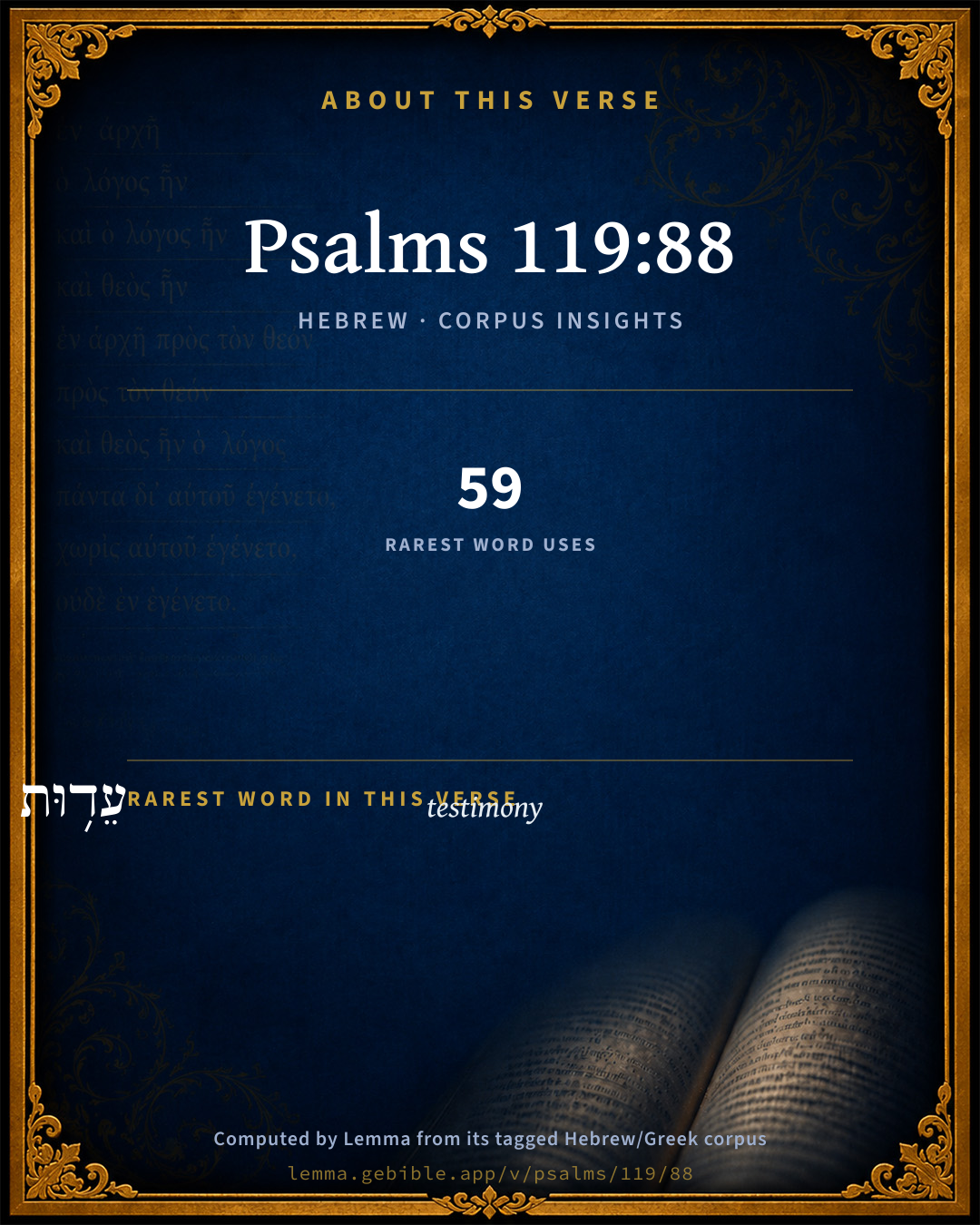
These counts appear in no published source. They are computed here, from the morphology-tagged text and Lemma’s own curated glosses. What Lemma adds →

5
words
5
distinct lemmas
Wisdom
section

Shared distinctive vocabulary

עֵד֥וּת testimony H5715 occurs in 57 verses of the Hebrew Bible. Also found in:

Grammatical profile

  • 2 verbs
  • 3 nouns

Verb forms

  • חַיֵּ֑נִי Piel · Imperative
  • וְ֝אֶשְׁמְרָ֗ה Qal · Cohortative

Hebrew & Septuagint length

In English translation the verse runs 17 words from the Hebrew and 15 from the Septuagint (LXX English) — closely comparable.

A rough comparison of the two English renderings, which tokenize alike — not a word-level alignment.

Word counts can differ between the Hebrew and the Greek without any difference in meaning — e.g. the Hebrew direct-object marker אֵת has no separate Greek word, and Greek often adds the article ὁ.

Cross-references

8

Topical passages linked to Psalms 119:88 in the Treasury of Scripture Knowledge — connected by theme and wording, ordered by reader-vote popularity; previews shown in the World English Bible.

  • Psalms 25:10 All the paths of Yahweh are loving kindness and truth To such as keep his covenant and his testimonies.
  • Psalms 119:25 My soul is laid low in the dust. Revive me according to your word!
  • Psalms 119:40 Behold, I long for your precepts! Revive me in your righteousness.
  • Psalms 119:2 Blessed are those who keep his statutes, Who seek him with their whole heart.
  • Psalms 119:146 I have called to you. Save me! I will obey your statutes.
  • Psalms 119:159 Consider how I love your precepts. Revive me, Yahweh, according to your loving kindness.
  • Psalms 78:5 For he established a testimony in Jacob, And appointed a law in Israel, Which he commanded our fathers, That they should make them known to their children;
  • Psalms 132:12 If your children will keep my covenant, My testimony that I will teach them, Their children also will sit on your throne forevermore."

Cross-references courtesy of OpenBible.info (CC BY 4.0).

Hebrew and Greek witnesses Masoretic Hebrew ↔ Greek Septuagint

The same verse in the two great witnesses to the Old Testament, shown verse-for-verse.

You’re reading Greek Psalm 118 (Hebrew Psalm 119). The Septuagint counts the superscription, so verse numbers can differ from the Hebrew — chapter-level alignment, not verse-by-verse. Numbering follows Rahlfs.

These are two independent witnesses, not word-aligned to each other, and the Septuagint is shown in lemma (dictionary) form.

Hebrew Psalms 119:88 Masoretic · Westminster Leningrad Codex

כְּחַסְדְּךָ֥ חַיֵּ֑נִי וְ֝אֶשְׁמְרָ֗ה עֵד֥וּת פִּֽיךָ

Preserve my life according to your loving kindness, So I will obey the statutes of your mouth.

World English Bible · Public Domain

Greek LXX Greek Psalm 118:88 Septuagint · lemma form

κατά ὁ ἔλεος σύ ζάω ἐγώ καί φυλάσσω ὁ μαρτύριον ὁ στόμα σύ

Quicken me according to your mercy; so shall I keep the testimonies of your mouth.

LXX2012 (modern English Septuagint) · Public Domain

Hebrew: Westminster Leningrad Codex (CC BY 4.0). Greek: Septuagint (public domain); English from LXX2012 (modern English Septuagint) (Public Domain). How the Septuagint differs from the Hebrew →

Commentary

Notes on Psalms 119:88 from classic Christian and Jewish commentators (each source and its license shown beneath its notes). The classic Christian expositions comment on the surrounding passage and are grouped to its opening verse, so a note may address several verses; the Jewish commentaries on the Tanakh (Rashi and others) are per-verse, so they appear only where the commentator wrote on this verse.

Lemma curates 59 commentaries, every one of them public domain or Creative Commons licensed, each selected and text-cleaned for this edition rather than reprinted as found. About our sources →

Trapp's Complete Commentary

John Trapp

Psa 119:88 Quicken me after thy lovingkindness; so shall I keep the testimony of thy mouth.

Ver. 88. Quicken me after thy lovingkindness] David under long affliction had his dumps and dullnesses; as the best faith, if long tried, will flag aud hang the wing. He, therefore, rouseth up himself, and wrestleth with God for quickening grace; which he promised to improve, and not to receive the grace of God in vain; "so shall I keep the testimony of thy mouth."

John Trapp, A Commentary or Exposition upon All the Books of the Old and New Testament (1647–1656) — public domain. Text from a community e-Sword module.

The Biblical Illustrator

Joseph S. Exell

Psa_119:88

Quicken me after Thy lovingkindness; so shall I keep the testimony of Thy mouth.

Grappling irons

I. His intense desire that he might keep the testimony of Gods mouth.

1. This desire was founded in a high esteem of Gods Word. He viewed the Divine revelation as coming directly from Jehovahs own mouth. Those who have this reverence for Gods Word will long to cling to it; they will be afraid of misinterpreting it; and they will not venture to add any of their own words to it, lest they be called into judgment for such presumption.

2. This prayer of Davids, springing from his great reverence for the revealed will of God, includes within it many points of virtue.

(1) He means, no doubt, that he desired to be steadfast in the doctrine which the mouth of the Lord had spoken. This meaning of the prayer is worthy of solemn note in these evil days.

(2) There is another meaning which will seem to some more practical, though, indeed, it is not so; for there is as much real practice about right thinking as about right acting; and for the understanding to be obedient to God is as vital a thing as for the actions of the life to be conformed to His will. We ought to be anxious to be obedient to God in all His precepts; and our prayer should daily be that we may be preserved in the keeping of the testimony of Gods mouth.

(3) David further desired that he might be preserved in perfect and unwavering confidence in the promises of God. The testimony of Gods mouth is largely made up of exceeding great and precious promises. Oh, what rich and eternal things hath He promised to them that fear Him!

II. His consequent prayer. He did not pray immediately that he might keep the testimony of Gods mouth, but he offered the next prayer to it, the one which leads up to it right surely. As a man that goeth up to his chamber doth not leap up all at once, but climbeth the stairs, so doth David rise to the keeping of the Lords word by the prayer, Quicken me after Thy lovingkindness.

1. This prayer is wisdom. He that saith, I shall keep the testimony of Gods mouth, for I am fully resolved to do it, had better salt that resolution with prayer, or it will rot like all things, which come of the flesh.

2. This prayer was suggested, I do not doubt, by Davids inward state. He says, Quicken me. He means that he felt the power of death working in him. Before he is quite numbed he cries, Quicken me.

3. It is a prayer which met Davids condition. Carefully read the octave of verses with Caph at the head of them, and see how well it fits in at the end of each. Whatever your difficulty, whatever your doubt, whatever your sorrow, whatever your temptation, here is a prayer that meets every case: Quicken me after Thy loving-kindness.

4. It is a prayer especially which answered to Davids aim in presenting it. He prayed this prayer that he might be enabled to keep Gods testimony.

5. He presented this prayer on the right ground. He pleads the mercy and love of God.

6. This is a prayer which has a promise attached to it. When I have a lock I am always glad to find a key which fits it. Here is the lock--Lord, I feel as if I were dead; and here is the key--He that believeth in Me, though he were dead, yet shall he live. That answers the supplication as a glove fits the hand.

III. His holy example.

1. Offer the prayer of life when you feel that you are dead. Such a prayer will prove an antidote to the poison of death.

2. Living truth can only be held firmly by living men. Let Jesus reign in your soul, and then He will make you a priest and king unto Himself by His own divine power.

3. Regard Gods lovingkindness as a source of life. Unhappily, too many have viewed it as an excuse for death. Oh, yes, they say, I am one of Gods chosen; I need not trouble myself about holiness or activity. I shall be saved by sovereign grace. The man who dares to pervert truth is already a lost man; but he that knows the lovingkindness of the Lord says, Quicken thou me, Lord. Such love as this I must translate into life: grant that to me to live may be love. Those words love and live are very near akin in their conformation; they are joined together in spiritual things, let no man put them asunder.

4. Let Divine aid, whenever we seek it or obtain it, lead us to the practical use of it in obedience. Quicken me, and so shall I keep. I put those words together in that fashion, for they are together. (C. H. Spurgeon.)

The Biblical Illustrator, edited by Joseph S. Exell (c. 1880s–1900s) — public domain. Text from a community e-Sword module.

J. A. Alexander on Psalms

Joseph Addison Alexander

88. (Psa 119:88) According to thy mercy quicken me, and I will keep the testimony of thy mouth. Restore me to life, or save me alive, as in Psa 119:25; Psa 119:37; Psa 119:40. Of thy mouth, as in Psa 119:11; Psa 119:72. This closes the eleventh stanza and the first half of the psalm. Two of these eight verses begin with different forms of the verb for to fail or faint, and three (including Psa 119:84) with the particle as or like.

Joseph Addison Alexander, The Psalms Translated and Explained (1850) — public domain. Text from a community e-Sword module.

Matthew Henry's Commentary

Here is, 1. David in care to be found in the way of his duty. His constant desire and design are to keep the testimony of God's mouth, to keep to it as his rule and to keep hold of it as his confidence and portion for ever. This we must keep, whatever we lose. 2. David at prayer for divine grace to assist him therein: "Quicken me after thy lovingkindness (make me alive and make me lively), so shall I keep thy testimonies," implying that otherwise he should not keep them. We cannot proceed, nor persevere, in the good way, unless God quicken us and put life into us; we are therefore here taught to depend upon the grace of God for strength to do every good work, and to depend upon it as grace, as purely the fruit of God's favour. He had prayed before, Quicken me in thy righteousness (Psa 119:40); but here, Quicken me after thy lovingkindness. The surest token of God's good-will toward us is his good work in us.

Matthew Henry's Commentary on the Whole Bible (1708–1710) — public domain (CC PDM 1.0). Text via the HelloAO Bible API.

Adam Clarke's Commentary

Verse 88. Quicken me] Make and keep me alive.

So shall I keep] Without the spiritual life there is no obedience; we must therefore rise from the dead, and be quickened by the Spirit of Christ.

ANALYSIS OF LETTER CAPH. - Eleventh Division

I. In this section the psalmist laments his being grieved with some inward anguish.

II. Complains of his enemies.

III. Expresses his hope and constancy; and,

IV. Prays to God for comfort and grace.

I. 1. He begins with a sad complaint: "My soul fainteth." As the body will fail if it want natural food, so will the soul if it get not the bread of life.

2. His eyes also failed with looking up. The blessing was long delayed.

3. Yet he hoped in God's word. He knew that it would not fail.

4. He made complaint: "When wilt thou comfort me?"

5. His state was most deplorable; his body dried and shrivelled up through long fasting and affliction, so that it resembled a leathern bottle hung up in the smoke.

6. Yet still he continued faithful: "I do not forget thy statutes."

II. He complains against his enemies.

1. How long he should be obliged to suffer them.

2. He inquires "when the Lord will execute judgments."

He describes these enemies from their qualities: -

1. They were proud. They would not bow down to nor acknowledge God.

2. They were treacherous. They digged pits for him - used every kind of means in order to destroy him; cruel, treacherous, and cowardly.

3. They were impious. In heart and conduct they were not "according to God's law."

4. They acted without a shadow of justice; wrongfully against law and justice.

III. He prays for succour: "Help thou me." Here are three things of especial note: 1. O Thou, who art infinite.. 2. Help; for thou hast all power in heaven and in earth. 3. Me, who cannot stand against my enemies; but "I trust in thee."

IV. 1. He closes with a frequent petition: "Quicken thou me - make me alive." All true religion consists in the LIFE of God in the SOUL of man.

2. The manner in which he wishes to be quickened: "After thy loving-kindness." He wishes not to be raised from the death of sin by God's thunder, but by the loving voice of a tender Father.

3. The effect it should have upon him: "So shall I keep the testimony of thy mouth." Whatever thou speakest I will hear, receive, love, and obey.

Adam Clarke's Commentary on the Bible (1810–1826) — public domain. Text from a community e-Sword/MySword module.

John Calvin's Commentaries

88. Quicken me according to thy goodness This verse contains nothing new. In the beginning of it David represents his life as depending on God’s mercy, not only because he was conscious of human frailty, but because he saw himself daily exposed to death in multiplied forms, or rather because he was convinced, that were God’s power withdrawn from him, he would be laid prostrate as if he were dead. He next promises, that when he shall be again restored to life, he will not be ungrateful, but will duly acknowledge this as a blessing from God, and that not only with the tongue, but also in his whole life. As the various instances in which God succors us and delivers us from dangers are so many new lives, it is reasonable that we should dedicate to his service whatever additional time is allotted to us in this world. When the law is called the testimony of God’s mouth, by this eulogium its authority is very plainly asserted.

John Calvin's Commentaries (1540-1563) — public domain. Text from the Calvin Translation Society English edition (1840s-50s) via the Christian Classics Ethereal Library (ccel.org). Calvin's coverage is partial (roughly two-thirds of the Bible); uncommented books and verses are honest gaps, never fabricated. The 19th-century editor's footnotes and remarks are omitted so the notes are faithfully Calvin's own voice.

The Cambridge Bible for Schools and Colleges

gen. ed. J. J. S. Perowne

88. If he is to continue glorifying God by the observance of His law, God must preserve his life, and free it from the hindrances which impede its devotion to His service.

The Cambridge Bible for Schools and Colleges (gen. ed. J. J. S. Perowne; Cambridge University Press, 1878–1918) — public domain. Text from a community e-Sword module.

John Gill's Exposition

Unless thy law had been my delights,.... Not the law of works, the voice of words, which they that heard entreated they might hear no more; which is terrible, and works wrath in the conscience; is a cursing and damning law to the transgressors of it; and so not delightful, unless as considered in the hands of Christ, the fulfilling end of it: but the law of faith, the doctrine of faith, or of justification by the righteousness of Christ, received by faith, which yields peace, joy, and comfort, even in tribulation: or the whole doctrine of the Gospel, the law of the Messiah, the isles waited for; the doctrine of peace, pardon, righteousness, and eternal life by Christ, which is exceeding delightful to sensible sinners;

I should then have perished in mine affliction; referring to some particular time of affliction he was pressed with, either through the persecution of Saul, or the conspiracy of Absalom which was very great and heavy upon him, so that he almost despaired of deliverance from it; and must have perished, not eternally, but as to his comforts: his heart would have fainted in him, and he would have sunk under the weight of the affliction, had it not been for the relief he had from the word of God, the doctrines and promises of it; he was like one in a storm, tossed with tempests, one wave after another beat upon him, and rolled over him, when he thought himself just perishing; and must have given all over for lost, had it not been for the delight and pleasure he found in reading and meditating on the sacred writings.

John Gill's Exposition of the Whole Bible (1746–1763) — public domain (CC PDM 1.0). Text via the HelloAO Bible API.

Albert Barnes' Notes on the Bible

Quicken me - Cause me to live; revive me. See Psa 71:20, note; Eph 2:1, note. Compare Psa 80:18; Rom 8:11; 1Pe 3:18; Joh 6:63.

After thy loving-kindness - Thy mercy; thy grace; thy compassion. That is, Let the measure of the grace given to me be thine own benevolent nature, and not my deserts. That is all I ask; that is all I could desire.

So shall I keep the testimony of thy mouth - Which proceeds out of thy mouth. His hope of being able to keep it was founded on the grace and mercy which he besought God to bestow upon him.

Albert Barnes' Notes on the Bible (1834–1885) — public domain. Text from a community e-Sword/MySword module.

Matthew Poole's English Annotations

Heb. and I will keep. I will testify my gratitude to thee by my obedience.

Matthew Poole's English Annotations on the Holy Bible (1683–1685) — public domain. Text from a community e-Sword/MySword module.

The Treasury of David

Charles H. Spurgeon

Ver. 88. Quicken me after thy loving kindness. Most wise, most blessed prayer! If we are revived in our own personal piety we shall be out of reach of our assailants. Our best protection from tempters and persecutors is more life. Lovingkindness itself cannot do us greater service than by making us to have life more abundantly. When we are quickened we are able to bear affliction, to baffle cunning, and to conquer sin. We look to the lovingkindness of God as the source of spiritual revival, and we entreat the Lord to quicken us, not according to our deserts, but after the boundless energy of his grace. What a blessed word is this "loving kindness." Take it to pieces, and admire its double force of love. "So shall I keep the testimony of thy mouth." If quickened by the Holy Ghost we shall be sure to exhibit a holy character. We shall be faithful to sound doctrine when the Spirit visits us and makes us faithful. None keep the word of the Lord's mouth unless the word of the Lord's mouth quickens them. We ought greatly to admire the spiritual prudence of the Psalmist, who does not so much pray for freedom from trial as for renewed life that he may be supported under it. When the inner life is vigorous all is well. David prayed for a sound heart in the closing verse of the last octave, and here he seeks a revived heart; this is going to the root of the matter, by seeking that which is the most needful of all things. Lord, let it be heart work with us, and let our hearts be right with thee.

Ver. 88. Quicken me after thy lovingkindness. Finally, the man of God appears entreating to be quickened, that so he may be enabled to keep the divine testimony... Here is a last resort, but it is a sure one. Let the living principles of divine grace be imparted to the soul, and the believer will be raised above dismay at the face of men. How does the spiritual mind triumph over even the infirmities of the body! We may behold this from the deathbed of the believer, and we may recall this in the lives and deaths of many eminent ones. The man of pure mind goes right to the fountain of life. He goes, with understanding, for he takes in the character in which the Lord hath spoken of himself: "Quicken me after thy lovingkindness." All at once he lays aside thought of his enemies; he is present with his God. His desire is to rise into higher spiritual existence, that he may hold closer communion with the Father of lights with whom there is no variableness. John Stephen.

Ver. 88. Quicken me, etc. He had prayed before, "Quicken me in thy righteousness" (Ps 119:40); but here "Quicken me after thy lovingkindness." The surest token of God's goodwill towards us is his good work in us. Matthew Henry.

Ver. 88. Quicken me. Many a time in this psalm doth David make this petition; and it seems strange that so often he should acknowledge himself a dead man, and desire God to quicken him. But so it is unto the child of God: every desertion and decay of strength is a death. So desirous are they to live unto God, that when they fail in it and find any inability in their souls to serve God as they would, they account themselves but dead, and pray the Lord to quicken them. William Cowper.

Ver. 88. The testimony of thy mouth. The title here given to the directory of our duty "The testimony of God's mouth, "gives increasing strength to our obligations. Thus let every word we read or hear be regarded as coming directly from the "mouth of God" (Joh 6:63). What reverence what implicit submission does it demand! May it ever find us in the posture of attention, humility, and faith! each one of us ready to say, "Speak, Lord, for thy servant heareth." Charles Bridges.

Ver. 88.

1. New life is the cause of new obedience.

2. New obedience is the effect of new life. G.R.

Ver. 88. Quickening.

1. Our greatest need.

2. God's most gracious boon.

3. The guarantee of our steadfastness; and so,

4. The promoter of God's glory.

Ver. 88.

1. He closes with a frequent petition: "Quicken thou me make me alive." All true religion consists in the LIFE of God in the SOUL of man.

2. The manner in which he wishes to be quickened: "After thy lovingkindness." He wishes not to be raised from the death of sin by God's thunder, but by the loving voice of a tender Father.

3. The effect it should have upon him: "So shall I keep the testimony of thy mouth." Whatever thou speakest I will hear, receive, love, and obey. Adam Clarke.

Psalms 119:89*

Charles H. Spurgeon's The Treasury of David (1869–1885) — public domain. Psalms only. Text from a community e-Sword/MySword module.

The Pulpit Commentary

Quicken me after thy loving-kindness (comp. vers. 25, 37, 44, 107, 149, 156, 159). So shall I keep the testimony of thy mouth (compare "the law of thy mouth," in ver. 72). It is God"s "quickeningi.e. his life-giving grace which alone enables his servants to observe andkeep his commandments.

Divine quickening our supreme need.

"Judged by his own, and, so far as we know, only work, the author of this psalm was a man wholly devoted to God and the Word of God. His confidence in that Word or Law, as the true rule of human life, had been exposed to the severest trials. He had seen the wicked in authority, using and straining their power to oppress and destroy the righteous. He himself had been called to suffer a long agony of anguish and distress, in which his soul fainted within him, simply because he would obey the highest rule he knew. In the time of his tribulation he had besought the Judge of all the earth to do him right, to vindicate the Word in which he put his trust, to deliver him from his afflictions. And, though neither answer nor deliverance came, he held fast his integrity; he refused to forget the statutes for his obedience to which he suffered, or to relinquish his trust in the God who did not save him" (S. Cox). But if such an attitude is to be maintained, the good man will find he has constant need of one thing Divine quickening. It may at the first starting of a religious life seem as if our supreme need were the precise Divine help in every detail of life and relation; and so the prayers of young Christians are often exact and minute; they ask for particular things, and expect precise answers. Then they often mistake contingencies for prayer-answers, and are in peril of assuming that they stand in some special Divine favor. As experience enlarges, the one thing most impressed on the renewed man is the tendency of the Divine life in him to flag and fail. It is always dying down. And it always needs requickening. It comes to us gradually that God would rather leave us free in the movements of life, and expect to do the best work for us by "strengthening us with strength in our soul." And we at last see that this constant quickening and requickening and soul-vitalizing is precisely our supreme need. Even Christian experience can reach no higher prayer than this, "Quicken thou me." So prayer in the good man"s life gradually loses its detailed character: it becomes simply a heart and life opening to the Divine quickening; and that is found to involve the supply of all our real needs. R.T.

The Pulpit Commentary (1880–1919), ed. H.D.M. Spence-Jones & Joseph S. Exell — public domain. Text from a community e-Sword module.

Lesson kit

Teaching starters — assembled from the data on this page, not authored interpretation. Every prompt links to the verse data it draws on. Edit before teaching.

Psalms, in the Wisdom, opens this verse with 5 words (5 distinct Hebrew lemmas). Its most distinctive word is ʻêdûwth (“testimony”). A historical commentator’s framing appears above. Read the whole chapter for the surrounding context.

Discussion questions

  1. What does “testimony” (ʻêdûwth) contribute to the verse as a whole?
  2. How does Exodus 16:34, which shares the word «testimony», read alongside this verse?
  3. These translations render this verse differently; the difference is in the English rendering, not the original. What questions does that raise?
  4. «חַיֵּ֑נִי» is a Piel Imperative verb. How does that grammatical form shape the action described?
  5. Compare how Trapp's Complete Commentary and The Biblical Illustrator read this verse. Where do they agree or differ?

Things to notice

Reading settings

Reading text

Shown beneath each verse's original-language words.

Old Testament
Old Testament edition

Read the OT as the Masoretic Hebrew (MT) or the Greek Septuagint (LXX).

English shown for the Greek Septuagint (in the Hebrew ↔ Greek comparison).

Comparing translations? Open the Compare panel on any verse page to stack up to four side by side.