Deuteronomy 16:20

Hebrew (Westminster Leningrad Codex) Deuteronomy 16:20 appears in the Hebrew Old Testament. The text above is from the Westminster Leningrad Codex. Each word links to its Strong’s number, a concise gloss, and parsing drawn from the Open Scriptures Hebrew Bible morphology. Click any word for its full Brown-Driver-Briggs (BDB) entry.
Download image
Cite this verse

Deuteronomy 16:20 (World English Bible). Public Domain. Lemma interlinear Bible study tool, https://lemma.gebible.app/v/deuteronomy/16/20.

Show BibTeX & RIS
BibTeX
RIS
English Translation
That which is altogether just shall you follow, that you may live, and inherit the land which Yahweh your God gives you.
World English Bible · Public Domain
Download a study sheet

One document with this verse’s original text, its word-by-word gloss line, the meaning frame, cross-references with their text, attributed commentary, and full source and license credits — printable, and it pastes into notes with its structure intact.

This verse Autodidact and up

Study sheet (.html) Plain text (.txt)

A passage Seminary Student

Up to 50 verses in one chapter. A passage sheet keeps up to 6 commentary sources and 12 cross-references per verse, in the order this page ranks them, and says so on the sheet whenever that leaves anything out. Ask for a single verse and you get the Autodidact verse sheet above.

Everything on this page stays free to read, with no account — the sheet is a download of what is already on screen, not access to it.

Want to remove ads? Support Godless Engineer
Compare translations 3

The same verse in 3 English versions, stacked beneath the original-language interlinear above. Click any original word for its lexicon entry.

Each is an independent rendering of the whole verse — the interlinear is not word-aligned to these translations.

Highlighted words mark where these versions differ — a whole-verse word diff, not a word-by-word alignment.

  • World English Bible Public Domain
    That which is altogether just shall you follow, that you may live, and inherit the land which Yahweh your God gives you.
  • King James Version Public Domain
    That which is altogether just shalt thou follow, that thou mayest live, and inherit the land which the LORD thy God giveth thee.
  • unfoldingWord Literal Text CC BY-SA 4.0
    Righteousness, righteousness you shall pursue, so that you will live and possess the land that Yahweh your God is giving to you.

unfoldingWord Literal Text — © unfoldingWord, licensed CC BY-SA 4.0. Word-aligned USFM3 via Door43 (git.door43.org/unfoldingWord/en_ult).

Versions to compare (up to 4)

3 of 4 selected

Show all 18 translations

Every available English version of this verse, each an independent rendering of the whole verse.

  • World English Bible Public Domain
    That which is altogether just shall you follow, that you may live, and inherit the land which Yahweh your God gives you.
  • Berean Standard Bible Public Domain
    Pursue justice, and justice alone, so that you may live, and you may possess the land that the LORD your God is giving you.
  • Majority Standard Bible Public Domain
    Pursue justice, and justice alone, so that you may live, and you may possess the land that the LORD your God is giving you.
  • King James Version Public Domain
    That which is altogether just shalt thou follow, that thou mayest live, and inherit the land which the LORD thy God giveth thee.
  • American Standard Version (1901) Public Domain
    That which is altogether just shalt thou follow, that thou mayest live, and inherit the land which Jehovah thy God giveth thee.
  • Revised Version (1885) Public Domain
    That which is altogether just shalt thou follow, that thou mayest live, and inherit the land which the LORD thy God giveth thee.
  • Geneva Bible (1599) Public Domain
    That which is iust and right shalt thou follow, that thou maiest liue, and possesse the land which the Lord thy God giueth thee.
  • Douay-Rheims (1899) Public Domain
    Thou shalt follow justly after that which is just: that thou mayst live and possess the land, which the Lord thy God shall give thee.
  • Young's Literal Translation Public Domain
    Righteousness -- righteousness thou dost pursue, so that thou livest, and hast possessed the land which Jehovah thy God is giving to thee.
  • Literal Standard Version CC BY-SA 4.0
    Righteousness—you pursue righteousness, so that you live and have possessed the land which your God YHWH is giving to you.
  • Unlocked Literal Bible CC BY-SA 4.0
    You must follow after justice, after justice alone, so that you may live and inherit the land that Yahweh your God is giving you.
  • unfoldingWord Literal Text CC BY-SA 4.0
    Righteousness, righteousness you shall pursue, so that you will live and possess the land that Yahweh your God is giving to you.
  • Darby Bible Public Domain
    Perfect justice shalt thou follow, that thou mayest live, and possess the land that Jehovah thy God giveth thee.
  • World Messianic Bible Public Domain
    You shall follow that which is altogether just, that you may live and inherit the land which the LORD your God gives you.
  • Webster's Bible Public Domain
    That which is altogether just shalt thou follow, that thou mayest live, and inherit the land which the LORD thy God giveth thee.
  • Free Bible Version CC BY-SA 4.0
    Always do what is right and just, so that you may go on living, occupying the land that the Lord your God is giving you.
  • Bible in Basic English Public Domain
    Let righteousness be your guide, so that you may have life, and take for your heritage the land which the Lord your God is giving you.
  • JPS Tanakh (1917) Public Domain
    Justice, justice shalt thou follow, that thou mayest live, and inherit the land which the LORD thy God giveth thee.

Literal Standard Version (2020), Covenant Press — licensed CC BY-SA 4.0. Text via the HelloAO Bible API (eBible.org). Unlocked Literal Bible (unfoldingWord) — licensed CC BY-SA 4.0. Text via the HelloAO Bible API (eBible.org). unfoldingWord Literal Text — © unfoldingWord, licensed CC BY-SA 4.0. Word-aligned USFM3 via Door43 (git.door43.org/unfoldingWord/en_ult). Free Bible Version, Dr. Jonathan Gallagher — licensed CC BY-SA 4.0. Text via the HelloAO Bible API (eBible.org).

Word by word

More ways to search: Search by grammar → Find every occurrence → Compare this word →

Practice this passage: Drill this verse → Learn its vocabulary →

צֶ֥דֶק
tsedeq
H6664
“righteousness”
Noun, Common, Masculine, Singular, Absolute
Part of Speech
Noun
Type
Common
Gender
Masculine
Number
Singular
State
Absolute
Full BDB Definition

Origin: from H6663

TWOT: 1879a

justice, rightness, righteousness - what is right or just or normal, rightness, justness (of weights and measures) - righteousness (in government) - of judges, rulers, kings - of law - of Davidic king, Messiah - of Jerusalem as seat of just government - of God's attribute - righteousness, justice (in case or cause) - rightness (in speech) - righteousness (as ethically right) - righteousness (as vindicated), justification (in controversy), deliverance, victory, prosperity - of God as covenant-keeping in redemption - in name of Messianic king - of people enjoying salvation - of Cyrus
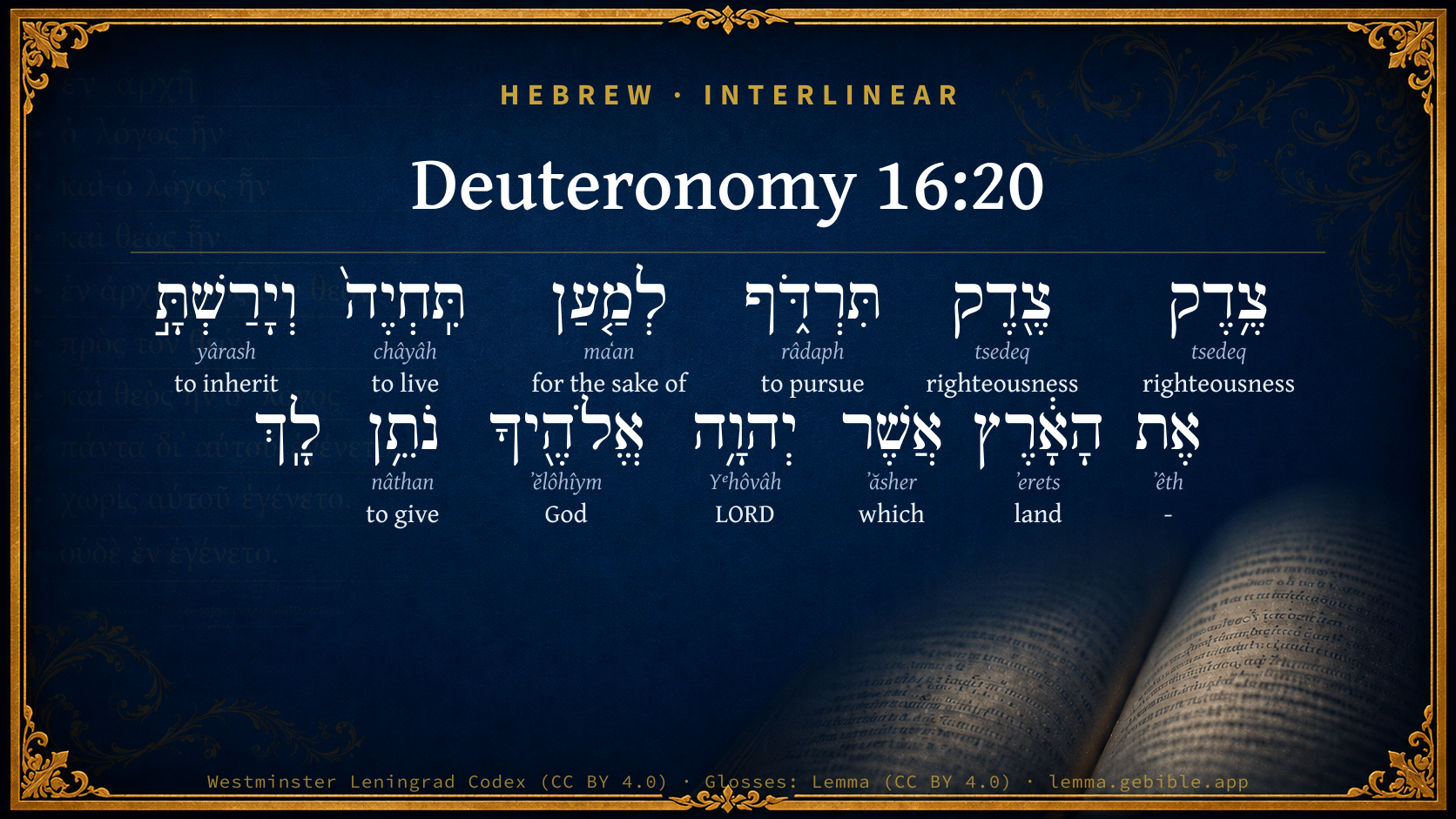
  1. צֶ֖דֶק tsedeq H6664 “righteousness” Noun, Common, Masculine, Singular, Absolute
  2. תִּרְדֹּ֑ף râdaph H7291 “to pursue” Verb, Qal, Imperfect, 2nd Person, Masculine, Singular
  3. לְמַ֤עַן maʻan H4616 “for the sake of” Preposition
  4. תִּֽחְיֶה֙ châyâh H2421 “to live” Verb, Qal, Imperfect, 2nd Person, Masculine, Singular
  5. וְיָרַשְׁתָּ֣ yârash H3423 “and · to inherit” Conjunction + Verb, Qal, Sequential Perfect, 2nd Person, Masculine, Singular
  6. אֶת ʼêth H853 “-” Particle, Direct Object
  7. הָאָ֔רֶץ ʼerets H776 “the · land” Particle, Definite Article + Noun, Common, Both, Singular, Absolute
  8. אֲשֶׁר ʼăsher H834 “which” Particle, Relative
  9. יְהוָ֥ה Yᵉhôvâh H3068 “LORD” Noun, Proper
  10. אֱלֹהֶ֖יךָ ʼĕlôhîym H430 “God(s) · your” Noun, Common, Masculine, Plural, Construct + Suffix, Personal, 2nd Person, Masculine, Singular
  11. נֹתֵ֥ן nâthan H5414 “giving” Verb, Qal, Participle Active, Masculine, Singular, Absolute

About this verse

These counts appear in no published source. They are computed here, from the morphology-tagged text and Lemma’s own curated glosses. What Lemma adds →

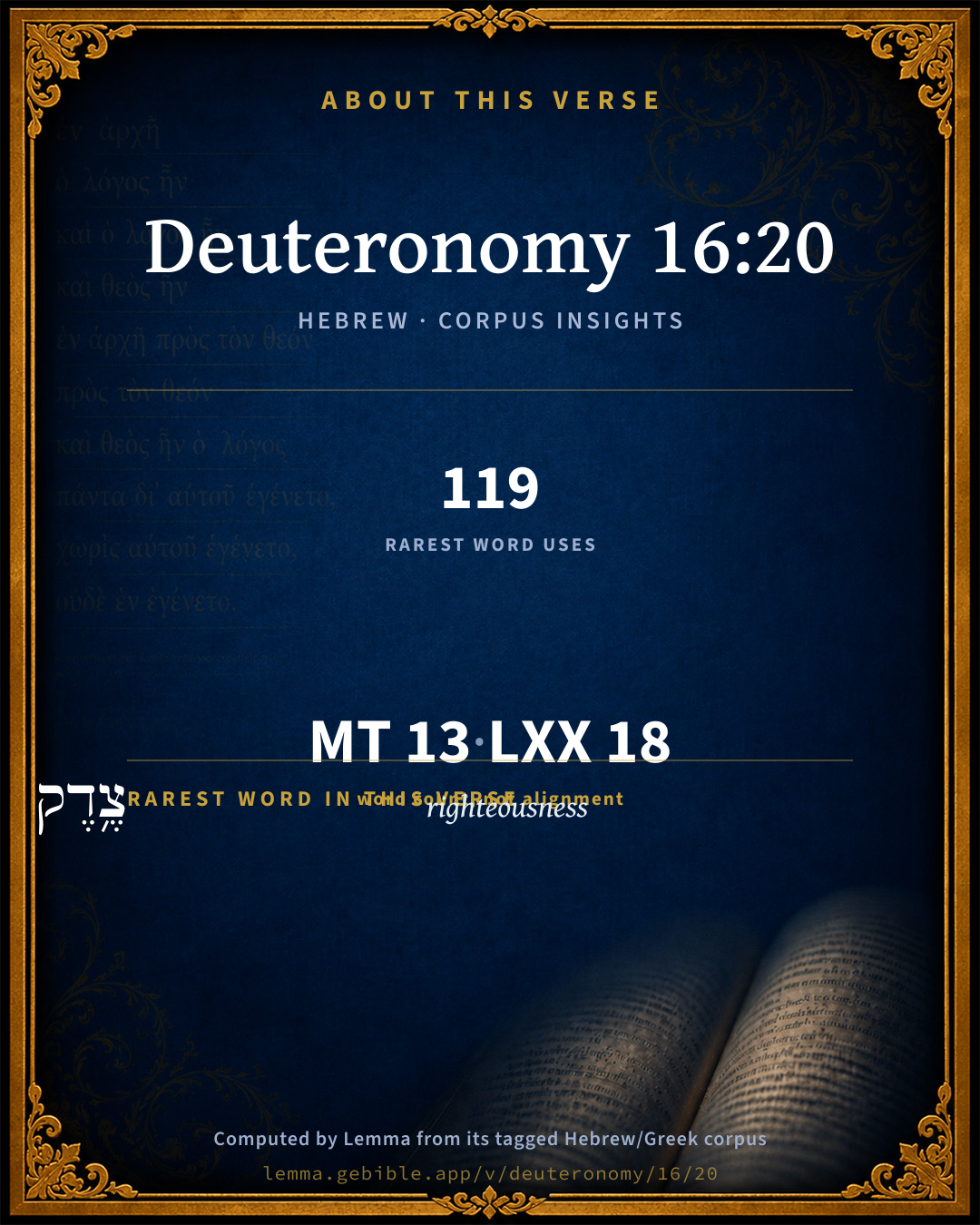
13
words
11
distinct lemmas
Pentateuch
section

Grammatical profile

  • 4 verbs
  • 5 nouns
  • 2 prepositions
  • 2 particles

Verb forms

  • תִּרְדֹּ֑ף Qal · Imperfect
  • תִּֽחְיֶה֙ Qal · Imperfect
  • וְיָרַשְׁתָּ֣ Qal · Sequential Perfect
  • נֹתֵ֥ן Qal · Participle Active

Repetition

A word recurs within this verse — often emphatic in Hebrew:

  • צֶ֥דֶק righteousness H6664 ×2

Hebrew & Septuagint length

In English translation the verse runs 22 words from the Hebrew and 23 from the Septuagint (LXX English) — closely comparable.

A rough comparison of the two English renderings, which tokenize alike — not a word-level alignment.

Word counts can differ between the Hebrew and the Greek without any difference in meaning — e.g. the Hebrew direct-object marker אֵת has no separate Greek word, and Greek often adds the article ὁ.

In the original languages it is 13 Hebrew tokens and 18 Greek tokens — but the two are counted differently (Hebrew bundles its prefixes and suffixes into one token; the Greek is in lemma form), so that isn’t a like-for-like length.

Cross-references

7

Topical passages linked to Deuteronomy 16:20 in the Treasury of Scripture Knowledge — connected by theme and wording, ordered by reader-vote popularity; previews shown in the World English Bible.

  • Philippians 4:8 Finally, brothers, whatever things are true, whatever things are honorable, whatever things are just, whatever things are pure, whatever things are lovely, whatever things are of good report; if there is any virtue, and if there is any praise, think about these things.
  • Ezekiel 18:9 has walked in my statutes, and has kept my ordinances, to deal truly; he is just, he shall surely live, says the Lord Yahweh.
  • Ezekiel 18:5 But if a man is just, and does that which is lawful and right,
  • Micah 6:8 He has shown you, O man, what is good. What does Yahweh require of you, but to act justly, To love mercy, and to walk humbly with your God?
  • Deuteronomy 4:1 Now, Israel, listen to the statutes and to the ordinances, which I teach you, to do them; that you may live, and go in and possess the land which Yahweh, the God of your fathers, gives you.
  • Deuteronomy 25:13–16 You shall not have in your bag diverse weights, a great and a small.
  • Romans 10:5 For Moses writes about the righteousness of the law, "The one who does them will live by them."

Cross-references courtesy of OpenBible.info (CC BY 4.0).

Hebrew and Greek witnesses Masoretic Hebrew ↔ Greek Septuagint

The same verse in the two great witnesses to the Old Testament, shown verse-for-verse.

These are two independent witnesses, not word-aligned to each other, and the Septuagint is shown in lemma (dictionary) form.

Hebrew Deuteronomy 16:20 Masoretic · Westminster Leningrad Codex

צֶ֥דֶק צֶ֖דֶק תִּרְדֹּ֑ף לְמַ֤עַן תִּֽחְיֶה֙ וְיָרַשְׁתָּ֣ אֶת הָאָ֔רֶץ אֲשֶׁר יְהוָ֥ה אֱלֹהֶ֖יךָ נֹתֵ֥ן לָֽךְ

That which is altogether just shall you follow, that you may live, and inherit the land which Yahweh your God gives you.

World English Bible · Public Domain

Greek LXX Deuteronomy 16:20 Septuagint · lemma form

δικαίως ὁ δίκαιος διώκω ἵνα ζάω καί εἰςἔρχομαι κληρονομέω ὁ γῆ ὅς κύριος ὁ θεός σύ δίδωμι σύ

You shall justly pursue justice, that you⌃ may live, and go in and inherit the land which the Lord your God gives you.

LXX2012 (modern English Septuagint) · Public Domain

Hebrew: Westminster Leningrad Codex (CC BY 4.0). Greek: Septuagint (public domain); English from LXX2012 (modern English Septuagint) (Public Domain). How the Septuagint differs from the Hebrew →

Targum (Aramaic paraphrase)

2

The Targum is the ancient Jewish Aramaic paraphrase of the Hebrew Scriptures — an interpretive translation, not the Hebrew text itself. Onkelos (literal) and Pseudo-Jonathan (expansive) render the Torah, and Jonathan the Prophets. Coverage is partial: where no permissively-licensed English translation exists for a verse, only the Aramaic is shown. This is verse-level text, not a word-by-word alignment to the Hebrew.

  1. Targum Onkelos Torah (Genesis–Deuteronomy)
    קֻשְׁטָא קֻשְׁטָא תְּהֵי רָדִיף בְּדִיל דְתֵיחֵי וְתֵירַת יָת אַרְעָא דַיְיָ אֱלָהָךְ יָהֵב לָךְ

    (no public-domain English translation for this verse)

    Targum Onkelos — Aramaic: “Onkelos Genesis” (public domain); “Onkelos Exodus” (public domain); “Onkelos Leviticus” (public domain); “Onkelos Numbers” (public domain); “Onkelos Deuteronomy” (public domain). English: “Sefaria Community Translation” (CC0 1.0 (public-domain dedication)); “J.W. Etheridge. The Targums of Onkelos and Jonathan Ben Uzziel on the Pentateuch. London: Longmans, Green, 1862” (public domain). Text via Sefaria.

  2. Targum Pseudo-Jonathan Torah (Genesis–Deuteronomy)
    דִּין קְשׁוֹט וְדִין שְׁלַם בִּקְשׁוֹט תְּהֵי רָדִיף מִן בִּגְלַל דְּתֵיחוּן וְתֵירְתוּן יַת אַרְעָא דַיְיָ אֱלָהָכוֹן יָהֵיב לְכוֹן

    Upright and perfect judgment in truth shalt thou follow, that you may come to inherit the land which the Lord your God will give you.

    Targum Pseudo-Jonathan — Aramaic: “Targum Jonathan on Genesis” (public domain); “Targum Jonathan on Exodus” (public domain); “Targum Jonathan on Leviticus” (public domain); “Targum Jonathan on Numbers” (public domain); “Targum Jonathan on Deuteronomy” (public domain). English: “The Targum of Jonathan ben Uzziel, trans. J. W. Etheridge, London, 1862” (public domain). Text via Sefaria.

Commentary

Notes on Deuteronomy 16:20 from classic Christian and Jewish commentators (each source and its license shown beneath its notes). The classic Christian expositions comment on the surrounding passage and are grouped to its opening verse, so a note may address several verses; the Jewish commentaries on the Tanakh (Rashi and others) are per-verse, so they appear only where the commentator wrote on this verse.

Lemma curates 59 commentaries, every one of them public domain or Creative Commons licensed, each selected and text-cleaned for this edition rather than reprinted as found. About our sources →

Trapp's Complete Commentary

John Trapp

Deu 16:20 That which is altogether just shalt thou follow, that thou mayest live, and inherit the land which the LORD thy God giveth thee.

Ver. 20. That which is altogether just.] Heb., Justice, justice; that is, let pure justice, without mud, run down; let all selfish affections be strained out.

John Trapp, A Commentary or Exposition upon All the Books of the Old and New Testament (1647–1656) — public domain. Text from a community e-Sword module.

The Biblical Illustrator

Joseph S. Exell

Deu_16:20

That which is altogether Just shalt thou follow.

Justice the decorum of the character of judges

(preached at the Assizes):--The duties which are incumbent upon us may be very properly divided into two classes--such as are incumbent upon all men, and such as are incumbent upon particular ranks of men.

I. Justice is immediately connected with the end of that office which magistrates, judges, and rulers bear. The exercise of justice itself is the proximate means of answering the purposes of government and judgment. One of the principal ways in which other virtues promote these purposes is by contributing to the steady and vigorous exercise of incorruptible justice. Injustice, directly and of itself, defeats these purposes, and is in every instance absolutely inconsistent with them. Other vices obstruct them sometimes very strongly, but always more remotely and indirectly, often by preparing the way to injustice.

II. Rulers and judges have, from their office, opportunity for many exertions of justice wholly peculiar to themselves. On this account also justice may be considered as in a special manner the virtue of their character and station. The poor man, who cannot himself resist the oppression of the great; the peaceable man, who is harassed by the encroachments of the man of violence; the orphan, whose rights are invaded by him that hath no bowels, claim the protection of the judge, and can obtain redress only by brining their cause under his cognisance. Differences arising from the ignorance or the self-partiality of persons well disposed can be determined only by the superior knowledge and unbiassed justice of the judge. When individuals are injured or the public disturbed by crimes, it is to the integrity of the judge that they must look up for help. How extensive, then, is the sphere of public justice which is peculiar to the ruler and the judge! In every instance of public justice he must make conscience of doing what is right, else he forfeits the character of a just and honest man, in the very same way as another person would forfeit it by being convicted of a transgression of private justice.

III. Justice may be considered as in a peculiar manner belonging to rulers, judges, and magistrates because they are under peculiar obligations to it. Every act of injustice brings positive hurt on the person who is affected by it; but an unjust judgment hurts with the cutting aggravations of its being done under form of law, and of its impeaching the person whom it injures, as if he had been injurious. Private persons are connected only with a few, and therefore only a few can be hurt by their injustice; but the injustice of a judge is of more extensive consequence, it hurts all who are subject to his jurisdiction. Private injustice may be checked or redressed by the righteousness of the judge; but if the judge be unrighteous, by whom shall his injustice be restrained? (Alex. Gerard, D. D.)

Civil justice

That which the air is in the elementary world, the sun in the celestial, the soul in the intelligible, justice is the same in the civil. It is the air which all afflicted desire to breathe; the sun which dispelleth all clouds; the soul which giveth life to all things. The unhappiness is, it is more found on the paper of writers than in the manners of the living. To be just is to be all that which an honest man may be, since justice is to give everyone what appertaineth to him. (N. Caussin.)

Justice in small things

Nouschirvan, the Persian king, having been hunting, and desirous of eating some of the venison in the field, several of his attendants went to a neighbouring village, and took away a quantity of salt to season it. The king suspecting how they had acted, ordered that they should immediately go and pay for it; then turning to his attendants, he said, This is a small matter in itself, but a great one as it regards me: for a king ought ever to be just, because he is an example to his subjects; and if he swerves in trifles, they will become dissolute. If I cannot make all my people just in the smallest things, I can, at least, show them it is possible to be so.

The Biblical Illustrator, edited by Joseph S. Exell (c. 1880s–1900s) — public domain. Text from a community e-Sword module.

Geneva Bible (1599)

Geneva Bible translators

The magistrate must constantly follow the tenor of the Law, and in nothing decline from justice.

Geneva Bible (1599) marginal notes — public domain. Text via Bolls.life.

The Cambridge Bible for Schools and Colleges

gen. ed. J. J. S. Perowne

20. That which is altogether just] Heb. righteousness, righteousness.

follow] Not only desire but indefatigably hunt after; cp. Deu_13:14, inquire, make search and seek diligently.

that thou mayest live, etc.] See note on Deu_4:1 and introd. to this passage.

The Cambridge Bible for Schools and Colleges (gen. ed. J. J. S. Perowne; Cambridge University Press, 1878–1918) — public domain. Text from a community e-Sword module.

John Gill's Exposition

Thou shall not plant thee a grove of any trees,.... Of any sort of trees, as oaks or any other; not but that it was lawful to plant trees and groves of them, but not for a religious or idolatrous use: particularly

near unto the altar of the Lord thy God, which thou shalt make thee; as the Heathens did near their altars, lest it should be thought to be done for a like superstitious and idolatrous use; which evil the Jews sometimes fell into in the times of wicked reigns, and which their good and pious kings removed and destroyed; see Kg2 18:4 and Hecataeus (b), an Heathen historian, relates of the city of Jerusalem, that there were there no image, nor plantation, nor grove, nor any such thing.

(b) Apud Euseb. Praepar. Evangel. l. 9. c. 4. p. 408.

John Gill's Exposition of the Whole Bible (1746–1763) — public domain (CC PDM 1.0). Text via the HelloAO Bible API.

Haydock's Catholic Bible Commentary

Just. Hebrew, "thou shalt follow justice." Thou shalt be guided solely by the dictates of justice, in passing sentence, Exodus xxiii. 1, 9. (Calmet) --- That judge who passes sentence according to truth, executes his office unjustly if he be actuated by the love of a temporal reward. (St. Gregory, Mor. 9.)

George Leo Haydock (1774–1849), Haydock's Catholic Family Bible and Commentary, 1859 edition — public domain. Excludes Psalms (Douay-Rheims chapter numbering differs from Protestant) and Deuterocanonical books (Catholic canon only).

Matthew Poole's English Annotations

That which is altogether just, Heb. righteousness, righteousness, i.e. nothing but righteousness in all causes and times, and to all persons equally. Compare Isa 26:7.

Matthew Poole's English Annotations on the Holy Bible (1683–1685) — public domain. Text from a community e-Sword/MySword module.

The Pulpit Commentary

That which is altogether just; literally, justice, justice. The repetition of the word is for the sake of emphasis, as in Gen_14:10, "pits, pits," equal to full of pits.

The Pulpit Commentary (1880–1919), ed. H.D.M. Spence-Jones & Joseph S. Exell — public domain. Text from a community e-Sword module.

John Wesley's Explanatory Notes

That which is altogether just - Hebrew. righteousness, righteousness, that is, nothing but righteousness in all causes and times, and to all persons equally.

John Wesley, Explanatory Notes Upon the Whole Bible (1754–1765) — public domain. Text via the GEBible commentary corpus.

Rashi

Rabbi Shlomo Yitzchaki (Rashi)

צדק צדק תרדף JUSTICE, JUSTICE SHALT THOU PURSUE — go to (search after) a reliable court (Sifrei Devarim 144:14; Sanhedrin 32b).

למען תחיה וירשת [JUSTICE, JUSTICE SHALT THOU PURSUE] THAT THOU MAYEST LIVE, AND INHERIT [THE LAND WHICH THE LORD THY GOD GIVETH THEE] — The appointment of honest judges is sufficient merit to keep Israel in life and to settle them in security in their land (Sifrei Devarim 144:15).

Rashi on the Tanakh — English translations: “The Judaica Press complete Tanach with Rashi, translated by A. J. Rosenberg” (CC BY 4.0); “Pentateuch with Rashi's commentary by M. Rosenbaum and A.M. Silbermann, 1929-1934” (public domain); “The Metsudah Tanach series, Lakewood, N.J” (CC BY 4.0); and “The Book of Joshua, Metsudah Publications, 1997” (CC BY 4.0). Text via Sefaria.

Ramban (Nachmanides)

Rabbi Moshe ben Nachman (Ramban / Nachmanides)

JUSTICE, JUSTICE SHALT THOU PURSUE. “Go to seek a reliable court. THAT THOU MAYEST LIVE, AND INHERIT THE LAND. The appointment of qualified judges is of sufficient [importance] to sustain Israel and to settle them upon their Land.” This is Rashi’s language quoting from the Sifre. 144. The reason for the repetition [of the word “justice”] is to indicate that the judges should judge the people with righteous judgment, and you must also pursue justice constantly by going from your place to the place of the great Sages: “after Rabban Yochanan ben Zaccai to Jabneh; after Rabbi [Yehudah Hanasi] to Beth Shearim.” And Rabbi Abraham [ibn Ezra] commented: “Justice, justice. It is mentioned twice in order to indicate that one should pursue justice whether it would be to his advantage or loss. Or [it may be mentioned] one time after another for emphasis.” But in the Midrash of Rabbi Nechunya ben Hakanah the Rabbis interpreted it by way of a secret. They said: “Justice — this is His attribute of justice in the world, as it is said, Justice, justice shalt thou pursue. After that it is written, that thou mayest live, and inherit the Land. If you will judge yourself [knowing whence you came, and whither you are going, and before Whom you are about to give account and reckoning] you will live. If not, He will judge you and affirm [His judgment over you] against your will. And why is justice mentioned twice? Because it is written, from the brightness before Him.. The two terms brightness and fire thus refer to these two aspects of justice (Abusaula). The first justice refers to actual justice, this being the Divine Glory, as it is written, righteousness lodges in her. And what is the second justice? It is that which frightens the righteous” [making them fearful that perhaps they do not merit the World to Come]. And there [in that Midrash] it is further explained: “Justice is the helmet of salvation upon His head. The ‘head’ denotes only truth, as it is said, The beginning of Thy word is truth, and ‘truth’ is peace, as it is said, Is it not so, if peace and truth shall be in my days? etc.” If so, Scripture is stating here, “You are to judge in your court [to attain] justice, and pursue therein justice and [try to] achieve it, that thou mayest live in the World to Come with the second justice [which alludes to Him] Who is the Higher Justice, this being the great light hidden for the righteous for the Time to Come, and this is also the Might of the Holy One, blessed be He; and thou shalt inherit the Land, the Land of Israel, with the first justice.”

Ramban (Nachmanides) on the Tanakh — English translation: “Commentary on the Torah by Ramban (Nachmanides). Translated and annotated by Charles B. Chavel. New York, Shilo Pub. House, 1971-1976” (CC BY 4.0). Text via Sefaria.

Lesson kit

Teaching starters — assembled from the data on this page, not authored interpretation. Every prompt links to the verse data it draws on. Edit before teaching.

Deuteronomy, in the Pentateuch, opens this verse with 13 words (11 distinct Hebrew lemmas). Its most distinctive word is tsedeq (“righteousness”). A historical commentator’s framing appears above. Read the whole chapter for the surrounding context.

Discussion questions

  1. The word tsedeq carries the sense “righteousness.” How does it shape the verse?
  2. Philippians 4:8 shares this passage’s theme. How do the two illuminate each other?
  3. “righteousness” occurs 2× in this one verse. What is the effect of the repetition?
  4. These translations render this verse differently; the difference is in the English rendering, not the original. What questions does that raise?
  5. The verb «תִּרְדֹּ֑ף» is Qal Imperfect. How does its form color the action?
  6. Reading how Trapp's Complete Commentary and The Biblical Illustrator read this verse, where do the two commentators agree and where do they part?

Things to notice

Reading settings

Reading text

Shown beneath each verse's original-language words.

Old Testament
Old Testament edition

Read the OT as the Masoretic Hebrew (MT) or the Greek Septuagint (LXX).

English shown for the Greek Septuagint (in the Hebrew ↔ Greek comparison).

Comparing translations? Open the Compare panel on any verse page to stack up to four side by side.