Numbers 21:8

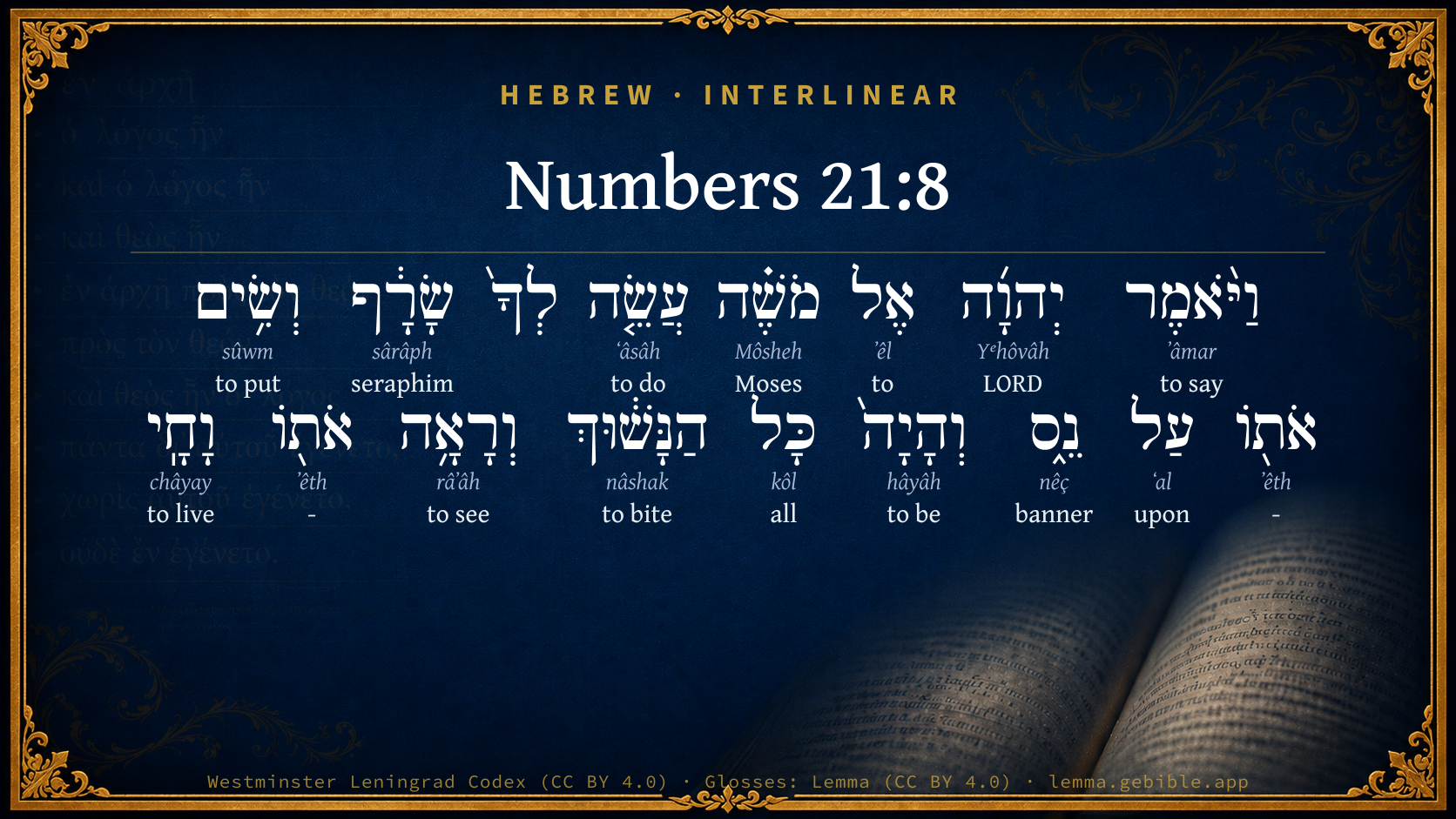
Hebrew (Westminster Leningrad Codex) Numbers 21:8 appears in the Hebrew Old Testament. The text above is from the Westminster Leningrad Codex. Each word links to its Strong’s number, a concise gloss, and parsing drawn from the Open Scriptures Hebrew Bible morphology. Click any word for its full Brown-Driver-Briggs (BDB) entry.
Download image
Cite this verse

Numbers 21:8 (World English Bible). Public Domain. Lemma interlinear Bible study tool, https://lemma.gebible.app/v/numbers/21/8.

Show BibTeX & RIS
BibTeX
RIS
English Translation
Yahweh said to Moses, Make you a fiery serpent, and set it on a standard: and it shall happen, that everyone who is bitten, when he sees it, shall live.
World English Bible · Public Domain
Highlights Full analysis ↓
Download a study sheet

One document with this verse’s original text, its word-by-word gloss line, the meaning frame, cross-references with their text, attributed commentary, and full source and license credits — printable, and it pastes into notes with its structure intact.

This verse Autodidact and up

Study sheet (.html) Plain text (.txt)

A passage Seminary Student

Up to 50 verses in one chapter. A passage sheet keeps up to 6 commentary sources and 12 cross-references per verse, in the order this page ranks them, and says so on the sheet whenever that leaves anything out. Ask for a single verse and you get the Autodidact verse sheet above.

Everything on this page stays free to read, with no account — the sheet is a download of what is already on screen, not access to it.

Want to remove ads? Support Godless Engineer
Compare translations 3

The same verse in 3 English versions, stacked beneath the original-language interlinear above. Click any original word for its lexicon entry.

Each is an independent rendering of the whole verse — the interlinear is not word-aligned to these translations.

Highlighted words mark where these versions differ — a whole-verse word diff, not a word-by-word alignment.

  • World English Bible Public Domain
    Yahweh said to Moses, Make you a fiery serpent, and set it on a standard: and it shall happen, that everyone who is bitten, when he sees it, shall live.
  • King James Version Public Domain
    And the LORD said unto Moses, Make thee a fiery serpent, and set it upon a pole: and it shall come to pass, that every one that is bitten, when he looketh upon it, shall live.
  • unfoldingWord Literal Text CC BY-SA 4.0
    And Yahweh said to Moses, “Make for yourself a fiery one and put it on a banner, and it will be all the bitten ones will see it, and he will live.”

unfoldingWord Literal Text — © unfoldingWord, licensed CC BY-SA 4.0. Word-aligned USFM3 via Door43 (git.door43.org/unfoldingWord/en_ult).

Versions to compare (up to 4)

3 of 4 selected

Show all 18 translations

Every available English version of this verse, each an independent rendering of the whole verse.

  • World English Bible Public Domain
    Yahweh said to Moses, Make you a fiery serpent, and set it on a standard: and it shall happen, that everyone who is bitten, when he sees it, shall live.
  • Berean Standard Bible Public Domain
    Then the LORD said to Moses, “Make a fiery serpent and mount it on a pole. When anyone who is bitten looks at it, he will live.”
  • Majority Standard Bible Public Domain
    Then the LORD said to Moses, “Make a fiery serpent and mount it on a pole. When anyone who is bitten looks at it, he will live.”
  • King James Version Public Domain
    And the LORD said unto Moses, Make thee a fiery serpent, and set it upon a pole: and it shall come to pass, that every one that is bitten, when he looketh upon it, shall live.
  • American Standard Version (1901) Public Domain
    And Jehovah said unto Moses, Make thee a fiery serpent, and set it upon a standard: and it shall come to pass, that every one that is bitten, when he seeth it, shall live.
  • Revised Version (1885) Public Domain
    And the LORD said unto Moses, Make thee a fiery serpent, and set it upon a standard: and it shall come to pass, that every one that is bitten, when he seeth it, shall live.
  • Geneva Bible (1599) Public Domain
    And the Lord said vnto Moses, Make thee a fiery serpent, and set it vp for a signe, that as many as are bitten, may looke vpon it, and liue.
  • Douay-Rheims (1899) Public Domain
    And the Lord said to him: Make brazen serpent, and set it up for a sign: whosoever being struck shall look on it, shall live.
  • Young's Literal Translation Public Domain
    And Jehovah saith unto Moses, `Make for thee a burning `serpent', and set it on an ensign; and it hath been, every one who is bitten and hath seen it -- he hath lived.
  • Literal Standard Version CC BY-SA 4.0
    And YHWH says to Moses, “Make a burning [serpent] for yourself, and set it on an ensign; and it has been, everyone who is bitten and has seen it—he has lived.”
  • Unlocked Literal Bible CC BY-SA 4.0
    Yahweh said to Moses, “Make a snake and attach it to a pole. It will happen that everyone who is bitten will survive, if he looks at it.”
  • unfoldingWord Literal Text CC BY-SA 4.0
    And Yahweh said to Moses, “Make for yourself a fiery one and put it on a banner, and it will be all the bitten ones will see it, and he will live.”
  • Darby Bible Public Domain
    And Jehovah said to Moses, Make thee a fiery [serpent], and set it upon a pole; and it shall come to pass, that every one that is bitten, and looketh upon it, shall live.
  • World Messianic Bible Public Domain
    The LORD said to Moses, “Make a venomous snake, and set it on a pole. It shall happen that everyone who is bitten, when he sees it, shall live.”
  • Webster's Bible Public Domain
    And the LORD said to Moses, Make thee a fiery serpent, and set it upon a pole: and it shall come to pass, that every one that is bitten, when he looketh upon it, shall live.
  • Free Bible Version CC BY-SA 4.0
    The Lord told Moses, “Make a model of a snake and put it on a pole. When anyone who has been bitten looks at it, they will live.”
  • Bible in Basic English Public Domain
    And the Lord said to Moses, Make an image of a snake and put it on a rod, and anyone who has been wounded by the snakes, looking on it will be made well.
  • JPS Tanakh (1917) Public Domain
    And the LORD said unto Moses: 'Make thee a fiery serpent, and set it upon a pole; and it shall come to pass, that every one that is bitten, when he seeth it, shall live.'

Literal Standard Version (2020), Covenant Press — licensed CC BY-SA 4.0. Text via the HelloAO Bible API (eBible.org). Unlocked Literal Bible (unfoldingWord) — licensed CC BY-SA 4.0. Text via the HelloAO Bible API (eBible.org). unfoldingWord Literal Text — © unfoldingWord, licensed CC BY-SA 4.0. Word-aligned USFM3 via Door43 (git.door43.org/unfoldingWord/en_ult). Free Bible Version, Dr. Jonathan Gallagher — licensed CC BY-SA 4.0. Text via the HelloAO Bible API (eBible.org).

Word by word

More ways to search: Search by grammar → Find every occurrence → Compare this word →

Practice this passage: Drill this verse → Learn its vocabulary →

שָׂרָ֔ף
sârâph
H8314
“seraphim”
Noun, Common, Masculine, Singular, Absolute
Part of Speech
Noun
Type
Common
Gender
Masculine
Number
Singular
State
Absolute
Full BDB Definition

Origin: from H8313

TWOT: 2292a , 2292b

serpent, fiery serpent - poisonous serpent (fiery from burning effect of poison) - seraph, seraphim - majestic beings with 6 wings, human hands or voices in attendance upon God
  1. וַיֹּ֨אמֶר ʼâmar H559 “and · to say” Conjunction + Verb, Qal, Sequential Imperfect, 3rd Person, Masculine, Singular
  2. יְהוָ֜ה Yᵉhôvâh H3068 “LORD” Noun, Proper
  3. אֶל ʼêl H413 “to” Preposition
  4. מֹשֶׁ֗ה Môsheh H4872 “Moses” Noun, Proper
  5. עֲשֵׂ֤ה ʻâsâh H6213 “do” Verb, Qal, Imperative, 2nd Person, Masculine, Singular
  6. וְשִׂ֥ים sûwm H7760 “and · put” Conjunction + Verb, Qal, Imperative, 2nd Person, Masculine, Singular
  7. אֹת֖וֹ ʼêth H853 “- · him” Particle, Direct Object + Suffix, Personal, 3rd Person, Masculine, Singular
  8. עַל ʻal H5921 “upon” Preposition
  9. נֵ֑ס nêç H5251 “banner” Noun, Common, Masculine, Singular, Absolute
  10. וְהָיָה֙ hâyâh H1961 “and · to be” Conjunction + Verb, Qal, Sequential Perfect, 3rd Person, Masculine, Singular
  11. כָּל kôl H3605 “all of” Noun, Common, Masculine, Singular, Construct
  12. הַנָּשׁ֔וּךְ nâshak H5391 “the · bitten” Particle, Definite Article + Verb, Qal, Participle Passive, Masculine, Singular, Absolute
  13. וְרָאָ֥ה râʼâh H7200 “and · to see” Conjunction + Verb, Qal, Sequential Perfect, 3rd Person, Masculine, Singular
  14. אֹת֖וֹ ʼêth H853 “- · him” Particle, Direct Object + Suffix, Personal, 3rd Person, Masculine, Singular
  15. וָחָֽי châyay H2425 “and · to live” Conjunction + Verb, Qal, Sequential Perfect, 3rd Person, Masculine, Singular

About this verse

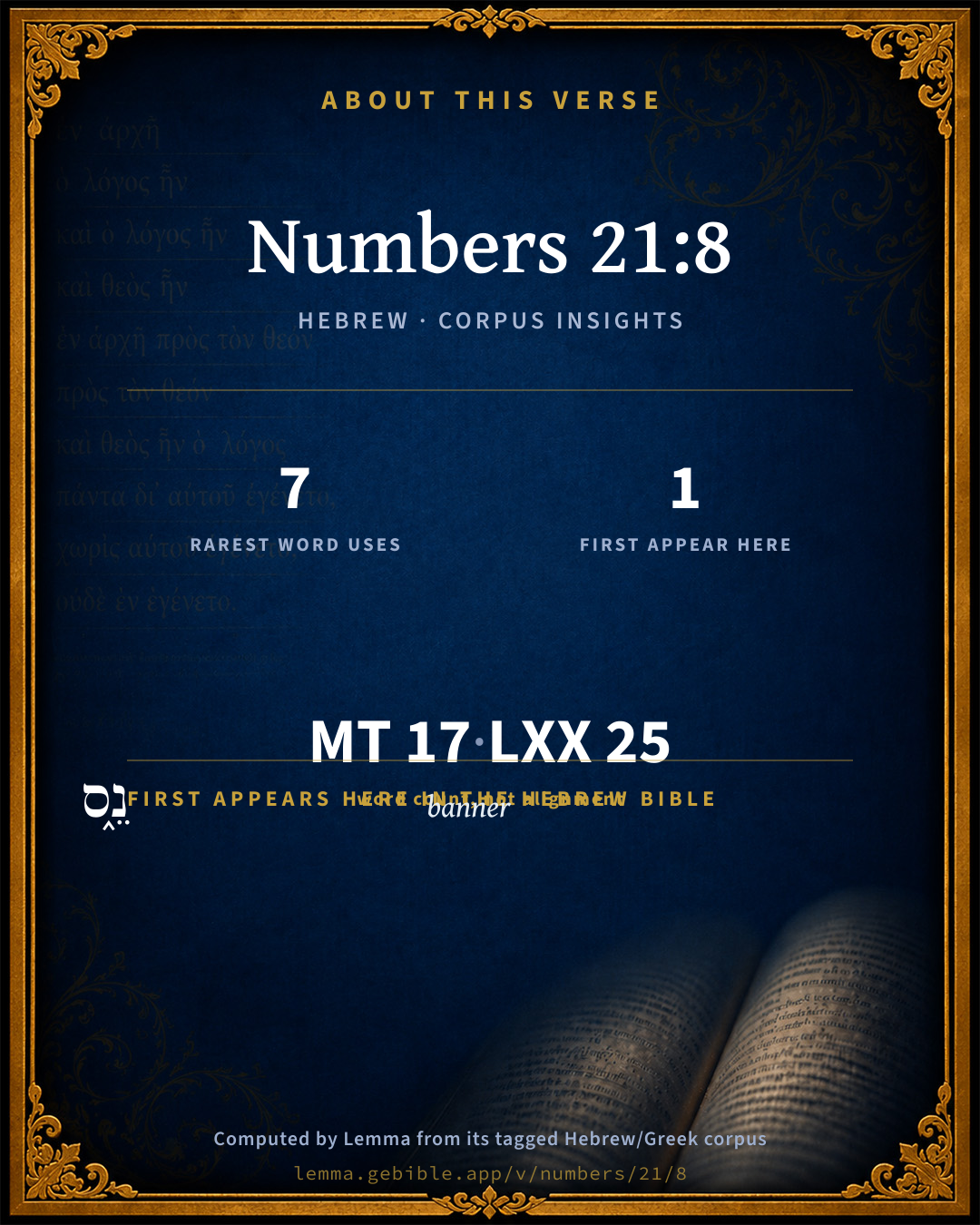
These counts appear in no published source. They are computed here, from the morphology-tagged text and Lemma’s own curated glosses. What Lemma adds →

17
words
15
distinct lemmas
Pentateuch
section

Notable vocabulary

The rarest word here is שָׂרָ֔ף seraphim H8314 — appearing just 7 times in the whole Hebrew Bible.

First appearance in Scripture

This word makes its first canonical appearance in the Hebrew Bible here:

Shared distinctive vocabulary

שָׂרָ֔ף seraphim H8314 occurs in 7 verses of the Hebrew Bible. Also found in:

Grammatical profile

  • 7 verbs
  • 5 nouns
  • 3 prepositions
  • 2 particles

Verb forms

  • וַיֹּ֨אמֶר Qal · Sequential Imperfect
  • עֲשֵׂ֤ה Qal · Imperative
  • וְשִׂ֥ים Qal · Imperative
  • וְהָיָה֙ Qal · Sequential Perfect
  • הַנָּשׁ֔וּךְ Qal · Participle Passive
  • וְרָאָ֥ה Qal · Sequential Perfect
  • וָחָֽי Qal · Sequential Perfect

Hebrew & Septuagint length

In English translation the verse runs 30 words from the Hebrew and 49 from the Septuagint (LXX English) — the Septuagint runs noticeably longer here. See the side-by-side →

A rough comparison of the two English renderings, which tokenize alike — not a word-level alignment.

Word counts can differ between the Hebrew and the Greek without any difference in meaning — e.g. the Hebrew direct-object marker אֵת has no separate Greek word, and Greek often adds the article ὁ.

In the original languages it is 17 Hebrew tokens and 25 Greek tokens — but the two are counted differently (Hebrew bundles its prefixes and suffixes into one token; the Greek is in lemma form), so that isn’t a like-for-like length.

Cross-references

3

Topical passages linked to Numbers 21:8 in the Treasury of Scripture Knowledge — connected by theme and wording, ordered by reader-vote popularity; previews shown in the World English Bible.

  • John 3:14 As Moses lifted up the serpent in the wilderness, even so must the Son of Man be lifted up,
  • Psalms 106:43–45 Many times he delivered them, But they were rebellious in their counsel, And were brought low in their iniquity.
  • Psalms 145:8 Yahweh is gracious, merciful, Slow to anger, and of great loving kindness.

Cross-references courtesy of OpenBible.info (CC BY 4.0).

Hebrew and Greek witnesses Masoretic Hebrew ↔ Greek Septuagint

The same verse in the two great witnesses to the Old Testament, shown verse-for-verse.

Here the Septuagint runs noticeably longer than the Hebrew — LXX2012 (modern English Septuagint) 49 words vs World English Bible 30. A rough length comparison of the two English translations, not a word-level alignment — read both below.

These are two independent witnesses, not word-aligned to each other, and the Septuagint is shown in lemma (dictionary) form.

Hebrew Numbers 21:8 Masoretic · Westminster Leningrad Codex

וַיֹּ֨אמֶר יְהוָ֜ה אֶל מֹשֶׁ֗ה עֲשֵׂ֤ה לְךָ֙ שָׂרָ֔ף וְשִׂ֥ים אֹת֖וֹ עַל נֵ֑ס וְהָיָה֙ כָּל הַנָּשׁ֔וּךְ וְרָאָ֥ה אֹת֖וֹ וָחָֽי

Yahweh said to Moses, Make you a fiery serpent, and set it on a standard: and it shall happen, that everyone who is bitten, when he sees it, shall live.

World English Bible · Public Domain

Greek LXX Numbers 21:8 Septuagint · lemma form

καί εἶπον κύριος πρός μωυσῆς ποιέω σεαυτοῦ ὄφις καί τίθημι αὐτός ἐπί σημεῖον καί εἰμί ἐάν δάκνω ὄφις ἄνθρωπος πᾶς ὁ δάκνω ὁράω αὐτός ζάω

And Moses prayed to the Lord for the people; and the Lord said to Moses, Make you a serpent, and put it on a signal-staff; and it shall come to pass that whenever a serpent shall bite a man, every one so bitten that looks upon it shall live.

LXX2012 (modern English Septuagint) · Public Domain

On this verse, Ellicott's Commentary for English Readers discusses the Septuagint’s reading. Read the note in Commentary ↓

Hebrew: Westminster Leningrad Codex (CC BY 4.0). Greek: Septuagint (public domain); English from LXX2012 (modern English Septuagint) (Public Domain). How the Septuagint differs from the Hebrew →

Targum (Aramaic paraphrase)

2

The Targum is the ancient Jewish Aramaic paraphrase of the Hebrew Scriptures — an interpretive translation, not the Hebrew text itself. Onkelos (literal) and Pseudo-Jonathan (expansive) render the Torah, and Jonathan the Prophets. Coverage is partial: where no permissively-licensed English translation exists for a verse, only the Aramaic is shown. This is verse-level text, not a word-by-word alignment to the Hebrew.

  1. Targum Onkelos Torah (Genesis–Deuteronomy)
    וַאֲמַר יְיָ לְמשֶׁה עֲבֵיד לָךְ קַלְיָא וְשַׁוִי יָתֵיהּ עַל אָת וִיהֵי כָּל דְיִתְנְכִית וְיֶחֱזֵי יָתֵהּ וְיִתְקַיָם

    (no public-domain English translation for this verse)

    Targum Onkelos — Aramaic: “Onkelos Genesis” (public domain); “Onkelos Exodus” (public domain); “Onkelos Leviticus” (public domain); “Onkelos Numbers” (public domain); “Onkelos Deuteronomy” (public domain). English: “Sefaria Community Translation” (CC0 1.0 (public-domain dedication)); “J.W. Etheridge. The Targums of Onkelos and Jonathan Ben Uzziel on the Pentateuch. London: Longmans, Green, 1862” (public domain). Text via Sefaria.

  2. Targum Pseudo-Jonathan Torah (Genesis–Deuteronomy)
    וַאֲמַר יְיָ לְמשֶׁה עִיבַד לָךְ חִיוְיָא דִנְחָשָׁא וְשַׁוִי יָתֵיהּ עַל אֲתַר תְּלֵי וִיהֵי כָּל דִנְכִית יָתֵיהּ חִיוְיָא וִיהֵי מִסְתַּכֵּל בֵּיהּ וְחָאִי אִין מְכַוִין לִבֵּיהּ לְשׁוּם מֵימְרָא דַיְיָ

    And the Lord said to Mosheh, Make thee a serpent of brass, and set it upon a place aloft; and it shall be that when a serpent hath bitten any one, if he behold it, then shall he live, if his heart be directed to the Name of the Word of the Lord.

    Targum Pseudo-Jonathan — Aramaic: “Targum Jonathan on Genesis” (public domain); “Targum Jonathan on Exodus” (public domain); “Targum Jonathan on Leviticus” (public domain); “Targum Jonathan on Numbers” (public domain); “Targum Jonathan on Deuteronomy” (public domain). English: “The Targum of Jonathan ben Uzziel, trans. J. W. Etheridge, London, 1862” (public domain). Text via Sefaria.

Commentary

Notes on Numbers 21:8 from classic Christian and Jewish commentators (each source and its license shown beneath its notes). The classic Christian expositions comment on the surrounding passage and are grouped to its opening verse, so a note may address several verses; the Jewish commentaries on the Tanakh (Rashi and others) are per-verse, so they appear only where the commentator wrote on this verse.

Lemma curates 59 commentaries, every one of them public domain or Creative Commons licensed, each selected and text-cleaned for this edition rather than reprinted as found. About our sources →

Joseph Benson's Commentary

Num 21:8-9. A fiery serpent — That is, the figure of a serpent in brass, which is of a fiery colour. This would require some time: God would not speedily take off the judgment, because he saw they were not thoroughly humbled. Upon a pole — That the people might see it from all parts of the camp, and therefore the pole must be high, and the serpent large. When he looketh — This method of cure was prescribed, that it might appear to be God’s own work, and not the effect of nature or art: and that it might be an eminent type of our salvation by Christ. The serpent signified Christ, who was in the likeness of sinful flesh, though without sin, as this brazen serpent had the outward shape, but not the inward poison of the other serpents: the pole resembled the cross upon which Christ was lifted up for our salvation: and looking up to it designed our believing in Christ. He lived — He was delivered from death, and cured of his disease.

Joseph Benson's Commentary on the Old and New Testaments (1811–1818) — public domain. Text from a community e-Sword module.

Geneva Bible (1599)

Geneva Bible translators

Or, upon a pole.

Geneva Bible (1599) marginal notes — public domain. Text via Bolls.life.

Adam Clarke's Commentary

Verse 8. Make thee a fiery serpent] Literally, make thee a seraph.

And put it upon a pole] על נס al nes, upon a standard or ensign.

Adam Clarke's Commentary on the Bible (1810–1826) — public domain. Text from a community e-Sword/MySword module.

Ellicott's Commentary for English Readers

(8) Make thee a fiery serpent.—The single Hebrew word which is here employed is saraph (a seraph), or burning one, as in Num_21:6, where the word nehashim—serpents—occurs also. The meaning is explained in the following verse, in which it is said that Moses made “a serpent of brass.”

Set it upon a pole.—Better, a standard. The LXX. have σημεῖον, the Vulgate signum. The Hebrew word (nes) is the same which occurs in Exo_17:15, “Jehovah-nissi”—i.e., Jehovah is my standard or banner.

A Bible Commentary for English Readers, edited by Charles John Ellicott (1878–1897) — public domain. Text from a community e-Sword module.

The Cambridge Bible for Schools and Colleges

gen. ed. J. J. S. Perowne

8. a fiery serpent] Here it is a single substantive, the second of the two in Num_21:6.

set it upon a pole] The rendering of the A.V. may here be retained.

The Cambridge Bible for Schools and Colleges (gen. ed. J. J. S. Perowne; Cambridge University Press, 1878–1918) — public domain. Text from a community e-Sword module.

John Gill's Exposition

And the Lord said unto Moses,.... Out of the cloud; or, it may be, Moses went into the sanctuary, and there prayed, and the Lord answered him from between the cherubim:

make them a fiery serpent; not a real one, but the likeness of one, one that should very much resemble the fiery serpents Israel had been bitten with:

and set it upon a pole; a standard, banner, or ensign, as the word signifies; perhaps meaning one of the poles on which their ensigns were carried: the Targum of Jonathan renders it, on an high place, that so it might be seen by all in the camp:

and it shall come to pass, that everyone that is bitten, when he looketh upon it, shall live; which is very wonderful, that by looking to the figure of a serpent, men should be cured of the bites of real ones, and which bites were deadly; the virtue of healing could not come from the figure, but from God, who appointed it to be made, the Targum of Jonathan adds, that one bitten should live,"if he directed his heart to the Word of the Lord,''even to that divine Logos or Word of God, whose lifting up was figured hereby; see Joh 3:14.

John Gill's Exposition of the Whole Bible (1746–1763) — public domain (CC PDM 1.0). Text via the HelloAO Bible API.

Albert Barnes' Notes on the Bible

Make thee a fiery serpent - i. e. a serpent resembling in appearance the reptiles which attacked the people. The resemblance was of the essence of the symbolism (compare 1Sa 6:5). As the brass serpent represented the instrument of their chastisement, so the looking unto it at God’s word denoted acknowledgment of their sin, longing for deliverance from its penalty, and faith in the means appointed by God for healing. In the serpent of brass, harmless itself, but made in the image of the creature that is accursed above others Gen 3:14, the Christian fathers rightly see a figure of Him Joh 3:14-15 who though “holy, harmless, undefiled, separate from sinners” Heb 7:26, was yet “made sin” 2Co 5:21, and “made a curse for us” Gal 3:13. And the eye of faith fixed on Him beholds the manifestation at once of the deserts of sin, of its punishment imminent and deprecated, and of the method of its remission devised by God Himself.

Albert Barnes' Notes on the Bible (1834–1885) — public domain. Text from a community e-Sword/MySword module.

Haydock's Catholic Bible Commentary

Brazen. Hebrew, "fiery." But, in the following verse, it is said to have been "of brass." We might translate, "make a seraph, and fix it upon a standard," (Calmet) in which form it would resemble one suspended on a cross. It was placed at the entrance of the tabernacle. (St. Justin Martyr, First Apology) Ezechias afterwards destroyed it, because it was treated with superstitious honours, 4 Kings xviii. 4. Thus the best things are often abused. (Haydock) --- God commands this image to be erected, while he forbids all images of idols. (Worthington) --- By comparing the different passages of Scripture we may discern the true import of them. Pictures may often prove very useful and instructive. They serve the ignorant instead of books. But then the ignorant must be carefully instructed not to treat them with improper respect, as St. Gregory admonishes. And is not the same caution requisite for those who read even the word of God, lest they wrest it to their own destruction, as both the unlearned and the unstable frequently do, 2 Peter iii. 16. If every thing must be rejected which is liable to abuse, what part of the creation will be spared? The Bible, the sacraments, all creatures must be laid aside. For we read, (Romans viii. 20, 22,) the creature was made subject to vanity --- every creature groaneth. (Haydock) --- It is probable that Moses represented on the standard such a serpent, as had been the instrument of death. This was not intended for a charm or talisman, as Marsham would impiously pretend. (Chron. x. p. 148.) Such inventions proceed from the devil; and the Marsi were famous for curing the bites of serpents, by giving certain plates of brass. (Arnob. ii.) See Psalm lviii. 5. But this image was set up by God’s express command; and the Book of Wisdom (xvi. 5, 7) assures us, that the effect was entirely to be attributed to him, the figure of a brazen serpent being rather calculated to increase than to remove the danger. (Kimchi; Muis) Hence Jonathan well observes, that only those were healed who raised their hearts to God. (Calmet)

George Leo Haydock (1774–1849), Haydock's Catholic Family Bible and Commentary, 1859 edition — public domain. Excludes Psalms (Douay-Rheims chapter numbering differs from Protestant) and Deuterocanonical books (Catholic canon only).

Matthew Poole's English Annotations

A fiery serpent, i.e. the figure of a serpent in brass, which is of a fiery colour. This would require some time: God would not speedily take off the judgment, because he saw they were not thoroughly humbled.

Set it on a pole, that the people might see it from all parts of the camp; and therefore the pole must be high, and the serpent large.

This method of cure was prescribed, partly that it might appear to be God’s own work, and not the effect of nature or art; and partly that it might be an eminent type of our salvation by Christ. See Joh 3:14,15. The serpent signified Christ, who was in the likeness of sinful flesh, Rom 8:3, though without sin, as this brazen serpent had the outward shape, but not the inward poison of the other serpents: the pole resembled the cross upon which Christ was lift up for our salvation; and looking up to it designed our believing in Christ.

Matthew Poole's English Annotations on the Holy Bible (1683–1685) — public domain. Text from a community e-Sword/MySword module.

Whedon's Commentary on the Bible

Daniel D. Whedon

8. Make thee a fiery serpent — This was an astonishing answer to the prayer. Moses doubtless expected that the serpents would disappear, as the plagues had vanished from Egypt when he interceded in behalf of Pharaoh. But instead of this he is directed to provide an antidote for those who may be bitten now or in the future. It was to be set upon a pole or standard, that it might be seen in the extremities of the camp, probably two miles distant from the tabernacle.

When he looketh — The healing involved, 1.) A confession of inability to heal himself; 2.) The exercise of his own volitions in a manner arbitrarily prescribed by God, and for which no reasons are assigned; 3.) Simple faith in God was requisite for putting forth the action necessary to the cure. The condition was so simple that every one could perform it. Even the apparently dying could turn his languid eye toward the brazen serpent and be healed. It is evident that every one who, being bitten, perished in the camp after this great antidote was devised died as wilful a death as the suicide.

Daniel D. Whedon (gen. ed.), Commentary on the Old and New Testaments (1874–1909) — public domain. Text from a community e-Sword module.

The Pulpit Commentary

Make thee a fiery serpent. A saraph. The Septuagint, not understanding the meaning of saraph, has simply ofin . (cf. Joh_3:14) Set it upon a pole. Septuagint shmeion . Vulgate, signum. The same word is better translated "ensign" in such passages as Isa_11:10; "banner" in such as Isa_60:4; "standard" in such as Jer_51:27. The "pole" may have been the tallest and most conspicuous of those military standards which were planted (probably on some elevation) as rallying points for the various camps; or it may have been one loftier still, made for the occasion.

The Pulpit Commentary (1880–1919), ed. H.D.M. Spence-Jones & Joseph S. Exell — public domain. Text from a community e-Sword module.

John Wesley's Explanatory Notes

A fiery serpent - That is, the figure of a serpent in brass, which is of a fiery colour. This would require some time: God would not speedily take off the judgment, because he saw they were not throughly humbled. Upon a pole - That the people might see it from all parts of the camp, and therefore the pole must be high, and the serpent large. When he looketh -This method of cure was prescribed, that it might appear to be God's own work, and not the effect of nature or art: and that it might be an eminent type of our salvation by Christ. The serpent signified Christ, who was in the likeness of sinful flesh, though without sin, as this brazen serpent had the outward shape, but not the inward poison, of the other serpents: the pole resembled the cross upon which Christ was lifted up for our salvation: and looking up to it designed our believing in Christ.

John Wesley, Explanatory Notes Upon the Whole Bible (1754–1765) — public domain. Text via the GEBible commentary corpus.

unfoldingWord translationNotes

Door43 World Missions Community

Make a snake

Since it is impossible for Moses to make a real snake, it is implied that he was to make a model of a snake. This implied information can be made clear. AT: "Make a model of a snake" (See: Assumed Knowledge and Implicit Information)

everyone who is bitten

This can be stated in active form. AT: "everyone whom a snake bites" (See: Active or Passive)

a bronze snake

"a snake out of bronze"

if he looked at the bronze snake, he survived

Here "he" refers to "any person" who was bitten by a snake.

translationWords

Yahweh

bronze

unfoldingWord translationNotes — © Distant Shores Media and the Door43 World Missions Community, licensed CC BY-SA 4.0. Source: git.door43.org/Door43/en_tn.

Rashi

Rabbi Shlomo Yitzchaki (Rashi)

על נס means [SET IT] UPON A POLE which is termed perche in O. F. Similar is, (Isaiah 30:17) “And like a polo (banner) upon the hill”; (Isaiah 49:22) “I will lift up my pole (banner)”; (Isaiah 13:3) “Lift up a banner." Because it is lofty so that it can serve as a sign and as evidence of something it is called נס, something raised on high (cf. Rashi on Exodus 20:17).

כל הנשוך ANYONE THAT IS BITTEN — even though a dog or ass had bitten him, he felt the effects of the injury and became enfeebled more and more (cf. Tanchuma); only that the bite of a serpent kills more speedily. On this account it is stated here: וראה אתו, “whoever has been bitten, when he seeth it, [shall live]” — a mere glance sufficed to heal him. But in the case of the serpent’s bite it is stated והביט, and he gazed — “and it came to pass that if a serpent had bitten any man, when he gazed [at the brazen serpent, he lived]”, for the serpent’s bite was not so quick to heal unless he gazed intently (cf. Jerusalem Talmud Rosh Hashanah 3:9). — Our Rabbis said: But could the copper serpent cause death or life?! But the explanation is that when the Israelites in gazing at the serpent looked up on high and subjected their hearts to their Father in Heaven, they were healed, but if they did not do this they waste away (Rosh Hashanah 29a).

Rashi on the Tanakh — English translations: “The Judaica Press complete Tanach with Rashi, translated by A. J. Rosenberg” (CC BY 4.0); “Pentateuch with Rashi's commentary by M. Rosenbaum and A.M. Silbermann, 1929-1934” (public domain); “The Metsudah Tanach series, Lakewood, N.J” (CC BY 4.0); and “The Book of Joshua, Metsudah Publications, 1997” (CC BY 4.0). Text via Sefaria.

Lesson kit

Teaching starters — assembled from the data on this page, not authored interpretation. Every prompt links to the verse data it draws on. Edit before teaching.

Numbers, in the Pentateuch, opens this verse with 17 words (15 distinct Hebrew lemmas). Its most distinctive word is sârâph (“seraphim”). The Greek Septuagint runs longer here. A historical commentator’s framing appears above. Read the whole chapter for the surrounding context.

Discussion questions

  1. The word sârâph carries the sense “seraphim.” How does it shape the verse?
  2. This is the first place “banner” appears in Scripture (first appears here). What does its debut here establish?
  3. How does Numbers 21:6, which shares the word «seraphim», read alongside this verse?
  4. The Septuagint runs longer here than the Hebrew. What might account for the difference?
  5. The translations on this page render this verse differently — a whole-verse word diff, not a word-by-word alignment. What might account for the different wordings?
  6. «וַיֹּ֨אמֶר» is a Qal Sequential Imperfect verb. How does that grammatical form shape the action described?
  7. Compare how Joseph Benson's Commentary and Geneva Bible (1599) read this verse. Where do they agree or differ?

Things to notice

Reading settings

Reading text

Shown beneath each verse's original-language words.

Old Testament
Old Testament edition

Read the OT as the Masoretic Hebrew (MT) or the Greek Septuagint (LXX).

English shown for the Greek Septuagint (in the Hebrew ↔ Greek comparison).

Comparing translations? Open the Compare panel on any verse page to stack up to four side by side.