
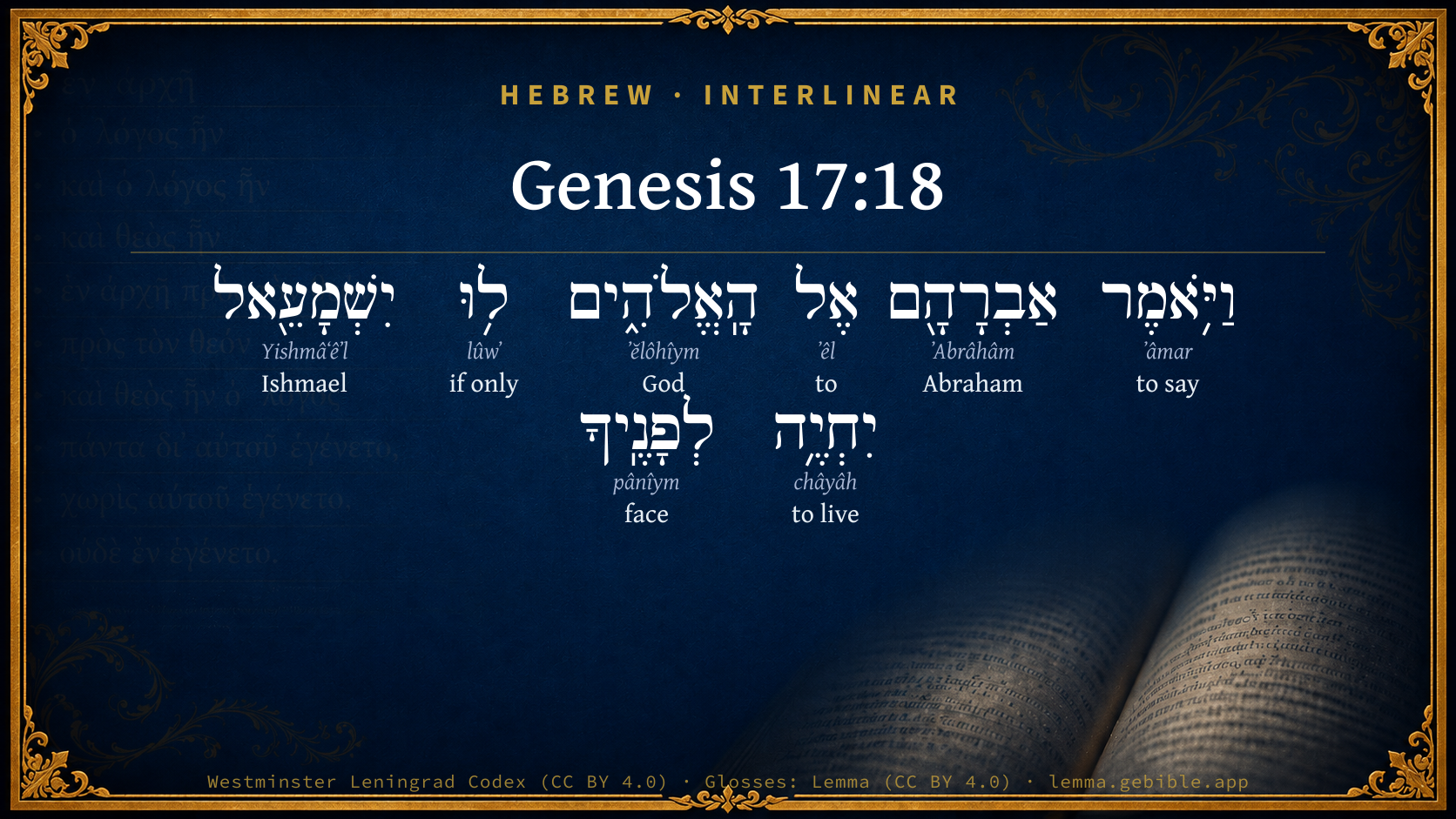
Genesis 17:18

Hebrew (Westminster Leningrad Codex) Genesis 17:18 appears in the Hebrew Old Testament. The text above is from the Westminster Leningrad Codex. Each word links to its Strong’s number, a concise gloss, and parsing drawn from the Open Scriptures Hebrew Bible morphology. Click any word for its full Brown-Driver-Briggs (BDB) entry.
Download image
Cite this verse

Genesis 17:18 (World English Bible). Public Domain. Lemma interlinear Bible study tool, https://lemma.gebible.app/v/genesis/17/18.

Show BibTeX & RIS
BibTeX
RIS
English Translation
Abraham said to God, "Oh that Ishmael might live before you!"
World English Bible · Public Domain
Highlights
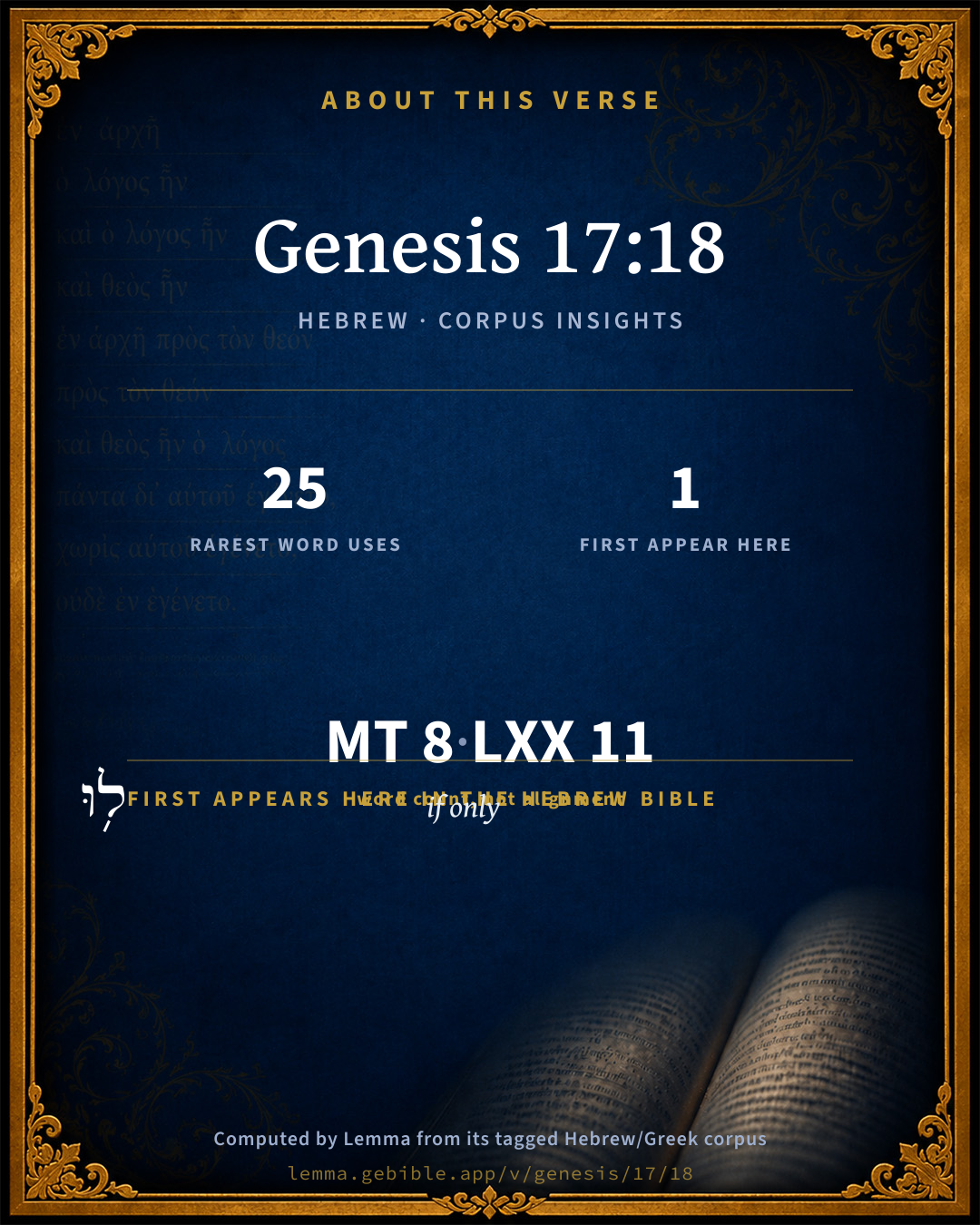
  • 1 first appearance in the Hebrew Bible
Full analysis ↓
Download a study sheet

One document with this verse’s original text, its word-by-word gloss line, the meaning frame, cross-references with their text, attributed commentary, and full source and license credits — printable, and it pastes into notes with its structure intact.

This verse Autodidact and up

Study sheet (.html) Plain text (.txt)

A passage Seminary Student

Up to 50 verses in one chapter. A passage sheet keeps up to 6 commentary sources and 12 cross-references per verse, in the order this page ranks them, and says so on the sheet whenever that leaves anything out. Ask for a single verse and you get the Autodidact verse sheet above.

Everything on this page stays free to read, with no account — the sheet is a download of what is already on screen, not access to it.

Want to remove ads? Support Godless Engineer
Compare translations 3

The same verse in 3 English versions, stacked beneath the original-language interlinear above. Click any original word for its lexicon entry.

Each is an independent rendering of the whole verse — the interlinear is not word-aligned to these translations.

Highlighted words mark where these versions differ — a whole-verse word diff, not a word-by-word alignment.

  • World English Bible Public Domain
    Abraham said to God, "Oh that Ishmael might live before you!"
  • King James Version Public Domain
    And Abraham said unto God, O that Ishmael might live before thee!
  • unfoldingWord Literal Text CC BY-SA 4.0
    Then Abraham said to God, “If only Ishmael might live before you!”

unfoldingWord Literal Text — © unfoldingWord, licensed CC BY-SA 4.0. Word-aligned USFM3 via Door43 (git.door43.org/unfoldingWord/en_ult).

Versions to compare (up to 4)

3 of 4 selected

Show all 18 translations

Every available English version of this verse, each an independent rendering of the whole verse.

  • World English Bible Public Domain
    Abraham said to God, "Oh that Ishmael might live before you!"
  • Berean Standard Bible Public Domain
    And Abraham said to God, “O that Ishmael might live under Your blessing!”
  • Majority Standard Bible Public Domain
    And Abraham said to God, “O that Ishmael might live under Your blessing!”
  • King James Version Public Domain
    And Abraham said unto God, O that Ishmael might live before thee!
  • American Standard Version (1901) Public Domain
    And Abraham said unto God, Oh that Ishmael might live before thee!
  • Revised Version (1885) Public Domain
    And Abraham said unto God, Oh that Ishmael might live before thee!
  • Geneva Bible (1599) Public Domain
    And Abraham saide vnto God, Oh, that Ishmael might liue in thy sight.
  • Douay-Rheims (1899) Public Domain
    And he said to God: O that Ismael may live before thee.
  • Young's Literal Translation Public Domain
    And Abraham saith unto God, `O that Ishmael may live before Thee;'
  • Literal Standard Version CC BY-SA 4.0
    And Abraham says to God, “O that Ishmael may live before You”;
  • Unlocked Literal Bible CC BY-SA 4.0
    Abraham said to God, “Oh that Ishmael might live before you!”
  • unfoldingWord Literal Text CC BY-SA 4.0
    Then Abraham said to God, “If only Ishmael might live before you!”
  • Darby Bible Public Domain
    And Abraham said to God, Oh that Ishmael might live before thee!
  • World Messianic Bible Public Domain
    Abraham said to God, “Oh that Ishmael might live before you!”
  • Webster's Bible Public Domain
    And Abraham said to God, O that Ishmael might live before thee!
  • Free Bible Version CC BY-SA 4.0
    Abraham said to God, “May Ishmael always live under your blessing!”
  • Bible in Basic English Public Domain
    And Abraham said to God, If only Ishmael's life might be your care!
  • JPS Tanakh (1917) Public Domain
    And Abraham said unto God: 'Oh that Ishmael might live before Thee!'

Literal Standard Version (2020), Covenant Press — licensed CC BY-SA 4.0. Text via the HelloAO Bible API (eBible.org). Unlocked Literal Bible (unfoldingWord) — licensed CC BY-SA 4.0. Text via the HelloAO Bible API (eBible.org). unfoldingWord Literal Text — © unfoldingWord, licensed CC BY-SA 4.0. Word-aligned USFM3 via Door43 (git.door43.org/unfoldingWord/en_ult). Free Bible Version, Dr. Jonathan Gallagher — licensed CC BY-SA 4.0. Text via the HelloAO Bible API (eBible.org).

Word by word

More ways to search: Search by grammar → Find every occurrence → Compare this word →

Practice this passage: Drill this verse → Learn its vocabulary →

About this verse

These counts appear in no published source. They are computed here, from the morphology-tagged text and Lemma’s own curated glosses. What Lemma adds →

8
words
8
distinct lemmas
Pentateuch
section

Notable vocabulary

The rarest word here is ל֥וּ if only H3863 — appearing just 25 times in the whole Hebrew Bible.

First appearance in Scripture

This word makes its first canonical appearance in the Hebrew Bible here:

Shared distinctive vocabulary

ל֥וּ if only H3863 occurs in 22 verses of the Hebrew Bible. Also found in:

Grammatical profile

  • 2 verbs
  • 4 nouns
  • 1 preposition
  • 1 conjunction

Verb forms

  • וַיֹּ֥אמֶר Qal · Sequential Imperfect
  • יִחְיֶ֥ה Qal · Imperfect

Hebrew & Septuagint length

In English translation the verse runs 11 words from the Hebrew and 11 from the Septuagint (LXX English) — the same length.

A rough comparison of the two English renderings, which tokenize alike — not a word-level alignment.

Word counts can differ between the Hebrew and the Greek without any difference in meaning — e.g. the Hebrew direct-object marker אֵת has no separate Greek word, and Greek often adds the article ὁ.

In the original languages it is 8 Hebrew tokens and 11 Greek tokens — but the two are counted differently (Hebrew bundles its prefixes and suffixes into one token; the Greek is in lemma form), so that isn’t a like-for-like length.

Cross-references

7

Topical passages linked to Genesis 17:18 in the Treasury of Scripture Knowledge — connected by theme and wording, ordered by reader-vote popularity; previews shown in the World English Bible.

  • Acts 2:39 For to you is the promise, and to your children, and to all who are far off, even as many as the Lord our God will call to himself."
  • Psalms 4:6 Many say, "Who will show us any good?" Yahweh, let the light of your face shine on us.
  • Psalms 41:12 As for me, you uphold me in my integrity, And set me in your presence forever.
  • Genesis 4:12 From now on, when you till the ground, it won't yield its strength to you. You shall be a fugitive and a wanderer in the earth."
  • Genesis 4:14 Behold, you have driven me out this day from the surface of the ground. I will be hidden from your face, and I will be a fugitive and a wanderer in the earth. It will happen that whoever finds me will kill me."
  • Isaiah 59:2 but your iniquities have separated between you and your God, and your sins have hidden his face from you, so that he will not hear.
  • Jeremiah 32:39 and I will give them one heart and one way, that they may fear me forever, for the good of them, and of their children after them:

Cross-references courtesy of OpenBible.info (CC BY 4.0).

Hebrew and Greek witnesses Masoretic Hebrew ↔ Greek Septuagint

The same verse in the two great witnesses to the Old Testament, shown verse-for-verse.

These are two independent witnesses, not word-aligned to each other, and the Septuagint is shown in lemma (dictionary) form.

Hebrew Genesis 17:18 Masoretic · Westminster Leningrad Codex

וַיֹּ֥אמֶר אַבְרָהָ֖ם אֶל הָֽאֱלֹהִ֑ים ל֥וּ יִשְׁמָעֵ֖אל יִחְיֶ֥ה לְפָנֶֽיךָ

Abraham said to God, "Oh that Ishmael might live before you!"

World English Bible · Public Domain

Greek LXX Genesis 17:18 Septuagint · lemma form

εἶπον δέ αβρααμ πρός ὁ θεός ισμαηλ οὗτος ζάω ἐναντίον σύ

And Abraam said to God, Let this Ismael live before you.

LXX2012 (modern English Septuagint) · Public Domain

Hebrew: Westminster Leningrad Codex (CC BY 4.0). Greek: Septuagint (public domain); English from LXX2012 (modern English Septuagint) (Public Domain). How the Septuagint differs from the Hebrew →

Targum (Aramaic paraphrase)

2

The Targum is the ancient Jewish Aramaic paraphrase of the Hebrew Scriptures — an interpretive translation, not the Hebrew text itself. Onkelos (literal) and Pseudo-Jonathan (expansive) render the Torah, and Jonathan the Prophets. Coverage is partial: where no permissively-licensed English translation exists for a verse, only the Aramaic is shown. This is verse-level text, not a word-by-word alignment to the Hebrew.

  1. Targum Onkelos Torah (Genesis–Deuteronomy)
    וַאֲמַר אַבְרָהָם קֳדָם יְיָ לְוַי יִשְׁמָעֵאל יִתְקַיָּם קֳדָמָךְ

    (no public-domain English translation for this verse)

    Targum Onkelos — Aramaic: “Onkelos Genesis” (public domain); “Onkelos Exodus” (public domain); “Onkelos Leviticus” (public domain); “Onkelos Numbers” (public domain); “Onkelos Deuteronomy” (public domain). English: “Sefaria Community Translation” (CC0 1.0 (public-domain dedication)); “J.W. Etheridge. The Targums of Onkelos and Jonathan Ben Uzziel on the Pentateuch. London: Longmans, Green, 1862” (public domain). Text via Sefaria.

  2. Targum Pseudo-Jonathan Torah (Genesis–Deuteronomy)
    וַאֲמַר אַבְרָהָם קֳדָם יְיָ הַלְוַאי יִשְמָעֵאל יִתְקַיֵים וְיִפְלַח קוּמָךְ

    And Abraham said before the Lord, May not Ishmael be established, and serve before Thee?

    Targum Pseudo-Jonathan — Aramaic: “Targum Jonathan on Genesis” (public domain); “Targum Jonathan on Exodus” (public domain); “Targum Jonathan on Leviticus” (public domain); “Targum Jonathan on Numbers” (public domain); “Targum Jonathan on Deuteronomy” (public domain). English: “The Targum of Jonathan ben Uzziel, trans. J. W. Etheridge, London, 1862” (public domain). Text via Sefaria.

Commentary

Notes on Genesis 17:18 from classic Christian and Jewish commentators (each source and its license shown beneath its notes). The classic Christian expositions comment on the surrounding passage and are grouped to its opening verse, so a note may address several verses; the Jewish commentaries on the Tanakh (Rashi and others) are per-verse, so they appear only where the commentator wrote on this verse.

Lemma curates 59 commentaries, every one of them public domain or Creative Commons licensed, each selected and text-cleaned for this edition rather than reprinted as found. About our sources →

Trapp's Complete Commentary

John Trapp

Gen 17:18 And Abraham said unto God, O that Ishmael might live before thee!

Ver. 18. Oh that Ishmael might live.] The life of grace here, and of glory hereafter: that he be not "killed with death" when he dies, as Jezebel’s children were. {Rev 2:23}

John Trapp, A Commentary or Exposition upon All the Books of the Old and New Testament (1647–1656) — public domain. Text from a community e-Sword module.

Joseph Benson's Commentary

Gen 17:18. And Abraham said, O that Ishmael might live before thee! — This he speaks, not as desiring that Ishmael might be preferred before the son he should have by Sarah, but as dreading lest he should be forsaken of God. The great thing we should desire of God for our children is, that they may live before him; that is, that they may be kept in covenant with him, and may have grace to walk before him in uprightness. God’s answer to this prayer is an answer of peace. Abraham could not say he sought God’s face in vain; nor shall we, if we seek it sincerely.

Joseph Benson's Commentary on the Old and New Testaments (1811–1818) — public domain. Text from a community e-Sword module.

MacLaren's Expositions of Holy Scripture

Alexander MacLaren

Genesis

A PETULANT WISH

Gen 17:18.

These words sound very devout, and they have often been used by Christian parents yearning for the best interests of their children, and sometimes of their wayward and prodigal children. But consecrated as they are by that usage, I am afraid that their meaning, as they were uttered, was nothing so devout and good as that which is often attached to them.

1. Note the temper in which Abraham speaks here. The very existence of Ishmael was a memorial of Abraham’s failure in faith and patience. For he thought that the promised heir was long in coming, and so he thought that he would help God. For thirteen years the child had been living beside him, winding a son’s way into a father’s heart, with much in his character, as was afterwards seen, that would make a frank, daring boy his old father’s darling. Then all at once comes the divine message, ‘This is not the son of the Covenant; this is not the heir of the Promise. Sarah shall have a child, and from him shall come the blessings that have been foretold.’ And what does Abraham do? Fall down in thankfulness before God? leap up in heart at the conviction that now at last the long-looked-for fulfilment of the oath of God was impending? Not he. ‘O that Ishmael might live before Thee. Why cannot he do? Why may he not be the chosen child, the heir of the Promise? Take him, O God!’

That is to say, he thinks he knows better than God. He is petulant, he resists his blessing, he fancies that his own plan is quite as good as the divine plan. He does not want to draw away his heart from the child that it has twined round. So he loses the blessing of the revelation that is being made to him; because he does not bow his will, and accept God’s way instead of his own. Now, do you not think that that is what we do? When God sends us Isaac, do we not often say, ‘Take Ishmael; he is my own making. I have set all my hopes on him. Why should I have to wrench them all away?’ In our individual lives we want to prescribe to God, far too often, not only the ends, but the way in which we shall get to the ends; and we think to ourselves, ‘That road of my own engineering that I have got all staked out, that is the true way for God’s providence to take.’ And when His path does not coincide with ours, then we are discontented, and instead of submitting we go with our pet schemes to Him; and if not in so many words, at least in spirit and temper, we try to force our way upon God, and when He is speaking about Isaac insist on pressing Ishmael on His notice.

It is often so in regard to our individual lives; and it is so in regard to the united action of Christian people very often. A great deal of what calls itself earnest contending for ‘the faith once delivered to the saints’ is nothing more nor less than insisting that methods of men’s devising shall be continued, when God seems to be substituting for them methods of His own sending; and so fighting about externals and church polity, and determining that the world has got to be saved in my own special fashion, and in no other, though God Himself seems to be suggesting the new thing to me. That is a very frequent phenomenon in the experience of Christian communities and churches. Ishmael is so very dear. He is not the child of promise, but he is the child that we have thought it advisable to help God with. It is hard for us to part with him.

Dear brethren, sometimes, too, God comes to us in various providences, and not only reduces into chaos and a heap of confusion our nicely built-up little houses, but He sometimes comes to us, and lifts us out of some lower kind of good, which is perfectly satisfactory to us, or all but perfectly satisfactory, in order to give to us something nobler and higher. And we resist that too; and do not see why Ishmael should not serve God’s turn as he has served ours; or think that there is no need at all for Isaac to come into our lives. God never takes away from us a lower, unless for the purpose of bestowing upon us a higher blessing. Therefore not to submit is the foolishest thing that men can do.

But if that be anything like an account of the temper expressed by this saying, is it not strange that murmuring against God takes the shape of praying? Ah! there is a great deal of ‘prayer’ as it calls itself, which is just moulded upon this petulant word of Abraham’s momentarily failing faith and submission. How many people think that to pray means to bring their wishes to God, and try to coax Him to make them His wishes! Why, half the shallow sceptical talk of this generation about the worthlessness of prayer goes upon that fundamental fallacy that the notion of prayer is to dictate terms to God; and that unless a man gets his wishes answered he has no right to suppose that his prayers are answered. But it is not so. Prayer is not after the type of ‘O that Ishmael might live before Thee!’ That is a poor kind of prayer of which the inmost spirit is resistance to a clear dictate of the divine will; but the true prayer is, ‘O that I may be willing to take what Thou art willing, in Thy mercy and love, to send!’

I believe in importunate prayer, but I believe also that a great deal of what calls itself importunate prayer is nothing more than an obstinate determination not to be satisfied with what satisfies God. If a man has been bringing his wishes-and he cannot but have such-continuously to God, with regard to any outward things, and these have not been answered, he needs to look very carefully into his own temper and heart in order to make sure that what seems to be waiting upon God in importunate petition is not pestering Him with refused desires. To make a prayer out of my rebellion against His will is surely the greatest abuse of prayer that can be conceived. And when Abraham said, ‘O that Ishmael might live before Thee!’ if he said it in the spirit in which I think he did, he was not praying, but he was grumbling.

2. And then notice, still further, how such a temper and such a prayer have the effect of hiding joy and blessing from us.

This was the crisis of Abraham’s whole life. It was the moment at which his hundred years nearly of patient waiting were about to be rewarded. The message which he had just received was the most lovely and gracious word that ever had come to him from the heavens, although many such words had come. And what does he do with it? Instead of falling down before God, and letting his whole heart go out in jubilant gratitude, he has nothing to say but ‘I would rather that Thou didst it in another way. It is all very well to speak about sending this heir of promise. I have no pleasure in that, because it means that my Ishmael is to be passed by and shelved.’ So the proffered joy is turned to ashes, and Abraham gets no good, for the moment, out of God’s greatest blessing to him; but all the sky is darkened by mists that come up from his own heart.

Brethren, if you want to be miserable, perk up your own will against God’s. If you want to be blessed, acquiesce in all that He does send, in all that He has sent, and, by anticipation, in all that He will send. For, depend upon it, the secret of finding sunbeams in everything is simply letting God have His own way, and making your will the sounding-board and echo of His. If Abraham had done as he ought to have done, that would have been the gladdest moment of his life. You and I can make out of our deepest sorrows the occasions of pure, though it is quiet, gladness, if only we have learned to say, ‘Not my will, but Thy will be done.’ That is the talisman that turns everything into gold, and makes sorrow forget its nature, and almost approximate to solemn joy.

3. My last word is this: God loves us all too well to listen to such a prayer.

Abraham’s passionate cry was so much empty wind, and was like a straw laid across the course of an express train, in so far as its power to modify the gracious purpose of God already declared was concerned. And would it not be a miserable thing if we could deflect the solemn, loving march of the divine Providence by these hot, foolish, purblind wishes of ours, that see only the nearer end of things, and have no notion of where their further end may go, or what it may be?

Is it not better that we should fall back upon this thought, though, at first sight, it seems so to limit the power of petition, ‘We know that if we ask anything according to His will He heareth us’? There is nothing that would more wreck our lives than if what some people want were to be the case-that God should let us have our own way, and give us serpents because we asked for them and fancied they were eggs; or let us break our teeth upon bestowed stones because, like whimpering children crying for the moon, we had asked for them under the delusion that they were bread.

Leave all that in His hands; and be sure of this, that the true way to peace, to rest, to gladness, and to wringing the last drop of possible sweetness out of gifts and losses, disappointments and fruitions, is to have no will but God’s will enthroned above and in our own wills. If Abraham had acquiesced and submitted, Ishmael and Isaac would have been a pair to bless his life, as they stood together over his grave. And if you and I will leave God to order all our ways, and not try to interfere with His purposes by our short-sighted dictation, ‘all things will work together for good to us, because we love God,’ and lovingly accept His will and His law.

Alexander MacLaren, Expositions of Holy Scripture (1904–1910) — public domain. Text from a community e-Sword module.

Jamieson, Fausset & Brown

Robert Jamieson, A. R. Fausset & David Brown

O that Ishmael might live before thee--natural solicitude of a parent. But God's thoughts are not as man's thoughts [Isa 55:8].

Jamieson, Fausset & Brown — Commentary Critical and Explanatory on the Whole Bible (1871) — public domain (CC PDM 1.0). Text via the HelloAO Bible API.

Adam Clarke's Commentary

Verse 18. O that Ishmael might live before thee!] Abraham, finding that the covenant was to be established in another branch of his family, felt solicitous for his son Ishmael, whom he considered as necessarily excluded; on which God delivers that most remarkable prophecy which follows in Ge 17:20, and which contains an answer to the prayer and wish of Abraham: And as for Ishmael I have heard thee; so that the object of Abraham's prayer was, that his son Ishmael might be the head of a prosperous and potent people.

Adam Clarke's Commentary on the Bible (1810–1826) — public domain. Text from a community e-Sword/MySword module.

John Calvin's Commentaries

18. And Abraham said unto God Abraham does not now wonder silently within himself, but pours forth his wish and prayer. His language, however, is that of a mind still perturbed and vacillating, O that (or I wish that) Ishmael might live! For, as if he did not dare to hope for all that God promises, he fixes his mind upon the son already born; not because he would reject the promise of fresh offspring, but because he was contented with the favor already received, provided the liberality of God should not extend further. He does not, then, reject what the Lord offers; but while he is prepared to embrace it, the expression, O that Ishmael! yet flows from him through the weakness of his flesh. Some think that Abraham spoke thus, because he was afraid for his firstborn. But there is no reason why we should suppose that Abraham was smitten with any such fear, as that God, in giving him another son, would take away the former, or as if the latter favor should absorb that which had preceded. The answer of God, which follows shortly after, refutes this interpretation. What I have said is more certain; namely, that Abraham prayed that the grace of God, in which he acquiesced, might be ratified and confirmed to him. Moreover, without reflection, he breaks forth into this wish, when, for very joy, he could scarcely believe what he had heard from the mouth of God. ‘To live before Jehovah’ is as much as, to be preserved in safety under his protection, or to be blessed by Him. Abraham therefore desires of the Lord, that he will preserve the life which he has given to Ishmael.

John Calvin's Commentaries (1540-1563) — public domain. Text from the Calvin Translation Society English edition (1840s-50s) via the Christian Classics Ethereal Library (ccel.org). Calvin's coverage is partial (roughly two-thirds of the Bible); uncommented books and verses are honest gaps, never fabricated. The 19th-century editor's footnotes and remarks are omitted so the notes are faithfully Calvin's own voice.

Ellicott's Commentary for English Readers

(18) O that Ishmael . . . —For thirteen years Ishmael had been the “son of the house” (Gen_15:3), and regarded probably as the true heir. Mingled then with Abraham’s joy there was also the pain, natural to a father, of knowing that this transference of the promise to Sarah’s child meant the deposition and disappointment of one who for so long had held the post of honour. Stoicism would have repressed this upright and natural feeling, but God hears and accepts the father’s prayers; and while the birthright and religious pre-eminence is justly given to the son of the freewoman, there is a large earthly blessing for the handmaid’s son.

A Bible Commentary for English Readers, edited by Charles John Ellicott (1878–1897) — public domain. Text from a community e-Sword module.

The Cambridge Bible for Schools and Colleges

gen. ed. J. J. S. Perowne

18. said unto God] The previous verse contained what Abraham “said in his heart.” Aloud he expresses his incredulity in a more reverent manner, shewing that his hope of descendants rested upon Ishmael.

might live before thee] i.e. that his life might be blessed by God’s special protection.

The Cambridge Bible for Schools and Colleges (gen. ed. J. J. S. Perowne; Cambridge University Press, 1878–1918) — public domain. Text from a community e-Sword module.

John Gill's Exposition

And Abraham said unto God,.... Being told he should have a son by Sarah, that should be his heir, he is concerned for Ishmael what would become of him; and who, being grown up, had doubtless a large share in his affections, and it is highly probable he began to think he was the promised seed, since he had lived to such an age, and had no other son, and Sarah was past bearing children: but now perceiving it would be otherwise, he puts up a petition for Ishmael, whom he did not neglect upon the promise of another, and to show his love to him, and regard for his welfare:

O that Ishmael might live before thee; he prays that his life might be preserved, and that it might be spent in the fear, worship, and service of God; so the Targum of Jonathan,"O that Ishmael might live and worship before thee,''and to the same sense Jarchi also; that he might enjoy the favour of God, his gracious presence and communion with him; that he might live a holy spiritual life here, acceptable and well pleasing to God, and possess eternal life hereafter: for we must take this prayer in as large a sense as we can suppose the heart of a father to be drawn forth in it for the good of his child; though it may greatly respect his sharing with the promised son in his blessings, and particularly regards the propagation of his offspring, or his living in his posterity at least; this was what the Lord took notice of, and answered him in.

John Gill's Exposition of the Whole Bible (1746–1763) — public domain (CC PDM 1.0). Text via the HelloAO Bible API.

Haydock's Catholic Bible Commentary

Before thee, under thy protection, and in a virtuous manner. (Menochius) --- He seems to be satisfied, though God should not bless him with any more children, provided this one may live worthy of God. (Haydock)

George Leo Haydock (1774–1849), Haydock's Catholic Family Bible and Commentary, 1859 edition — public domain. Excludes Psalms (Douay-Rheims chapter numbering differs from Protestant) and Deuterocanonical books (Catholic canon only).

Matthew Poole's English Annotations

Grant, O Lord, that the giving of one son may not be joined with the taking away of another; that Ishmael may faithfully serve thee, and may have a share in thy favour and gracious covenant. For this seems to be the meaning of this phrase of living before God, or in God’s presence, by comparing a parallel phrase, of walking before God, Gen 17:1, and elsewhere, and an opposite phrase, from thy face shall I be hid, Gen 4:14.

Matthew Poole's English Annotations on the Holy Bible (1683–1685) — public domain. Text from a community e-Sword/MySword module.

Whedon's Commentary on the Bible

Daniel D. Whedon

18. O that Ishmael might live before thee — The patriarch seems to fear that Ishmael is to be cut off. The boy of thirteen has won a deep place in his father’s heart, and notwithstanding the promise of a son by Sarah, he yearns to see Ishmael blessed of God.

Daniel D. Whedon (gen. ed.), Commentary on the Old and New Testaments (1874–1909) — public domain. Text from a community e-Sword module.

The Pulpit Commentary

And Abraham said unto God, O that Ishmael might live before thee! Not implying that Abram was content with Hagar"s child as the promised seed without waiting for Sarai s son (Jerome, Calvin, Kalisch); scarcely that he feared lest God might remove Ishmael by death now that Isaac had been promised (Wordsworth); but probably that he desired that Ishmael might not only live and prosper (Bush), but share with Sarah s son in the blessings of the covenant (Keil, Longs, Rosenm Murphy, "Speaker"s Commentary," Inglis).

The Pulpit Commentary (1880–1919), ed. H.D.M. Spence-Jones & Joseph S. Exell — public domain. Text from a community e-Sword module.

John Wesley's Explanatory Notes

And Abraham said, O that Ishmael might live before thee! - This he speaks nor as desiring that Ishmael might be preferred before the son he should have by Sarah, but as dreading lest he should be forsaken of God, he puts up this petition on his behalf. The great thing we should desire of God, for our children, is, that they may live before him, that is, that they may be kept in covenant with him, and may have grace to walk before him in their uprightness. God's answer to this prayer, is an answer of peace. Abraham could not say he sought God's face in vain.

John Wesley, Explanatory Notes Upon the Whole Bible (1754–1765) — public domain. Text via the GEBible commentary corpus.

Rashi

Rabbi Shlomo Yitzchaki (Rashi)

לו ישמעאל יחיה means O THAT ISHMAEL MIGHT LIVE: I am unworthy to receive such a reward!

יחיה לפניך LIVE BEFORE THEE — live in reverence of thee; similar in sense is Genesis 17:1, התהלך לפני, which Onkelos renders by “worship Me”.

Rashi on the Tanakh — English translations: “The Judaica Press complete Tanach with Rashi, translated by A. J. Rosenberg” (CC BY 4.0); “Pentateuch with Rashi's commentary by M. Rosenbaum and A.M. Silbermann, 1929-1934” (public domain); “The Metsudah Tanach series, Lakewood, N.J” (CC BY 4.0); and “The Book of Joshua, Metsudah Publications, 1997” (CC BY 4.0). Text via Sefaria.

Ramban (Nachmanides)

Rabbi Moshe ben Nachman (Ramban / Nachmanides)

‘LU’ (O) THAT ISHMAEL MIGHT LIVE BEFORE THEE. The meaning of this word lu everywhere is as the word im (if), and it is also found combined in the word lulei, which means “if not.” [The Hebrew word lulei, ordinarily written with a yud at the end] is sometimes written with an aleph at the end., 43:10. It is also combined into the form of ilu, as in the verses: ‘Ve’ilu’ (But if) we had been sold for bondmen and bondwomen; ‘Ve’ilu’ (And if) a thousand years twice told. The purport of this word ilu is “even if,” and its meaning is as if it said, “if if,” the double use of the word being for the purpose of emphasis, as in the expressions: Is it only through Moses alone; ) are redundant and used for emphasis. Was it because there were no graves; are both negatives. Again the redundancy is for special emphasis. and other similar cases. Abraham thus said: “If Ishmael live before Thee, I will be pleased with this blessing with which Thou hast blessed me, namely, with seed from Sarah.” For since He promised him at first, One born of your own body is to be your heir, and the heir was to be one person, he [Abraham] had thought that this referred to Ishmael. But now that he was told that he will beget a child from Sarah and he understood that this child was to be the heir, he feared lest Ishmael die. Therefore, he said this: [O that Ishmael might live before Thee].Live before Thee. Rashi explained: “Live in reverence of Thee, similar in meaning to Walk before Me, which Onkelos renders, ‘Worship Me.’” But this is not correct, since He said, And as for Ishmael, I have heard thee. Instead, its meaning is that he live and his seed will always exist.

Ramban (Nachmanides) on the Tanakh — English translation: “Commentary on the Torah by Ramban (Nachmanides). Translated and annotated by Charles B. Chavel. New York, Shilo Pub. House, 1971-1976” (CC BY 4.0). Text via Sefaria.

Radak

Rabbi David Kimhi (Radak)

ויאמר... לו ישמעאל, he meant to say that he would be content if Ishmael whom G'd had granted him, a gift he considered an extremem act of loving kindness on the part of g'd, would live a meritorious life, abiding by G'd's wishes. יחיה, a life in the full sense of word, that he would have children, would multiply and generally be an asset and a credit to his father. If Ishmael were to develop in this manner, G'd could keep his promise to Avraham to give the land of Canaan to his descendants. (compare 12,7) That prophecy would then be fulfilled by means of Ishmael.

Radak on the Tanakh — English translations: “Sefaria Community Translation” (CC0 1.0 (public-domain dedication)); “Eliyahu Munk, HaChut Hameshulash” (CC BY 4.0); “Rabbi Mike Feuer, Jerusalem Anthology” (CC BY 4.0); and “R. David Kimhi on the first book of Psalms, Translated by R.G. Finch, London, 1919” (public domain). Text via Sefaria.

Lesson kit

Teaching starters — assembled from the data on this page, not authored interpretation. Every prompt links to the verse data it draws on. Edit before teaching.

Genesis, in the Pentateuch, opens this verse with 8 words (8 distinct Hebrew lemmas). Its most distinctive word is lûwʼ (“if only”). A historical commentator’s framing appears above. Read the whole chapter for the surrounding context.

Discussion questions

  1. The word lûwʼ carries the sense “if only.” How does it shape the verse?
  2. This is the first place “if only” appears in Scripture (first appears here). What does its debut here establish?
  3. How does Genesis 23:13, which shares the word «if only», read alongside this verse?
  4. These translations render this verse differently; the difference is in the English rendering, not the original. What questions does that raise?
  5. «וַיֹּ֥אמֶר» is a Qal Sequential Imperfect verb. How does that grammatical form shape the action described?
  6. Compare how Trapp's Complete Commentary and Joseph Benson's Commentary read this verse. Where do they agree or differ?

Things to notice

Reading settings

Reading text

Shown beneath each verse's original-language words.

Old Testament
Old Testament edition

Read the OT as the Masoretic Hebrew (MT) or the Greek Septuagint (LXX).

English shown for the Greek Septuagint (in the Hebrew ↔ Greek comparison).

Comparing translations? Open the Compare panel on any verse page to stack up to four side by side.